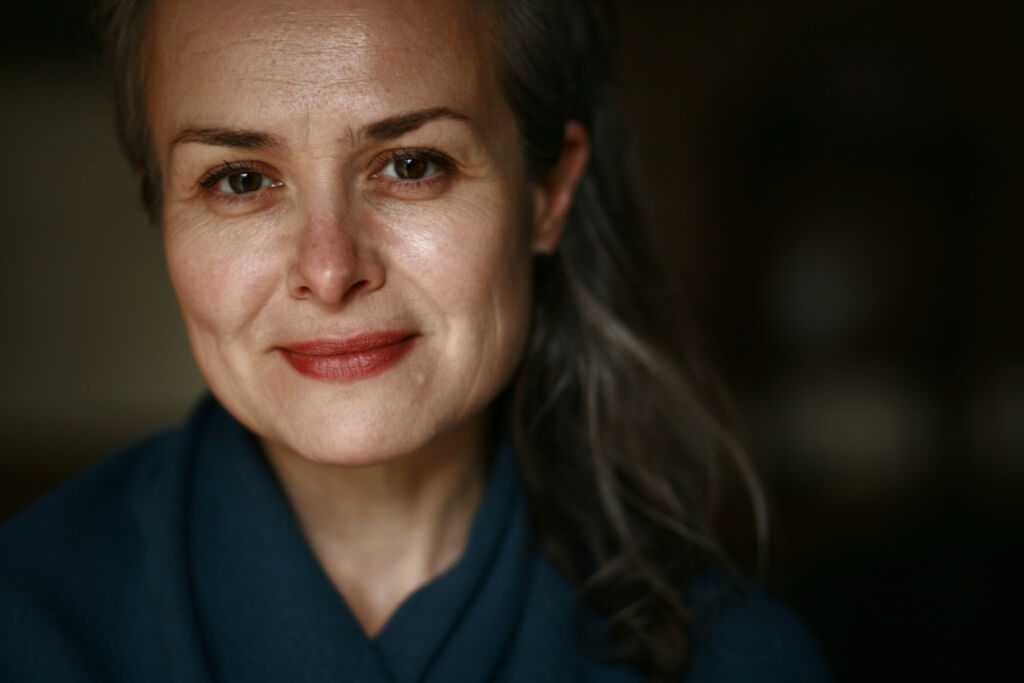
Just two-and-a-half months into teaching at the Max Reinhardt Seminar, and one’s already asked to take stock: it can only be mdw Magazine that’s asking! In response, Magdalena Gut—who began teaching courses on stage design and scenography in October 2025—both gladly and adeptly provided us with answers and insights on a field of foremost significance to theatre that’s all too often relegated more than just literally to the background in the performances to which actors and directors give rise.
Without the practitioners of that craft which transforms stages into images and images into stages, stages themselves would seem rather naked. Magdalena Gut is one such practitioner. Since 1998, Gut has been working with great success at renowned theatres and opera houses in the German-speaking region and farther afield as a stage and costume designer, thereby pursuing a personal passion that captivated her as a teenager and has kept hold of her ever since.
“Back when I was 14, I had a pivotal experience: I got invited to see Woyzeck—at the Burgtheater, I think—in a production by Achim Freyer. I experienced it as this totally incomprehensible world. The play itself isn’t particularly accessible to begin with, and that particular production made it all very cryptical. It was so mysterious that I ended up fascinated beyond all measure, owed simply to how I felt like I didn’t understand it,” says Gut of her initial introduction to theatre—which she would proceed to make one of the important contexts of her youth and ultimately land on as her preferred medium.
“It just really captivated me. When I thought about what profession I might like to pursue, I realised that with my interests in language, text, images, and space, stage design would be the ideal medium through which I could unite them all.” Enticed by this “concentrate” of everything she was interested in, Magdalena Gut ultimately enrolled in the Academy of Fine Arts Vienna’s programme for stage and costume design.
After graduating from her studies there, Gut felt drawn back into academic life again and again. She went on to teach scenography at places including her alma mater, and she also worked with students at the University of Arts Linz. Today, she teaches stage design at the Max Reinhardt Seminar—a mission that now claims a central place in her life alongside her artistic activities as a stage and costume designer at various theatres in German-speaking countries as well as in Poland, her country of birth.
One new thing for Gut in her present position at the Max Reinhardt Seminar is how it’s about training not aspiring stage designers but theatre directing students. “That’s a different job—because it’s clear to me how, for my students, the point is not to design stage spaces themselves but to develop an understanding that helps them work with and effectively use spaces in their productions. Just like they learn to work with actors, they should also learn to work with spaces.” Part of Gut’s concern is to convey how directors can “speak, communicate, and express what’s important to them” when working with stage designers—and, not unimportantly, “that they also learn how to give their partners the latitude they need to develop freely.”
A further focus in Gut’s teaching is to guide students toward the formulation of their own individual aesthetics. ”My desire is to ultimately support their ability to ask the right questions as well as to perhaps also provide clues that enable them to make their own decisions and refine how they access the aesthetic realm.” She also finds it important to avoid making students feel like they have to adhere to any particular aesthetic: “Aesthetics change constantly, after all. So I think the point is more to find some essence of one’s own and develop one’s own ways of working.”
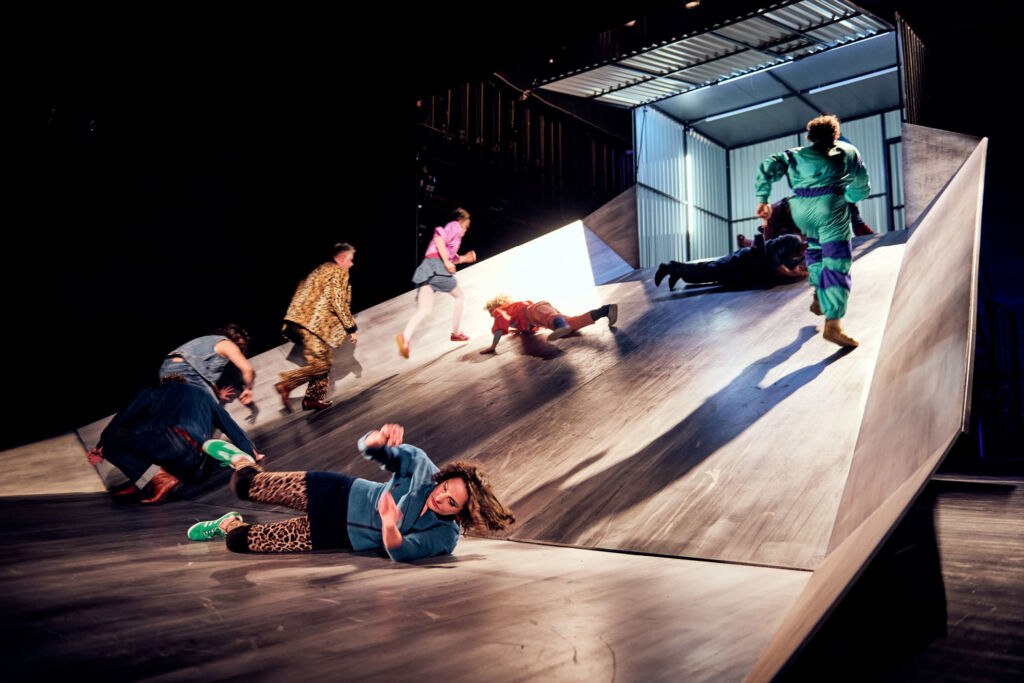
What’s more, Magdalena Gut would like to guide her students through a fundamental exploration of questions such as: “What is space? What do I need it for? Why stage design? What does it mean? In what dimension? And is it always something that’s built, or occasionally something different?” She points out how the primary thing for aspiring stage directors isn’t to design stage scenery or theatrical spaces by themselves but simply “to know about these scenographic processes, to be aware of what takes place when someone conceives of a space and realises something there.”
Magdalena Gut’s own artistic career has seen her “realise” and bring to life a multitude of such spaces. “There’ve been several spaces or spatial solutions that I’ve found hugely fulfilling for a variety of reasons, though it’s often my most recent work with which I still have a particularly strong emotional connection.” Some of the happiest moments in her own pursuits, says Magdalena Gut, arise when an idea of her own—one she knew would present a challenge—actually pays off. “Or when it even ends up paying off way more than I’d originally thought.”
The ways in which she approaches things usually look similar: initial sketches get turned into models, “whereupon you’ve built a small-scale world and figured out what kinds of movement could take place therein.” The resulting world becomes especially interesting, she says, when actors enter the scene. “Actors bring life into the space, moving around within it and perhaps also doing things you wouldn’t have thought possible.”
Being surprised is something Magdalena finds desirable both as a audience member and in her own work. “As an theatregoer, I do want to have my viewing habits disrupted or challenged in some sense.” And it’s when something she’s “discovered or invented” in a project of her own ends up inspiring her, the director, or even the actors, when they do things she perhaps hadn’t imagined, that it feels truly right and “lively”.
Symbiotic collaboration between all participants is something she finds particularly valuable. “Let’s say that I do like putting in my two cents at the directorial level. For me, it’s not simply about providing an aesthetic framework that then gets filled; I’m also fond of being involved in the rehearsal processes and the overall production, and I enjoy engaging in continual exchange.”
Such proximity to and close exchange with directorial personalities was also one major aspect that made teaching at the Max Reinhardt Seminar so attractive to Gut. “When I learned that this job would entail working together with directing students, with me starting from my position as a stage designer, they from theirs as directing students, and the dialogue in between, it became clear to me that it was one I’d say yes to.” She considers it essential to convey such dialogue’s urgent significance ”in order that we don’t tend to think, ‘This is mine, that’s yours, and we’ll meet somewhere in the middle,’ but instead inspire each other as to how we can make use of something and then work very much as a team to implement it.”
“This is also why one does theatre in the first place,” adds Gut. For her, it’s always about close collaboration, the symbiosis of ideas, and giving rise to something shared based on differing requirements. “I’m really glad to be working with directing students who are extremely interested, eager to get talking, and totally motivated to work on their projects.” Gut also notes consistently great interest in her own work on the part of her students. “One of the things I love about what I do here is how I have to very thoroughly scrutinise my own way of working in order to figure out how I can explain it to someone else in a way they can understand.” When speaking about her own works in class, Magdalena Gut always tries to share experiences and information of a universal nature. And alongside explaining what various things are (“What’s a tech rehearsal? What’s a fly loft? What’s under-stage machinery?”), she’s also giving real-life practice its due—from visiting the workshops of the theatre service company ART for ART to group projects with stage design students as part of the directing practica and on to planned festival visits together with students.
All these activities are set to grow even more intense for Magdalena Gut over the next few months. And for the moment, she’s put her own involvement in stage productions and artistic projects on the back burner to concentrate fully on her teaching at the Max Reinhardt Seminar. “Since I don’t have any theatrical projects planned for the time being, I can comfortably shift my focus even further in this direction—and I’m now looking forward to settling in here a bit more!”