The mdw’s Church of St. Ursula can look back upon 350 years as an important location for (sacred) music in Vienna. Empress Dowager Eleonora Gonzaga, the widow of Emperor Ferdinand III, brought the Order of Saint Ursula to Vienna in 1660. A central concern of this order, one that they shared with the Jesuits, was to promote education. The small group of invited sisters, who arrived from Liège, first took up residence on Dorotheergasse before moving to Johannesgasse in 1663. The Ursulines proceeded to open up entirely new opportunities for girls, who had previously been at a severe disadvantage in terms of scholastic education. The order offered instruction to daughters from wealthy backgrounds as well as poor children in various types of schools. The demand was enormous, and the number of Schülerinnen (simple pupils who received free education) and Kostzöglinge (boarders whose schooling and lodgings had to be paid for) soon became so large that the abbey and school complex was expanded to abut Seilerstätte and Annagasse. Today, a large part of this complex is occupied by the mdw.
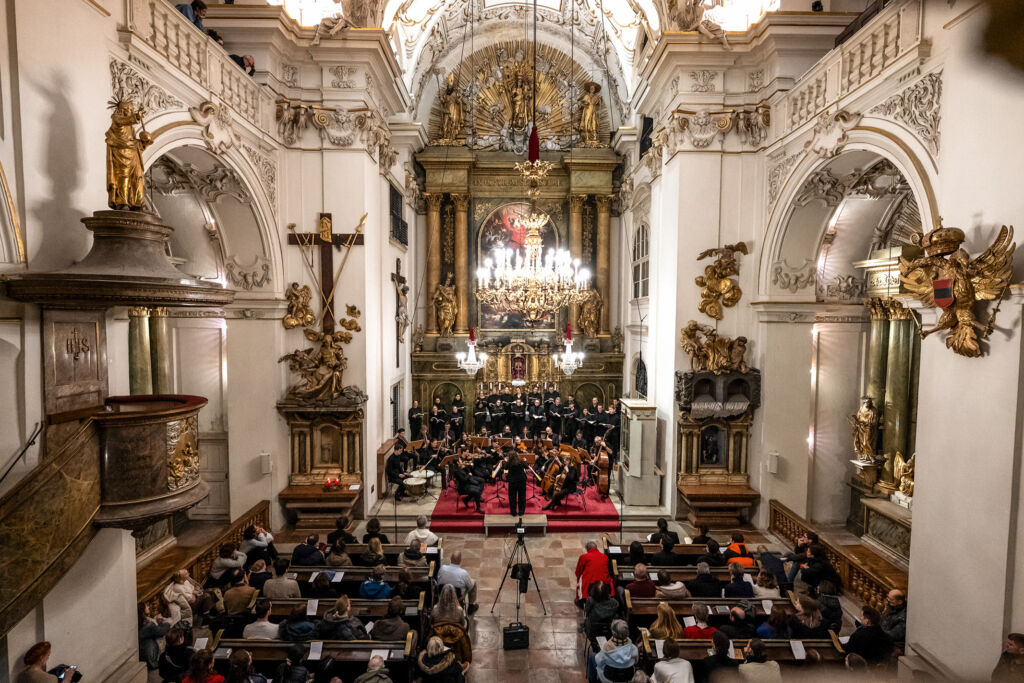
The cornerstone for the church itself was laid in 1673—and on 15 September 1675 (The date of this feast was ultimately changed to 12 September by Pope Pius X.—Ed.), the Feast of the Most Holy Name of the Blessed Virgin Mary, the Church of St. Ursula was consecrated in the presence of the Imperial family. Behind its rather plain facade, which one hardly notices today due to Johannesgasse’s narrowness, lies concealed a representative interior of notable art-historical significance.
It wasn’t just in their school-based work that the Ursulines exhibited openness to the “outside world”. Important personages, first and foremost members of the Imperial family, were regular guests at the abbey and the church. Clemens Maria Hofbauer, now among Vienna’s patron saints, was active here from 1813 until his death in 1820 as a confessor and preacher—in which capacity he captured the imaginations of countless people who consequently flocked to services.
Music played an important role for the Ursulines from the very beginning. Chorschwester [choir sisters] and Choralschwester [sisters with choral responsibilities] schooled members for the Divine Office. Depending on the occasion, musical performances featured Gregorian chant, polyphonic repertoire, and also—on commensurately festive dates—compositions with instrumental accompaniment (frequently with the tympani and trumpets that were reserved for especially representative contexts). A Gesangmutter [precantrix or lit. “singing mother”] saw to the girls’ musical training, and musical talent was a priority as early as candidates’ selection for admission to the order. When entering the convent, girls normally had to provide a dowry. However, this dowry’s provision could be waived for persons of particular talent—especially where music was concerned.
It is notable how the Ursulines usually saw to the vocal and instrumental music themselves and were thus heard publicly in their church. And on top of playing string instruments and the trumpet as well as singing the soprano and alto parts, they also had bass vocal parts sung by sisters whenever possible. In the convent’s book of remembrance, their probably best-known bass singer—Mother Maria Johanna Nepomucena, deceased in 1774—is described as having had “an incomparably beautiful bass voice thanks to which she had been accepted”. Church music here also involved participation by outside musicians when necessary. And in order to ensure music of appropriately high quality, exceptions were even made to the rule according to which only Ursulines were permitted to enter the choir—with individual (male) musicians being admitted, as well. Alongside liturgical celebrations, visits by special guests gave occasion for “concerts” and other musical performances by sisters of the order and their boarders.
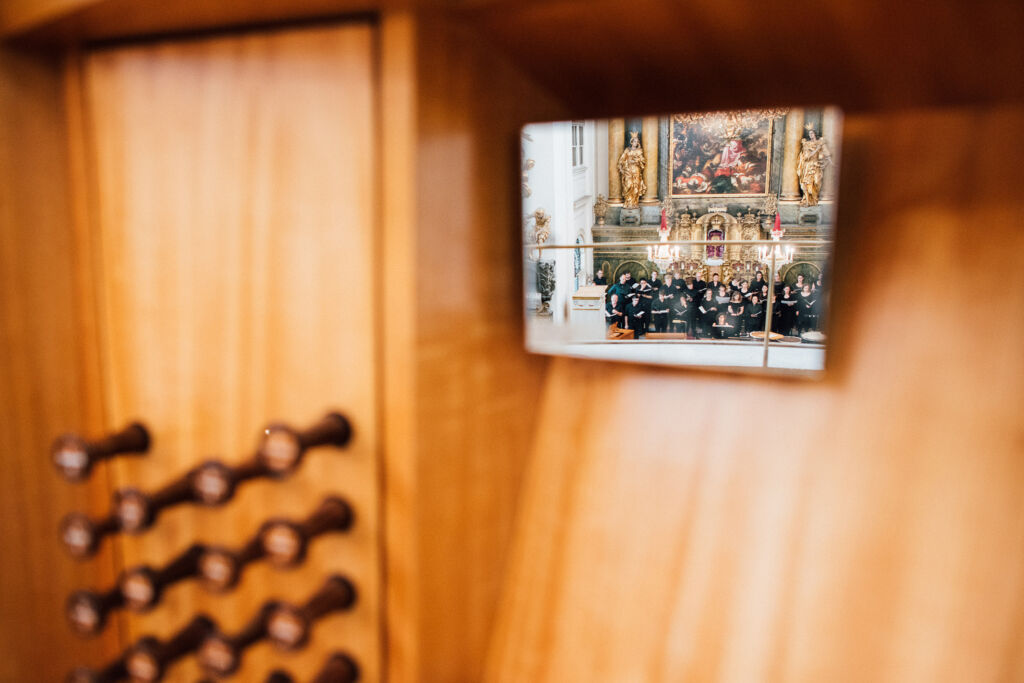
In 1960, the Ursulines sold their complex of buildings to the Republic of Austria and moved to the Viennese district of Mauer. 1968 then saw several departments of the mdw (still called the Academy at that time) move in. One of these was the Department of Church Music. Its future head, the young organ professor Hans Haselböck, played a particularly important role in this move and in planning the newly acquired spaces, including the Church of St. Ursula—which had nearly fallen victim to a proposal for Johannesgasse’s “automobile-appropriate” modernisation and widening. A new home for the church’s historic organ was found in Katzelsdorf an der Leitha, allowing an instrument optimised for teaching and concert-giving (built by Gregor Hradetzky in 1968) to be installed. Today, the church is home to three stylistically distinct instruments: in addition to the organ from 1968, there is an Italian organ from the 18th century as well as the home organ of Franz Schmidt. Moreover, a positive organ, a grand piano, and a harmonium are available when needed.
St. Ursula’s is now a lively church that serves a variety of purposes. For around 50 students enrolled in the degree programmes Church Music, Organ Performance, and Music Education for Instruments and Voice – Organ, it functions as a concert hall, a church with regular services, and a radio broadcast location, not to mention as a space for lessons and final exams. It also serves as a venue for a diverse range of projects that play a significant role in encouraging exchange and collaboration with other departments (especially the Department of Early Music).
The range of music heard here over the past anniversary year, from Gregorian chant to brand-new compositions’ experimental organ sounds and on to improvisation, exceeded this church’s age by many centuries. And under the motto of “Gott in der Mitte” [God at the Centre], a new event series was created that lets students provide the music for church services on mid-month Wednesdays, thereby enabling the church music repertoire’s entire stylistic breadth to be experienced.
Two special performances organised by the Department of Early Music and the Department of Organ, Organ Research and Church Music and held during the anniversary year of 2025 sought out direct ties to the history of this church: one was of the Oratorio di Santa Susanna, composed for the Ursuline Convent by the Imperial Court Composer Carlo Agostino Badia and premièred in 1707 for the Feast of Saint Ursula. The other featured the Ursuline Mass (K. 49) by the young Wolfgang Amadeus Mozart (1768), which possibly saw its first performance right here and includes an unusual aria-like bass solo that just may have been composed specifically for the Ursuline bass singer Maria Johanna Nepomucena.