Musik und Suizidalität. Interdisziplinäre Perspektiven, ed. Julia Heimerdinger, Hannah Riedl, and Thomas Stegemann, mdwPress, Vienna and Bielefeld 2025.
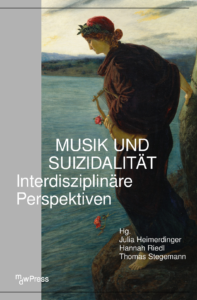
These days, playlists with titles like “Music About Suicidal Thoughts” are easy to find. It’s thus anything but a marginal topic that the book Musik und Suizidalität. Interdisziplinäre Perspektiven [Music and Suicidality. Interdisciplinary Perspectives] sets out to tackle, thereby taking its place among a growing number of publications that scrutinise the effects had by music about suicidal fantasies, intentions, preparations, and acts both generally and on the phenomena that it addresses. The individual contributions to this book offer insights from various disciplines: cultural studies and musicology; medicine and music therapy; and suicide research, youth psychiatry, and media psychology. In view of recent developments, such a combination makes a huge amount of sense even if only the most important aspects focussed on by the relevant disciplines could ultimately be included. This shouldn’t, however, lead one to expect simple handbook-style articles: all of the texts here are of considerable weight precisely because of their focussed character. A (reprinted) contribution by Thomas Macho on “The Cultural History of Suicide Epidemics” sets the overall standard. Julia Heimerdinger and Andy R. Brown then compliment Macho’s article by highlighting historical and contemporary combinations of music and suicidality in opera, art songs, instrumental music, and heavy metal. From the standpoint of medicine and music therapy, approaches to the topic of music and suicide present an ambivalent perspective. It is from the “Papageno effect” that physician and psychotherapist Claudius Stein derives his insights pertaining to crisis intervention and suicide prevention. This notwithstanding, music is by no means consistently successful in preventing suicide—as music therapist Susanne Korn likewise reports on the basis of her own experience. A posthumously published text by Harm Wilms entitled “On the Role of Music in Suicidal Acts” then provides a retrospective survey of his earlier research pertaining to this topic. Insights into recent investigations of how suicide risk factors and individual musical preferences relate are offered by Benedikt Till and Thomas Niederkrotenthaler, both of them experts situated in the fields of suicidology and public mental health. Picking up where they leave off is a contribution concerning music, self-harm, and suicidality by Paul Plener, head of the Medical University of Vienna’s Department of Child and Adolescent Psychiatry, who provides his own description of the ambivalent effects of music and social media—which entail risks but can also serve preventative ends. The book concludes with a special text by students who participated in a course on music’s role in the Netflix series 13 Reasons Why held at the mdw by Julia Heimerdinger (musicology) and Thomas Stegemann (child and adolescent psychiatry). Together with music therapist Hannah Riedl, Heimerdinger and Stegemann organised the May 2022 conference that produced the present collected volume, which is also available as an open access publication and contains a QR code that provides a link to musical examples.