“Shakespearean sonnets and an old factory: at the outset, no one has any idea what might result. Which is exactly why it interested me,” says stage director Michael Sturminger. What ultimately did result was musical promenade theatre at an unusual site with a unique working atmosphere for the participants—and a thoroughly electrified audience.
The work Sonettfabrik [Sonnet Factory], specially conceived for the defunct lignite briquette factory LOUISE in Domsdorf, Brandenburg and produced as part of the Max Reinhardt Seminar’s cooperative relationship with the Lausitz Festival, served as that festival’s opening performance. And shortly thereafter, at the palace Schloss Leopoldskron in Salzburg, a version tailored specifically to this location entitled Reinhardt probt Shakespeare-Sonette [Reinhardt Rehearses Shakespeare Sonnets] was performed. A sonnet is a type of poem that adheres to a specific structure and rhyming scheme, and William Shakespeare’s sequence of 154 sonnets was first published in 1609.
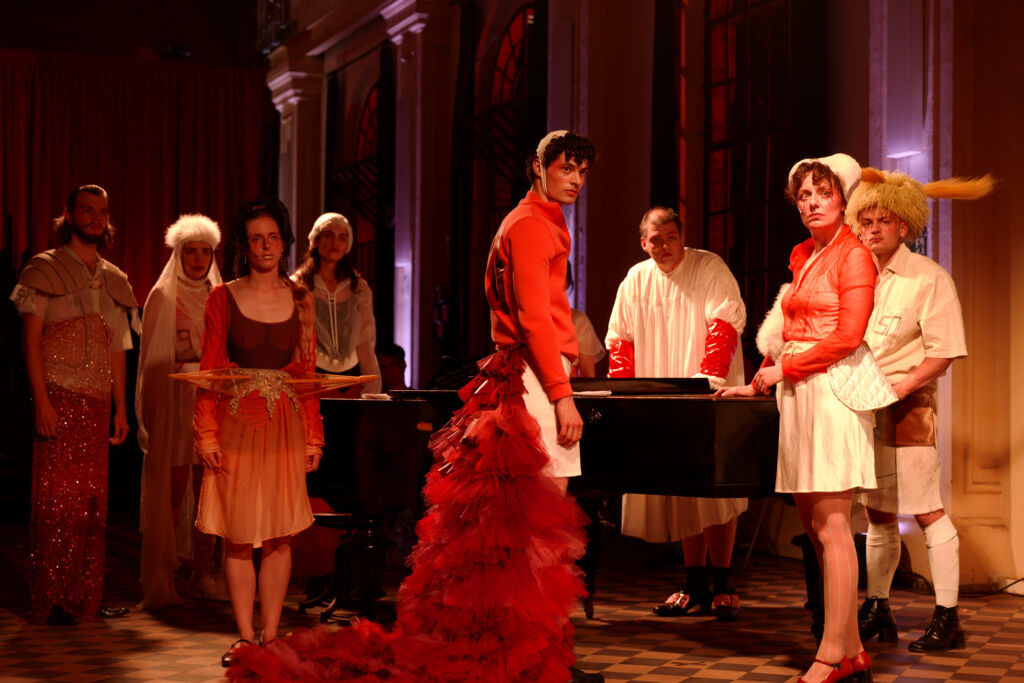
2023 witnessed the Max Reinhardt Seminar’s initial activities in cooperation with the organisation Salzburg Global (which owns Schloss Leopoldskron today) in conjunction with the 150th birthday of Max Reinhardt, who owned Schloss Leopoldskron from 1918 to 1938. “Back then, Reinhardt would invite his students to the palace and integrate them into the Salzburg Festival,” says Reinhardt Seminar head Alexandra Althoff. The ongoing cooperation with Salzburg Global enables students of the Max Reinhardt Seminar to work on chosen material in a “theatre lab” and subsequently present it to the public. For this year, engaging with Shakespeare’s sonnets had been the idea right from the start. Then came the offer by the Lausitz Festival to do something at the former lignite briquette factory LOUISE, which is now run as a museum. “What’s special about the Lausitz Festival is that it brings out lots of people who’ve never been to a theatre before,” says Althoff, who was responsible for the dramaturgy of this production in the promenade theatre genre. The leading team viewed bringing Shakespeare’s poems to this particular region and its populace as an especially attractive prospect. The region of Lusatia [German: Lausitz] has been shaped by the opencast mining of lignite, also known as brown coal, and the history and importance of this formerly large industry are still quite present for numerous people who live there. LOUISE employees led the audience members between the various stations and/or locations in the factory, where the actors—performing individually or as small ensembles—presented dramatised versions of the sonnets that had been chosen. “It did take some courage and determination. In some cases, we were standing face to face with the audience members—who effectively became part of these scenes and would also sometimes comment out loud,” says 4th-year acting student Crispin Hausmann. The team was also quite pleased at the LOUISE employees’ enthusiastic support of these performances and the interest they took in the theatrical work.
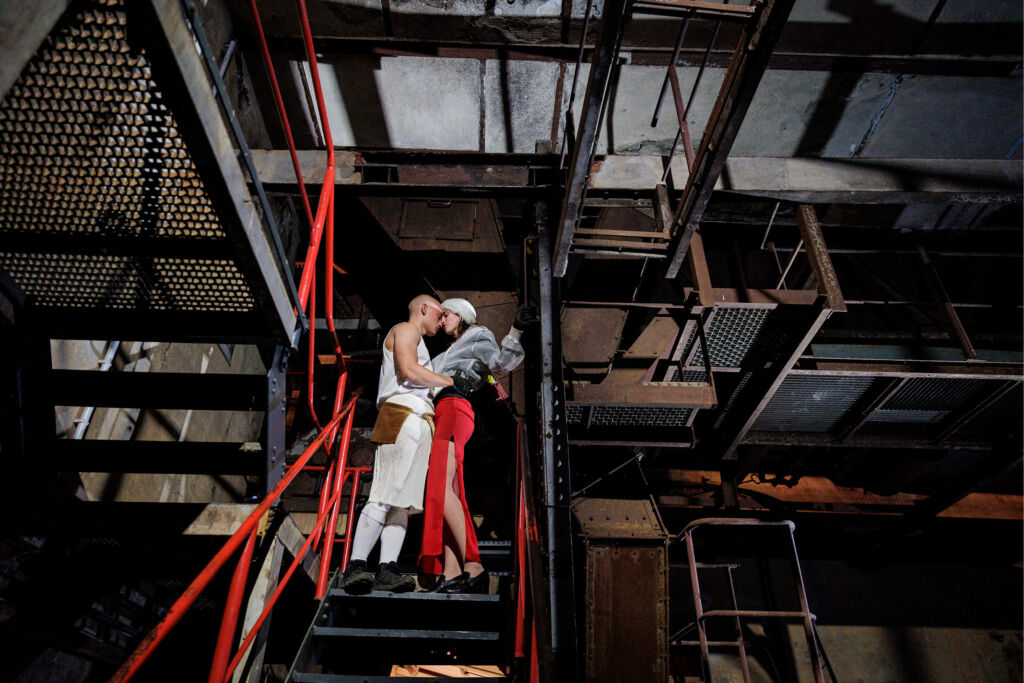
A mere three weeks had been set aside for rehearsals. “We approached the sonnets less as poems than as short dramatic texts. Though these works are often viewed as sacrosanct, we just took them and threw them around,” says Hausmann of their strategy. In the lion’s share of the sonnets, Shakespeare addresses a young man; in the rest, he speaks to a woman—the Dark Lady. Love, jealousy, disappointment, ephemerality, eternity, and criticism of power are central themes. “I think it’s fascinating how bisexuality is treated as a matter of course in these sonnets, as if Shakespeare’s era had been far ahead of our present times—including with respect to the idea of gender fluidity,” remarks Althoff.
The sonnets were performed not only in German and English but also in Sorbian, a Slavic language specific to Lusatia. “Shakespeare’s sonnets can’t be fully understood at first blush. You have work on them—and lots of things will remain enigmatic even so. You need a different kind of understanding when you engage with poetry,” Sturminger points out. “These are texts of a musical and rhythmic nature, so it seemed to make sense to combine them with music,” says Hausmann, who played violin in this production—while his acting colleagues played accordion, flute, and piano. Singing, sounds made by the factory’s machines, and electronic music were also employed. “We tried to make it possible to understand and truly grasp these sonnets by playing with the material rhythmically and musically and also employing repetition. After all, the word ‘sonnet’ originally denoted a ‘work in sound’,” explains the director.
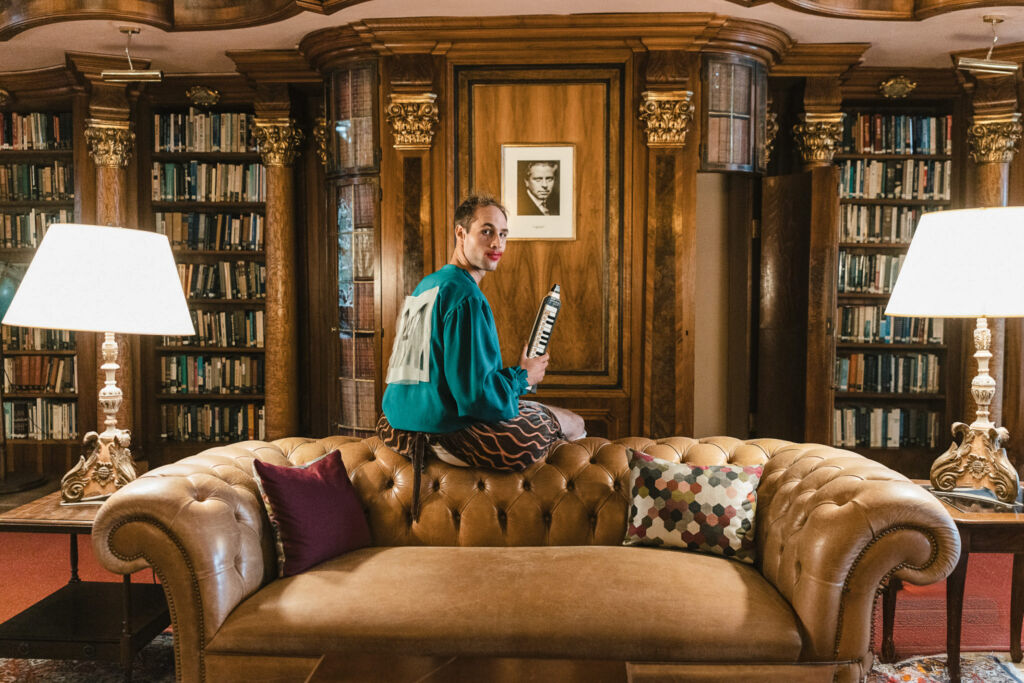
An additional, likewise very condensed rehearsal phase then saw their promenade theatre production adapted for Schloss Leopoldskron, where it was performed to great audience interest. Since this palace is now used as a hotel and event location, these performances offered an outstanding opportunity to take in some of its magnificent interior spaces. The entire team stayed at the palace while they worked, affording them an intense experience of Schloss Leopoldskron’s historical ambience as well as an idea of its importance to Max Reinhardt. “It was an extremely felicitous and constructive working atmosphere—and achieving that despite a tight rehearsal schedule and a festival opening is a speciality of Michael Sturminger,” says Althoff. “I don’t distinguish between work with students and with fully trained actors,” Sturminger himself explains. “We strive to make the texts our own, to penetrate them to a point where they suddenly come to life. I then attempt to prolong these moments and make them truly bloom.” On his overall experience, Hausmann states that “it was fascinating to present these delicate, intricately constructed poems in such powerful spaces due to the contrasts that arose as a result.” For the coming year, talks are underway with both Salzburg Global and the Lausitz Festival with an eye to building upon the success of these cooperative projects.