The Franz Schmidt Organ Competition was first held in 2006 and has taken place every two years since then. Its initiator was the mdw organ professor Rudolf Scholz (1933–2012), who headed our university’s Department of Keyboard Instruments. As a tireless advocate and promotor of Franz Schmidt’s organ works, his ultimate intent was to help make Schmidt better known. Until 2014, the competition took place in Kitzbühel (with its second round in Hopfgarten). It moved to Vienna in 2016, since which time the mdw—as a cooperating partner of the association Camerata Viennensis – Konzertvereinigung—has served as its umbrella institution.
Viewed internationally, the Schmidt Competition takes its place among a number of similar events that include an emphasis on specific composers (such as the Hermann Schroeder Competition in Trier, the Helmut Bornefeld Competition in Heidenheim, and others). Even so, it is and always has been Austria’s only organ competition that aims to encompass a stylistically broad repertoire—in contrast, for example, to the Paul Hofhaimer Competition in Innsbruck, which is devoted almost entirely to early music. The aforementioned stylistic breadth has repeatedly attracted highly qualified participants, as evidenced by its winners’ further careers, and the overall field of contenders this year hailed from a total of 13 countries. This broad musical scope quite naturally has to be done justice by the instruments on which it is carried out, which was one of the reasons behind the competition’s move to Vienna.
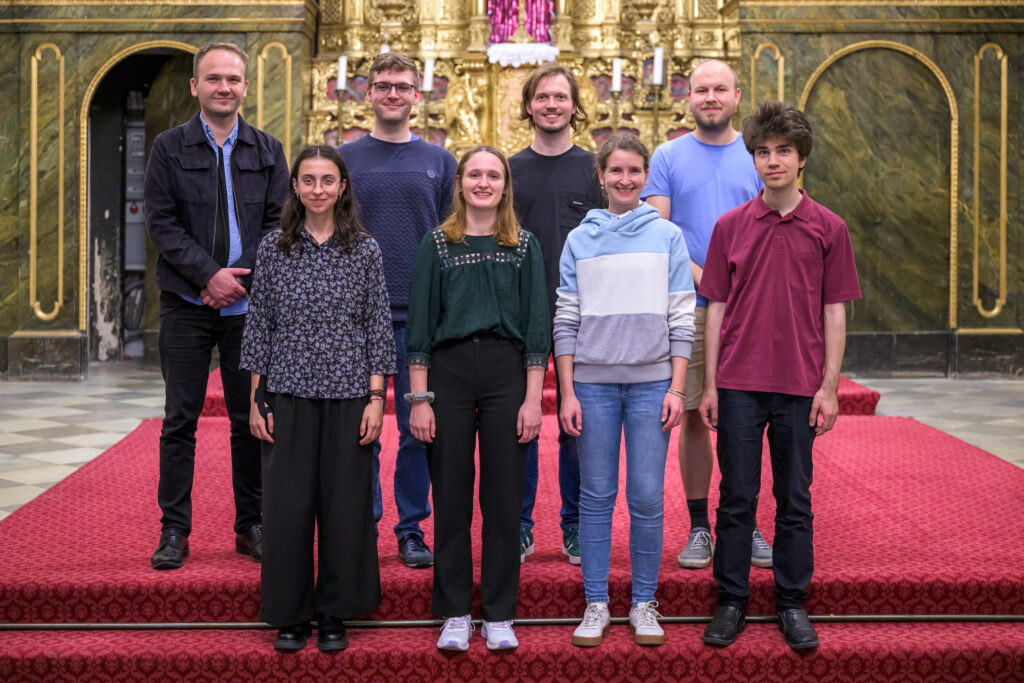
For the 2025 edition, several elements were reconceived. To allow for more efficient conduct (and in keeping with an international trend), a preliminary video round was introduced. Based on the videos that were submitted, the jury selected a limited number of participants in early April who were then invited to the main round in September. It was quite evident how this motivated numerous organists to register, seeing as the preliminary round required them to prepare only part of the programme while enabling them to find out well in advance whether they’d be permitted to participate in Vienna. What’s more, this edition’s call included a greater number of freely selected pieces and less obligatory repertoire. And finally, the fact that it was held at the Jesuitenkirche and the Schottenkirche as well as on the Franziskanerkirche’s historical choir organ (1642) doubtless represented a further attraction for the participants.
Organising an organ competition is a highly complex undertaking. As different as modern pianos may be in terms of the finer points of touch and intonation, one really is much like the other—particularly where their overall handling is concerned. And at violin or flute competitions, for that matter, participants bring their own instruments to begin with. Organs, on the other hand, live where they live—so participants get to know them just one or two days before a competition begins. It’s only then that they can make decisions about registration—meaning how they combine the available timbres represented by the stops on a given instrument. Getting acquainted with an instrument is even more important when that instrument is a historical organ. Certain notes at the bottom of the keyboard are “missing”: where one normally finds the lowest F# and G#, for instance, one might instead hear D and E. It’s hence the case that all participants need practice time on the various instruments, and this requires precise scheduling that takes prayer and service times at the respective churches into account. It’s obvious that competitors’ handling of such special conditions and their registration choices play a role in how their playing is evaluated, which means that—unlike at violin or piano competitions—there are several parameters that extend far beyond technical mastery and musical interpretation. Moreover, a work’s historical background always needs to be considered: Could a timbre that one selects today even have existed in 1690? Or: For this piece from 1935, wouldn’t one much rather have had to choose register X or Y?
With this year’s relaunch, the Franz Schmidt Competition now features more opportunities to choose from the repertoire. In such cases, the question of whether a freely chosen piece works well or less well on the respective instrument likewise affects how a participant is judged. And by the same token, the jurors’ task has also grown more difficult in certain cases—for when very different works are played, the participants become less comparable. One participant might play a piece of great technical difficulty that requires less registration, while the exact inverse might be true of a piece played by the next participant.
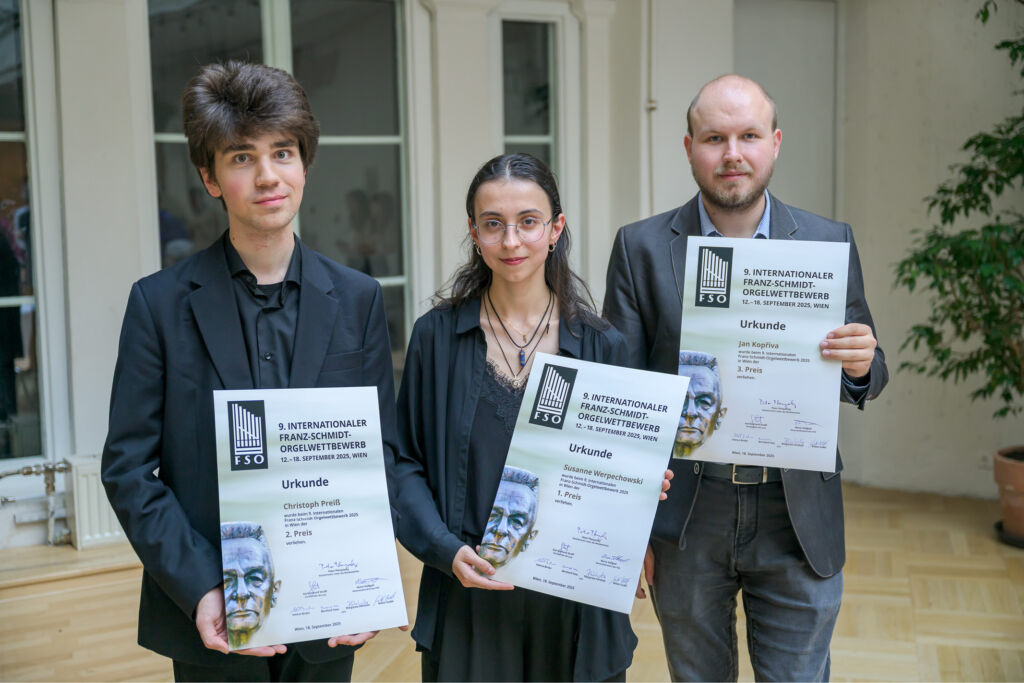
The winners of the competition’s 2025 edition are:
1st prize: Susanne Werpechowski (Austria)
2nd prize: Christoph Preiß (Germany)
3rd prize: Jan Kopřiva (Czech Republic)
Vienna’s Franz Schmidt Competition has done great things for Austria’s visibility in the international organ scene, and its place in the world of competitions is well established—a fact that will be confirmed all the more by its 10th edition in 2027.