A Space for Musical Encounters on World Music Day 2025
On 23 June 2025, the Banquet Hall of the mdw played host to the third edition of “Kooperieren – Amateurmusiker_innen musizieren mit Studierenden” [Cooperating – Amateur Musicians Make Music with Students]. This evening event, held as part of the annual Fête de la Musique, once again placed amateur music-making and musical exchange between students, teachers, and lay musicians firmly in the spotlight.
The aspiration behind “Kooperieren” is clear: it seeks to provide an artistic space where differing worlds of musical experience come together—a space situated directly between didactic and non-didactic activity. In doing so, the project features particularly close conceptual ties to the courses Didactics of Violin (taught by Isabel Schneider) and Instrumental Teaching Practice for Clarinet (taught by Barbara Haslinger). The event itself gives students a chance to explore musical practice and engage in creative exchange with amateur musicians. The objective is to afford an experience of musical communication outside of traditional instructional settings.
Piano teachers Sigrid Strauss and Magdalena Fuchs of the Perchtoldsdorf Music School were likewise involved in the project together with their students. Both additionally serve as mentors for mdw students in the IGP programme, thereby playing a double role in which they embody the close interlocking of university-level training with the practice of music education in the amateur sphere.
This event was deliberately scheduled to take place close to 21 June—which marks the June solstice as well as the “Fête de la Musique” (also known as World Music Day), a celebration that first took place in Paris in 1982 at the initiative of France’s then-minister of culture Jack Lang and has since spread across the entire globe. The basic idea of this celebration—providing public access to music in its diversity and openness and extending low-threshold invitations for people to make music—is also reflected in its concept.
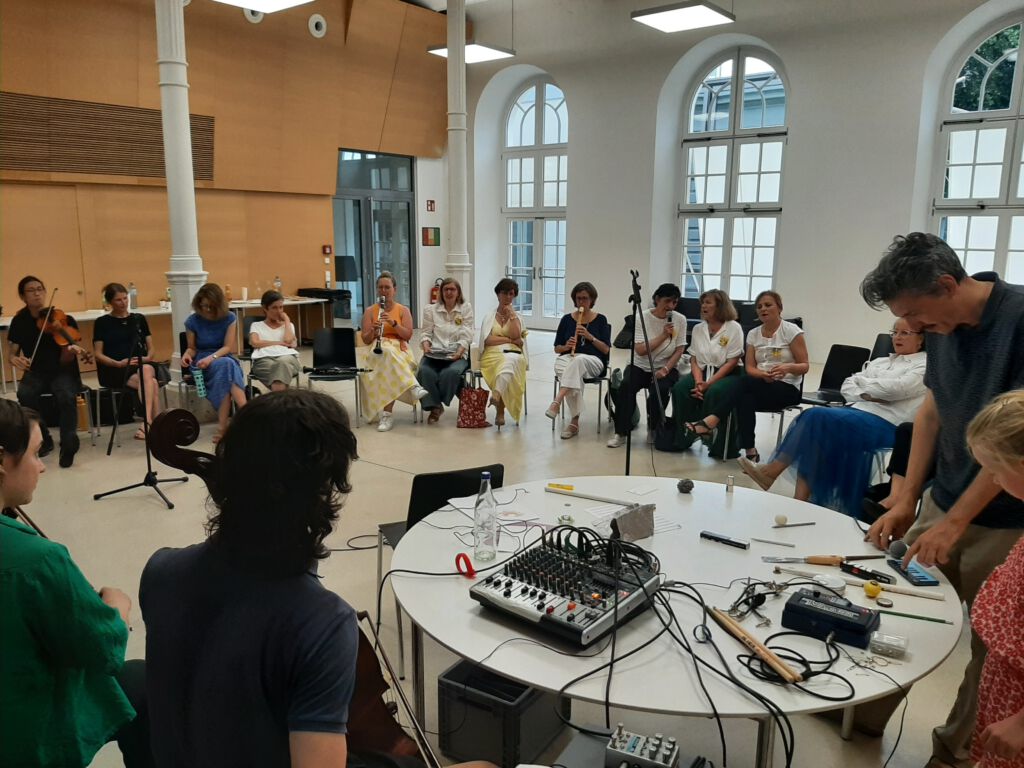
The event at the mdw began with an open music-making session led by Selina Pilz and Angelo Beltrame, both of whom study in the CAP master’s degree programme. Pilz and Beltrame also share leadership of a community orchestra, from which they contributed their experiences. Step-by-step and with great sensitivity, they guided the approximately 30 participants—a heterogenous group of strings, winds, pianists, singers, and accordionists—towards improvisation and experimentation as a group, working acoustically as well as with electronic instruments and unconventional sound sources. Especially remarkable was the diversity of the participants, who united multiple age groups, levels of experience, and musical backgrounds. The joy they took in making music as a group was palpable, with musical “conversations” arising in smaller groups as well as through exchange across the entire group. In addition to musical dialogue, this event also offered space for personal encounters. In conversations following the music-making session, contacts were made and experiences exchanged—a further indication of music’s potential to bring people together. The conclusion was a concert in which previously rehearsed works were performed by students together with amateur musicians.
With this overall format, initiators Judith McGregor and Isabel Schneider seek to lend visibility to the great relevance of amateur music-making in the broader contexts of music and society at large. By the same token, this event also opens up new perspectives for the instrumental teaching professions that reach beyond the realm of formal lessons. More than ever, the instrumental teachers of tomorrow are being called upon to create such opportunities for exchange and encounter. Places and instances in which music is made as a group—whether institutionally or informally—contribute not just to musical education but also to social cohesion.
This event makes it clear how the effects of musical learning extend far beyond formal educational contexts as part of lively communities of practice in public spaces of experimentation, listening, and creative collaboration. Such initiatives pick up on international developments that underline the social and cultural significance of this practice such as UNESCO’s recognition of lay and amateur instrumental music-making as intangible cultural heritage in Germany (2016). Amateur music-making contributes in an important way to social cohesion and cultural participation and simultaneously opens up new perspectives for the practice of music education.
The participants’ positive feedback shows how such formats generate valuable impulses for a future-oriented mode of instrumental teaching that builds bridges between generations, experiential worlds, and forms of musical expression.