
Humidity measurements in concert halls

Extract from a master's thesis Part II:
Nagl, Wolfgang (2020)
Humidity influence on natural drumheads.
Department of Music Acoustics – Wiener Klangstil, University of Music and Performing Arts Vienna. 
In the first part of Wolfgang Nagl's work, the influence of humidity on natural fur is measured and analysed under laboratory conditions. In the second part, a series of temperature and humidity measurements were carried out in concert halls during concerts. An overview of the results and findings is given here.
Impact of audience
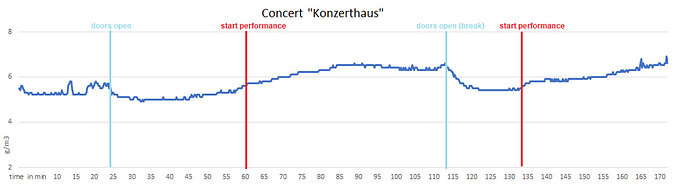
The first measurement in a concert hall was about proofing the impact of the audience on humidity. To do so, two measurements were conducted. One measurement at the general rehearsal and the other one at the concert. Both measurements took place on the same day in the same hall. A concert in the Wiener Konzerthaus was chosen. The first graph of the rehearsal has nearly no evolution of humidity over time, whereas the concert measurement shows a lot more motion in humidity.
General rehearsal
On closer inspection, a small increase of humidity occurs before the rehearsal starts as the musicians take their seats. And a drop of humidity can at least be imagined as soon as the break starts. All in all, the humidity moved between 5.2 g/m3 and 5.6 g/m3.

Concert
The concert measurement, on the other hand, shows a much greater fluctuation of humidity. The doors were opened 35 minutes before the concerts started. This let fresh air in the hall and made sure that the humidity dropped perceptible. The absolute humidity dropped from 5.7 g/m3 to 4.9 g/m3. The more people entered the more the humidity raised again. This effect is going on up to its climax of 6.6 g/m3 at the end of the concerts first part. During the break the humidity again dropped down to 5.4 g/m3 which led to a repetition of occasions where the humidity reached 6.9 g/m3 in the end of the concerts second part.
The maximum increase measured during a concert happened at the Musikverein in Vienna. The orchestra performed Bernstein’s 3rd Symphony in the second part. This required the participation of a speaker, one solo vocalist, a big orchestra plus choir and even an extra boys’ choir. All in all, the timpanist was surrounded by about 200 people. In the concert’s first part the humidity rose from 7.7 g/m3 up to 10.3 g/m3. After dropping down to 9.2 g/m3 in the break, the humidity rocketed up in the second part to 11.2 g/m3.
Taking these values into consideration and comparing them to the laboratory measurements, it can be considered that the timpani would pitch out of tune perceptibly. The total change in absolute humidity amounts to 3.5g/m3 and took place over about 140 minutes. The 4 g/m3 humidification in the laboratory tests lasted for 28 minutes and caused the drumhead to drop in intonation by not less than a half-step (goat) or in the case of the calf even more than a full step. Due to the longer humidification period during the concert, the laboratory change is assumed at least, but probably the change would be even greater.
Not only does humidity rise, it can also be the subject of a dramatic decline. Measured at a concert in the Brucknerhaus in Linz, the graph of the relative humidity provides some interesting details. First of all, there is the huge fall of humidity during the concert break. Second, there is the drop in humidity during the soloist’s encore.
Counteracting humidity fluctuations / Measurements inside a timpano
The aforementioned humidity fluctuations cause serious pitch alterations to the instruments. To counteract these fluctuations the musicians often use pieces of wet cloth on a wooden stick or metal wire. These pieces of cloth are placed inside the timpani by inserting them through the hole at the bottom of the kettle. Originally this technique was invented to achieve the low bass tones on very dry days by humidifying the timpani inside, but it turned out that this humidification also prevents the timpani from big pitch changes.
To measure the inside of a timpano kettle, a special data logger was constructed at the Department for Music Acoustics (IWK). Therefore, three DHT22 humidity and temperature sensors were mounted on suction cups that could be stuck on the inside of the kettle. To do so, the drumhead had to be dismounted. The cables were routed through the hole in the kettle and the data logger was placed under the timpano.
Measurements
At the concert in the Brucknerhaus, not only was the air humidity of the hall measured but also the inside of the bass timpano. The inside was moistened with wet cloth pieces about one hour before the performance started. The data logger started 7 minutes before the concert, recording the actual temperature and relative humidity every 15 seconds. Out of this data the absolute humidity was determined.
The saturation of the volume was much higher than with any measurement before. With the start of the concert the absolute humidity was 16.8 g/m3. This stayed more or less at the same level with the exception of a few fluctuations, which are due to the musician playing the instrument. When hitting the skin, the air volume in the inside is compressed, which is compensated by the hole at the bottom of the kettle. The humidified air is blown outside and the outer, dryer air, is sucked in. That is why the humidity stayed almost the same level until the soloist’s encore when the absolute humidity was 17 g/m3. From that point the instrument was not used and the wetted cloth inside moistened the volume of the kettle up to 17.6 g/m3. With the beginning of the break (17.4 g/m3) it took a little while until the dry air reached the inside of the kettle. But nevertheless, even the great reduction of humidity measured in the hall impacted the inside of the kettle via the small hole for air exchange at the bottom of the kettle and resulted in 16 g/m3 absolute humidity. In the second part of the concert, the timpano was used until minute 92 and afterwards was no longer needed. This can also be seen in the graph as the wet cloth is able to moisten the volume of the kettle undisturbed by the musician. That allowed the humidity to rise from 16.4 g/m3 at the beginning of the second part to 18 g/m3 at the end.

Rapid changes
It was expected that the stage area of an opera house stores a different composition of air than the audience area, which is released by the curtain when rising or when the stage is rotating. Therefore, the 3-minute interval response measurements in the laboratory tests were executed. To see how big these changes were under real conditions, the opera premiere performance of von Einem’s Der Besuch der alten Dame in the Theater an der Wien was chosen to be measured.
Curtains
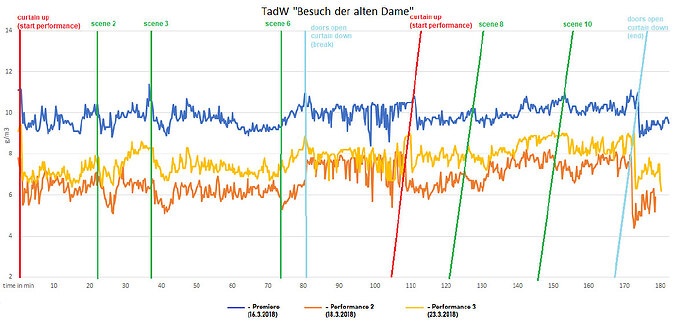
During the performance the curtain was raised twice, in the beginning and after the intermission. It seems that the stage area contained air that is a lot dryer than the air in the orchestra’s pit or the audience area. The humidity falls at these spots significantly. When the opera starts, the humidity drops from 11.2 g/m3 down to 9.2 g/m3 in less than two minutes. Also, after the intermission this effect is rather strong and takes place in exactly one minute, when the humidity drops from 10.8 g/m3 to 9.2 g/m3.
Stage rotations
So as not to disturb the performance, the staging was based on fluid scenes that changed without clear cuts through the curtain. This was achieved by rotating the total stage area for another design when changing scenery. Most of these scene changes show similar symptoms as they occur when the curtain is moving. The change in scenery brings dry air to the audience area as well as the orchestra pit, which has a huge impact on the air humidity. The shorter the intervals of changing scenery were, the more the two air compositions mixed. This can be seen at scene 4 to scene 6, where the rotating has hardly any effect on the air humidity. An exception is scene 6, where the rotation has no impact, but this final scene demanded a lot from the singers onstage, which led to a significant increase in humidity during the final scene before the intermission from 9.2 g/m3 to 11 g/m3.

To prove whether the humidity changes in the opera were caused by the described phenomenon or simply happen by chance, the same performance of von Einem’s Der Besuch der alten Dame was combined with two other measurements of the same production. Not all of the scenery changes described before can be seen but most of them were reproduceable.
A few things catch the eye immediately:
- Huge fluctuations of humidity during the intermission. Unfortunately, the author did not protocol the intermission. Therefore, it cannot be said with certainty where these fluctuations came from. Probably from construction work onstage. Nevertheless, even these works are the same at every performance and reproduced in the chart
- Differences in the timing of the second part of the performances: The reason therefore is quite simple and due to the different length of the intermission, which could not be synchronized in the chart without falsification of the whole graph.
- Different levels of absolute humidity. Although the actions onstage seemed to be reproduceable, the total humidity level was not. The “Theater and der Wien” is an old opera house built in 1801 (Vereinigte Bühnen Wien , 2019). The technical equipment is not as modern as in newer houses, which makes this opera house susceptible to external influences as it cannot counteract the temperature and humidity entering the opera house from outside through open doors or the delivery gate for the scenery parts. A closer look at the weather in Vienna supports this assumption (for more detail please have alook on the data presented on page 58 of the thesis).
Modern opera houses
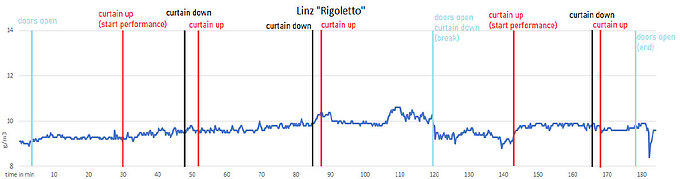
In contrast to the old Theater an der Wien there exist, of course, much newer opera houses with a lot of technology built in. Unfortunately, there was only one measurement done during the investigation of this paper, which took place in a newly built opera house, but nevertheless it already shows that all the technology pays off.
Conclusion
Modern technology can avoid big environmental differences affecting both the performers and the instruments. Compared to the laboratory measurements, the fluctuations at the Musiktheater Linz probably have hardly any influence on the intonation.
On the basis of the studies carried out for this paper, there should no longer be any doubt about the effects of moisture on natural drumheads. Air humidity is a very changeable element which can almost instantly cause an instrument to become out of tune. The experiments shown should illustrate these changes and give musicians an idea of how the interaction of humidity and instrument takes place. Whether opera or concert, after this work any timpanist should be able to foresee the expected changes and counteract them accordingly.