
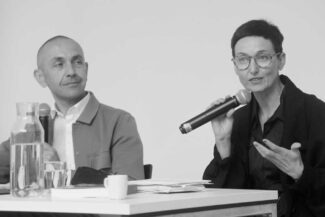
Ruth Anderwald + Leonhard Grond work as artists, curators, and artist-researchers and are guest professors at the Artistic Research Center. Since 2025, they have been affiliated members at the CSS Centre for Sensory Studies, Concordia University, Montreal. Until 2024, they were professors at the University of Applied Arts, Vienna, responsible for the PhD in Art Artistic Research program.
Ruth’s and Leonhard’s artistic work has been shown internationally, e.g., at 15th Bienal de la Habana (2025), Centre Pompidou, Paris (2009, 2020), Himalayas Art Museum, Shanghai (2010), or Tate Modern, London (2008).
They have curated exhibitions, as well as discoursive and screening programmes for institutions such as Kunsthalle Wien (2012), Whitechapel Gallery London (2013), Kunsthaus Graz (2017) and U-jazdowski Castle Warsaw (2018).
They have led two FWF-PEEK projects, Dizziness-A Resource (2015-2017) and Navigating Dizziness Together (2020-24), and initiated the EU-funded projects The Arts of Resistance (2024-2025) and ART WORKS! European Culture of Resistance and Liberation (2019-21) with Museion Bolzano, MSU Museum of Contemporary Art Zagreb, wannseeFORUM Foundation, HKW Haus der Kulturen der Welt Berlin, Foundation Between Bridges, HBK Braunschweig and the University of Applied Arts Vienna. ART WORKS! was recognized by the European Commission as best practice project in response to the COVID-19 crisis. The Construction Site of Remembrance (2018-2023) accompanied the remodelling of the Austrian exhibition (Blog 17) at Auschwitz-Birkenau Memorial Museum commissioned by the Austrian National Fund.
Researching states of dizziness for the last 15 years, they recently initiated Iliggocene–The Age of Dizziness together with curator Sergio Edelsztein, an arts-based research project in the decentralized form of a network exhibition and discursive series, including screenings and performances; its process and findings will be documented and published in an audio archive. The Iliggocene explores the socio-political and artistic side of dizziness as states of unpredictability and uncertainty. The term Iliggocene (from iliggos – Greek for “dizziness”) refers to states of dizziness as investigated through artistic research by Ruth and Leonhard together with Sergio Edelsztein laid out in their podcast series On Certain Groundlessness (downloaded in more than 40 countries, available on Spotify, Apple Podcast and here: https://www.on-dizziness.com/resources-overview/podcast).
The first Iliggocene exhibition opens at KINDL-Centre for Contemporary Art Berlin in March 2026, funded by KSB, followed by events, performances, lectures, and further exhibitions at Museum of Contemporary Art Zagreb, Kunsthaus Graz, and n.b.k. Neuer Berliner Kunstverein, 2026-28.
Recent academic publications include ‘Contemplations: A Perspective on Reflexivity out of the “Brackish Waters” of Artistic Research’ in Revisiting Reflexivity: Liveable Worlds in Research and Beyond. (Eds. Sarah R Davies, Andrea Schikowitz, Fredy Mora Gámez, Elaine Goldberg, Esther Dessewffy, Bao-Chau Pham, Ariadne Avkıran, & Kathleen Gregory) The Bristol University Press, Bristol (2025), as well as the reader Dizziness—A Resource, (Eds. Ruth Anderwald, Karoline Feyertag, Leonhard Grond) Sternberg Press, Berlin (2019).
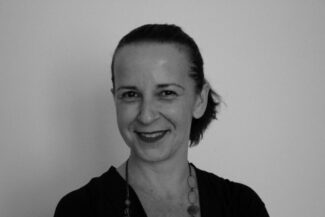
Hande Sağlam (Mag. art. PhD) was born in Istanbul. She is the head of the audio-visual archive of the Department of Folk Music Research and Ethnomusicology at the University of Music and Performing Arts Vienna. She studied composition at Bilkent University/Ankara, obtained her master’s degree in music theory from the University of Music and Performing Arts Vienna, and received her doctoral degree in ethnomusicology at the Department of Folk Music Research and Ethnomusicology of the same university. Her dissertation was on the musical differences between Alevi and Sunni Âşıks in Sivas/Turkey.
Her research interests include music and minorities, Anatolian Âşık tradition and the musical identity of immigrants in Europe, with a special focus on Turkish immigrants in Austria, traditional music transmission methodologies, cultural memory, interculturality, bi- and multi-musicality. She has worked on a range of research projects on music and minorities, on audio-visual archives in Austria and Turkey, and on the transmission methods of traditional musics. She has organized many symposiums and written a large number of publications.
Since 2005, she is a member of the ICTMD Study Group on Music and Minorities and acts as the secretary of this group since 2017. Between 2015 and 2019 was she vice chair of the ICTMD National Committee of Austria and served there as chair between 2019 and 2021.
Since 2022 Hande Sağlam is working on a research project called “Transmission of Knowledges: The Master-Apprentice Relationship in the ÂşıkTradition” funded by the European Commission Horizon 2020 Marie Skłodowska-Curie Actions Program.
Conducted Research Projects:
2022-2023 Transmission of Knowledges: The Master-Apprentice Relationship in the Âşık Tradition., funded by Co-Funded Brain Circulation2 Scheme European Commission Horizon 2020 Marie Skłodowska-Curie Actions programe
2018-2022 Towards an alliance for distributed ethnomusicology data (funded by ASEA-Uninet)
2016-2017 Bi- Multimusicality – Changing mdw sound landscapes and their constructions” Funded by mdw
2014-2015 Music without Borders – Multilingualism in Music and Understanding the ‘Other’ and the Unfamiliar (https://www.mdw.ac.at/upload/MDWeb/ifs/downloads/Musik-ohne-Grenzen_ENG_Langfassung.pdf)
2013-2015 Music – Religion – Integration: Muslims in Styria/Austria
2010 – 2015 Digitalizing of historical records – Constructing a database and archiving digital sound materials of the IVE – mdw
2009 – 2010 Bi-musicality and intercultural dialogue at mdw
2007 – 2009 Embedded Industries. Cultural entrepreneurs in different immigrant communities of Vienna
2005 – 2007 Immigrant Music in Vienna – Musical identity and the acculturation process of immigrants in Vienna
Teaching experience (selection):
University of Vienna – Department of Musicology: “Transcription and Analysis”, “Introduction to Music from Turkey”, “Makam Music in Turkey”
mdw: “Introduction to Field Research”, “Field Research Practice” “Field Research at Viennese Schools”, “European Folk Music”
Kärntner State Conservatory “Introduction to Ethnomusicology”,
Mimar Sinan University State Conservatory – Ethnomusicology Department: “Current Studies in Ethnomusicology”, “Research Projects in Ethnomusicology”.
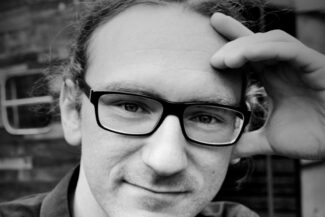
Wolf-Georg Zaddach, PhD (*1985) studied musicology as well as cultural management at the Music University Franz Liszt Weimar and modern history at the Friedrich Schiller University Jena as well as jazz guitar at the VOS Praha with David Dorůžka.
From 2011 to 2021, he worked at the department of musicology in Weimar in the DFG-funded research project „Melodic-Rhythmic Design of Jazz Improvisations. Computer-based musical analysis of monophonic jazz solos“ (Prof. Dr. Martin Pfleiderer) and at the Chairof Cultural Management (Prof. Dr. Steffen Höhne). Since May 2021, he is employed at the Institute for Art, Music and their Mediation at the Leuphana University of Lüneburg with a focus on studio practice, since April 2023 in the DFG / AHRC-funded project „SongwritingCamps in the 21st Century“ (Prof. Dr. Michael Ahlers). Since March 2024 he is Professor for Music Production and Songwriting at Macromedia University of Applied Sciences in Berlin. His research interests are in the fields of Artistic Research (methods, applications), Climate Change and Music Culture, Jazz (history, theory and analysis), Rock & Heavy Metal, Music Business & AI, and Sociology and Psychology of Music (creativity & improvisation,analysis and digital methods, youth cultures).
Wolf-Georg Zaddach has taught at numerous institutions in scientific and artistic departments, including the British and Irish Modern Music Institute (BIMM) in Berlin, the Popakademie Baden-Württemberg, Columbia University NYC, Bauhaus University Weimar, InitiativeMusik Berlin, Stiftung Ettersberg Weimar, Demokratie jetzt e.V., Deutsche POP Dresden. In addition, Wolf-Georg Zaddach is artistically active as a guitarist and music producer in various genres and for several labels.
https://Wolf-georgzaddach.com
https://zaddachmusic.com/about
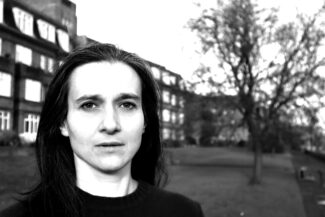
Lucia D’Errico is an artist–researcher in the field of music with a special focus on experimental performance practices and wide-ranging interests in transmediality, the visual arts, post-structural philosophy, semiotics and epistemology. She works as a performer, composer, sound artist, and graphic designer.
After she dedicated the first decades of her artistic career to music performance with a special focus on Western new and experimental music, her work today focuses on the transformative power of artistic research. Her research milestones include the decisive contribution to the ERC founded project “MusicExperiment21” as a doctoral researcher (led by Dr. Paulo de Assis) and the foundation of a multi-disciplinary doctoral programme at the University Mozarteum Salzburg.
As an artist-researcher, she has explored new musical practices (especially the practice of “divergent performances” and “rhopophony”), new concepts (especially the concept of the “operator”), new methods (e.g. “techniques of minoration”), new epistemological frameworks (the tetrapartition of the relationship between knowledge and the unknown, the monadic approach to artistic research, the notion of the “knowledge rift,” the concept of “images of research”), as well as artistic-political concepts (“micro-formalism” and “micro-universalism”).
Her research focus is strongly transdisciplinary and aims to challenge current approaches in music performance and composition by relating them to concepts and practices from other fields. Other areas of research include the critique of representation, the role of the human in relation to the non-human, the paradoxical relationship between writing and what escapes writing, the suspension of teleological temporalities, the status of the question in artistic research, and the Investigation of machinic ontologies. She is dedicated to the study of a particular line of post-structural philosophy that focuses primarily on the figures of Jacques Lacan, Maurice Blanchot, Gilles Deleuze, Félix Guattari and Salvoj Žižek.
