Animal Movement in Twentieth Century Opera Exemplified by Adaptations of Gotthelf’s Black Spider
Leo Dick 
How to cite
How to cite
Abstract
Abstract
This article deals with the representation of animal movement in operas of the twentieth century. In accordance with a main interest of composers, librettists and directors in this field, the focus is on aspects of the uncanniness of such representations. An exemplary comparison of the adaptations of Jeremias Gotthelf’s novella Die schwarze Spinne by Heinrich Sutermeister (1934) and Rudolf Kelterborn (1984) shows how animal symbolism is used to negotiate current role and body images. The analysis results in supporting the thesis that both case studies are prototypical for the aesthetic influence of a state-induced cultural and social policy that propagates, among other things, a certain gender-specific role and body image. This is done under the opposing signs of tradition affirmation in the first case, and a critical self-questioning in the second.
Outline
Outline

It took a long time in the history of the genre before such a legendary and mythically charged animal as the spider appeared on the opera stage for the first time. It may be because the animal is soundless that, for a long time, it was not considered suitable for music and/or theater. However, inspired by Jeremias Gotthelf’s world-famous tale The Black Spider (1842) and probably also by countless horror tales and films thereafter, composers and theater makers gradually discovered the aesthetic potential of spider representations, especially regarding the animal’s incomparable movement. Its uncanny movement patterns not only became the starting point for unconventional sound, text, and performance formations, but they also proved to be highly adaptable symbol patterns for social self-reflection with artistic means, especially for mirroring current anxieties related to sexuality, search for identity, heteronomy, and threat of technology.
The following study deals with two transfers of Gotthelf’s story to music theater. The basis of this investigation is the now widely accepted interpretative reading that a “narrative construction of ‘woman’ is somehow deeply at issue in this horror story.”1 From this gender-theoretical perspective of reception, the question will be discussed of how gender-specific body and role images are negotiated, (re)produced and propagated with the means of music theater. The aim is to identify aesthetic configurations of symbols that allow conclusions to be drawn about contemporaneous gender concepts and thus about an essential aspect of societal definitions. The diachronic approach of the study identifies both constants and changes in the reception of Gotthelf’s fable on the one hand, and in the music-theatrical construction of gender on the other. The limitation to two Swiss case studies is meant to exemplify general principles of the interrelation between artistic symbolization and the concrete conditions in a particular social environment.
After a preliminary introduction to the general history of animal figures in opera, I will locate Gotthelf’s novella in the cultural history of the spider motif. Furthermore, we will briefly discuss the political and social conditions of the time when The Black Spider was created: Gotthelf’s tale emerged during the decisive transformational phase of modern Switzerland, at the end of which the loose confederation of states became a federal state. An echo of these social disturbances is permanently inscribed into the text and inevitably influences any in-depth examination of the subject.
The main part of the study is devoted to an exemplary comparison of the music theater compositions of Heinrich Sutermeister (1934) and Rudolf Kelterborn (1984). Interestingly, these two versions share an important condition of origin. Both works were produced by the Swiss Broadcasting Corporation for the most popular medium at the time they were written: the older work as a radio opera, the more recent as a television opera. The analytical work focuses on aspects of the compositional, choreographic, and performative transmission of three key moments of the narrative in which the artistic negotiation of gender is condensed: the devil’s kiss, the dance festivities in the village, and the mother’s final battle with the spider for her newborn child.
In the concluding part of the contribution, a conceptual outlook is ventured, taking a cursory glance at a recent setting of Die schwarze Spinne by the composer Peter Roth from 2016 as an opportunity to speculate about adaptation strategies that could bring Gotthelf’s story into our time in an adequate way with the means of contemporary music theater.
However, I would like to preface the discussions of The Black Spider with a brief historical overview of animal representations in opera. The symbolic configurations in Sutermeister and Kelterborn are in fact embedded in a system of operatic aesthetic conventions that has been formed over centuries. Many of the conceptual decisions being discussed can actually only be explained within this context.
Figurations of Animal in Opera History
Animal representations play a role in opera that should not be underestimated. Since its beginnings in the early seventeenth century, the genre has by no means limited itself to the performing of the relationship between human beings or between gods and human beings. Rather, from the outset, nature animated or embodied by animals was also included in the artistic depiction of a universal world structure.2 In the course of the history of the genre, this initially happened under “Orphic” auspices. The mythical figure of the Thracian singer Orpheus is known to be the first real operatic hero. His heroism is based not least on his ability to influence his natural environment by the power of his artistry: “His singing and string playing bring morality and order among human beings and tame even the wild beasts.”3
Countless variations of this archetypal scene have left their mark on the entire operatic repertoire. The most famous example of this is Tamino’s use of the magic flute in Mozart’s eponymous last opera, bringing both wild animals and the elements such as fire and water under control. Such portrayals of the human-animal relationship express, on the one hand, a belief in the civilizing power of music and art in general; musical performance is supposed to tame affects and provide order. In this context, human beings are usually shown as standing above animal urges. At times, however, the animal topos is also varied to the effect that the (supposedly) wild beasts, once tamed, are used as a model for civilized life.4 On the other hand, this constellation also celebrates absolutist rule. In a political sense, the dressage of animals performed on the opera stage can be understood as “subject behavior.”5 In every direction, animal instincts, behavior, and physis are presented as something to be suppressed, domesticated, and controlled.
This symbol configuration of a feudal world on the threshold of the Enlightenment underwent an expansion with the beginning of the modern era. In romantic opera, encounters with animals symbolically reopen the human being’s lost access to areas of the unconscious and/or numinous. As a result, they primarily endow the hero with contemplative and transcending experiences beyond civilizational alienation and restriction. Later, especially under the influence of Sigmund Freud’s writings, these sublimation tendencies are more and more turned into their shadowy counterpart. Subsequently, representations of animals often refer to the confrontation with what an individual or a collective represses, rejects, or unacceptably longs for. In Julia Kristeva’s terminology, such symbols stand thus for “abjection” processes6 that human beings have to go through in their psychosexual development before entering the “mirror stage,”7 that is, the establishment of such boundaries as self and other or human and animal.
In response to various developments in politics, culture, sciences, and social life, the function of animal symbolism in opera was gradually expanded. Opera animals metamorphosed from the object to be mastered, to the unconscious part of the individual subject, finally to the disintegrated, rejected abject. The fact that the three functions potentially interpenetrate each other is made clear by Richard Wagner in his Siegfried when he makes his hero interact successively with a bear (trained object), a forest bird (aspect of the hero’s own subjective personality), and a lindworm (abject).
Following the differentiation of psychoanalytic theories, modern opera developed a special affinity for the monstrous body that results from the fusion of human being and animal. Since 1940, numerous pieces have negotiated abjection aspects of uncanny hybrid creatures, for example in the grotesque courtroom scene of Arthur Honegger’s Jean d’Arc au Bûcher (1942), in settings of Kafka’s Metamorphosis by Paul-Heinz Dittrich (1986) and Frank Moon (2013), in the adaptation of the ancient Minotaur legend by Harrison Birtwistle (2008), or in pieces such as Olga Neuwirth’s Bählamms Fest (2003) with its varied cast of half-animal characters, and Karlheinz Stockhausen’s Licht (1977-2003) with its many Lucifer transformations. The focus of compositional experimentation in all of these pieces is on shaping timbre with the intention of creating a kind of monstrous vocality, for example in the mixture of voice and live electronics in Neuwirth’s opera. With the discovery of Gotthelf’s Black Spider as opera material, on the other hand, compositional parameters gained importance that have been otherwise rather neglected in the sound design of opera monsters. According to the physiological characteristics of the animal, rhythm, movement, and spatiality are preferably used to imitate the spider’s behavior and movement patterns. This opens up new symbolic worlds and potential meanings that have been far from exhausted.
Spider Symbolism
The physical appearance of the arachnids has impressed mankind since ancient times. The mix of fascination and horror with which we encounter the movement, hunting, social and pairing behavior, or the feeding of the spider has been preserved over the centuries until modern times.
This ambiguity is undoubtedly at the origin of the countless symbolic assignments that have been given to the arachnid species in the course of human history. In Ovid, Arachne (ancient Greek for “spider”) is a gifted but arrogant weaver. She challenges the goddess Athena to a creative contest in the field of weaving. Arachne performs brilliantly and weaves a tapestry depicting the amorous escapades of the Olympian gods. As punishment for her insolent hubris, Athena transforms the rebellious competitor into a weaving spider. Almost two thousand years after Ovid, psychoanalysis and depth psychology see in the animal the “the archetypal image of the Great Mother with her threatening, ensnaring, and devouring qualities.”8 In the spider symbol, which almost always has explicit female connotations, two streams of motifs are thus intertwined. On the one hand, the spider is staged as a rebel against the world of the gods, and thus against the political and economic system of rule. Similar to Prometheus, the animal thus functions as an enlightener and bringer of culture. On the other hand, fears are projected onto the spider’s body that are related to the distribution of roles between men and women.9
These two overlapping aspects predestine the spider to be the monster protagonist in the genre of horror literature and scary movies. Music theater, on the other hand, adopted the spider archetype surprisingly late and hesitantly. So far, only Gotthelf’s elaboration of the spider motif has become operatic material. His tale is about a devil’s pact that the self-confident farmer Christine enters into in order to save her village from the aggressions of a ruthless feudal lord. The price: an unbaptized child. The deal is sealed with a kiss, which Christine receives on the cheek. Several times the devil is cheated out of his reward. As punishment, Christine first gives birth to little spiders from the devil’s mark on her cheek. These fall as a black plague on the cattle. Later, Christine herself is transformed into a large spider, which from then on decimates the village population. Only a young mother finally succeeds, sacrificing her own life, to banish her into the window pillar of a farmhouse.
Gotthelf’s tale has acquired a status in Switzerland that goes beyond its reception as mere literature. As a result of its canonization as mandatory school reading, The Black Spider has increasingly become the projection of an imagined common since the 1920s: wherever the current social constitution of Switzerland is publicly debated, the black spider is not far away as an illustrative example.10 This also applies to the field of theater. To date, countless stage adaptations of the material have been created. A comparative analysis of significant productions of the spider archetype based on Gotthelf can therefore provide insight into the state and development of collective images of the self and of others.
My two case studies, the opera compositions by Heinrich Sutermeister and Rudolf Kelterborn, are united by the fact that they were not originally conceived for the theatrical stage, but in each case for the most popular broadcast medium of the time. In the case of both Sutermeister’s radio opera and Kelterborn’s TV opera, the Swiss Broadcasting Corporation acted as both the commissioner and producer of the project and was thus also responsible for the choice of subject. This production pattern is unusual for the decidedly federalist Switzerland, where art and culture are explicitly seen as the responsibility of the municipalities and cantons and not of the federal government. National broadcasting is an exception in this respect, and initiatives from this side usually aim at having discourses of national importance negotiated by artistic means. In the following, I will argue that state-induced debates about self-understanding are encoded in both commissioned works. For this purpose, I will examine sequences of the pieces in which gender-specific roles and body images are reproduced with music-theatrical means, starting from the archetypal symbolism of the spider.
Sutermeister’s Schwarze Spinne: An Affirmative “Radio Festspiel”
It may seem surprising that a text as popular as The Black Spider was not set to music by a Swiss composer until ninety years after its publication. But during his lifetime, Gotthelf was anything but a consensually recognized literary figure of the newly emerging federal state of Switzerland. Rather, the “poet pastor” distinguished himself as a sharp critic of the new constitution and as a voice of warning against the victory of uncontrolled liberalism, in which he saw the triumph of the right of the strongest. Gotthelf only underwent a radical reinterpretation from an inconvenient social analyst to a “Heimatpoet” with majority appeal posthumously in the period between the two World Wars. The harmonizing reception of his texts, which was necessary for this, has left traces in Sutermeister’s adaptation. The piece begins with a chorale sung by the village church congregation in thanksgiving for the supposed divine rescue from a pestilence plague. An acoustic zoom-in then brings Christine’s confessional conversation with the priest to the fore. She confesses to having asked the devil for help in the face of the rampant pestilence. He promised help and pressed a kiss on her forehead to confirm it. For this agreement, she asks for absolution, which she is denied, while in the background the congregation sings their Gloria anew.
The motif of the rebellion of an oppressed community is omitted in this version. Instead, the black plague is unceremoniously reinterpreted as the cause rather than the consequence of the devil’s pact. Gotthelf’s strong woman, Christine, experiences a significant domestication in various respects. She enters into the devil’s pact not out of audacity and full of self-confidence, but out of desperation, and without immediately being informed of the price to be paid. Her encounter with the devil is decidedly desexualized: the kiss is on Christine’s forehead and not on her cheek, which at least weakens the symbolism of procreation and pregnancy. Consequently, Christine does not give birth to spiders from the gaping devil’s mark. Moreover, the pact is not shown, but only recounted, and that from the mouth of a humble young woman. The erotic fascination that surrounds the figure in Gotthelf is thus completely lost; Christine is instead reduced, not without empathy, to her role as a scapegoat who must be sacrificed for the good of the community.
The figure of the devil also appears in a completely different light than in Gotthelf. Due to the omission of the authoritarian father figure, the devil can no longer be read as a projection of the oppressed farmers’ inner potential for rebellion; rather, he manifests a danger of seduction coming from the outside. The devil appears in Sutermeister’s opera in the flesh after Christine has been denied absolution. His appearance is in no way metaphysically exaggerated; rather, he seems to come directly from the mundane world of the big city. This is at least suggested by the use of muted trumpet, blue notes, and seventh chords, as well as somewhat later by the musical ductus between chanson and dance music.
Christine offers her body to the devil for the price of release from her torments. He rejects her and demands instead the procurement of an unbaptized child. The archetypal Oedipal constellation of the trade in Gotthelf fully degenerates in the following scene to the plain agenda of a (possibly pedophile) libertine. Contrary to the original, the devil sneaks into the upcoming village festivity and unsuccessfully tries to seduce a young girl on his own. An alienated “Ländler” creates a peculiarly subdued mood: its tempo is noticeably slowed, and into the static C major diatonic—composed more modally than functionally in harmony—are mingled those chromatic alterations of the third, fifth, and seventh degrees that I have previously referred to as blue notes (see figure 1). The dancing people prove to be potentially endangered, but ultimately resistant to decadent influences from the outside.
Meanwhile, Christine fails in her first attempt at child abduction and mutates into the black spider. As such, Sutermeister sends her into a final confrontation with the mother of the child chosen as the victim. After her transformation, Christine’s vocal part is reduced to wordless vocalises and chromatic, glissando passages, thus symbolically dehumanized. The orchestral setting evokes a tense atmosphere with tremolos, trills, and signal-like phrases and seems to mimetically trace the uncanny movement of the black spider (see figure 2). First and foremost, however, a musical gesture of suffering is formulated here: this is evident in the motivic treatment of Christine’s earlier lament aria as well as in the chromatic ascents and descents, which oscillate between sighing figures and passus duriusculus.
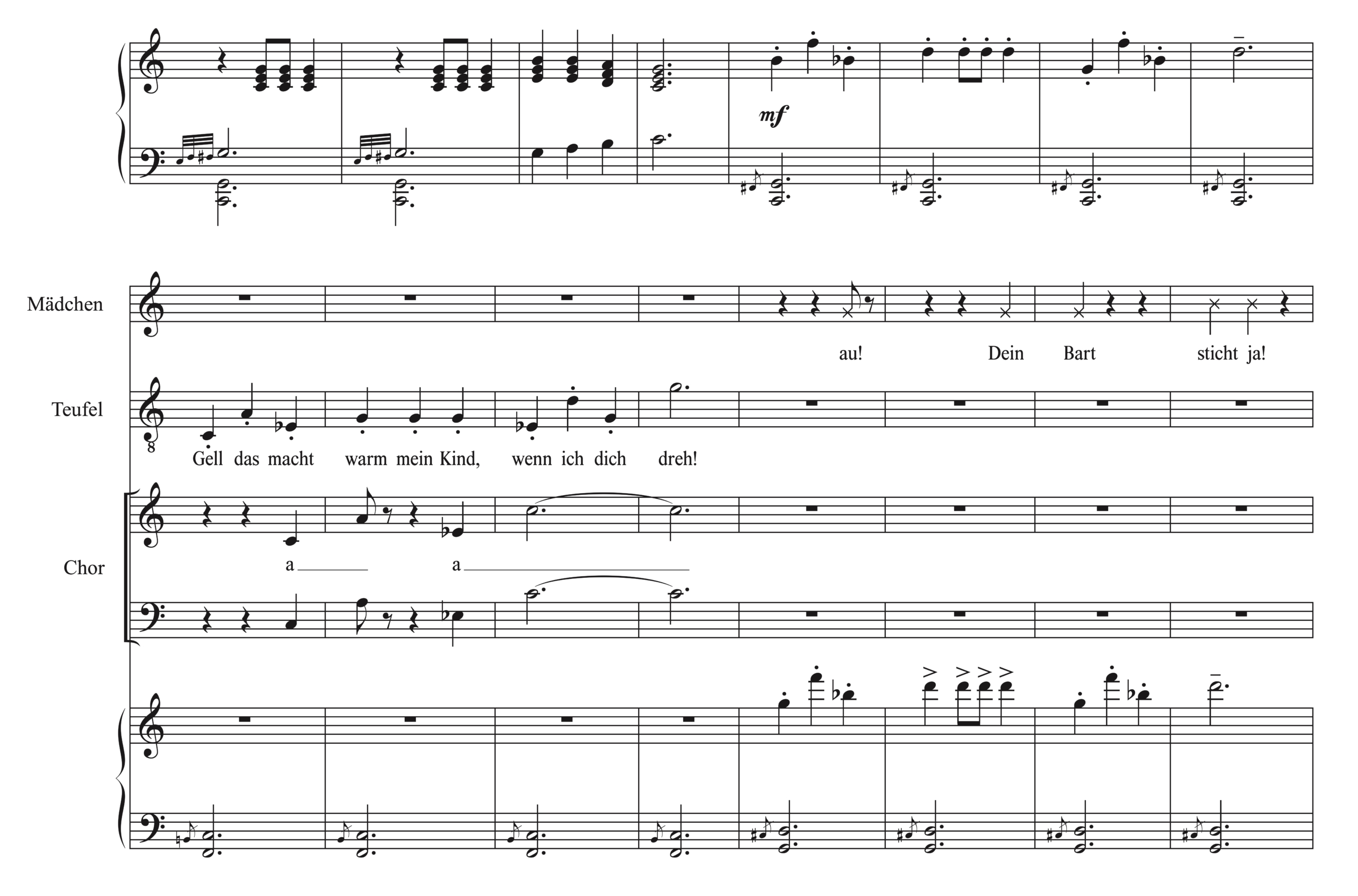 Music example 1: Heinrich Sutermeister: The Black Spider, VII. Chorscene mit Teufel und Mädchen, excerpt from the piano score (“Ländler” with blue notes).
© 1949 Schott Music. Ltd, London. Mit freundlicher Genehmigung von SCHOTT MUSIC, Mainz.
In the battle of the “final girl”11 with the monster, the good mother triumphs completely, unlike in Gotthelf. The spider is not only temporarily banished but destroyed once and for all. The domestic role ascribed to women by God as caring and protecting mother is emphatically confirmed. Behind this affirmative attitude, which runs completely against the spirit of the original, lies the agenda of a political-cultural movement in Switzerland, which had as its goal the strengthening “of values declared as Swiss.”12 In the spirit of the so-called “Geistige Landesverteidigung” (“intellectual defence of the nation,” translation by the author), Sutermeister and his librettist Roesler show us that the evil of this world basically comes from the outside. If it does infect someone on the inside, it is necessary to isolate the contaminated person in order to prevent the individual case from further infecting the whole community. In any event, the evil is localizable, thus controllable and, with a little help from good mother Helvetia, even defeatable.
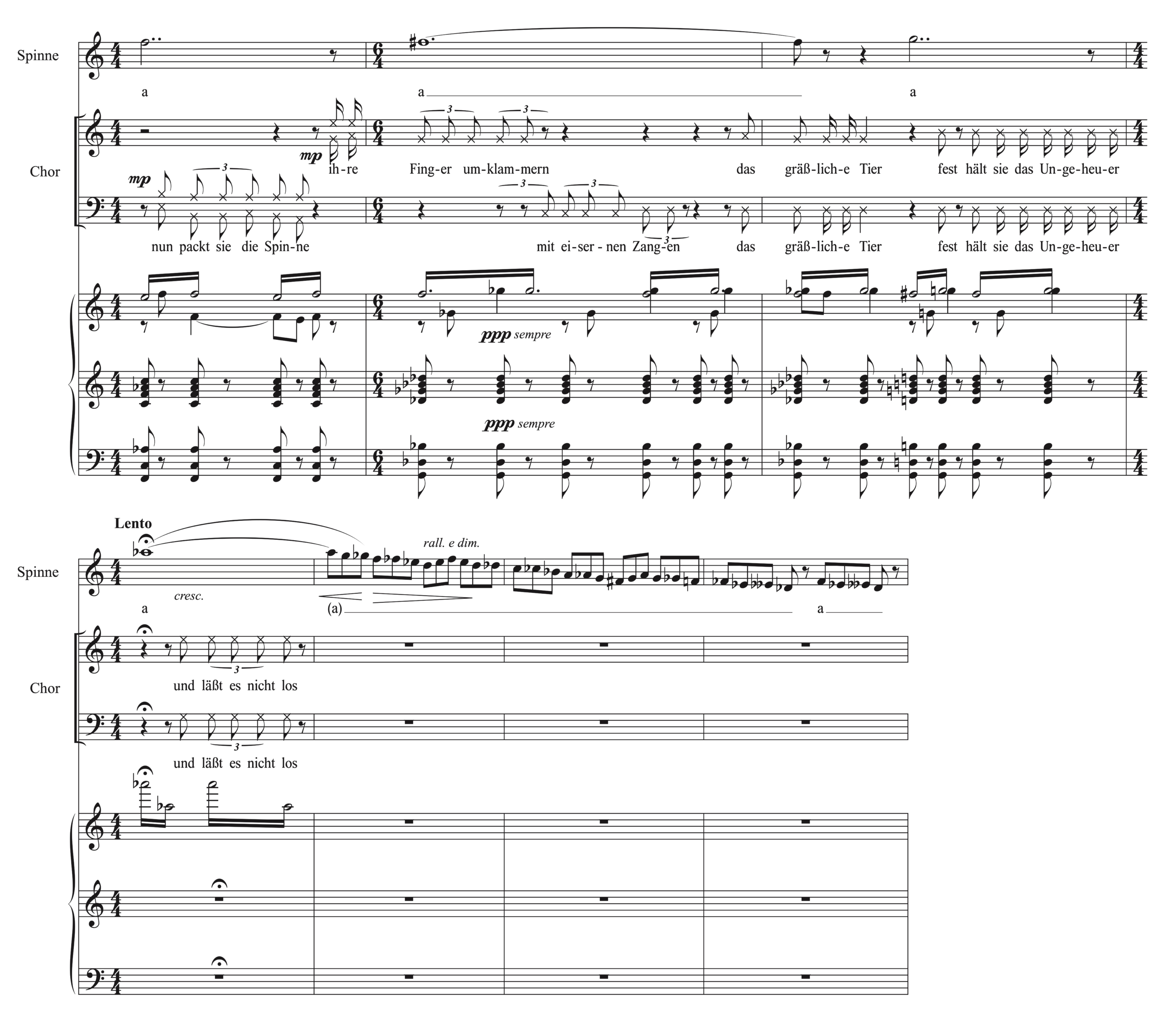
Music example 2: Heinrich Sutermeister: The Black Spider, X. Duett: Spinne (Christine)—Mutter, excerpt from the piano score. © 1949 Schott Music. Ltd, London. Mit freundlicher Genehmigung von SCHOTT MUSIC, Mainz.
In Sutermeister’s conception of the piece there is no place for complicated dialectics. One may criticize the reduction of complexity compared to the literary original with good reason. However, one must concede to the composer that he understood very precisely what was to be conveyed aesthetically via the then new form of radio opera on the one hand and what was expected of him from the political side on the other. The showy juxtaposition of sharply contrasting sound tableaus and the transparency of the orchestration demonstrate an instinctive understanding of the potential of radiophony in view of the state of technical development at that time. In form and content, the piece certainly met the requirements of a unifying popular radio station. The fusion of chamber opera and radio can be understood as a contemporary response to a traditional form of popular music theater in Switzerland, the so-called “Festspiel”13:
In a sense, radio formed the most advanced stage of the Swiss Festspiel tradition—mass meetings that involved the population, regardless of origin, in the ritual of the festival as a performance by the people for the people, typical of a country with a political culture based on communal responsibility and the principle of participation.14
The form of the affirmative “Radio Festspiel,” of course, severely restricts the possibilities of access to Gotthelf’s multi-layered novella. Apart from the few illustrative moments in the music described above, Sutermeister’s interpretation of the narrative largely suppresses that uncanny kinetic potential of the spider archetype that is so impressively described in Gotthelf in its nonlinear, network-like constitution, i.e. in its unpredictability. The clear front lines and unambiguous role assignments propagated by Sutermeister’s opera may have been useful for the construction of a defense-oriented self-image of Switzerland in pre-war and wartime. As an authentic reflection of a society that gradually opened up after 1945, the work was no longer suitable, at the latest since the end of the 1960s. At the beginning of the 1980s, the Swiss Broadcasting Company therefore once again commissioned a composition for a Black Spider Opera.
Kelterborn’s Remake as Critical Television Play
The necessary impulse for renewal in the 1984 remake, a “musikalisch-dramatische Erzählung” (musical-dramatic narrative) for television, was guaranteed by the choice of the artistic team alone. With Kelterborn, Hansjörg Schneider as librettist, Werner Düggelin as director and Hans Hollmann as performer, protagonists of the progressive Swiss music and theater scene of the time were involved. They were all united by the effort to break up encrusted social structures, which is unmistakably reflected in their resulting joint work. The figure of the cruel superfather Hans von Stoffeln is reinstated, the revolt of the oppressed thus becoming, as in Gotthelf, the central motor of the fable. The antagonist Christine presents herself this time as a self-confident and erotically self-determined woman. Her breaking of taboos is correspondingly re-connotated compared to Sutermeister.
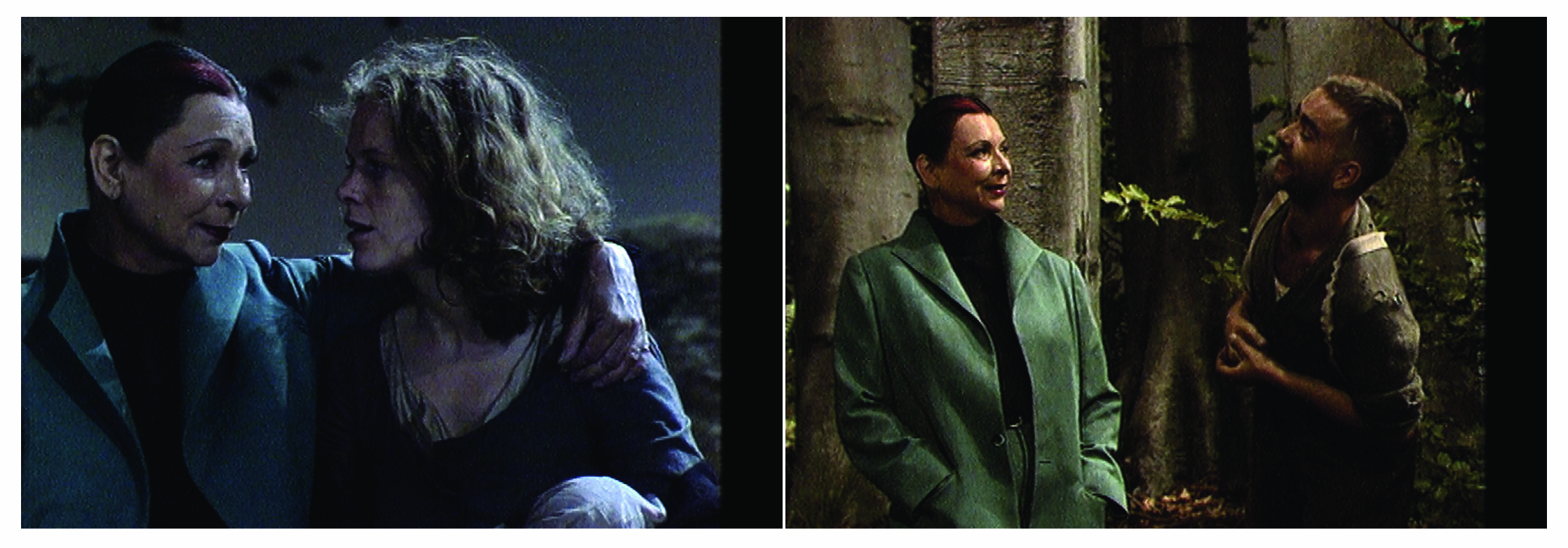
Figure 1a and b: Screenshots from the television play The Black Spider, musical-dramatic narrative after Jeremias Gotthelf (text: Hansjörg Schneider, music: Rudolf Kelterborn, directed by Werner Düggelin): the devil (Agnes Fink) and Christine (Annelore Sarbach), and the devil and the village fool (Ernst Sigrist). © 1983 Schweizer Fernsehen DRS, reprinted with kind permission of SRF.
The musical setting of the central kissing episode captures something of that “freakish gender elasticity”15 long-identified as an essential feature of the narrative in psychoanalytically oriented Gotthelf scholarship.16 The casting of Agnes Fink in a travesty role as the devil, the musical underscoring of the spoken dialogue with a soprano/tenor duet of vocalises, and the plaintive gesture of the atonal composition open up an ambiguous associative space: here, the male primal fear of the strong woman is articulated just as much as the objection to heteronormative and paternalistic gender norms, and beyond that, a fundamental desire for nonconformity. In any case, the shadow in this version arises from within society and is not cast upon it from the outside. This is evident not only in the alter-ego constellation between Christine and the devil, but also in the playful, pleasurable physical interaction of both with the additionally invented figure of the village fool.
This physicality, which violates etiquette and is therefore commonly suppressed, takes place in two complementary party tableaus. For Sutermeister, the village dance festivity was still an innocent practice that was threatened to be corrupted from the outside. Kelterborn places the celebration of salvation from the punishment of the feudal lord in the vicinity of the legendary medieval dance frenzy (also known as tarantism17), the cause of which was identified as spider bites until modern times. As a counterpart on the knight’s side, we are later shown the binge drinking of an amoral hedonistic male elite that degrades women into available objects of pleasure. This anarchic unleashing of bodily drives naturally reflects the equally vital and critical spirit of various social movements at the beginning of the 1980s in Switzerland: women’s movement, sexual revolution, advance of a self-confident youth culture and rebellion against a repressive elite with its bourgeois double standard.
The Spider Opera of the Future?
The linking of this liberation energy to the basically very domesticated physique of (sometimes half-naked) human actors and trained animals seems somewhat old-fashioned today, in the age of post- and transhuman visions. At the very latest, the appearance of a real tarantula as the final monster crosses the line into the unintentionally comical. Does this mean that the plot no longer has anything to say to us today? Recent adaptations of the story suggest the opposite. In his 2012 setting, which is stylistically close to rural operetta, composer Peter Roth equated the devil’s pact with the release of nuclear energy. Accordingly, the black spider mark on Christine’s face becomes a radiation warning sign. In Roth’s work, the short-sighted energy pact is explicitly entered into by the guilty collective as a whole, while Christine, as a single mother, warns of the late consequences for the children’s generation. This approach to actualization seems quite coherent, but its dramaturgical design is kept deliberately unambitious.
Today, an association of the spider with fears and desires aroused by the intelligent interconnection of cybernetics and robotics would be more likely. In the 2017 Basel theater production, the entire ensemble imitated the creepy spider-crawling with their fingers, which can be read as a literal translation of digital, i.e.: finger-related impulses with analog means. The production was also remarkable in that, unlike previous adaptations, it broke with the norm of frontal presentation in theatrical and cinematic performances. Instead, the audience was placed around the performing area. The omnipresence of danger in the midst of us, as depicted by Gotthelf, thus became more tangible than in the frontal setting of a standard stage, but it still remained dutifully enclosed. As a continuation of this approach, it would be conceivable to translate Gotthelf’s “Bauernstube” (room of a farmhouse) into a thoroughly organized smart home, in whose surveillance network the visitors to the house become entangled. Perhaps a walk-in multi-sensory installation would be an adequate form with which contemporary music theater could address the inconceivable ubiquity of the monster that Gotthelf so concisely evoked. The line of development of radio and TV opera could just as well be continued with an Internet opera that goes viral. In any case, Gotthelf’s spider metaphor remains a worthwhile challenge for opera composers. The kinetic energy that his text generates just by reading it is still waiting for the ultimate transfer into composed music:
Thus, it was that the spider was now here, now there, now nowhere, now down in the valley, now up on the hills; it hissed through the grass, fell from the roof or sprang up from the ground. […] It would fall upon people’s faces at night, it would encounter them in the forest or descend upon them in the cattle shed. No one could avoid it, for it was nowhere and everywhere; no one could screen himself from it while he was awake, and when he was asleep there was no protection.18
-
William Collins Donahue, “The Kiss of the Spider Woman: Gotthelf’s ‘Matricentric’ Pedagogy and Its (Post)war Reception,” in The German Quarterly 67/3 (Summer 1994): 304-24, 304.↩︎
-
See Christine Fischer, “Tier und Macht: Oper im Spannungsfeld von Natur und Zivilisation,” in Basler Jahrbuch für historische Musikpraxis, vol. 33 (2009): 67-95.↩︎
-
Elisabeth Frenzel, Stoffe der Weltliteratur (Stuttgart: Kröner Verlag, 1998), 603 (translation by the author): “Sein Gesang und sein Saitenspiel bringen Sitte und Ordnung unter die Menschen und bändigen selbst die wilden Tiere.”↩︎
-
Such a variant of the animal topos is described, for instance, in the following paper: Stephanie Schroedter, “Tanzende Bären im Zeichen der ‘Triumphierenden Liebe’—ein hochfürstlicher Hochzeits-Ballet aus dem Jahre 1653,” in Bühnenklänge. Festschrift Sieghart Döhring zum 65 Geburtstag, ed. Thomas Betzwieser, Daniel Brandenburg, Rainer Franke, Arnold Jacobshagen, Marion Linhardt, Stephanie Schroedter, and Thomas Steiert (Munich: Ricordi 2005), 3-24.↩︎
-
Fischer, “Tier und Macht,” 76 (translation by the author): “Einübung eines Untertanenverhaltens.”↩︎
-
Kristeva uses the term “abjection” to describe powerful responses such as horror and disgust, which are spontaneously evoked by things like garbage, corpses, excrement, or certain animals: “It is thus not the lack of cleanliness or health that causes abjection but what disturbs identity, system, and order. What does not respect borders, positions, rules. The in-between, the ambiguous, the composite.” (Julia Kristeva, Powers of Horror. An Essay on Abjection, trans. Leon S. Rudiez [New York: Columbia University Press, 1982], 4.)↩︎
-
Jacques Lacan refers to the identification of the young child with his own image (what he terms the “Ideal-I” or “Ideal ego”) as “mirror stage.” For Lacan, this act marks the primordial recognition of one’s self as “I,” although at a point before entrance into language and the symbolic order, see: Jacques Lacan, The Four Fundamental Concepts of Psycho-Analysis, trans. Alan Sheridan, ed. Jacques-Alain Miller (New York: Norton, 1977), 203ff.↩︎
-
Bernd Rieken, Arachne und ihre Schwestern. Eine Motivgeschichte der Spinne von den ‘Naturvölkermärchen’ bis zu den ‘Urban Legends’ (Münster: Waxmann, 2003), 268 (translation by the author): “das archetypische Bild der Großen Mutter mit ihren bedrohlichen, umgarnenden und verschlingenden Eigenschaften.”↩︎
-
See ibid., 7.↩︎
-
As a recent example of referencing Gotthelf’s tale in political speeches, see, for example: “Die Schwarze Spinne heute. Rede von Bundesrat Ueli Maurer anlässlich der Bundesfeier 2016 vom 31. Juli in Fischingen und Bussnang,” accessed 3 March 2022, https://www.admin.ch/gov/de/start/dokumentation/medienmitteilungen.msg-id-62934.html.↩︎
-
The “final girl” is a trope in horror films. It refers to the last girl(s) or woman alive to confront the monster.↩︎
-
Marco Jorio, “Geistige Landesverteidigung,” in Historisches Lexikon der Schweiz (HLS), accessed 3 March 2022, https://hls-dhs-dss.ch/de/articles/017426/2006-11-23/: “von als schweizerisch deklarierten Werten” (translation by the author).↩︎
-
For the history and characteristics of the Swiss “Festspiel,” see: François de Capitani, “Festspiel,” in Historisches Lexikon der Schweiz (HLS), accessed 2 March 2022, https://hls-dhs-dss.ch/de/articles/011212/2005-11-28/.↩︎
-
Carlo Piccardi, “Moderne Musik im Schweizer Radio,” in “Entre Denges et Denezy …” Dokumente zur Schweizer Musikgeschichte 1900-2000, ed. Ulrich Mosch (Mainz: Schott, 2000), 123 (translated by the author): “In gewissem Sinne bildete das Radio das fortgeschrittenste Stadium der schweizerischen Festspiel-Tradition—Massenzusammenkünfte, welche die Bevölkerung ohne Ansehen der Herkunft in das Ritual des Festspiels als einer Vorstellung des Volkes für das Volk einbezogen, wie es typisch für ein Land ist mit einer auf gemeinschaftliche Verantwortung und auf das Prinzip der Teilhabe gegründeten politischen Kultur.”↩︎
-
Collins Donahue, “The Kiss of the Spider Woman,” 311.↩︎
-
This view of Gotthelf’s novella was formulated quite early in the work’s reception history; see as the first prominent example: Gustav Hans Graver, Die schwarze Spinne. Menschheitsentwicklung und Frauenschicksal nach J. Gotthelfs Novelle (Schwarzenburg and Bern: GBS-Verlag, 1952).↩︎
-
The tarantella dance from Southern Italy supposedly evolved from a therapy for tarantism. For the detailed history of this phenomenon, see: Rieken, Arachne und ihre Schwestern, 136-40 and Gregor Rohmann, Tanzwut. Kosmos, Kirche und Mensch in der Bedeutungsgeschichte eines mittelalterlichen Krankheitskonzepts (Göttingen: Vandenhoeck & Ruprecht, 2013).↩︎
-
Jeremias Gotthelf, The Black Spider [1842], trans. H.M. Waidson (Richmond: Alma Classics, 2009), 169. (“So war die Spinne bald nirgends, bald hier, bald dort, bald im Tale unten, bald auf den Bergen oben; sie zischte durchs Gras, sie fiel von der Decke, sie tauchte aus dem Boden auf. […] Sie fiel des Nachts den Leuten ins Gesicht, begegnete ihnen im Walde, suchte sie heim im Stalle. Die Menschen konnten sie nicht meiden, sie war nirgends und allenthalben, konnten im Wachen vor ihr sich nicht schützen, waren schlafend vor ihr nicht sicher.” Jeremias Gotthelf, Die schwarze Spinne, in Jeremias Gotthelf. Ausgewählte Erzählungen II, ed. Walter Muschg [Zürich: Diogenes, 1978], 70-1.)↩︎