Reflections on A Study on Effort1
Keir GoGwilt  and Bobbi Jene Smith
How to cite
How to cite
Abstract
Abstract
This dialogue is centered on choreographer Bobbi Jene Smith’s work, A Study on Effort, made and performed in collaboration with violinist Keir GoGwilt. Beyond discussing the work and the process of its making, we parse some of the cultural histories undergirding dance and music collaborations. A few themes recur throughout our dialogue: the historical disciplining of performing bodies; the role of improvisation in navigating personal and traditional expressions; the relationship between effort and pleasure; the relationship between gesture and abstraction; and the imaginative labor that interdisciplinary work requires. We bring in a host of interlocutors whose work influenced the piece: Malcolm Goldstein, James Tenney, Judson Dance Group, the Batsheva Dance Company, JS Bach, and Johann Paul von Westhoff. And we are in dialogue with thinkers like Eduard Hanslick, George Lewis, and Holly Watkins, whose writings help us to parse the webs of influence holding our work and thought.
Outline
Outline

Introduction (Keir)
“What does effort look like for you, on the violin?”—This was the first question that Bobbi asked me as we began working towards our duet version of A Study on Effort (hereafter referred to as ASOE), first premiered in June 2016. Given the customarily invisible role of instrumentalists in dance, Bobbi’s curiosity was disarming. Looking back now, the motive behind Bobbi’s question has become clearer. Her work stages a spectrum of physical and emotional efforts, which often go unnoticed in daily life, and which tend to be suppressed in classical images of virtuosity. These include the affective labor of partnership, the physical/psychological effort of holding a strenuous position, or the intellectual labor of critically examining one’s social and cultural contexts. In ASOE, Bobbi and I seek out the pleasure and ritual of effortful practice. We present our effort, or labor—both in the space of performance and the everyday—as continual attention, maintenance, and care, rather than as work with clearly defined outcomes.
ASOE initially included six sections, based around prescribed efforts devised by Bobbi:
“missing,” “lifting,” “drawing a line,” “pleasure,” “not knowing,” and “taking care.” Much of our earliest process involved finding ways for me to support, engage, or match Bobbi’s physicality on the violin. In certain cases I accompanied her through the gradual movement of oscillating tones. In others, we found a register of sonic-gestural improvisation that amplified my bodily actions of improvising on the instrument. Elsewhere, I performed baroque dances for solo violin, providing a musical armature for Bobbi’s movement.
This essay on ASOE takes the form of a dialogue between Bobbi and me, developed out of our work together over the last five years. We discuss the common ground of musical and physical movements: bodily gestures, emotional shifts, and patterns of musical tones and structures. Our conversation extends beyond the world of ASOE, to the personal and cultural histories that shaped its making. For Bobbi, this often means drawing from her experience of testing the limits and effects of her body’s movement through various stages: as a veteran dancer for the Batsheva Company, as an expecting mother, as a choreographer re-adjusting to her body postpartum. Her reflections on her changing body carry over into her attention to the movement of other bodies and beings. She describes this attention as a kind of imaginative, empathic becoming, grounded in the people she choreographs with and the unique qualities of their thought, movement, and effort.
My own reflections on the creative process tend towards the cultural histories determining my work as a musician and scholar. In particular, I consider the enduring aesthetics of musical formalism for instrumental music. The nineteenth century music critic Eduard Hanslick made the most explicit case for formalism, arguing that musical meaning was entirely contained within the composer’s handling of musical form and materials.2 This aesthetic paradigm contributed to a pedagogical tradition that understood performing bodies as a material means for expressing the abstract meanings embedded in musical works. I see a natural alliance between Bobbi’s attention to musicians’ bodily labor, and my own interest in modes of expressivity that stay with the bodily and gestural thinking of instrumentalists. Rather than simply looking to compositional structure as a way of directing bodies, in ASOE we explore affective and emotional meaning arising out of interactions between our musical-corporeal movements.
Parts one and two of our dialogue focus on the first two sections of ASOE: the efforts of “missing” and “lifting.” In the effort of “missing,” I play James Tenney’s Koan to support Bobbi’s movement through various bodily shapes and formations. In the effort of “lifting,” I begin with my own improvisations, which amplify the impulsive, bodily gestures of my playing. We find a helpful interlocutor in the violinist-composer Malcolm Goldstein, who visited our early workshops for ASOE. I sought out Malcolm after meeting him and hearing about his early experiences composing, improvising, and performing with the Judson dance group. Malcolm’s writings on improvisation and gesture became helpful points of reference as we worked through the contexts shaping our work. Parts one and two of this essay hone in on the opposition between the structural legacy of nineteenth-century formalist aesthetics and more personal, experimental modes of inquiry articulated by Malcolm. Malcolm’s writing presents improvisatory exploration as the assertion of individual voice against the de-personalizing structures of classical pedagogy. We seek a nuanced view that both remains critical of Euro-logics grounded in the occlusion of performing bodies, and also acknowledges the ways in which our individual voices are mediated by collective culture.
Part three of the dialogue turns to the following three sections of ASOE: “drawing a line,” “pleasure,” and “not knowing.” Over the course of “drawing a line” and “pleasure,” I perform the “Sarabande” and “Double” from Johann Sebastian Bach’s B minor Partita. In “drawing a line,” I walk slowly across the space, and Bobbi walks at her own pace behind me holding a sandbag and drawing a thick line of sand, which eventually bisects the stage. During the next section, I remain at the end of the stage while Bobbi moves a dozen fifty-pound sandbags from one end to the other, and finally mounts the last one and pleasures herself on it. This section underpins one of the primary motivations of ASOE: to find and follow pleasure in one’s effort and labor. As a direct staging of a body following its pleasure, it stands in sharp relief to customary depictions of female sexuality in dance. The section reframes pleasure-making and seeking as labor rather than leisure, and as an activity that the whole body follows, not simply the mind and the organs of perception and sensation.
In the effort of “not knowing,” I play Johann Paul von Westhoff’s Partita in D minor on one side of the line of sand, with Bobbi dancing on the other. This section presents the clearest conversation between our disciplines. Rather than simply framing my performance as the aural complement to Bobbi’s dance, we attend to the expressive elements of physical gesture that arise from playing an instrument. In performance, Bobbi amplifies and dialogues with my movement through her improvisatory responses. Our discussion here turns to some of our collaborations beyond ASOE, in which musical structure, more than bodily gesture, becomes a guiding narrative arc for Bobbi’s choreography. This alternation between bodily gesture and musical structure grounding stage narrative again draws attention to the multimedia movements—bodily, tonal, formal—intersecting music and dance.
Part four of our dialogue turns to the last section of ASOE, the effort of “taking care.” In “taking care,” Bobbi grafts a plant to her chest and slowly falls, holding herself up, supine. I play Malcolm Goldstein’s Gentle Rain Preceding Mushrooms. The grafting of the plant, Bobbi’s trembling effort against gravity, and the direction of Malcolm’s piece to connect the ricochet motion of the bow to one’s breath, direct attention to the material and environmental contingencies beyond our crafted control. Our instruments measure the physis that escapes us: involuntary shakes and tremors of the bow, body, and breath; shapes and sounds that fly out of us without landing or achieving; the sprawl of the plant and soil that Bobbi grafts to her chest. This image leads us to reflect upon our ritual efforts, which are seemingly insignificant in the face of globally unfolding ecological crises. In particular, we ask how to continue cultivating the giving, taking, and receiving of care.
Throughout ASOE, we negotiate personal meaning, cultural inheritance, and the limits of physicality. We make visible the pleasure of labor and the labor of following pleasure. Despite parsing different personal and cultural histories, we find common cause in seeking out more nuanced descriptions of performing bodies and the efforts, expressions, and meanings intrinsic to them. Our collaborations, in performance and dialogue, remain grounded in our expansive understandings of movement, gesture, and the imaginative becoming of missing, not knowing, taking care.
Part 1: The Chasm That Yawns between (“missing”)
Keir: The music for the first and last sections of ASOE came from the violinist, improviser, and composer, Malcolm Goldstein. He visited some of our rehearsals when we were first putting the piece together in Montreal.
Bobbi: I remember he was watching the first section, “missing.” We were trying to find your part in relation to the forms I was making, holding, and moving out of. I knew I wanted you to walk the perimeter of the stage, but we were stuck on what you would play.
Keir: Malcolm suggested James Tenney’s Koan, which begins with the violinist bowing across the low G and D strings, and progresses in a continuous, almost imperceptible slide up to an octave above the high E string. It’s a meditation across the pitch spaces of the instrument, which follows the physical gesture of the bow arm’s constant movement over alternating strings. I found that by blurring the string-crossings, so that I was actually often playing a double-stop weighted to one string or another, I could in some cases create an intense beating effect, as well as combination/difference tones, which hung above the fundamental pitches of the bowed strings.3
Bobbi: It heightened the physicality of your sound and gave me the sense of moving through a textured, sonic field. It supported my movement.
Keir: Malcolm actually gave me one of the copies of the original postcard on which Tenney scored Koan.4 Tenney wrote Koan for Malcolm—the two of them were close friends. Malcolm’s interpretation of Koan is markedly different from my own. He never aspired to play the string crossings in a perfectly even way—the piece engaged and activated the idiosyncrasies of his bodily execution. For my part, I wanted to give the piece a lot of tonal consistency—to create this thick, durational texture that would hold your movement.
Malcolm taught me how the piece worked before showing me the score. And yet, moving the piece from his body to mine—from his proximal relationship to Tenney to the role that Koan plays in ASOE—created a separation. Malcolm writes of this in the context of European art music, that “we separate the person playing from the object [i.e. the score] being performed and, in the process of realization, what often is expressed/experienced is the chasm that yawns between. How then shall a piece-of-music/the-musician become whole?”5
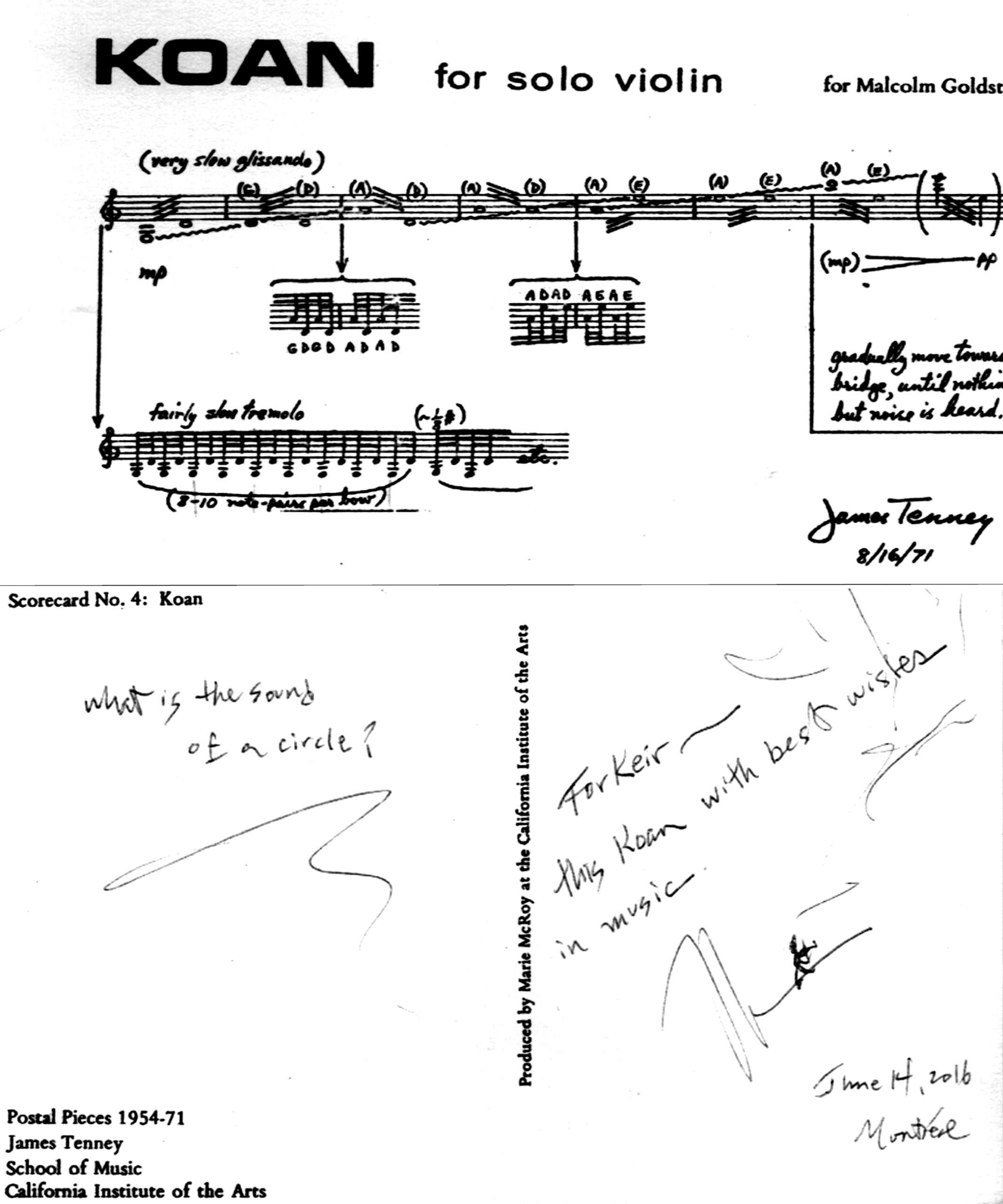
Figure 1 and b: Koan by James Tenny. a) Scan of a postcard to Keir by Malcolm Goldstein, b) other side of the postcard, with Malcom’s writing. © James Tenny.
Bobbi: That statement reminds me of the time we put on ASOE at UNC [Carolina Performing Arts at University of North Carolina Chapel Hill]. I was pregnant, and Ariel [Friedman] did my part. Going into it I had so many doubts about how separable the piece was from my performance, but watching it from the outside, it almost felt like the piece itself was more whole for having another person bring herself into it.
As I’ve begun choreographing larger pieces I’ve become more comfortable stepping outside of my work. But that comfort only comes from having the time and process to build trust and context with dancers. People make a piece work; and that’s where I agree with Malcolm. Abstracting a score from the people who’ve made it—if it’s done without care it can come close to appropriating someone’s personal movement as your own.
Keir: There’s something about the immediacy of your movement-making that’s very foreign in the contemporary world of classical music. As classical musicians we inherit nineteenth- and twentieth-century musical discourses, for example, in which it was very common to discuss performance as the faithful reproduction of composers’ musical works and ideas.6 Theodor Adorno’s monograph describes performance as the reproduction of the musical work, facilitated by the historical abstraction of notation.7 But according to Adorno, even within this history of progressive abstraction, some trace of the body’s gestural, impulsive reflexes still endures, playing an operative role in interpretation.
Malcolm’s statement about the “chasm between” similarly refers to the distance between his contemporary classical musicians and the historical music they interpreted—a distance that he saw as a symptom of societal fragmentation. It was partly geographical, partly historical/cultural: he was looking at the classical establishment in the States at the time and wondering why they were continually replaying canonical European literature, while he was working with experimental composers and improvisers in NYC, at Columbia, Judson, or in Sheffield, VT. For him, creating music came very much from reflexive, impulsive, and gestural motion—an improvisatory practice that to some degree remains illegible to the tastes and techniques cultivated in classical music.
Bobbi: But I think that whether you’re inside or outside a piece, or a culture, you always have a fragmented picture. Even when you make all of your own movement, or direct others from outside a piece, you’re playing but one part.
Keir: Perhaps contra Malcolm’s desire for restoring “wholeness,” the effort of “missing” was always about making visible the vulnerability that comes with feeling apart. I’ve always seen the difficult shapes that you hold in “missing” as a physical manifestation of the affective labor involved in maintaining relationships at a distance.
Bobbi: Absolutely. At the time I first started making the earliest, solo versions of ASOE, I had just left the Batsheva Dance Company in Israel, my now-husband, and what had been my home. I danced for Batsheva for ten years—I had started there when I was twenty-one. “Missing” was my attempt to express the effort of this physical and emotional displacement in my body—in all the shakes and quavers and falls that happen when I move through these positions. It wasn’t just missing others; it was also missing a sense of oneself—who I was or continued to be in this moment of transition. And when we’ve come back to the piece after I gave birth, missing those muscles that had been cut in the cesarean section—it made this section of ASOE that much harder, and more visible.
Part 2: The Role of Improvisation (“lifting”)
What does improvisation ask of the performer
that is so different from printed, through-
composed pieces of music?
… perhaps: “Who are you?”;
“How do you think or feel about this moment/sound?”
Malcolm Goldstein, The Politics of Improvisation8
Keir: The experience of working with Malcolm was revelatory, insofar as he had managed to uncouple his movement from conventional practices in an incredibly rich and expressive way. Reading accounts of him taking part as a dancer in Judson, reminds me of participating in your own movement workshops and warm-ups. When I’m in that world, my whole body feels engaged as an expressive agent—I become aware of parts of me that get somewhat muted by inherited logics of instrumental pedagogy. I had certain teachers and coaches, for example, who would criticize aspects of my movement that weren’t directly related to the act of playing the notated score, as though our bodies were only there to serve some preordained ideal of sound. Physical movement was always a way for me to more viscerally experience the music I was playing, and working with you reminded me of how much I had consciously silenced it.
Bobbi: In the context of building movement, improvisation has always been fundamental, since it marks something individual about the person. It’s their way of moving in the world—and that’s exactly what I want them to bring to any creative process. On the other hand, it’s not necessarily a solution—an individual’s improvisatory practice can be easily used or appropriated. There has to be so much care taken in a choreographic process that involves asking questions of your artists, unlocking their personal sounds and movements, and then weaving them into a larger piece. And there are all sorts of limitations around improvisation in this context: the concept of the piece, its dramatic world, your relationship with other characters.
Keir: That’s why I feel somewhat ambivalent about Malcolm’s portrayal of improvisation as a way back to a holistic musicianship. He posits improvisation as a way to achieve wholeness in a fragmented society, but there’s no detailed accounting of the way in which improvisation is mediated in the context of groups, or by a collective historical culture. This idea of getting to “you”—to the un-mediated subject or sound—still runs the risk of reproducing structuring ideologies of European classical culture. In Paris Conservatoire pedagogy, for example, there was a whole lot of rhetoric around finding one’s individual sound, voice, and style, while also serving an institutional paradigm that quite literally took creative agency out of performers’ hands.9
In George Lewis’ article, “Improvised Music After 1950: Afrological and Eurological Perspectives,” he quotes Malcolm: “Who are you? How do you think or feel about this moment/sound?” next to Charlie Parker: “‘Music is your own experience, your thoughts, your wisdom. If you don’t live it, it won’t come out of your horn.’ The clear implication is that what you do live does come out of your horn.”10 This tenet of Lewis’s “Afrological” music-making—that you are “‘telling your own story’”11—is certainly practiced by Malcolm (as suggested by Lewis); and it’s an important counter to claims of autonomy for the musical works and sounds made by modernist Euro-logics. There’s a long history of erasing the lived experience of performing bodies in European music—a history which culminates in claims of absolute music, musical structuralism, and the weird and tortured relationships many classically-trained musicians have with their bodies (i.e. the “chasm” that Malcolm refers to).
At the same time, while finding your own sound is really a cathartic experience, my sense throughout making ASOE was that we were as much attending to our own stories as we were to the cultural and social contexts around us: inherited understandings of classical order, disciplinary pedagogies, and cultures of ensembles or dance groups revolving around dominating personalities. In order to make our own labors seen and heard, we had to think through the ways in which they were controlled and mediated.
Bobbi: Done right, being on stage can give your actions more attention and visibility, but there is so much life around that moment on stage that enables it—buying the plant for the last section, “taking care”; renting the Airbnb; feeding your artists; buying the sandbags; finding sand with the right consistency. And that’s only the work that happens in the weeks leading up to the performance. I can imagine that having an authoritative score, and a long history of interpreting it, could feel like a really secure thing to keep your art going. But you’re right that there’s a lot of space between the magic of something that falls into place against all odds and a well-oiled machine that you play your designated role within.
In ASOE, I wanted to put the work of staging next to the work you normally see on stage. And by staging I mean not only the logistics of putting the show together, but the emotional expenses: the precarity of needing the stage, personally and professionally; the lost-ness of finding your way back to it; the feeling of not knowing how people around you manage to be so at ease (seemingly) in their daily lives.
The effort of “lifting”—the second section of ASOE—was perhaps the clearest physical representation of the feeling of this labor. I’m hoisting my arms up and then down again, until I don’t know which direction I’m going anymore. The disorientation accompanying this movement captures something of this feeling I have of casting off my movement all around me, with no appreciation or sense of it landing or achieving.
Keir: One of your early questions for me as we began working towards this section was, “what does lifting look like for you, with the violin?” This was a moment in the piece for me to explore a musical action that wasn’t mediated by the reproduction of a pre-existing score or pedagogical procedure. If your lifting was representing intense labor removed from a recognizable task or outcome, mine also came detached from conventions of patronized music-making. I began with this gesture of just lifting the bow, listening to the rhythms and speeds it brought out of my body. It was more staged than the “pedestrian movement” that Malcolm explored with Judson Dance,12 but there was a similar feeling of putting a spotlight on something before or around the actual act of sounding the instrument. There was also a similar feeling of rhapsodic re-discovery in this disorientation from the instrument, which Malcolm describes: “Touch releasing things into motion; gesture realized/resonances of texture becoming song. (Music: the process of living, sound.) […] An overflowing of myself in space.”13 This was where I most closely experienced the feeling of “freeing” myself from the classical understanding of the body as a kind of mechanism for the transmission of the composer’s ideas and spirit.
At the same time, I also knew that I was orienting these improvisations in reference to the kinds of physicality you followed in your own “lifting.” That is to say, I wasn’t exploring musical ideas or figurations—there was no system of “language types” like those structuring the improvisations of Anthony Braxton.14 Though I was listening to solos by Braxton and Roscoe Mitchell while working up this section, to get a sense of how they created spaces and movement with a primarily monophonic instrument. I started from a corporeal place: different zones of engagement with the instrument that moved my body in different ways. For example, there were multiple speeds of lifting the bow, sounding it through the air; there was a gestural action of digging and ripping from the low strings, which could bleed into a kind of false-fingering gesture on the high strings, or these shuddering movements of the right arm that would draw my whole body down into the instrument.
Bobbi: Sometimes I feel your improvisations here—and elsewhere in our work—wanting to become more “musical,” in the sense of moving towards understandings of form, proportion, or melody. In these cases I’ve always felt that it actually takes away from the rawness of seeing you move like this with the instrument. Because it’s something that goes against your training, it really represents something “outside” the circumscribed space of the musician in dance, whose body is normally obscured, or entirely absent.

Figure 2: Image from “lifting”; taken at the Invisible Dog in Brooklyn, NY, 2016. © Maria Baranova
Part 3: Bach and Westhoff (“drawing a line,” “pleasure,” “not knowing”)
Keir: I find that Malcolm’s writing posits certain dichotomies: the European establishment versus American composer-performers; historical canons versus experimental practices; orchestral players versus improvisers. There’s language noting a “European approach” to violin pedagogy,15 as opposed to revelatory experiences in which Malcolm says things like “I heard the violin.”16 For him, the way out of the system of un-thinking musical reproduction is described as exceptional acts of listening—to the sound itself, or to the particulars of the sound-making subject (“who are you?”)—in a way that certainly feels cathartic and necessary for any musician seeking some way out of the most stringent orthodoxies of the classical discipline. Still, I find that this characterization of an unmediated individualism of the player misses a more detailed parsing of all the cultural histories that articulate that self.
Bobbi: When I first saw Malcolm moving with the violin, there was a freeness there that was incredibly expressive and emotional. He had uncoupled the instrument from his body in a way that you don’t see with most classical musicians. We wanted to put that freeness in the same space as a really personal interpretation of Bach, or of Westhoff. To acknowledge all the emotions in that music. Because how you hear and play Bach is the result of many individual lives experiencing the same pieces.
Keir: In ASOE, I draw on solo violin partitas by J.S. Bach and Johann Paul von Westhoff. These partitas consist of dance movements—the “Allemande,” “Courante,” “Sarabande,” and “Gigue”—which emerge from a musical tradition of violinists serving as dance-masters.17 We are calling upon the historical image of the violinist as a figure keeping rhythm and liveliness in a ballroom, but in a way that appears to fly in the face of classical music’s contemporary cultural identity as an aspirational, bourgeois endeavor.
Bobbi: Which is to say, you wouldn’t go to a classical concert held in an industrial warehouse to watch some woman mounting a sandbag.
Although it really wasn’t my intention to make fun of classical music at all. Just in the same way that the effort of “pleasure” [section five of ASOE] was completely earnest, contrary to my somewhat flippant description just now. In this section, you’re playing the “Sarabande-Double” from Bach’s first B minor Partita, while I carry a dozen fifty-pound sandbags from one end of the stage to the other. Once I’ve moved the last one, I mount it and begin to pleasure myself on it. Given how often choreographers depict female sexuality in dance, I wanted to just show—this is what pleasure looks like. What it does to a body. What a body has to do to achieve it.
In a conversation I had with the dance critic/scholar Sima Belmar, she mentioned that this section was significant to her for countering some popularly-held beliefs: that the depiction of sexuality is more “proper” than the taking of proper pleasure; or that a labor that one takes pleasure in is no longer labor.18
This is something that links seeking pleasure and making art. Yes, pleasure is this private act with great reward, but it also takes work when done with care and attention. A lot of critics assumed the climax was fake, but I get there every time. The effort of pleasure is not done for the sake of thumbing a nose or anything; it’s also not simply some generic symbol of female empowerment. The point of performing the effort is to really do the work, and that means it’s neither self-indulgent nor a flippant representation of the action.
Keir: We chose the Bach B minor Partita [the “Sarabande” and “Sarabande-Double”] for the simple reason that I had it well in my memory and fingers—though its historical relation to dance also presented a sort of justification. Of course, the justification we needed for any of this only came from trying it, and seeing how the music might shape these sections. I remember when you told me the tasks that Bach would complement—drawing a line of sand, moving the sandbags, mounting a sandbag—I was a bit unsure, but also intrigued. It only felt right after several performances, as it became a sort of ritual whose meaning we weren’t trying too hard to curate.
Bobbi: Of course not. I never want to over-determine the world of a piece—the audience, and the performers, need to have the freedom within it to find their own stories.
Keir: That being said, I haven’t stopped trying to interpret it for myself. I keep coming back to the fact that Bach looms large as this composer whose music was seen as operating within the realm of the intellectual/spiritual. As Bach’s music was revived in the nineteenth century, it became imbued with the idealism of the era, to the point that the violinists teaching and physically playing his works were describing the music as transcending their bodies entirely.19 This is a big part of the story of how performers and their bodies—in the classical tradition—get written out of score- and composer-centric histories and aesthetic theories of European art music.
Bobbi: I choreographed your performance of the Bach “Chaconne” for later pieces that we worked on together [With Care and Lost Mountain]. I remember hearing so many stories within the piece. But whereas ASOE really focused on your physicality as a player, those later pieces were more narratively driven. Something about the movement and architecture of the “Chaconne” does feel like it moves into a world beyond the body playing it.
Keir: Absolutely. And the process of watching you build movement on the “Chaconne” really reinforced how narrative that music is. The quartet version of “Chaconne,” which appears both in Lost Mountain and Caldera, turns the piece into two dialogues between two coupled partners. There’s this dramatic moment in Lost Mountain, right at the transition to the D major section of the “Chaconne,” in which you suddenly notice Or [Schraiber], run to him and fall into his arms. This transition is one of only two harmonic modulations in the piece and, given the fact that the whole movement is in variation form, it becomes this really significant moment that is customarily marked by a sudden, affecting shift in timbre. But actually seeing musical shifts, like this one, play out in relationships between people, brings more color and life to this harmonic, structural narrative. It’s amazing to see the “Chaconne,” a dance movement which Bach abstracts into this grand formal structure, provide the armature for this intimate story told through you and Or, Ariel [Friedman] and Yiannis [Logothetis].

Figure 3: “Not Knowing”; taken at the Invisible Dog in Brooklyn, NY, 2016. © Maria Baranova
Bobbi: I think that performing Westhoff [Partita in D minor] with you in ASOE prepared the grounds for that later collaboration with the “Chaconne.” This section, the effort of “not knowing,” was about trying to catch each other’s meaning. Often times I would start by just standing there and listening, both to your body and the music. I always wanted more gestural information from you because it was something that I could pick up and transmit to the audience.
Keir: This section staged a collision of practices. There’s the context of Westhoff’s composition, which represents a nascent practice of solo violin concert music—as opposed to dance music. But then there’s Malcolm’s world of “gesture realized/resonances of texture becoming”; this unlearning of classical pedagogy, and a turn towards bodily impulse as the unlocking of a more personal “song.” I felt pulled between these worlds, until I realized that actually this tension creates a third term. That is, the choreographed movements of playing repertoire, like the Westhoff, create their own impulsive reverberations through the body. And given how much documented attention has been given to the bodily discipline of the violinist since the turn of the eighteenth century, we have this resource of bodily thinking, which might be mobilized in expressive ways. That is, subtly extending or exaggerating the choreographed gestures of violin-playing created some more common terrain between the two of us—a kind of rhythmic and affective flow that traveled between the music and our movement.
Part 4: Effort and Ecology (“taking care”)
Listening to music, we unconsciously experiment with being other. Music creates a multitude of virtual worlds, or virtual configurations of space and time, that listeners can vicariously experience as alternative forms of embodiment, affect, spirit, thought, or some combination thereof.
Holly Watkins, “On Not Letting Sounds Be Themselves”20
Bobbi: In the last section of the piece, the effort of “taking care,” I am holding a plant to my chest. I am holding the plant against me and holding myself up off the ground. The strain of holding myself up makes the plant tremble. And my voice also trembles when I begin to hum with you.
Keir: I’m playing Malcolm’s Gentle Rain Preceding Mushrooms (1992), a piece that he wrote in memoriam for John Cage after he passed. The first four notes of the piece, sounded and then held over three strings for an extended period, spell C-A-G-E. After these notes are held, Malcolm instructs the violinist to drop and ricochet the bow across the strings, playing these four notes in different configurations. Eventually we begin humming—first you, and then me as well.
Bobbi: This is the first time in the piece when we really sit together, without moving. It’s also the first time that either of us uses our voice. People love interpreting this image. Does the dirt represent death, burial? Does the plant represent re-birth?
Keir: What strikes me, more than the symbolism of the image, is how much goes into cultivating it. Every time we do ASOE you spend hours traveling to different shops to find the perfect plant, with just the right amount of color, height, and sprawl.
The plant is itself an expressive instrument that echoes and projects your trembling, and your singing. Just as, in Gentle Rain, my breath is the impetus that sends the bow bouncing, connecting these somewhat uncontrolled movements to my exhalation. It mirrors the way in which the soil clumps and breaks across your chest. The plant’s movement is fused with yours, but its materials retain their own patterns of movement and dispersal.
Bobbi: Actually, so often what motivates my choreography is this idea of identifying as something totally foreign to myself: a mountain, an arrow, an anchor, a long dirt road. Each thing has its own movement, its own inner speed and momentum. Just this exercise of identifying with animate and inanimate things whose experience I’ll never have creates so many questions: How does it move? What is the sensation of its growth? How does it engage our eyes, bodies, and imaginations?
Keir: The relative stasis of this last section of ASOE draws attention to the connections between our bodies, instruments, and voices; the movement of my bow, connected to my breath, and to my humming (as per Malcolm’s score). This singing is connected to your singing, which is connected to the effort of holding yourself up. And all the resulting trembles are heard both in your breath and in the movement of the plant and soil on your chest.
This cycle of empathic becoming, which you describe as a fundamental choreographic method, really underlines the commonalities between music and movement. Holly Watkins describes music as a medium that “spurs to imagine creating, being, or undergoing an almost endless variety of dynamic movement that […] need not be heard as expressions of human subjectivity or embodiment.”21 Rather than pointing to an exceptional act of listening that reveals the individual subject, Watkins is describing the “dynamic movements” of music, which allow us to “experiment with being ither” than human.
I read Watkins’ attention to music’s empathic potentials as a strategy to expand our ability to imagine the present climate crisis. I don’t think that we’re making such a direct argument, but part of the work of ASOE was that it forged connections I hadn’t previously seen in a lifetime of playing the violin: connections between instrumental practice and the study of affective and intellectual labor, the representation of sexuality and the effortful pursuit of pleasure, the elements of our work that never escape the cultural contexts of our histories, or the physical constraints of our bodies in the world. Thinking through my culture and craft continually nudges my personal work closer to the paralyzing precariousness of this existential moment, and has allowed me to keep making in spite of it, in relation to it.
Bobbi: In this section, “taking care,” the world of the piece suddenly becomes much smaller, more intimate. It allows the audience to focus on the movement of the plant and our voices. You were talking earlier about the idea of performance as the global reproduction of revered works, and I see it too in the industry emphasis on internationalism, constant touring, being all over for everyone. I think this moment, with Malcolm’s elegy for his friend, is the opposite of that. It’s about paying attention to what you have in front of you, mourning what you’ve lost, growing what you can. Finding the rituals that keep you going so that you can be in a position to give and take care.
This was always the aim in ASOE. To find the basic tasks to make our labor visible. Doing the tasks is difficult, but if they are clear you don’t have to worry about making them more than what they are. Over the last five years they’ve become a measure of personal growth and decay. There’s something beautiful about noticing what becomes harder for your body. The parts of yourself that you can no longer control, that were there but now are missing. But in that missing, in that loss, there is the potential for new growth.
Conclusion
This paper/dialogue points to another labor that is traditionally thought to lie outside the space of performance, and yet plays an outsized role in creative work. This is the labor of research and reflection: the acquisition and synthesis of knowledge that may or may not be articulated in scholarly terms. Underlying any artist’s approach to the act of making music or movement is a set of philosophical precepts that often go unnoticed and unquestioned. What we perform in the space of our dialogue is the work of excavating these precepts, holding them at a distance, and deciding what parts of them to keep, and what to shed.
The process of making and performing ASOE allowed me (Keir) to explore common misgivings about inherited tenets of the classical discipline: its preoccupation with historical genius, its work and score-centeredness, its uncompromising directions, structures, and hierarchies. Also, its erasure of the world outside of it—a neglect that is baked into the inherited wisdom of classical music’s historical objectivity. Joining the craft of violin-playing with Bobbi’s study on effort helped me to approach sound as the extension and reverberation of extramusical considerations, rather than as the outcome of a predetermined goal. Still, the studied craft of playing an instrument is precisely what allows me to engage a collective history built by generations of other bodies and minds. It is its own effortful practice, the labor and pleasure of which grounds me in the work of people before and around me.
In this essay, we have endeavored to show how dialogical reflection enriches opportunities for creative collaboration across our disciplines. Beyond this, we have found a productive dialectic between personal experience and specific modes of cultural-historical research. While we seek to better understand the contingencies of each other’s lives and labors, we also understand the ways in which they are grounded in contexts beyond our individual experience. Our hope is that this synthesis of craft, bodily knowledge, and scholarly research, helps us speak more personally and truthfully in relation to our present cultures and ecologies.
-
Special thanks to Sima Belmar, Ay Cimini, and Celeste Oram for their encouraging, insightful, and discerning commentary on this essay in its many stages; to Malcolm Goldstein and Marta Miller for their generous guidance in the making of ASOE; to Matthew Aucoin, Jen Chen, Zack Winokur, and AMOC for our continuing work together.↩︎
-
Lee Rothfarb and Christoph Landerer, Eduard Hanslick’s “On the Musically Beautiful”: A New Translation (Oxford: Oxford University Press, 2018).↩︎
-
Hermann von Helmholtz describes combination and difference tones as such: “These tones are heard whenever two musical tones of different pitches are sounded together, loudly and continuously. The pitch of a combinational tone is generally different from that of either of the generating tones, or of their harmonic upper partials.” Hermann Helmholtz, On The Sensations of Tone, trans. Alexander J. Ellis (New York: Dover Publications, 1954), 152-3.↩︎
-
Koan was one of Tenney’s postal pieces, which he wrote on postcards and mailed to friends. Frank J. Oteri, “James Tenney: Postcards from the Edge,” in New Music Box, accessed 2 May 2021, https://nmbx.newmusicusa.org/james-tenney-postcards-from-the-edge/.↩︎
-
Malcolm Goldstein, “Towards a Whole Musician in a Fragmented Society,” in I.S.A.M. Newsletter XII, no. 2 (May 1983): 6.↩︎
-
In his book Beyond the Score, musicologist Nicholas Cook takes issue with music theorists Adorno and Schenker, who base their analytical methods on a common understanding of performance as the reproduction of musical works and structures; Nicholas Cook, Beyond the Score (Oxford: Oxford University Press, 2013), 89.↩︎
-
Theodor W. Adorno, Towards a Theory of Musical Reproduction: Notes, a Draft and Two Schemata, trans. Weiland Honban, ed. Henri Lonitz (New York: Wiley, 2014), 168.↩︎
-
Malcolm Goldstein, “The Politics of Improvisation,” in Perspectives of New Music 21, no. 1/2 (Autumn 1982 – Summer 1983): 89.↩︎
-
Kailan Rubinoff, “Toward a Revolutionary Model of Music Pedagogy,” in Journal of Musicology 34, no. 4 (2017): 473-514.↩︎
-
George Lewis, “Improvised Music After 1950: Afrological and Eurological Perspectives,” in Black Music Research Journal 22 (2002): 215-46, 243.↩︎
-
Ibid., 241.↩︎
-
Jay Arms, The Music of Malcolm Goldstein (master thesis, University of California, Santa Cruz, 2012), 12.↩︎
-
Arms quoting LP jacket of Malcolm Goldstein’s Soundings for Solo Violin (1980); Arms, The Music of Malcolm Goldstein, 40.↩︎
-
Mike Heffley, “The Solo Music’s Axis (Tradition/Innovation),” in The Music of Anthony Braxton (Westport and London: Greenwood Press, 1996), 212-57.↩︎
-
Arms, The Music of Malcolm Goldstein, 38.↩︎
-
Arms quoting interview with Dan Warburton in the Paris Transatlantic (April 2006); Arms, The Music of Malcolm Goldstein, 38.↩︎
-
David D. Boyden, The History of Violin Playing from Its Origins to 1761 and Its Relationship to the Violin and Violin Music (Oxford: Oxford University Press, 1990).↩︎
-
Sima Belmar and Bobbi Jene Smith, “Dance in Conversation: Bobbi Jene Smith with Sima Belmar,” in The Brooklyn Rail (February 2019), accessed 2 May 2021, https://brooklynrail.org/2019/02/dance/BOBBI-JENE-SMITH-with-Sima-Belmar.↩︎
-
For example, the well-known twentieth-century violin pedagogue, Leopold Auer writes: “It has been said and truly that these Sonatas, ‘notably in the movements in polyphonic style, represent the victory of the spirit over material limitations,’ and this applies especially to the ‘Ciaconna.’” Leopold Auer, Violin Master Works and Their Interpretation (New York: Carl Fischer, 1925), 21.↩︎
-
Holly Watkins, “On Not Letting Sounds Be Themselves,” in CR: The New Centennial Review 18, no. 2 (Fall 2018): 76.↩︎
-
Ibid.↩︎