Fabian Czolbe 
How to cite
How to cite
Abstract
Abstract
The moving audience is becoming increasingly valuable in contemporary music theater. This paper presents an analytical approach that examines different pieces to discuss the audience’s movement in music theater performances. By heuristically questioning the performance experience and the artistic participants, such as directors or composers, a functional differentiation emerged. Three perceptual models of the moving audience can be described: an installative, a stationary, and a performative one.
Each of these models presupposes a distinct space of action for the audience and the artistic concept. This also allows alternative narrative forms that do not follow a linear structure. This paper should also be seen as a basis for the development of analytical tools of this dimension in the context of contemporary music theater. This requires, among others, a critical interweaving of aspects of perception in movement and narrative concepts.
Outline
Outline

Introduction or Introducing the Self-Reliant Audience
The audience at concerts, staged music, or musical theater is no longer tied to a fixed seat. For more than two centuries, and in a large number of established bourgeois concert halls, the audience has cultivated a seated mode of perceiving music. But there were and are concerts where you can stand, walk around, lie down, or even swim. Today one finds artists who invite the audience to wander through public space, to search for sounding objects, or to explore their own perception as well as certain elements from different angles and perspectives. The following text questions the ‘moving’ or rather the ‘moved’ audience in the literal sense. It is not about emotions or cognitive stimuli, but about the physicality of the audience on a perceptual level. What does it mean for a participant to move through the performance space? How does it affect their reception? And finally, on what level can composers reflect the choreography of the audience in their work?
In 2014 Julia H. Schröder already points out in the book Zur Position der Musikhörenden that specific perception situations have been established today and are reflected more and more by composers, ensembles and concert dramaturges of contemporary music. She does not approach the question primarily from the perspective of concert pedagogy or music education, but instead focusses on the aesthetic experience from the perspective of the listener. In addition to the perception situation in the context of concert halls, combined with frontal, mostly fixed listening positions, she discusses open stationary formats that include a standing, sitting or lying audience. Her approach examines and presents concepts including movement in artistic or public space for both the artists and the audience. Schröder therefore speaks rightly of the ‘moved listener’ (“Bewegte Zuhörer”) and emphasizes emphatically that it is not initially about being emotionally and cognitively ‘moved’, but rather about the physicality of the recipient’s physical movement before, after or while listening.1 It becomes clear that the ‘mode of experience in motion’ must be understood as a question of shared attention in perception2 and can also become an important aesthetic dimension of the work or concert situation. Schröder convincingly demonstrates that theatrical and performative elements of post-dramatic theater concepts3 therefore increasingly form the basis for music and sound art experiences today.4
Since contemporary music theater in particular repeatedly reveals points of contact and overlaps between concert, theater, installation, performance, etc., similar questions arise: To what extent is the movement of the audience considered as part of the compositional process? In which way can the movement be a formative part of the narrative structure? How can the movement shift the perception during attending the performance?
This chapter discusses the aesthetic significance of the moving audience for contemporary music theater using a number of case studies.5 While music theater still primarily takes place on stage or within a stage arrangement, one increasingly finds concepts that involve the audience in less rigid reception positions. To overcome these inflexible positions, one can either incorporate the concept of co-composing the moving audience within the creative process or one can integrate a directed choreography of the audience in the performance of the finished piece. Both approaches assign fundamental importance to the perspective of the audience reception. This text discusses the value of audience reception for the compositional process. It emphasizes the importance of understanding reception as an integral part of the work rather than just an aesthetic consideration. The distinction between these two concepts is significant: while the former approach views the audience’s perception as a means to establish concrete perspectives on the finished piece, the latter approach considers the audience as an active participant in shaping a specific work. The first approach links audience performance directly to the structure of the piece, generating musical peculiarities from the close reading of the interweaving of reception and specific sounding gestures. The second approach is subordinate and positions perception in a certain way. It follows an analysis of the aesthetic configuration of the completed piece to identify the most valuable reception situation to support or contradict the sounding narrative. This could be understood as a dramatized approach by the artist or a third party.
Initiated by this functional differentiation,6 three models can be observed that allow for particular reception situations: these can be installative models on the one hand, stationary models on the other, and finally performative models. As my research is in its early stages of exploring this compositional dimension, the terms used should be understood as working definitions. The models help to draw a line within the heterogeneous field of moving audiences in contemporary music theater. The following reflections and theoretical propositions are methodologically based on the analysis of my own performance experiences, supported by notes, working materials, and conversations with those involved. Therefore, my remarks can be understood as a taxonomic approach to this field of research and further reflections.
The Audience in Music Theater Installations
In the second half of the twentieth century, the visual arts broadened their terminological horizons from spatial perception in the context of sculpture to discuss a genre called installation art. A ‘new genre,’ of course, with roots in the idea of multimodal and immersive theater in ancient Greece, the Gesamtkunstwerk of Richard Wagner, the ready-mades of Marcel Duchamp, the spatial works of Kurt Schwitters, the experimental art forms of the Japanese Gutai Art Association, and finally Allan Kaprow’s happenings. In some cases, it could be called music theater, but these were intermedial and site-specific movements in the arts, not opera or music theater. Regardless of the historiographical terminology, two fundamental aspects of aesthetics become clear: the spatial expansion of art and the associated attitude of perception. Shortly after or perhaps at the same time as the concept of the concert installation in music, the concept of the installation found its way into the practice of music theater. The interweaving of spatial characteristics with the staged scene forms a dramatized, site-specific configuration in this context that invites the audience member to find his or her own way through the music theater performance.
In the following I will discuss different forms of music theater installations on the basis of Fidelio (2020) by the opera company NOVOFLOT7 and Land (Stadt Fluss) (2018) by Daniel Kötter and Hannes Seidl8. On the one hand you can see a repetitive music theater configuration that allows the visitor to enter and leave the installation at any time. On the other hand there is an continuously structured piece in whose spatial arrangement the participating audience can also move freely. Thus, here is a kind of a loop that can be entered at different points or experienced several times and there is a continuous piece that lasts several hours and encourages an individual positioning and moving while the performance.
In the first part of the trilogy Wir sind so frei #1–#3, a reflection on 250 years of the discursive effects of a Beethoven’s oeuvre on the art of the present and the present of art, NOVOFLOT performs Fidelio as an ‘echo of an opera of freedom’. A trumpet, sound installation, keyboard instrument, voices, performer, objects, and video appear as a performance in an art exhibition hall to mark a field of acoustic sources and artifacts. The piece with its spatial staging offers many approaches of various political, philosophical, and artistic revolutions which appear as long-forgotten attributes of our cultural history. The trumpet signal for example, once the salutary musicalized message of the supposed happy ending, becomes the cornerstone of an experimental arrangement in the museum’s white cube with an ensemble that examines the utopian potential of this opera as well as of Beethoven’s ‘music-dramaturgical’ elements within the creative process of that piece. The protagonists of the opera are also heard as voices from the beyond, embedded in a kaleidoscope of sound, Beethoven’s music and new compositions.
The exhibition’s concept, direction, and composition successfully transform the sterile atmosphere of the space with scenic and installation elements. The visitor is taken on a journey through an installative cemetery of failed struggles for freedom, followed by a liberation scene complete with trumpet signals, aria fragments, and choreographed musicians. The great themes of love, trust, freedom, and visionary models of society are the table. NOVOFLOT presents the question of freedom, which has accompanied world events in revolutions right up to the present day, as a freely accessible loop in this installation-based music theater. This experimental arrangement makes it possible within the music theater to experience scenes or entire runs several times from different perspectives. Inevitably, the question arises as to what holds back individual characters, what drives scenes forward, or how sound energies accumulate before they erupt. The piece offers an aesthetic experience that enables a coexistence between visual, sound, music, and scene, leaving the audience free to decide for themselves. As a visitor, one may ask: Am I free? Where is my spatial and historical position? What shall I look at? Can I leave the performance and re-enter it at another time? What am I allowed to do here, and what outside this art space? The installation space allows the audience to experience a dynamic and interactive environment, which stimulates both physical and cognitive responses.
Sven Holm director of NOVOFLOT underlines the strong connection between the artistic questioning of concepts of freedom and the offered freedom to move and think in the installative music theater space. The moving audience is a part of the piece’s conception that arranges sounding and narrative objects in the space and uses the musicians to initialize an erratic dynamic of movement through the space to translate these moving dynamics to the audience. The audience here is driven by the dynamics of the performance as well as by their individual momentum.
Similarly, composer Hannes Seidl and director Daniel Kötter transform an outdoor space into an indoor space while exploring the fundamental question of ‘How do we want to live?’ through various theatrical experiences. The trilogy Stadt Land Fluss (2017-19) by Kötter and Seidl opens up different perceptual perspectives for the audience. While in Stadt it is the heterogeneous community that explores the installative arrangement on individual routes, visitors are released into the virtual reality of Fluss each on her/his own. Land explicitly seeks the communality of the rural commune, which one can experience both in the staged film and in the performance space—the stage acts here as a space where performers, musicians and audience temporarily live together. The audience embarks on a meadow between Frankfurt and Cologne for five hours. Kötter and Seidl take time to act in the time experience of the local commune: It seems as if there is a specific time configuration for working, making music, cooking, ramming piles, land seizure, thinking, and, above all, listening.
Even though there is a kind of libretto with fictional and real texts and stories on the subject of land, there is hardly any dialogue reference function apart from the signal-like marking of the five parts, each lasting just over an hour. The text displayed in the theater space as a handbook was not the starting point for the play, but rather the result of research into the place and its social, political and economic structures. It is not staged, but is merely available for the audience as freely available material. It remains open as to whether, when and how much of it the individual reads.
Land shifts the audience’s perspective away from the reference and exchange between the filmic and site-specific levels of action towards a continuity between the auditory-visual artifact and the live performance situation. For instance, the audience in the theater performance is seated on actual grass, which is also featured in the film. Musicians in both the theater and film interact with each other and continue musical gestures. Additionally, food and drink are provided for both the actors in the film and the audience in the theater (figure 1).
The time configuration in the film, according to Christian Grüny, “is synchronized with that of the performance.”9 For example, the video was shot at the same time as the performance takes place in the theater space—from 6 pm to 11 pm.10 The film shows an idyllic-looking scene of a kind of rural commune, in which living together seems to simply happen, but is repeatedly broken up by musical actions. These include various time markers such as the path in the film and on the theater meadow, which connects film and theater every hour like a clock hand; a tower clock that strikes every quarter of an hour; the brass band on the avenue every fifty minutes; fanfares every seventy-two minutes and the time regime of the light from day to night, which directly interweaves the film and theater space. The music is only predetermined to a limited extent, so often only short, repeated, sometimes quarter-tone motifs, fragments or merely intervals appear—it becomes atmospheric and gives the effect of pastoral sequence of a romantic symphony. Moreso, the openness of the concept and the composition allows a creative space for musical practices in the countryside, in the public space. It is therefore about making music and not about consuming a series of arias or musical numbers.
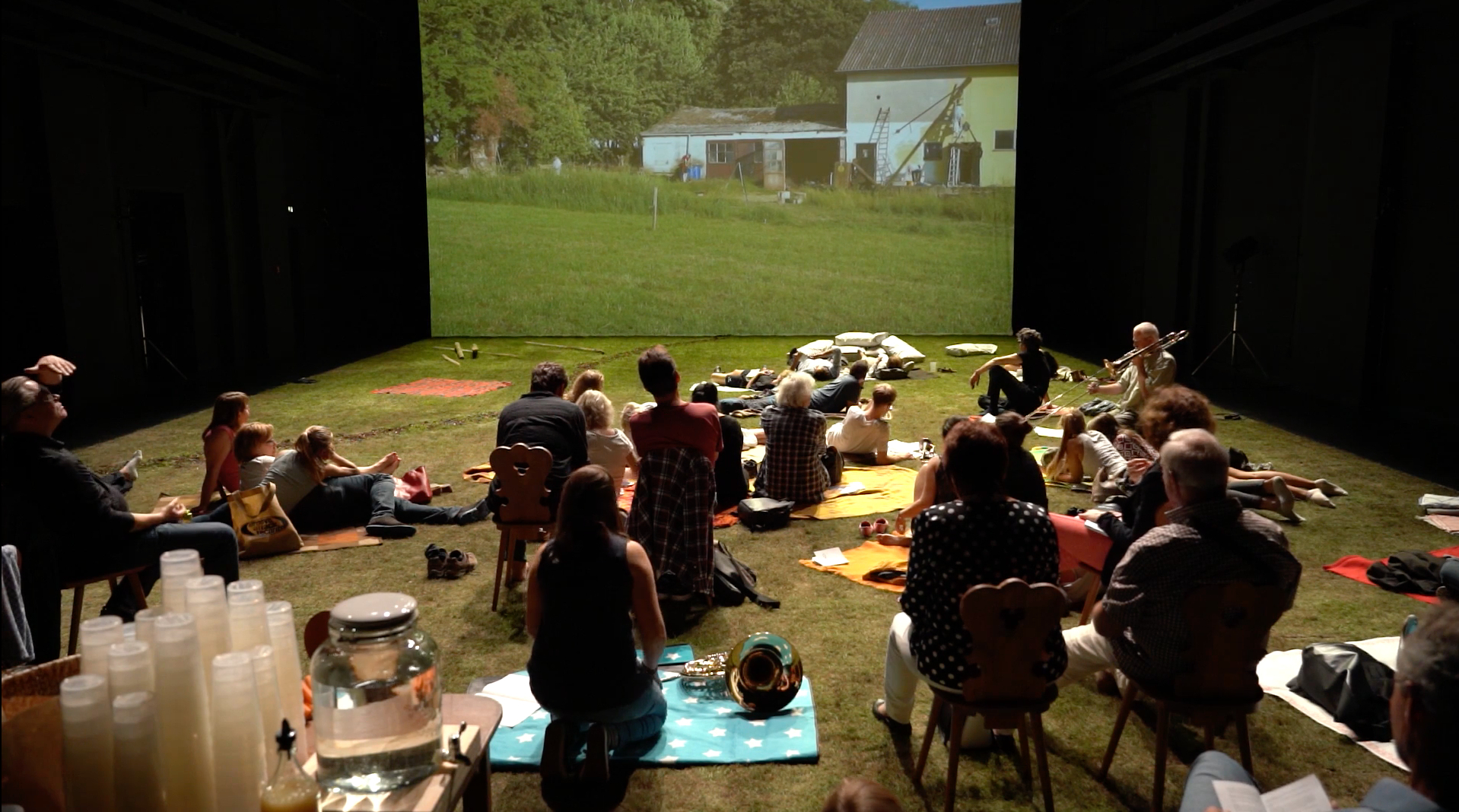
Figure 1: Video still from the trailer for Land (Stadt Fluss) (2018) by Daniel Kötter and Hannes Seidl. View of the performance space with audience, musicians, video, and a self-service stand on a lawn within the performance hall. © Daniel Kötter and Hannes Seidl
The auditory and visual aspects of the stage and film are intertwined. The cinematically extended meadow and space for movement create a physical experience for the audience. One can sit on the meadow or a picnic blanket, or stand, but it is important to avoid sitting in fixed rows of seats. Instead, the audience is encouraged to go to the table to get a drink or, later, a bowl of soup. It is also recommended to look for a different place on the meadow to gain a new perspective and a new space for action. One can leaf through the libretto and forget the filmic events until a musical fragment or a sound attracts one’s attention—the audience realizes the piece through itself, and unfolds the narrative of the evening, the narrative of the temporary community and perhaps an utopian draft of the initial question.
The corporeality of the movement in space, the actors in the film, and in the performance space, as well as the relationships between the participating individual and the rest of the audience through physical presence become part of the piece. At the same time, these marks nothing less than the central artistic and dramaturgical elements of this music theater piece. The moving audience undoubtedly creates its own horizon of perception. This means that when an artist creates an artistic situation that includes a moving audience, he/she should have thought about and dramatized this element of the piece’s perception. The installative model offers more autonomy to the audience, but at the same time requires an artistic concept that includes openness to different perspectives on the artwork. This raises the question of whether the dramaturgy is based on a strong or weak hierarchy of perspectives. It also raises the question of a teleological narrative in a music theater piece, or how to dramatize an open form. Finally, it goes without saying that the audience can move independently and is thus understood as an independent entity. However, this presupposes a music theater structure that has been dramaturgically shaped with the moving audience in mind.
Moving Audience Between Dramatized Arrangements
In contrast to works with installation character, such as those discussed above, works like Manos Tsangaris’ Beiläufige Stücke: Mauersegler (2013), François Sarhan’s Gestern und Morgen—Die Wahrheit über die Villa Elisabeth (2018), or THE WHALE WHALE SONG (2019) by the music theater collective Hauen und Stechen arrange a path of different ‘stations’ for a moving audience to explore. The audience must physically move along a dramatized line through the space. They are faced with a dramatized arrangement of situations or scenes characterized by and capable of creating a specific temporal configuration of perception.11
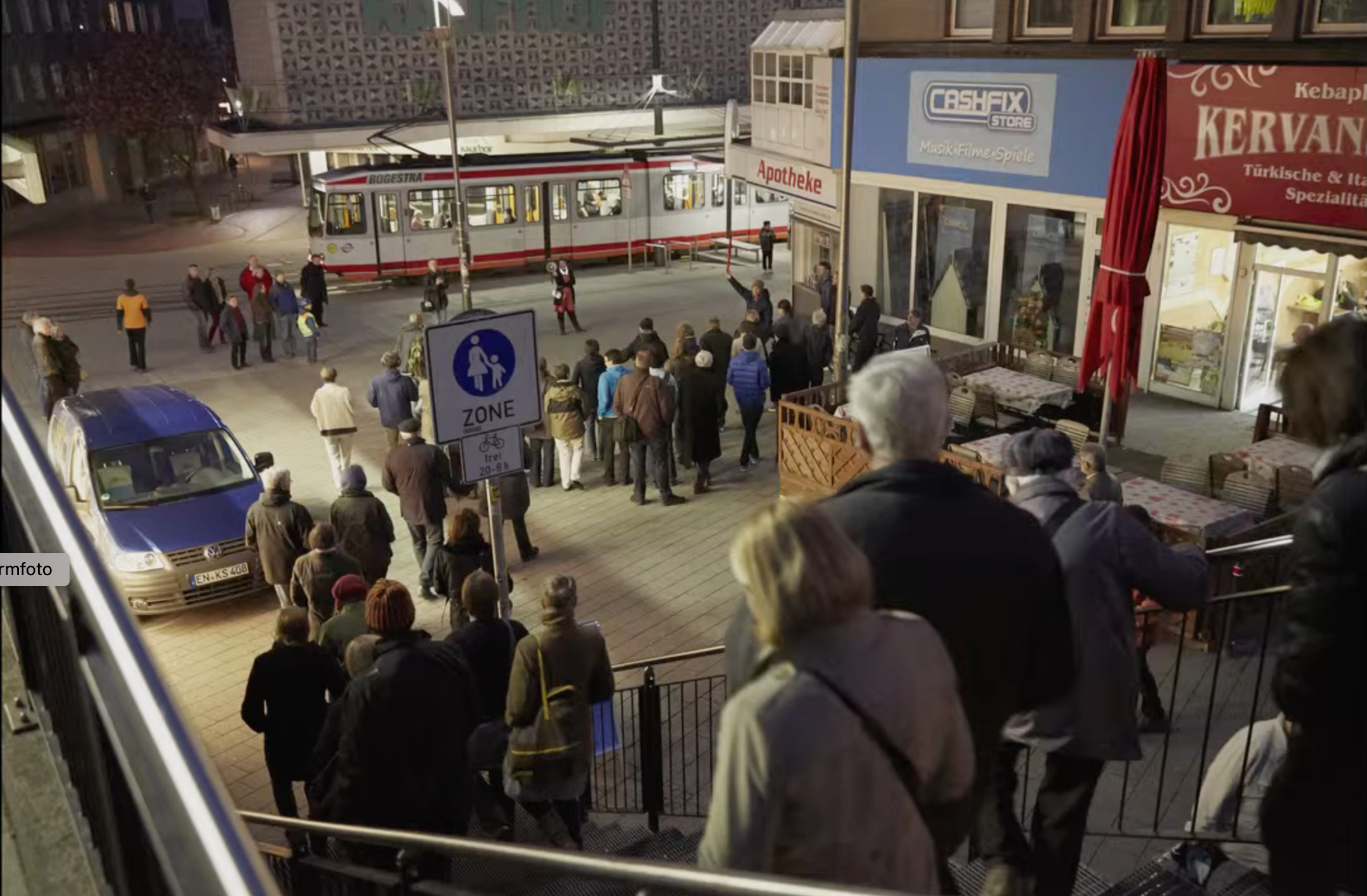
Figure 2: Video still from Beiläufige Stücke: Mauersegler (2013) by Manos Tsangaris. Transition 1. © Manos Tsangaris
Manos Tsangaris’ Mauersegler, for example, begins with a kind of peep-box stage for the audience. The stage projection depicts the city outside. Framing the partial view of the city initially creates a sense of manageability for the observer. From this position, as a spectator, one has a view of the entire theater stage. One can distance the self-perception of one’s own body by positioning the audience remotely above the stage. However, as the play progresses, this sense of safety and physical superiority may be challenged. The play then leads the audience outside with a choreography that is both sophisticated and well-planned (figure 2). It further leads into a small shop with a new framed view of what is happening outside the door. The new perspective is framed theatrically once again, but this time at eye level. The view from above, the distance, and the darkness of the auditorium have vanished, along with the possibility of recognizing everything. There are only limited perspectives now. It becomes evident in the next step when the audience is finally invited to go outside to a tram stop. Perception framing and distanced overview are completely lost. Each visitor must find an individual position to observe what is happening in the tram while also asserting themselves physically against the tram as a stage, the other spectators, and the city as an observer.
In Mauersegler Tsangaris juxtaposes the physicality of the audience with that of the theater space.12 This creates a reflection that results from the specific spatial and physical relationships, which are ultimately integrated into a music-theatrical process. The composer co-composes perception situations for the audience, seeking to create specific and occasionally unexpected music-theatrical situations for our perception to reflect upon.
The Whale Whale Song, a production by music theater collective Hauen und Stechen, explores whale stories from world history in a freely associative manner—including Richard Wagner’s ‘Wal-Küre’. Here, the changing relationship between the physical sensation of the audience and the theater space becomes a factor in the dramaturgy of the piece. The Volksbühne am Rosa-Luxemburg-Platz building serves as a performance space with various locations and spatial configurations. The theater’s presence is striking, engulfing the audience upon entry. The interior offers a sensory theatrical experience that aims to connect with the audience: The music theater collective is about “not just looking at the art, but being part of it” and taking the audience into it.13
As a tribute to the fading music of whales, The Whale Whale Song draws on sources from a wide variety of fields. For instance, the play utilizes stories from the biblical tale of Jonah, followed by Moby Dick and Pinocchio. The various narrative strands interconnect to create a network that spans the entire theater, from the foyer to the cloakrooms and cupboards to the stairwells and corridors. In doing so, Hauen und Stechen take the audience into the interior of the theater itself and allow excerpts of musical history to pass by in diverse places: Alongside improvised sounds and fairground music, there is classical opera repertoire (a Georg Friedrich Händel aria appears alongside Henry Purcell’s Cold Song, Debussy’s Clair de Lune and excerpts from Pelleas et Melissande as well as Richard Wagner’s Walküre), of course in an idiosyncratic mix of professional music practice and theatrical free play. This aesthetic approach is supported by musicians who play their instruments in every conceivable way throughout the corridors of the theater, or singers and actors moving rhythmically through sound and space.
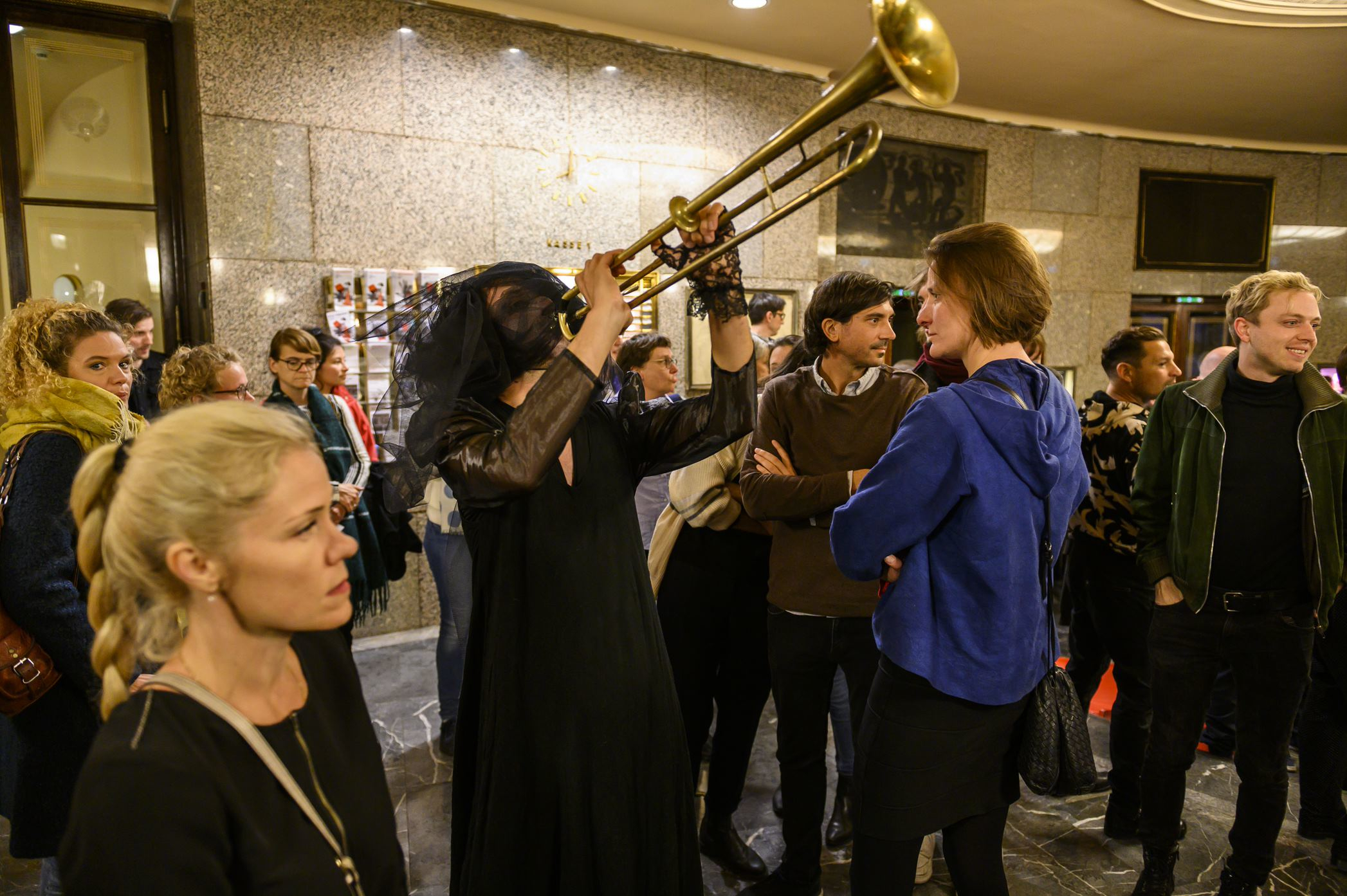
Figure 3: The Whale Whale Song (2019) by Hauen und Stechen. Entry scene in the box office of Volksbühne am Rosa-Luxemburg-Platz. © Marcus Lieberenz
The dramaturgically well-thought-out choreography takes the audience into a musical narrative about whales, repeatedly taking them to different places in the theater. This almost permanently changes the perspective on the respective narrative and thus also the perception of the audience and the theater space. The prologue, for example, welcomes the audience in the box office foyer with tinny whale songs and leads into the stairwells and cloakrooms of the whale-theater (figure 3). From there the piece goes through the whale’s mouth into the Sternfoyer to Wagner’s ‘Whale-hall’ (figure 4). The foyer on the upper floor offers various positions between a view from above of the entire foyer as a stage and a position in the foyer directly between the actors. In contrast to the openness of the foyer, the bar or the staircase forces the audience into a confined space; there is hardly any possibility of escaping and an almost intimate closeness is created between the audience and the actors. Finally, the entrance/exit area of the Volksbühne offers something akin to an amphitheater before each individual was led through the final intestinal twists and turns to the end of the play. With the libera me of church funerals and Nick Drake’s “I Was Born to Love Magic” the theater-whale releases the audience.
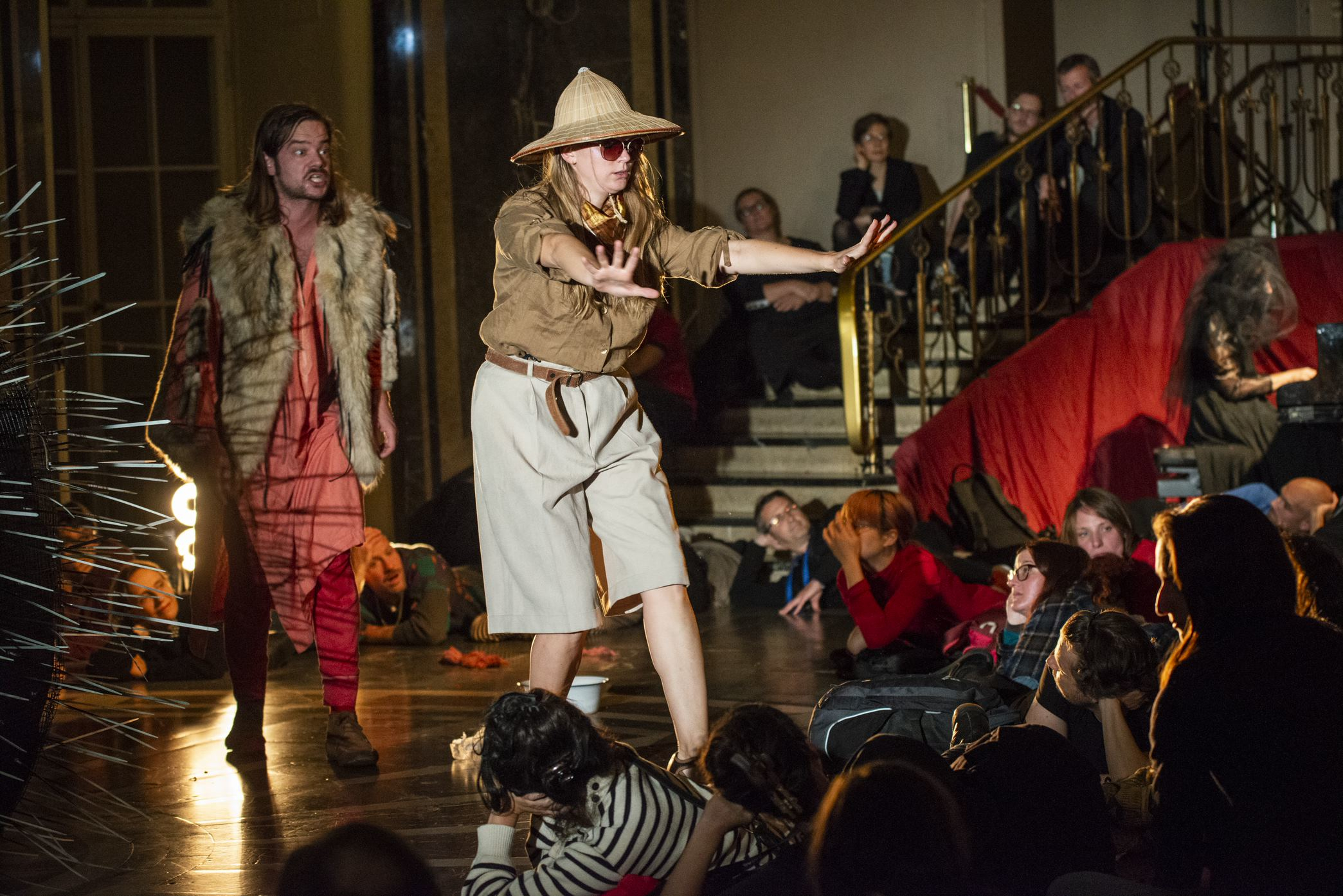
Figure 4: The Whale Whale Song (2019) by Hauen und Stechen. Playing in the theater foyer with three levels of observation: the floor, stairs, and from the first-floor balustrade. © Marcus Lieberenz
The movement of the audience not only puts the spectators into a certain observer position, but also changes their perception of themselves and the space through changing spatial configurations and the physical movement of their bodies: “The concept was based on the wandering through the Volksbühne—always around the large stage, and in the end you didn’t need it at all,”14 says director Franziska Kronfoth in an interview with the author after one of the performances. “The wandering of the audience always seems to me to be a good ‘way’ to actively participate in the performance […], you can’t lean back in your theater seat.”15 Movement creates situations of reception between omniscient distance and intimate closeness. Through walking, one experiences the spatiality of a specific place and relates it to one’s own individual spatial configurations. In this case the physical experience becomes a part of the artistic concept.
Station models consciously work with the different specifics of the respective spatial configurations in order to take the audience out of the comfort zone of the seat ticket. The site-specific positioning of the audience, the physicality of the movement in the space, and the respective perspective on the action can thus become a ‘co-composed’ and ‘choreographed’ element of the work’s aesthetic. In this context, composers or composer-director-collectives understand the site-specificity of different spaces, or rather different stages, as a dramaturgical dimension in the narrative of the piece. They can therefore search for an ideal reception perspective, even co-compose it, and ultimately have to choreograph the audience’s movement accordingly.
Performing Audience on Site
The third artistic approach can be characterized by so-called performative models that make the boundaries between performance and audience increasingly permeable. The performance of the audience is understood not only as the spatial movement of the participants, but rather in their performative participation in the performance of the piece. Performative music theater concepts seek ways to activate and interact with the audience. All the models presented so far assume an active audience, in contrast to the generally passive attitude of a person attending a classical art music concert. The approaches in the context of performative music theater models seek spaces for interaction. Their music-theatrical composition is oriented towards both the content and the audience, seeking opportunities for interaction with the audience and incorporating these creative spaces for action into the overall dramaturgical concept of the piece and the performance.
Dorfkneipe International (2018) by glanz&krawall, for example, is a piece that goes beyond both installative and stationary models to stage an almost continuously moving and partly interactive music theater experience for the audience. glanz&krawall work between music theater and drama, whereby their arrangements can jump directly between the high culture of opera and the poetic forlornness of a solo entertainer in a village disco. Singers often form alliances with actors, performers, and instrumentalists to explore the milieus of lost places: these include corner pubs, empty railway stations, boxing halls, open-air swimming pools, campsites, and much more, telling stories of the everyday life.
This is the case as well in Dorfkneipe International. There in Berlin’s Mitte district, in one of the last smokers’ bars, the real estate market and international travelers heralds the last evening of a unique pub culture. That is the reason for the artists of the music theater company to perform on site, in the pub, in the adjoining cinema, and the public space to tell these stories. Even though, or perhaps precisely because, property investors are already waiting in the wings, the bar and the cinema will open one last time before another piece of subculture becomes history. The artistic question became: “How to say goodbye properly?”
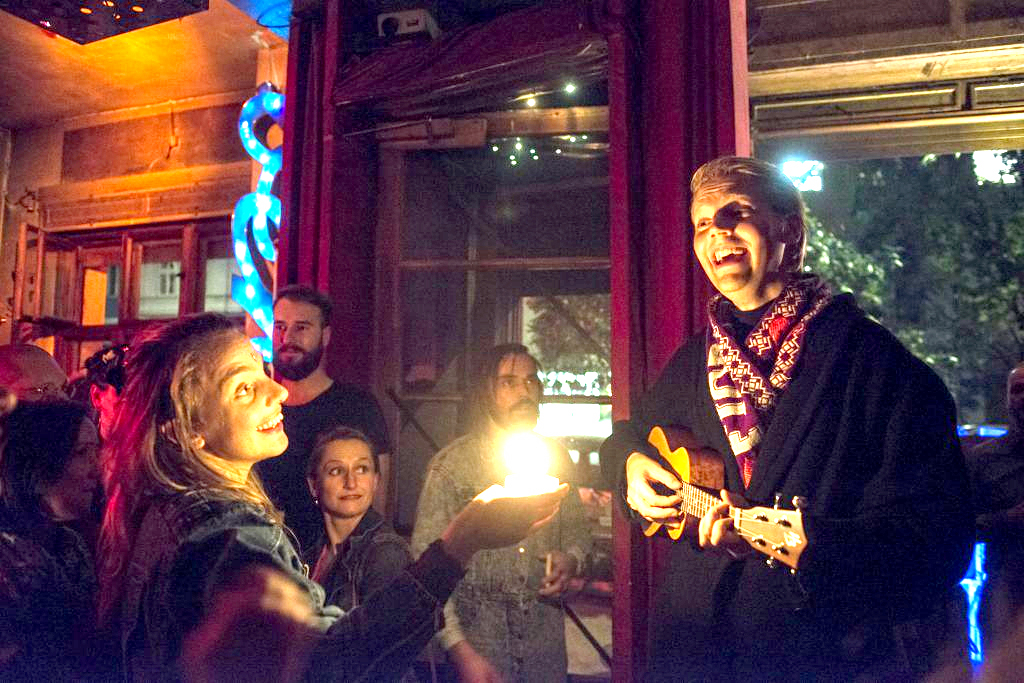
Figure 5: Dorfkneipe International (2018) by glanz&krawall. Storytelling as collaborative reenactment. © Marcus Lieberenz
The performance of Dorfkneipe International stages the last supper for regulars, neighbours, and the curious. So, it remains unclear who is audience, performer, bartender, and regulars until the end of the performance. The bar looks like every day with its bartender and regulars, drinking, talking, and smoking. In the back on the cinema stage, meanwhile, the grief processing program is underway with an strange funeral orator and the Titanicas, an a cappella trio with polyphonic lamento parts between grotesque and profound melancholy. As the audience moves from the cinema to the bar, a blissfully entertaining round of Berlin dance music hits such as Harold M. Kirchstein’s and Richard Busch’s “Auf meiner Geige spiel ich dir heut ein Abschiedslied” from the Roaring Twenties opens up. It is important to note that when the audience departs the cinema, they also leave or alter their own perspective. The individuals who were spectators and mourners during the funeral ceremony on stage become guests and relatives at the subsequent funeral meal in the bar—the observer becomes a participant. The piece is going to make the audience feel like the pub is lost, but never mind, raise the cups, because in the moment before the end, freedom is ultimately at its greatest.
The entire evening occasionally drifts into a kind of a happening (figure 5). The performance and the dramaturgical structure make the boundary between audience and stage, between viewer and narrative, between theater and pub, between piece and regulars ever more permeable and fragile. Audience and performer are singing, laughing, drinking and dancing together until everyone leaves the pub slightly intoxicated. An ongoing mash-up of dance music hits, theater, performance, video, operatic arias, and drinking songs turn the audience into participants and actors or thus into storytellers themselves. The physical difference between audience and performance increasingly dissolves, creating an intimate closeness of the private sphere that temporarily suspends critical reflection in favor of the sensual experience and only allows it again after one leaves the performance. In this case the music theater starts with a face-to-face situation that turns into a music-theatrical happening. The audience is free to move in the situation, and is free to determine their individual action in the dramatized situation: one can go to the bar and have a drink, one can talk to the others, one can sing along, listen or simply observe.
The dramaturgical concept of such a play needs both a strong narrative threat and an openness to interaction. The piece must carry enough possible narrative strands to ultimately depict the continuity of life. It must be able to think through the expected and the unexpected actions of the audience in the musical and performative structure. The self-reliance of the audience becomes a co-actor in the conception of the piece as well as in the final performance. In this case, it is not only impossible to choreograph the movement of the audience, it is not even desired. Rather, the artistic focus is on an open music-theatrical situation that offers countless narrative strands, but leaves open which of these strands will be taken up, how, and by whom. The conception of the work must therefore take into account the freedom of action of the audience and thus make the movement of the audience an aesthetic characteristic and co-composed part of the work itself.
Conclusion or Moving Audience as Composed Element
When examining various music theater works, three distinct models appear: an installative, a stationary, and a performative one. Each of these models incorporates some level of co-composed or conceptualized audience movement. As a result, it is reasonable to expect or assume that the audience or individuals within the performance will move in various ways. This expectation requires a compositional reflection during the creative process. However, it is unclear whether this dimension has been thoroughly considered in the aesthetics of the work or if it has been intentionally choreographed to enhance the dramaturgy of perception.
When analyzing performance and perception, it is evident that the more the degree of independence and physical as well as mental movement of the audience increases, the less the determinability and choreographability of the audience’s movement becomes. It can also be seen that the site-specificity as a compositional factor of music theater can be shaped more strongly by a moving perception or a moving audience. Therefore, site-specificity becomes a crucial aspect of dramaturgy. If the audience is guided to specific locations during the performance, the historical, associative and sensory aspects of the site can become active participants in the production’s dramaturgy. In a certain environment these aspects have a stronger effect. It is important to consider these factors when analyzing the impact of the environment.
It has become clear that works of contemporary music theater consciously engage with the body and the movement or motion of the audience in their conception. These are sometimes ‘co-composed,’ as movement and changes of perspective are part of the poetics of the piece, or choreographed in such a way that the audience’s perception can be focused on the situational narrative. A specific perceptual situation, especially that of the moving or freely moving audience, creates a specific view of the piece. Hence, the movement of the audience becomes more and more a significant element of the perception, the structure of the work and the creative process of contemporary music theater.
-
Cf. Julia H. Schröder, Zur Position der Musikhörenden: Konzeptionen ästhetischer Erfahrung im Konzert (Hofheim: Wolke, 2014), 82ff.↩︎
-
Cf. ibid., 165. Regarding questions of the psychology of perception in these cases the cognitive perception and the cognitive processes perceiving “auditory streams” as well as “auditory segregations,” as Albert Bregman calls it, see Albert S. Bregman, Auditory Scene Analysis. The Perceptual Organization of Sound (Cambridge, MA et al.: MIT Press, 2001). Concerning the shift towards the audience’s perception and autonomous action in the context of sound art and music, see Helga de La Motte-Haber, “Einleitung,” in Elmar Budde, Helga de La Motte-Haber, and Barbara Barthelmes, Geschichte der Musik im 20. Jahrhundert: 1975-2000. Vol. 1. (Laaber: Laaber Verlag, 2000), 11-22; Sabine Sanio, “Musik jenseits des Konzertsaals,” in Dissonanz 82 [August] (2003): 4-13.↩︎
-
Concerning post-dramatic theater, music in post-dramatic theater, and post-dramatic music theater see Hans-Thies Lehmann, Postdramatisches Theater (Frankfurt am Main: Verlag der Autoren, 1999); Anno Mungen, Ulrike Hartung, and Universität Bayreuth Forschungsinstitut für Musiktheater, eds., Mitten im Leben Musiktheater von der Oper zur Everyday Performance. Thurnauer Schriften zum Musiktheater 23 (Würzburg: Königshausen & Neumann, 2011); Regine Elzenheimer, “Dekonstruktion Von Subjekt Und Erzählung: Aktuelle Musiktheaterproduktionen Von Bernhard Lang, Salvatore Sciarrino Und Gerhard Stäbler,” in Neue Musik in Bewegung: Musik- und Tanztheater heute, ed. Jörn Peter Hiekel. Veröffentlichungen des Instituts für Neue Musik und Musikerziehung Darmstadt (Mainz: Schott Musik International, 2011), 51-64; Matthias Rebstock and David Roesner, eds., Composed Theatre Gesthetics, Practices, Processes (Bristol and Chicago: Intellect, 2012); Jelena Novak, Postopera Reinventing the Voice-Body. Ashgate interdisciplinary studies in opera (London: Routledge, 2016); Matthias Rebstock, “Spielarten des Freien Musiktheaters in Europa,” in Das Freie Theater im Europa der Gegenwart, ed. Manfred Brauneck and ITI Zentrum Deutschland (Bielefeld: transcript, 2016), 559-611; Ulrike Hartung, Postdramatisches Musiktheater. Thurnauer Schriften zum Musiktheater 36 (Würzburg: Königshausen & Neumann, 2020); Gerhard R. Koch, “Unterwegs ins Ungewisse: Was ist, was könnte ‘postdramatisches Theater’ sein? Wie sieht ein ‘postdramatisches’ Musiktheater aus? Wie klingt es? Ein Essay,” in Oper: das Jahrbuch der Zeitschrift Opernwelt (2022), 142-45.↩︎
-
Concerning the moving recipients in sound art in the public space see Fabian Czolbe, “Klangkunst Goes Mobile,” Proceedings of the Electroacoustic Music Studies NetworkConference. Electroacoustic Music Beyond Performance, Berlin, June 2014, accessed 5 March 2024, http://www.ems-network.org/IMG/pdf_EMS14_czolbe.pdf; Fabian Czolbe, “Bewegtes Hoeren,” in bonn hoeren—urban sound art / stadtklangkunst 2010-2019, ed. Carsten Seiffarth (Mainz: Schott Music 2020), 49-51.↩︎
-
The case studies mostly come from Berlin’s current independent music theater scene, which was showcased at BAM! festival (bam-berlin.org) in 2018, 2019, and 2022 organized by the Zeitgenössisches Musiktheater Berlin e. V. (musiktheater-berlin.de). The fact that the selected examples are representative works of contemporary music theater should reinforce the fact that some of these mostly young ensembles and collectives have been operating successfully for more than a decade in the ever-growing and increasingly internationally acclaimed scene. Concerning the independent music theater scene in Europe see Matthias Rebstock and Deutschland Internationales Theater-Institut Zentrum Bundesrepublik, eds., Freies Musiktheater in Europa Vier Fallstudien = Independent Music Theatre in Europe : Four Case Studies (Bielefeld: transcript, 2020).↩︎
-
Here, the term ‘differentiation’ is used in the notion of Niklas Luhmann’s systems theory. In particular, referencing to the concept of ‘outdifferentiation of the art system’ in his book Die Ausdifferenzierung des Kunstsystems (Bern: Benteli, 1994) and Die Kunst der Gesellschaft (Frankfurt am Main: Suhrkamp, 1995; engl. trans.: Art as a Social System [Stanford: Stanford University Press, 2000]).↩︎
-
Wir sind so frei #1—Fidelio was staged in collaboration with the Akademie der Künste as part of the festival Labor Beethoven 2020 to celebrate Beethoven’s anniversary. NOVOFLOT (https://novoflot.de) is an independent opera company based in Berlin and founded in 2002.↩︎
-
Land (Stadt Fluss) is the second part of the trilogy Stadt, Land, Fluss (2017-19) by the artists Daniel Kötter and Hannes Seidl.↩︎
-
Christian Grüny, “Orte, Flächen, Grenzen: Die ‘Stadt Land Fluss’-Trilogie von Hannes Seidl und Daniel Kötter im Mousonturm in Frankfurt am Main,” in Neue Zeitschrift für Musik, CLXXXI/2: Hybrid Generation 181/2 (2020): 16-9, here 18.↩︎
-
The film camera rotates a full 360° every hour, creating a continuous continuity of recurring durations. The film is a continuous, uncut film that has a continuous time sequence like that of the actual theater performance. Although the theater space is thus expanded medially, it remains synchronous in its time configuration.↩︎
-
Cf. Fabian Czolbe and Ulrich A. Kreppein, “Erzählte Zeit—Zeiterfahrung als Narrativ im Musiktheater heute,” in ACT—Zeitschrift für Musik und Performance, Beharrungs- und Bewegungskräfte: Musiktheater im institutionellen Wandel zwischen Musealisierung und neuen Formaten 9 (Bayreuth, 2019), accessed 31 November 2023, https://www.act.uni-bayreuth.de/resources/Heft2020-01/04-Erzaehlte-Zeit.pdf.↩︎
-
Cf. Jörn Peter Hiekel, “Erhellende Passagen. Zum Stationentheater Von Manos Tsangaris,” in Musik & Ästhetik 13/52 (2009): 48-60.↩︎
-
Cf. the film documentation “BAM!—Berliner Festival für aktuelles Musiktheater 2018”, a film by Uli Aumüller, see 0ʹ55ʹʹ-1ʹ03ʹʹ.↩︎
-
“Die Konzeption beruhte auf der Wanderung durch die Volksbühne—immer um die große Bühne herum, und am Ende brauchte man die gar nicht.” (original quote)↩︎
-
“Die Wanderung des Publikums scheint mir immer ein guter ‘Weg’ zu sein, auf eine aktive Weise an der Aufführung teilzunehmen […], man kann sich nicht zurücklehnen in seinen Theatersessel.” (original quote)↩︎