Choreography and Music in Igor Stravinsky’s Early Ballet Compositions
Christoph Flamm 
How to cite
How to cite
Abstract
Abstract
The relationship between choreography and music in Stravinsky’s three early ballets, L’Oiseau de Feu, Pétrouchka, and Le Sacre du printemps, changed dramatically within a few years: from the pedantic mimicry of body movements in the fairy-tale ballet to the grotesque psychograms of the fairground puppets to the “undanceable” rhythms of barbaric prehistory. This development was partly due to the changing interplay of the actors involved in Dhiagilev’s Ballets Russes, especially Fokin and Nijinsky. At the same time, however, it reflects general tendencies of avant-garde dance art in the early twentieth century, of which Stravinsky’s ballets are at the forefront. Using the original choreographies as examples, this contribution examines how the coordination of music and movement was radically transformed.
There is no question that Igor Stravinsky not only significantly enriched the dance theater of the twentieth century, but also fundamentally transformed it. However, as his fame grew, he increasingly absolutized the importance of the music in his ballets, and at the same time relativized or completely devalued the interplay of the arts in these productions. The latter issue concerns in particular the multi-layered and finely tuned relationship between subject and narration, between soloists and groups in the choreography, and between set and direction, which also included dynamic lighting direction. Stravinsky’s paradoxical view of reality (or his liberal attitude towards truth), as revealed in his own statements, would be a separate and rather complex topic. Regardless of this, the question arises as to the extent to which dance, or—more generally speaking—to what extent physical movement is inscribed in the scores of Stravinsky’s music? To what extent does the choreography react to his music—or vice versa the composer to the body movements? To answer these questions, this contribution examines his first ballets L’Oiseau de feu and Pétrouchka, followed by a brief overview of Le Sacre du printemps, in order to outline the development of the relationship between score and movement within a few years, and how both music and dance increasingly emancipated themselves from their traditions. Although these facts are not unfamiliar, focusing on central aspects of this interplay will hopefully stimulate further reflection.
L’Oiseau de feu
Michel Fokine (Mikhail Fokin), the creative center of L’Oiseau de feu—and as Ivan Tsarevich, also one of the protagonists in the premiere—gave an impressive account of the ballet’s creation in his memoirs.
I have staged many ballets since “The Firebird,” but never again, either with Stravinsky or any other composer, did I work so closely as on this occasion. […] I did not wait for the composer to give me the finished music. Stravinsky visited me with his first sketches and basic ideas, he played them for me, I demonstrated the scenes to him. At my request, he broke up his national themes into short phrases corresponding to the separate moments of a scene, separate gestures and poses. I remember how he brought me a beautiful Russian melody for the entrance of the Ivan Tsarevich. I suggested not presenting the complete melody all at once, but just a hint of it, by means of separate notes, at the moments when Ivan appears at the wall, when he observes the wonders of the enchanted garden, and when he leaps over the wall. Stravinsky played, and I interpreted the role of the Tsarevich, the piano substituting for the wall. I climbed over it, jumped down from it, and crawled, fear-struck, looking around—my living room. Stravinsky, watching, accompanied me with patches of the Tsarevich melodies, playing mysterious tremolos as background to depict the garden of the sinister Immortal Kostchei. Later on I played the role of the Tsarevna (Princess) and hesitantly took the golden apple from the hands of the imaginary Tsarevich. Then I became Kostchei, his evil entourage—and so on. All this found most colorful interpretation in the sounds that came from the piano, flowing freely from the fingers of Stravinsky, who was also carried away with this work.1
Already in an interview from 1910, Fokine recounted:
The Firebird was created by him and me hand in hand. Without one harassing the other on their own ground, we wrote every bar together. The result was an astonishing stringency, the complete agreement of the music with the meaning of the work. At the same time, the composer’s dependence on the ballet master did not in the least affect the creative freedom of the musician nor the quality of the music itself.2
Thus, music was still essentially a contribution to the choreography, but no longer in the traditional sense of fulfilling a prefabricated minutage, such as Pyotr Tchaikovsky and Alexander Glazunov had still received. Instead, choreography and music now were created simultaneously in a collaboration in which both participants reacted to each other. The result was a seamless correspondence between the action on stage and the sound design in the orchestra pit. This was so important for Fokine because it was the only way he could overcome the traditional narrative patterns in the story ballet, in terms of both the solos and the groups. In L’Oiseau de feu he obviously wanted to explore the newly discovered potential of dance narrative on all levels. This already began with the pantomime:
The Tsarevich did not say—as was customary in ballet tradition: ‘I have come here.’ Instead, he just entered. The princesses did not say: ‘We are having a good time.’ Instead, they had a good time, in reality. King Kostchei did not say: ‘I will destroy thee,’ instead, he attempted to turn the Tsarevich into stone. The fairest princess and the Tsarevich did not use sign language to express their love. But from their positions and looks, from their longing for each other, from the very fact that Ivan wrenched at the gates in order to follow her and from her tearful pleading with him in trying to save him from King Kostchei—from all this one could conclude and feel their mutual love. In short, no one had to explain anything to anyone else or to the audience; everything was expressed by action and dances. [footnote:] […] I use storytelling but not narration. There is no conversation in The Firebird. Ivan explains nothing. This is a vital difference between the old and the new ballet.3
The bumpy rehearsal phase before the premiere shows how unusual the ballet music that resulted from this creative teamwork was. After Maria Kshessinskaya had long before cancelled her participation in the 1910 Paris season, Anna Pavlova also dropped out as the Firebird: “I shall never dance to such nonsense!”4 Finally, Tamara Karsavina took over the title role.
There is a photo of a rehearsal phase with Stravinsky sitting and Fokine standing at the piano and Tamara Karsavina in the center, it appeared barely two weeks before the premiere.5 Since Karsavina is dancing here in a tutu, the reference to L’Oiseau de feu is not recognizable. The well-known Firebird’s costume designed by Leonid Bakst—with its oriental, fairy-tale and erotic elements—rejected all traditional notions of ballet dress, just as the dance movements of the role remained only partially connected to the academic tradition. Fokine explains:
The dance of the Firebird I staged on toe and with jumps which predominated in the choreography. The dance was highly technical but without entrechats, battements, ronds de jambes and, of course, without a turnout and without any preparations. The arms would now open up like wings, now hug the torso and head, in complete contradiction of all ballet arm-positions. In the ornamental arms of the bird, as in the movements of Kostchei’s servants, there was an Oriental element.6
Fokine had already tried out such flowing erotic movements the previous year in the ballet Cléopâtre. In L’Oiseau de feu, Fokine retained the classical pointe dance, which had dominated the appearance of the prima ballerinas as a stereotype, only for the title character. Here, however, the pointe technique was no longer an end in itself, but was given scenic significance: Tamara Karsavina had to make the title character float, all the more so since the stage machinery of the Paris Opéra did not allow any real flights.
In retrospect, Tamara Karsavina confessed in an interview about the rehearsal phase, that grasping the musical structures initially caused her great problems, and that she only reached her goal thanks to Stravinsky’s patience. The surviving handwritten rehearsal plan for the Paris premiere in 1910 shows that Fokine began with the most conventional element: the round dance (Chorovod) of the princesses.7 The “general dance” was rehearsed last, i.e. the Danse infernale as a dance culmination with special challenges. The surviving vignettes8 (figure 1a und 1b) show how Fokine finds symmetrical geometric arrangements and spatial movement patterns in the group dance of the princesses, which in turn unfold narrative potential. For example, the princesses first separate Ivan and the beautiful Tsarevna, that is, the future bride and groom, starting with their floor movements, in order to finally let the groom get through to his bride. Stravinsky’s music here forms a closed three-part form with a folk song melody as the main material, which runs through in a steady, calm pulse, thus leaving the choreographer every freedom.
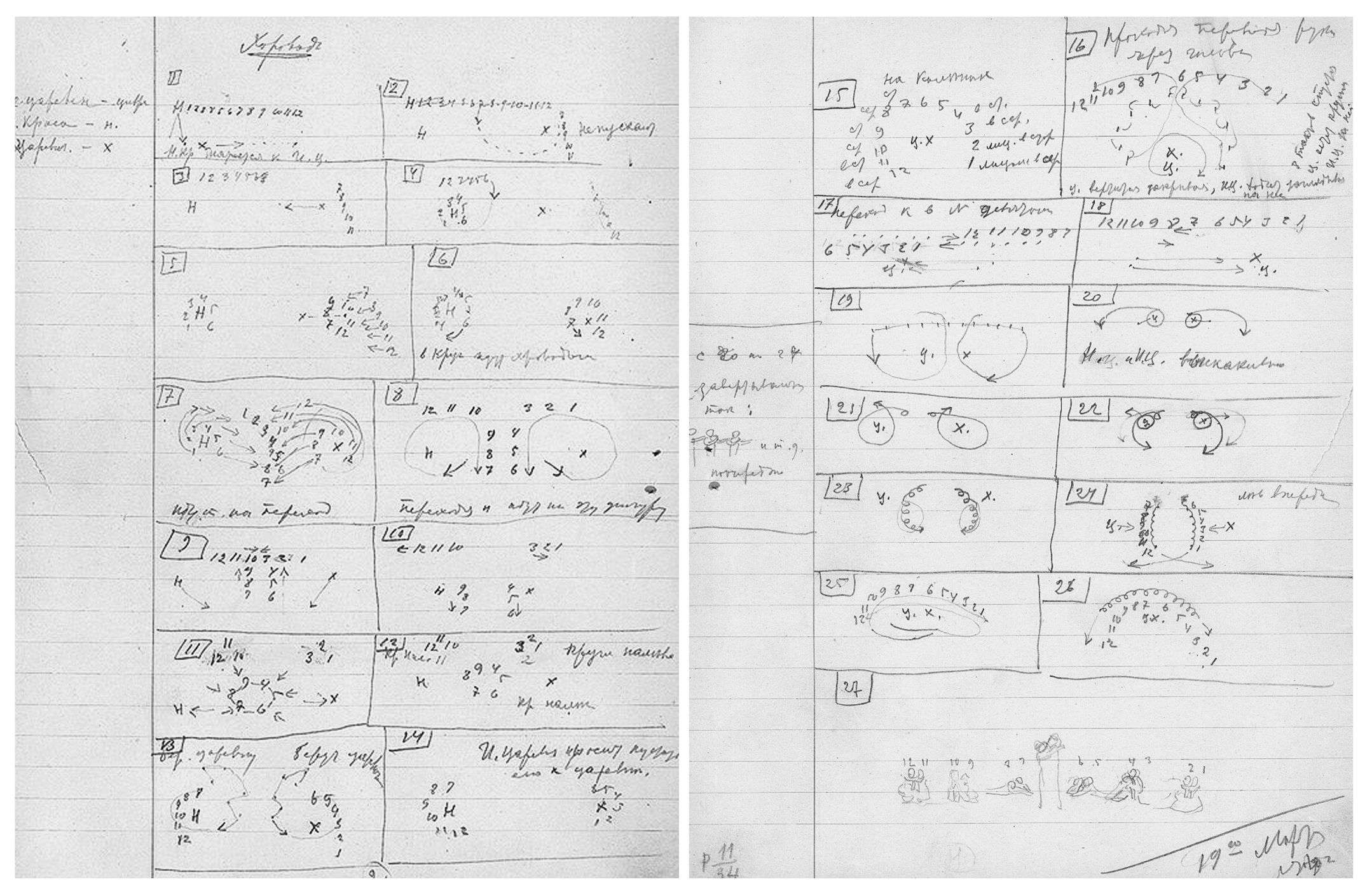
Figure 1a and b Michel Fokine, Firebird, choreographical sketches for the Khorovod of the Princesses. St. Petersburg State Theatre Library, Archiv M. M. Fokina, R11/34 © St. Petersburg State Theatre Library (with kind permission)
The barefoot dancing of the princesses is almost certainly a reflection of the expressive dancing of the American Isadora Duncan, who performed in St. Petersburg from December 1904 and undoubtedly also inspired Fokine.9 Nevertheless, Fokine always dismissed direct influences and emphasized the priority of his dance reforms. In fact, Duncan’s vocabulary would not have been sufficient to represent stories like those of L’Oiseau de feu in dance—not least because she did not even intend to create such narratives.
Fokine himself commented: “The princesses danced barefoot with natural, graceful, soft movements and some accent of the Russian folk dance.”10 In order to enhance the dance expression, the dissolution of classical poses and figures went hand in hand with the avoidance of what might be called speaking gestures. The movements of the Russian figures were linked to free expressive dance as much as to traditional folk dances. The dance design of the title figure was characterized by the novel sensuality of flowing orientalism, as well as by those expressive elements of classical dance that serve the illusion of floating. In this respect, both the solo dance and the ensemble designs combine tradition and departure.
The grotesque physicality of the evil Kastschei and his monsters, on the other hand, offered a welcome break with tradition. Of the multitude of creatures in Kastschei’s entourage, including monsters with two heads, unfortunately only very few illustrations have survived. Only Kastschei himself is frequently depicted in contemporary sources. In one of those very rare photographs, Kastschei’s servants resemble a cheerful carnival party rather than a horde of terrifying monsters.11 The entourage in the illustration of a performance at London’s Covent Garden in 1912, drawn by the artist Fortunino Matania for the journal The Sphere, has a similar effect.12 There, the dramatic moment is captured when Ivan Tsarevich (now Adolph Bolm instead of Fokine) throws up the egg with the soul of the immortal Kastschei (now Enrico Cecchetti instead of Alexis Bulgakov) in order to break it. Except for the missing firebird, the protagonists and the groups of monsters, princesses, Kastschei’s wives, as well as the rarely noticed Indian women, and presumably also the knights or princes who have apparently already come to life, are depicted in detail here. This drawing is probably the only existing document that gives an overall impression of the original production.
The appearance of the monsters is, of course, not just a question of décor. Fokine broke new ground with the choreography:
The evil kingdom was built on movements at times grotesque, angular and ugly, and at times comical. The monsters crawled on all fours, and leaped like frogs. Sitting and lying on the ground, they stuck the palms of their hands out like fins, now from under the elbows, now from under the ears, tying their arms into knots, rolling from side to side, jumping in squat positions, and so forth. In short, they did everything which twenty years later appeared under the label of ‘modern dance,’ but which, at the time, seemed to express most adequately nightmarish horror and hideousness.13
Fokine invented spectacular “diabolical” jumps for Kastschei’s servants, which were performed from the height of the castle hill, with twists in the air with bent legs, and appeared as dangerous as they were effective. Stravinsky’s music picks up directly on Fokine’s imagery, and not just the general grotesque of the monster procession with hollow xylophone sounds. The tritone repetitions, sharpened by acciaccaturas, could even be heard as a kind of croaking. Such musical frogs would then presumably be a direct reaction of the composer to the choreographer’s visual imagination.
This brings us to the final point of L’Oiseau de feu: musical mimicry. According to Richard Taruskin, the real musical innovation of the ballet was the continuous orchestral recitative,14 which allowed the fairy tale narrative to unfold like a film without cuts. As already mentioned, Fokine’s memoirs reveal that the choreographer meticulously pantomimed each scene for the composer and that Stravinsky divided his musical ideas into suitable pieces, thus adapting his material to the scenic events in a practically tailor-made manner. Two examples of such “Mickey-Mousing,” as it is called in film studies, may suffice. When Ivan first approaches the playing princesses, the long phrase of his recognition melody is broken down, as before, into short pieces, between which the reactions of the princesses take place: first a frightened flinch as a rapid chromatic 32nd run in the cellos over a nervously quivering organ point, then a shy, benevolent bow in the violins and violas. The moment when Kastschei tries to turn Ivan into stone is even more musically vivid. In the process, he utters his demonic curse three times, but on the third occasion Ivan begins to wave the talismanic feather he had received from the firebird. Every single one of these movements is precisely coordinated with the music. This degree of precise coordination marks it as a real novelty in ballet history.
Less comprehensible for us today is the confusion that Stravinsky’s Danse infernale caused. Serge Grigoriev remembers:
From the moment they heard the first bars [“Danse infernale”] the company were all too obviously dismayed at the absence of melody in the music and its unlikeness to what they were used to dancing to at the Mariinsky. Some of them indeed declared that it did not sound like music at all.15
The completely even rhythm, pulsating like a racing heartbeat, cannot possibly be perceived as “undancing” by anyone who grew up with rock and pop, regardless of all the syncopation. It was probably the gestural wildness of the tension unleashed that broke with conventional aesthetic patterns to such an extent that incomprehension spread among the dancers. In the end, however, it was precisely this tumultuous dance with its abrupt ending in which everyone falls flat to the floor, that regularly provoked the audience to break out in applause at the end of the scene. It was to find an echo in Pétrouchka in the “Dance of the Coachmen and Stablemen.”
Fokine defended L’Oiseau de feu’s fundamental principle of dance movements motivated directly by the scene against his critics. At the same time, however, it meant a new shackle: the choreography was symbiotically bound to the scenario, and the music symbiotically bound to the choreography. Therefore, Fokine, when seeing subsequent foreign productions, perceived every deviation, no matter how small—be it from the original set, or from the choreography—as a violation of the original intention.16 L’Oiseau de feu as a total work of art only functioned for him in its most original conception, elaborated down to the last detail.
Pétrouchka
In L’Oiseau de feu, Fokine essentially specified what the composer was to translate into music. However, in Pétrouchka, the entire choreography was created after Alexandre Benois had fixed the plot in close consultation with Stravinsky. Stylized puppet movements had to be found for the three protagonists that corresponded to the psychology of the characters. Furthermore, the gigantic crowds of people in the fairground scenes had to be coordinated. Finally, Stravinsky’s now very often asymmetrical rhythms posed a particular hurdle for the choreography.
For the group dances of the wet nurses, coachmen and stable hands, Fokine essentially made use of folkloric dance patterns that matched the historically precise costumed social types or occupational groups. These dances are choreographically among the most conventional elements of Pétrouchka,17 but are at the same time also among the most effective, not least due to the power of Stravinsky’s “beat.” Fokine and Alexandre Benois agreed on the basic aesthetic stance, namely the naturalistic reproduction of reality. Their meticulousness had its most important model in the performance style of the Moscow Art Theater founded in 1898 by Konstantin Stanislavsky, of which Benois became director in 1909. Like Fokine and Benois, Stanislavsky strived for “the creation of historical illusion based on direct observation of reality combined with historical reconstruction.”18
The colorful mass of fairground visitors required a new approach. For the realistic treatment of the corps de ballet, Fokine was already able to draw in part on predecessors such as Alexander Gorsky.19 But whereas Stravinsky could episodically highlight individual voices from the acoustic tangle of the fairground, combine them in counterpoint and also bring them into the foreground in complete isolation, the choreographer was confronted with a crowd permanently present on stage.
If I had kept close to the interpretation of the rhythmic and other qualities of each phrase as it is done by the orchestra, it would have resulted in my having a tediously static crowd on stage instead of a gay and merry one. Why? Because Stravinsky had all the described characters appear consecutively, while on stage I had them all simultaneously. For example: when the drunks enter on the stage, no characters, other than they, are interpreted in the music—without regard to the mass of other people I have on the stage at that moment.20
Fokine’s solution was, in part, to let the extras more or less improvise. Stravinsky was dissatisfied with this.21 Yet, that his score would provide, as he claimed, clear movement patterns for the crowd—which Fokin did not implement—is not true. Stravinsky’s collage does sometimes combine two or even three elements of the stage action, which is spectacular enough in terms of music history. However, it cannot truly depict a scenic totality. The repetitive change of triadic chords, inspired by the accordion, serves as a musical “foundation,” which, however, is not applied everywhere. Where could such a mass choreography have led in the first place? As Fokin has noted, uniform movements are inappropriate to the collage idea of the whole fairground bustle, but individual ones in such large numbers would require a rather utopian amount of rehearsal. Advising the extras hired for the crowd scenes to improvise was a less-than-ideal solution to create the illusion of an uncoordinated crowd of individuals—but probably more convincing than the amalgamation of a hundred individual choreographies which the audience would no longer be able to perceive.22
Additional difficulties arose because Stravinsky’s metrics left the familiar paths. The irregular metrical structures of the first tableau, basically connected to the imitation of the fairground barker (balaganny ded), lie above a continuous movement of the accordion sounds, and can thus be covered up dance-wise. The choreography threatened to fail, however, where the dancers had no such steady basis, yet could not internalize the asymmetrical counting patterns. Fokine from his perspective of practical choreographic realization, considered some rhythmic complexities unnecessary, namely where they were not psychologically motivated, as in the part of Petrushka. Whereas the “rhythmic disruption” in the first tableau fulfilled the representational purpose of a colorful crowd, he felt “that not until the general dance begins, when everyone is united by one rhythm, should this rhythm go into its repetitious movements, emphasizing the same over and over again.”23
This is precisely what the “Dance of the Coachmen” vividly demonstrates. Even more than in the Danse infernale from L’Oiseau de feu, a continuous pulse is almost manically prolonged here, as if it were post-war beat music. This maximum uniformity of the metric structure, a novelty in music history once again, allowed the choreography complete freedom. The negative extreme for Fokine, on the other hand, was the dance of the masked and disguised people in the fourth tableau:
After the appearance of the masqueraders, the 5/8 count is played at a very rapid pace. This was so difficult to grasp that my rehearsal changed into a lesson in rhythmics. I summoned the troupe to the piano and asked them all to clap their hands. Everyone clapped, but on a different beat. The result was general confusion, so we tried again. I would clap first, then the others would follow me. Then the dancers clapped without me. […] Finally we achieved our objective. But when we applied the acquired rhythms to the dances, nothing happened. Again, I called everyone to the piano. Again I recalled everyone to the piano. Again a lesson in rhythms—and so on. In such a manner, very gradually, we finally mastered it. The stumbling block was finally surmounted. After a few performances, the rhythms again became unclear. Was this obstacle an absolute necessity to the composer? I doubt it. I believe that Stravinsky could have achieved the same musical result with a more natural rhythm for this dance.24
This assumption is naïve: Stravinsky’s asymmetrical and changing meters here not only question the musical period structure, but at the same time quite consciously question basic principles of dance—not coincidentally towards the end of the piece. It was precisely in the ballet’s finale that the novelty lay: the complete rejection of established conventions which could have reconciled the audience with all the preceding audacities; the renunciation of an all-encompassing, intoxicating harmony spilling over onto the audience. The demonic animal and devil figures tear apart the colorful, saturated pictorial fresco both musically and choreographically, and open up a space for the tragic end, the collapse of illusions, the fragmentation of perspectives. It is indicative that Sergei Prokofiev, as Stravinsky recalls, disapproved of precisely this ending:
[Prokofiev] was once seated beside me at a performance of that work when, in the fourth tableau, at the climax of the Russian dances, he turned to me and said, ‘You should have ended here.’ But it is obvious to any perceptive musician that the best pages in Petroushka are the last.25
Fokine may have lacked the last insight into Stravinsky’s broken-up metrics, but his ensemble scenes in Pétrouchka were memorable. He understood the corps de ballet not as a homogeneous mass but as a heterogeneous set of individuals. It was this liberation of the ensemble that made such frenetically wild final dances in Fokine’s ballets possible, on the model of the orgy in Cléopâtre or the slaughter in Schéhérazade. In the words of Lynn Garafola:
Fokine’s crowds replicated the paroxysm of revolution itself: the fury of the masses unchained, the ecstasy of blood, the triumph of instinct over ego, the liberation of the self through collective action.26
In creating the three puppet protagonists, Fokine expanded the naturalistic method to include a symbolic dimension; the meticulous observation of external nature was now joined by that of internal nature. The individualization of the crowd found its counterpart in the upgrading of the dancers to actors, to performers of individual characters whose movements and gestures were fundamentally dramatically motivated. This was done in the service of an emotional truth, which Konstantin Stanislavsky’s modern artists’ theater also sought to achieve. The physical processes were thus the direct echo of the psychological ones. All roles became thereby character roles, including the main characters, whereby the repertoire of forms (variation, pas de deux, etc.), which had been developed over decades and by which the title roles usually defined themselves, was eliminated.27
Fokine was also able to draw on the experimental theater of Vsevolod E. Meyerhold, in particular his impressive embodiment of the grotesque, lanky Pierrot in Alexander Blok’s The Puppet Booth. In the case of the three protagonists in Pétrouchka, Fokine was concerned with translating the non-human (or semi-human) of their existence into puppet-like movement, while at the same time drawing a psychogram of the respective figure. The result was a distorted image of academic movement patterns that were ignored or parodied.
In the case of the ballerina, the parody aspect was particularly evident: her superficiality and simplicity were expressed in a mechanical idling of stereotypical dance figures—a facade devoid of meaning that Stravinsky’s music had all too clearly mapped out. Lynn Garafola remarks:
The Ballerina, in fact, stood for everything he [Fokine] most despised: technical trickery (her coy échappés and tiny hops on pointe, passés relevés and whipping fouetté turns were variation staples) and empty display, as well as any number of lesser sins: drawn-out preparations, the extremes of turnout, arms en couronne, segmented phrasing—all of which he refused to countenance in his ‘straight’ choreography.28
Although the ballerina Tamara Karsavina is still named first in the program of the premiere and in the score, the dismantling of this position has probably nowhere been executed more drastically than in Pétrouchka. The love duet of the ballerina and the Moor in the third tableau is accordingly conceived as a caricature of a pas de deux.
An even more caustic parody of the prima ballerina cult are the female street dancers. Fokine asked Bronislava Nijinska to perform acrobatic feats of her own choosing; she imitated Matilda Kshessinskaya’s celebrated coda from Le Talisman29 to his amusement. Last but not least, the wriggling dance movements of the Danse russe can also be considered a “biting satire on the routine of the old ballet.”30 This is the historical significance of Fokine’s choreography: it almost completely overturns the old conventions, albeit rarely substituting striking new elements in their place—a step reserved for Vaclav Nijinsky in Le Sacre du printemps.
The real sensation was Nijinsky’s title role. To portray the suffering eponymous hero, it was not virtuosity that was required, but pantomime and acting talent, and the death scene in particular was felt to be “indescribably moving”31 in Nijinsky’s dance. Fokine’s desire to use the whole body as an instrument of emotional expression in the male protagonists led to unusual solutions:
It was not my wish to give completely opposite plastiques to the two characters. The basic difference is simple: the Moor is all en dehors (“turned out”); Petrouchka all en dedans (“turned in”). I have never seen a better example of choreography which discloses so eloquently the personality of two such different characters. This self-satisfied Moor, an extrovert, completely turns himself out; while the pathetic, frightened Petrouchka, an introvert, withdraws into himself. Has this been borrowed from life? Most certainly. It has been borrowed from life to be introduced into the most unlife-like puppet pantomime—puppet movements built on a psychological foundation.32
The outward turn (“en dehors”), which is part of the basic vocabulary of classical ballet, is further increased in the movement vocabulary of the Moor, in short: over-turned outwards. In doing so, the usually angled foot positions are in places performed frontally, as if on a line running horizontally opposite the audience, whereby the Moor reveals the view of his body without the otherwise usual slanted angles, i.e., without restriction. The en dedans (“turned inwards”) position characterizing Petrushka was also used as early as the seventeenth century, at first for comic-grotesque roles, later for malicious or miserable characters. Yet Petrushka’s “twisting in” or rather “introversion” as a fetus-like slumping into himself had to appear as a mockery of traditional ballet aesthetics, which was further heightened by awkward jumps and stiff arm movements. In this respect, Fokine developed the eccentric characters of his two male protagonists from elementary movements.
Fokine’s artistic skill undoubtedly lay in shaping Petrushka’s movements in such a way that they gave the psychogram of the suffering puppet vivid contours—such as the jumps with arms and legs spread out in a cross shape.33 At the same time, however, the success of the character was based on Nijinsky’s talent for mimicry:
But Nijinsky succeeded in rendering so convincingly the sorrows of the ill-treated captive, his utter despair, his jealousy, his longing for liberty, and his resentfulness towards his gaoler, that Sarah Bernhardt, on witnessing the performance, said, ‘J’ai peur, j’ai peur, car je vois l’acteur le plus grand du monde.’34
One of the most vivid descriptions was left by Bronislawa Nijinska:
When Pétrouchka dances, his body remains the body of a doll; only the tragic eyes reflect his emotions, burning with passion or dimming with pain. The heavy head, carved out of a wooden block, hangs forwards, rolling from side to side, propped on the shoulder. […] The soft knees bend suddenly under the weight of the body, the knock-kneed legs sway from side to side, and the wooden dangling feet dance freely. Petrouchka dances as if he is using only the heavy wooden parts of his body. Only the swinging, mechanical, soul-less motions jerk the sawdust-filled arms or legs upwards in extravagant movements to indicate transports of joy or despair.35
In order not to disappear completely behind Nijinsky’s performance, which in retrospect was becoming increasingly absolute, Fokine emphasized in his memoirs that he had developed the role of Petrushka entirely himself; Nijinsky had even asked him to prompt him behind the scenes at the premiere.36
It is unmistakable that the puppets in Pétrouchka attack all conventional notions of beauty in dance. The subject offered a justification for overcoming them: whereas in L’Oiseau de feu it was dancing monsters, in Pétrouchka it is dancing puppets. The grey prehistory of Sacre will then provide a projection screen to eliminate the last remnants of a tradition that was parodied in Pétrouchka on the one hand and was still vaguely recognizable in the ensemble dances on the other. The music played an increasingly large part in this process, in the end probably the largest.
Le Sacre du printemps
To conclude, let us briefly discuss the relationship between music and movement in Le Sacre du printemps. Except for the final Danse sacrale, all the dances here are ensemble dances, thus consistently continuing the dismantling of the prima ballerina to the point of her symbolic destruction and sacrifice. Body movement is now fundamentally movement of plastic masses. In the reconstruction of the original choreography by Millicent Hodson, this basic feature is perfectly recognizable.37 Above the Danse de la terre in the particell, Stravinsky wrote the dedication “To the genius Michelangelo Buonarotti” in large letters—his music, too, now sees itself as the sculptural shaping of tonal masses in space, no longer as a generator of rhythm for step sequences.38
Stravinsky forced the choreography to abandon the direct parallelization of sound event and body movement altogether with his irregular meters, which he pushes even further—especially in the concluding Danse sacrale. This dissociation is the exact opposite of the mimicry that prevailed in L’Oiseau de feu and which the composer felt in retrospect to be an excessive heteronomy. Out of his categorical rejection of the traditional coordination of music and dance, a new freedom of body movement is forced to emerge. Sacre means for dance: compulsion to freedom.
In his criticism of Nijinsky’s choreography, Stravinsky himself addressed this conceptual change:
My own disappointment with Nijinsky was due to the fact that he did not know the musical alphabet. He never understood musical metres and he had no very certain sense of tempo. You may imagine from this the rhythmic chaos that was Le Sacre du Printemps, and especially the chaos of the last dance where poor Mlle Piltz, the sacrificial maiden, was not even aware of the changing bars. […] He believed that the choreography should re-emphasize the musical beat and pattern through constant co-ordination. In effect, this restricted the dance to rhythmic duplication of the music and made of it an imitation.39
Stravinsky is scandalously unfair in this quotation: the dissolution of the doubling of music and movement was a step that was only taken in and through Sacre in the first place—rhythmical imitation and coordination had been the unchallenged basis of all dance theater until then.
The choreographic entries in Stravinsky’s copy of the four-hand piano version of Sacre, presumably only made for Leonid Massine’s choreography of 1920, show a kind of contrapuntal interaction between musical and choreographic rhythm.40 Jann Pasler recognizes as basic principles of these notations the alternation between movement and stillness in the music on the one hand, and between movement and standstill on the stage on the other;41 where music and dance then do reach perfect agreement, significant moments are highlighted. It is the document of a changed ballet aesthetic, which for the first time puts the direct connection between music and dance movement up for discussion, or rather negotiates it on the open stage.
Nijinsky, who had almost no experience as a ballet master, developed the choreography in a good three months and 120 rehearsals for the total of sixty-seven roles in the Paris premiere with the support of Marie Rambert, a student of Émile Jaques-Dalcroze from Hellerau. The interest in eurhythmics was no incidence, since Dalcroze’s method sought for a direct connection between rhythm in time and rhythm in space, between tone duration and according gesture—ideas which helped overcome the traditional staple of poses and movements and allowed for a stronger interaction with the musical score. In Sacre du printemps, the only connection between music and dance was rhythm. Rambert recalls:
Originally they thought that if I would teach the people Dalcroze Eurhythmics—they admired the method very much—they would be able to interpret the music easily. But Dalcroze’s method, which is terribly simple, didn’t help because Stravinsky didn’t care a hoot if one bar was three-four and the next seven-eight, then from three-four to five-three. I mean it was absolutely impossible. You had to learn it by heart … It was a matter at the time of concentrating on a few bars at a time, certain phrases.42
Nijinsky further developed the bent poses and twitching movements in connection with Pétrouchka; he was obviously inspired as well by the wooden idols and totem poles in Nicholas Roerich’s paintings.43 Here it was no longer a psychogram turned outwards, but an attempt to evoke the imagination of a pre-civilized atmosphere through maximally uncivilized postures and movements. Bronislava Nijinska emphasized that “primal” nature of the groups:
The men in Sacre are primitive. There is something almost bestial in their appearance. Their legs and feet are turned inwards, their fists clenched, their heads held down between hunched shoulders; their walk, on slightly bent knees, is heavy as they laboriously struggle up a winding trail, stamping in the rough, hilly terrain. The women in Sacre are also primitive, but in their countenances one already perceives the awakening of an awareness of beauty.44
Seen like this, beauty in Sacre was something hidden behind an avalanche of distortion and ugliness. The ballet turned traditional conceptions of beauty upside down: the primitivity of Roerich’s prehistoric stage design and costumes, the elaborate rudeness of Stravinsky’s score and the block-like mass movements devoid of any conventional elegance all contributed to the final sacrifice—that of art itself. It was a rebirth of new vital forces through the destruction of standard aesthetic (not to speak of academic) values. In a certain sense, such had already been the mission of Diaghilev’s first productions in Paris. But while at the beginning the objective would be reached by a maximally detailed and all-encompassing coordination among all elements of the spectacle, in the end the art forms would freely coexist in a fusion of a higher order, with narrative elements reduced to an absolute minimum (such as the kiss of the earth or the choice of the sacrificial maiden). The chains which only three years before had so very tightly connected dance, music, and scenery, were now broken off, once and for all. It was an emancipatory step not only on the side of musical logic, but ultimately for choreography above all else. Instead of counting bars or following complex changes of meters with mathematical precision, body movements now willy-nilly had to be inspired freely, not by small musical units, but by the overall energy, atmosphere and expression of music. Such artistic freedom was a necessary result of the seemingly atavistic (but in reality hyper-erudite) quality of Stravinsky’s score. The step of stage design into abstraction was soon to follow.
-
Michel Fokine, Memoirs of a Ballet Master, trans. Vitale Fokine, ed. Anatole Chujoy (Boston and Toronto: Little, Brown and Co, 1961), 161.↩︎
-
A.P., “Simfoniya v khoreografii,” in S.-Peterburgskiye teatral’nïye novosti, 10 September 1910, as cited in Igor Stravinskiy, Perepiska s russkimi korrespondentami. Materialï k biografii, ed. Viktor Varunts, vol. I: 1882–1912 (Moscow: Compozitor, 1989), 454.↩︎
-
Fokine, Memoirs of a Ballet Master, 168-9 (with footnote).↩︎
-
Anna Pavlova, as cited in Joni Lynn Steshko, Stravinsky’s Firebird: Genesis, Sources, and the Centrality of the 1919 Suite (PhD dissertation, Los Angeles, University of California, 2000), 53.↩︎
-
See photograph in Comoedia illustré, 15 June 1910.↩︎
-
Fokine, Memoirs of a Ballet Master, 168.↩︎
-
See reproduction in Claudia Jeschke, “Russische Bildwelten in Bewegung—BewegungsTexte,” in Schwäne und Feuervögel. Die Ballets Russes 1909–1929, ed. Claudia Jeschke and Nicole Haitzinger (Leipzig: Henschel, 2009), 58-89, 71.↩︎
-
Cf. ibid., 68-9.↩︎
-
Cf. Elizabeth Souritz, “Isadora Duncan and Prewar Russian Dancemakers,” in The Ballets Russes and Its World, ed. Lynn Garafola and Nancy van Norman Baer (New Haven: Yale University Press, 1999), 97-115; Galina Dobrovol’skaya, Michail Fokin. Russkiy period (St. Petersburg: Giperion, 2004), 39-71.↩︎
-
Fokine, Memoirs of a Ballet Master, 167.↩︎
-
See photographs in Comoedia illustré, 15 July 1910.↩︎
-
See reproduction in Jane Pritchard, ed., Dhiagilev and the Golden Age of the Ballets russes (London: V & A Publishing, 2010), 176.↩︎
-
Fokine, Memoirs of a Ballet Master, 167.↩︎
-
Richard Taruskin, Stravinsky and the Russian Traditions, vol. 1: A Biography of the Works Through Mavra (Berkeley and Los Angeles: University of California Press, 1996).↩︎
-
Serge L. Grigoriev, The Diaghilev Ballet 1909–1929, trans. and ed. Vera Bowen (London: Constable, 1953/2009), 32.↩︎
-
Cf. Fokine, Memoirs of a Ballet Master, 175.↩︎
-
Cf. Tim Scholl, “Fokine’s Petrushka,” in Petrushka. Sources and Context, ed. Andrew Wachtel (Evanston: Northwestern University Press, 1998), 41-50, 47.↩︎
-
Lynn Garafola, Diaghilev’s Ballets Russes (New York and Oxford: Oxford University Press, 1989), 19.↩︎
-
Cf. ibid., 21.↩︎
-
Fokine, Memoirs of a Ballet Master, 189.↩︎
-
Igor Stravinsky, Chroniques de ma vie (Paris: Denoël & Steele, 1935), 59-60.↩︎
-
Cf. Dobrovol’skaya, Michail Fokin, 309-10.↩︎
-
Fokine, Memoirs of a Ballet Master, 187.↩︎
-
Ibid., 188.↩︎
-
Igor Stravinsky and Robert Craft, Memories and Commentaries (London: Faber & Faber, 1960/1981), 67.↩︎
-
Garafola, Diaghilev’s Ballets Russes, 23.↩︎
-
Cf. Scholl, “Fokine’s Petrushka,” 45.↩︎
-
Garafola, Diaghilev’s Ballets Russes, 37.↩︎
-
Cf. ibid.↩︎
-
Scholl, “Fokine’s Petrushka,” 45.↩︎
-
Grigoriev, The Diaghilev Ballet 1909–1929, 54.↩︎
-
Fokine, Memoirs of a Ballet Master, 192.↩︎
-
Cf. Jann Pasler, “Music and Spectacle in Petrushka and The Rite of Spring,” in Confronting Stravinsky. Man, Musician, and Modernist, ed. Jann Pasler (Berkeley and Los Angeles: University of California Press, 1986), 53-81, 61.↩︎
-
Romola Nijinsky, Nijinsky (New York: Simon & Schuster, 1934), 128.↩︎
-
Bronislava Nijinska, Early Memoirs (New York: Holt, Rinehart and Winston, 1981), 373.↩︎
-
Cf. Fokine, Memoirs of a Ballet Master, 194.↩︎
-
Millicent Hodson, “Nijinskij’s Choreographic Method. Visual Sources from Roerich for ‘Le Sacre du Printemps’,” in Dance Research Journal 18 (1986/87): 7-15.↩︎
-
Cf. Christoph Flamm, Igor Strawinsky. Der Feuervogel—Petruschka—Le Sacre du printemps (Kassel: Bärenreiter, 2013), 159-60.↩︎
-
Stravinsky and Craft, Memories and Commentaries, 37.↩︎
-
See description and analysis in Robert Craft, “The Rite: Counterpoint and Choreography,” in The Musical Times 129 (1988): 171-6.↩︎
-
Pasler, “Music and Spectacle in Petrushka and The Rite of Spring,” 78-9.↩︎
-
As cited in Millicent Hodson, “Ritual Design in the New Dance. Nijinsky’s Le Sacre du Printemps,” in Dance Research 3 (1985): 35-45, 37-8.↩︎
-
Hodson, “Nijinskij’s Choreographic Method,” 7.↩︎
-
Nijinska, Early Memoirs, 459.↩︎