
Mario Aschauer
How to cite
How to cite

It is all but a miracle that the friars of the Vienna Minorite Order have been able to shield the treasures of their music archive against the perils of time for over 400 years. Around 1600, the monastery began to establish itself as an elite musical institution in Vienna.1 One of its most significant members, Father Alexander Giessel (1694–1766) was most likely a student of imperial court Capellmeister Johann Joseph Fux – the highest ranking musician of the Holy Roman Empire at the time – and friends with court organist Gottlieb Muffat.2 Inspired by Athanasius Kircher’s art and natural science collections, Giessel earned a reputation as compiler of a similar collection of ‘rarities of nature, mussel shells and other growths of the sea, minerals, fossils, marble and rocks, antiquities, antique coins, more recent commemorative coins, copper engravings, artfully cut stones, art and masterworks, etc.’3 Furthermore, he made perhaps the most important contributions to the monastery’s library and archive of classical keyboard manuscripts, similar to Padre Martini’s collection in Bologna.
Among the archive’s treasures, now catalogued under call number XIV.714, is a manuscript codex containing more than 500 keyboard pieces. As such, Codex 714 is one of the largest collections of early 17th-century keyboard music. However, its size is only a minor factor in what makes the codex so extraordinary – and mysterious.
We know next to nothing about the provenance of Codex 714. Riedel4 compiled a first inventory of pieces updated by Hill5 along with a black and white facsimile, now long out of print. The breadth of keyboard genres ranges from magnificats, hymn variations, and other chant-based organ music to intabulations of secular vocal and ensemble music. While some scholars have called it the product of an anonymous German organist scribe,6 others have argued for Prague as its place of origin.7 The fact that the codex contains organ music for both Catholic and Protestant liturgies – making it all but unique among 17th-century keyboard manuscripts – could be explained by Prague’s exceptionally ecumenical climate during the Thirty Years’ War. On the other hand, like Friedrich W. Riedel has suggested, the extraordinary breadth of repertoire could also be the product of a wide-travelled musician such as Vincenzo Scapitta whose career led him from Italy to Innsbruck, Olomouc, and Warsaw before he fled to Vienna in 1655 and died there a year later.8 This would explain, beyond the striking denominational diversity of the repertoire, the geographical spread of its composers. Codex 714 is the venue for an unlikely encounter between composers such as Merulo and Frescobaldi from the deep Catholic South and Protestant figureheads Jan Pieterszoon Sweelinck and Samuel Scheidt from the far North of Germany and The Netherlands. At any rate, the pieces in the manuscript that were most likely copied from contemporary prints suggest the first three decades of the 17th century as the codex’ period of creation.
Opening the manuscript’s ornate heavy leather cover reveals another unusual aspect. The music is notated in a scala decemlinealis, a ten-line staff with treble and bass clef, recommended by 16th- and 17th-century music theorists for analytical purposes rather than keyboard notation.9 Moreover, each staff spans the space of the entire double page as another unusual feature.
The existence of Codex 714 has been recognized by music scholars ever since the late 19th century. Since then, most scholarship has been interested in the pieces by individual composers such as Hassler10 and Sweelinck.11 Markus Grassl has recognized Codex 714 as singular source for the instrumental music of Liberale Zanchi and Carolus Luython.12 Siegbert Rampe shows a similar situation for the music of Johann Feldmayr.13 Also for seven canzonas by Giovanni Valentini Codex 714 constitutes the only source.14 All of this notwithstanding, more than 90% of the repertoire remains untranscribed and unrecorded. This is particularly true for the great number of anonymous compositions which, traditionally, receive the least scholarly interest.15
However, even for a prominent composer such as Claudio Merulo Codex 714 has fascinating aspects in store that have hitherto attracted little attention. This is particularly true for the ‘Tocata .1. toni | Clau: Correg:’on fols. 87v–89r that is published as ‘Primo tuono. Toccata Seconda’ in the first book of toccatas printed by Simone Verovio in 1598.16 For this piece, Codex 714 features a version with significant textual divergencies from the printed version.
Already Bob Judd in his 1988 dissertation showed that the second volume of the so-called Torino organ tablatures17 contains two fascinating oddities among the Merulo toccatas it contains:18 the eighth toccata (‘Quarto tuono. Toccata ottava’) from the first book and the eighth toccata (‘Ottavo tuono. Toccata ottava’) from the second book of toccatas19 each in two versions, here referred to as a and b. While the b-versions, further in the back of the volume, present a text very close to the Verovio prints, the a-versions, more toward the front, show numerous, in part considerable variants from the print. Judd categorizes these variants into eight classes including added or missing ties, different or missing pitches, different rhythms, octave displacement, and different presentation of ornaments. Furthermore, the a-version of the toccata from the first book lacks the lengthy imitative section of the printed version. By the same token, several measures which are not in the printed version were actually inserted. All in all, Judd suggests that the model for the a-versions was ‘an exemplar far removed from the print.’20 His comparative transcription of the a- and b-versions illustrates that, apart from the architectural differences, it is a distinctly more modest style of ornamentation that characterizes the a-versions – or, in other words, the b-versions show a decided ‘intensification’ of the ornamental vocabulary. Essentially, this refers to the strongly increased use of biscrome in the b-versions and their sparing occurrence in the a-versions. Judd concludes, ‘it is highly likely that the [a versions] […] are early versions of toccatas printed at the end of Merulo’s life, and comparison with the printed versions allows a revision process to be seen, in which Merulo’s primary emendations appear to have been the elaboration of ornamentation and the addition or alteration of imitative sections.’21
Curiously, the a-versions in the Torino tablature are part of a group of toccatas ascribed to Merulo for which no printed concordances are known. These pieces show a striking stylistic likeness to the a-versions. This has led Judd to hypothesize that they may, in fact, constitute a group of early toccatas from Merulo’s tenure in Venice, 1557–84. They could have been connected to the book of ‘Toccate d’Organo’ Merulo had announced as ‘settimo libro’ in his ‘Ordine de’ libri d’intavolature d’organo, che promette successivamente dare in luce Claudio Merulo da Correggio’ on the backside of the title page of the 1567 Ricercari.22 In more recent times, Luigi Collarile has argued that the scarcity of biscrome in these pieces may, in fact, be evidence in favor of this connection since the edition would have been printed with moveable type and a multitude of 32nd-notes would have constituted an all but insurmountable technical challenge.23 He also proposed that, therefore, the Torino tablature may, in fact, be evidence in favor of the theory that this early book of toccatas was actually published and that simply no copy of it survives today.24
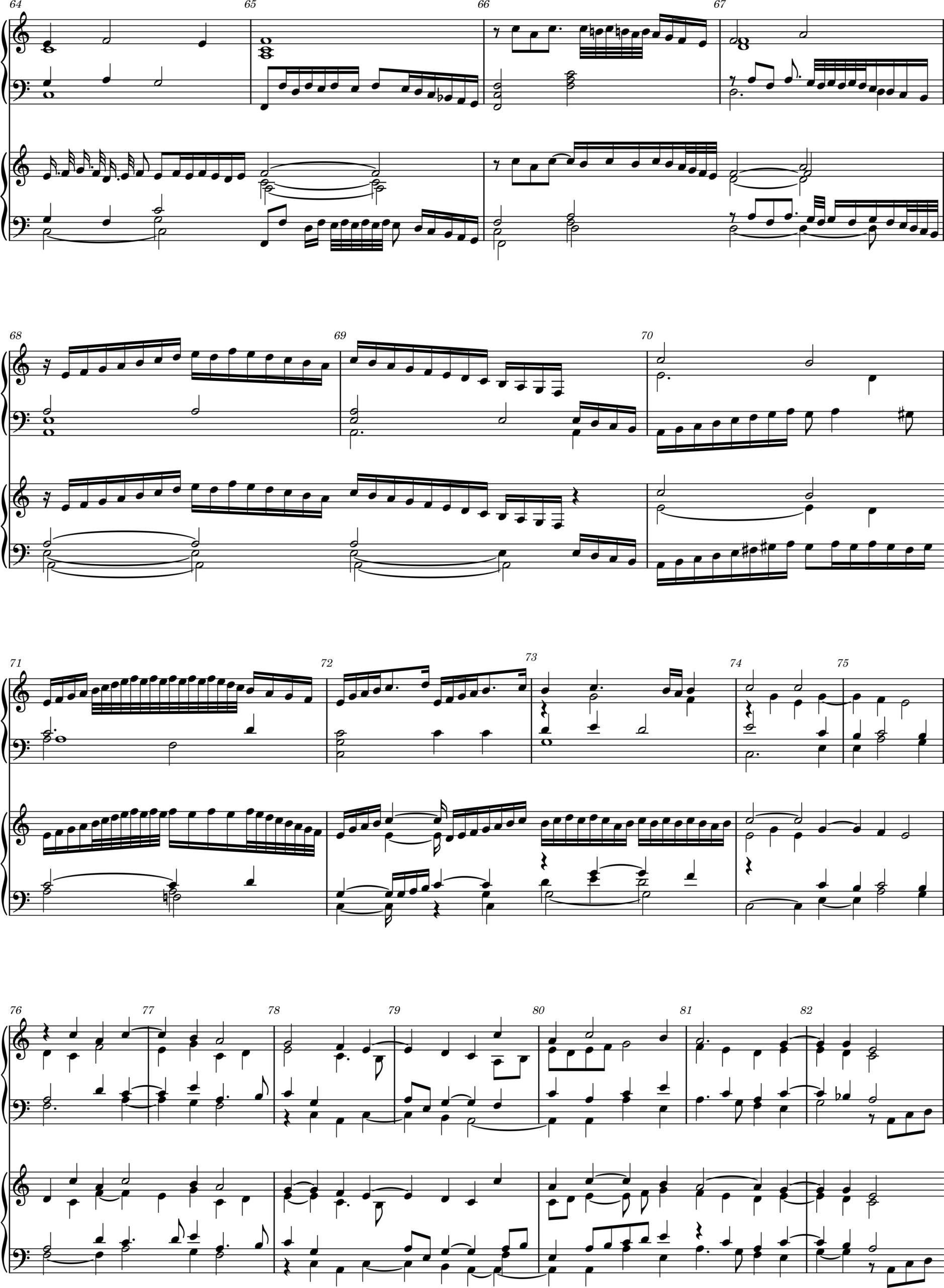
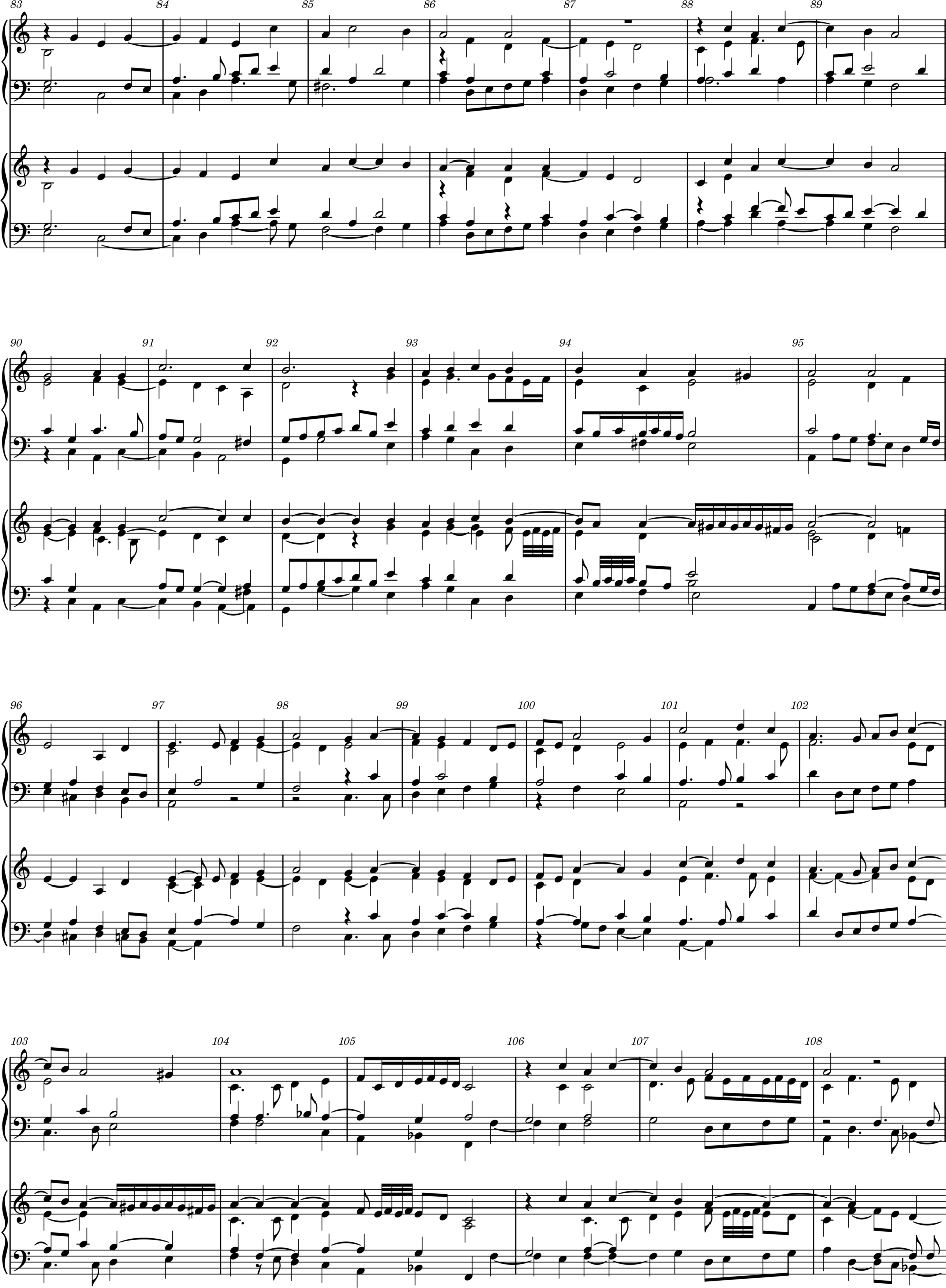
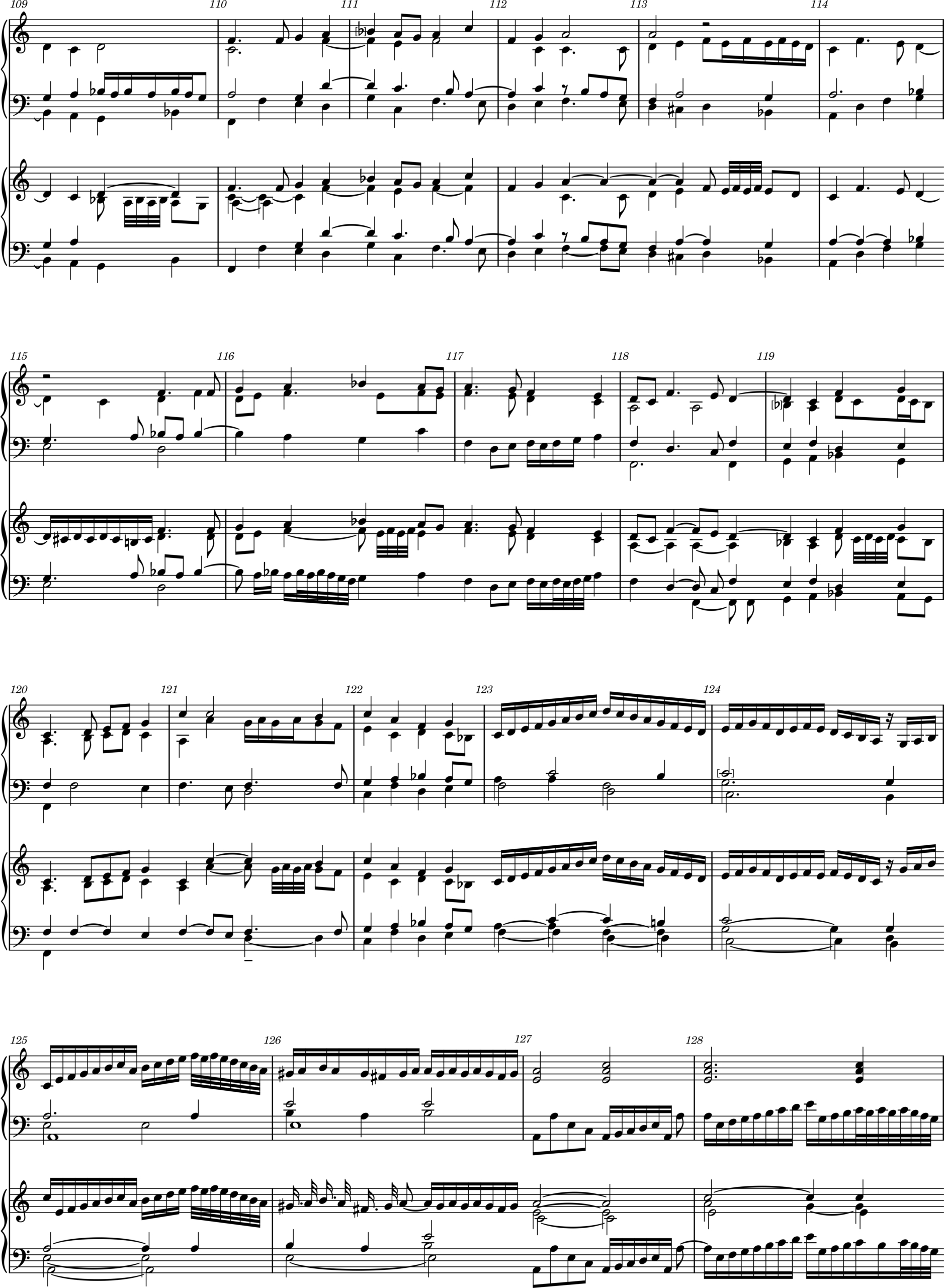
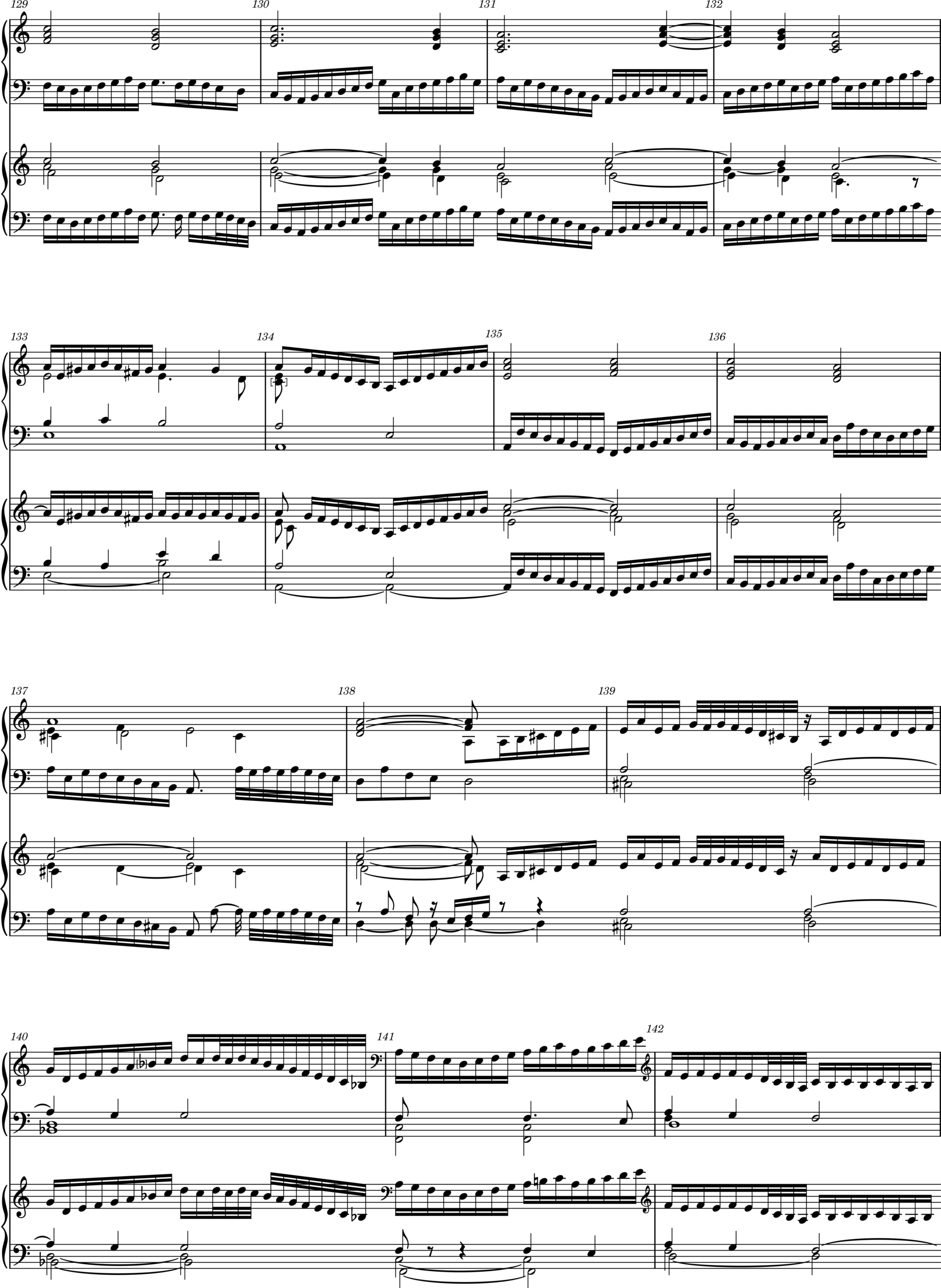
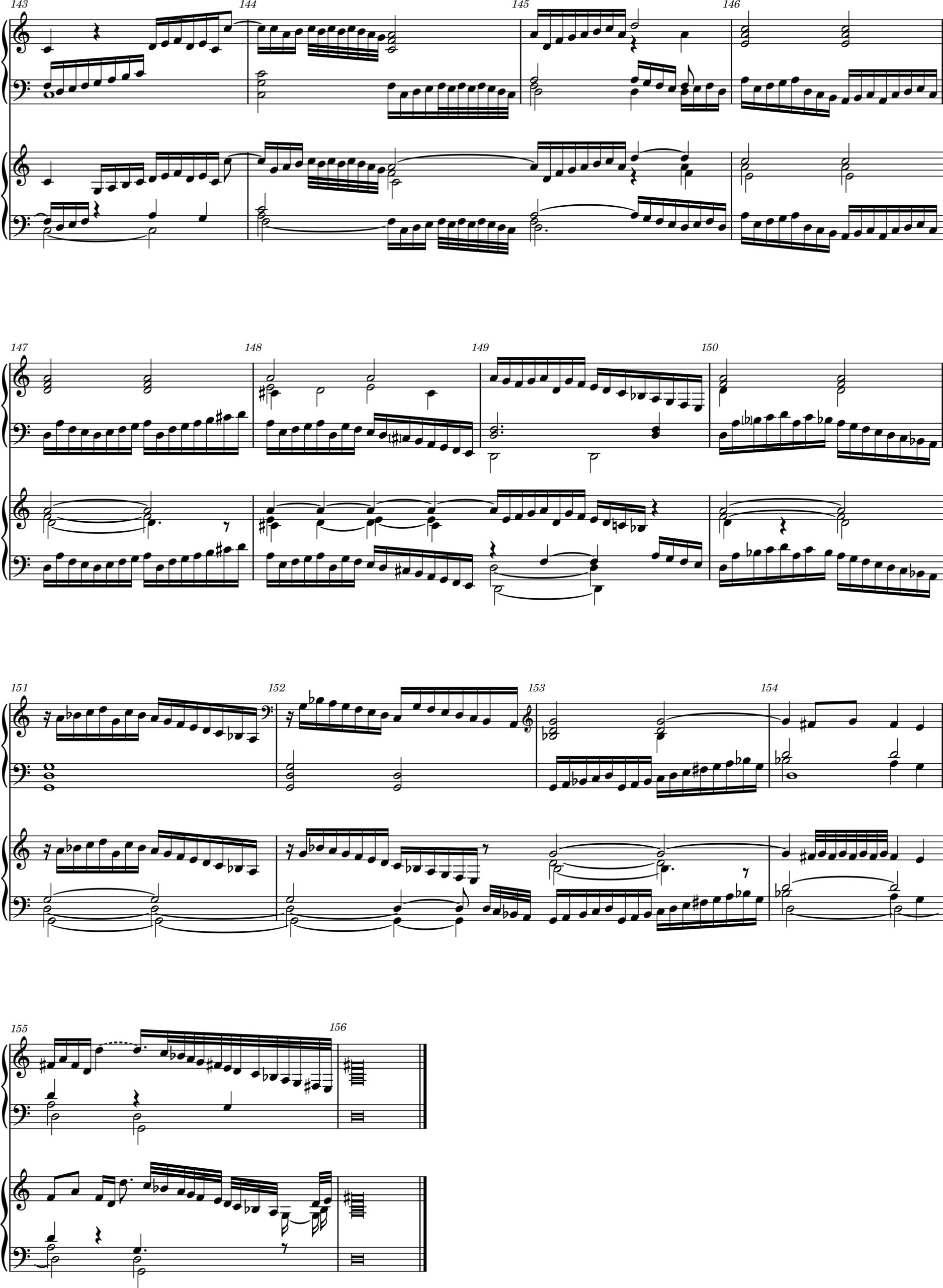
The ‘Tocata .1. toni | Clau: Correg:’on fols. 87v–89r in the Minorite Codex 714 constitutes yet another case of a manuscript text that considerably deviates from the 1598 Verovio print. Already a cursory glance at the transcription (see App.) shows, similar to the Torino tablatures, a more modest use of biscrome. However, unlike the Torino tablatures, they are not all but absent. Rather, there are passages where both versions show biscrome, sometimes in different rhythmical variants such as in mm. 67–8. In this case both versions use groups of crome and biscrome, but in reverse order. There are also passages where the Codex 714 version offers a reading with biscrome while the print version ‘reduces’ to crome – like the end of m. 19.
Like in the Torino a-versions, Codex 714 seems to prefer bigger note values instead of the remarkable abundance of (unnecessarily) tied notes in the print. Augusta Campagne has suggested25 that the ‘tie chain notation’ in the Verovio prints could be reflective of a difference in performance practice between organ and harpsichord as described, for example, by Diruta. In order not to lose ‘more than half of the harmony’ on the harpsichord, Diruta writes, keys need to be re-struck several times.26 Accordingly, perhaps the ‘tie chain notation’ is meant to be played tied on organ, but untied on harpsichord. If this was, indeed, Merulo’s intention it seems to have been introduced as part of the preparations for the Verovio prints while the earlier versions make little to no use of it.
The a-versions in the Torino tablatures feature a fascinating difference concerning the imitative sections in ‘ricercare style’. The a-version of the toccata in fourth tone omits the imitative passage altogether.27 In the toccata in eighth tone, mm. 45–50, it is retained, but notated in doubled note values.28 This has led Domen Marinčič to conclude that perhaps a change of tempo was implied in the a-version.29 In contrast, the Codex 714 version of the toccata in first tone is almost identical with the formal architecture of the print version.
It features the entire imitative section in ‘ricercare style’ in the shorter note values of the print (mm. 75–c. 125). In fact, with m. 62 it even contains one measure of musical material that is not in the print.
Unlike the a-versions of the Torino tablatures the cadences in the Codex 714 version often remain remarkably plain while the Verovio print offers much more ornamented formulas like, for example, in m. 16, 20, 26, 29, etc. It seems, of course, unlikely that the performer of Codex 714 was expected to play the plain versions. The print version, however, makes them more explicit and thus pushes an improvisatory practice more into the realm of a res facta of sorts – perhaps resulting from a change of target groups.
In summary, many questions about the Codex 714 version of the toccata remain unanswered. It is probably fair to describe the character of the print version as ‘revised’ or ‘reworked’, but the differences in this category are moderate in number and scope. More importantly, the print appears to make an effort to perhaps put in more concrete terms what the manuscript version leaves open, particularly in terms of cadential ornamentation and adaptation on a specific keyboard instrument. The question whether the publication confers the status of a ‘definitiveness’ upon the Verovio version is difficult to answer. Surely, after the urtext revolution of the 20th century we are likely inclined to accept this proposition. However, the existence of the Codex 714 version could also suggest the interpretation that both manuscript and print versions share a common nucleus that they transmit in individual manifestations. In this light, the Verovio version could be understood as exemplum for one (of many) possible renditions of Codex 714. After all, it is as a school in elegance and gracefulness that Diruta recommends Merulo’s keyboard works to his readers: ‘Et in somma chi vuol sonarlo con politezza, e leggiadria, studia l’Opere del Signor Claudio, che in quelle trouerà quel che in ciò fa bisogno.’30
Video 1: ‘The Merulo Toccata in Codex Vienna, Minorite Convent, 714’. Mario Aschauer, harpsichord. Harpsichord by Joel Katzman (Amsterdam, 1999) after Alessandro Trasuntino (Venice, 1531).Appendix
Claudio Merulo: Toccata seconda del primo tuono
Comparative transcription by Mario Aschauer
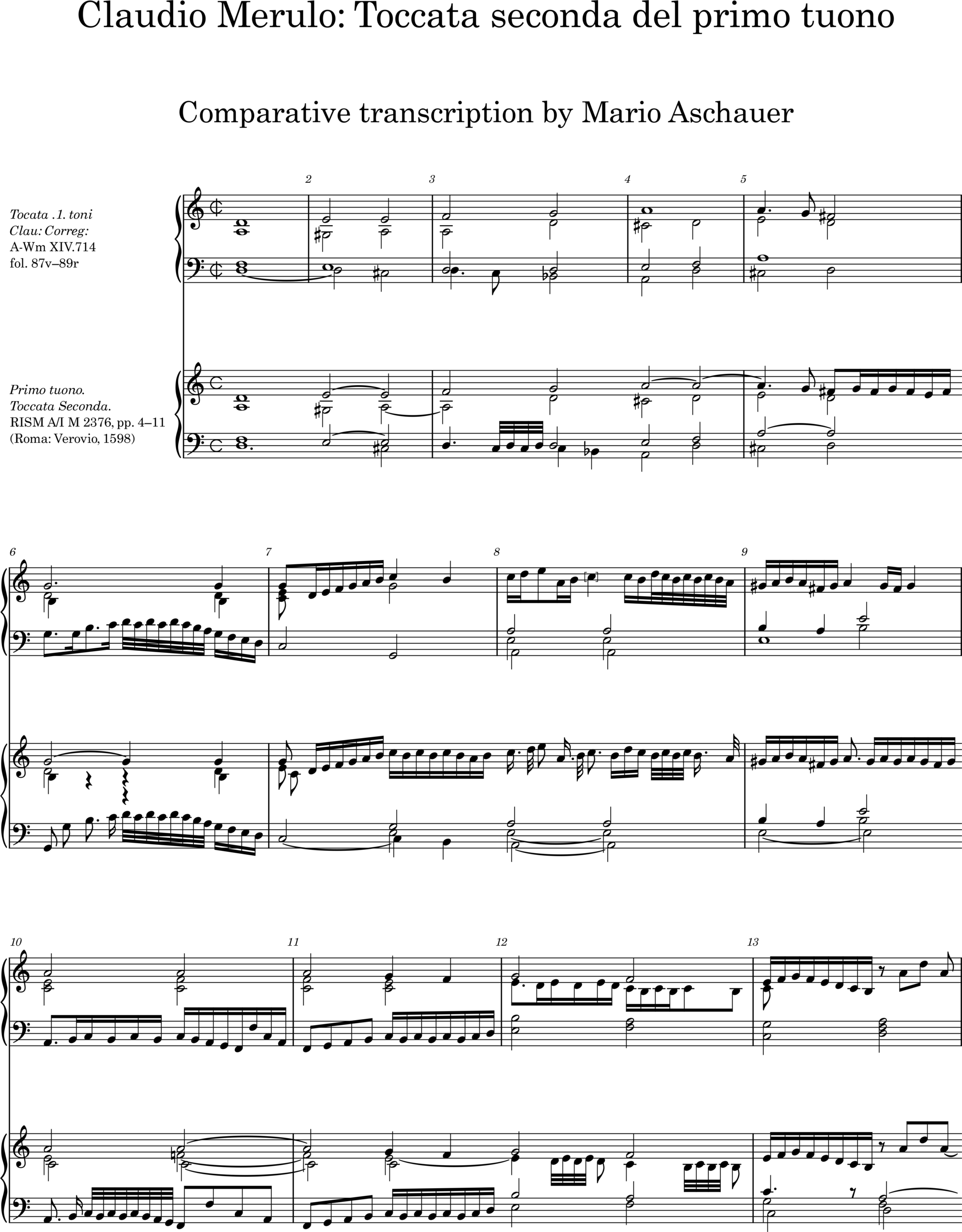
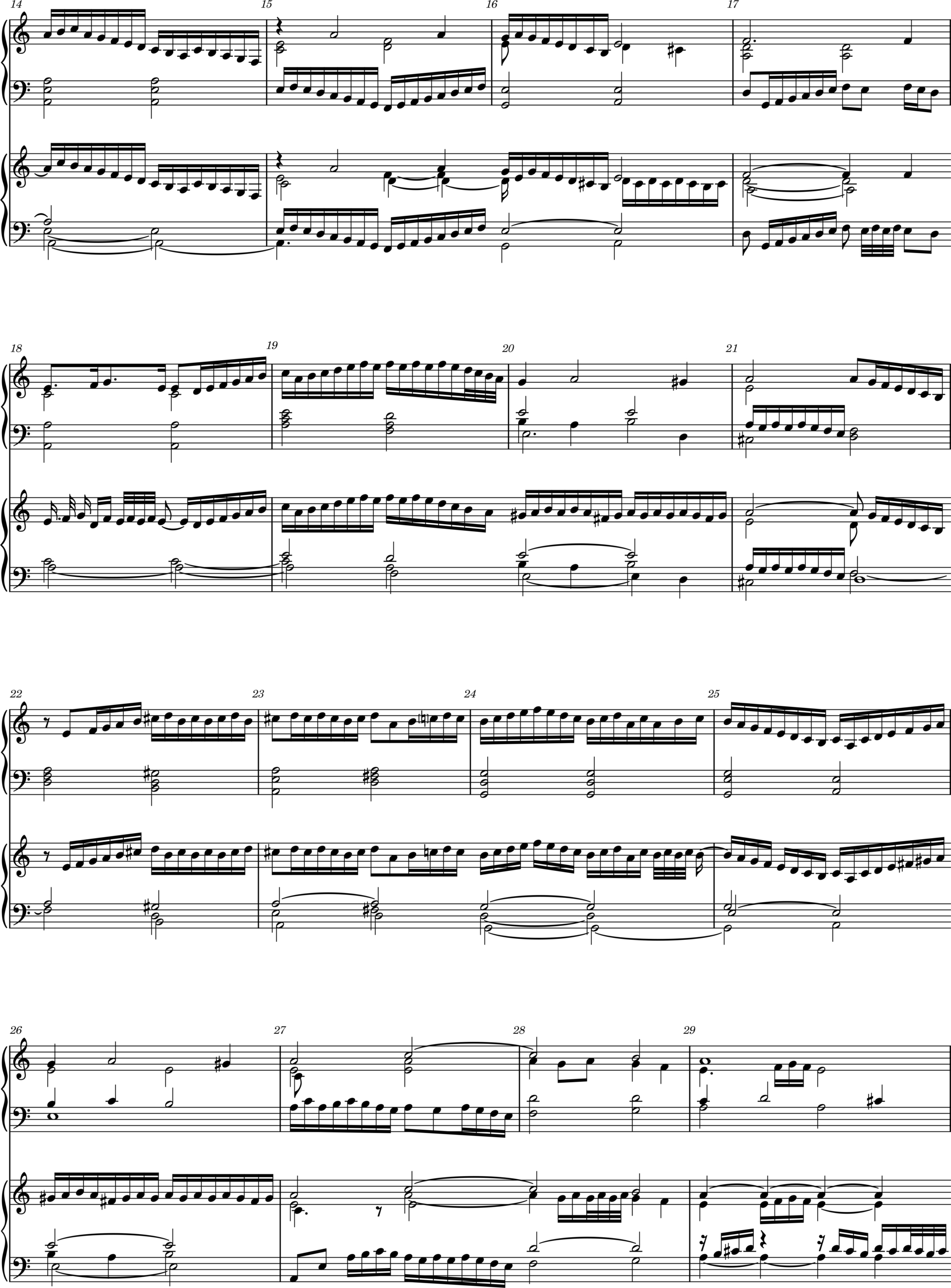
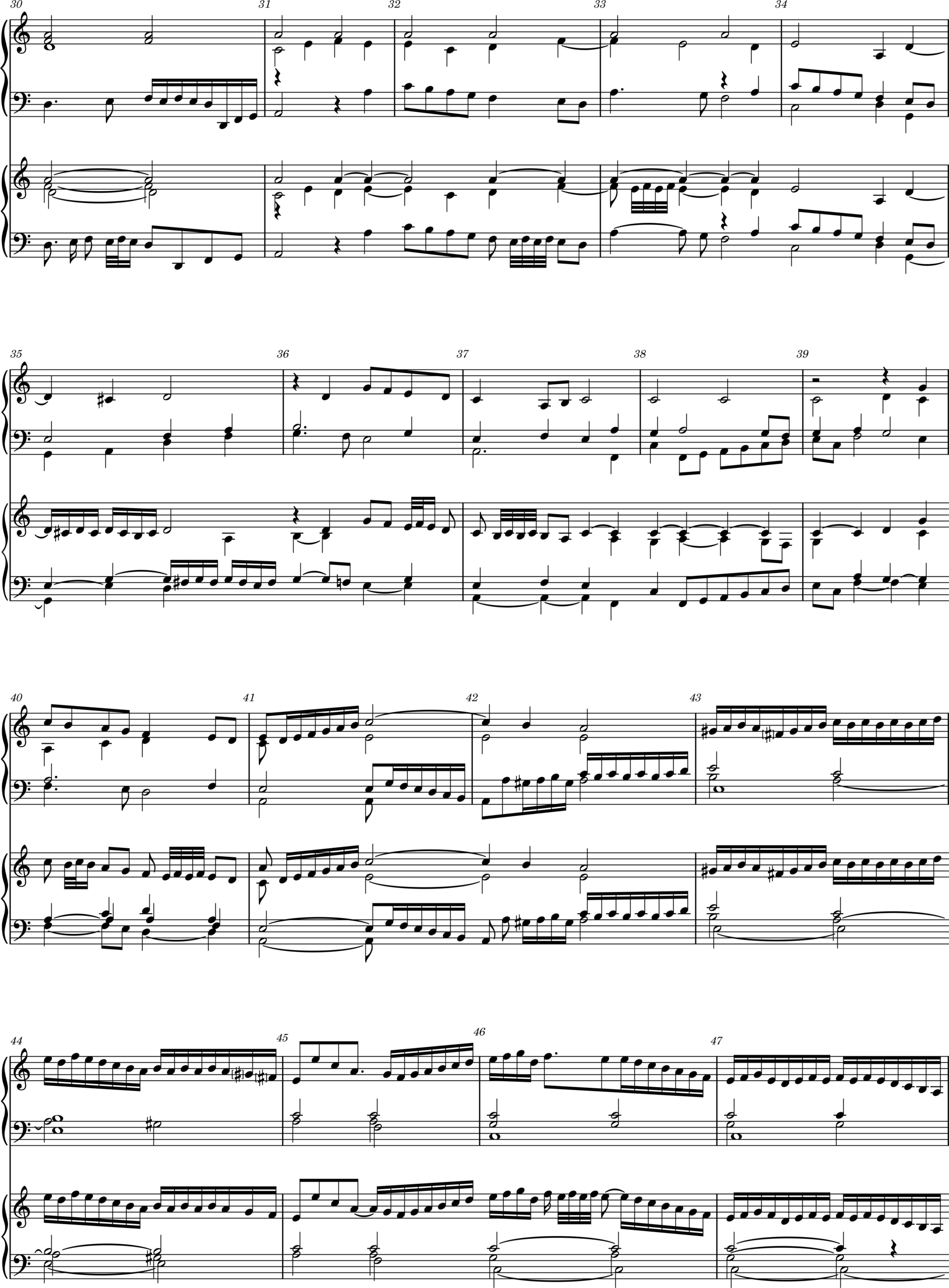
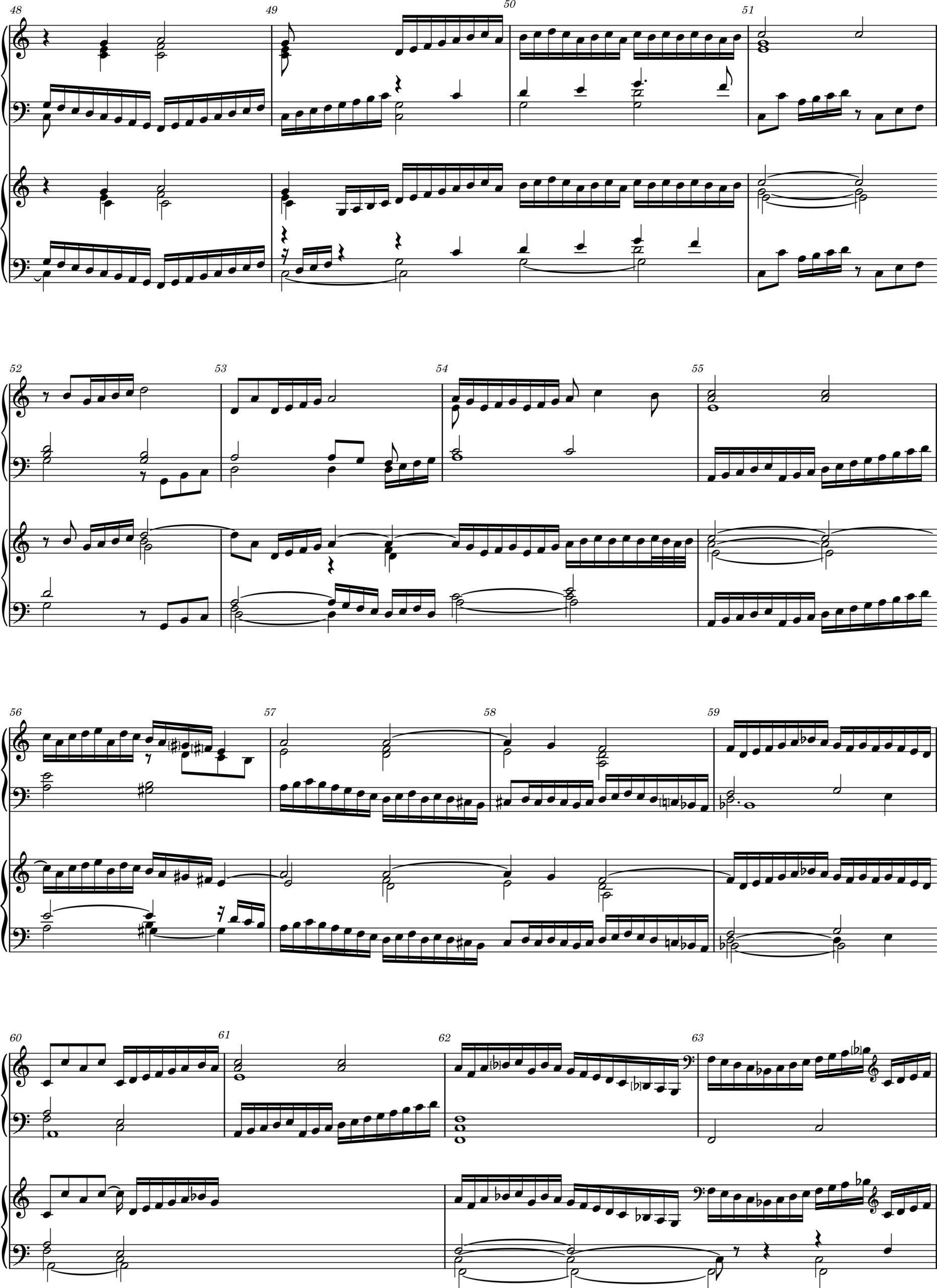
Endnotes
-
Friedrich W. Riedel, ‘Die Wiener Minoriten und ihre Musikpflege’, in: Singende Kirche 16 (1996), 161–5.↩︎
-
Friedrich W. Riedel, ‘Die Musikpflege der Minoriten’, in: 750 Jahre Minoriten in Wien: 1124–1974, ed. Landulf Honickel (Vienna, 1974), 83–90.↩︎
-
Obituary in Wienerisches Diarium, oder Nachrichten von Staats, vermischten, und gelehrten Neuigkeiten 49 (18 June 1766), 5–6, <https://anno.onb.ac.at/cgi-content/anno?aid=wrz&datum=17660618&seite=5&zoom=33> (accessed on 20 Dec. 2024): ‘Donnerstag den 12. dieses [i.e., 12 June 1766] ist in dem Herrn entschlaffen, der Wohlehrwürdige P. Alexander Giessel, Minoritenordens der österreichischen Provinz, Chorregent in dem Kloster zum H. Kreutz allhier, welcher durch die von ihm mit ungemeiner Mühe und Fleiß gemachte vortreffliche Sammlung von Seltenheiten der Natur, Conchilien, und andern Meergewächsen, Mineralien, Versteinerungen, Marmor und Steinerten, Alterthümern, alten Münzen, neuern Schaupfenningen, Kupferstichen, antiquen Steinen von eingeschnittener und erhabener Arbeit, Kunst und Meisterstücken etc. welches alles beysammen in dem Klostermuseo zu sehen ist, sich vielen Verdienst und bey der gelehrten Welt Ruhm erworben hat, in dem 73. Jahr seines Alters.’ (Translation by the author).↩︎
-
Friedrich W. Riedel, Das Musikarchiv im Minoritenkonvent zu Wien (Katalog des älteren Bestandes vor 1784), Catalogus Musicus I (Kassel, 1963), 43–72.↩︎
-
Robert Hill (ed.), Vienna, Minoritenkonvent, Klosterbibliothek und Archiv, MS XIV.714, 17th-Century Keyboard Music: Sources Central to the Keyboard Art of the Baroque 24 (New York/London, 1988), xi–xxv.↩︎
-
Lydia Schierning, Die Überlieferung der deutschen Orgel- und Klaviermusik aus der ersten Hälfte des 17. Jahrhunderts, Schriften des Landesinstituts für Musikforschung Kiel 12 (Kassel, 1961), 60–2 and 117–24; and Hill, Vienna, Minoritenkonvent,v.↩︎
-
Jan Pieterszoon Sweelinck, Complete Organ and Keyboard Works, ed. Siegbert Rampe, vol. 1.2: Toccatas (Kassel, 2003), vi–vii.↩︎
-
Riedel, ‘Die Musikpflege der Minoriten’ (see n. 2), 85.↩︎
-
Mario Aschauer, ‘“Study, practice, and a reasonable working method”: Toward a History of Creative Process Pedagogy Between 1500 and 1850’, in: The Oxford Handbook of the Creative Process in Music, ed. Nicolas Donin (online ed., Oxford Academic, 8 May 2018), <https://doi-org.ezproxy.rice.edu/10.1093/oxfordhb/9780190636197.013.11> (accessed on 21 Sept. 2024).↩︎
-
Vincent J. Panetta, ‘Hans Leo Hassler and the Keyboard Toccata: Antecedents, Sources, Style’, PhD diss., Harvard University, 1991, 218–50.↩︎
-
Pieter Dirksen, The Keyboard Music of Jan Pieterszoon Sweelinck: Its Style, Significance and Influence (Utrecht, 1997), 68–73.↩︎
-
Markus Grassl, ‘Luythons Instrumentalmusik: Anmerkungen zu Autorschaft und Kontext’, in: Clavibus unitis 10/3 (2021), 75–98, <https://www.acecs.cz/media/cu_2021_10_03_grassl.pdf> (accessed on 20 Dec. 2024); idem, ‘Paralipomena zur Instrumentalmusik im Umkreis Rudolfs II.: Liberale Zanchi und seine Canzonen in A-Wm XIV.714’, in: Wiener Musikgeschichte. Annäherungen – Analysen – Ausblicke. Festschrift für Hartmut Krones zum 65. Geburtstag, ed. Julia Bungardt, Maria Helfgott, Eike Rathgeber and Nikolaus Urbanek (Vienna/Cologne/Weimar, 2009), 67–86.↩︎
-
Siegbert Rampe (ed.), Organ and Keyboard Music at the Salzburg Court 1500–1800 (Kassel, 2005), vi.↩︎
-
Siegbert Rampe (ed.), Organ and Keyboard Music of the Imperial Court Chapel Vienna, 1500–1700: Collection of First Editions (Kassel, 2006), viii.↩︎
-
A selection of unica from the Codex is featured on my album Keyboard Music from Codex Vienna, Minorite Convent, 714 (Aulicus Classics 2022).↩︎
-
Claudio Merulo, Toccate d’intavolatura d’organo […] libro primo (Rome: Simone Verovio, 1598), 33–8, <https://www.digitale-sammlungen.de/de/details/bsb00094272> (accessed on 20 Sept. 2024).↩︎
-
I-Tn Mss. Giordano 2.↩︎
-
Robert Floyd Judd, ‘The Use of Notational Formats at the Keyboard: A Study of Printed Sources of Keyboard Music in Spain and Italy c. 1500–1700, Selected Manuscript Sources Including Music by Claudio Merulo, and Contemporary Writings Concerning Notations’, 2 vols., PhD diss., University of Oxford, 1989, ii, 238–71, <https://www.academia.edu/attachments/50221810/download_file?st=MTcyMjY5NDI1Miw4MC4xMDkuMjM4LjIwMCwxMzcxNjE5&s=profile> (accessed on 15 Oct. 2024).↩︎
-
Claudio Merulo, Toccate d’intavolatura d’organo […] libro secondo (Rome: Simone Verovio, 1604), 34–8, <https://mdz-nbn-resolving.de/details:bsb00094273> (accessed on 20 Sept. 2024).↩︎
-
Judd, ‘The Use of Notational Formats’ (see n. 18), 255.↩︎
-
Ibid., 270.↩︎
-
Claudio Merulo, Ricercari d’intavolatura d’organo […] libro primo (Venice, 1567).↩︎
-
Luigi Collarile, ‘Claudio Merulo nell’intavolatura tedesca di Torino: Il problema delle fonti’, in: Organo pleno: Festschrift für Jean-Claude Zehnder zum 65. Geburtstag, ed. Luigi Collarile and Alexandra Nigito (Bern, 2007), 89–112, at 103.↩︎
-
Ibid., 111.↩︎
-
Private communication with Augusta Campagne. A corresponding publication is forthcoming.↩︎
-
Girolamo Diruta, Il Transilvano dialogo sopra il vero modo di sonar organi, & istromenti da penna (Venice: Giacomo Vincenti 1593), 6, <http://hdl.loc.gov/loc.music/muspre1800.100422> (accessed on 25 Sept. 2024).↩︎
-
Judd, ‘The Use of Notational Formats’ (see n. 18), 243–8.↩︎
-
Ibid., 265–6.↩︎
-
Domen Marinčič, ‘“Nach seinem selbst gefallen mit der Mensur wexln”: Instances in Sixteenth-Century Keyboard Music Where Ornamentation and Changing Note Values Might Induce the Player to Vary the Beat’, in: ‘Universum rei harmonicae concentum absolvunt’: The Harpsichord in the Sixteenth Century, ed. Augusta Campagne and Markus Grassl (Vienna, 2024), 79–111, at 89–90, <https://www.mdw.ac.at/mdwpress/mdwp003-ornamentation-note-values/> (accessed on 22 Sept. 2024).↩︎
-
Diruta, Il Transilvano (see n. 26), 6.↩︎
Bibliography
Mario Aschauer, ‘“Study, practice, and a reasonable working method”: Toward a History of Creative Process Pedagogy Between 1500 and 1850’, in: The Oxford Handbook of the Creative Process in Music, ed. Nicolas Donin (online ed., Oxford Academic, 8 May 2018), <https://doi-org.ezproxy.rice.edu/10.1093/oxfordhb/9780190636197.013.11>
Luigi Collarile, ‘Claudio Merulo nell’intavolatura tedesca di Torino: Il problema delle fonti’, in: Organo pleno: Festschrift für Jean-Claude Zehnder zum 65. Geburtstag, ed. Luigi Collarile and Alexandra Nigito (Bern, 2007), 89–112
Pieter Dirksen, The Keyboard Music of Jan Pieterszoon Sweelinck: Its Style, Significance and Influence (Utrecht, 1997)
Girolamo Diruta, Il Transilvano dialogo sopra il vero modo di sonar organi, & istromenti da penna (Venice: Giacomo Vincenti 1593), <http://hdl.loc.gov/loc.music/muspre1800.100422>
Markus Grassl, ‘Luythons Instrumentalmusik: Anmerkungen zu Autorschaft und Kontext’, in: Clavibus unitis 10/3 (2021), 75–98, <https://www.acecs.cz/media/cu_2021_10_03_grassl.pdf>
Markus Grassl, ‘Paralipomena zur Instrumentalmusik im Umkreis Rudolfs II.: Liberale Zanchi und seine Canzonen in A-Wm XIV.714’, in: Wiener Musikgeschichte. Annäherungen – Analysen – Ausblicke. Festschrift für Hartmut Krones zum 65. Geburtstag, ed. Julia Bungardt, Maria Helfgott, Eike Rathgeber and Nikolaus Urbanek (Vienna/Cologne/Weimar, 2009), 67–86
Robert Hill (ed.), Vienna, Minoritenkonvent, Klosterbibliothek und Archiv, MS XIV.714, 17th-Century Keyboard Music: Sources Central to the Keyboard Art of the Baroque 24 (New York/London, 1988)
Robert Floyd Judd, ‘The Use of Notational Formats at the Keyboard: A Study of Printed Sources of Keyboard Music in Spain and Italy c. 1500–1700, Selected Manuscript Sources Including Music by Claudio Merulo, and Contemporary Writings Concerning Notations’, 2 vols., PhD diss., University of Oxford, 1989, <https://www.academia.edu/attachments/50221810/download_file?st=MTcyMjY5NDI1Miw4MC4xMDkuMjM4LjIwMCwxMzcxNjE5&s=profile>
Domen Marinčič, ‘“Nach seinem selbst gefallen mit der Mensur wexln”: Instances in Sixteenth-Century Keyboard Music Where Ornamentation and Changing Note Values Might Induce the Player to Vary the Beat’, in: ‘Universum rei harmonicae concentum absolvunt’: The Harpsichord in the Sixteenth Century, ed. Augusta Campagne and Markus Grassl (Vienna, 2024), 79–111, <https://www.mdw.ac.at/mdwpress/mdwp003-ornamentation-note-values/>
Claudio Merulo, Ricercari d’intavolatura d’organo […] libro primo (Venice, 1567)
Claudio Merulo, Toccate d’intavolatura d’organo […] libro primo (Rome: Simone Verovio, 1598), <https://www.digitale-sammlungen.de/de/details/bsb00094272>
Claudio Merulo, Toccate d’intavolatura d’organo […] libro secondo (Rome: Simone Verovio, 1604), <https://mdz-nbn-resolving.de/details:bsb00094273>
Vincent J. Panetta, ‘Hans Leo Hassler and the Keyboard Toccata: Antecedents, Sources, Style’, PhD diss., Harvard University, 1991
Siegbert Rampe (ed.), Organ and Keyboard Music at the Salzburg Court 1500–1800 (Kassel, 2005)
Siegbert Rampe (ed.), Organ and Keyboard Music of the Imperial Court Chapel Vienna, 1500–1700: Collection of First Editions (Kassel, 2006)
Friedrich W. Riedel, Das Musikarchiv im Minoritenkonvent zu Wien (Katalog des älteren Bestandes vor 1784), Catalogus Musicus I (Kassel, 1963)
Friedrich W. Riedel, ‘Die Musikpflege der Minoriten’, in: 750 Jahre Minoriten in Wien: 1124–1974, ed. Landulf Honickel (Vienna, 1974), 83–90
Friedrich W. Riedel, ‘Die Wiener Minoriten und ihre Musikpflege’, in: Singende Kirche 16 (1996), 161–5
Lydia Schierning, Die Überlieferung der deutschen Orgel- und Klaviermusik aus der ersten Hälfte des 17. Jahrhunderts Schriften des Landesinstituts für Musikforschung Kiel 12 (Kassel, 1961)
Jan Pieterszoon Sweelinck, Complete Organ and Keyboard Works, ed. Siegbert Rampe, vol. 1.2: Toccatas (Kassel, 2003)
Wienerisches Diarium, oder Nachrichten von Staats, vermischten, und gelehrten Neuigkeiten 49 (18 June 1766)