
How to cite
How to cite
Outline
Outline

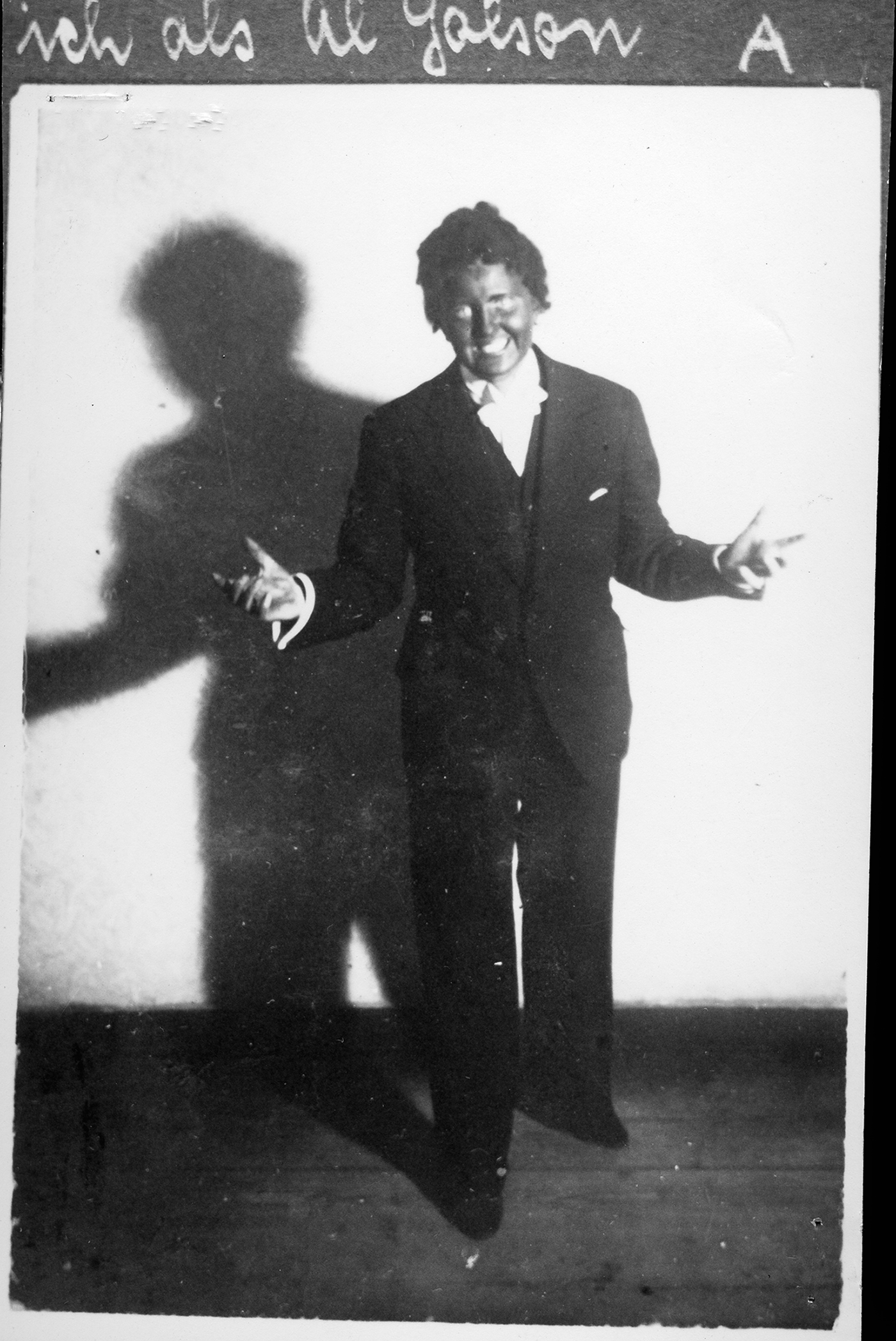
Figure 14: Eva Braun, presumably at Studio Heinrich Hoffmann, ca. 1928/29. Photograph from Braun’s private album, Heinrich Hoffmann Collection, Bayerische Staatsbibliothek, Munich (hoff-333).
“ich als Al Jolson”—“me as Al Jolson”—is the handwritten caption above a black-and-white album photo. The image shows a smiling white woman in drag, staging herself as someone else—in a man’s suit, with a blackened face and a frizzy wig. Her “me” (“ich”) in the title appears unequivocal, presented clearly in a mode of as-if, and thus set apart from the name of the “other,” Al Jolson.189 On the white wall in the background, her shadow double can be seen leaning slightly forward, as if dancing, while her upright, somewhat stiff body standing on nondescript wooden planks seems to have been still at the moment the shot was taken. Someone has been posing for the camera, arms outstretched, weight shifted onto the front foot.
The gesture depicted here, the position of the arms, can be read as a restaging of The Jazz Singer (1927), with Al Jolson in the leading role. As emphasized in advertising posters for this first officially distributed sound film, which was also shown in Cape Town around that time, the photo appears to evoke Jolson’s gestural repertoire. The backstage film being referenced here presented vaudeville music as a creolized melting pot, while visually excluding Black actors.190 In the film, blackface was used to portray the son of a cantor from a religious family, who entered the Broadway scene from the bars of precarious Lower Manhattan—an impoverished predominantly Eastern European Jewish neighborhood—by way of the vaudeville theater. Both the film’s plot and Jolson’s biography seem to figure in this photograph. In any case, the person depicted is imitating Jolson with a mixture of somewhat awkward and perhaps also resentful laughter.
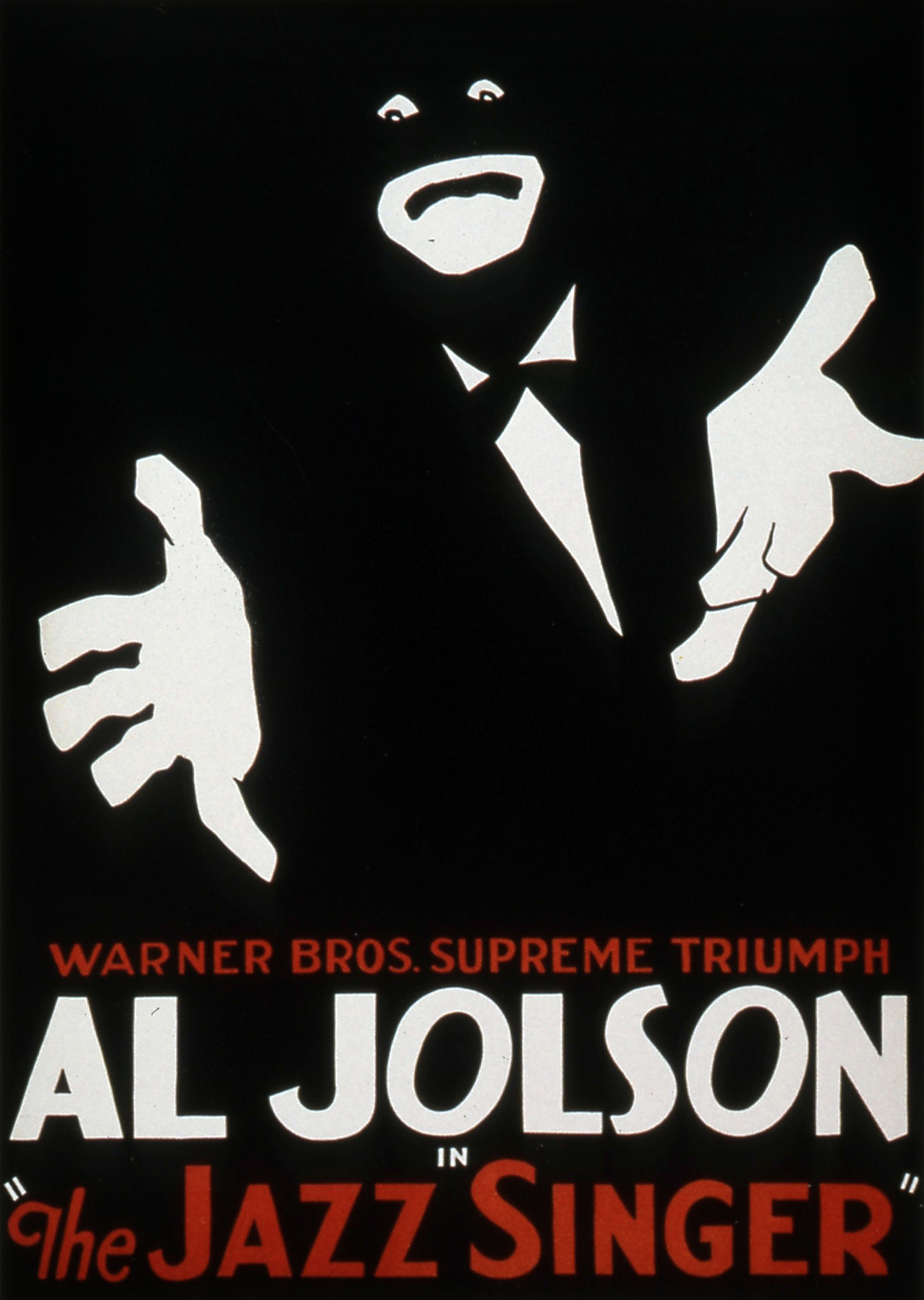
Figure 15: Advertising poster, The Jazz Singer, 1927. William Auerbach-Levy, Bridgeman Images.
The Jazz Singer introduces Jackie Rabinowitz as a creolized figure who grows up with ragtime in New York and eventually becomes a star against his father’s wishes. Played by one of the most famous contemporary blackface actors, the persona is authenticated and marketed through Rabinowitz’s biography. Born Asa Yoelsen in the then-Russian town of Srednik, Jolson himself rose from the son of a cantor to become a US entertainment icon. His cinematic alter ego allegorizes the historical entanglement of migrant Eastern European Jews and Black music within a new mass culture. On the eve of the Nazis’ seizure of power, the photo echoes this entanglement.
It serves as a counterpart to Kewpie’s friendly, defiant drag scene and his seemingly conspiratorial laughter in a pose that visualizes creolization, as discussed in the previous chapter. When placed in context, by contrast, this studio shot exemplifies the potentially pejorative use of creolized forms of performance. Clearly staged, it can be read, together with the caption, as an equivalential chain of resentments191—stereotypically staging all kinds of “others”: as a Widerspiel,192 that is, a counterperformance, to minor mimesis; as a pejorative “false projection,” to borrow from Theodor W. Adorno’s and Max Horkheimer’s “Elements of Anti-Semitism” in their Dialektik der Aufklärung (Dialectic of Enlightenment). At least retrospectively, this dragging ties itself to National Socialist propaganda—that is to say, it schlepps a specific reference to antisemitism along.
To open this chapter on Nazism, I read the short-circuiting of gender bending and blackfacing in this photograph as a reaction to creolization in the German interwar period, to then discuss related modes of “drag” in entertainment culture, propaganda, and cultural studies of the time. The invention of a Nazi modernity of its own will prove to be the flipside of gender bending and color bending within a mass culture that had long since been globalized. While the first chapter explored queer-creolized forms of appearance in the context of apartheid as critical theory put into practice, this chapter traces the lines of flight of exclusionary devaluation, of exoticisms and Eigentlichkeit, which one might loosely translate as fictitious authenticity, within a complementary configuration of allegedly dirty dragging.
Braun (Brown)
In 2011, the photo caused a scandal in contemporary new media.193 As a supposedly sensational find, it has since circulated on the internet as an obscene illustration of National Socialist racism; in this reception, blackface was perceived as an iconic, suprahistorical sign of an unchanging antiblack racism. In this sense, the image appears as appropriative, racialized dragging. Often dated to 1937, however, the photo also tells something about today’s conditions of reception: the decontextualized availability of archival material and the back-projections of contemporary discourses, which tend to occlude questions of local and historiographical situatedness, as well as questions of aesthetic differences. And indeed, the image is more complex than its reception suggests. It refers to Weimar mass culture, while—through its caption—linking the visualization of blackface in drag to a Jewish figure.
The copy photograph shows a young photo lab assistant, unknown at the time, who became a public persona only after 1945, and thus posthumously. Apparently shot in Munich, the original must have been taken shortly after the German film release of The Jazz Singer around 1928/29—according to the catalog of the Bayerische Staatsbibliothek in Munich. The archive later added an additional caption: “in Faschingskostüm” (“in carnival costume”).194 As a photograph retaken from an album, the picture with the caption above it can be found in the collection of Heinrich Hoffmann, who was already shaping Nazi visual politics—especially depictions of the Führer—at the time.195 The photo was therefore apparently first shot in the studio that determined the graphic aesthetics of Nazi organs such as the Völkischer Beobachter—and presumably by the same photographer who was already responsible for the antisemitic weekly Auf gut deutsch—roughly: “In plain German”—and helped shape the Nazi image empire.
The frontal, professional photograph, taken slightly from above, shows Eva Braun, who would later meet Adolf Hitler in Hoffmann’s studio, but would remain absent from official Nazi imagery until 1945.196 Read against this background, a specific relation comes into play: the relationship between the photograph—which seems to have been intended for private use only—and later propaganda images, in which the minstrel mask and the staging of the colonized diverge. As will be shown in more detail later, the grotesque mask of blackface was not only specifically gendered but also charged with antisemitic resentments in the Nazi era, and was thus mobilized as the allegedly terrifying image of the creolization of Europe.197
This photo comes from Braun’s private album with caption. It can be found as image 27A in album 33 of the thirty-five albums confiscated from U.S. soldiers, which ended up in the U.S. National Archives (Washington, DC) after 1945.198 The photograph itself is visibly staged. Carefully lit from the top right, it plays with Braun’s oblique shadow. And it is this shadow which may evoke the Cake Walk, and possibly also posters from Friedrich Wilhelm Murnau’s Nosferatu—Eine Symphonie des Grauens (A Symphony of Horror, 1922), or images from the Schwarze Schmach (black shame) campaign against French colonial soldiers during World War I—that is, the visually staged hauntings of German femininity by dark creatures.199 Braun’s shadow in the background thus still recalls visual tropes from the Weimar period that can be associated with antisemitism and racism. In contrast, however, Braun’s bodily appearance does not directly cite these stereotypes, but rather, in the name of Al Jolson, the mask popularized in Cape Town as a counterimage to prevailing social conditions.
And in Braun’s photo, as well, blackface remains legible as the sign of transoceanic mass culture.200 However, her image in drag also gestures toward the formation of a specific visual politics in the wake of Nazism and can be read as a particular form of right-wing carnivalization. Her cross-dressing in blackface, taken in Hoffmann’s studio, was apparently rephotographed along with the caption during the Nazi era—from the backstage of power, so to speak. Returned to Hoffmann’s studio as a private souvenir of earlier times, “me as Al Jolson” does not function as a simple racist depiction or a straightforward denigration of dark skin. Rather, Braun in drag seems to project onto the visual history of European urban Jewishness—marked by forced migrations and creolization—an artificially blackened face, via the explicitly evoked name of “the Other.” The image can be read as transposing the label of creolized entertainment from the United States into a sign of nongenealogical appearance. In drag, in a man’s suit, Braun invokes the exemplary figure of “the Jew” as someone “without a tribe.” Seen in this light, it concerns perhaps less the dynamic of “love and theft,” as Eric Lott describes the affectively charged use of African American music and carnivalesque performance traditions by white minstrels in the United States.201 This “love” notwithstanding, the image also drags antisemitic projections into transoceanic modern mass culture in its citation of cross-dressing and blackface referencing Jolson.
Signifying the color brown, Braun’s surname can in this context be associated with a kind of mock-browning. Her cross-dressing can be read within the specific visual context of the shoot—“brown,” that is, Nazi visual politics—as a play with referential ambivalence and, simultaneously, as a gesture of empowerment. This staging in front of the camera thus potentially also functions as a mockery of equivalential figurations of Blackness, of queerness, of Jewishness.202 The image, however, does not so much invert the hegemonic white position into what Ernesto Laclau’s On Populist Reason describes as the constitutively unrepresentable—“a void within signification”—in order to evoke “the people” as an empty signifier.203 Instead, blackface here may have become an empty signifier of resentment, conflating arbitrary forms of Othering with notions of sexual deviance and with modern mass culture as miscegenation. Accordingly, the representational registers of anti-Judaism and colonialism have become obsolete. Neither hooked-nose nor jungle stereotypes appear in the picture; the memory of them lingers at most in Braun’s shadow. Rather, the image invokes a vision of modern, transgressive dirtiness, in which women and men appear just as indistinguishable as “non-Aryans” and “Germans.” In this context, blackface can be read through Braun’s inscriptio as a modernized sign of supposed Jewish mimicry. Linked to Hoffmann’s studio, Jolson’s name in Braun’s title becomes the “ground of the thing”:204 On Populist Reason brushed against the grain—the empty signifier not of “the people,” but of its precondition: the invented alien who is presumed to be perpetually disguised and thus to be banished beyond the carnival.
Shot in the photo studio of an alter Kämpfer, an early member of the Nazi movement, and photographed again with a reference to Jolson, the image inverts US racial dynamics—the separation of black and white—that The Jazz Singer is often seen to epitomize. According to Michael Rogin’s influential reading, the film portrays Jewish upward mobility while simultaneously erasing the presence of the Black US population. It thereby testifies to how becoming white entails exclusion via disfiguration of an invented Other, specifically via blackface. In his book Blackface, White Noise, perhaps the most well-known interpretation of The Jazz Singer, Rogin ultimately sees the film as a continuation of racist minstrel shows and a mass cultural depoliticization of creolized mimetic practices. He argues that the narrative portrays the complicity of Jewish immigrants by integrating into the white majority, achieved through the appropriation of early US mass culture, the performance of masculinity, and the overcoming of their own exclusion: “Blackface … allows the protagonist to exchange selves …. Blackface is the instrument that transfers identities from immigrant Jew to American. By putting on blackface, the Jewish jazz singer acquires … first his own voice, then assimilation through upward mobility, finally women.”205
The blackface in drag, taken at the Hoffmann photo studio and presumably sent back from Obersalzberg, Hitler’s private mountain retreat, makes Braun appear as the personification of “the Other” in its multiple figurations—as Black, Jewish, queer. Braun’s blackface seems to cast Jolson as the allegorization of “the Jew,” effeminized in drag, in keeping with common antisemitic stereotypes. In my reading, the antisemitic operation staged by the photo and its caption inverts Rogin’s interpretation. It instead presents a fundamentally different conception of whiteness—a Nazi-specific vision of supremacy.206 Braun in drag is not about the integration of a Jewish immigrant into white American show business through the visual exclusion of Black performers. Rather, the caption equates the blackened face with the invisible Jewish face, portraying it as fake and making it visible as dirty. Situated within the Nazi context, “me as Al Jolson” allegorizes a different kind of resentment. The Othering inscribed in Jolson’s blackface, as Rogin interprets it, is here performatively reversed and charged with antisemitism, redirecting its force back onto Jolson whose gesture is cited.
Referentiality shifts here from skin color to dirtiness—also as an aesthetic form, as minor mimesis. Braun’s conspicuously blackened hands in the photograph makes this clear. In addition to white gloves—the usual minstrel sign featured in The Jazz Singer’s promotional poster—the image evokes Jolson’s self-referential song “Dirty Hands, Dirty Face.” It marks the film’s transformation of Jackie Rabinowitz into the celebrated American entertainer Jack Robin after growing up in a working-class slum, or rather in a neighborhood of the lumpen, the ragtag proletariat, that is, within earshot of the Black community and their creolized music. Braun’s drag transposes the gestural repertoire of the singing figure in the so-called Coffee Dan scene, which is also featured in the poster, into a blackface performance. The lyrics of “Dirty Hands, Dirty Face,” however, are ostensibly not about black skin or minstrel masks;207 instead, a father sings about his child getting dirty while playing. Whereas Rogin critiques the theft of Black music, the song itself suggests an alternative logic: it reframes the white entertainment industry’s obscene love for creolized music—as outlined by Lott—into a sanitized version suitable for underage viewers. The music in this first officially distributed sound film is stripped of almost all syncopation and anything reminiscent of jazz, blues, swing, or ragtime. In this sense, blackface in the film visually represents the domestication of a specific “dirtiness,” which is then commented on in the song “Dirty Hands, Dirty Face.”
Both Braun’s captioned photograph and Jolson’s backstage film scenes are shaped by modes of framing designed to keep mask play from being perceived as—to use Walter Lhamon’s words—“too slippery and multisignificant to police.”208 Their aesthetics are akin and linked to a specific episteme. Both photo and film seem governed by the belief that one can clearly distinguish between one’s own face and the mask of another. And this fantasy of a singular, authentic face is tied to a specific sense of temporality allowing for controlled interruption. The caption above the Hoffmann studio image reflects the promise that Braun’s “filthy,” transgressive play will end by Ash Wednesday at the latest. This stands in contrast to the rebellious Jazz Singer quotation in the streets of Cape Town during carnival or Kewpie’s photo in front of the District Six ruins, where drag is a queer-creolized everyday practice resisting apartheid and makes no claim to a real face, a real identity, behind what is performed. Braun’s drag scene, by contrast, is designed to dissociate her face—her bodily image outside the photo—from the “other” evoked by Jolson’s name. Through rhetorical containment, Braun’s blackface drag aligns aesthetically with the backstage film genre. In turn, dramatic representation in backstage film serves to stabilize the relationship between mask and person. The blackface scenes in The Jazz Singer’s white cast are thus narratively contained—confined to the stage or the changing room.209 The film itself signals a shift in the use of blackface, one that began, at the latest, with the official abolition of slavery in the United States, and continued in the increasingly codified form of minstrel shows.
The Jazz Singer belongs to a genre that makes it suitable for ironic quotation in the Nazi context. It differs significantly from the rough, folk-theatrical performances of early blackface acts like those of T. D. Rice akin to commedia dell’arte. His performances exemplify the overt transgression of the boundaries between onstage and offstage, and between black and white, yet without regard for the political necessity of abolition.210 In contrast to figures like Jim Crow and other tramp or trickster characters, The Jazz Singer’s use of blackface aligns more closely with what appears in early nineteenth-century sheet music covers and, even more so, in the widely circulated advertising posters of minstrel shows around 1900: the framing and taming of the relationship between mask and face.
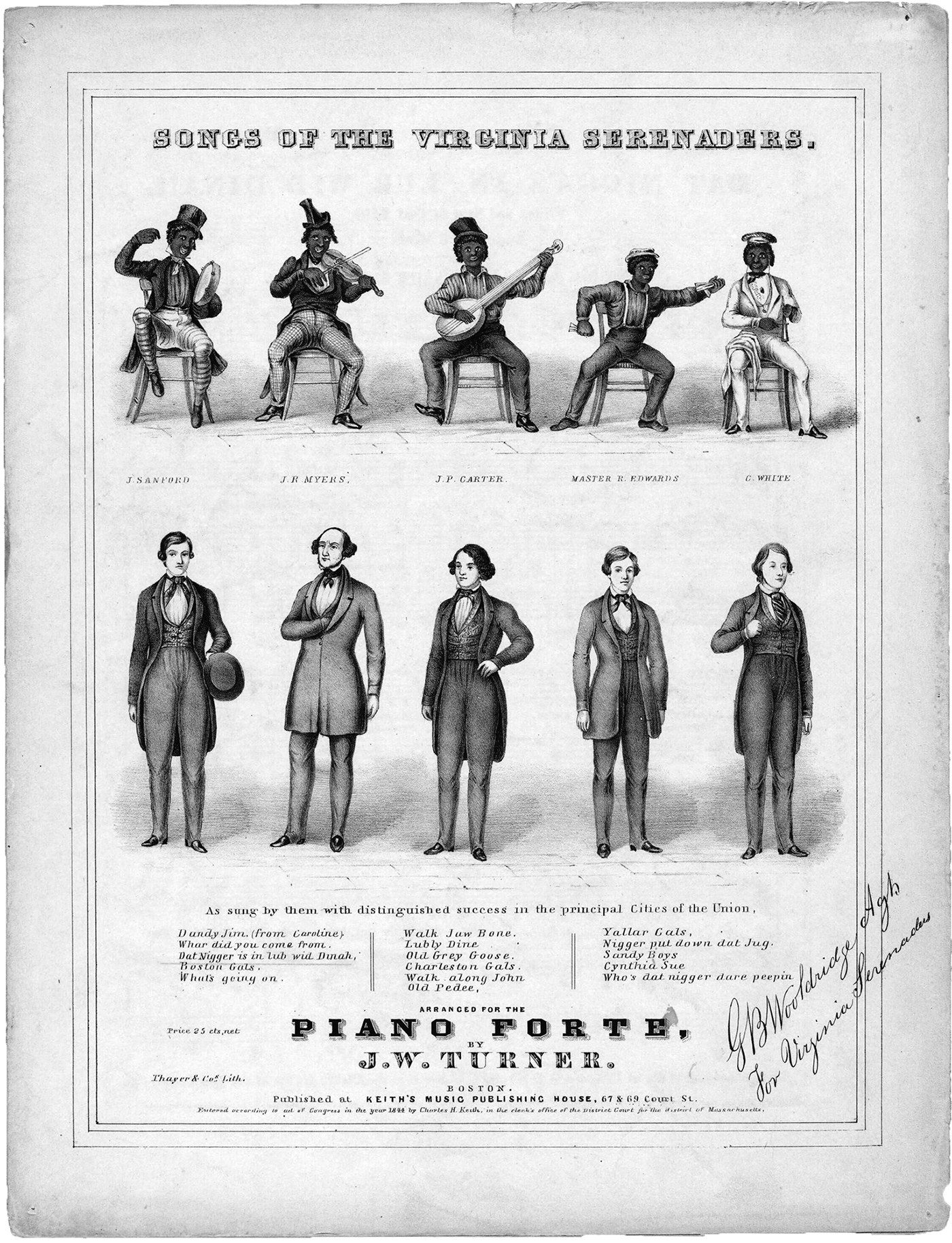
Figure 16: Virginia Serenaders, Sheet Music Cover, 1844. Harvard Theatre Collection on Blackface Minstrelsy, 1833—1906 (Houghton Library).
In Love and Theft, Lott refers to a cover by the Virginia Serenaders from 1844: at the top, it depicts the five musicians in blackface, costumed and performing exaggerated gestures. Below, the performers are shown with upright posture, without makeup, as respectable citizens. Mask and face, entertainment and bourgeois self-representation beyond the stage, are clearly separated.211 This, however, is not a reflection on practices of figuration. Instead, the carnivalesque is domesticated. Stabilizing references became a prerequisite for using blackface as a racist representation after abolition. The Janus faces on modern minstrel advertising posters—and thus in an early form of visual mass culture—make this clear. In the Library of Congress, for example, one finds a frequently cited poster of Billy Van as The Monologue Comedian in the context of “Wm. H. West’s Big Minstrel Jubilee.” Dating from the turn of the nineteenth to the twentieth century, the poster plays with multiple framings. Van’s portraits—his bourgeois face on the left, his blackface with wig, wide eyes, and red-painted mouth on the right—are framed in ornate gold, thus at least superficially separated yet connected by interlocking rings, that is, an infinity sign.
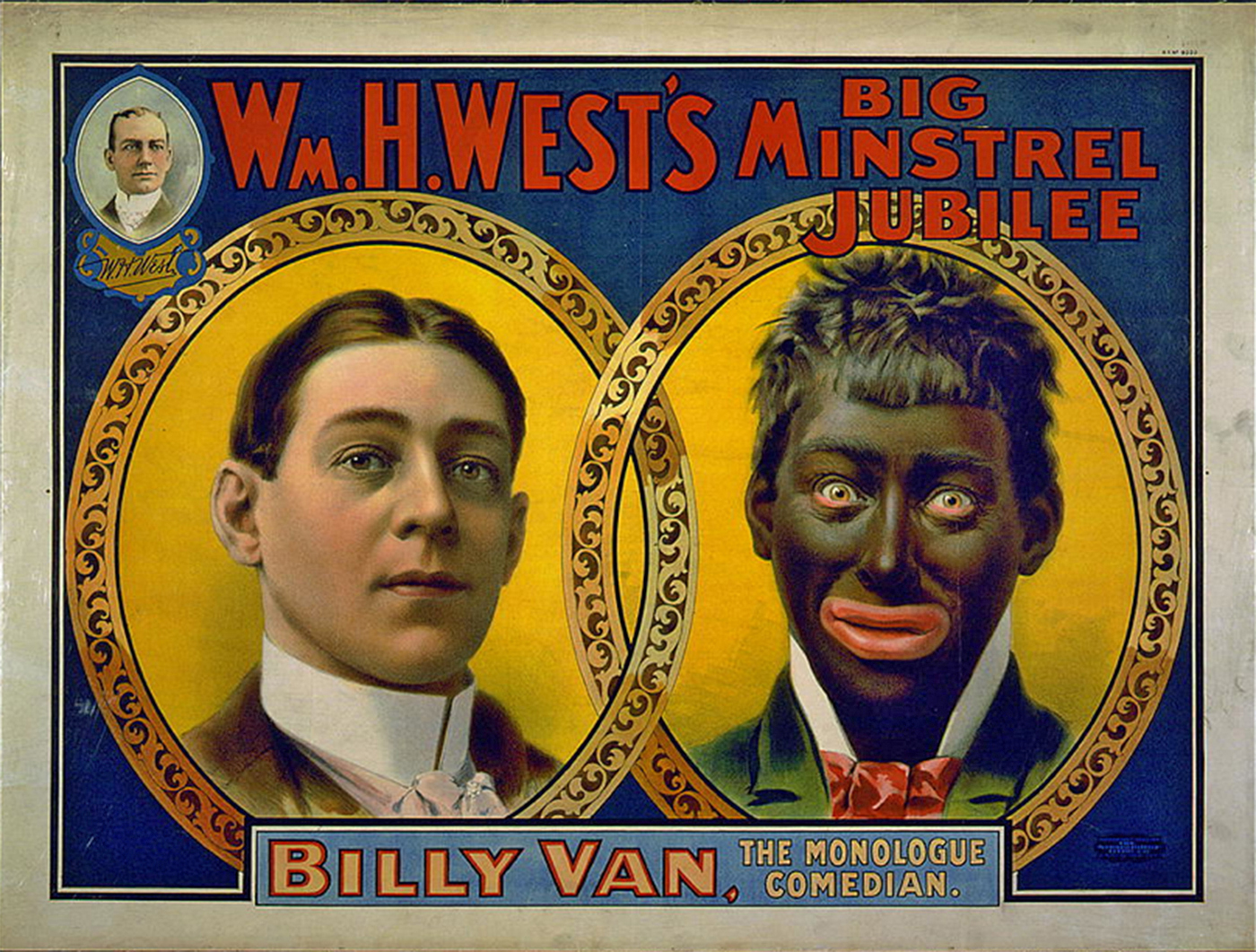
Figure 17: Billy Van, “Wm. H. West’s Big Minstrel Jubilee.” Advertising poster, 1900. Library of Congress, Washington, D.C. (2014637077).
In The Jazz Singer, the separation of mask and face is even more explicit. Blackface is transposed into a film drama that clearly distinguishes between stage and backstage. In stark contrast to early cinematic experiments linked to the fairground and popular theater—with their play on endless metamorphoses—the sequences of images here are subordinated to narrative and governed by central perspective.212 Although sound has not yet assumed the role it would in later talkies—reinforcing illusionistic representation—and although the music possesses its own acoustic dimension, while speech is largely confined to inserted intertitles, blackfacing emerges as a narratively contained play within the play.
It is “faceism,” in this context, that is emphasized.213 Retrospective interpretations often project this representational understanding of the mask onto all forms of blackface, viewing it as a constant vehicle of racist misrepresentation, thereby overlooking its shifting forms and functions. The problematic nature of this concept of representation becomes evident in the counterpart to grotesque defacements: the staging of an actual white face. The close-up of such a face was established by a popular film that, roughly a decade before The Jazz Singer, played a key role in the second founding of the Ku Klux Klan: D. W. Griffith’s The Birth of a Nation (1915). A milestone in film history, it introduced previously unseen special effects and camera techniques. Griffith deployed these innovations in service of a racist narrative that sought to relegitimize the plantation system and authenticate the myths of the South.214
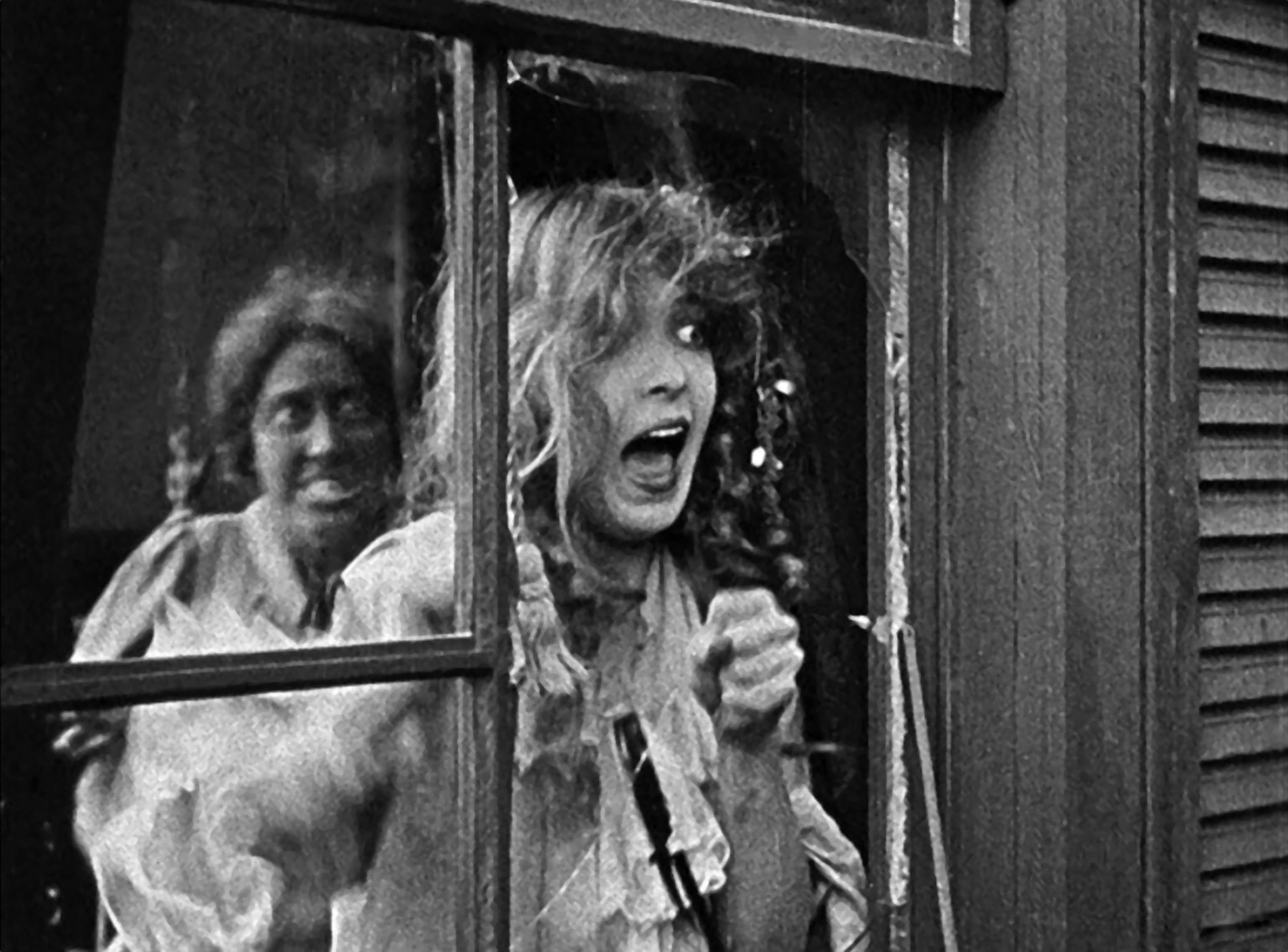
Figure 18: Lilian Gish as Elsie Stoneman in D. W. Griffith’s The Birth of a Nation, 1915 (Screenshot).
The film’s awkward juxtaposition of different modes of staging blackness—the depiction of a black rapist by a white actor in black makeup, alongside the casting of subaltern roles with actual Black supporting actors—undermines the illusion, at least from the perspective of contemporary viewing habits. Yet it functions effectively in positioning another face at the center of the drama: a representation of white femininity in need of protection. The close-up of lead actress Lillian Gish contorted in fear—an affection-image in Deleuze’s terms—helped to launch the cult of stardom accompanying the film.215 Unlike the grotesque distortions used for ridicule, this image served to legitimize the racist violence that had been perpetrated in the Klan’s name since the late 1860s. The film’s cinematically rendered retrotopian pullback—the legitimation of the Southern slavery regime—had terrifying consequences.216 The Birth of a Nation helped establish the second Ku Klux Klan as a mass movement and triggered a new wave of lynchings in the 1910s. Gish’s distorted face signals how the Klan’s resurgence after its decline during the Jim Crow era was evoked. The gendered staging of victimhood in this propagandistic film drama highlights the affective pliability of hegemonic representation: the call to restore the disfigured white face through violence.
Braun’s blackface in drag is quite extraordinary compared to Gish’s defacement. The image does not depict Braun as a woman in need of protection. Taken in the laboratory of Nazi visual politics on the eve of the seizure of power and later captioned from the backstage realm of the Nazi state apparatus, this shot of cross-dressing may be interpreted as a gesture of feminine empowerment. Set against the backdrop of the antisemitic visual machinery in which it was apparently produced, Braun’s photo in blackface appears to cast Jolson as a representative of an “un-German,” creolized US culture—a “filthy other” artificially blackened without a face of his own. In this reading, Braun marks Jolson as exemplary dirt, while her cross-dressing feminizes Jewish masculinity. The photo thus does more than simply intertwine various forms of drag (cross-dressing, playing Jewish, and blackface); it inflects the masquerade in the film it quotes with unpredictable twists, potentially shifting the association of dirtiness onto the figure of “the effeminate Jew” allegorized in the caption. From this perspective, the image does not just counter the narrative of Jewish whitening. Braun’s blackface in drag appears to assert control over the carnivalesque, marking those who visually elude identification as “others.” In doing so, it cites a cinematic format already designed to regulate meaning.
In this context, Braun’s caption can be read as a pun linking her own name with the “brown movement” of the Nazis. In this reading, the “ich“ plays not only on Braun’s surname—as a paraphrase of the dark makeup and thus a nod to the creolized US mass culture associated with Jolson and to blackface as rather “dirt” of those labeled as without a tribe,217 but also evokes the political, that is, brown-shirted, context in which the studio photograph was taken. This layered pun connects references to creolized appearance and party affiliation through the personal pronoun and the foreign proper name—Jolson instead of Braun. Reflecting on the image, in any case, reveals semantic shifts, while the image itself mobilizes gender and color bending as constitutive visual markers of alterity. If deconstructive and queer-theoretical readings of drag highlight the performative contingency of gender,218 Braun’s image seems to suggest equivalences among what is deemed minor, setting them in contrast to Nazism. Seen in this light, the photograph’s gesture may also be read as a move toward “decreolization.” It appears to speculate on shared ridicule, as its inscriptio merges “brown” as a label for the tribeless with “brown” as the color of Nazism. The image thus playfully claims control over the conflation of references. Reading the image as a response to the contemporary globalization of entertainment culture and its Nazi-coded link to Jewishness also means that Braun’s caption asserts carnivalesque laughter as something that can be controlled.
Decreolizing (Baker, Krenek)
“… who walks with bended knees … and looks like a boxing kangaroo … Is this a man? Is this a woman? Her lips are painted black, her skin is the color of a banana, her hair, already short, is stuck to her head as if made of caviar, her voice is high-pitched, she shakes continually, and her body slithers like a snake.”219 To observers in Europe in the 1920s, Josephine Baker—born in the South in 1906 and thus six years older than Braun—appeared as an illegible figure. Her Danse Sauvage in the Revue nègre became a scandal—translating female nudity, previously depicted statically in the visual arts of Old Europe, into the kinaesthetic realm. Yet beyond that, contemporary critics saw in her dancing an unrestrained, excessive physicality: they credited her with transfigurative abilities that challenged the essentialization not only of gender and skin color, but of the human figure itself. The review cited above draws on zoomorphic, racist clichés. But these were precisely the tropes embedded in a reception that also celebrated mimetic virtuosity—aesthetic skills.220 Amalgamating gender bending and color bending, Baker’s performances came across as more-than-human dragging.
According to Anne Anlin Cheng, Baker’s stage appearances can neither be essentialized nor dismissed as mere masking; by transforming “skin into cloth,”221 they instead bear witness to a specific contemporary form of precarious subjectivity. Through dance, Baker allegorized the cult of surfaces and ornamentation of the time, which, in post-World War I Europe—after the senseless destruction wrought by industrialized militarism—responded to a longing for a new beginning.222 In this sense, Cheng argues, Baker enacted the contemporary crisis of selfhood within a specific context: “One of Baker’s lived contradictions was that she was recreating her own imaginary ‘Africa’ out of her African American heritage for Europeans who were telling her what African American dance should and should not look like.”223 Baker’s creolized appearance in 1920s Europe—both in revue theater and in film dance scenes, such as those from La Sirène des tropiques (1927)—embodied the promise of a transatlantic mass culture that appeared to break with entrenched European structures of violence, gender hierarchies, and nationalisms. This promise continued to resonate in Baker’s own politics, from her later work in the Résistance to her Rainbow Family.224 In the 1920s, forty years after the partition of the African continent by European colonial powers and in the lingering shadow of the shell shock caused by World War I, Europe celebrated a new culture of amalgamation, exemplified by Baker.225 Therefore, Baker may also be read as the latent negative reference in Braun’s use of blackface in drag. Yet by citing Jolson instead of Baker as the contemporary icon of gender and racial transgression, of subverting anthropocentric representational registers, blackface in drag may have appeared more easily to control.
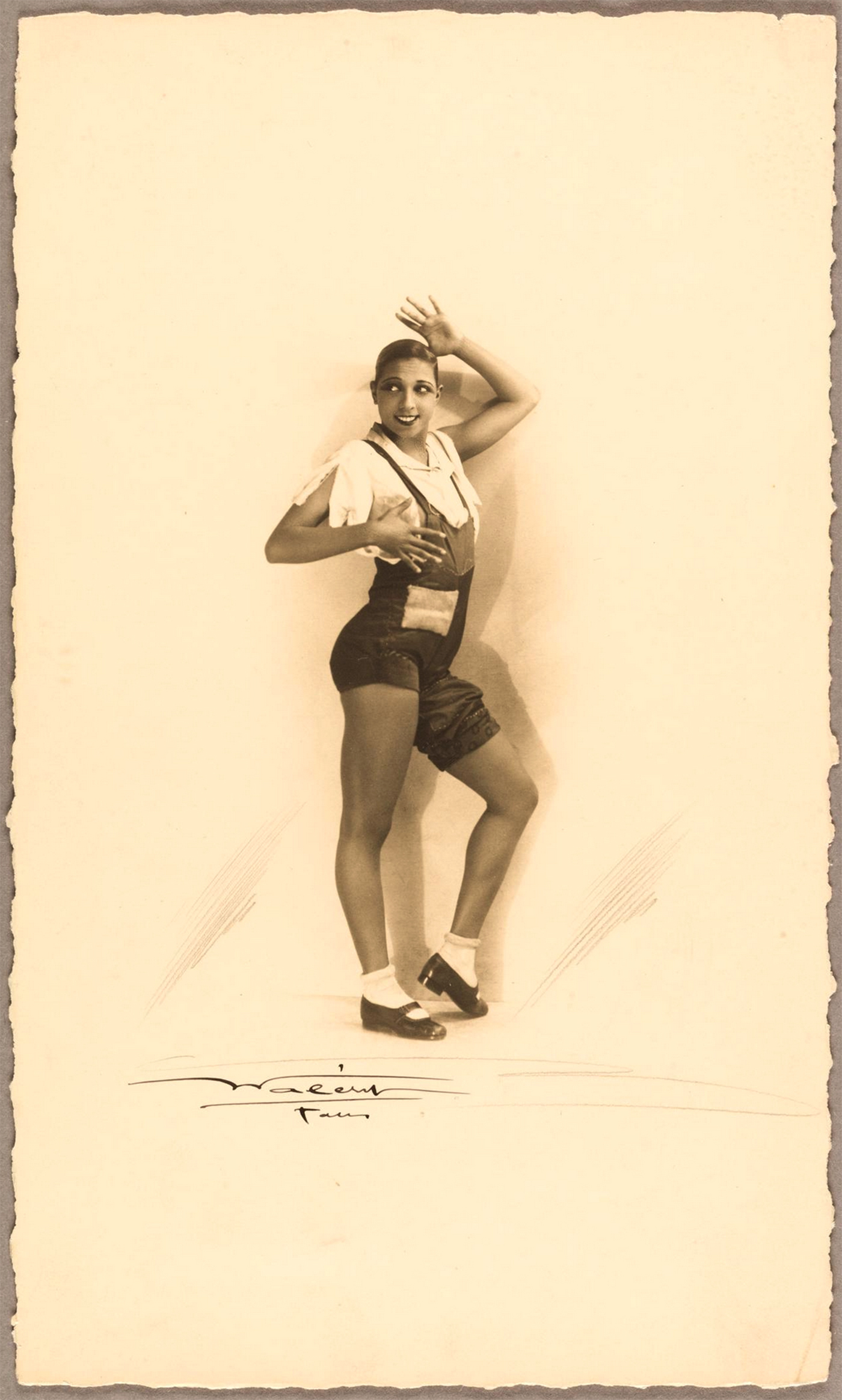
Figure 19: Josephine Baker, portrait, Paris, 1927. Photo: Lucien Waléry.
Baker’s creolized language took the form of syncopated dance, distantly related to the jumping harlequin.226 Despite referencing fabricated African colonial or minstrel-like plantation clichés, her bodily performance undermined racist, biologistic projections; Baker staged her sexualized “nature” as something skillfully constructed, as artistically crafted, and was thus perceived as offering a new transcontinental movement culture. It was precisely in this context that Baker drew on elements of blackface—echoing the emergence of Black US performers within a new mass culture that resisted easy containment. Photographs from the early 1920s show Baker with a bobbed haircut, oversized shoes, a plaid dress, and twisted eyes—invoking the clownish mask tradition of minstrel shows and thereby Black blackface comedians such as Bert Williams.227 Baker’s use of blackface allusions thus reflected the entanglement of the comic figure with creolized US mass culture and its nonidentitarian potential—emphasizing movement as mimetic excess and thus privileging an environmental, allegorical conception of mimesis over representational imitation.
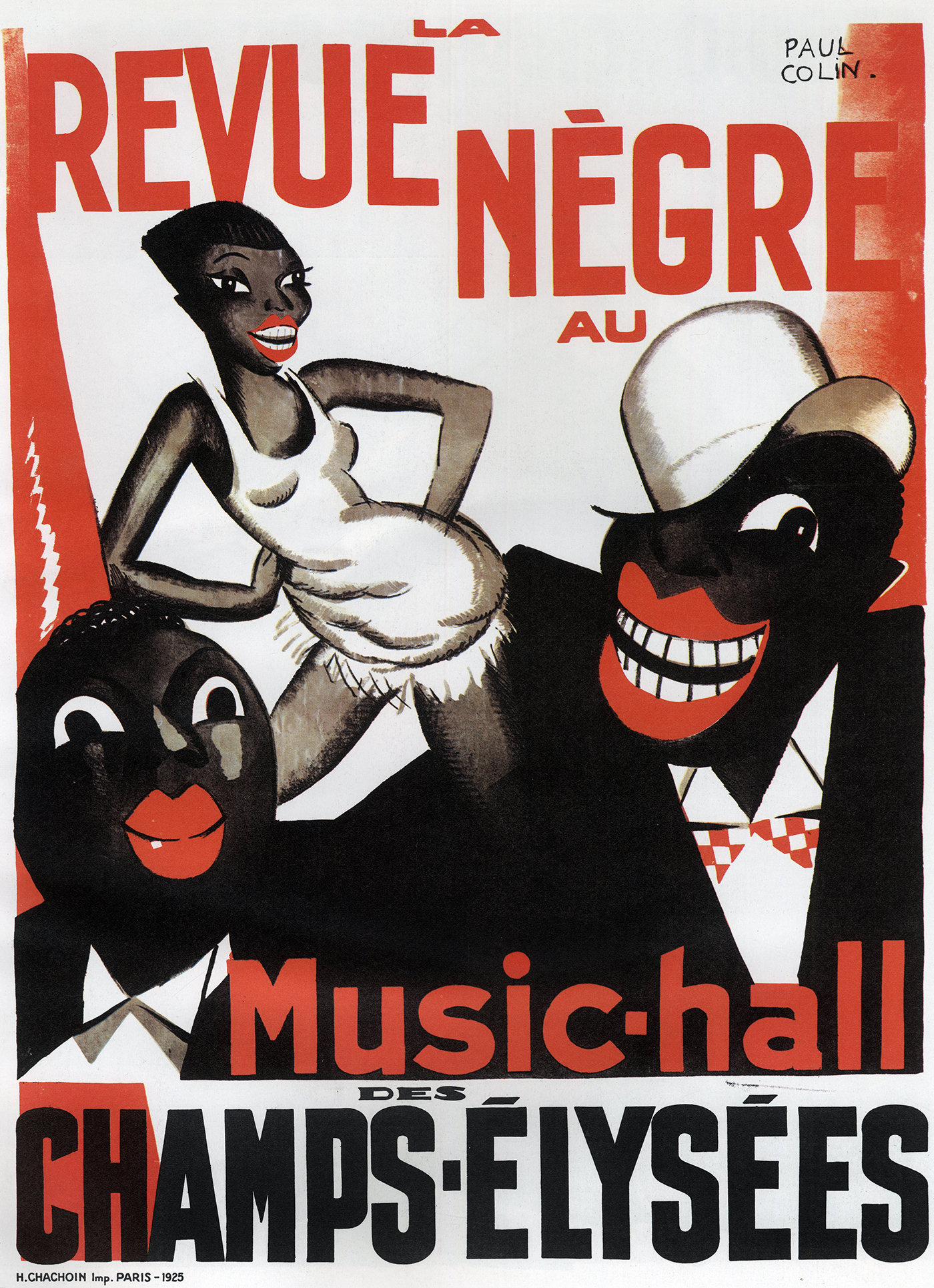
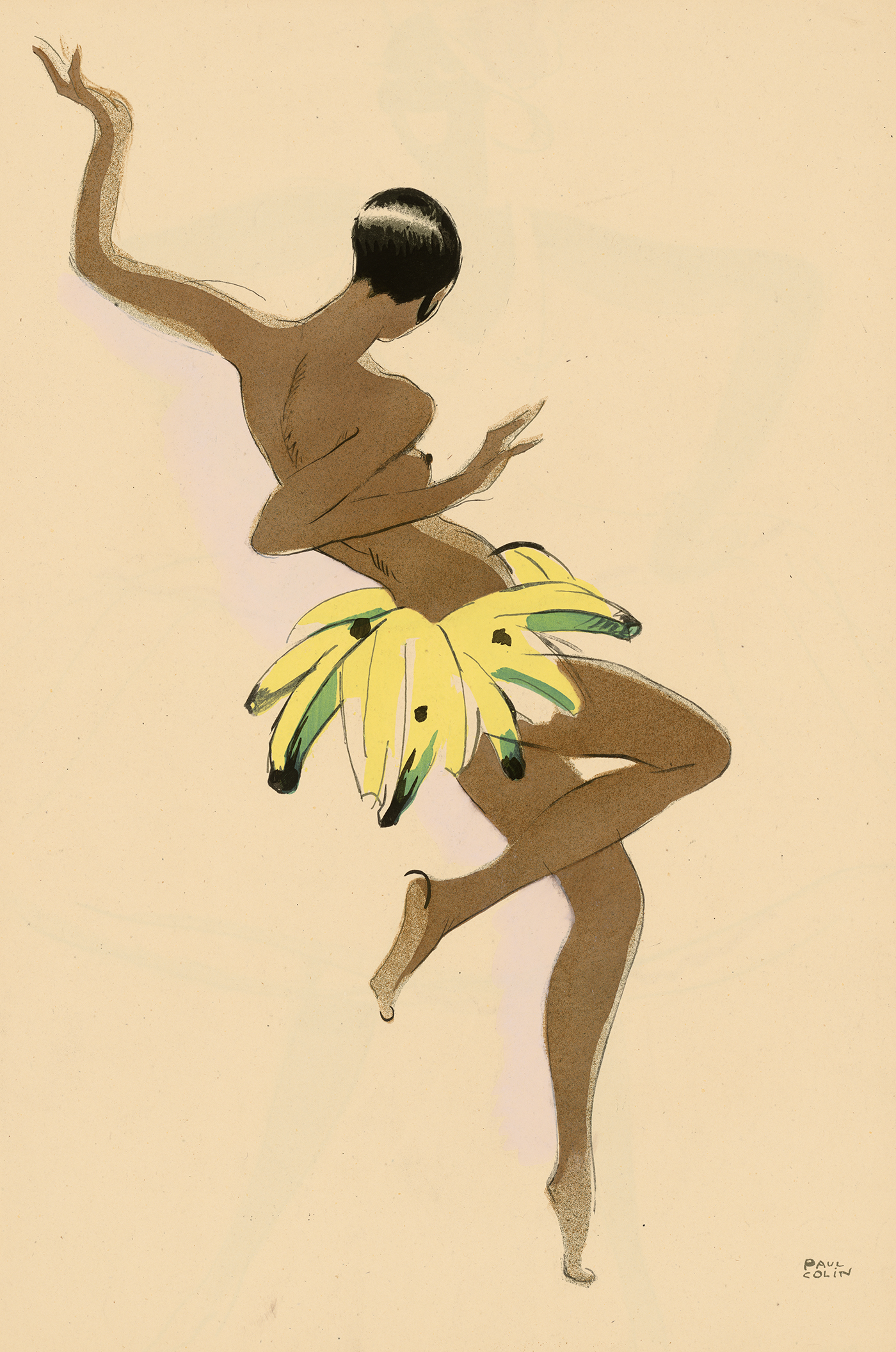
Baker thus indicates a pact between creolized movement art and forms of popular theater, along with modes of perception tied to the new media of the time, which contradicted bourgeois, individualized notions of dramatic, that is, symbolic representation. Her performances in the Revue nègre of 1925 and other shows became mass attractions from Paris to Berlin. Her phallic banana skirt and the exotic staging of her revues aggressively exaggerated sexist and colonial racist stereotypes. As such, Baker embodied anything but the forms of authentication that characterized nineteenth-century folk shows.228 Her minstrel quotation can be read as a kind of “browning” that rejected the phantasm of old lineages and the ideology of blood and soil.
Instead, Baker’s movement repertoire referenced an interweaving of performative cultural techniques, highlighted the affinities among popular dance forms from the Charleston to the Schuhplattler, and showcased related kinaesthetic skills.229 Baker thus became a pop icon of a globalized mass culture that celebrated mimetic excess—an excess perceived as threatening by the identitarian right of the time. In this sense, Baker can be read as a dancing counterfigure to Braun’s pejorative freeze of blackface in drag. While invoking various forms of Othering, yet without essentializing them, Baker allegorized a creolizing world that was also changing Old Europe.
Accordingly, in the German-speaking context of the 1920s in particular, blackface became a focal point in the cultural struggle against the so-called Jazz Republic,230 to which Braun’s drag scene can be linked. A “brown,” National Socialist campaign aimed to expel mimetic performances like Baker’s from what Christopher Balme has called the theatrical public sphere.231 On February 14, 1929—one day after Ash Wednesday—Baker was scheduled to perform at the Deutsches Theater in Munich. Her performance was preemptively banned, apparently in anticipatory obedience, and against the backdrop of earlier Nazi disruptions.232 In 1928, the Austrian composer Ernst Krenek’s scandalous 1927 opera Jonny spielt auf (Jonny strikes up) had already been targeted by Nazis, who attacked performances with stink bombs.233 The opera portrayed a Black US musician—a petty criminal and tramp figure, contrasted with the persona of an effeminate white artistic genius from Old Europe. It played with blackface iconography and the sexualized, exoticized visual tropes of minstrelsy associated with the Jazz Age, that is, with the globalized mass culture of the Weimar Republic.
Especially in Munich, the Nazis’ stronghold and self-declared “capital of the movement”—where Hoffmann’s studio was located—the SA (storm troopers) had already been aggressively disrupting public events.234 Alfred Jerger, the white actor who played Jonny, later claimed that he was nearly lynched until the enraged crowd realized he was merely wearing black makeup. In reality, however, National Socialist propaganda was primarily directed against blackface itself, because in contemporary reception—as in the cases of Jonny and Josephine—it signaled the creolization of Europe. In any case, in Jonny spielt auf, jazz was presented as the sound of a new mass age, although Krenek’s composition had even less to do with Black music than The Jazz Singer.235
As everyone danced in circles around a globe-like clock, the choir sang in a manner reminiscent of Baker in the final scene: “Die Überfahrt beginnt! So spielt uns Jonny auf zum Tanz. Es kommt die neue Welt übers Meer gefahren mit Glanz und erbt das alte Europa durch den Tanz!” / “The crossing begins! And so Jonny plays for us to dance. The new world comes sailing across the sea in splendor and inherits Old Europe through dance!”236 Krenek’s Weltreigen, or “dance round the world,” as the subtitle proclaimed, interweaves allusions to Baker, minstrel borrowings, and blackface with the European medieval motif of the dance of death, associated with carnival and clown masks.237 In this context, the Black musician figure in the opera was seen as burying “Old Europe.” Blackface was thus recontextualized and redefined in connection with the personification of death. This syncretic use resonated with the times—drawing on US minstrelsy—while also contributing to the renewed exoticization of the existing Afro-German population.238 After the loss of the colonies and amid racially motivated nationalist policies, this blackface motif became a tool for “Othering” Black bodies and faces. Yet within Krenek’s work—as in Baker’s—the appropriation of blackface may also have obscured the everyday realities of creolization already present in Weimar Germany and the presence of Black Germans who had migrated from the former colonies.
In any case, Jonny became a hit.239 Even years after the Nazi seizure of power, the minstrel-related portrayal of the protagonist—carrying a saxophone and wearing a “funny stiff hat on his head”240—continued to be attacked by Nazi propaganda as an indicator of a modernity deemed rootless and “degenerate.” Hans Severus Ziegler, a local politician from the Rhineland who had allegedly made a name for himself in 1930 as the NSDAP’s theater officer in Thuringia with his decree “Wider die Negerkultur, Für deutsches Volkstum” (“Against Negro Culture, For Germandom”), issued in response to the Krenek scandal, organized the Entartete Musik, or “Degenerate Music” exhibition in Düsseldorf in 1938—the same city where Baker would celebrate her spectacular comeback in 1953, adorned with feathers.241 Confronted with accusations of having violated §175, the ban on homosexuality, Ziegler redirected attention toward other resentments by attacking modern artists instead. Apparently acting on his own initiative, he curated the exhibition, which featured librettos, scores, stage designs, photographs, caricatures, and selected recordings, for the Reich Music Days.242
Propaganda minister Joseph Goebbels, who had initiated the Entartete Kunst, or “Degenerate Art” exhibition in 1937—which toured until 1941 and was conceived in Munich as a counterpoint to the Erste Große Deutsche Kunstausstellung (“First Great German Art Exhibition”)—had allegedly tried to block Ziegler’s crude project. Ultimately, though, he had to concede to the antimodernist faction within the party. Entartete Musik attested to an identitarianism that had taken on a life of its own. Ziegler’s accompanying brochure framed the exhibition as a National Socialist Abrechnung (reckoning), as the title of his accompanying text declaimed, aiming to expose a contemporary “mental enslavement and spiritual poisoning.”243 Jewishness was branded as a “ferment of decomposition” and equated with cultural Bolshevism.244 And although Krenek came from a Catholic Austrian family, Jonny spielt auf was ultimately invoked to raise what Ziegler called the “national question of honor”:
Ein Volk, das dem »Jonny«, der ihm schon lange aufspielte, nahezu hysterisch zujubelt, mindestens aber instinktlos zuschaut, ist seelisch und geistig so krank geworden und innerlich so wirr und unsauber, daß es für die unendliche und uns immer wieder erschütternde Reinheit und Schlichtheit und Gemütstiefe der ersten Takte der »Freischütz«-Ouvertüre gar nichts mehr übrig haben kann. (…) da beginnt eine völkische Ehrenfrage (…).242
A nation that wildly cheers on this Jonny—who has been performing for them for quite some time—or at the very least watches on without any instinct, has become so spiritually and mentally diseased, so inwardly chaotic and impure, that it is no longer capable of feeling anything for the boundless, ever-moving purity, simplicity, and emotional depth of the opening notes of the Freischütz overture. … what is at stake here is a matter of national honor
Ziegler’s “reckoning” did not target Baker but attacked Krenek, composers such as Arnold Schönberg, Hanns Eisler, and Kurt Weill, Paul Hindemith, the librettists Ernst Toller and Bert Brecht, and—apparently the only woman mentioned—the dancer Valeska Gert. Jewish and communist German-speaking artists, in particular, were targeted. After the Nazi state apparatus had consolidated its power, this strand of propaganda no longer focused on the transatlantic flavor of Weimar pop culture. Instead, the music of local classical modernism was especially portrayed as an internationalist, communist-driven decomposition of Germanness.246 Whatever Ziegler—a self-proclaimed “educator of the Volk” who, after the war, became a schoolteacher in West Germany and later retired to write apologetic books about Hitler 247—imagined jazz to be, Black music examples did not appear in his 1938 “reckoning.”
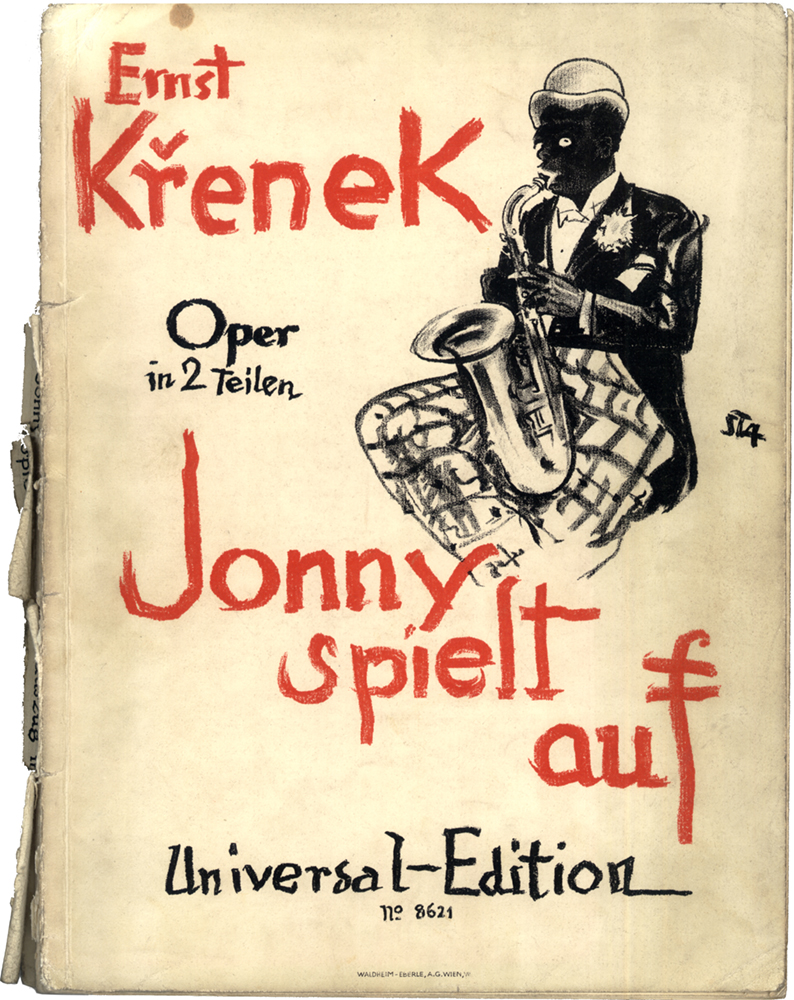
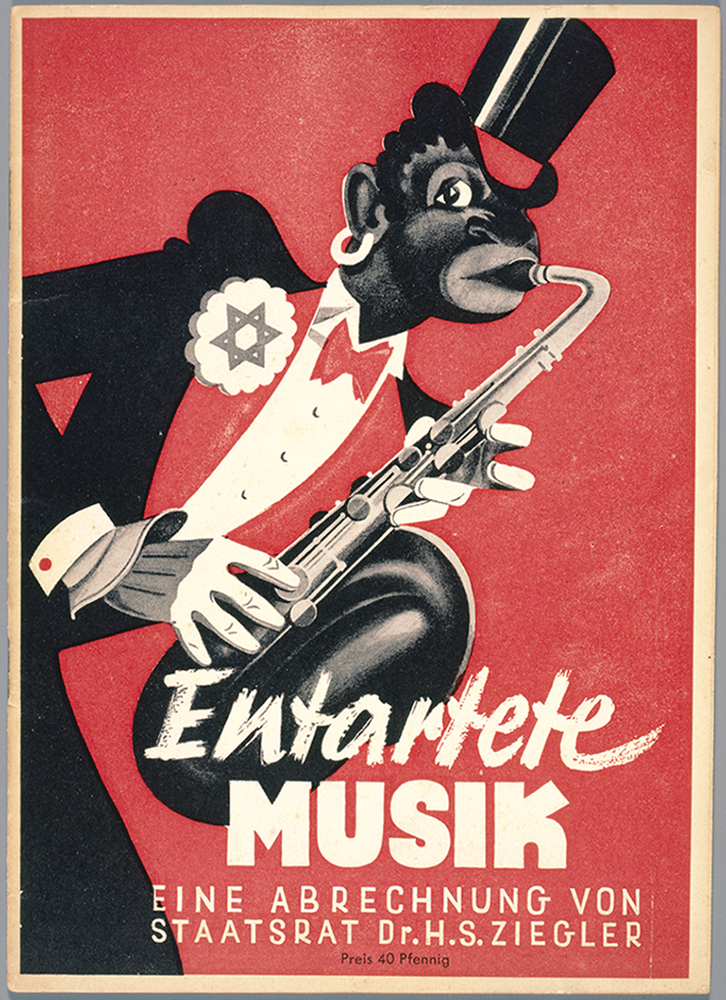
The cover of his pamphlet, however, responded to the Weimar reception of the minstrel mask. Ziegler himself later claimed that the graphic—designed by Ludwig Lucky Tersch for the Völkischer Verlag Düsseldorf—ran counter to his “sense of style and … taste.”248 The cover echoed the graphic reception of blackface in Europe, prefigured by Paul Colin’s illustrations for the Baker revues, and specifically referenced the title page of Krenek’s score.249 While Colin had increasingly emphasized the transfigurative dimension of Baker’s movements in his drawings, Krenek’s cover was concerned with static illustration.250 As a visual link between the Jazz Age and modern opera, it depicted a saxophonist in checked trousers and a slanted hat—a minstrel allusion—while the Universal edition featured a photograph of Alfred Jerger, also holding a saxophone and wearing an oversized flower in his buttonhole.251 Jonny was thus being marketed during the Weimar era as a figuration of new music in the broadest sense—a representation of a modern world. The equivalence between European classical-modern music and creolized mass culture from the United States was already being foreshadowed. Tersch’s Entartete Musik cover mirrored Krenek’s but replaced Jonny’s flower with a Star of David and distorted his face into something zoomorphic. The exaggerated blackface reference was thus given an antisemitic charge, visualizing the supposed connection between so-called cultural Bolshevik modernism and Jewish conspiracy. Aimed at the German-speaking educated middle class, this Nazi “reckoning” and its accompanying visual politics built on earlier efforts at decreolization—echoing the Jolson caption on Braun’s blackface photo in drag.
Oddkinships I (Benjamin, Kafka)
On the eve of the National Socialist regime, in 1933, Walter Benjamin’s “Erfahrung und Armut (“Experience and Poverty”) called for a new barbarism in response to the devastation of World War I and the threat of German nationalism hardening into state fascism. This call for a positive notion of barbarism—a new language marked by “its arbitrary, constructed nature”252 and a rejection of anthropomorphism as a principle of humanist, i. e. anthropocentric imitatio—signified a turn toward contemporary minor aesthetics, related to mass culture, as a way to confront the present. Benjamin portrayed this present as a ghostly, seemingly endless mummers’ dance: “philistines in carnival disguises roll endlessly down the streets, wearing distorted masks covered in flour and cardboard crowns on their heads”; “we need to remind ourselves of Ensor’s magnificent paintings, in which the streets of great cities are filled with ghost.”253 Benjamin described a cultural climate energized by “astrology and the wisdom of yoga, Christian Science and chiromancy, vegetarianism and gnosis, scholasticism and spiritualism,”254 in which he saw the flipside of a destructive “development of technology”255 as badly in need of a different, “barbarized,” and disruptive countercarnival. In “Erfahrung und Armut,” he outlined a break with the Old World faintly prefiguring Glissant’s notion of creolization, though otherwise disengaged from colonial history and respective everyday amalgamations:
was ist das ganze Bildungsgut wert, wenn uns nicht eben Erfahrung mit ihm verbindet? … Diese Erfahrungsarmut ist Armut nicht nur an privaten sondern an Menschheitserfahrungen überhaupt. Und damit eine Art von neuem Barbarentum.
Barbarentum?
In der Tat. Wir sagen es, um einen neuen, positiven Begriff des Barbarentums einzuführen. Denn wohin bringt die Armut an Erfahrung den Barbaren? Sie bringt ihn dahin, von vorn zu beginnen; von Neuem anzufangen; mit Wenigem auszukommen …256For what is the value of all our culture if it is divorced from experience? … Indeed (let’s admit it), our poverty of experience is not merely poverty on the personal level, but poverty of human experience in general. Hence, a new kind of barbarism.
Barbarism?
Yes, indeed. We say this, in order to introduce a new, positive concept of barbarism. For what does poverty of experience do for the barbarian? It forces them to start from scratch; to make a new start; to make a little go a long way; to begin with little and build up further, looking neither left nor right.
For Benjamin, the break with the past was necessary because a language once considered as shared had been lost. In a frequently quoted passage, he attributed this loss to the shell shock of World War I:
nie sind Erfahrungen gründlicher Lügen gestraft worden als die strategischen durch den Stellungskrieg, die wirtschaftlichen durch die Inflation, die körperlichen durch den Hunger, die sittlichen durch die Machthaber. Eine Generation, die noch mit der Pferdebahn zur Schule gefahren war, stand unter freiem Himmel in einer Landschaft, in der nichts unverändert geblieben war als die Wolken, und in der Mitte, in einem Kraftfeld zerstörender Ströme und Explosionen, der winzige gebrechliche Menschenkörper. 257
For never has experience been contradicted more thoroughly: strategic experience has been contravened by positional warfare; economic experience, by the inflation; physical experience, by hunger; moral experiences, by the ruling powers. A generation that had gone to school in horse-drawn streetcars now stood in the open air, amid a landscape in which nothing was the same except the clouds and, at its center, in a force field of destructive torrents and explosions, the tiny, fragile human body.
“Erfahrung und Armut”evoked the trauma of vulnerable bodies amidst their destroyed surroundings—of being confronted with an environment that no longer seemed to be a given.258 It countered the defeat of the German army and the militaristic, expansionist justifications for war with a nonnostalgic engagement with cultural remains. Against the backdrop of the traumas of World War I, Benjamin did not invoke the decline of the West but instead conjured Walt Disney’s Mickey Mouse—a figure not just animated by technical marvels, but also making fun of them. He used a popular cartoon to highlight the potential of a globalized, US-style mass culture to conceive of mimesis as beyond anthropocentric imitation. In opposition to the destructive, nationalist use of technology, Benjamin proposed a playful, “environmental” way of relating to the world through constantly shifting figurations:
Denn das Merkwürdigste an ihnen ist ja, daß sie allesamt ohne Maschinerie, improvisiert, aus dem Körper der Micky-Maus, ihrer Partisanen und ihrer Verfolger, aus den alltäglichsten Möbeln genau so wie aus Baum, Wolken oder See hervorgehen.
Natur und Technik, Primitivität und Komfort sind hier vollkommen eins geworden und vor den Augen der Leute, die an den endlosen Komplikationen des Alltags müde geworden sind und denen der Zweck des Lebens nur als fernster Fluchtpunkt in einer unendlichen Perspektive von Mitteln auftaucht, erscheint erlösend ein Dasein, das in jeder Wendung auf die einfachste und zugleich komfortabelste Art sich selbst genügt, in dem ein Auto nicht schwerer wiegt als ein Strohhut und die Frucht am Baum so schnell sich rundet wie die Gondel eines Luftballons. 259For the most extraordinary thing about them, is that they all appear, quite without any machinery, to have been improvised out of the body of Mickey Mouse, out of his supporters and persecutors, and out of the most ordinary pieces of furniture, as well as from trees, clouds, and the sea.
Nature and technology, primitiveness and comfort, have completely merged.
And to people who have grown weary of the endless complications of everyday living and to whom the purpose of existence seems to have been reduced to the most distant vanishing point on an endless horizon, it must come as a tremendous relief to find a way of life in which everything is solved in the simplest and most comfortable way, in which a car is no heavier than a straw hat and the fruit on the tree becomes round as quickly as a hot-air balloon.
Benjamin described these transfigurations as improvised—emerging from the surroundings, from furniture or trees, before people’s eyes. To advocate for a positive notion of new barbarism, and thus for a contemporary, transformed aesthetic attuned to the affordances of new media, however, it was a specific kind of figuration—a now largely forgotten blackface reference transposed into animated film—that he brought into play.
In 1928, Walt Disney’s Mickey Mouse in the animated cartoon Steamboat Willie, drew on minstrel and vaudeville masks by depicting a white-gloved, black-faced mouse with huge eyes.260 In these early portrayals, the memory of blackface was still clearly legible—at least within the US context.261 The unruly figure evoked the “oddkin” of Jim Crow. Benjamin’s reading, however, did not address US segregation. Instead, Mickey Mouse offered him a vision of how shared significations could be discarded elsewhere in order to laughingly “make a new start; to make a little go a long way.”262 Against the backdrop of World War I, Benjamin described a specific disposition for the reception of creolized mass culture. From this perspective, the political stakes of the resentful struggle against an emerging transatlantic mass culture—intensifying in the Weimar Republic—become more legible. Braun posing in blackface and Baker dancing “grotesquely,” as so many contemporary observers claimed, emerge as paradigmatic antipodes of dragging within this context. Complementary to the Cape Town Carnival and its reception of US mass culture, in the German context blackface was recontextualized as a contested sign of the nomadic.
Later, in a note from his so-called Passagen-Werk (The Arcades Project), probably written in 1937 in exile in Paris, Benjamin outlined the deterritorializing, nongenealogical gathering of found objects as a kind of dirty dragging: as collecting rags (Lumpen). In this, he reflected on his own style of writing: performative transpositions, modified quotations without quotation marks. In a note on literary montage, he wrote:
Aber die Lumpen, den Abfall: die will ich nicht inventarisieren sondern sie auf die einzig mögliche Weise zu ihrem Rechte kommen lassen: sie verwenden.263
But the rags, the refuse—these I will not inventory but allow, in the only way possible, to come into their own: by making use of them.
Countering the territorial violence of the Nazis, Benjamin’s note described dragging as a kind of nomadic schlepping, indifferent to the origins of found objects.264 Against the backdrop of forced flight, Benjamin’s understanding of quotation as performative transposition was decidedly political. It also resonated with a conception of language that recalled the history of earlier forced migrations in Europe. In ancient Greece, incomprehensible, foreign stammering was described as barbaric. Benjamin’s advocacy for a new, barbaric attitude and his later reflections on ragpicking as dragging aimed toward understanding language as constitutively foreign. It exposed the difference between ahistorical quoting that serves confirmation bias and a deterritorializing, creolized use of signs.
This deterritorializing practice also aligns with Franz Kafka’s understanding of language. Benjamin’s view is thus not singular, yet specifically situated, resonating—like Kafka’s—with the echo of forced migration in specific cultural techniques. Within Europe, they may reflect the impact of the history of anti-Judaism, which later developed an afterlife as colonial terror. In 1912, shortly before World War I, Kafka delivered what would become known as his Rede über die jiddische Sprache, which has been translated as “An Introductory Talk on the Yiddish Language.”265 Kafka’s perspective was tied to his encounter with Eastern European exile theater and its performative approach to language. As a confused jargon, he argued, Yiddish disrupted the orderly structures of understanding typical of Western Europe. Highlighting the exemplary nature of Yiddish theater, Kafka described it as a form of what I am elucidating here as dragging: without understanding a single word, a listener would still grasp more than expected. As the youngest European language, Kafka continued, Yiddish lacked a formal grammar, consisting instead of foreign words and dialects, and retaining the haste and liveliness with which it had stolen from other idioms. As a hustler slang (Gaunersprache) that dragged foreign terms along with it, Yiddish for Kafka revealed both the arbitrariness and the potential of referentiality. He thus portrayed Yiddish as a form of reflexive dragging—of deliberately collecting all kinds of expressions like rags, indifferent to their former signification, and instead offering multidirectional translations. This nonproprietary understanding of language has found a contemporary anti-identitarian afterlife, as in Saul Zaritt’s Taytsh Manifesto: “Taytsh is an untranslatable vernacular of translation … not entirely one’s own.”266
Kafka did not invoke Yiddish to assert the linguistic territoriality of Jews or to lay claim to the language of a religious community. Rather, his reference to a small, exiled popular theater served as a reflection on language as a nomadic deterritorialization of German. Bettine Menke reads Kafka’s Rede über die jiddische Sprache as a rejection of the national language model.267 In this view, language does not assimilate what it has stolen into settled possession, but instead prevents it from coming to rest.268 By exposing the groundlessness of linguistic concatenations, she argues, Kafka thus illuminated a defining feature of language as such.269 Like creolized language use, this deterritorializing conception of language, which he shared with Benjamin, is shaped by forced migration. It is specifically tied to the history of political violence and the cultural techniques of modern mass culture. Both Benjamin and Kafka linked their vision of a language without grounding to the media assemblages of their time, thereby highlighting a particular diasporic disposition for engaging with mass culture. This can be seen in Kafka’s short text Wunsch, Indianer zu werden (1913), published around the same time as his Rede über die jiddische Sprache and inadequately translated as The Wish to Be a Red Indian instead of Wish to Become (an) Indian. Cast in the irrealis, the text—at first glance an instance of “ethnic drag” romantically playing “Amerindian”—invokes the prominent figuration of indigeneity in contemporary cinema, as well as within the German literary canon.270 Kafka, however, does so in order to deterritorialize imagined indigeneity:
Wenn man doch ein Indianer wäre, gleich bereit, und auf dem rennenden Pferde, schief in der Luft, immer wieder kurz erzitterte über dem zitternden Boden, bis man die Sporen ließ, denn es gab keine Sporen, bis man die Zügel wegwarf, denn es gab keine Zügel, und kaum das Land vor sich als glatt gemähte Heide sah, schon ohne Pferdehals und Pferdekopf.271
If one were only an Indian, instantly alert, and on a racing horse, leaning against the wind, kept on quivering jerkily over the quivering ground, until one shed one’s spurs, for there needed no spurs, threw away the reins, for there needed no reins, and hardly saw that the land before one was smoothly shorn heath when horse’s neck and head would be already gone.
Omitting personal pronouns and quoting cinematic stagings of “the Indian,” the text explores the relationship between figure and surrounding. Kafka thus reflects on the act of projection, just as his text can be read as a rhetorical mimesis of a tracking shot. By shattering the visual frame of contemporary westerns and liquidating the figure of the native, the text abandons control of the reins. As it transforms trembling ground into a smoothly mown heath—a homely landscape—it stages a kind of becoming environmental that resists the romanticization of “wild” life. In relation to Kafka’s portrayal of Yiddish as jargon, the form of his Indian text performs the very deterritorializing movement of language it describes. Kafka’s becoming-Indian thus defigures imagined indigeneity.272 By letting referentiality go astray, his text challenges self-assuring projections onto rootedness in one’s environment and simultaneously highlights the particular situatedness of the imagined elsewhere it evokes.
Citing him without quotation marks, that is, without indicating, Deleuze translated Kafka’s engagement with language into the notion of a nomadic becoming-minoritarian.273 In a short 1973 text, Pensée nomade (“Nomad Thought”), Deleuze evokes modes of writing that aim less at signification than at deterritorializing affects.274 Such modes of writing, he suggests—implicitly drawing on Mikhail Bakhtin’s notion of the carnival—are linked to a Dionysian, contagious, transgressive culture of laughter.275 In A Thousand Plateaus (1980), Deleuze and Guattari describe nomadic thinking as a practice of thinking in flight lines of becoming, a thinking in transversal deterritorializations, a rhizomatic thinking that not only gestures beyond points of origin, but also beyond their deconstructions.276 Glissant in turn quotes these reflections on the rhizomatic and the nomadic—again without explicit references—in his readings of Caribbean literature. He transposes them into a reflection on cultural techniques indebted to concrete processes of creolization and located in the Black Atlantic. Provincializing Deleuze and Guattari, he thus gives their thinking a correspondingly materialist twist277—foregrounding, against the backdrop of a world long since creolized, the aftereffects of colonial violence. Anti-identitarian transfigurative cultural techniques, then, are not confined to twentieth-century artistic or mass cultural developments. For Glissant, a writer committed to thinking through transversal relations rather than clearly definable notions of rootedness haunted by fantasies of purity, they are prefigured in the cultural techniques of the enslaved—those forced during the Middle Passage to forge a creolized language from dislocated and untraceable fragments, from rags so to speak, in order to communicate despite of mutual incomprehension.278 Benjamin’s and Kafka’s understandings of language can be linked to questions of political history and to the emergence of transoceanic modes of relation due to forced migration. Kafka’s nomadic, deterritorializing writing and Benjamin’s call for a new barbarism transpose mass cultural forms—forms that themselves negotiate processes of creolization through the quotation of blackface or reflexive figurations of indigeneity—into texts that reject territorial terror. Their work evokes the destructive violence of World War I (Benjamin) and movements of flight from antisemitic violence sedimented in language (Kafka). These texts are thus not merely concerned with a particular theory of language, but with mobilizing its political potential against the afterlives of political violence and the identitarian epistemes that sustain it. They demonstrate that modern mass culture cannot be reduced to either the containment and commodification of the represented—as in The Jazz Singer—or to racist caricature, as in minstrel shows. Even when evoking stereotypes, these texts do justice to transfigurative, deterritorializing, nomadic forms of relating.
Read alongside Glissant, the potential for alliance among such related yet specifically situated intellectual movements and cultural techniques becomes evident: they show how to do without phantasms of rootedness and linear genealogies, and to assert instead the right to assemble tout-monde. Here, the oddkinship—borrowing Donna Haraway’s term—between creolized performative practices in the South African Cape and deterritorializing modes of writing in Central Europe comes into view.279 Glissant explores the history of creolization under colonial conditions in the Black Atlantic; in Benjamin’s notion of the new barbarism, similar figures of thought arise in response to the trauma of industrialized, mass-destructive war; in Kafka’s writing, they recall the history of antisemitism and forced migration within Europe. Beyond their specific local and historical contexts, the nonidentitarian, nomadic epistemes emerging from these perspectives evoke an unforeseeable potential for transoceanic solidarity—an alternative to the violence of divide and rule.280
Exoticisms (Revue)
Around the time the Nazis exploited the quotation of blackface in Krenek’s Jonny spielt auf as a sign of the supposed world conspiracy of cultural Bolshevism and Judaism during the summer of 1938, and orchestrated the November Pogrom as an escalation of antisemitic boycotts into open violence, a comic revue took place in Berlin from February 19 to March 6. It was a modern entertainment spectacle attuned to its time and a countermodel to the minstrel show—an updated form of colonial racism. Directed by Wolf Völker with musical arrangements by Joe Rixner, and performed by the Deutschlandhalle orchestra under Karl Stäcker, the revue accompanied the Internationale Automobilausstellung (International Motor Show) as a demonstration of German technical prowess. Traces of it remain today in the collection of stage designer Traugott Müller in the archive of the Institute of Theater Studies at the Freie Universität Berlin.281 Reportedly, 10,000 spectators filled the Deutschlandhalle’s arena to see Ki sua heli: mit 300 km/h durch die Tropen (Ki sua heli: through the tropics at 300 km/h) on a 500-square-meter stage.
The title played on the exoticism of early film and operetta. But this revue—centered on a fictional film expedition into the East African jungle—not only continued the popular pact of nineteenth-century operettas and chorus girl formations of contemporary mass spectacles and films—the Mädchenkomplexe—as described by Siegfried Kracauer.282 It also recalled the deep entanglement between industrial exhibitions and ethnological shows—the staging of hegemonic and colonized cultures.283 On the eve of World War II, and in the shadow of Germany’s loss of its “place in the sun” after World War I, the expedition narrative served as a kind of surrogate colonialism. As Susann Lewerenz has shown, it responded to fantasies of global mobility and exotic consumption.284 In doing so, the revue referenced cinema, which by the early twentieth century had displaced the Völkerschauen (human zoos) as the medium for presenting imagined foreign worlds to German audiences. These fictive geographies stood in marked contrast to the pejorative portrayals of globalized, nomadic modernity associated with blackface.
The revue’s program made no explicit mention of contemporary colonial discourse, though it did present Kiswahili as the “lingua franca of the whole of equatorial Africa.” Yet from the very first scene—Der unberührte Urwald (The untouched jungle)—colonial implications were unmistakable. This scene, staged through the “stamping dance of the natives” and the “mask dance of the medicine men,”285 portrayed the jungle as territory awaiting colonization. According to one of the many newspaper reviews, white female dancers later appeared in a “parade of tropical products,”286 presented like trophies. In response to the loss of the so-called “German territories” after World War I, the revue avoided naming any specific colony, yet ultimately laid claim to the entire continent through the white female allegorization of African resources.287 If creolized mass culture of the time was given a grotesque, zoomorphic face in the illustration for Ziegler’s Entartete Musik exhibition, then the exoticism of this Africa revue served as a surrogate for both the “Jazz Republic” (Wipplinger)288 and the lost colonies. To that end, the revue staged a stark contrast between Black bodies—figured as natives—and the modern marvels of German technology.289
The space for this celebrated “colonial revue” had been designed by former “shock troop leader” and stage designer Traugott Müller,290 whose papers include numerous rehearsal photographs. Hans Hessling and Jupp Hussels took on the roles of adventurers and were initially positioned above the audience’s heads, overlooking the stage and cracking jokes. The bird’s-eye view, typical of colonial visual regimes, framed the scene from a position of dominance. The spectacle later culminated in a sensational scene in which the pilot Hanna Reitsch flew through the Deutschlandhalle in a Focke helicopter. Celebrating modern technology, Ki sua heli offered the illusion of national superiority and foreshadowed what entertainment cinema would fully realize by World War II—particularly in aviation films—as a complement to Leni Riefenstahl’s beginning of Triumph of the Will, her film on the Nazi party rally in Nuremberg: the ideologically charged perspective of the Führer persona.291
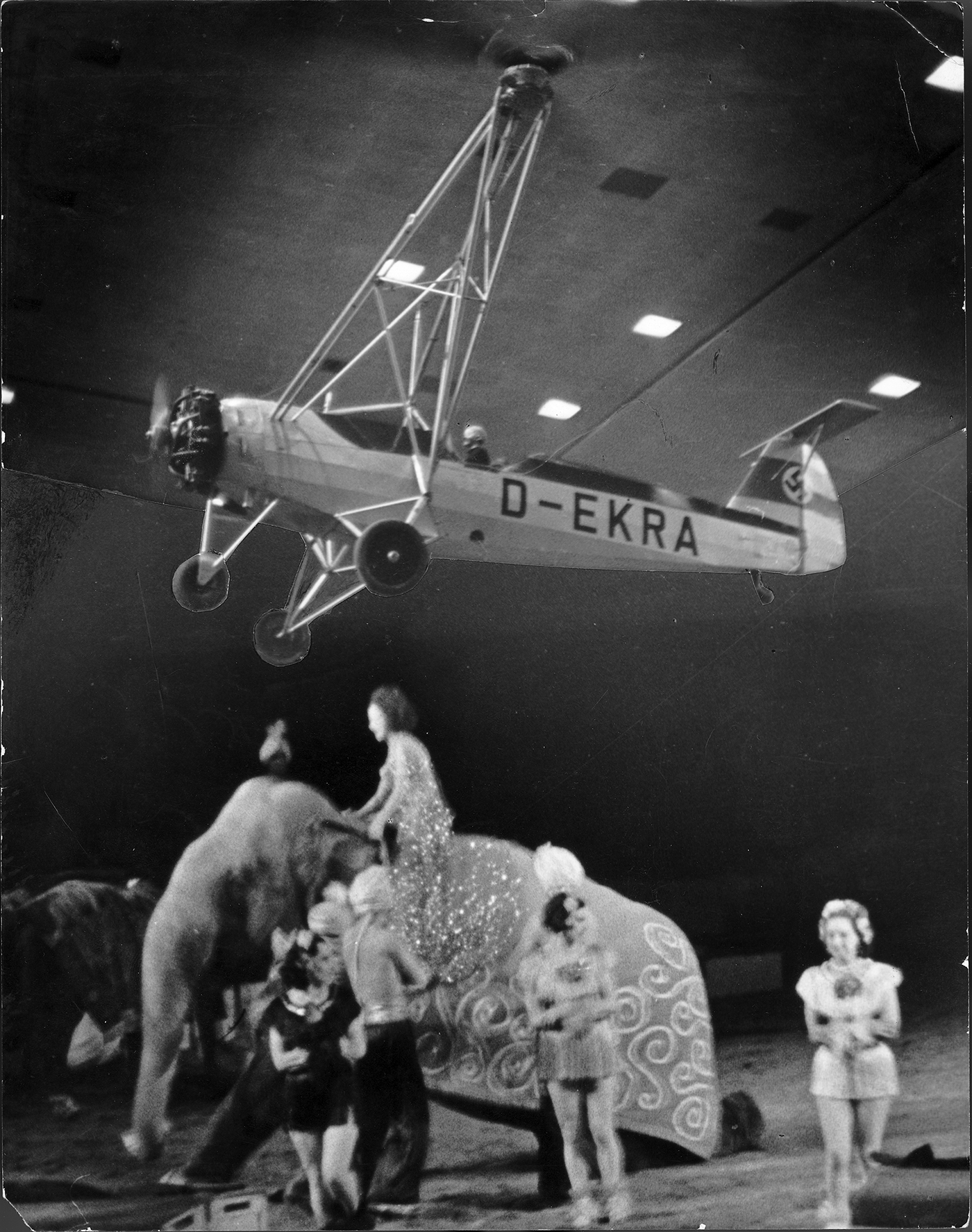
Figure 24: Hanna Reitsch, flying through the Deutschlandhalle, Ki sua heli, Berlin, 1938. Traugott Müller Collection, Theaterhistorische Sammlungen of the Theater Studies Institute at the FU Berlin.
While Reitsch addressed an audience that explicitly included female Volksgenossen, or “Volk-comrades,” at a time when the country was preparing for war,292 Black German performers were cast as an exoticized backdrop. The staging of technology and colonialism were thus mutually dependent. Only Louis Brody, the best-known Black actor in Weimar film, was explicitly named in the program. Whereas the Black extras remained anonymous, he portrayed the role of Chief Bosambo.293 Before the Nazi seizure of power, Brody had publicly spoken out against the racist “black shame” campaign, was involved in the founding of the Liga für Menschenrechte (League for Human Rights) and was considered a communist. During World War II, he appeared in anti-British colonial propaganda films such as Ohm Krüger (1941), set during the South African Boer War, as well as in Carl Peters (1941) and Germanin (1943). And in the antisemitic Nazi counterpart to The Birth of a Nation, Veit Harlan’s Jud Süß (1940), Brody played the role of the Black subaltern. During the Weimar period, he had called himself Alcolson—presumably referencing both his alcohol consumption and the blackface actor Jolson. In Ki sua heli, he was marketed as a doppelgänger of the American film star Paul Robeson, who had played another Bosambo in Zoltan Korda’s film Sanders of the River (1935).294 Brody’s Bosambo, however, remained a supporting character, and was listed solely as a singer in the program booklet, and was thus separated from the main protagonists of the plot.
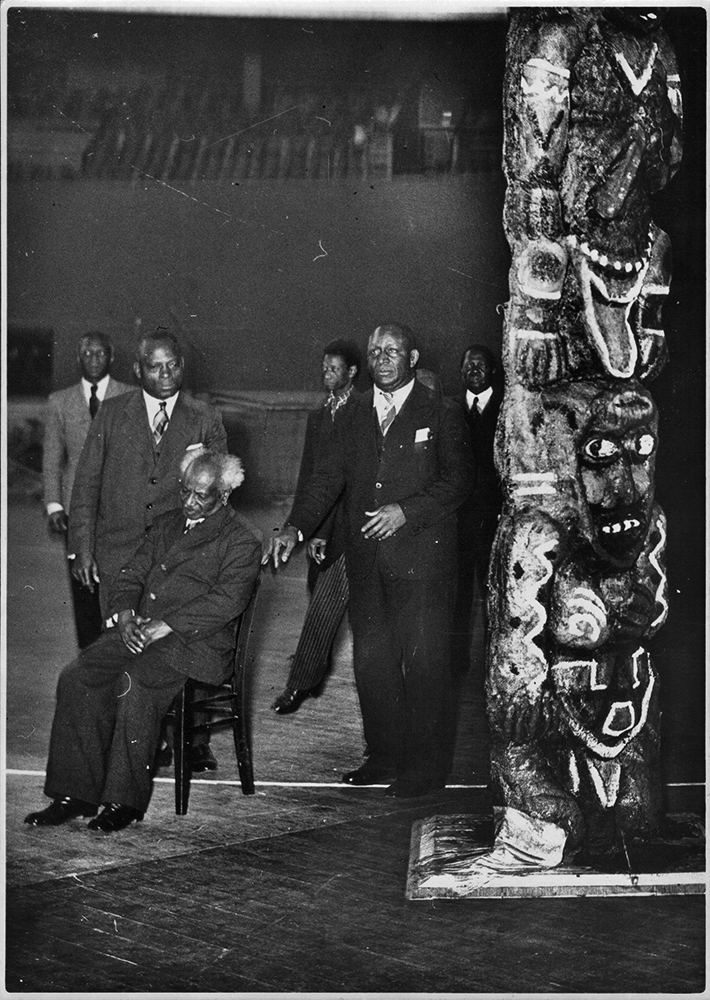
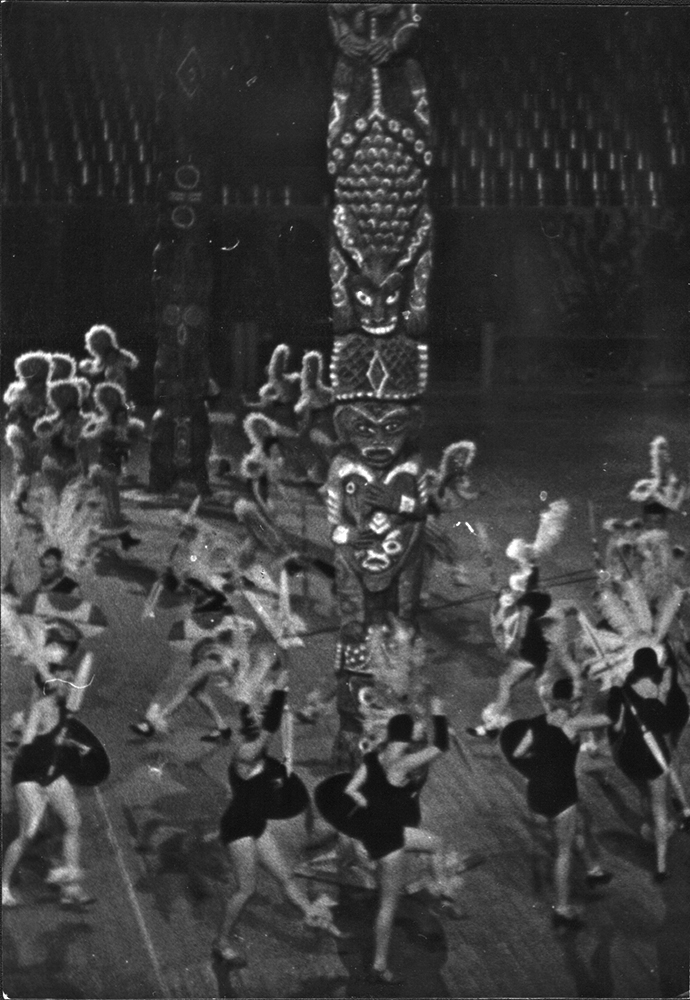
The reviews and the program booklet remained largely silent about who appeared in Ki sua heli as “natives” performing so-called African war, mask, and sword dances.295 One article claimed that, for the first time, “Völkerkunde,” that is, ethnology, had assisted in a revue; totem poles, palm trees, and chattering Hagenbeck flamingos surrounded the stage, serving to place “us in a “jungle mood.”296 The totems—resembling torture poles and supposedly referencing East African carving art—more likely evoked the expressionist-inflected reception of “primitivism” from the period before the Nazi seizure of power. The headdresses of the African figures, meanwhile, apparently wrapped in brightly colored cloths, seemed to recall the feathered ornaments of stereotypical “Indians” in nineteenth-century Wild West shows or contemporary western films. Appearing half-naked, they visually echoed the 120 equally nameless, feathered white revue girls of the ballet company. As choral figures on the periphery, they exposed the superimposition of gender and colonial political hierarchies.297
The staging of African indigeneity came across as rather ambivalent, as suggested between the lines of the feature pages. J. Müller-Marein, for example, describes “negro groups” that, as he writes, “have been living in Germany for a long time but have lost nothing of the exoticism of their tropical homeland.”298 The article implies that those representing Africa were part of the German population. Another piece claims there were fifty-six people from Berlin, Hamburg, and other German cities who would present “the wild dances of their homeland.”299 Yet rehearsal photographs from Traugott Müller’s papers show them in street clothes, clearly identifying them as urban German residents.
By 1938, Jews had long been excluded from the stage. “Each group that the Nazis subjected to their peculiar ‘racial’ gaze,” as Robbie Aitken and Eve Rosenhaft write regarding the paradoxical situation of the Black German population under Nazi rule, “had its own history of social negotiations around ‘otherness’ and of cultural racialization, and those histories informed the way that they were treated in practice.”300 The contradictions between racist segregationist agendas on the one hand and colonial revisionist interests within parts of the Nazi apparatus on the other resulted in an arbitrary, flexible treatment of the Black population by the authorities. Policy fluctuated between deportation plans and restrictions on emigration, yet over the course of World War II, it became increasingly radicalized.301 The Nuremberg Laws of 1935 deepened the precarious position of Black Germans, pushing them further into roles as African extras. As people were declared stateless and excluded from the legal system, prevailing gender policies—tied to miscegenation discourses about so-called racial shame—increasingly led to forced sterilizations in the second half of the 1930s.302 In the 1940s, some Black Germans were deported to concentration camps or confined in psychiatric institutions. As Aitken and Rosenhaft note: “in official thinking and practice there was a progressive assimilation of Blacks to a global category of ‘racial aliens’ subject to removal without any separate rationale and without regard to historical, sentimental or foreign-policy considerations.”303
Nazi entertainment and propaganda thus inverted what Rogin outlines in The Jazz Singer. Jews were not gradually whitened and integrated into dominant society; rather, exclusionary policies that had once been unimaginable were tested on fellow citizens—from the performance bans and exclusion from public service in 1933, to the loss of citizenship rights in 1935, to expropriation and exclusion from public life in 1938, and finally, from 1941 onward, to deportation and industrial extermination. Ostracism was gradually extended to further categories of othered groups, including the Black German population. Work opportunities for them were increasingly restricted to colonially coded jobs such as selling tropical fruit, caring for animals at the zoo, or other precarious but exoticizing labor,304 while the supposed African performers in Ki sua heli were assigned an intermediate status as minor choral figures, closer to stage decoration—somewhere between the revue girls and the animals from the Hagenbeck Zoo. These extras were thus rendered zoomorphic—not, however, to expose the supposedly degenerate face of a culture dominated by Jewish-Bolshevik world conspiracy, as indicated on the cover of Ziegler’s Abrechnung, with its blackface figure as a signifier of “degenerate” music. Rather, they were staged to stand in for an African premodernity—as a counterimage to German technological mastery. In Ki sua heli, this counterimage was foundational to the fiction of the Volksgemeinschaft, the ethnonational community.
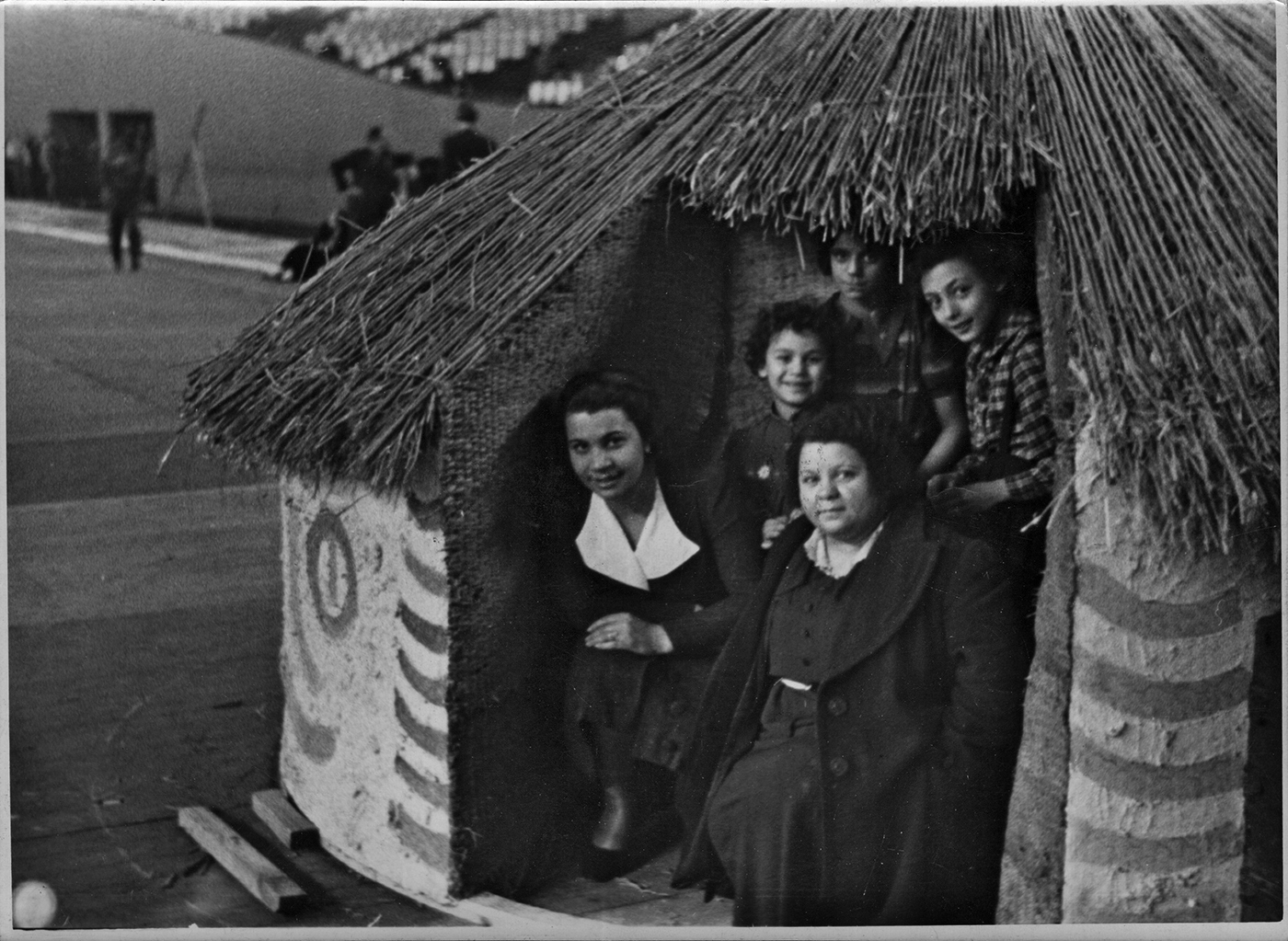
Abbildung 27: Intermission photo, Ki sua heli, Deutschlandhalle Berlin, 1938. Traugott Müller Collection, Theaterhistorische Sammlungen of the Theater Studies Institute at the FU Berlin.
The rehearsal photos found in the Traugott Müller collection are a reminder of what the propagandistic stage spectacle had to conceal. Curious and perhaps slightly surprised at being photographed, three children, along with an older and a younger woman—each dressed in everyday local street clothes—look up toward the camera, which captures them from a diagonal angle. They are positioned inside a painted hut, part of Müller’s jungle stage design. Their names may no longer be traceable, but their image speaks to what the spectacle itself left out. They likely did not appear in Ki sua heli at all and at most worked backstage, since their very presence contradicted the neat division between Blacks performing Africans and a white, modern “master race.” Perhaps the people depicted in the photograph were relatives of the male extras.305 The photo bears witness to the existence of a part of the German population that the revue’s visual politics worked to erase—gradually rendering the grotesque hypervisibility of blackface in Nazi propaganda obsolete. Probably taken during a rehearsal break, the image brings into view something other than personifications of a continent supposedly without any history.306 It reveals that Nazi Germany had long since been creolized—to paraphrase Glissant, that colonization had led to reverse migration and, especially in urban centers, had produced everyday relational modes of amalgamation that developed independently of imported US popular culture. The exoticization of the supposed “other” in a jungle setting was itself precarious, as the photo makes clear. While contrasting the Weimar era creolization of mass culture, the staging of Ki sua heli was nonetheless shaped by the nomadic dynamics the Nazis sought to deny.
In this respect, Braun’s blackface in drag, the promotion of the Entartete Musik exhibition, and the photograph of anonymous people described here form a constellation that challenges us to explore the complexity of political histories of violence and their resulting visual politics. In the case of the revue, Nazi depictions of Africa were determined by the ideological charge of native blood and soil that accompanied the invention of an Aryan, Germanic modernity. The theatricalization of African natives and the performative production of the national community were thus complementary forms of Nazi propaganda, intended to banish the nomadic, creolized signature of the present.
Endnotes
-
The caption plays with the rhetorical figure of giving a face; on rhetorical face-giving, see Menke, Prosopopoiia, 2000; see also Chase, Giving a Face to a Name, 1986: 82—112 (in Decomposing Figures); de Man, Autobiography, 1979; Hamacher, Unlesbarkeit, 1988, as well as Annuß, Elfriede Jelinek, 2005.↩︎
-
For prominent criticism of the film, see Rogin, Blackface, White Noise, 1996; in contrast, see the readings by Chude-Sokei, The Last “Darky,” 2006: 97—104; Kelman, “Acoustic Culture,” 2006; Lhamon, Raising Cain, 1998: 102—115.↩︎
-
See, with a focus on instituting the figure of the people, Laclau, On Populist Reason, 2005. On the current right-wing construction of equivalential chains, see, for the German-speaking context, Wielowiejski, “Identitarian Gays,” 2020; see also the other articles in Dietze and Roth, Right-Wing Populism and Gender, 2020; Dietze, Sexueller Exzeptionalismus, 2019.↩︎
-
Adorno and Horkheimer, Dialektik der Aufklärung, 1969: 196/Dialectic of Enlightenment, 2002: 137.↩︎
-
See https://www.thestranger.com/slog/archives/2011/03/09/eva-braun-in-blackface; https://www.washingtonpost.com/blogs/blogpost/post/eva-braun-in-never-before-seen-images-creepily-even-intimately-familiar/2011/03/14/ABBHLiU_blog.html; https://www.tabletmag.com/sections/news/articles/eva-braun-in-blackface, accessed September 5, 2024.↩︎
-
See photo archive Heinrich Hoffmann, Bayerische Staatsbibliothek: https://bildarchiv.bsb-muenchen.de/metaopac/search?id=bildarchiv13167&View=bildarchiv, accessed September 5, 2024.↩︎
-
See Hoffmann’s complementary series of postcards taken around the same time, which show the future Führer rehearsing his gestures like in a silent movie (Herz, Hoffmann und Hitler, 1994: 92—137) and illustrate what Bertolt Brecht called the theatricality of fascism (Brecht, GBA 22.1: 561—569).↩︎
-
For the biography of Eva Braun, who became a photo lab assistant at the Heinrich Hoffmann Studio at the age of 17, see Görtemaker, Eva Braun, 2010.↩︎
-
On European creolization, see Gutiérrez Rodríguez and Tate, Creolizing Europe, 2015; Gutiérrez Rodríguez, “Archipelago,” 2015.↩︎
-
See https://catalog.archives.gov/id/124034694, accessed September 5, 2024. The picture is placed after photographs of a New Year’s Eve party in 1931/32, in which Hitler can also be seen, and before Braun’s earliest vacation pictures from the 1920s. The photos are thus not organized chronologically. Moreover, unlike the other photos, the shot “as Al Jolson” is not a snapshot and is apparently the only one that shows Braun “in carnival costume.”↩︎
-
See, for example, the cover of Guido Kreutzer’s 1921 Die schwarze Schmach: Roman für das gefährdete Deutschland. Available at https://img.ricardostatic.ch/images/8fe14269-ebb8-4344-becb-9ec37aea5b0f/t_1000x750/die-schwarze-schmach-g-kreutzer-1921, accessed September 11, 2024. ↩︎
-
On the history of Jewish migration and blackface in the context of a new US mass culture, see Slobin, “Putting Blackface in Its Place,” 2003.↩︎
-
See Lott, Love and Theft, 1993; see also the shift in emphasis from his critique of appropriation to the thesis of the “theatricalization of race” in Black Mirror, 2017: 7.↩︎
-
On the analogization of Slavic and Black populations in Nazi colonial discourse and its prefiguration in European Orientalism, see Snyder, Black Earth, 2016.↩︎
-
Laclau, On Populist Reason, 2005: 105.↩︎
-
Laclau, On Populist Reason, 2005: 101.↩︎
-
Rogin, Blackface, White Noise, 1996: 95. Lhamon questions this appropriation as replacement discourse and instead outlines the accumulation of doubles in the film; Raising Cain, 1998: 102—115.↩︎
-
On the historicization of German-occidental whiteness, see Hund, Wie die Deutschen weiß wurden, 2017; Benthien, Haut, 2001:172—194. See also the critique of critical whiteness discourse from the German-speaking left-wing, postmigrant Kanak Attak: Ibrahim et al., “Decolorise It!,” 2012; https://www.akweb.de/bewegung/diskussion-um-critical-whiteness-und-antirassismus-decolorise-it/, accessed September 11, 2024.↩︎
-
See Lhamon, Raising Cain, 1998: 105—106. The song lyrics contrast the plot in which Jackie Rabinowitz is disowned by his father because of his love for what is sold in the movie as ragtime. ↩︎
-
Lhamon on T. D. Rice, Jump Jim Crow, 2003: 3.↩︎
-
Senelick, Changing Room, 2000.↩︎
-
On Rice, see Annuß, “Blackface,” 2014. On the harlequin’s erratic form of performance in opposition to new modes of discipline, see Münz, Theater und Theatralität, 1998: 62.↩︎
-
See Lott, Love and Theft, 1993: 20—21; however, the complementary representation of the Virginia Serenaders does not operate in a proto-Brechtian, reflexively alienating sense—as Lott suggests—but rather functions as a mode of evidence production. On the metaphor of theft and metalepsy, see Nyong’o: “minstrelsy … heisted an image of blackness that did not exist prior to its theft but that was constituted through this theft.” See Amalgamation Waltz, 2009: 112.↩︎
-
On the visuality of dramatic representations, see Heeg, “Szenen,” 1999; see also Das Phantasma, 2000. ↩︎
-
Weigel, “Das Gesicht als Artefakt,” 2013: 11.↩︎
-
For criticism of The Birth of a Nation, see Dyer, “Into the Light,” 1996; Gubar, Racechanges, 1997: 57—66; Gunning, D. W. Griffith, 1994. ↩︎
-
On the affection-image as close-up, see Deleuze, Cinema 1: The Movement-Image, 1997: 87—101. See also Deleuze and Guattari, A Thousand Plateaus (1987): “The inhuman in human beings: that is what the face is from the start. It is by nature a close-up” (170—171); on the face of the star as close-up (241); on the white horror face—in a subliminal reference to blackface as its flipside (190). The gendering of face and blackface, however, is left out here.↩︎
-
See Bauman, Retrotopia, 2017. On pullback and temporal drag, see again Freeman, Time Binds, 2010: 62; in “Blackface from Time to Time,” 2025, Lott inverts Freeman’s reading with reference to the use of blackface pervaded with nostalgia for the plantation.↩︎
-
For T. D. Rice’s Jim Crow, see Lhamon, Raising Cain, 1998: 106.↩︎
-
See Butler, Gender Trouble, 1990: 146. Lott refers to the contradictory readings of gender and color bending in Black Mirror, 2017: 9. ↩︎
-
This is taken from Pierre de Régnier’s newspaper review “Aux Champs-Elysée, La Revue Nègre,” published on November 12, 1925 on page 6 of Candide: Grand Hebdomadaire Parisien et Littéraire 2:87; cited here from Dayal, “Blackness as Symptom,” 2012: 35, see also Baker and Chase, Josephine, 2001: 5, as well as the memoirs of her illustrator Paul Colin, who describes Baker as “part boxer kangoroo [sic], part rubber woman, part female Tarzan” (cited in the introduction to Dalton and Gates, Josephine Baker, 1998: 9; for the French original, see Colin, La Croûte, 1957: 74). On the dual character of projection and self-staging, see Cheng, Second Skin, 2013; Hanstein, “Revue und Recherche,” 2021; Jules-Rosette, Josephine Baker, 2007. On Baker and drag, see Garber, Vested Interests, 1992: 279—281.↩︎
-
On the mimetic capacity of resembling, see Benjamin arguing that a child does not just pretend to be a merchant or a teacher, but also a windmill or a railroad; “On the Mimetic Faculty,” 2007: 333—336, on 333/“Über das mimetische Vermögen,” II.1, 1991: 210—213, on 210; see also “Doctrine of the Similar (1933),” 1979: 65—69/“Lehre vom Ähnlichen,” II.1, 1991: 204—210. For a differing view embedded in critical race studies, i. e., on racist animalizations as “disavowed recognition,” see Jackson, Becoming Human, 2020: viii—xi, 681; “Animal,” 2013: 681.↩︎
-
Cheng, Second Skin, 2013: 172. On Baker, see also the third chapter, “Savage Dancer,” in Burt, Alien Bodies, 1998: 57—83; and on the quotation of African American minstrel tropes: 66. ↩︎
-
See Kaes, Shell Shock Cinema, 2009; see also Annuß, “In the Air,” 2024.↩︎
-
Cheng, Second Skin, 2013: 70. See also Dayal: “Baker embodied blackness as a symptom of the modern European subject”; “Blackness as Symptom,” 2012: 36.↩︎
-
On Baker’s decidedly antiessentialist Rainbow Tribe, her children adopted from all over the world, and the emotional costs for those involved, see Pratt Guterl, Josephine Baker, 2014; on her biography, see also Horncastle, Baker, 2020.↩︎
-
On amalgamation as mixing, extracting, and transforming, from a perspective that counters simple notions of hybridity, see Nyong’o, Amalgamation Waltz, 2009: 74, 83; see also Cockrell, “Jim Crow,” 1996: 178.↩︎
-
“The “message” of the figurations of the “harlequin principle” consisted solely in their appearance, according to Münz, Theater und Theatralität, 1998: 62; their typical move was the jump—an indication of insubordination. On Baker’s creolized dancing, see preliminary considerations in Annuß, “Racisms and Representation,” 2024.↩︎
-
See the illustrations in Cheng, Second Skin, 2013: 40—41. On Bert Williams’s blackface, see Chude-Sokei, The Last “Darky,” 2006. See also Frederick Douglass’s ambivalent description of a minstrel show in which Black performers appear in burnt cork; “Gavitt’s Original Ethiopian Serenaders,” North Star, June 29, 1849. See also Lott, Love and Theft, 1993: 36—37.↩︎
-
On the history of the Völkerschauen, see Lewerenz, Die Deutsche Afrika-Schau, 2006: 65—86; Andreassen, Human Exhibitions, 2015.↩︎
-
On creolized dance forms using the example of the Cake Walk, see Kusser, Körper in Schieflage, 2013: 437.↩︎
-
Wipplinger, Jazz Republic, 2017.↩︎
-
Balme, Theatrical Public Sphere, 2014. On Baker’s reception in the context of National Socialism, see Alonzo and Martin, Stechschritt, 2004: 274—291, especially Dorgerloh, “Zwischen Bananenröckchen.”↩︎
-
“Josephine verboten,” Die Stunde, February 19, 1929: 7.↩︎
-
See on Jonny spielt auf, Rogge, Ernst Kreneks Opern, 1970, on the Munich scandal: 65—66; Wipplinger, “Performing Race,” 2012; on the reception in Nazi Germany Alonzo and Martin, Stechschritt, 2004: 292—315, esp. Dümling, “Ernst Kreneks Oper”: 314. On the similar Viennese reception by the composer Julius Korngold, who migrated to the United States in 1934, see his article “Operntheater” in Neue Freie Presse, January 1, 1928: 1—3. ↩︎
-
For the specific role of Munich, see Bauer et al., München, 2002.↩︎
-
On music and the use of shimmy figures, see Wipplinger, “Performing Race,” 2012.↩︎
-
Jonny spielt auf, 1926: 51.↩︎
-
On the proximity of the medieval jester figure and the dance of death, see also Mezger, Hofnarren im Mittelalter, 1981.↩︎
-
On the prehistory of blackface in the German context, see Bowersox, “Blackface and Black Faces,” 2024; Gerstner, Inszenierte Inbesitznahme, 2017.↩︎
-
On the more than 500 performances, see Wipplinger, “Performing Race,” 2012: on 236. He attributes the prominent reception of Jonny to Krenek’s play with the ambivalence between blackface and blackness.↩︎
-
In German: “komischen steifen Hut auf dem Kopf.” Krenek, Jonny spielt auf, 1926: 10.↩︎
-
On Ziegler, see Dümling, “Hexensabbat,” 2011: esp. 192, 194—195; Dümling and Girth, Entartete Musik, 1988: 144—145. See also http://www.ziegler.rosa-winkel.de/, accessed September 11, 2024. For the decree, see the official gazette of the Thüringisches Ministerium für Volksbildung (Thuringian Ministry of National Education), April 22, 1930, reprinted in Dümling, “Hexensabbat,” 2011: 193.↩︎
-
The Propaganda Ministry used Entartete Musik to dissolve the previous professional association, the Allgemeiner Deutscher Musikverein, replacing the Tonkünstlerfeste it had organized with the Reichsmusiktage, thereby asserting itself against the interests of Alfred Rosenberg and Hermann Göring in the internal competition over music policy within the Nazi regime; see Dümling and Girth, Entartete Musik, 1988, 118. See also Prieberg, Musik im NS-Staat, 1989. On the general chaos of competition within Nazism, see Bollmus, Das Amt Rosenberg, 1970. On the Entartete Kunst exhibition, see Hecker, “Kunststadt,” in Bauer et al., München, 2002, 310—316, on 314—316.↩︎
-
In German: “seelischen Versklavung und einer geistigen Vergiftung.” Ziegler, Abrechnung, 1938; published in Dümling and Girth, Entartete Musik, 1988: 127—143, on 129.↩︎
-
In German: “Ferment der Dekomposition.” Ziegler, Abrechnung, 1938; in Dümling and Girth, Entartete Musik, 1988: 129.↩︎
-
Ziegler, Abrechnung, 1938; in Dümling and Girth, Entartete Musik, 1988: 133.↩︎
-
On the relevance of sound for early Nazi propaganda, see Annuß, Volksschule, 2019: 73—126; “Gemeinschaftssound,” 2015.↩︎
-
See Ziegler, Wer war Hitler?, 1970.↩︎
-
In German: “Stilgefühl und … Geschmack.” Ziegler quoted in Dümling and Girth, Entartete Musik, 1988: 145.↩︎
-
On the significance of the saxophone on the advertising poster, see Wipplinger, Jazz Republic, 2017: 127—128. The reproduction of Colin’s lithographs can be found in Lahs-Gonzales, Josephine Baker, 2006: 13.↩︎
-
See the introduction by Dalton and Gates, “Josephine Baker,” 1998: 4—12.↩︎
-
See Dümling, “Jonny,” 2004: 191.↩︎
-
Benjamin, with reference to Scheerbart, “Experience and Poverty,” 2005, 733. In German: “Zug zum willkürlichen Konstruktiven.” Benjamin “Erfahrung und Armut,” II.1, 1991, 216. In contrast, see the Nazi discourse on the Jewish “mixed race” and the ethnologically justified notion of the rootless bastard; see the corresponding propaganda material in Alonzo and Martin, Stechschritt, 2004, esp. 376—377.↩︎
-
Benjamin, “Experience and Poverty,” 2005, 732. In German: “karnevalistisch vermummte Spießbürger, mehlbestäubte verzerrte Masken, Flitterkronen über der Stirne, wälzen sich unabsehbar die Gassen entlang”; man müsse “an die großartigen Gemälde von Ensor denken, auf denen ein Spuk die Straßen großer Städte” erfülle. Benjamin, “Erfahrung und Armut,” II.1, 1991: 215. On James Ensor’s paintings, see Becks-Malorny, James Ensor, 2016.↩︎
-
Benjamin, “Experience and Poverty,” 2005, 732. In German: “Astrologie und Yogaweisheit, Christian Science und Chiromantie, Vegetarianismus und Gnosis, Scholastik und Spiritismus.” Benjamin, “Erfahrung und Armut,” II.1, 1991: 214. What Benjamin barely hinted at were the gender and colonial dimensions of the general lack of experience he described.↩︎
-
Benjamin, Experience and Poverty, 2005, 732. In German: der Kehrseite einer zerstörerischen “Entfaltung der Technik.” Benjamin, “Erfahrung und Armut,” II.1, 1991: 215. ↩︎
-
Benjamin, “Erfahrung und Armut,” II.1, 1991: 215; “Experience and Poverty,” 2005, 732.↩︎
-
Benjamin, “Erfahrung und Armut,” II.1, 1991: 214; Benjamin, “Experience and Poverty,” 2005, 732.↩︎
-
See Annuß, “In the Air,” 2024; with regard to Brecht, see Kirsch, “Fatzers Aggregate,” 2016; with reference to Sloterdijk’s discussion of “Atmoterror,” Luftbeben, 2002.↩︎
-
Benjamin, “Erfahrung und Armut,” II.1, 1991: 218—219; “Experience and Poverty,” 2005, 735.↩︎
-
See https://archive.org/details/steamboat-willie-mickey, accessed September 11, 2024.↩︎
-
On the connection between blackface and comics, with recourse to Art Spiegelman’s Mickey Mouse adaptation, see Frahm, Sprache des Comics, 2010: 309—314; Ditschke et al., “Birth of a Nation,” 2009: 15—21.↩︎
-
Benjamin, Experience and Poverty, 2005, 732. In German: “von Neuem anzufangen; … mit Wenigem auszukommen.” Benjamin, “Erfahrung und Armut,” II.1, 1991: 215.↩︎
-
Benjamin, Das Passagen-Werk, V.1, 1991, 574; N 1a, 8; The Arcades Project, 1999, 460, N1a, 8. See Annuß, “Dirty Dragging,” 2022. On Benjamin’s praxeological understanding of quoting, see Menke, “Nach-Leben im Zitat,” 1991; Sprachfiguren, 1991. Benjamin inverts Marx’s devaluation of ragpickers, vagabonds, and of “the whole indefinite mass,” i. e., “der ganzen unbestimmten Masse,” in The Eighteenth Brumaire of Louis Bonaparte (Marx, 1972, MEW 8, 63).↩︎
-
On the nomadic as opposed to the genealogical, see Deleuze and Guattari, A Thousand Plateaus, 1987; Deleuze, “Pensée nomade,” 1963/“Nomad Thought,” 1992; Braidotti, Nomadic Theory, 2011.↩︎
-
See Kafka, “Jargon,” 1993; for the English version: Kafka, “An Introductory Talk on the Yiddish Language,” 1990, 263—266; see also Menke, “Zerstreuungsbewegungen,” 2019, esp.: 243—250. ↩︎
-
Zaritt, Taytsh Manifesto, 2021: 213. On the connection between Yiddish and creolization, see also Isabel Frey’s dissertation Voicing Yiddishland: Diasporic Afterlives of Yiddish Folksongs (mdw, 2024).↩︎
-
See Menke, “Zerstreuungsbewegungen,” 2019: 243; with reference to Kilcher, Sprachendiskurse, 2007: 69.↩︎
-
See Menke, “Zerstreuungsbewegungen,” 2019: 249.↩︎
-
Scafidi, Who Owns Culture?, 2005, by contrast, is paradigmatic for the widespread discourse on cultural appropriation as theft during the last decades.↩︎
-
See Sieg, Ethnic Drag, 2009. For a rereading of the German cultural infatuation with North American “Indians,” see also Balzer, Ethik der Appropriation, 2022.↩︎
-
Kafka, “Indian,” 1996 (originally published in 1913); “The Wish to Be a Red Indian,” 1971, 421. ↩︎
-
Established in the 1980s as a legal category, “indigeneity,” by now serves as a globalized marker of identity; see Niezen, The Origins of Indigenism, 2003. The starting point of today’s use of the term is less the necessary securing of the right to local subsistence labor than the genealogical connection to the land; for a critique of respective figures of thought, see Erasmus, “Who Was Here First?,” 2020.↩︎
-
On Kafka’s understanding of language as nomadic deterritorialization, see Deleuze and Guattari, A Thousand Plateaus, 1987: 88; Deleuze/Guattari, Kafka, 1986.↩︎
-
See Deleuze, Pensée nomade, 1973; “Nomad Thought,” 1992.↩︎
-
See Bakhtin, Rabelais, 1984. With Warstat, the carnival could be read as “social theatricality”(2018).↩︎
-
On the rhizome as antigenealogy, see Deleuze and Guattari, A Thousand Plateaus, 1987: 3—25.↩︎
-
On the postcolonial critique of Deleuze and Guattari, see Bay, “Transkulturelle Stockungen,” 2010.↩︎
-
See Glissant, Poetics of Relation, 1997.↩︎
-
See Haraway, Staying with the Trouble, 2016; for a critique of her abstract “non-natalism,” which ignores racist biopolitics, see Dow and Lamoreaux, “Situated Kinmaking,” 2020. ↩︎
-
On the more recent debate regarding the potential for solidarity, see Kastner and Susemichel, Unbedingte Solidarität, 2021; referring to Elam’s concept of groundless solidarityin Feminism and Deconstruction, 1994: 69; Mokre, “Solidarität,” 2021; “Leere Signifikanten,” 2024; Rothberg, Multidirectional Memory, 2009: 115. On the political difference between assemblies and assemblages of identities, see also Butler, Notes, 2016. ↩︎
-
Traugott Müller’s papers include the program booklet of the revue Ki sua heli, an album with numerous rehearsal photos and a collection of mostly undated excerpts from newspaper reviews; Theaterhistorische Sammlungen, Theater Studies Institute at the FU Berlin. On Ki sua heli, see also Lewerenz, Geteilte Welten, 2017: 259—263.↩︎
-
On the chorus girl formations, see Kracauer, The Mass Ornament, 1995: 75—76. See also Matala de Mazza’s study Der populäre Pakt, 2018, on modern European entertainment culture’s reclaiming of the freedom to wear masks and its subsequent development into an instrument of governing.↩︎
-
See Annuß, “Astramentum,” 2022.↩︎
-
See Lewerenz, Divided Worlds, 2017: 261.↩︎
-
In German: “Stampftanz der Eingeborenen” and ”Maskentanz der Medizinmänner.” Ki sua heli (program booklet), 1938: 5 and 7. ↩︎
-
J. Müller-Marein, “Das Schiff der Tänzerinnen,” February 19, 1938; Müller papers, clippings, n. d.↩︎
-
For indirect colonial revisionist propaganda in contemporary popular culture, including operettas such as Heinz Henschke’s Die oder keine: Große Ausstattungs-Operette in 10 Bildern, which was first performed in the Berlin Metropol Theater and later, in the following two years, in the Admiralspalast, see Lewerenz, Geteilte Welten, 2017: 263. ↩︎
-
Wipplinger, Jazz Republic, 2017; on “jazz” in the Weimar Republic and its Nazi reception, see also Alonzo and Martin, Stechschritt, 2004: 240—273, on the jazz ban of 1935: 269.↩︎
-
On “the logic of the ‘indigenization’ of colonists,” see in a different context Mbembe, Critique of Black Reason, 2017, 57.↩︎
-
On the “colonial revue,” see “Hanna Reitsch fliegt durch die Deutschlandhalle,” February 21, 1938; Müller papers, clippings, n. d. The term “Stoßtruppführer” (shock troop leader) comes from the program booklet on Müller’s participation in World War I; see Felix Lützkendorf, “Stoßtruppführer—Bühnenarchitekt: Traugott Müller erzählt von seinem Leben und Wollen,” 1938: 14—16, on 14.↩︎
-
On the significance of the gaze for theatrical propaganda, see Annuß, Volksschule, 2019: 405—437. On the connection between aviation and fascism, see also Esposito, Mythische Moderne, 2011. The Führer’s perspective as a bird’s eye view has been set as a means and trope of propaganda since the opening scene of Riefenstahl’s Triumph des Willens (1935), at the latest. ↩︎
-
See also the propaganda for women aviators, as in in Helmut Weiß’s exoticist film Quax in Afrika, shot in 1943/44 and starring Heinz Rühmann.↩︎
-
On the biography of Louis Brody, see Nagl, “Sieh mal …,” 2004: 83—87; Louis Brody, 2005. In the program booklet he is announced as “Negersänger” Brody-Mpessa.↩︎
-
On the Nazi reception of Robeson, see Alonzo and Martin, Zwischen Stechschritt und Charleston, 2004: 316—324, esp. Naumann, “Euphorie,” 2004.↩︎
-
On “Kriegs-, Masken- und Schwerttänze,” see “Wassergraben mit 200 Flamingos”; Müller papers, clippings, n. d.↩︎
-
Clippings, Müller papers, collection of criticism, n. d.↩︎
-
On the emphasis on nudity, see “Hanna Reitsch fliegt durch die Deutschlandhalle,” February 21, 1938; Müller papers, clippings, n. d.↩︎
-
The German is “Negergruppen.” “Das Schiff der Tänzerinnen” from February 18, 1938; Müller papers, clippings, n. d.↩︎
-
“Der Ozean liegt am Funkturm. 56 Neger sprechen ‘Ki sua heli’ in der Deutschlandhalle”; Müller papers, clippings, n. d.↩︎
-
Aitken and Rosenhaft, Black Germany, 2013: 232; on the contradictory Nazi policies, see Chapter 7: 231—278. On the differentiation of Black victims of the Nazis, see Lusane, Hitler’s Black Victims, 2003: 87. See also Campt, Other Germans, 2004: 21.↩︎
-
On the exemplary treatment of the Deutsche Afrika-Schau, an initially self-organized, primarily Afro-German travelling circus that toured National Socialist Germany and Austria until 1940, see Aitken and Rosenhaft, Black Germany, 2013: 250—259; Joeden-Forgey, “Deutsche Afrika-Schau,” 2004; Lewerenz, Die Deutsche Afrika-Schau, 2006; on the gradual displacement of women, the former main attraction of Völkerschauen: 110—115; Geteilte Welten, 2017: 225—230.↩︎
-
On the denial of citizenship rights at the time and its consequences, see the chapter on the end of human rights in Arendt, The Origins of Totalitarianism, 2017 (originally published in 1951): 349—396; German version: Elemente und Ursprünge, 1986 (*1955): 422-470. On the history of racist forced sterilizations under National Socialism, see Lewerenz, Die Deutsche Afrika-Schau, 2006: 53; Pommerin, “Sterilisierung,” 2004.↩︎
-
Aitken and Rosenhaft, Black Germany, 2013: 274.↩︎
-
See Aitken and Rosenhaft, Black Germany, 2013: 250.↩︎
-
On children of Black extras in Völkerschauen and in the circus during Nazism, see Theodor Michael’s autobiography Deutsch sein und schwarz dazu, 2013.↩︎
-
On Africa as a “Kindernation” (child nation), see the posthumously published transcripts of Hegel’s lectures on the philosophy of history(1986, 12: 120).↩︎