A Musical-Gestural Perspective
Barbara Lüneburg 
How to cite
How to cite
Abstract
Abstract
In the artistic research project “Embodying Expression, Gender, Charisma – Breaking Boundaries of Classical Instrumental Practices,” funded by the Austrian Science Fund (AR 749-G), Barbara Lüneburg investigates bodily artistic expressions in instrumental playing as an essential part of performers’ musical and cultural expression and values they share with their audiences. Through their corporeality instrumentalists allow audiences insight into their individual but also staged and culturally shaped personalities. Audience members–influenced by personal and cultural values they bring to the concert situation–perceive the performers’ intentions and feelings from their posture, movements, facial expressions, and gestures, and reflects these in their own physical and emotional reactions. This paper introduces the project’s interdisciplinary methodological approach from artistic research, discourse analysis and gender studies, and discusses findings of a pilot project conducted in 2021/22.
Outline
Outline

Introduction
In this article, I introduce the reader to the artistic research project “Embodying Expression, Gender, Charisma—Breaking Boundaries of Classical Instrumental Performance Practices,” funded by the Austrian Science Fund in the program PEEK (project no AR 749), and explore first case studies from the pilot project that preceded it. As described in the research proposal and on the project website,1 in this project my team—consisting of the sociologist Dr. Kai Ginkel (postdoc), flutist and artistic researcher Renata Kambarova (praedoc), and myself in the role of principal investigator, performer, and artistic researcher—explore the role of a performer’s body in classical music as a determining factor in musical expression, gender and charisma, and investigate how it manifests in and through the body.
Our basic premise is that the body is the medium through which instrumentalists realize sound, musical ideas, and emotion. We claim that their body, simultaneously, is the emotion, and the conveyer of sound and musical idea. Performers use—consciously or unconsciously—gestures and facial expression as well as the staging of the body as a means of expression, communication, and interaction with the audience. Through their corporeality they allow the audience insight into their individual but also staged and culturally shaped personalities.2 The audience in turn perceives the performers through their body language as well as through the sound, i.e. the acoustic musical expression. Psychologist Jane Davidson reports that “the body movements of the performers inform the audience about their musical intention,” and further suggests that “in live or video performance viewing, audiences can enhance their understanding of a musical performance by observing the performer’s movements.”3
We understand a performer’s “embodiment” as technique and habit inscribed in their body through training, years of practice, cultural association, lived routines, conventions and values of their discipline and individual personality. Embodiment plays directly into or even constructs the value system that is shared with the audience because bodily and artistic expression are intertwined with social messages and meanings. Emotions and thought processes are produced and presented through gestures. They will become part of the charisma that is constructed together with the audience. We tie together body and mind, music and situatedness, the fluidity of genderedness, and charisma. We investigate how liberating a performer from pre-conceived values and learned habits “directly influences the performers’ creative strategies and goals, musical objectives, and capacity to share their artistic experiences with the audience.”4
The research examines Western classical instrumental concert practice, incorporating performances from classical to contemporary music into its investigation, and translates the research findings into artworks for a multimodal exhibition and performance for violin and multimedia.5 In the preceding pilot project (from 2021 to summer 2022) I tested my main method “Re-Enacting Embodiment” and its implication on myself and a workshop for master’s violin students at Anton Bruckner University and with the start of the project, a one-week workshop at the isa—International Summer Academy6 with four different instrumental groups. I have also developed initial artworks to explore and demonstrate the embodiment of expression in an artist’s work and probed the question of how to capture or ‘narrate’ gender in the classical performance world.
Three main research objectives guide our investigation. We ask:
- What constitutes expression, gender, and charisma in a performer’s bodily work? How is the body of a performer an essential part of it?
- How do a performer’s bodily routines on stage establish norms, values, and social relations? What are the audience’s expectations of values and charisma within a particular discourse? Who articulates these expectations and through which channels? How does gender play a role in the performer’s embodiment and how does the audience perceive the interpretation of a musical work and the performer?
- How can performers control, shape, and change cultural routines and the canon of norms and values that surround their practice through embodied techniques? How can this be expressed and deconstructed in newly created artworks? How does this affect the charismatic relation to the audience?7
Interdisciplinarity
We study our topics from different theoretical and methodological perspectives. Methods of artistic research, including performance, creation, and narration, are brought together with methods and theories of sociology of practices and gender studies. Our focus will lie as much on the institutional regulations of propositional practices and their performative, reality-constituting power, as on the individual performance, experience, and agency of the creative actors in the field, and how their practice is linked to societal, institutional, and implicit and explicit gender expectations. We will work towards breaking boundaries in classical instrumental music through performative embodiment, multimedia composition, the development of new narratives and staging formats. In the subchapter “Case Studies,” I will look at examples from the pilot project to discuss our first steps forward.
The idea of embedding “research in an interdisciplinary approach” is to “provide a point of reference and accountability,” different from a single discipline. “[T]he typical first-person perspective of artistic research” will “be supported by second and third-person research. It [will] help to counterbalance subjectivity and reduce the defensiveness that might result from research ‘at home’.”8 This inclusive approach is treated as a pivotal dynamic through which understanding and change will be brought forward.
Artistic Research
The process of doing art and art production is the focal point of the investigation. This is how we produce the material and data and follow the artistic processes that we will subsequently explore. We identify three steps:
- Artistic research based on practice: Based on the Re-enacting Embodiment method developed by the author, we explore the meaning the body holds for classical instrumentalists and strive to recognize how musical expression manifests in and through the body.
- Artistic research through creation: Incorporating findings from step 1, we will create several multimedia artworks that (de-)construct the topics of embodying expression, gender, and charisma.
- Artistic research and sociology of practice: Here we reflect on what kind of gender expectations an audience assigns to a concert setting, how performers answer to it via nonverbal, bodily expression, and how this relates to the construction of charisma between audience and performer.9 We will employ historical and multimodal critical discourse studies combined with action-oriented analyses of the practices of individual classical music performers. “Gender as discourse,” based on John Scott’s concept for analyzing gender relations and gender orders,10 will be compared with “gender as experience” and “narrating gender” as a method we will use in artistic research.
Biannual work labs with artists and scholars from thematically related disciplines complement the team’s ongoing work and support the building of a network around the topics in question.
Sociological Research
For our epistemological sociological approach, we apply the principle of “second-order observation,”11 a constructivist view understood as “observation of the observer.” That is, we observe how categorization is done by the social actors in the field, including ourselves. Instead of asking questions like “What makes performer X appear charismatic or uncharismatic?”; “What marks the performing body as male or female?”; or “What is a legitimate way to move on stage?”, we ask with Luhmann “Who (i.e., which system) uses the distinction [charismatic vs. uncharismatic; male–female–queer; the author] as a framework (or schema) of observations; or: Who is the observer? What does he [she/they; the author] invest in making this distinction, and what does he [she/they] lose by maintaining it?”12
We are interested in how the various actors (or systems) that make an appearance—audiences, music promoters, colleagues, critics, social media followers, etc.—establish categories to evaluate the embodied work of an instrumental performer. What questions and problems are raised by the social actors in this field themselves in their practical activities? “Observing the observer” helps us maintain a critical distance to our fieldwork, to avoid stereotypes and instead to look at systems, historical circumstances, fashions, and related perspectives in a differentiated way. We are aware that this does not make us objective “meta-observers,” and some blind spots will remain. We are always involved in some way but will reflect this through our transdisciplinary teamwork.
Case Studies
(1) Artistic Research Based on Practice: Re‑Enacting Embodiment
For my first case study—conducted as part of the pilot project—I applied the practice-based method “Re-enacting Embodiment” that I developed as our fundamental method to explore the meaning of the body of classical instrumentalists as a determining factor in musical expression and to recognize how musical expression manifests in and through the body13.
“Re-enacting Embodiment” is about slipping into the experience of another corporeality and consciously compare it with one’s own corporeality to then reflect on it systematically. As I explain in my article “Knowledge Production in Artistic Research–Opportunities and Challenges”14 it is about attempting to precisely recreate the musical and physical interpretation (i.e., the “embodied techniques”) of another person. With a focus on the subjective experience, the re-enactment evokes skills that can be learned, and insights that can be drawn from it. Its purpose, however, is not to recreate historical situations as done in historical interpretation research,15 nor is it an acting exercise in which a performer would try to “become” the soloist they re-enact. The concept of “embodied techniques” “differs from related concepts like performativity and habitus in that it emphasizes the epistemic dimension of practice”16—in our case instrumental performance practice. As the method is central to the project, I describe it in detail before reporting on the first case study.
The following figure depicts the steps to be taken in the “Re-enacting Embodiment” method.
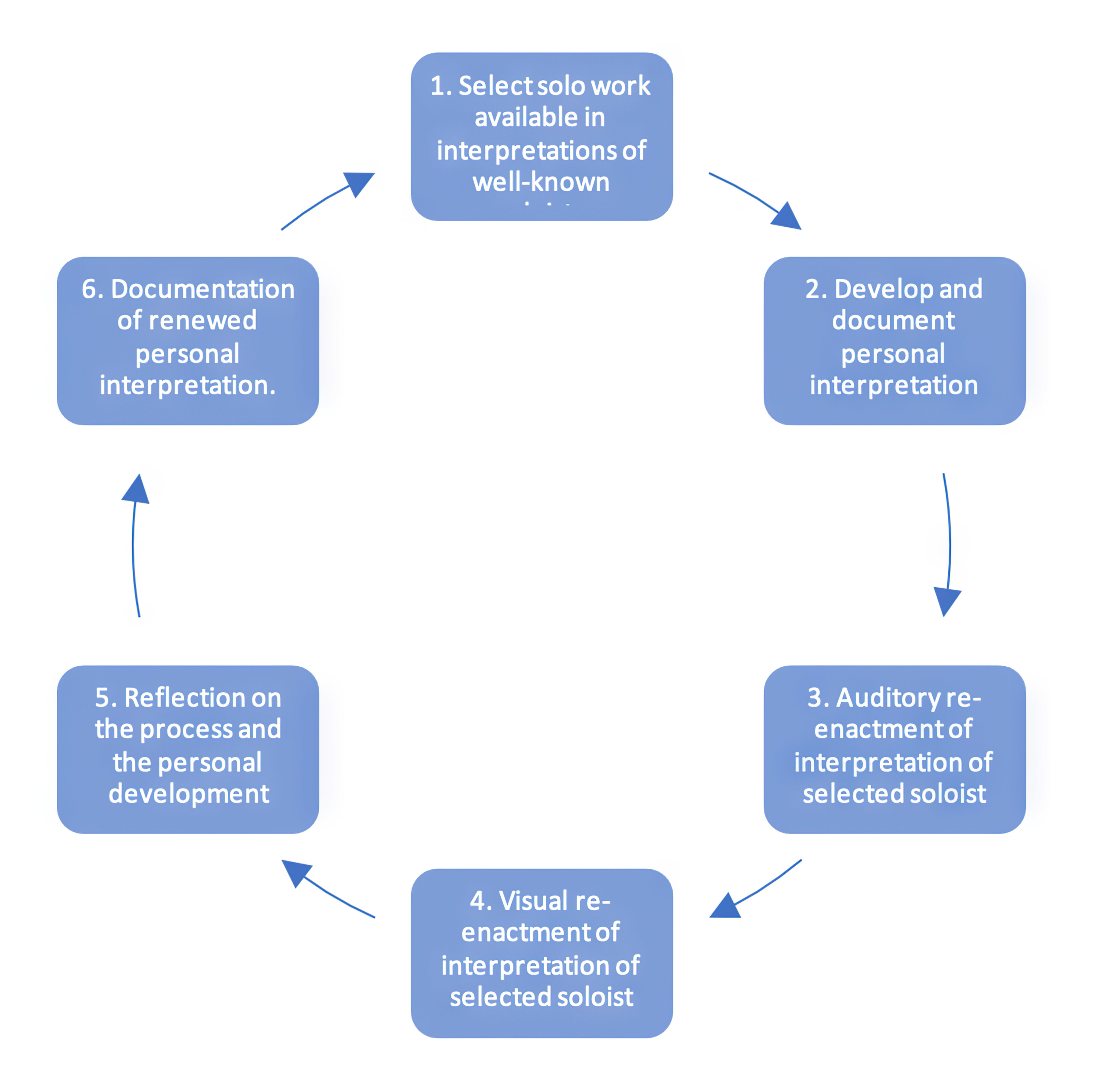
Figure 1: The “Re-enacting Embodiment” method developed by the author. © Barbara Lüneburg
Starting the circle from the top, “Re-enacting Embodiment” includes the following steps17:
- Select a solo work with audiovisually documented interpretations by two established soloists (female and male).
- Develop and document your personal interpretation of this work in a video prior to re-enacting the interpretation of either of the chosen soloists.
- Re-enact the interpretation and performance by each soloist by only listening to their interpretation and using your own bodily repertoire.
- Visually re-enact the soloists’ performances by emulating their body language as exactly as possible.
- While pursuing the re-enactment, ask yourself: How does the conscious appropriation of another person’s movement repertoire affect my own interpretation and self-perception? How does the embodiment of movement patterns foreign to me enrich my musical expressive and performative agency? How can we reflect embodied techniques theoretically and practically in phenomenological observations, academic text, and artworks?
- After experiencing and reflecting on the re-enactment follows a renewed interpretation and audio-visual documentation of the selected work. This version is not a documentation of any of the re-enactment steps, but a new personal interpretation based on the work with the method. This is to establish how the embodiment of movement patterns foreign to me has changed my musical expressive and performative agency.
The results of this work feed back into the artist’s corporal and musical means of expression and have the potential to expand personal artistic boundaries. It has further implications for one’s own under¬standing of music and the audience’s perception of it. Psycho¬biologist Vittorio Gallese states, “embodied simulation […] mediates our capacity to share the meaning of actions, intentions, feelings, and emotions with others, thus grounding our identification with and connectedness to others.”
To test the method, I pursued a pilot case study based on Ysaÿe’s Violin Sonata no. 3 Ballade (step 1). I developed my personal interpretation of the Ballade and documented it as an audiovisual recording (step 2). Next, I picked two interpretations of the same work by a male and a female soloist (Maxim Vengerov and Hilary Hahn) which are both available as YouTube videos.18 I analyzed the musical and physical interpretations in detail, and in a first step I re-enacted the interpretation purely from listening to it (step 3), in the second more extreme step, I re-enacted the visual interpretation embodied in arm movements, gestures, facial expressions and postures of the individual soloists as seen in the YouTube videos (step 4)
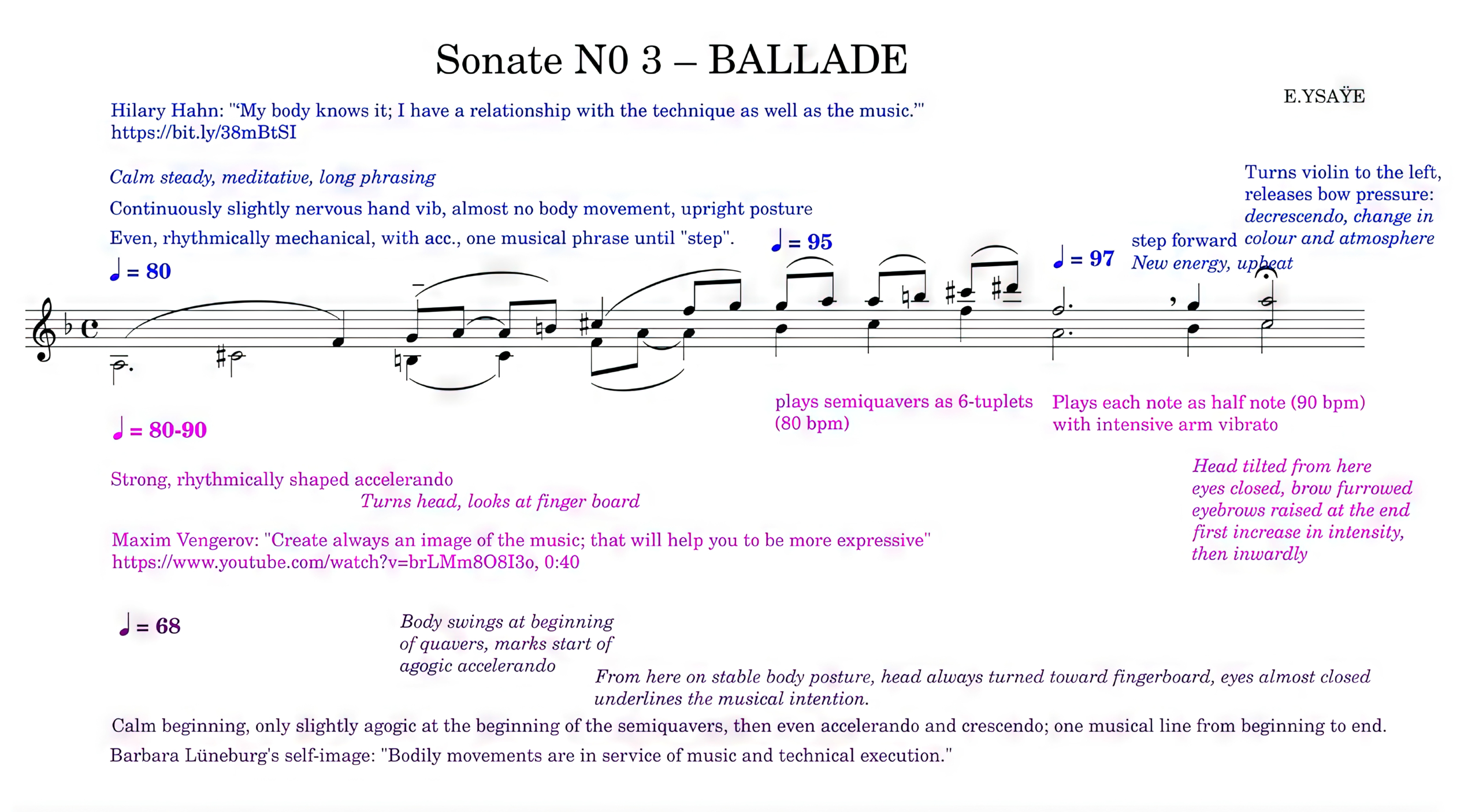
Figure 2: Transcription, comparison, and interpretation of the movements and musical expressions of three performers, including some relevant comments by the interpreters themselves: Hilary Hahn (blue), Maxim Vengerov (pink), and Barbara Lüneburg (purple) when performing Ysaÿe’s Ballade. © Barbara Lüneburg
Later in the project, I developed a template for the re-enactment journal that enabled systematic and detailed data collection which would later serve as the basis for the team members’ individual coding sessions. In the first part of the template, I ask for analytical records on metronome indications and specific tempo profiles or characteristics of a passage, its rhythmic features and musical shaping, which includes accents, vibrato, bowing, fingerings, timbre, phrasing, melodic and rhythmic form, and character, followed by a detailed description of the embodiment of musical expression and affect. The latter involves detailed observation of the various parts of the body that carry the performance, including breathing and the body as a whole.
The second part of the observation is dedicated to the interpretation of the collected data and includes the perceived musical expression, especially in connection with the physical expression. The assessment is based partly on the previously collected facts and partly on the performer’s own bodily experience while re-enacting.
This initial process is followed by two further categories: The first deals with the observations the artist-researcher makes about their own practice during re-enacting. Here, challenges, accomplishments and steps taken are noted and reflected upon. Finally, the field notes are concluded with general comments on the process of embodiment. The aim here is to observe or develop successful practice strategies that may extend the personal boundaries of the re-enacting subjects and to note ideas for artworks that could emerge from the reenacting process.
While re-enacting visual body language as accurately as possible, I found that there could be no re-enactment without a profound understanding of the meaning of a body movement for musical expression. This observation was repeated in workshops with students of different instrumental groups. Without an understanding of the “why” of a body movement, it is almost impossible to recreate it physically or musically. Conversely, when body movement is understood and is re-enacted, it most often has a direct influence on musical expression.
To give an example: Maxim Vengerov tends to hold his head at an extreme angle, with his cheek resting entirely on the chin rest. At first, trying to imitate the extreme tilt of his head made my neck hurt; it felt uncomfortable and unhealthy, and it disturbed me in performing.
I wondered why Vengerov was doing something that clearly went against healthy anatomy, when everything we are taught in violin lessons is not to work against the body to avoid long-term damage. It was only when I linked the body movement with a performative-musical meaning that it began to make sense to me, and I could integrate it meaningfully in my playing. I interpreted the tilting of the head as a form of deep listening to the sound of the violin and the music, with Vengerov literally putting his ear as close as possible to the instrument. When I re-enacted this posture with this mindset—without my conscious intention to do so—it automatically increased the tonal and musical intensity of my playing. An interesting side effect was that my neck immediately stopped hurting. Looking at Vengerov’s face and posture when leaning into the music and listening intensely, this intensity becomes visually tangible to the audience.
Our investigation differs from previously conducted research in gestures in the fields of cognitive neuroscience of music and psychology,19 empirical musicology,20 participant observation in performance and theater studies,21 or in the field of semiotics.22 “Re-enacting Embodiment” is a practice-based method that allows us to examine gesture and embodiment from an intrinsic perspective in a bottom-up approach through our own doing. To evidence our investigation, we employ the knowledge mode of “Know-how”23 that “comprises tacit and embodied knowledge exclusively known and gained from the perspective of the practitioner, and which can be identified as experiential, haptic, performative instances of knowing and may be articulated in specific skills and techniques.”24 Through the “Re-enacting Embodiment” method we have a tool to understand why which gestures are made and how they become part of the musical and artistic expression of an instrumentalist.
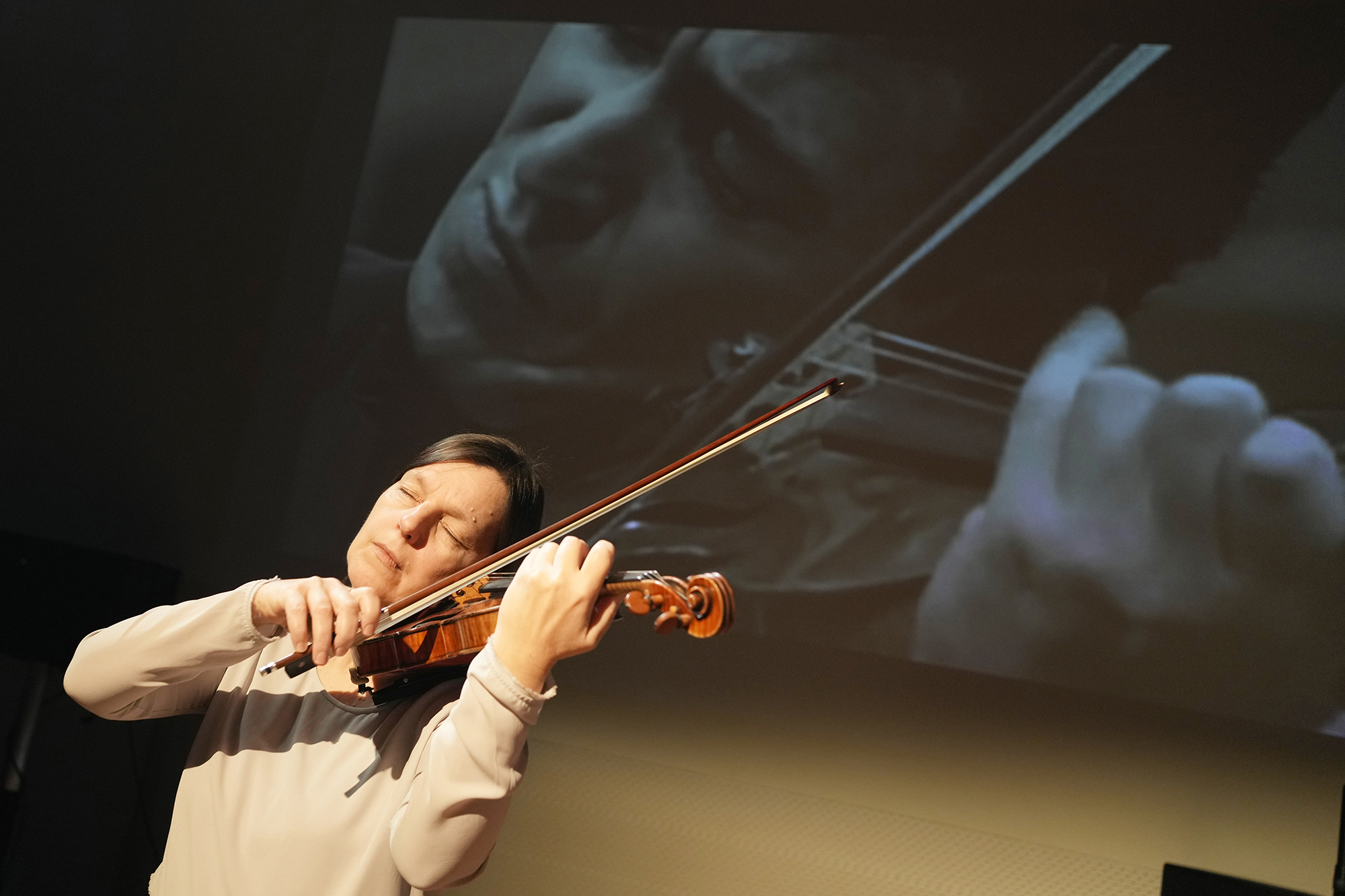
Figure 3: Barbara Lüneburg re-enacts Maxim Vengerov’s extreme chin position. © Reinhard Winkler
I also applied the method in a workshop with master’s students at Anton Bruckner University (violin and viola, group instruction). Here the focus was on freeing the performing body from habitual restraints by slipping into the experience of a corporality other than their own. I met with the students for an introductory session where I went through the different steps of the method. In the next sessions the idea of working with an “air instrument” was born. Playing with an “air violin” meant putting away the instrument and pretending to play an imaginary violin while imitating the posture, footwork, gestures, and facial expressions of the impersonated soloist. It allowed us to focus on the movements and musical expressions of the soloist we re-enacted without being constrained by technical and mental difficulties of playing a real instrument.
In the feedback sessions, the master’s students compared their normal teacher-student situation with the “Re-enacting Embodiment” experience. They emphasized that re-enacting the physical performative patterns of another person encourages breaking out of one’s own bodily habits and unconscious self-limitations, and even boundaries imposed by violin traditions and schools to which they felt they belonged. They additionally stressed the liberating effect of the bodywork, which they found to be playful, curiosity-promoting, and self-educating. A similar observation was provided by doctoral candidate Joanna Wicherek (piano) who reported that re-enacting the pianist Lang-Lang’s corporal language—which is in her own account “very foreign” to her—liberated her own playing when interpreting Debussy’s Jardins sous la pluie. She describes re-enacting as an act of relinquishing responsibility for the interpretation:
I felt that impersonating another person gave my performance confidence and freed me from the responsibility for the musical decisions and their results in my playing. While focusing only on the physical accuracy of the re-enactment, I discovered that my performance developed new elements of expression.25
One of the findings was that trying out counter-models and relinquishing responsibility for one’s own musical choices by imitating great soloists and trying to understand their performative and bodily work in detail encourages the development of greater physical and musical competence in one’s own playing.
A third opportunity to test and adapt the method arose at the isa – International Summer Academy 2022, where I taught embodiment and charisma to young performers from various instrumental groups such as string players (violin, viola, violoncello), woodwinds (oboe, flute, clarinet, bassoon), brass players (horn), and keyboard (piano). Here, the main goal was for them to recognize ingrained kinesthetic habits in their playing and understand how kinesthetic experiences are on the one hand instrumental for playing, but at the same time have a communicative potential that conveys meaning. As Carrie Noland suggests,
The body we observe in the act of writing [performing; the author] may indeed be communicating a message or completing a task [mastering a musical score and instrument], but it is simultaneously measuring space, monitoring pressure and friction, accommodating shifts of weight. These kinesthetic experiences that exceed communicative or instrumental projects affect the gestures that are made and the meanings they convey.26
I intended to offer them the knowledge and skills to change or expand their physical range of expression according to their artistic visions and musical intentions.
A variant of the “Re-enacting Embodiment” method served as a starting point. The instrumentalists chose one video of a soloist whose musical and physical language they admired, and one of a performer they found physically strange, uninspiring or simply “terrible.” By explaining their choice to me, they took a first step towards an awareness of their performing body. Next, I asked them to recognize and reflect on their personal movement patterns. The way they move their body while playing turned out to be an unconscious act for many, and was difficult to pinpoint. Therefore, we first had to establish how the whole body from feet to the crown of the head, posture, facial expression, vertical and horizontal reach, and movements around different axes all belong to our repertoire of bodily expression. Subsequently, the students worked with the aforementioned principle of the “air instrument.” They played along with the video of their favorite performer, to compare their movement patterns with the physical expression of another person and to break personal, unreflective habits through new kinesthetic experiences. Again, simply imitating another person’s physical actions sometimes felt unsatisfying, alien, and meaningless. It proved essential that the students find musical and emotional reasons for moving in a certain way. The students were only able to develop a different basic emotional feeling and alternative musical statements when they engaged with another person’s body movement in an act of social and musical identification. As Vittorio Gallese states, “Social [in our case “artistic”; the author] identification incorporates the domains of action, sensations, affect, and emotions and is underpinned by the activation of shared neural circuits.”27
Working with the “Re-enacting Embodiment” method guides performers’ attention towards different value systems of their audiences which have personal and socio-cultural roots. We discussed how the body is a means of conveying emotion in human conversations and how it relates to the values our audiences bring to the concert situation. We considered how they could use this phenomenon to use their bodies as a means of expression that complements and extends musical expression and through which emotions are experienced by the audience in an act of empathy and embodied simulation. We started from the idea that “When observing other acting individuals, and facing their full range of expressive power (the way they act, the emotions and feelings they display), a meaningful embodied interpersonal link is automatically established.”28 We were therefore looking for ways to explore and use the full range of the physical expressiveness of one’s performative body to strengthen this interpersonal connection between performer and audience.
I observed that different instrument groups bring different body awareness to the table. Wind players are trained to use breath and body as a consciously reflected unity; string players are usually good at sensing and establishing connections between all parts of the body when playing standing up. Whereas, due to their seated playing posture, pianists and cellists often seem to need to take a greater mental and physical step to feel their physicality as a continuous unit. Disadvantaged by the fact that their upper and lower body are at right angles to each other, it seems to be more difficult for them to feel the body as a total complex in which the individual parts work together and in which the center of the body acts as the center of focus and strength.
(2) Artistic Research through Creation
Another challenge in this project is to make the implicit explicit. This concerns all three areas of enquiry: expression, gender, and charisma. The research method I use for this is in turn derived from artistic research using the process of arts creation for investigation and the actual artwork for the display and dissemination of research findings. It builds on the experience with the “Re-enacting Embodiment” method, which I use to create audiovisual installations and remixes that feature the performing body in the classical instrumental practice. I will elaborate on a first example:
I am in the process of setting up a website on the international database for artistic research, the Research Catalogue,29 where over time I will create profiles of female and male soloists from different generations and countries: The Body that Performs.30 First profiles planned are about the violinists Jascha Heifetz (1901-1987), Erica Morini (1904-1995), Zoria Shikhmurzaeva (1933-2010), Salvatore Accardo (*1941), Leonidas Kavakos (*1967), Isabelle Faust (*1972), Maxim Vengerov (*1974), Patricia Kopatchinskaja (*1977), Sergey Khatchatryan (*1985), Ziyu He (*1999), and Maria Dueñas (*2003).
The profiles will each expose—as central artwork and focus of attention—a remix that features the individual movement patterns that are central to the expressive language of the individual soloist. For that I examine YouTube recordings of each performer for the expressive potential of their body movements. What characterizes their body language? How is musical decision making and execution expressed in their posture, facial expression, head tilt, upper body mobility, footwork, etc.? And how can I present this in such a way that the body is perceived as a powerful tool that shapes the musical execution as much as the perception?
Watching and analyzing videos of different instrumentalists it became apparent that the performers’ face and body movements contribute to the musical expression. Gestures and music are closely, almost intimately fused. It is important to my research to emphasize the body’s expressiveness so that others can see and perceive it in a focused way. For that I realized that I need to detach the gestures from the overall experience of the performance and from the soloist that we as an audience admire, in a way that the focus of the viewer’s attention is no longer on the music but shifts to the body movements. The challenge is to separate body language and music in such a way that they are perceived as belonging together, but still seen independently of each other.
To achieve this, I separate the original music from the performing body via various steps: by subjecting the original composition to a remix in order to break the familiarity of the work and thus create a distance from the audience’s normal listening habits; by superimposing body movements of the soloists on the remix, which are taken from the piece but almost always from a different location in the work; by zooming in twice: once literally on the video footage bringing details of the video closer to the viewer, and secondly by slowing down the movements, some of them extremely, to focus on details in the facial expression or movement pattern.
The website The Body that Performs | The Shared Space will feature a landing page with a general introduction, a second page introducing the reader to remixing as a method of research, and a third page that explains the choice of soloists and the different modes of alignments: a) a chronological timeline: since physical expression is not only a personal characteristic, but also subject to fashions of the time and possibly gender assignments, I pair male and female soloists of one generation31; b) an alignment that features similarities between performers in their physical embodiment: here I group the soloists according to their physical movement patterns and the way they embody their musical interpretations in order to investigate and point out historically influenced fashions in the way they move; c) a third mode of alignment that is concerned with gender observations will be added later.
The two main pages will be followed by profile pages of the chosen soloists. Here the audiovisual remixes I will create are central. A profile page contains basic information about the featured soloist, the audiovisual remix showing the physical characteristics of the player accompanied by my observations on how musical and gestural expression are related and what I felt was important to show. This is followed by comments from critics writing for professional journals and from the community (for instance on YouTube channels) who remark on the soloists’ physicality and expressiveness.
The following picture (fig. 4) shows a section of one of the first profiles I have created, featuring the violinist Sascha Heifetz.
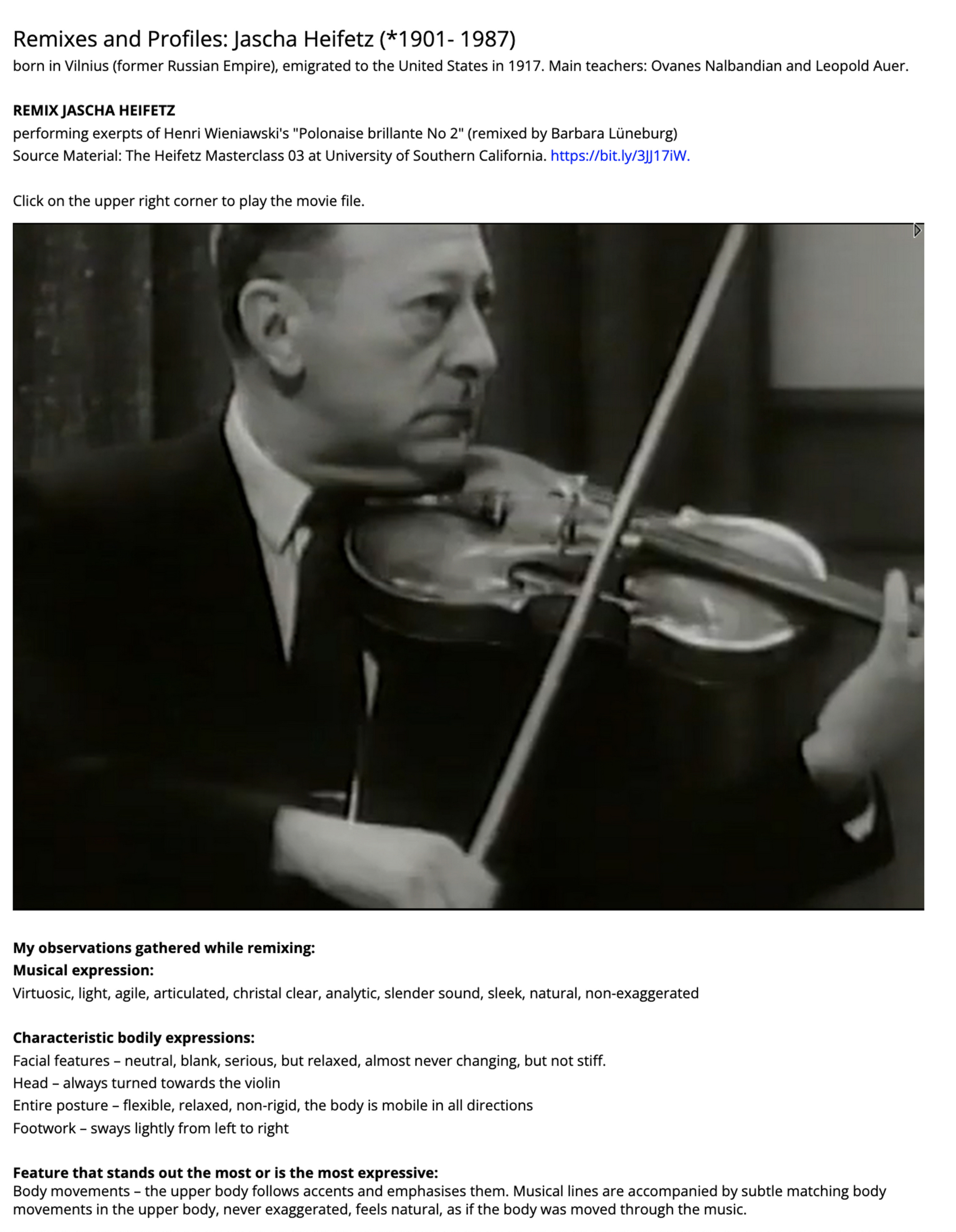
Figure 4: Example of the appearance of a musician’s profile page in the Research Catalogue. © Barbara Lüneburg
The remixes and profiles that will be collected here provide a condensed summary and interpretation of the movement patterns of the individual soloists and offer immediate opportunities for comparison, taking into account the artistic and historical context of the performers and the social and emotional space they share with their audience via YouTube or reviews.
(3) On the Tracks of Gender
In the project we are interested in how performers answer to and challenge gender allocations through their body that are produced and upheld by both them and their audience and how this is negotiated in the field. Furthermore, we investigate how it is possible to break through personal and socio-cultural boundaries and open up new forms of bodily expression and artistic being. In thinking about gender we follow gender scholar Monika Mommertz who claims that “[i]nstead of using the term ‘gender’ to postulate a more or less constant differentiation of the forms of existence of ‘men’ and ‘women’ across times and spaces, ‘gender’ should first be understood as a culturally constructed and coded ‘marking’.”32 In our research, gender marking can take different forms, for example, in the way a performer’s physicality is perceived and signified by the audience, or in the way a performer’s body lives in her/his embodied practice on stage and how she/he signifies it in their personal self-perception or professional branding, or how gender is narrated through art.
We assume that performers consciously and unconsciously respond to what is expected of them, what is considered legitimate or what is fashionable; therefore we also need to ask ourselves what we allow ourselves to do as performers, where we set personal boundaries within a framework of gender given to us in a particular historical period and fashion of the time, the educational system or the demands placed on us by an organizer, a venue, a stage. Sociologist Anna Bull notes in The Musical Body that
Practice assumes an actor who knows what to do within her field; for Bourdieu this ‘feel for the game’ (1991) is conceptualized as the ‘habitus’, the semi-conscious sense of what is possible or not possible for someone in a particular social position.33
To systematically investigate this, we will work with methods of discourse analysis and Luhmann’s aforementioned “second-order observation” while considering the “four interrelated elements” proposed by gender scholar Scott for analyzing gender relations and gender orders:
As a constitutive element of social relationships based on perceived differences between the sexes, gender involves four interrelated elements: first, culturally available symbols that evoke multiple (and often contradictory) representations […] Second, normative concepts that set forth interpretations of the meanings of the symbols, that attempt to limit and contain their metaphoric possibilities. […] a notion of politics as well as reference to social institutions and organizations––the third aspect of gender relationships. […] The fourth aspect of gender is subjective identity.34
Through artistic research we will further explore how and if we can trace gender attributions and expectations in physical performance through the re-enactment of male and female soloists. In doing so, we consider the individual re-enactment experience of this fourth aspect of gender—“subjective identity”—as shaped “by gender norms and discourses,” and we are aware that it is “historically mutable and varies from individual to individual.”35 As an example, I provide a case study that is not yet investigated to the end, but which already points to gender issues worth exploring further.
Maxim Vengerov’s interpretation of the Ballade by Eugène Ysaÿe for violin solo, which was the first interpretation I tried my “Re-enacting Embodiment” method on, is one of the shortest documented on the internet.36 Vengerov plays the Ballade exceedingly fast, precise, and crisp. By committing myself to Vengerov’s extraordinary virtuosity as a researcher—not as a musician striving for her own interpretation who may have a different musical focus—the question of whether I am able to play a passage as fast as he does, becomes secondary to my task of re-enacting it. Virtuosity becomes a bodily matter that I have to investigate: I strive to learn how it physically feels to go into Vengerov’s extremes of speed and perfection. I analyze the obstacles along the way, I breathe, lower my diaphragm, relax my forehead, loosen my shoulders, listen to where I stumble, analyze the bodily and mental reasons for it and force myself not to fluctuate in speed and precision but to keep playing through the fastest passages, just as Vengerov does. Approaching the kind of extreme virtuosity Vengerov displays requires both physical and intellectual skills from the re-enactor, and I’ve realized for myself that I need mental courage to break through my own conditioning and self-image to “dare” attempt this kind of virtuosity. But what does this have to do with gender? In the following section, I will explain how I began to question my attitude and approach to extreme virtuosic skills, taking into account a historical perspective.
Gender scholar Cordelia Miller explains in Musikdiskurs als Geschlechterdiskurs im deutschen Musikschrifttum des 19. Jahrhunderts that in the nineteenth century, which showed the rise of virtuoso female pianists, women were ascribed an “inauthentic virtuosity” while men were ascribed “true virtuosity.” She explains that when virtuoso female pianists emerged in the nineteenth century “‘[f]eminine’ attributes were used here to describe the ‘inauthentic’ virtuoso who was merely skilled in playing technique and concerned with outward effect, while ‘masculine’ attributes were used to characterize the ‘true’ virtuoso who served the musical work.”37
Without being able to prove it through research so far, I believe I have observed that even today, “extreme” virtuosity tends to be displayed by and attributed more often to men. I wonder if, in a twist of collective memory, the label of “inauthentic virtuosity”—as assigned to female soloists in the nineteenth century—today means that women do not view sheer virtuosity per se as desirable and rather view it as “inauthentic,” a label they do not want to expose themselves to. Further, I wonder if they might thereby be denying themselves not only a form of expression—the enjoyment of virtuosity for virtuosity’s sake—but also a particular skillset in the service of musical expression.38
In this context, the next question to explore further is whether the nineteenth century designation of “female” for “inauthentic virtuosity” and “male” for “true virtuosity” might still have an impact on how male and female performers deal with virtuosity today and how it is perceived and appreciated by audiences. If that is the case, can we determine in what ways, in what contexts, and by which actors? And are there other factors at play in this issue? Is there a difference in how male or female players define and perform virtuosity in their performances? For now, however, I am conquering “extreme” virtuosity as another way to express myself and my musical ideas by re-enacting Vengerov’s interpretation. I intend to explore whether this potential in developing extraordinary technical skills is accessible to others through my method of re-enacting embodiment.
To round off this overview on the artistic research project “Embodying Expression, Gender, Charisma—Breaking Boundaries of Classical Instrumental Performance Practices,” I will touch briefly on another strand of artistic research that we will pursue with regard to gender: the creative act of “narrating gender” through art. We use “the very act of narrating,” that is, creating artworks such as composing and performing multimedia works, as “a gendered activity that constructs, represents and narrates gender as a culturally mediated primary category of human existence, and these fundamentally gendered ways of narrating then construct, define and reify gendered ways of being in the world.”39
In doing so, we ask: How can performers control, shape, and change the canon of norms and values that surround their practice through embodied techniques? How can this be expressed and deconstructed in newly created artworks for an exhibition and a multimedia performance and through specific dissemination formats? How does this affect the charismatic relation to the audience?
Conclusion
Bodily and artistic expression are intertwined with how artists—as senders of an artistic, as much as social message—are perceived by their recipients, the audience, within a shared value system and thus within a jointly constructed concept of charisma.
“Re-enacting Embodiment” is a method for understanding bodily movements and their meaning for musical expression from an inner perspective. The method has potential for both research and personal musical development of the user. However, it also has some limitations. First, it is a slow method. It takes time to analyze, understand, and consistently re-enact the bodywork of other artists and to allow for real changes in one’s own performance. Second, its application requires extensive technical mastery of the instrument, body awareness, and the ability to maintain an intellectual, observational distance while playing in order to perceive what is happening to one’s own body and how it is connected to musical expression. Nevertheless, it allows deep insights into the intertwined interplay of body and artistic expression. Moreover, applied over the long term, working with the method can expand a performer’s own technical, musical, and artistic expressive boundaries.
Awareness of the discourse we live, and knowledge of embodied techniques enables us to challenge the conditions in which we perform and to break the boundaries of classical instrumental concert practice by developing new approaches in performance, developing an innovative discourse between all actors involved.
- Barbara Lüneburg, description of the project: Embodying Expression, Gender, Charisma – Breaking Boundaries of Classical Instrumental Practices”, accessed 14 March 2023, http://embodying-expression.net/↩︎
- Barbara Lüneburg, “Knowledge Production in Artistic Research–Opportunities and Challenges,” in Music & Practice, Volume 10 (2023): https://www.doi.org/10.32063/1009, accessed 14 March 2024, https://www.musicandpractice.org/knowledge-production-in-artistic-research-opportunities-and-challenges/↩︎
- Jane D. Davidson, “The Social in Music Performance,” in The Social Psychology of Music, ed. David Hargreaves and Adrian North (Oxford: Oxford University Press, 1997), 222f.↩︎
- Marko Ciciliani, Barbara Lüneburg, and Andreas Pirchner, LUDIFIED (Berlin: The Green Box, 2021), 98.↩︎
- Barbara Lüneburg, description of the project: Embodying Expression, Gender, Charisma – Breaking Boundaries of Classical Instrumental Practices”, accessed 14 March 2023, http://embodying-expression.net/↩︎
- University of Music and Performing Arts Vienna, 2022, isa—International Summer Academy, accessed 2 September 2022, https://www.isa-music.org/en/.↩︎
- Barbara Lüneburg, description of the project: Embodying Expression, Gender, Charisma – Breaking Boundaries of Classical Instrumental Practices”, accessed 14 March 2023, http://embodying-expression.net/↩︎
- Barbara Lüneburg, TransCoding—From ‘Highbrow Art’ to Participatory Culture (Bielefeld: transcript, 2018), 167, accessed 25 September 2022, https://doi.org/10.14361/9783839441084.↩︎
- We examine charisma as a social process, following theories from sociology such as those put forward by C. Marlene Fiol, Harris Drew, and Robert House in “Charismatic Leadership Strategies for Effecting Social Change,” in Leadership Quaterly 10 (1999): 449–82, or by Jürgen Raab in “Präsenz und Präsentation,” in Intermediale Inszenierungen im Zeitalter der Digitalisierung. Medientheoretische Analysen und ästhetische Konzepte, ed. Andy Blättler, Doris Gassert, Susanna Parikka-Hug, and Miriam V. Ronsdorf (Bielefeld: transcript, 2010), accessed 5 January 2023, https://doi.org/10.14361/9783839411919-009.↩︎
- Joan W. Scott, “Gender: A Useful Category of Historical Analysis,” in The American Historical Review 91/5 (1986): 1053–75, accessed 25 September 2022, https://doi.org/10.2307/1864376.↩︎
- Niklas Luhmann, “Deconstruction as Second-Order Observing,” in New Literary History 24/4 (1993): 763–82, accessed 25 September 2022, https://doi.org/10.2307/469391.↩︎
- Ibid., 764.↩︎
- Barbara Lüneburg, Re-enacting Embodiment: The Method, accessed 14 March 2023, http://embodying-expression.net/english/re-enacting_embodiment.html↩︎
- Barbara Lüneburg, “Knowledge Production in Artistic Research–Opportunities and Challenges,” in Music & Practice, https://www.doi.org/10.32063/1009, accessed 14 March 2024, https://www.musicandpractice.org/knowledge-production-in-artistic-research-opportunities-and-challenges/↩︎
- Cf. Kai Köpp, Johannes Gebauer, and Sebastian Bausch, “Chasing Dr Joachim—Die Jagd nach Dr. Joachim: Joseph Joachim, Romanze in C-Dur. Reenactment der Aufnahme des Komponisten, 1903,” in Arts in Context Kunst, Forschung, Gesellschaft, ed. Thomas Gartmann and Christian Pauli (Bielefeld: transcript, 2020), 86-99, accessed 25 September 2022, https://arbor.bfh.ch/13197/7/AiC_09_Koep-Gebauer-Bausch.pdf, https://www.doi.org/10.14361/9783839453223-009.↩︎
- Ben Spatz, What a Body Can Do: Technique as Knowledge, Practice as Research (London and New York: Routledge, 2015), 16.↩︎
- Barbara Lüneburg, Re-enacting Embodiment – The Method as described in the research proposal for the Austrian Science Fund (FWF) and on http://www.barbara-lueneburg.com/Embodying_Expression_Gender_and_Charisma_ Breaking_Boundaries/ , accessed 14 March 2023.↩︎
- Maxim Vengerov performing Eugène Ysaÿe’s Sonata no. 3 in D minor, Ballade op. 27, accessed 2 September 2022, https://www.youtube.com/watch?v=Bg1NUBLK1tk; Hilary Hahn performing Eugène Ysaÿe’s Sonata no. 3 in D minor, Ballade op. 27, accessed 2 September 2022, https://www.youtube.com/watch?v=biEUK9Winqo.↩︎
- Alexander P. Demos, “The Perception of Movement through Musical Sound: Towards a Dynamical Systems Theory of Music Performance,” University of Connecticut, 7 October 2013; Federico Visi, Methods and Technologies for the Analysis and Interactive Use of Body Movements in Instrumental Music Performance (PhD dissertation, Plymouth University, 2017).↩︎
- Eric F. Clarke, “Creativity in Performance,” in Musical Imaginations: Multidisciplinary Perspectives on Creativity, ed. Dorothy Miell, Raymond MacDonald, and David Hargreaves (Oxford: Oxford University Press, 2012), accessed 25 September 2022, https://www.doi.org/10.1093/acprof:oso/9780199568086.003.0002; Bradley W. Vines, Marcelo M. Wanderley, Carol L. Krumhansl, Regina L. Nuzzo, and Daniel J. Levitin, “Performance Gestures of Musicians: What Structural and Emotional Information Do They Convey?,” in Lecture Notes in Computer Science (2004): 468-78, accessed 25 September 2022, https://doi.org/10.1007/978-3-540-24598-8_43; Micheline Lesaffre, Pieter-Jan Maes, and Marc Leman, The Routledge Companion to Embodied Music Interaction (London: Routledge, 2019), accessed 25 September 2022, https://doi.org/10.4324/9781315621364.↩︎
- Christoph Wulf and Erika Fischer-Lichte, Gesten: Inszenierung, Aufführung, Praxis (München: Wilhelm Fink Verlag, 2010); Spatz, What a Body Can Do.↩︎
- Lina Navickaité-Martinelli, Piano Performance in a Semiotic Key (Helsinki: Semiotic Society of Finland, 2014), accessed 25 September 2022, https://helda.helsinki.fi/bitstream/handle/10138/136475/pianoper.pdf.↩︎
- Robin Nelson, Practice-as-Research in the Arts. Principles, Protocols, Pedagogies, Resistances (London: Palgrave Macmillan, 2013), 37, accessed 25 September 2022, https://doi.org/10.1057/9781137282910.↩︎
- Sara Hubrich, The Creative Embodiment of Music—Practice-Based Investigations into Staged and Embodied Interpretations of Instrumental Music (PhD dissertation, The Birmingham Conservatoire—Faculty of Media, Arts and Design, 2014), 19, accessed 25 September 2022, http://www.open-access.bcu.ac.uk/4917/.↩︎
- Joanna Wicherek, “Overcoming Performative and Expressive Boundaries in Intermedial Theatrical Piano Music,” examination paper at Anton Bruckner University, 2022.↩︎
- Carrie Noland, Agency and Embodiment: Performing Gestures / Producing Culture (Cambridge, MA: Harvard University Press, 2009), 2.↩︎
- Gallese, “Mirror Neurons, Embodied Simulation, and the Neural Basis of Social Identification,” 519.↩︎
- Ibid., 520.↩︎
- Society for Artistic Research, Research Catalogue. An International Database for Artistic Research, n.d., accessed 10 August 2022, https://www.researchcatalogue.net/.↩︎
- I expect the platform to be available to the public at the completion of the project. It will be accessible via my personal profile: https://www.researchcatalogue.net/profile/?person=156033.↩︎
- The reduction to the binary approach is due to the concert context of Western classical music. The gender representations of international soloists who perform in traditional concert halls are culturally marked mainly as male or female, based on gender characteristics such as clothing, name or physical appearance. More diverse gender representations are rarely addressed or lived on stage. The fluidity of gender representations shown on stage by the soloists studied is done more indirectly through physicality and embodiment or slight variations in clothing, haircut etc. and is part of our study. In the team’s coding of the re-enacting research protocols, we use anonymized gender-neutral descriptions with the pronouns “they/them/their” and omit references to for instance clothing or hairstyle. Instead, we look for the affect that embodiment and physicality of the performer convey or evoke. We compare this with the comments of the viewers that we find on YouTube, which give us an indication of how the movement, physical expression and musical interpretation were perceived and felt by them.↩︎
- Mommertz (2004), cited by Claudia Opitz-Belakhal, Geschlechtergeschichte (Frankfurt am Main: Campus Verlag, 2010), 22 (trans. Barbara Lüneburg): “Statt mit dem Begriff ‘Geschlecht’ eine über Zeiten und Räume hinweg mehr oder weniger gleichbleibende Differenz der Existenzformen von ‘Männern’ und ‘Frauen’ zu postulieren, sollte ‘Geschlecht’ zunächst als eine kulturell konstruierte und codierte ‘Markierung’ verstanden werden.”↩︎
- Anna Bull, The Musical Body: How Gender and Class Are Reproduced among Young People Playing Classical Music in England (PhD dissertation, London, Goldsmiths, University of London, December 2014), accessed 25 September 2022, https://research.gold.ac.uk/id/eprint/12299/1/SOC_thesis_BullA_2015.pdf, 37.↩︎
- Scott, “Gender: A Useful Category of Historical Analysis,” 1068f.↩︎
- Opitz-Belakhal, Geschlechtergeschichte, 15 (trans. Barbara Lüneburg): “Die Geschlechtsidentität wird durch Geschlechternormen und -diskurse geprägt, ist aber, wie die Subjektivität auch, historisch wandelbar und individuell unterschiedlich ausgeprägt.”↩︎
- Maxim Vengerov performing Eugène Ysaÿe’s Sonata no. 3 in D minor, Ballade op. 27, accessed 2 September 2022, https://www.youtube.com/watch?v=Bg1NUBLK1tk.↩︎
- Cordelia Miller, Musikdiskurs als Geschlechterdiskurs im deutschen Musikschrifttum des 19. Jahrhunderts (Oldenburg: BIS-Verlag, 2019), accessed 25 September 2022, http://oops.uni-oldenburg.de/4679/1/2383-4__Miller__Musikdiskurs%20als%20Geschlechterdiskurs.pdf, 19 (trans. Barbara Lüneburg): “‘Weibliche’ Eigenschaften wurden hierbei benutzt, um den ‘unechten’, lediglich spieltechnisch versierten und auf äußeren Effekt bedachten Virtuosen zu beschreiben, während ‘männliche’ Attribute bei der Charakterisierung des ‘echten’, dem Musikwerk dienenden Virtuosen Verwendung fanden.”↩︎
- Please note that this consideration does not imply that there are not extremely virtuosic female instrumentalists. However, I wonder, if we see as many that display their virtuosity for virtuosity’s sake.↩︎
- Robyn Fivush and Azriel Grysman, “Narrative and Gender as Mutually Constituted Meaning-Making Systems,” in Memory, Mind & Media, vol. 1 (2022), e2: 1-14, 1f., accessed 25 September 2022, https://doi.org/10.1017/mem.2021.4.↩︎