Simon Rose  and Ingo Reulecke
How to cite
How to cite
Abstract
Abstract
Abstract
Abstract

IR: As a dancer, I’ve been involved with this sort of practice for about twenty years—working in sessions with musicians in what I describe as real-time composition. I like to make this reference to the Echtzeitmusik (real-time1 music) scene in Berlin.2 I’m curious as to how we make sense out of what we are doing in movement and sound: how do we manage to improvise coherently and create real-time composition? How can we better understand such composing, that manifests in the moment, without specific pre-planning? I find such creativity regularly in sessions with dance and music. Together, over a dedicated period of five-month’s research period, we’ve focused on these question through intensive work in the studio and through discussion. I’ve been interested in how a development of shared practice might take place alongside a deepening of understanding of the complex processes at work. Through our research design we immediately reflected verbally and kept a spoken record of that which has occurred in activity. This has supported the flow of iterative activity within the ongoing process. Often, we found an immediate reflective response with substantial thoughts and ideas concerning the relation between music and dance/sound and movement. I guess we are able to reach this level quickly, as we’ve been involved in extensive work in this field for many years.
SR: Over the months since we began this systematic research approach, turning over what the nature of our practice together is, this simple word shared has become a constant. Shared is referred to in its broadest sense—the shared agreement to do something together—even if this is activity that can be oppositional or have great juxtaposition—the shared-ness remains. Collaboration is happening, and this is an important theme of improvisation, but this shared-ness, or willingness to share, seems to go to a deeper level of mutual understanding.3 Perhaps because, in addition to collaborating through disciplinary improvisation, we’re engaged in interdisciplinary activity that calls for a particular kind of openness. It is certainly to do with working with sensitivity. At the level of embodiment and intuition we already know what is going on; after all, we successfully perform together, and this is, in large part, due to knowledge and skill that we are bringing from our respective fields. But the challenge here is to articulate this embodiment in words. Of course, shared-ness can suggest a “touchy-feely,” cocooned kind of activity that may be more suited to privacy and in which consensus is the likely main goal. Incubatory activity is certainly nurturing but I think we are dealing more in terms of having left the nest—we’re not spring chickens! Shared-ness here is more towards the development of a professional performance practice.
This performance practice is situated; the context is instrumental for creating. And this shared-ness of performance practice extends to the audience. So, shared-ness involves a robust, dynamic, communicative activity and working closely, with immediacy with the other who is simultaneously involved in a practice other than your own; this calls for a kind of heightened sense of sharing. Truly being there for one another in a creative, public context requires commitment in terms of time, energy, and thinking and I experience this as felt in our collaboration.
Although the large baritone saxophone can be cumbersome, it has its own strong bodily presence and I am fond of it. Now, the logic could be, if you wish to work with dancers—play a piccolo or use voice but I have developed a love of the sound-world possible with the baritone saxophone; this is my main musical interest, one that I choose to contribute with in collaboration in any artistic context. I’m consciously working with the resistance and limitations created by the choice of instrument. So, in my case the somatic ideas that we’re exchanging are processed through such limitations. In our practice I realized early on that, given the musical constraints, working with spatial awareness and developing movement and certain positions, it is the relational choices that provide for a way of working with consideration of the dance while also supporting the music’s embodiment.
The interdisciplinary connection you make to Berlin’s Echtzeitmusik is interesting. This music scene is now an umbrella term for a wide range of music practices—you can find noise, string ensembles, electronics, jazz-based, new-music compositional procedures, and much more. However, beyond tendencies, styles, and labels, a closer look reveals improvisation, in different degrees, as a thread that runs through, connecting musicians. Typically, musicians are able to collaborate and perform together within this array through some shared understanding of processes of improvisation—even if the outcome may be fixed. In this way improvisation forms a connectivity, much as how we are using it.
IR: What I’ve experienced in sessions with musicians, as well as dancers, I find very special. These moments of shared space and time tend to occur more often with musicians than with dancers—currently I’m performing more frequently with musicians. Often what takes place is not described or discussed in advance. Rather, the process of composition is integrated and unfolds as a time-based practice. This is in high contrast to rehearsing in order to construct a fixed dance piece or product. I find the former more productive and creative. We are immersing ourselves, together, in a zone of openness, an open field. This is a particularly interesting participatory moment. The idea of shared space, in which we are paying attention, together, is really important. I describe this in terms of the space working for us. This supports the outcome of the improvisation.
The quality of attention in practice needs to be highlighted. And this is informed by experience; there’s a discernible difference when we encounter those who have developed a conscious quality of paying attention via work on awareness, listening and so forth through which empathy in practice becomes possible in the moment of improvising. This enables a kind of flow to develop between us.
SR: Since I began working with dancers my interest in the body has gradually deepened. While musicians are often preoccupied with an instrument, we undeniably share this theme of body; we have an equal bodily presence. So, the dancer’s bodily knowledge offers ideas and material arising from the field and rightly becomes foregrounded in our explorative exchange—looking at strategies for approaching movement and sound together—such practice offers huge interdisciplinary potential.4
Initially, I found the idea of working together in sound and movement, on the face of it, a beguilingly simple idea, yet it turns out to be fascinatingly complicated! And as I was becoming more interested in the potential of developing interdisciplinary work with dance, I saw an established dance company in Berlin. The dancers were working with “classical” musicians and it was clear that there was a thematic choreographic decision for the dancers to work in close proximity and in contact with the musicians’ movements. But, as they did so the feeling from the musicians was one of compliance—there was an awkwardness. I felt there was a lack of consideration given to the embodied nature of music—the choreography overlooked the musicians’ already highly honed form and sense of embodiment that leads from the requirement for the maintenance of technique so prized in classical music. In working together in sound and music, there are bigger, more in-depth questions beyond how can we draw musicians into dance. Conversely, when some enthusiastic musicians work with dancers in improvisation there can be an uncritical compulsion to move with or try to mirror the dancer. Of course, a lot of this is to do with intention, interpretation and experience, and how much interest, time, and care is afforded to development. There are many more sides to this, but by acknowledging the complexity of what we’re working with, we can develop a more useful understanding for the development of practice in sound and movement.
For the musician, we can consider this developing of practice in sound and movement via a more holistic attitude that builds from increased interdisciplinary bodily awareness. But this also builds from the acknowledgement of difference in the two activities. From a musician’s perspective, we are already wholly engaged in an embodied activity, with our instrument (that is also itself a body). This has its own demands for the aesthetic production of music and sound and, of course, this calls for its own perspectival awareness. The musicians’ embodiment contributes to the shared development of improvisation in music and dance. So, what is the nature of the musician’s embodiment? And how does this relate to the dancer’s embodiment? Such questions aren’t straight forward and may give rise to contradictions, for example if you look at instrumental pedagogy, in purist saxophone teaching and practice, movement may be frowned upon as it alters the alignment of body/instrument posture and resultant sound production. Saxophonist Wayne Shorter is an interesting and humorous thinker; he is rare in that, even in his eighties, he is constantly seeking to be inventive and creative, he says don’t tap your foot, by doing so you are introducing a limitation via a bodily diktat—a limitation to the temporal, improvisational possibilities. He’s saying don’t move! Or, rather, don’t introduce extraneous movement. His preference is to free the musical possibilities by dedicating all activity to creativity in sound without the hinderance of additional movement. This is an interesting, informed position, and here Shorter is not referring to working with dancers; nevertheless it indicates the challenge to overly simplistic thinking about the relation or translation between the two disciplines, particularly in terms of initiating activity and pedagogy. Limitations and resistances form part of the sharing and these will also suggest frameworks for action and creativity. For example, I cannot work successfully without the resistance of the reed in my mouthpiece and we are both working with the limitation and resistance created by gravity. One initial, introductory way of forming an explicit acknowledgment of the nature and differences in our activity is to simply consider that we have a spatial plane and a sonic plane, simultaneously, and we situate ourselves in relation to these—we can develop varying degrees of awareness of these, and in sound and movement in improvisation make informed choices by considering either or both. This framing can open the space, and leave the door open for everyone, regardless of experience, skill, level of interest, or instrumentation. The interdisciplinary nature of the shared practice is achieved through a clarity of approach that acknowledges and values the other.
Let’s discuss some specific examples of ways we worked together somatically in our studio sessions. You introduced the idea of what you call “the four corners of the feet” for our improvisation work in music and dance. I found this increased bodily awareness useful for our shared practice; as a musician I don’t much consider how I am standing, or moving, and the very basis, the contact with the ground is fundamental.
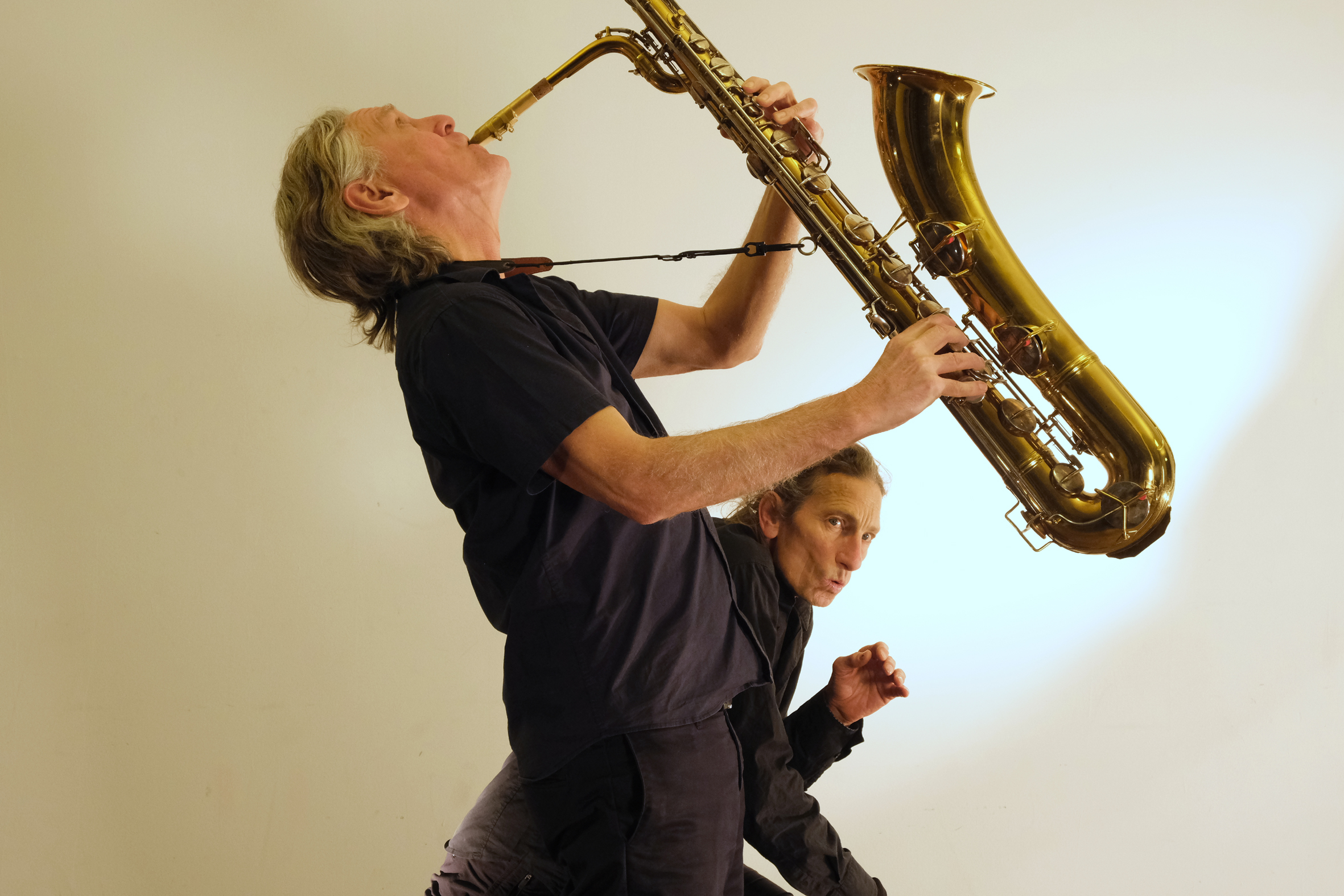
Figure 1: Ingo Reulecke (dance) and Simon Rose (baritone saxophone) © Gesina von Schroeder
IR: I find the awareness of the extremities very important in dance as it connects us physically with the space and the environment. The feet carry such fundamental importance for our movement. Directing and enhancing our perception of how the feet engage with the ground is very important for me. The four points are: inner ball, outer ball, inner heel, outer heel. By aiming to experience these more fully we may achieve an increased conscious approach to grounding. We also increase awareness of how our body’s weight is distributed through parts of the feet. My approach in this work on awareness and perceiving is to focus upon one part of the body, and from there direct the concentration to other parts. We then expand our perception, making us more present, more concentrated. I think of this part of the practice as becoming tuned. This work prepares us for open improvisation. And, it’s worth registering how precise preparatory work may influence and determine the quality of the open improvisation that follows.
SR: I found the manner in which you introduced me to slowly concentrating and developing awareness of my contact with the ground also led to a kind of calming, sort of meditative state, and when we began the improvisation I was inclined to continue rather than break this feeling and connectedness with the ground. So, in that respect, through improvisation the exercise informed the composition of the music. You also introduced the idea of the “four dignities.”
IR: The four dignities are: sitting, standing, lying, and walking. I like to introduce simplicity, be it with dance or dance plus music. By paying close attention to something that is very familiar and simple we can open new perspectives of how we move, and how we experience spatially. We employ these postures all the time, yet we’re not necessarily conscious of them. The task in the exercise is to carry these out more consciously, to feel and become more aware of our embodiment within the posture as well as how we move from one posture to the next, what happens in transition, and how we create a posture, or dignity, with our presence. This activity can move from an exercise to a kind of score that is limited by choices regarding the four dignities. This can become as challenging and complex as participants choose it to be, depending upon ability, but the important thing is to retain the awareness found in the exercise. I find this work necessary in moving towards individual and group improvisation as it opens up the space to the body—participants may begin to experience an increased sense of proprioception as a tool for improvisation work. By spending time paying close attention to what we usually think of as the simple things, increasing awareness of these, we can fly high in improvisation. Through this kind of activity, I often find a kind of meditative or highly concentrated state with which I play.
In free exploration I’m often astonished by how much we share in dance and music—the intensity of shared experience, which is multi-layered. It goes far beyond, say, a spoken conversation. Daily, more pedestrian activities rarely reach a deeper level of awareness and communication. There is huge potential for communication and experience in this codified art space when we dig into the shared process.
SR: You introduced a further focus on perception through work on looking and seeing as a way into developing awareness and compositional ideas in activity. It’s a useful, equally open point of reference for dancers and musicians, a means of developing further awareness within the shared process of improvisation that can also lead to material. I found this engaging: increasing perceptual awareness; noticing and considering the elements of the given space; and how we may relate to and within the given space as well as with one another. This subsequently led to your reference to William Forsythe’s idea of making the eyes go out of focus as an extension of the seeing exercise—a technique aimed at overriding habitual patterns of moving by creating a different sense of the body as we move.5
Developing awareness through such activities became a consistent focus within our sessions. And, immersing in the somatic and sensory work led us to reflect upon awareness-of-awareness; what it means to be more fully present and available in sound and movement; and, more generally, the nature of consciousness in relation to this work. This all arose within the setting of shared somatic practice. It seems that what we do is most obviously asking questions of my body, the musician’s body, and this simply doesn’t arise in the everyday culture of musical practice. Typically for a musician, it’s only if you have a physical problem that you begin to seriously consider the body and the practice more ergonomically. However, sharing such ideas by using the sensory as a reference opens a world of interdisciplinary possibilities.
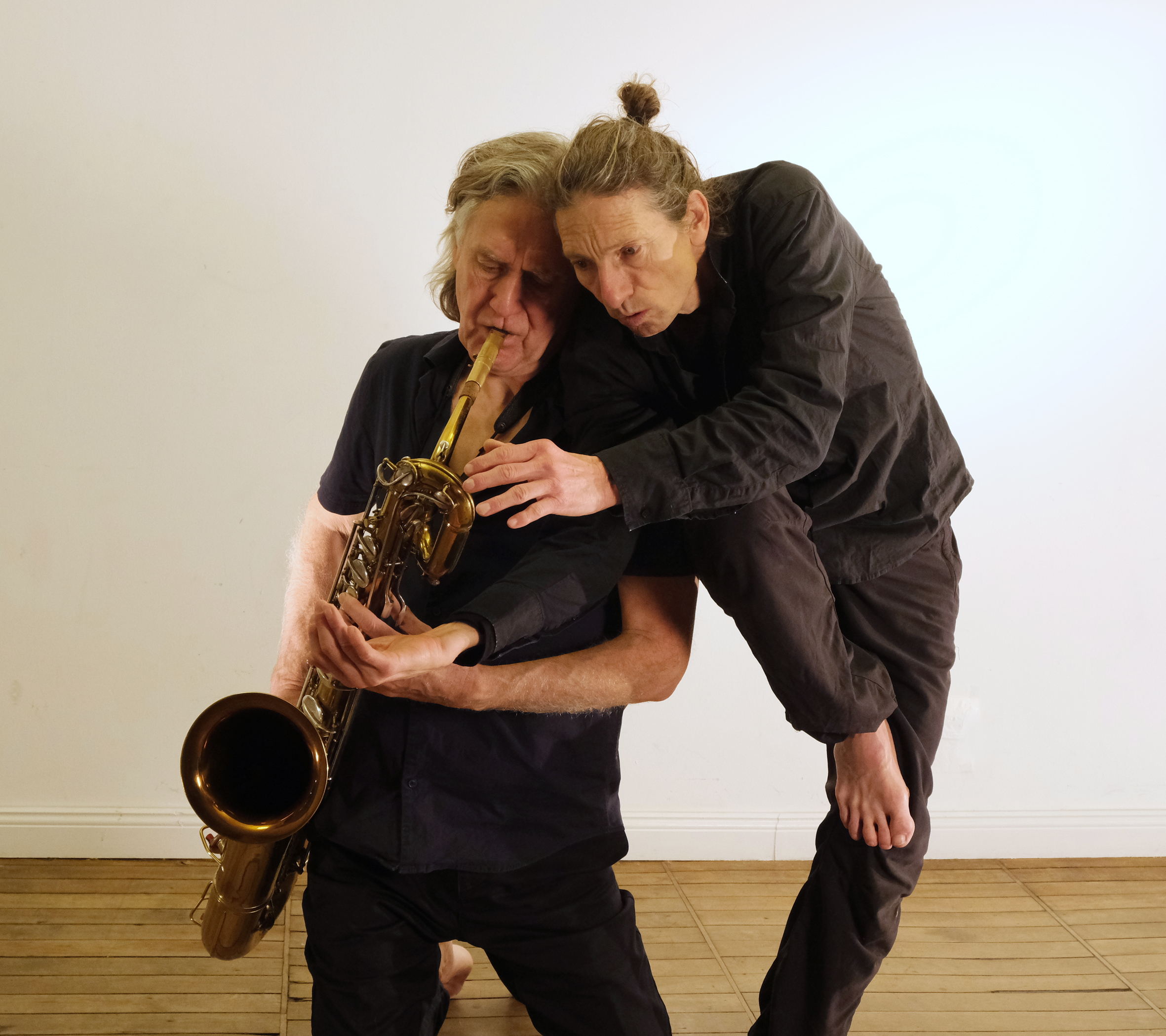
Figure 2: Ingo Reulecke (dance) and Simon Rose (baritone saxophone) © Gesina von Schroeder
Of course, listening in improvisation is an important theme of music and this can become interdisciplinary.6 Listening offers an equally relevant means of entering the shared activity of improvisation in sound and movement. Pauline Oliveros’ Deep Listening is a useful reference and began as a way of thinking about engagement with sound, music, and composition and is now a much more encompassing multidisciplinary practice.7
IR: Awareness is a necessary part of our sharing. In a way, the aspect of listening is a holistic one, and in this sense, covering the sensory and even the proprioception. I have the feeling that to some degree I’m able to listen with my skin and the layers of the body (muscles, bones). But I refer to the whole instrument of the body as listening, or aware, in the best case—this can be something to aim for. I apply all kinds of fine-tuned work to get close to this kind of awareness—different practices such as mindfulness training (concentration, meditation, awareness exercises). I believe this is more significant than aiming to become virtuosic on an instrument or as a dancer. And I connect to Pauline Oliveros’ Deep Listening—she used different methods and techniques to develop the capacity for listening, in a very broad sense. You can fine-tune yourself as a receptive being and you can also fine-tune a way of exchanging information with the outer world in an improvisation in which you are communicating with others in time and space. I appreciate a receptive and aware partner as a co-improviser in the space and do view this as a holistic process. The whole situation of improvising in performance across artistic disciplines is so complex we need to be fully equipped on many levels to be ready for these huge challenges. I believe strongly that in improvisation in sound and movement everything in time and space matters; the other performers as well the audience in any given context is important and this can become addressed through the practices that we choose to engage with.
Sound and Movement in Improvisation: Developing a Transdisciplinary Practice
SR: For improvisation in sound and movement the fine line between interdisciplinary and transdisciplinary offers a pivot for thinking that can offer clarity for practice and pedagogical thinking. Interdisciplinary is understood here as those with different disciplinary knowledge and skill sharing in a common aim; transdisciplinary as when this disciplinary knowledge and skill is pooled and a third way emerges. Being clear about the value of our disciplinary perspectives and that of our partners, it is the interdisciplinary nature of our working together that allows for the development of shared practice. The activity is founded in interdisciplinarity through which it may develop in more holistic, transdisciplinary ways. We need each other, but are not co-dependent; rather, the more identifiable and rigorous the practice of the other, the deeper their knowledge and skill, the more there is to play with. The acknowledgement of interdisciplinarity creates an even playing field for development from a basis of understanding towards mutual composing8 in sound and movement. And from this understanding the multiplicity of tendencies, opinions, and beliefs found across the field can be welcomed.
How does this practice become transdisciplinary—how does a focus with different disciplines balance with the more holistic character of our experience of working together? Firstly, to enter the field of music and dance requires a curiosity and motivation to share with the other practice creatively. This is assisted by our experience of learning in different ways. Within a metacognition of learning, the work on learning styles suggests different individuals may prefer to approach a problem in their own way: this may be kinesthetic, visual, aural (Learning Skills and Research Centre, 2004).9 However, learning styles are more usefully considered as indicative rather than prescriptive and we adopt different approaches to learning in everyday ways that may not be overtly acknowledged. For example, I recently attended a dance class held by Maria Colusi (Berlin 2020) in which we were guided to develop improvisation within the frame of staccato and legato movement, and Colusi demonstrated the development of “phrases” by means of “your inner music.” Without discussion, everybody in the group of dancers appeared to grasp the intention via the use of interdisciplinary terms from music. Earlier we referred to the sonic plane and the spatial plane in order to delineate and establish a focus that is capable of embracing both fields simultaneously, without assuming a bias. But of course, sound and music are also spatial and, as we see, dance is experienced as musical. Nevertheless, the possibilities and opportunities arising from contemporary improvisation in dance and music ask that we more consciously develop awareness of ourselves and the other in order that we can be discerning in the shared moment of improvisation. By going deeply into the practice we become not only more aware but more appreciative of the other’s history of practice, as distinct from our own. This deepens the intrinsically relational aspect. Such an attitude supports our more intuitive, impulsive, and spontaneous responses to the other in improvisation.
Developing from this informed basis, improvisation in sound and movement is freed, enabling a more transdisciplinary activity. As the distinction between practices softens in collaboration, we become engaged in a less separated third way. Through shared, open improvisation in performance, we can enter a “not-yet-known”10 space, together. We also refer to guitarist Derek Bailey’s description of “non-idiomatic” or not-predetermined free improvisation through which outcomes are discovered in the course of performance.11 The use of not-predetermined here describes the creative process that takes place together forming through a shared unknown. While individuals will have familiar ways of working, it is participation in the shared unknown that is the site of improvisation in sound and movement. Improvisation is often characterized by a searching quality, discovering together, and in our work improvisation has fittingly been both the subject of investigation and the primary means of exploring questions through performance practice. This not-predetermined feature of free improvisation intersects with Borgdorff’s description of the significance of “not-yet-knowing” in artistic research contexts, and what Kershaw describes in performance studies as the necessary state of unknowing that forms a “lacuna” of transdisciplinarity.12
This transdisciplinary aspect, working through the unknown, is also the most challenging to articulate beyond the act of performance. Our entire exchange can be understood as a concern for an articulation of the conditions that allow for this unknown, not-pre-determined, not-yet-knowing that is a site of shared creativity. Paradoxically, the holistic nature of improvisation in sound and movement may seem disrupted by the need to attend to the specifics of, for example, the development of awareness through exercises that support the whole. However, the aim of exploring not-yet-known territory benefits from preparation.
In the artistic field, improvisation in sound and movement is characterized by a diversity of approaches and practices and this is significant for thinking about pedagogy. The content of shared improvisation develops from the interests of those involved. The myriad possible ways of doing things means there is great opportunity for individuality within the group setting, for this reason we have avoided being prescriptive.13 This is an inclusive activity in which difference is key for creativity. Improvisation offers the individual the opportunity to assert identity through artistic choices while at the same time working creatively by allowing and supporting the other in group contexts.
Maintaining the moment of shared improvisation activity as performance event is important. In our research approach in the studio, open improvisation activity was preserved and the other activity, such as exercises that develop awareness, supportive. The development of practice is incremental and benefits from support: confidence can be nurtured through empathic instructions and simple structures that value imagination and experimentation while engendering trust. The development of improvisation in sound and movement from playful initiation to independent artistic activity can also be thought of systematically via Vygotski’s Zone of Proximal Development (ZPD).14 ZPD is the movement from what is known towards that which is currently unknown by means of degrees of support. Scaffolding has become an interchangeable term. ZPD provides an acknowledgement of an important intertwining of the unknown as a condition of learning and of open improvisation. In improvisation, for example, with guidance, musicians new to collaborative activity with dance may simply consider their spatial relationship to the dancer, and then begin to experiment with this in a compositional manner without guidance. Simultaneously, we need to be mindful of the potential complexity arising through the “not-pre-determined” character. In transdisciplinarity we are transitioning from the known towards an acceptance of the unknowing as the condition of practice.
Shared and personal reflection can offer an important supportive role for the development of practice. In embodied action we pass through moments that may be unrepeatable and value can be had through reflection that benefits from staying close to the felt transdisciplinary experience. For this reason, reflection that takes place following embodied activity is of particular value. In an ongoing manner this can establish a pattern that becomes a learning cycle. The same qualities of awareness and listening valued in the improvisation activity also carry over to reflection that is shared. Reflection upon the experience has a different function from that of discussion—the task of the listener is heightened—the quality of listening is of equal importance to that which is said. In this way reflection becomes a precise learning tool, one that can also contribute to personal as well as more formal assessment. Carefully handled, reflection is an opportunity to draw out and share less tangible yet important aspects of improvisation, such as the sense of intersubjectivity found in improvisation. Intersubjectivity occurs in improvisation as we internalize the psychological state of the other by means of empathy. Doing and subsequent reflection form an iterative learning cycle that offers secure continuity for ongoing development.15
Collaborative improvisation in sound and music, at any level, depends upon the quality of engagement; the level of commitment; and affinity. It is an opportunity to share tacit disciplinary knowledge and the process extends participants’ knowledge through increased awareness and understanding of the other and of the self. In improvisation we primarily develop knowledge through doing; this can be at odds with dominant modes of thinking, a theme Chrysa Parkinson has described—how in the art world the concept is valued over the act or craft.16 The recontextualization of our own practice in the inter-/transdisciplinary setting can lead to a reflective reappraisal of our own work. In music it is notable how those attracted to improvisation can typically engage in an ongoing process of artistic development that is likely to continue as long they remain active—it can form a lifetime of engagement, and, as Roscoe Mitchel has commented, you may need more than one lifetime to achieve all that is wished for in music.17 While working in improvisation with those of another discipline, we bring this enquiring attitude within the development of improvisation practice—we want to discover what “makes them tick.” In these ways, engagement with improvisation in sound and movement is a process of in-depth learning. The depth of knowledge within the other’s history of practice may reflect decades of disciplinary experience and achievement from which a well of new artistic knowledge is available for the other.
A version of this chapter is included in the book Relational Improvisation. Music, Dance and Contemporary Art, ed. by Simon Rose (New York: Routledge, 2024). The focus of Relational Improvisation is with improvisation through which collaboration and interdisciplinarity in arts and beyond are explored. © 2024 by Routledge, reproduced by permission of Taylor & Francis Group.
-
Simon Rose and Raymond MacDonald, “Improvisation as Real Time Composition,” in The Act of Musical Composition. Studies in the Creative Process, ed. Dave Collins (London: Routledge, 2012).↩︎
-
Burkhard Beins, Christian Kesten, Gisela Nauck, and Andrea Neumann, eds., Echtzeitmusik Berlin: Selbstbestimmung einer Szene/self-defining a scene (Berlin: Wolke Verlag, 2011).↩︎
-
For a more general discussion of creative collaboration see: Keith Sawyer, Group Genius: The Creative Power of Collaboration (New York, NY: Basic Books, 2007).↩︎
-
For more on different disciplinary approaches to improvisation see: George E. Lewis and Benjamin Piekut, eds., The Oxford Handbook of Critical Improvisation Studies (Oxford: Oxford University Press, 2016).↩︎
-
William Forsythe, Improvisation Technologies. A Tool for the Analytical Dance Eye, CD-ROM (Ostfildern-Ruit: Hatje Cantz, 1996).↩︎
-
Simon Rose, “When Law Listens,” in Critical Studies in Improvisation/Études critiques en improvisation 12/1 (2017), accessed 17 July 2022, reflected interdisciplinary research of music and law.↩︎
-
Pauline Oliveros, Deep Listening: A Composer’s Sound Practice (New York: Deep Listening Publications, 2005).↩︎
-
Simon Rose, “Mutual Composing: Practice Led Research: Improvisation in Dance and Music,” in Tanzpraxis in der Forschung—Tanz als Forschungspraxis, ed. Susanne Quinten and Stephanie Schroedter (Bielefeld: transcript, 2016), 217-22.↩︎
-
For more on improvisation in music and learning see: Simon Rose, Improvisation, Music and Learning: An Interpretive Phenomenological Analysis (PhD dissertation, Glasgow Caledonian University, 2013).↩︎
-
Henk Borgdorff, The Conflict of the Faculties: Perspectives on Artistic Research and Academia (Leiden: Leiden University Press, 2012), 173.↩︎
-
Derek Bailey, Improvisation: Its Nature and Practice in Music (New York: Da Capo Press, 1993), 18.↩︎
-
Baz Kershaw, “Performance Practice as Research: Perspectives from a Small Island,” in Mapping Landscapes for Performance as Research: Scholarly Acts and Creative Cartographies, ed. Shannon Rose Riley and Lynette Hunter (New York: Palgrave Macmillan, 2009), 3-13.↩︎
-
For examples of this diversity in sound and movement see Jenny Hack’s Sound Dance Festival, accessed 10 January 2023: https://archiv.soundance-festival.de/programm-2020/?_gl=1*1elrdjt*_ga*MTM4Mzk5MzM3MS4xNjU4MjI0ODUz*_ga_XHXVD5HGTX*MTY1ODIyNDg1My4xLjAuMTY1ODIyNDg1My4w&_ga=2.202807505.1792038313.1658224853-1383993371.1658224853. And for more on the diversity of improvisation in dance see: Vida L. Midgelow, The Oxford Handbook of Improvisation in Dance (Oxford: Oxford University Press, 2019).↩︎
-
Lev Semonovich Vygotsky, The Collected Works of L.S. Vygotsky, ed. Robert W. Rieber and Aaron S. Carton (New York: Plenum Press, 1987).↩︎
-
Deniz Peters, “Musical Empathy, Emotional Co-Constitution, and the ‘Musical Other,’” in Empirical Musicology Review 10/1 (2015): 2-15.↩︎
-
Chrysa Parkinson, The Value of Dance as Practice, podcast (Audiostage, 2016), accessed 17 July 2022, http://audiostage.guerrillasemiotics.com/chrysa-parkinson-the-value-of-dance-as-practice/.↩︎
-
Simon Rose, The Lived Experience of Improvisation: in Music, Learning and Life (Bristol: Intellect, 2017).↩︎