Vienna’s New Year’s Concerts and Musical Tradition
Every year on the first day of January, millions of people in nearly 100 countries turn their attention toward the Golden Hall of the Vienna Musikverein. The Vienna Philharmonic’s annual New Year’s Concert is an international fixture—seemingly always the same, with the Blue Danube Waltz and the Radetzky March as perennial highlights. But is that really true? Is it, as Miss Sophie puts it in Dinner for One, really just “the same procedure as every year”?
This is the question posed in the science communication project “Same Procedure as Every Year” at the mdw’s Department of Music Acoustics – Wiener Klangstil (IWK). Led by David M. Weigl, it is funded through the science communication programme of the FWF (SCP 1556025) and builds upon the recently completed research project “Signature Sound Vienna” (FWF P 34664-G) in order to playfully present that project’s research tools to a broader public.
A Wealth of Data on Tradition and Change
More than just being a cultural touchpoint, the New Year’s concerts embody a uniquely valuable data set for music research. The same works are performed again and again across decades but by an orchestra whose membership is constantly changing—and, since 1987, under an annually rotating circle of star conductors. This blend of repetition and variation makes it possible to study how performance styles evolve and just what constitutes the Philharmonic’s unmistakable “fingerprint”.
To investigate this, the team assembled an extensive collection including over 80 albums with recordings from over 60 New Year’s Concerts alongside recordings by numerous other famous orchestras. This was not always straightforward, as only the recordings made from 1987 onward are still commercially available. For the older years, their search led to flea markets and second-hand shops.
Seamless Time-Travel
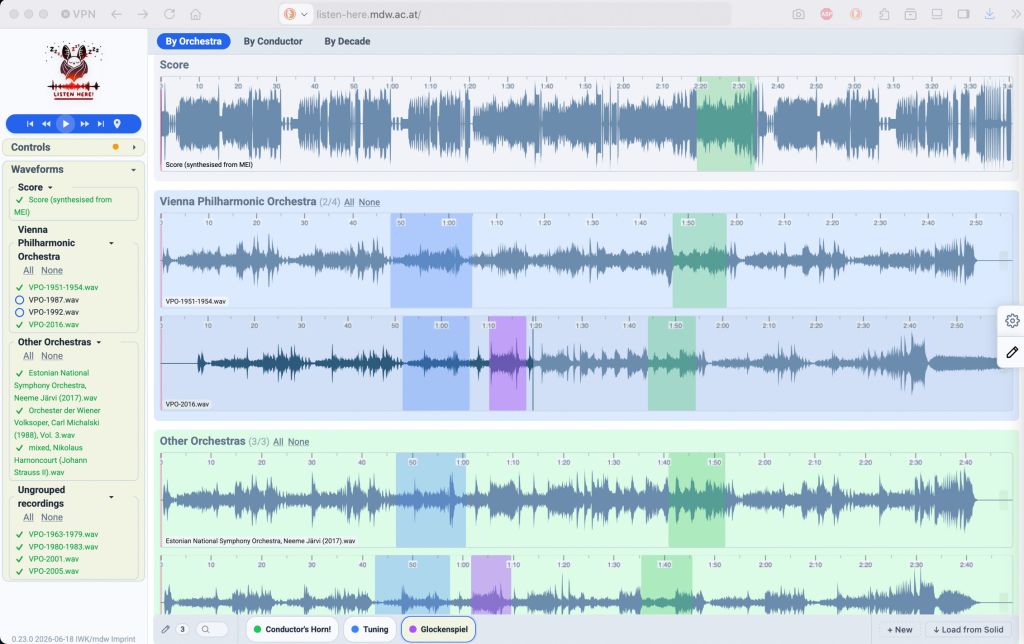
At the heart of the aforementioned research project was the development of freely available open-source tools that run directly in a browser, with no installation required: “Listen Here!” enables one to view dozens of recordings of the same piece as sound waves stacked one above another. Automatic algorithms first synchronise them with note-level precision. Listeners begin with one recording and can then switch seamlessly to another with a single click and no interruption of the musical flow. Commonalities and differences become more directly audible, and individual passages can be marked and compared in a targeted way across many versions. What’s more, the listener can use digital scores created with the “mei-friend” editor to jump straight to the corresponding spot in each recording. All audio is processed right in the browser: nothing is ever uploaded or stored externally, allowing users to safely examine copyright-protected collections with these tools. Listen Here! was built by Weigl in close collaboration with the project’s lead musicologist Dr. Chanda VanderHart, who guided its development based on hands-on listening and analytical work with the collection compiled for the original study.
When Tradition Supersedes the Score
What comes to light can occasionally be surprising. Right at the opening of the Blue Danube Waltz, for instance, every critical edition of the score has the first flute ascending. In practice, however, almost every orchestra plays a descending line at this point—a habit so entrenched by now that a faithful rendering of the score strikes one as almost alien. In the entire collection of recordings, only four (none of which are by Viennese orchestras) actually follow the score. Moments like these show how an unwritten performance tradition can override the written source—and how individual conductors leave lasting marks: certain dynamic gestures introduced by Herbert von Karajan in 1987, for instance, have shaped every Viennese recording made since then.
Some traditions are simply a delight. During the era of concertmaster Willi Boskovsky, the fast polkas came to feature tongue-in-cheek, entirely unscored interludes—from the playful “tuning” of a train conductor’s horn in “Vergnügungszug” to musical interruptions and the creative use of percussion instruments to colour the score. Such fleeting moments would have long since been forgotten without the recordings. And now, one can not only compare them directly across multiple years but also track them in cases where they spread from orchestra to orchestra.
Participatory Science
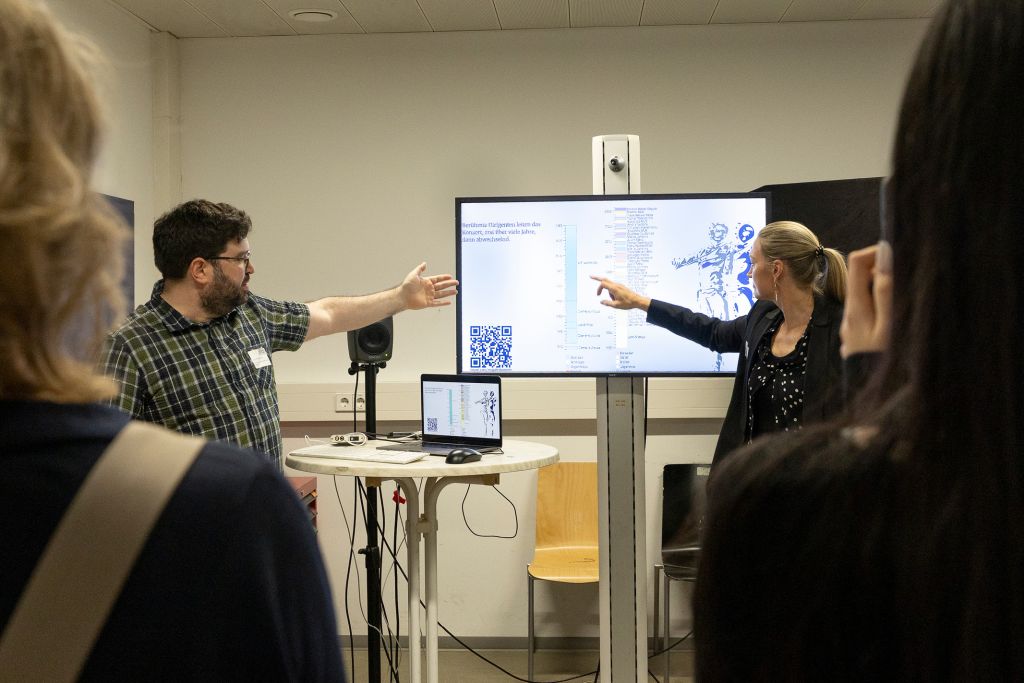
The core objective of “Same Procedure” is to make the original study’s new tools accessible—not only to researchers elsewhere, but to all music lovers. Digital musicology can often feel abstract, but here it becomes an interactive experience that anyone can playfully explore using a multimedia interface. Because the tools are open-source and aligned with FAIR research data principles, other researchers and curious minds are already able (and welcome!) to put their own music collections under the microscope. But it is in the present project that the New Year’s collection will be made available for the general public to experience for the first time. Thanks to a partnership with the museum House of Strauss at Vienna’s historic Casino Zögernitz, an interactive exhibit is now taking shape that will enable visitors to set off on a musical journey through time and explore these recordings in a comparative manner. Prototypes are currently being developed via an approach that includes AI-assisted methods, a modus operandi that the team has examined self-critically in a recent publication. And from this autumn, user studies will begin shaping the developmental process with an eye to having the final exhibit be playfully easy and intuitive for a broad audience to use—just in time for the next New Year’s concert.