What Makes a Eurovision Song?
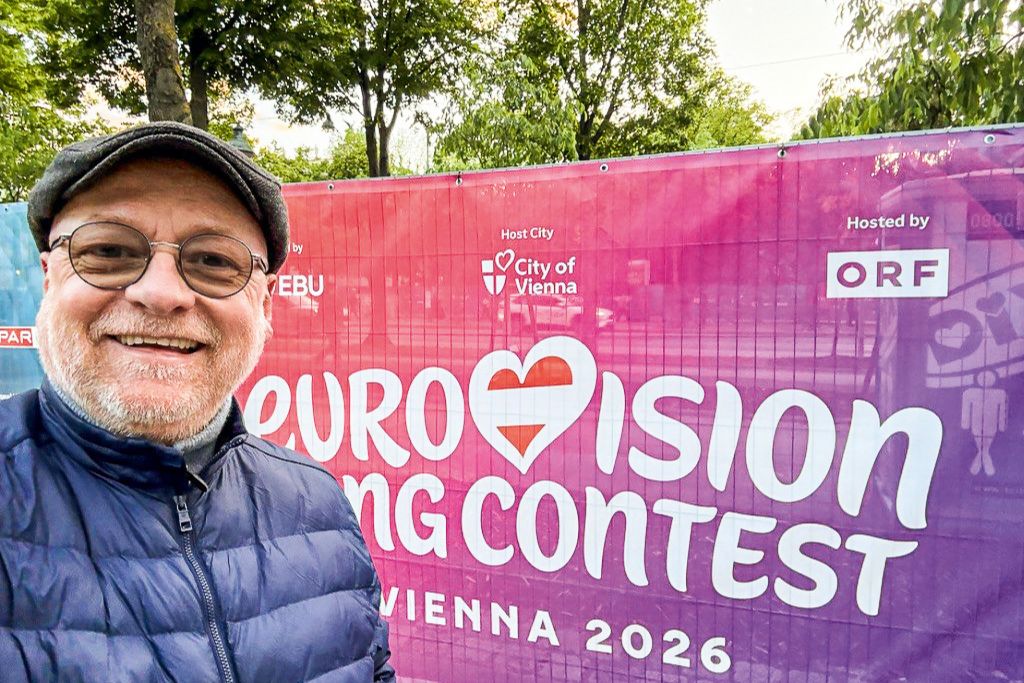
During the week before the Eurovision Song Contest, the popular-music scholar and forensic musicologist Joe Bennett visited the mdw at the invitation of Ralf von Appen. As part of a Eurovision-focused popular music seminar, Bennett worked with students Linda Oppelmayer, Mariella Ackerl, and Leonie Bauer to investigate the contest’s musical language. Their collaboration combined detailed listening, a multi-year data set, and reflection on how popular music shifts along with culture and technology.
A Meeting Place for Popular Music Research
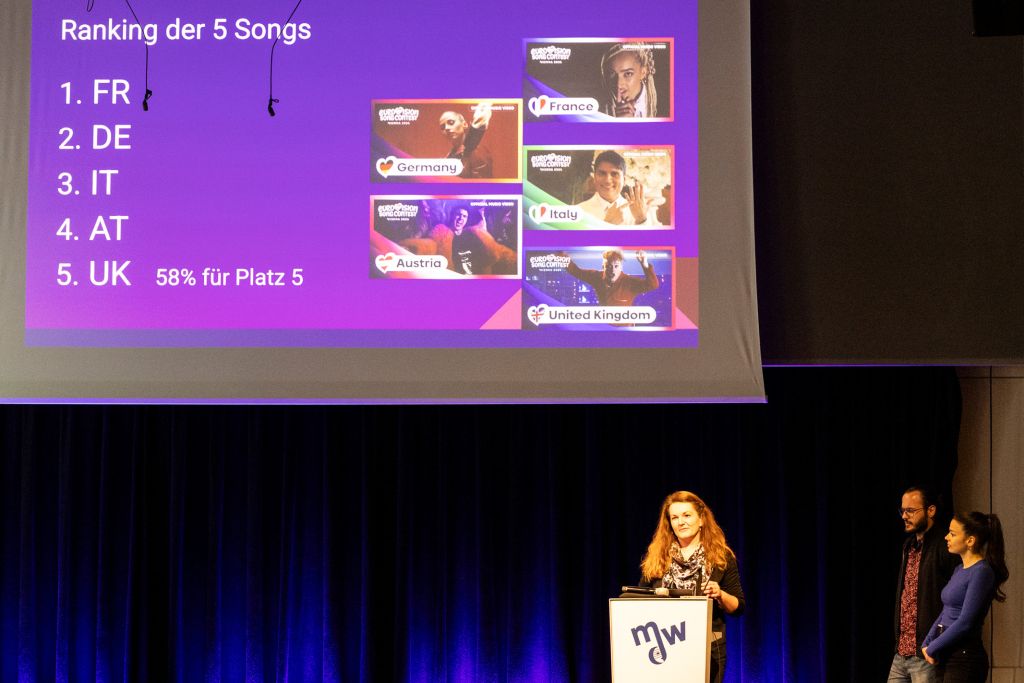
The research group concentrated on the musical and lyrical characteristics of Eurovision songs, building upon Bennett’s earlier work and extending it to the contest’s most recent editions. Their collaboration over the course of the week moved beyond the seminar room, with Bennett and the students presenting their research together on two occasions. Their first presentation was at the University of Vienna’s Department of European Ethnology, and the second was at “Alle Neun in Contest”, a singer-songwriter and band competition that brings together emerging artists nominated by all nine of Austria’s music-oriented higher education institutions. As part of this event, the seminar’s various research groups presented their respective projects, providing academic perspectives on Eurovision alongside the student competition’s live musical performances.
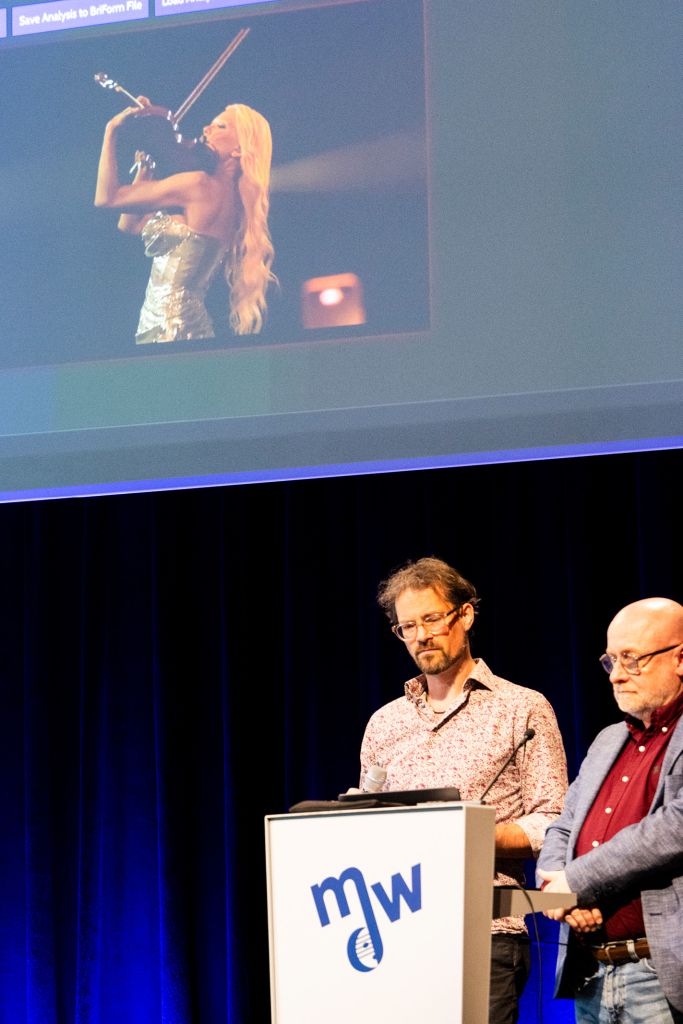
For Bennett, the visit to Vienna was an opportunity to continue an established research project while also exchanging ideas within a university community committed to the academic study of popular music. He described both Vienna and the mdw as exceptionally welcoming and praised the university’s eagerness to support international collaboration.
Bennett was particularly impressed by the institutional recognition of popular music here. While higher music education has historically been shaped by a strong classical tradition, he argued that popular music deserves equal attention as a culturally and artistically significant form of human expression. “I really admire the mdw for being prepared to take that step and support popular music scholarship,” he stated.
During his visit, Bennett also took part in an academic session on forensic musicology, discussing musical similarity and copyright with mdw students. The resulting conversation, he remarked afterward, was both engaged and highly informed.
An unexpected Eurovision outcome
Though Bennett had spent years studying Eurovision, its 2026 edition still managed to surprise him. He has been accompanying the contest with a live musicology blog since 2011, analysing elements such as chords, tempo, and songwriting structure. More recently, he has also attempted to predict the winner by combining musical analysis with betting odds, personal judgement, and—as he openly acknowledges—a degree of geopolitical consideration.
This year, however, his prediction was not borne out. Though Bennett had liked “Bangaranga” from the moment of its release, he hadn’t expected such an unconventional entry to reach the top three—let alone win. “It was a great hook and a really fantastic performance,” he explained, “but I just didn’t think that the Eurovision voters would go for something that was so left-field.”
For Bennett, the outcome also demonstrated how Eurovision cannot be understood based on its songs’ composition alone. The winning performance combined a memorable hook with strong choreography and a striking visual identity. In conversation with the students, he described the entry as almost “made for TikTok”. Its central word was easy to pronounce across different languages, while its dance routine and instantly recognisable aesthetic suited a culture in which music is increasingly consumed through visual and short-form media.
This reflects a broader principle highlighted in Bennett’s work, namely, that the form in which music is distributed has a material effect on the music itself. TikTok rewards immediacy, encouraging songwriters to introduce hooks earlier and avoid lengthy instrumental openings. And the context of Eurovision provides a particularly revealing case study—for as Bennett emphasised, it is not simply a collection of songs but a television programme. Every entry must function within a three-minute format while also producing a compelling sequence of visual images.
“You can’t divorce the performance and the visuals from it,” asserted Bennett. The audience does not encounter an abstract composition, instead experiencing live vocals, choreography, costumes, camera work, and staging simultaneously.
Between National Identity and Universal Pop
The 2026 entries also illustrated differing approaches to cultural identity. Bennett described the Australian and Finnish entries as examples of numbers that pursue a broadly universal European pop sound. Such songs avoid strongly country-specific musical or visual references and instead adopt the polished conventions associated with contemporary Euro-pop.
Moldova, by contrast, moved in the opposite direction. Bennett praised Viva Moldova as a “high-spirited slice of harmless patriotism”. Its performance combined contemporary musical elements with sports clothing and traditional dress, presenting national identity as an explicit part of the act. To Bennett, both strategies are characteristic of Eurovision. A country can minimise its national identity in search of universality, or it can place that identity at the centre of its lyrics, sound, and staging. Eurovision tends to reward extremes of presentation—so when an entry chooses a particular strategy, it often embraces it fully.
Extending 15 Years of Eurovision Research
The collaborative work at the mdw continued a project that Bennett had originally conducted in 2020 with a research team and funding connected with the Netflix film Eurovision Song Contest: The Story of Fire Saga. This initial study examined entries from 2010 to 2019 and developed a taxonomy for the analysis of recurring musical and lyrical characteristics.
Bennett had assumed his project to be at an end following publication of the original research. However, the interest shown by the mdw students then presented an opportunity to expand and reassess it. This new project extended the period under investigation to 2026. The researchers analysed 422 Eurovision songs and compared the more recent entries with representative selections from the British, German, French, and Italian singles charts. Among their guiding questions were whether Eurovision has developed a distinct style, what recurring song types could be identified, and how the contest’s musical features had changed over time.
Each entry was examined according to a shared set of criteria: tempo, key and tonality, key changes, lyrical theme, vocal constellation, and musical archetype. The archetypes included Euro-pop, Ethno-pop, Anthem, Ballad, Schlager, Chanson and a broader “Niche” category for styles such as rock, metal, electro, and reggaeton. The lyrics were likewise classified according to themes such as love, self-assertion, unity, music, and dance. Love songs were further divided into seasonal stages: searching for love, celebrating love, relationships in crisis, and heartbreak after a relationship’s demise.
A Changing Eurovision Sound
Some of the results confirmed the stability of familiar Eurovision conventions, while others pointed towards change. Euro-pop remained the largest category, accounting for 28.6 percent of the songs. Anthems represented 20.6 percent and ballads 18.7 percent, followed by Ethno-pop at 13.7 percent and niche genres at 13.2 percent. Across the period studied, both Euro-pop and Ethno-pop increased, while anthems became slightly less common.
Compared with the selected mainstream charts, Eurovision exhibited considerably greater stylistic variety. Ethno-pop played an especially important role within the context but was near-absent from the chart sample. The researchers attributed this partly to national branding, especially among entries from Southern and Eastern European countries that incorporated cultural and musical references associated with their home countries.
The aspect of tonality revealed another notable difference. The majority of Eurovision entries were written in minor keys, with 2023, 2024, and 2026 exhibiting what the researchers described as a “minor boom”. In 2026, the contrast was especially pronounced: this year’s Eurovision songs were overwhelmingly in minor, whereas most songs in the chart sample were in major. Modal systems such as Dorian, Mixolydian, and Phrygian also appeared within the Eurovision corpus, particularly in Ethno-pop.
The extended timeline revealed changes in lyrical themes, as well. Bennett highlighted the decline of “winter” love songs—songs of loneliness, regret, or heartbreak—which were more common during the 2010s than in the present decade. The tempo data, meanwhile, showed a significant increase in recent years.
“What excites me about this research is that it combines hard data trends with socio-cultural observation,” Bennett explained. Tempo provides measurable evidence, while lyrical themes and archetypes reveal how songwriting responds to changing cultural preferences.
The collaboration also encouraged Bennett to reconsider aspects of his original taxonomy. In particular, working in Austria and exchanging ideas with mdw students and researchers gave him a more nuanced understanding of the “Schlager” concept. Rather than viewing it as a fixed or outdated style associated with the mid-twentieth century, he came to recognise both its longer history and its continuing transformation as a living musical tradition.
The resulting study does not claim that every Eurovision song can be placed neatly into a single category. The distinction between anthem and ballad, for example, was not always clear, and a classification system designed specifically for Eurovision could not be transferred seamlessly to mainstream chart music. Yet these methodological difficulties were themselves revealing: they suggested that Eurovision operates as a distinctive musical environment, with conventions that differ sufficiently from mainstream pop to make a possible status as a genre in its own right worthy of consideration.
Listening Closely: Bennett’s Forensic Work
The analytical attention that Bennett brings to Eurovision is also central to his work as a forensic musicologist. Alongside his position as a professor at Berklee College of Music, where he teaches songwriting and music copyright studies, he works as a professional consultant musicologist. His task in this context is to determine whether similarities between songs might be problematic from a copyright perspective. His clients include artists, publishers, record labels, advertising agencies, and companies working with music for television and film. A composer, for example, might wish to evoke a familiar style or mood without reproducing protected musical material too closely—in which case forensic musicology can help to identify where the relevant boundary might lie.
Despite the specialised nature of this work, Bennett thinks of it as part of a wider commitment to making musical analysis accessible. Through teaching, public talks, social media, podcasts, and his BBC programme Midnight Musicology, he shares techniques for understanding how songs are constructed.
Whether it’s about potential copyright conflicts or asking why a particular Eurovision performance manages to connect with millions of viewers, the underlying method remains the same: listen carefully, identify the musical details, and consider the surrounding cultural conditions. The recent collaboration at the mdw demonstrated how productive this approach can be—bringing together data, critical listening, and international perspectives to better understand the songs that shape contemporary popular culture.