The mentoring programme arts of change symbolically kicked off its seventh year with a performance workshop at Karlsplatz, held in collaboration with the Climate Biennale Vienna.
arts of change – change of arts is an inter-universitary project that has been supported by all six Austrian state art universities since 2019. It is currently organised by the Sustainability Coordination Office at the mdw – University of Music and Performing Arts Vienna. The following article gives insights into these events staged in public space, and aims at encouraging musicians and performers to explore how social sustainability can be enhanced through transdisciplinary practice.
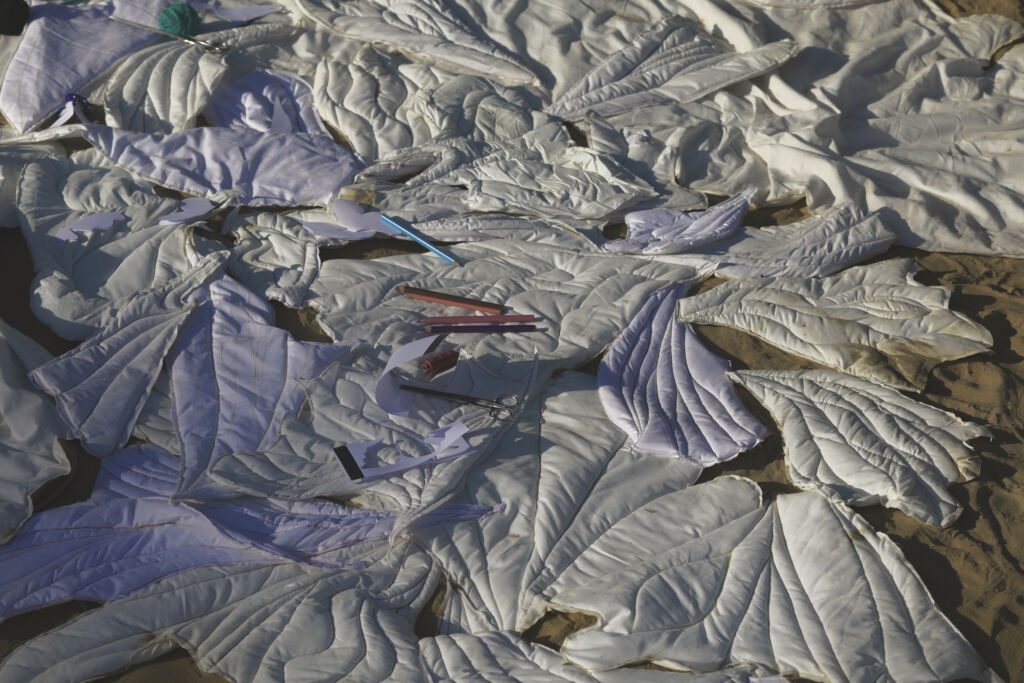
Wind, water, sand and a couple of rocks keep about 60 wing-shaped cushions and two huge lung-shaped blankets from flying away. This is the materiality shaping the spatial environment. What might first bring the picture of a beach to mind, is actually a temporary landscape structure at one of the biggest squares in Vienna, Karlsplatz. This place served well for launching not only our participatory workshop, but also the 7th edition of our annual arts of change mentoring programme by the Austrian association forum n. In 2026, the programme’s focus lies on fostering matters of care and action through art practice. While we prepared its concept throughout the spring season, we also co-created a textile installation and participatory workshop titled Whatever happens to the wings. For the first set of performances, we explored the installation’s potential as a platform and tool for collective healing. This project was brought to life by an interdisciplinary project team, art mediator Julia Herzog and visual artist Tereza Sýkorová.
Haptics and symbols of a safe space
Whatever happens to the wings aims at unifying two dimensions of a healing process. It consists of 60 different butterfly wing-shaped cushions and two big blankets reflecting the shape of the human lungs. On the one hand, the material fragility of these textile pieces express the frequently trauma-related sensation as a response to high pressure in close surroundings. As the human lungs are often said to carry intense emotional and physical distress, the blankets’ shapes are intentionally chosen to signify the most central and important organs of the human body. The butterfly-shaped wings, on the other hand, signify sole lightness in its purest form.
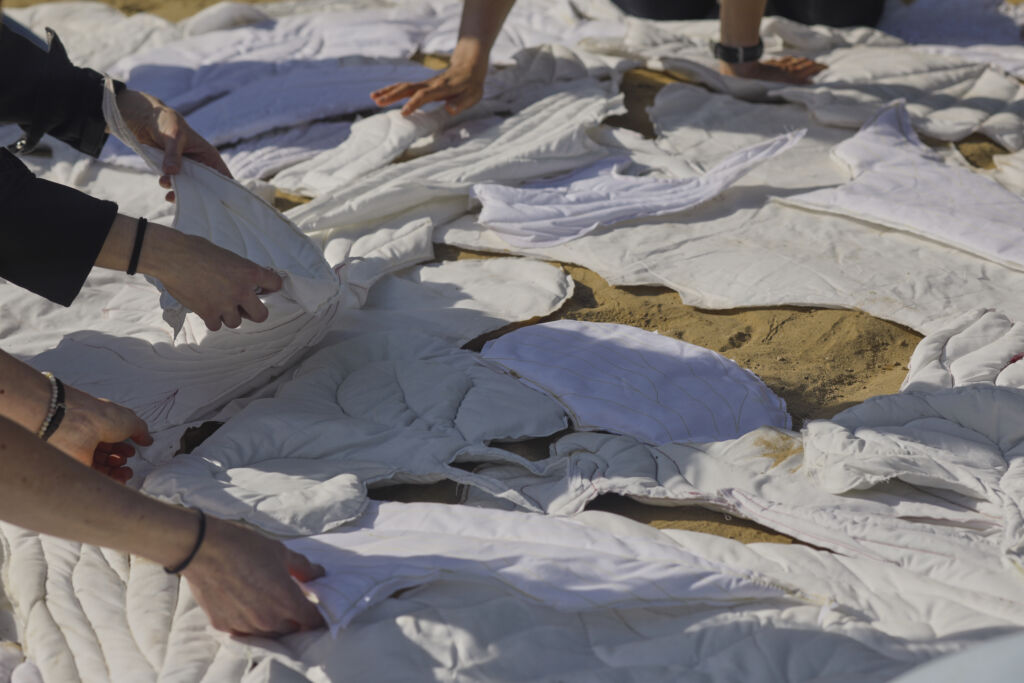
The installation originates from the desire to create a tool that softly intertwines inner motion with transformative movement through acts of self-reflection and embodiment. Textiles have specific properties that align well with the theory of care: they are soft and tactile, bear the marks of time and use, connect body and memory, and are associated with protection and repair as a metaphor for social healing.
They teach us to live with wounds and transform them. The act of letting go is considered here as an act of care and trust. And as the butterfly theory says: even small changes can lead to unpredictable consequences over time. Creating a spacious seating area and the haptic qualities of the textile pillows were essential for us to let participants become part of the space.
Spatial interrelation and public interaction
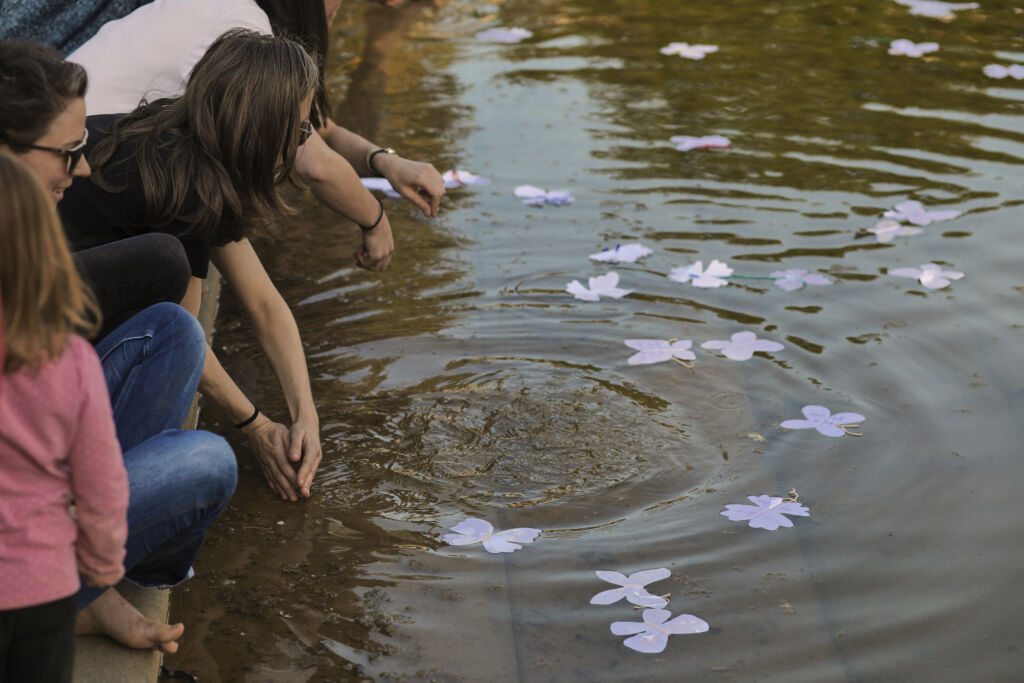
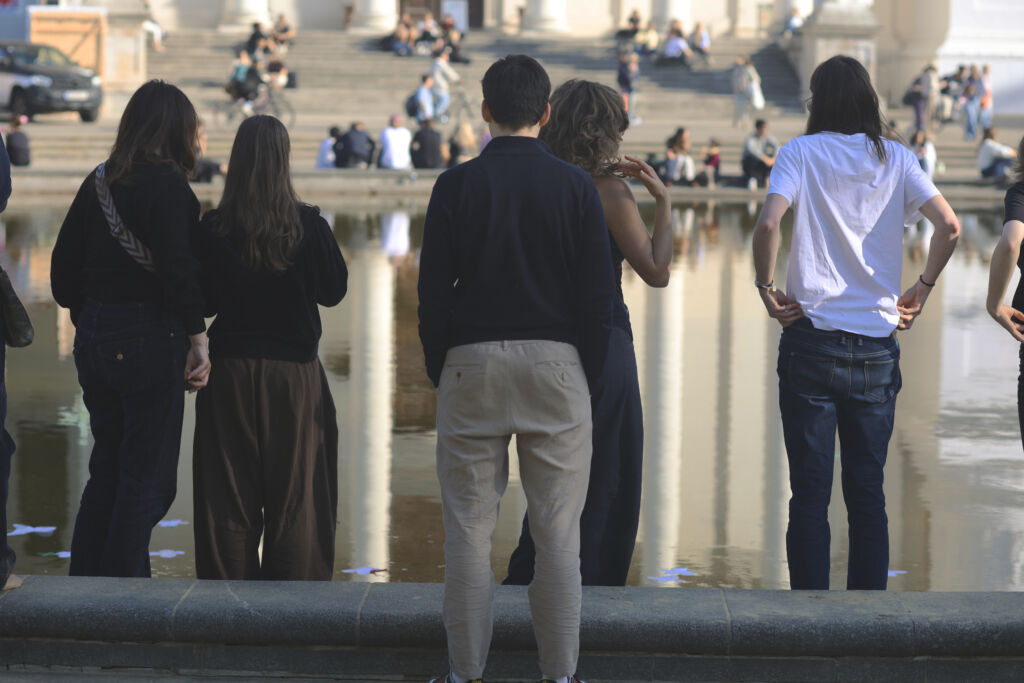
Throughout the workshops, participants were repeatedly invited to interact with the installation and change the spatial order of wings. As an introduction, we collectively listened to a sound piece titled Let go on everything written by Tereza Sýkorová and sung by Francesca Brigandi, which gradually led us to self-reflection and thus became a link between our inner experience and the actual presence of water. We then guided them through a writing session in which they received space to individually write down what they wanted to let go of on paper representing the shape of butterflies. As a closing ritual, all these butterflies were jointly put on the water surface at Karlsplatz. Together, we watched them float away. Some of the writings disappeared, others refrained from vanishing. Some of the butterflies sank, others rested on the calm surface. Although our installation was placed amidst a heavily vibrating area, participants were deeply engaged with the practice in a special kind of intimacy. Even without explicitly stating what each person wants to let go of, sharing this process has brought us closer and participants appeared calm and satisfied.
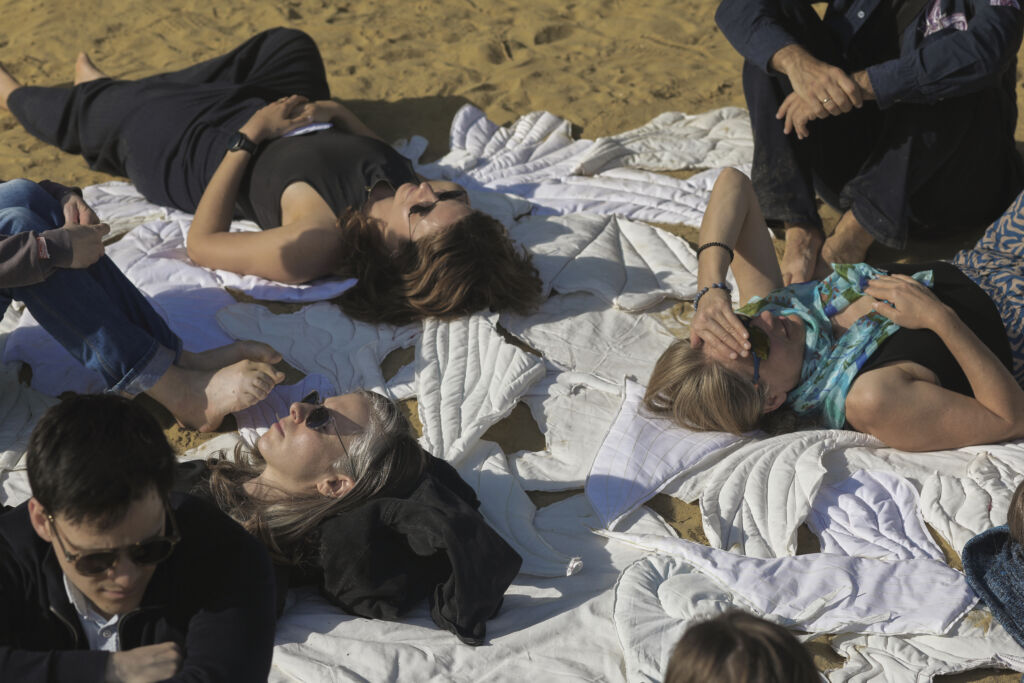
Throughout the workshop, we made sure that everyone felt safe in the environment while engaging in self-reflection activities. Our experience with art mediation shows that when developing healing mechanisms through creative activity, it is essential to maintain a balance between observing and holding a space.
Listening, sharing, mutual support without stigmatization, connection, and collective consciousness, as well as the nonverbal expression of emotions in a safe environment, enable inner transformation. These are the fundamental philosophical pillars of the “arts of change” programme, which, in addition to transdisciplinarity and solidarity, also aims at fostering social sustainability, inclusion, and collaboration.