The doors of the Metro open practically into the heart of the Gasometer’s Tower C – albeit you’d need to walk through several floors of a shopping mall, and past the many fast food options to reach the conference venue “Musik im Dialog-Saal”. When finally seated facing the speakers, one can’t ignore the scratches on unmistakably a dance floor. In spite of a ballet bar running along one wall and a concert grand piano pushed to the side, the room manifests a multitude of uses. Conventions are not on brand here: built in the late nineteenth century as a gas storage facility, the building today houses a music school, music venues, and occasional academic discussions, such as Excellently Engaged which asked whether artistic excellence and societal engagement are separable at all.
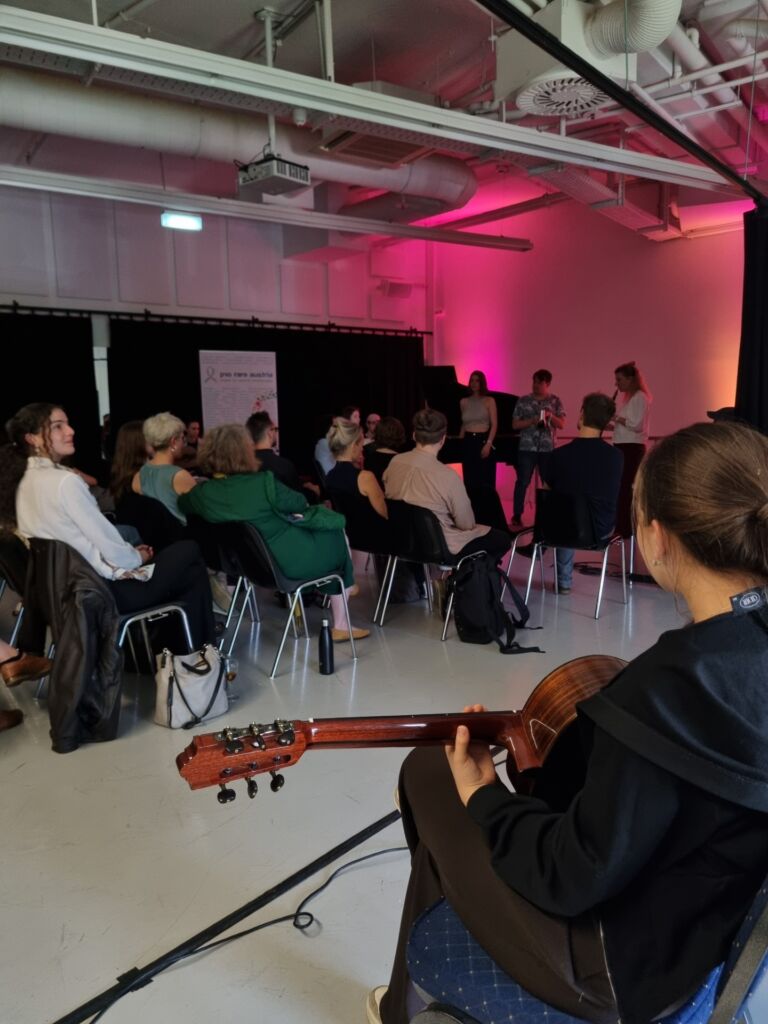
The answer to this question may lie deep within the higher music education institutions and the canon they sustain. According to the Donne Report (2024), Tchaikovsky and Beethoven alone receive more performance time than all FLINTA* composers and other marginalised groups combined: measured not only in works programmed but in total minutes those works occupy within a concert. The day began with a workshop on canon and repertoire led by Musica inaudita and ended with a concert of the inn.wien quartet featuring a program with works of female composers. Together, the workshop and concert highlighted that the canon is socially constructed and becomes established as a norm through specific power structures. Confronting it means confronting what Phil Ewell calls the “White Racial Frame” of music theory – and it is only when we recognise that canons operate across multiple levels simultaneously that they can begin to be broken.
To echo that proposition, the organizer of the conference Axel Petri-Preis opened the day by framing the very venue as a site of critique: a decentralised space where artistic excellence and societal engagement may be mutually reinforcing. He argued that societal engagement should not be understood as a separate Third Mission of universities, but as a responsibility that permeates teaching, research, and artistic practice. Otherwise, socially engaged initiatives risk remaining structurally isolated and vulnerable to political and economic pressures.
What an equal partnership with communities beyond the institution might look like in practice was taken up by Rosie Perkins and the discussion on the civic conservatoire. Civic engagement is a continuous process of building local relationships – according to Perkins – characterised by arriving as collaborators rather than funding applicants, and building what she called the “civic ear” through a dialogic approach that actively amplifies quieter and unheard voices. Her work on musical care as healthcare provided a concrete anchor for these claims.
What would happen if music students were asked to perform the political? With much of her speaking time allocated to a video documentary of an unprecedented student festival, Tuulikki Laes let the answer flood the room: a cacophony of styles and methods, all beautifully personal. Reframing higher music education as a site of public pedagogy in the tradition of Biesta’s “in the interest of publicness,” she argued for surrendering to generative interruption: to encounters whose outcomes cannot be scripted in advance. “This is the kindergarten of the political,” Tuulikki recalled one of the festival participants reflecting on their experience, “but it’s a good start.”
Irina Kirchberg closed the lecture programme with a typology of resistance to the social turn in higher music education. From those who reject it on naturalist grounds to those who accept it in theory while resisting its institutional consequences, the spectrum of attitudes that this provocation covered reminded us that the field’s internal contradictions are worth mapping honestly.
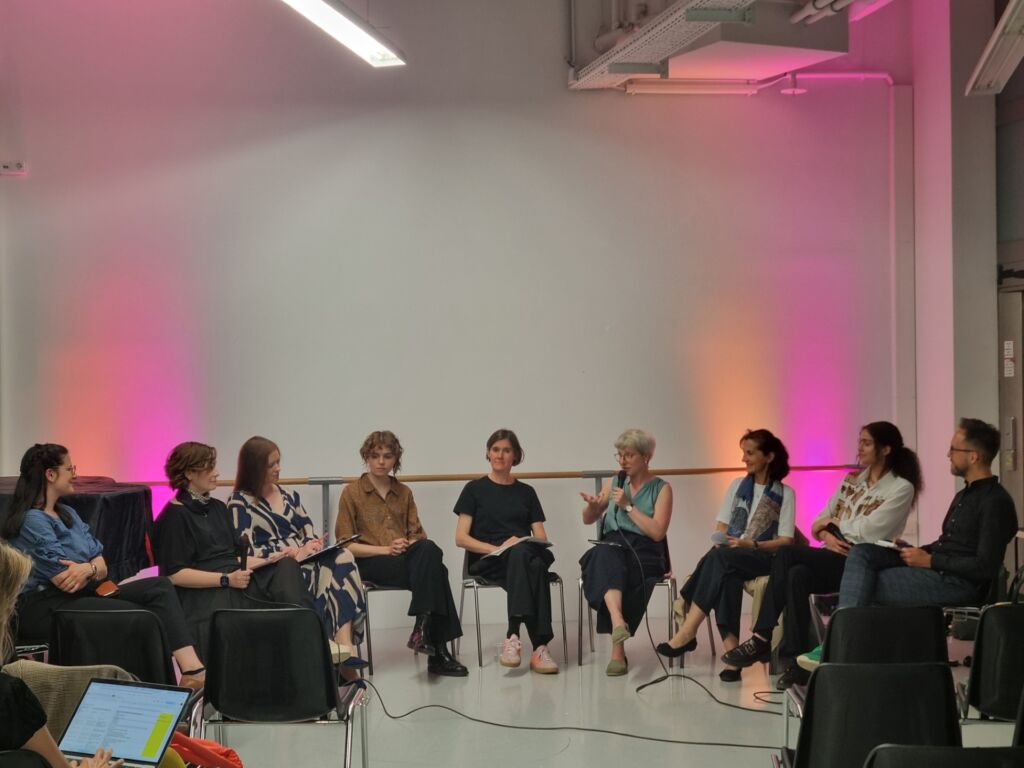
So what exactly does excellence mean, and who has the power to decide? Several voices in the closing panel proposed extending it to encompass what people bring to their communities, the Lebenskünstlertum of navigating structural adversity. Others were more cautious: so deeply embedded in the institutional grammar of higher music education, the term risks ceding the conversation if abandoned. The more uncomfortable question, though, was whether the choice between embracing or rejecting excellence is itself only available to those who already fit the system. If so, queering it may be less a matter of redefinition than of structural change: in admissions, in curricula, in the very criteria by which institutions measure and reward what they value.
Without attempting to resolve these tensions in a single day, Excellently Engaged made the case that they belong at the centre of how music universities understand their own purpose: as spaces where the personal and the political not only coexist, but mutually reinforce one another.
Further infos on the programme.