December of last year witnessed the second opening event of the International Research Center – Gender and Performativity (ICGP). With some distance, we can now look back upon a successful symposium. Focusing on the relationship between gendering and racialisation from a global perspective, topics such as fascistisation, populism, and institutional complicity were critically analysed. In the process, the potential of artistic and scholarly as well as performative practices was highlighted with reference to specific examples.

This time, in contrast to the previous opening event in June 2025, a wintery pre-Christmas atmosphere prevailed on the mdw campus. Despite the low temperatures, however, this second opening saw the continuation of political discourses as well as heated discussions both in the conference spaces and during breaks. This demonstrated once more just how great the demand for space to exchange views remains in times of global crises and increasing pressure on gender studies. This was also reflected in the opening remarks: both mdw Rector Ulrike Sych and Susanne Lettow of FU Berlin’s Margherita von Brentano Center emphasised the ICGP’s socio-political significance, referring to its doctoral programme in gender studies and performativity as a key resource for local and international research and teaching. Dominik Reisner, who attended the event as a representative of the Federal Ministry of Women, Science, and Research, emphasised the Center’s unique positioning as a bridge between the academic community, the performing arts, and society.
All this was brought to life in the inaugural lecture of Evelyn Annuß—a scholar of culture, theatre, and literature and the ICGP’s director—entitled “Dirty Dragging. On Gender, ‘Race’, and Transgression”. Drawing on her new book Dirty Dragging. Performative Transpositions (mdwPress 2025 [German], 2026 [English]), her lively lecture outlined the future profile of this newly founded research center. In the packed Joseph Haydn Hall, she addressed drag as a political practice and the status of gender studies in the humanities and social sciences against the backdrop of an increasingly authoritarian shift. Annuß proposed expanding existing approaches in queer theory, thereby reflecting on the respective social and political situatedness of transgressive forms of performance. Drawing on contrasting drag photographs from the apartheid and Nazi eras, she reframed “dragging” as “schlepping along” in order to query performative engagement with political violence and its afterlife in contemporary spectacles against the backdrop of current processes of fascistisation. This question also ties into the mdw publication Facing Drag. Gender Bending and Racialized Masking in Performing Arts and Popular Culture, edited by Annuß and last year’s ICGP visiting professor Raz Weiner. Facing Drag intertwines diverse perspectives on queer modes of performance, on racism, and on colonialism and was presented at the symposium together with contributing authors Sam Ehrentraut, Zimitri Erasmus, and Eric Lott. Both publications are now available in open-access online versions as well as in print.
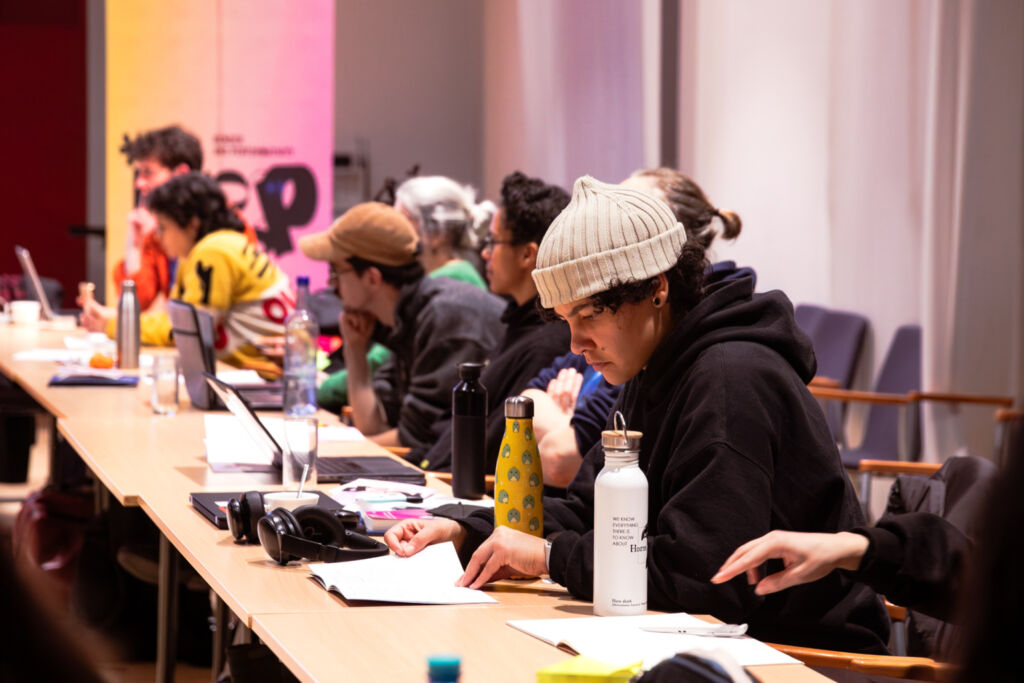
The two days of symposium activities that followed underscored the ICGP’s international scope in alignment with its three main areas of focus: engagement with the performing arts, with political spectacles, and with advanced (queer) theories of the performative. Accordingly, gender issues at the intersection of aesthetics and politics were addressed. Weiner’s lecture, which took his own family history in Israel as its starting point, as well as Sirah Foighel Brutmann and Eitan Efrat’s film Vents Violents (Two Letters to Chantal Akerman) explored the intertwining of political histories of violence—the Holocaust and colonialism—and their performative and artistic interrogations. Various forms in which racism and gender are expressed in music and in theatre/performance were the focus of a discussion between the New York-based cultural studies scholar Eric Lott, the ICGP visiting professor Zimitri Erasmus (who teaches in Johannesburg), and the performance artist nora chipaumire (based in New York and Mutare, Zimbabwe) moderated by Isabel Lewis, director of Tanzquartier Wien. In this context, the discourse on academic complicity that had already played out during the ICGP’s summer event was continued with additional guests in order to shed light on the current threat to academic autonomy and critical (gender) research in diverse contexts—in Austria (Isabel Frey), Germany (Sam Ehrentraut, Susanne Lettow), and Serbia (Tatjana Nikolić) as well as in South Africa (Zimitri Erasmus), Israel (Raz Weiner), and the USA (Eric Lott).
The ICGP opening in December was once again a great success—a success made possible by the support of the mdw and the commitment of numerous individuals, whom we would like to thank once again. In the present summer semester, the annual gender studies lecture series—set to take place as the symposium “Performing Challenges” (June 16–18)—will provide an opportunity to continue ongoing discussions with a focus on trans- and queer-feminist theoretical, artistic, and activist explorations pertaining to questions of solidarity.