Research, Art, and Democracy Ambassadors
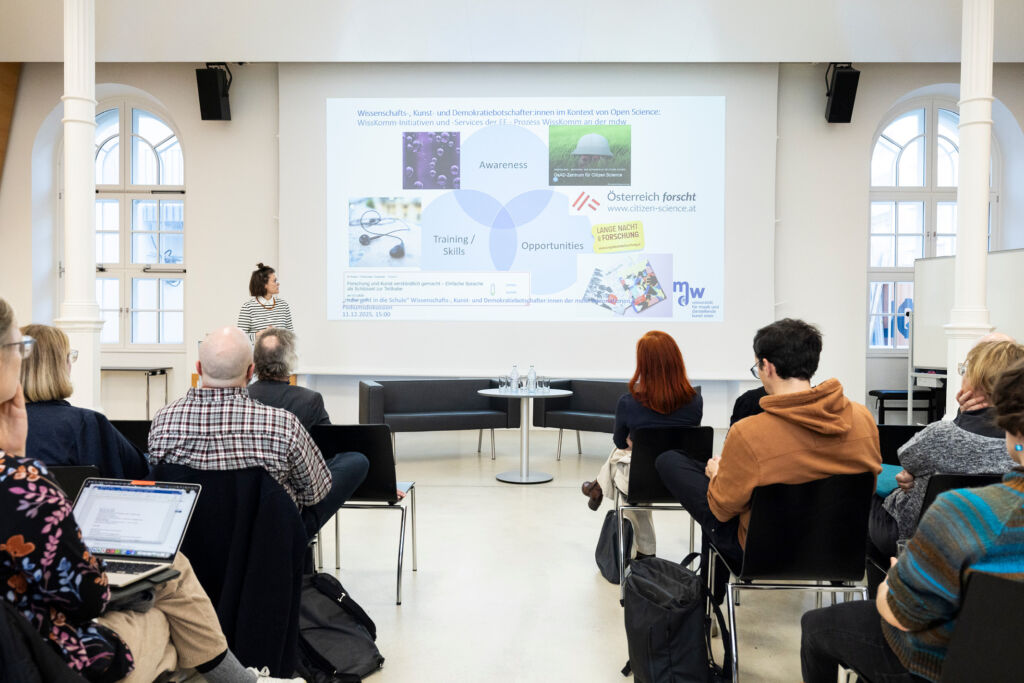
How do art and research mediation relate to pro-democratic awareness-raising? What contribution can research and democracy ambassadors active in schools make to the cultivation of critical thinking as a skill central to democratic action? And how might this be done in actual practice? These questions were the focus of an exchange event at the mdw’s Banquet Hall on 11 December 2025. Vice-Rector Johannes Meissl, in cooperation with the mdw’s Office of Research Support, invited mdw faculty to introduce the possibilities and potentials inherent in visiting schools as individual ambassadors of their respective disciplines as well as in the offerings of the OeAD (Austria’s Agency for Education and Internationalisation) as an organisational platform. In her introductory remarks, mdw Office of Research Support head Therese Kaufmann outlined just why our institution considers it a priority to motivate researchers and artists to visit schools. The mdw’s “third mission” as a university, she said, comes with a social responsibility that is central particularly in light of rising populism and anti-democratic, authoritarian societal tendencies coupled with scepticism of science. Open science and methods such as citizen science are well established at the mdw and of growing significance in efforts to actively cultivate society’s participation and critical capacity via the opening of universities. Personal encounters with kids and teens realised as dialogue-based forms of coequal exchange make it possible to join hands in posing questions, honing arguments, exposing disinformation, and encouraging curiosity.
Vice Rector Meissl emphasised our university’s desire to facilitate cultural sharing and codetermination across social boundaries. As an example he mentioned the 2025 mdw Advent Calendar, which turned various locations across Vienna into settings for cultural activity.
Anna Wukovits-Zethner introduced the Office of Research Support’s emphasis on science communication and “Young Research”. Her office functions as a central point of contact for the mdw’s ambassadors and supports a variety of formats ranging from workshops and digital offerings to cooperative projects like the Art & Science Hub or suggestions of themes for pre-academic final papers authored as part of the Matura (Austria’s secondary school-leaving exam). In this context, the “mdw young research award”—conferred annually since 2023—has demonstrated the great interest in dealing with topics from music and the performing arts at large that exists among final-year students at various types of secondary schools.
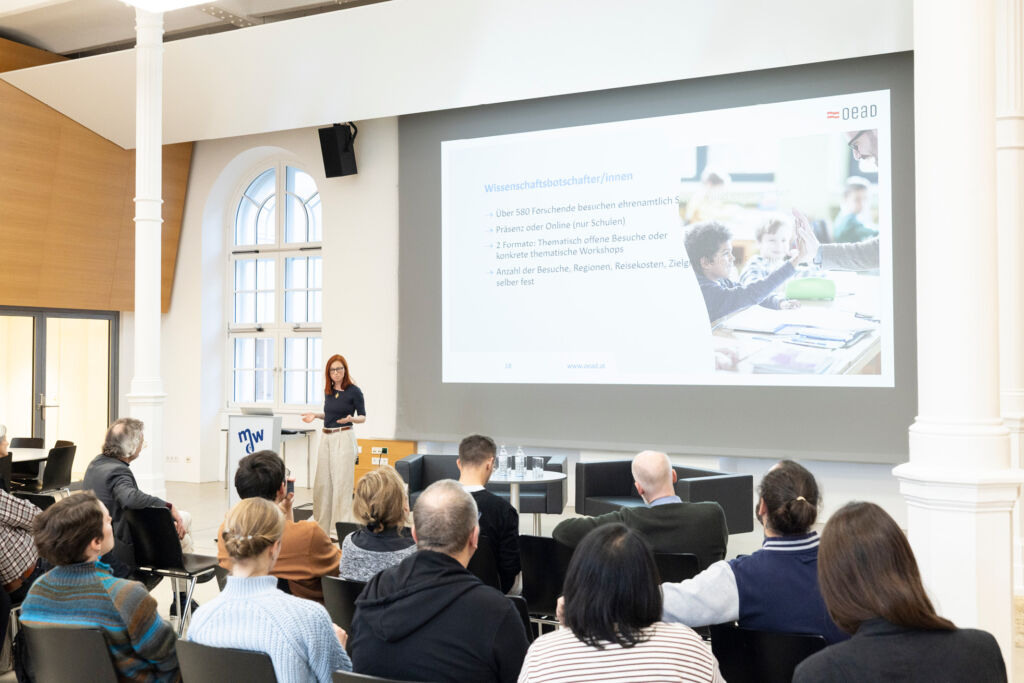
Lydia Glaser, assistant head of the “public science” sector at the OeAD, presented her organisation’s services for research ambassadors—who can now pay visits across the entire spectrum of scholastic education beginning with the elementary level. The OeAD arranges these visits, provides organisational support, and runs a platform that lays out concrete offerings for schools.
In the panel discussion moderated by Therese Kaufmann, participants Ruth Anderwald (Artistic Research Center), Vice Rector Johannes Meissl, and Axel Petri-Preis (Department of Music Education Research and Practice) reported on their experiences in projects with schools and across broader society. Artistic research, community music initiatives, and initiatives such as the Art & Science Hub (in which the Office of Research Support likewise participated), Musethica, and “Weites Nahen” have shown the potential of participative artistic work.
The concluding discussion reflected upon art and research ambassadors’ role as ambassadors of democracy. In this regard, personal contact and transparent communication about existing challenges can strengthen trust in research, while artistic projects can provide experiences of self-efficacy and encourage critical reflection in the spirit of artistic citizenship.
In all of this, the Office of Research Support supports members of the mdw community with advising, networking opportunities, and assistance in making their offerings visible so as to best reach target groups.