Lena Zechner and Melvyn Zeyns study production at Film Academy Vienna. November 2025 saw both of them win German Short Film Awards, Germany’s most important and lucrative form of recognition for short films. These awards are conferred annually in six categories at a ceremony in Hamburg. Zechner and Fabian Leonhardt (Filmakademie Baden-Württemberg) were responsible for producing At Home I Feel Like Leaving, a cooperative effort by students of Film Academy Vienna and Filmakademie Baden-Württemberg. Zeyns was the producer of Garnelius, which involved cooperation with students at DFFB – Deutsche Film- und Fernsehakademie Berlin. It was owed to great proactivity and dedication on the part of the involved students that these instances of successful cross-border cinematic cooperation arose at all, and mdw Magazine caught up with Zechner and Zeyns to speak with them about their experiences.
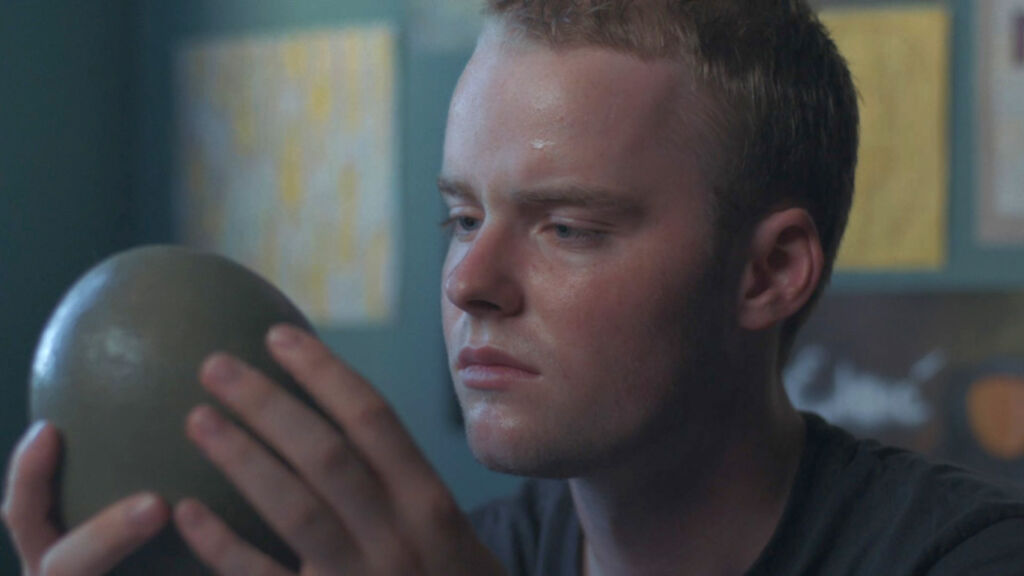
Garnelius, which the jury tapped to receive the “Special Award” for the best medium-length film, tells a story about two brothers and their seemingly quite withdrawn father. One day, something unexpected occurs: Karl, the elder brother, wakes up sitting upon an egg from which a peculiar creature proceeds to hatch—a creature for which Karl must now care. In its statement, the German Short Film Award jury described this work as “a film that speaks about social sensitivities in a metaphorical and enduring manner”.
Certain members of the team behind Garnelius shared pre-existing ties: Melvyn Zeyns, himself from Berlin, already had contacts at DFFB from earlier projects and was asked by the DFFB-based director Julia Ketelhut to participate in this production after he’d begun studying in Vienna. Zeyns then approached Nina Slunsky, who studies in Film Academy Vienna’s Digital Art – Compositing MA programme and agreed to do the special effects work needed to bring the film’s “creature” to life.

In realising these co-productions, the educational institutions’ differing legal forms had a palpable impact: while many German film academies are organised as GbmHs (limited liability companies), Film Academy Vienna is not. “At Film Academy Vienna, the films we make as students legally belong to us—for which reason we also bear primary responsibility. But a German film academy, being a GmbH, is itself the producer of such films,” explains Zeyns. “At Film Academy Vienna,” adds Lena Zechner, “we producing students learn to handle our films with great independence quite early on. We decide on our own which subsidies we’ll apply for and how we intend to make money from our films.”
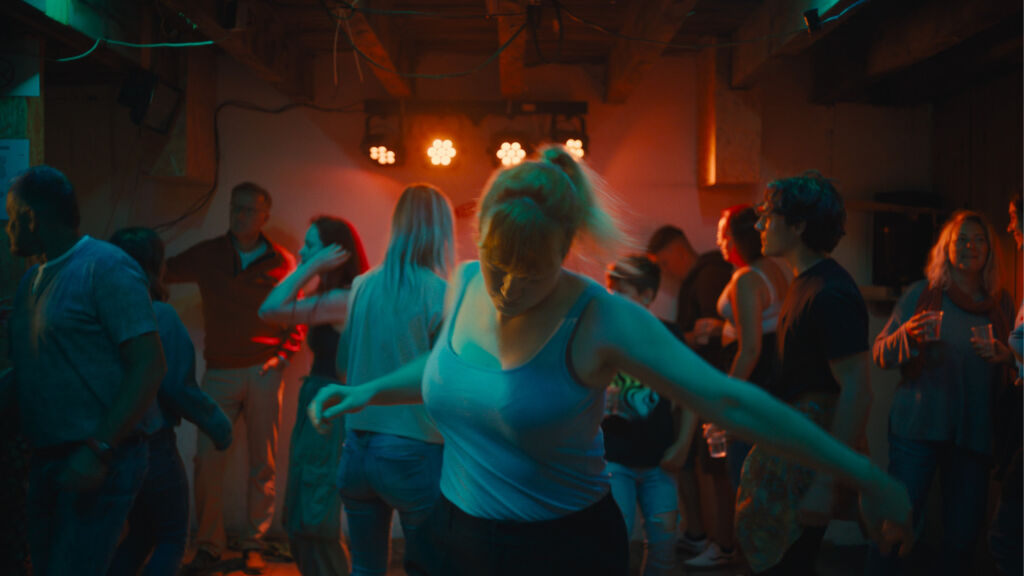
With At Home I Feel Like Leaving, as well, it was existing contacts between students that provided the impetus to cooperate inter-institutionally: director Simon Maria Kubiena, who studies at Film Academy Baden-Württemberg, already knew producer Zechner from other projects. At Home I Feel Like Leaving plays in Austria and accompanies a young woman who gets called back to her home village because her father has begun repeatedly disappearing into the woods, requiring others there to search for him. The German Short Film Award jury praised this work as “a warm-hearted film of quiet but lasting power that animates viewers to reconcile themselves with their own biographies and identities” and hence gave it the nod in the category “Fiction (15–30 minutes)”.
These cooperative projects with German film schools entailed greater-than-usual bureaucratic effort—which was understandable in light of these institutions’ legal form, say the two Film Academy Vienna students. In this regard, Zechner mentions a scene with a summer solstice bonfire for which she, as the producer, had to procure an official permit. For their German partner institution, the mere presence of firefighters on set was not sufficient. The painstaking work entailed by this, says Zechner, was an important overall learning experience: “Things like that serve to hone your awareness of your own responsibility and the required safeguards in terms of contracts and insurance policies.”
International cooperative projects do come with advantages, though, such as broader funding options. Zechner, as a producer resident in Vienna, was able to apply for funding here—as was Zeyns. And Film Academy Baden-Württemberg, for its part, enjoys very good ties with German television stations—which led to At Home I Feel Like Leaving ultimately becoming a co-production with Arte and SWR.
“In our training, co-productions are treated as the ultimate discipline. It’s understandable that you first need to get a grip on how to work in your own country, but I find co-productions particularly interesting in that they open up additional funding options and markets,” says Zechner. One offering that helps aspiring producers learn how co-productions work is what’s known as the “Alpine Cooperation”. Organised by the University of Television and Film Munich, ZeLIG – School for Documentary, Television and New Media in South Tyrol, the Zurich University of the Arts, and Film Academy Vienna, this annual one-week production workshop enables students to practice working on an international co-production, network with others in the group, and become acquainted with the respective countries’ film subsidy models.

Like many production students, Zeyns—currently in the final phase of his master’s degree studies—already works in the film industry and has served as unit manager on multiple projects. “I’m fond of supporting visions, and I frequently have the pleasure of putting together teams,” he says of his motivation to pursue a career as a producer. “One special interest of mine,” says Zechner, “is being with a project from beginning to end. And as a producer, I can also help decide just what content gets treated how.” Zechner is nearing completion of her bachelor’s degree and likewise already works in the industry—currently at FreibeuterFilm, where she’s serving as the producer of a debut film being made under the aegis of the Austrian Film Institute’s Talent LAB programme for early-career talents.
Both of them would welcome it if film schools were to investigate more avenues by which to ease students’ realisation of cross-border projects. “Bringing together our two film schools was sometimes difficult on account of the different ways in which they’re regulated, but we students made it happen—and all parties were ultimately very happy with the final result,” concludes Zeyns.