The two sentences above are taken from a text by Ilse Aichinger, niece to the avid cineaste, pianist, and piano teacher Erna Kremer. They convey a both concise and telling impression of how Kremer’s fate turned following Austria’s “annexation” by National Socialist Germany. Aichinger’s writings contain multiple references to her aunt:
She was my mother’s youngest sister. She lived, as did the rest of us, in my grandmother’s flat on Hohlweggasse, at the out-of-town end near the Gürtel. Up to March 1938 […] she taught piano at the Academy of Music in Vienna. […] And after her last private pupils, too […] had gone home, her urge was to go out. She wanted to go to the movies […]. 1
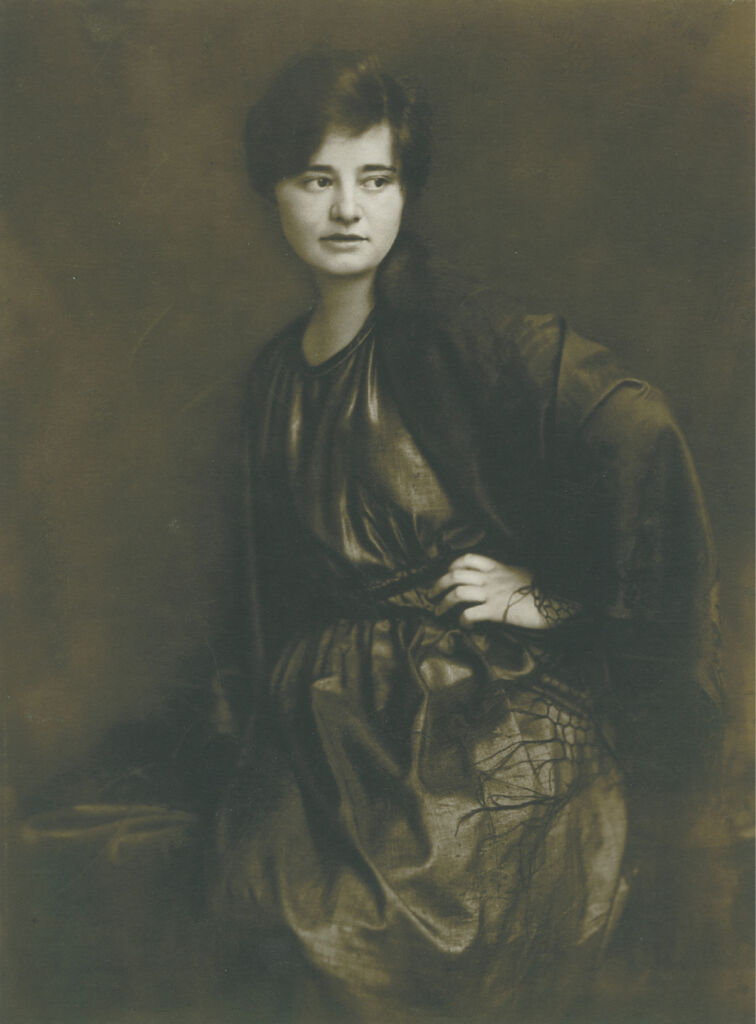
Origins and Education
Born in Lemberg (today’s Lviv, Ukraine) in 1896 to an assimilated Jewish family, Kremer grew up in Sarajevo until her father—an officer and civil servant employed by the Ministry of War—was transferred to Vienna in 1905. While religion played zero role in her family, education was highly valued: the children were permitted to pursue any avenue of training they desired. Kremer, like her sisters, received her first piano lessons from her mother. At age ten, she continued her pianistic training in a preparatory programme at what is now the mdw. And in 1914, she graduated from her piano studies by passing the graduation exam with honours, an Academy diploma, and a prize for outstanding achievement. She subsequently entered the institution’s “Teacher Education Course”, from which she once again graduated with a prize, and thereafter continued her studies in Emil Sauer’s master class for piano during the 1915/16 academic year.
Artistic and Teaching Career
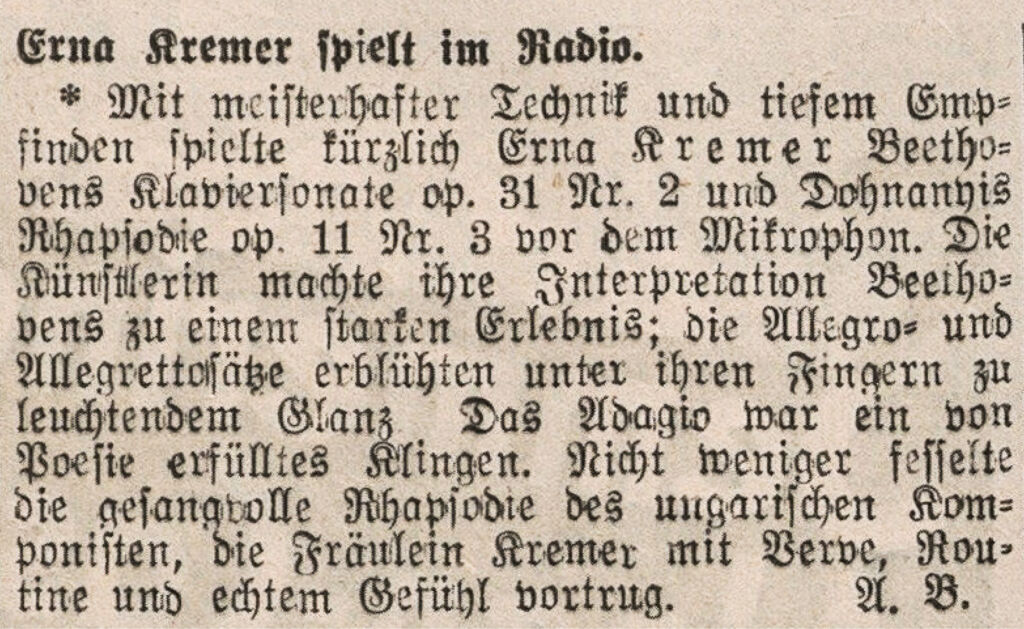
The earliest traces of public appearances by Erna Kremer as a soloist, piano accompanist, and chamber musician date from the early 1920s, and one newspaper review also alludes to a tour in Sweden. By 1923, at the latest, she was heading a class of piano majors at the Neues Wiener Konservatorium and also teaching privately on the side. But despite how a concert review from that era prophesied that “this artist will soon be known as a piano virtuoso of continental rank,”2 Kremer did not succeed in building an international career. From the early 1930s onward, however, she did play for radio broadcasts—thereby becoming a nationally recognised name. And in 1934, Kremer was appointed to head a class of piano minors at the mdw, in which capacity she taught up to 70 students each semester.
Persecution and Murder
Upon Austria’s “annexation” by Nazi Germany, Erna Kremer lost the entire professional basis of her existence due to her Jewish descent—in which context her conversion to Catholicism in 1919 was entirely irrelevant. What’s more, the numerous restrictions placed on the segment of the population defined as Jewish also included a ban on movie attendance. In a 1940 letter to a girlfriend, Kremer remarked, “Yes, the cares and worries are growing ever larger and have long since exceeded any bearable proportion.”3 At that point, she had already been moved into a collective apartment in Vienna’s third district together with her brother and mother. It was probably in early May of 1942 that the family was then transferred to a Sammellager [collection camp] together with around 1,000 other Jews before being deported on 6 May to the extermination camp in the Belarusian village of Maly Trostinets, where they were murdered in the nearby woods immediately following their arrival on 11 May.
Ilse Aichinger last saw her aunt in Vienna when she was carted off to the train station in an open lorry.
Her cinema was the Fasankino; it was almost always the Fasankino to which she went. She’d come home with a chill, usually telling us how it’d been draughty, how one could catch one’s death of the cold. But she wouldn’t part with her Fasankino, nor did she catch her death there. Catch it she did, however—together with my grandmother in the extermination camp near Minsk where they’d been deported. It would’ve been better if she’d died at the Fasankino, for it was a place she loved.” 4
Further infos on Erna Kremer on spiel|mach|t|raum.
- Ilse Aichinger, “Stadtauswärts: Die Klavierspielerin”, in: Film und Verhängnis. Blitzlichter auf ein Leben, p. 11.
- Linzer Volksblatt, 25 May 1922, p. 4.
- Letter from Erna Kremer of 30 Nov. 1940, Deutsches Literaturarchiv Marbach.
- Ilse Aichinger, “Stadtauswärts: Die Klavierspielerin”, in: Film und Verhängnis. Blitzlichter auf ein Leben, p. 13.