A fascination with different ethnicities and worlds of sound has accompanied Salah Ammo since the very beginning. And thanks to a new master’s degree programme at the mdw, this passionate Kurdish Syrian musician has been able to realise a long-held dream: to engage with the broad field of ethnomusicology as a researcher.
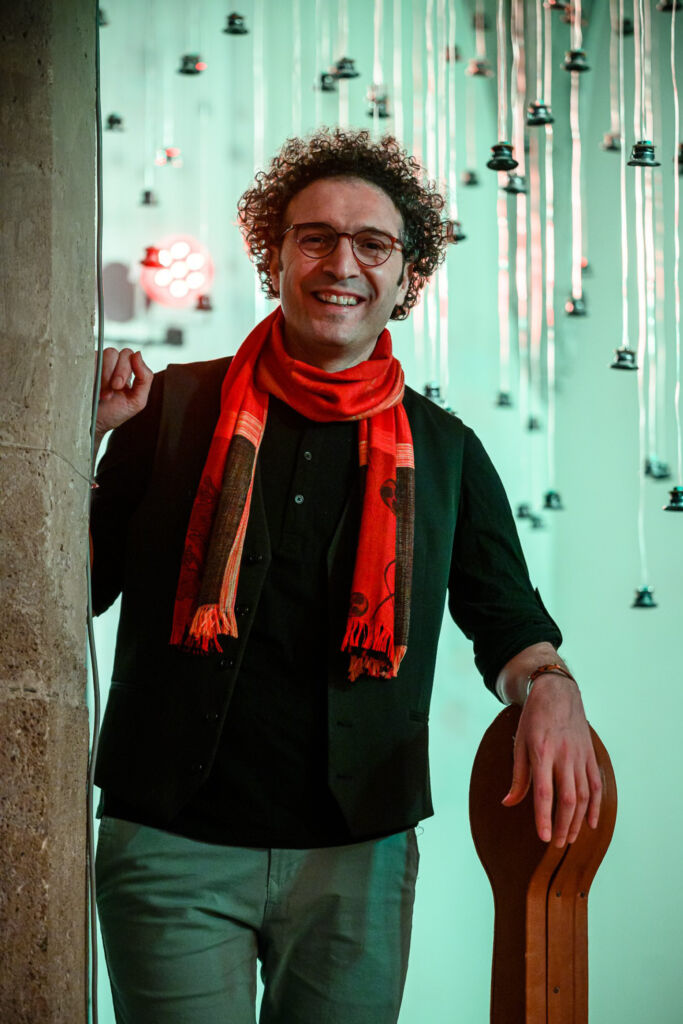
Salah was just eleven years old when an interest in producing sounds led him to build his own first instrument. There were no places of musical education in the small north-eastern Syrian town of Ad Darbasiyah, where he grew up in a family with eleven children. He describes his early contact with music as authentic and natural: “I never attended a music school, but I remember how singing always touched me.” His mother sang to him from his birth onward, and a neighbour later showed him his first fingerings on the bouzouk, a Syrian long-necked lute.
Making music gave my life meaning. My heart cried out for it, and I said yes.
“I think I must’ve been born as a musician, seeing as I’m the only one in my large family.” When he began having thoughts about following his passion at around age 18, however, his father was opposed. He sent Salah to Damascus to learn French so that he could obtain a scholarship to study IT. But at a concert in the Syrian capital, Salah instead ended up meeting his future bouzouk teacher—who then gave him his first real instrumental lessons. The young member of Syria’s Kurdish community was 20 years old when he made the decision to devote himself to music. “At that point in time, I hadn’t really thought about exactly what I’d be able to use my studies for afterward—I just had to do it.” His new teacher prepared him for the entrance examination at the Higher Institute of Music in Damascus—which was no easy undertaking, since the standards were quite rigorous and the bouzouk was not offered as a major. But despite all difficulties, this dedicated musician succeeded in winning over the examination committee and was then admitted as that institution’s first student with a major in bouzouk. After graduating in 2004, Salah Ammo founded the band Joussour—whose name translates literally as “Bridge”. His aim was to unite the diverse ethnic and musical influences that exist in his home country. “I wanted to present a mosaic of Syrian music,” explains the versatile artist. On the side, he performed Kurdish music as a soloist and composed music for theatre productions and films, in addition to which he began teaching at the Higher Institute of Music in Homs in 2007. The group Joussour was quick to earn itself a good reputation and went on to perform at numerous renowned concert venues including the Damascus Opera House. They also represented traditional Syrian music in guest appearances abroad—including at the important Arab Music Festival and Conference in Cairo. 2010 saw him awarded a production grant for his first album, Bayê Sibê. However, the outbreak of war in Syria forced the cancellation of this album’s planned presentation in early 2011. Salah then decided to pursue a master’s degree abroad and was granted a student visa for the United Kingdom. In order to enable his family to join him, he applied for asylum but was rejected due to an earlier visa for Austria—to where he was then deported. He ended up spending somewhere between two and three weeks in the reception camp at Traiskirchen, a period that he describes as very difficult. “I had no passport, just a number, and was forbidden to leave the location to which I’d been assigned. I was alone and afraid,” he recalls, “and I wasn’t even allowed to accept an invitation to appear as a representative of Kurdish-Syrian music at the renowned Morgenland Festival Osnabrück in Germany.”
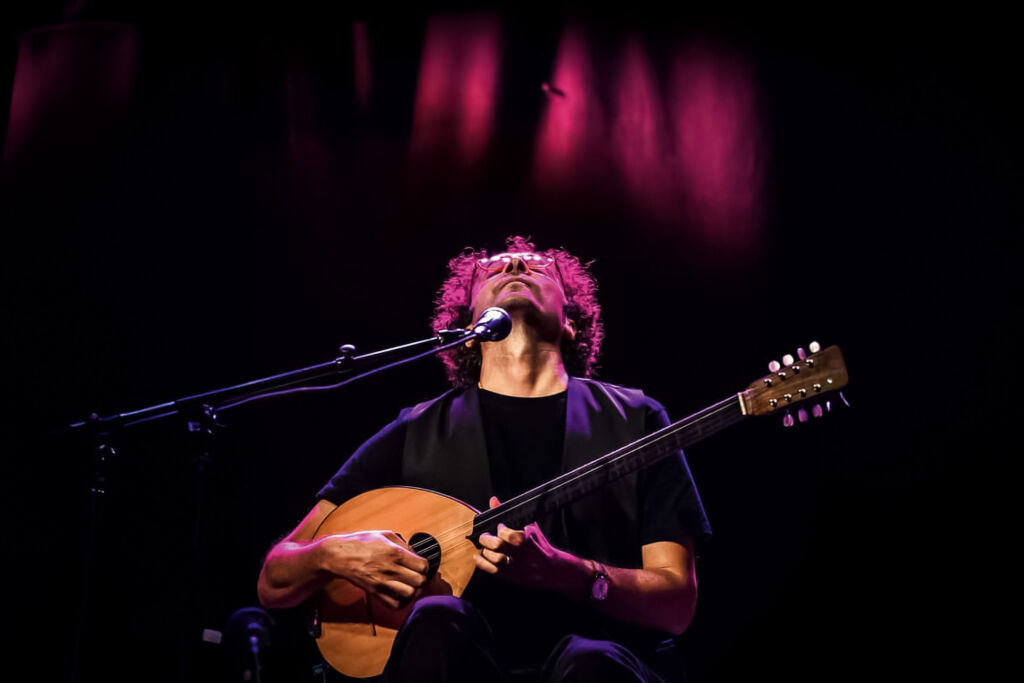
For me, studying ethnomusicology had always been a secret dream.
In 2013, the Syrian musician ultimately wound up in Vienna and set about rebuilding his musical career. While attending a concert, Salah made the acquaintance of Austrian percussionist Peter Gabis, who shortly thereafter proposed that they try out making music together. As a duo, they then proceeded to record the album ASSI – A story of a Syrian river, which was later shortlisted for the German Record Critics’ Award. And in 2014, the two even made it into the Austrian World Music Award’s final round. It was a few years later, at a concert in Salzburg at which Salah spoke publicly about the bouzouk and the musical traditions of his homeland, that he met Ulrich Morgenstern, a professor at the mdw’s Department of Folk Music Research and Ethnomusicology, who told him about our university’s new ethnomusicology MA programme. “I was absolutely floored, since studying this subject had always been a secret dream of mine.” Though bureaucratic hurdles made it difficult to gain admission, Salah was indeed able to begin his studies in the programme in 2019. “Being able to study at the mdw was something I’d had to fight for. And I ultimately became the first student to take the master’s degree examination in ethnomusicology—as well as the first to graduate from this new programme.” Shortly after he commenced his studies, there was a renewed setback: COVID-19 made his everyday activities as a student and a professional musician enormously more difficult. So in order to keep busy in some way that made sense, this variously interested student attended an mdw course on Viktor Frankl’s logotherapy, a form of psychotherapy centred on meaning. “It then became clear to me that I wanted to continue learning about this, and with concerts being impossible due to Covid-19, I had the time.”
Through my art, I process my own painful experiences.
His further studies in this regard and generally ended up being a source of support in his efforts to work through his own traumas. And half a year ago, Salah Ammo began working for the charitable organisation Diakonie as a psycho-social counsellor—as which he is now able to help displaced young people on the basis of his own story. Today, this ethnomusicologist knows how the paths people take as professional musicians can be quite diverse—and he’s very sure of one thing: “If you’re a musician deep down inside, then you have to follow that call. Otherwise, you’ll always feel like something’s missing.”