Dance Resonance – Artistic Attunement in Motion was the theme of this year’s symposium of the Gesellschaft für Tanzforschung [Society for Dance Research], which took place from 25 to 27 September at the mdw in spaces formerly part of the adjacent Salesian abbey on Rennweg. This event was held as a cooperative effort between the mdw’s Artistic Research Center and Department of Music and Movement Education/Rhythmics and Music Physiology as well as the University of Hildesheim’s Institute for Theatre, Media and Popular Culture. The chosen location couldn’t have been a more ideal setting for the symposium’s approximately 100 presentations (lectures, lecture-demonstrations and -performances, workshops, and panel discussions). These were given and experienced by well over 200 participants across six atmospheric rooms and halls, each with its own special charm: the generously inviting Alter Konzertsaal and Neuer Konzertsaal (including buffet), the two friendly and bright movement studios, the magnificent meeting hall of the Office of the Dean of Music Education Programmes, and the idyllic vaulted seminar room AEG10 on the ground floor. Especially the guests from elsewhere who attended could hardly believe the outstanding possibilities offered by the mdw for the (near-effortless) hosting of events of this magnitude. And in a similar vein, some could hardly fathom what it must be like to study in such an exceptional place.
In the event’s first keynote, Gabriele Klein (Hamburg/Amsterdam) introduced the concept of “resonance” around which Hartmut Rosa’s monograph Resonance: A Sociology of Our Relationship to the World (Berlin 2016) revolves. Klein, a sociologically trained dance scholar and performance art theoretician, portrayed important hallmarks of this theory in an equally stringent and nuanced manner while also elucidating marked points of criticism in order to ultimately explore whether or to what extent this concept could be of interest to the actual practice of dance and/or to dance scholarship.
The second keynote, delivered by dance historian Andrea Amort (Vienna), served as the nucleus of a mini-symposium of sorts within this fundamentally very open and broad-based annual event that dealt exclusively with the longer-term effects—”resonances” in a broader sense—had by the Hochschule für Rhythmik, Gymnastik und Tanz [Academy of Rhythmics, Gymnastics, and Dance] that once existed in the town of Laxenburg near Vienna. It was 100 years ago (in 1925) that this educational institution moved from Dresden-Hellerau, where the Vienna native Émile Jaques-Dalcroze had initially established “rhythmics” as a field of music education in its own right, to Austria. What subsequently developed with great vigour and even more idealism was an independent and decidedly body- and movement-oriented tradition of rhythmics. Further lectures and discussions concerning the roots of this specifically Viennese version of rhythmics were joined by workshops and performances that quite vividly highlighted practical dimensions of the corresponding approaches.
The third and concluding keynote by Darrel Toulon (Vienna)—who spent 15 years as a choreographer at the Graz Opera before going on to create his “Docu-Dance-Theatre” as a stage for people who have been marginalised and stigmatised for various reasons—placed a focus on resonances in transformative processes. With examples localised at a sensitive interface between art and the realities experienced by such people, Toulon emphatically highlighted societal challenges whose explosive urgency—much like the concerns of his dance projects’ main protagonists—has yet to be widely recognised.
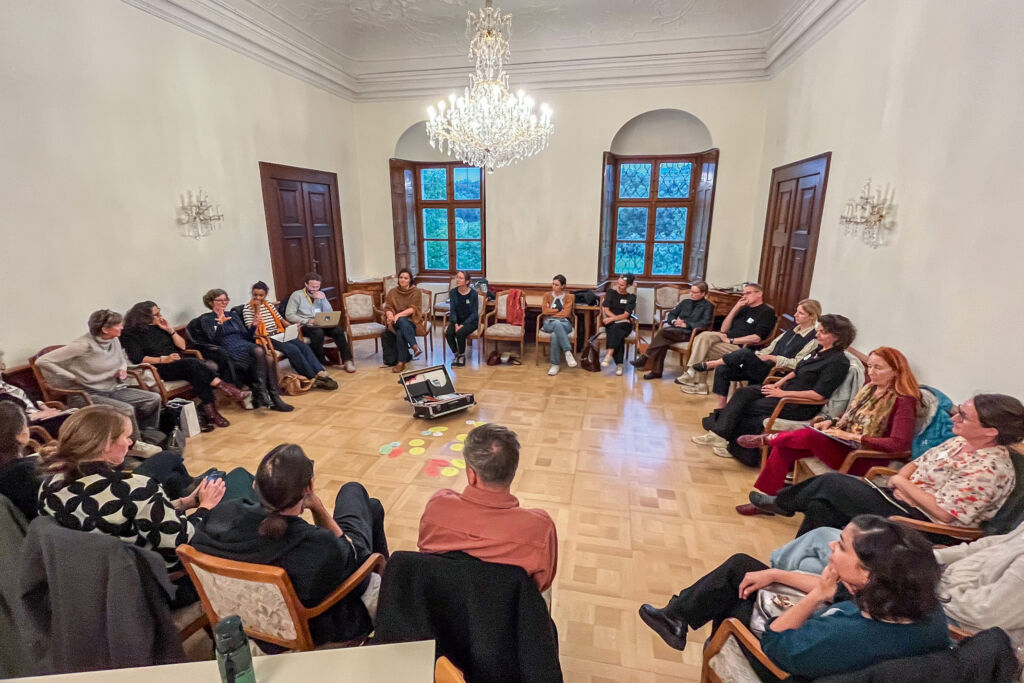
The thematic range of the further presentations encompassed (multi-)sensory, eco-somatic, ecological, spatial, relational, digital, social, queer, decolonial, pedagogical and mediatory, communal and participative, and above all critical aspects of the resonance-concept along with the possibilities that this concept opens up for artistic and creative processes. No less impressive was the provenance of the lecturers, who travelled to Vienna from a wide range of European, North and South American, Middle Eastern, and East Asian countries in order to contribute to a symposium that, in a way akin to phenomena of emergence, ended up being significantly more than the sum of its individual contributions: it was a colourful kaleidoscope of perspectives in which every motion (or turn) revealed new facets. Wholly in keeping with Hartmut Rosa’s concept of resonance, these three effervescently intense days gave rise to transformations (as mutual emotional impulses that require “giving oneself over to things as well as a willingness to change, as if putting one’s own self on the line”) based on instances of affection (understood as “the ability to be and the experience of being ‘touched’ by an Other without being possessed or controlled by said Other”) and self-efficacy (the “ability to ‘touch’ and the experience of ‘touching’ or reaching an Other without possessing or controlling said Other”) whose outcomes remain entirely open as of today. But despite the “unavailability” of further developments for now, the abundant and overwhelmingly enthusiastic feedback received thus far does indeed permit the assumption that this symposium will continue “resounding” for a long time to come.