“Every beginning is precarious” is a statement that holds true for a great many projects in creative and artistic fields. But with their film project SOLDAT, Film Academy students Vivian Bausch and Fabian Rausch experienced the exact opposite. Just how they ended up landing a generous filmmaking subsidy, how it feels to write a screenplay as a duo, and how the two assess the current situation for film professionals in Austria are all things they discussed with mdw Magazine.
A girl in a military uniform. For weeks on end she lives, exists, moves around in this one single outfit, never taking it off. It’s at once a protective shield and a declaration of war. Her fellow school students have got to think she’s a weirdo, turning up to class in the ever-same costume. But the girl refuses to take it off. It feels just too good to be shielded from the outside world and those around her, cultivating a life of her own inside this martial-looking shell. It was in a neighbourhood near the southern end of Linz around the turn of the millennium that one might have encountered this girl named Vivian. In Auwiesen, in the residential development there where she grew up. A girl who would one day bring to life an altered and fictionalised version of herself—in her first feature film as a director.
This film is called SOLDAT [SOLDIER]. In addition to directing it, Vivian Bausch also co-wrote its screenplay together with screenwriter Fabian Rausch. Both of them study at Film Academy Vienna. Speaking with us, Vivian Bausch—who was born in Munich but grew up in Linz—is quick to emphasise that her film shouldn’t be viewed as autobiographical. It is true, though, that a workshop with directing legend Doris Dörrie led Bausch to take inspiration for this story from her own past.
“The idea had already been in my head for a while, and then I had this creative writing workshop with Doris Dörrie. She gets very personal, of course, and she suggested that we write something about a piece of clothing from childhood. I remembered how I’d worn an Austrian military uniform for an entire year back when I was about eight—I just hadn’t wanted to take it off. I also did push-ups in it every day and even slept wearing the cap that went with it. It was a kind of armour. I didn’t care one bit what anyone said—and it just looked so wild,” says Vivian Bausch with a laugh. Doris Dörrie, says Bausch, was positively surprised and said she’d never seen a film character like that. Thus encouraged, Bausch then started bringing her idea into progressively sharper focus until it eventually began to resemble a screenplay for a coming-of-age film.
This is where Fabian Rausch came into play. He joined the project around two years ago, a good while after Vivian Bausch had come up with her idea and developed the screenplay’s initial pages. “Vivian already had her basic concept of this child growing up with her mother plus a few motifs—like the military jacket. And the title SOLDAT was also there right from the start; that never changed. It was on the set of Night of Passage by our colleague Reza Rasouli, who also studies at the Film Academy, that we became acquainted. Initially, we just went about getting to know each other and exploring things a bit to find out whether we might arrive at some kind of common language, common approach, or common utopia for this project.” It soon became clear, he says, that the way in which they were able to collaborate worked very well.
There’d been a few hurdles that Vivian Bausch had needed to overcome before the screenplay for SOLDAT saw the light of the (public) world. “I began in 2022 by just writing up an exposé. Really fast—but with quite a sense of shame,” admits Bausch. She’d felt such hesitance quite often in her career up to then. “With the initial films I made, especially when the material touched on autobiographical, personal themes, I was often quick to have a poor opinion of my own work. I think that was owed to this shame we sometimes feel when we bring up and talk about painful personal issues. But this act of ‘going there’ is something I also find somehow important.” So in spite of everything, says Bausch, she ended up submitting her exposé—for the Carl Mayer Screenplay Award of the City of Graz and a grant from the “Talent LAB” funding programme of the Vienna Film Fund and the Austrian Film Institute. “And it then happened that things suddenly fell right into place.”
“It all became concrete from one moment to the next,” seconds Fabian Rausch. “Half a year later, with us not expecting anything at all, we got this call where they told us we’d actually won this award. And since we’d just continued working on the project, it was already a good deal farther along by then.”
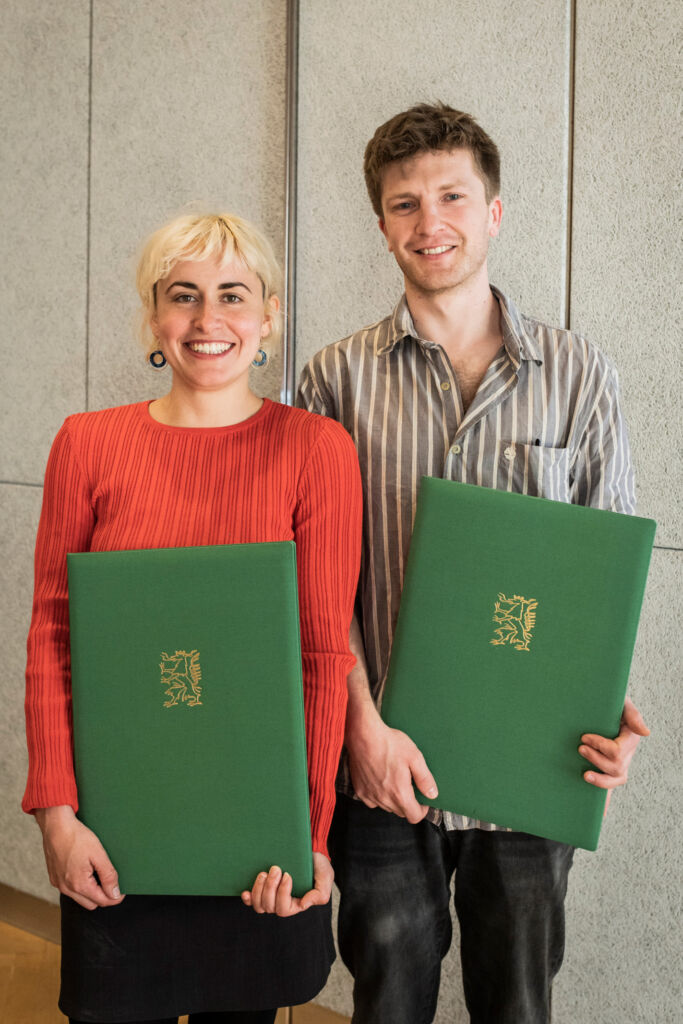
The Carl Mayer Award was a powerful bit of affirmation for the two young filmmakers, affirmation that was subsequently compounded by the selection of SOLDAT by the Vienna Film Fund and the Austrian Film Institute for generous “Talent LAB” funding. The Talent LAB programme supports young filmmakers with a funding pool of around EUR 1.2 million in total. It also includes workshops, advising, and opportunities to interface with other film professionals and industry representatives as well as to develop the awarded projects and place them on a professional footing. SOLDAT was one of five projects chosen for funding this year—and it benefitted immensely from associated opportunities. “I learned a lot from the other projects and people there,” says Vivian Bausch. In addition to the exchange itself, which she found touching and highly enriching in certain respects, she also greatly appreciated the esteeming and constructive feedback culture, the high degree of openness, and the chance to debate about just how they wanted to go about making films in the future. An aspect positively highlighted by Fabian Rausch is how the Talent LAB programme gave them the opportunity to take a renewed deep dive into their screenplay with support from mentors. What’s more: “Growing together with the other four debut films and being able to benefit from each other was a wonderful thing.” For around three quarters of a year, they received “really, really intensive support and guidance. […] It’s something like a miniature debut film boot camp.”
Overall, the two filmmakers have positive things to say about the funding landscape for up-and-coming filmmakers in Austria. “If you look around Europe, you’ll see that a whole lot of people have to work extremely hard to scrape together their budgets from all kinds of sources. My German colleagues, for instance, have had a far tougher time getting their debut films funded. So I think that the EUR 1.2 million made available by the Talent LAB is a pretty staggering sum of money,” says Vivian Bausch. Fabian Rausch, as well, views Austrian film as being in a privileged situation: “I think that as far as the available opportunities, grants, awards, calls, and subsidies go, we in Austria can count ourselves very, very lucky that it all exists. It’s still there—even though money is getting tighter and tighter, especially since it’s always somehow tied to the public sector. But I do think the infrastructure in Austria is very, very good.” Film, being a creative industry, is quite naturally competitive. And with lots of people after the same funding opportunities, these have to be fought for—“but fundamentally, I’d say that what we have in Austria is a situation where your projects really do have a good, realistic chance,” says Fabian Rausch.
To Vivian Bausch, the high number of successful films by early-career Austrian filmmakers seen in recent times bears further witness to how Austria indeed does have a functional funding landscape: “Over the past few years, there’ve been so many debut films that are just fantastic—like Bernhard Wenger’s Pfau – Bin ich echt?” And her personal sense is that the budgetary scope of her debut work is just right: “If I had much more money to work with, I probably wouldn’t be able to handle all the responsibility entailed by what is, after all, my first film,” she says, smiling.
The fact that Vivian Bausch makes films at all is owed to purely intrinsic motivation and a little push from Austria’s Public Employment Service (AMS)—or, better put, from a career orientation workshop that the AMS once held at her school. “Back in secondary school, I had this AMS session where they evaluate what you’d be suitable for career-wise. And I still remember exactly what came out of that: their list contained a bunch of things, and the one that appealed to me most was stage directing. I remember how I didn’t tell a soul because I found it embarrassing, but I did think to myself: oh, wow … didn’t expect that!” Around age eleven, says Bausch, it had also been the case that she’d always had a camera with her and shot videos everywhere—“which they weren’t at all cool with at school. I actually almost got thrown out for that kind of nonsense,” she says wryly. It then took a few detours—at a sports channel and in the “Time-Based and Interactive Media Arts” programme of the University of Arts Linz, among other things—for Bausch to ultimately wind up at Film Academy Vienna. “I often heard feedback to the effect that I didn’t fit the directorial mould at all because I’m not the ‘decisive’ type.” However, working together with directors like Barbara Albert did eventually help her become more and more self-confident—as part of which she realised how directing is a field that’s open to people with all kinds of personalities.
Fabian Rausch’s love of film was unleashed in part by the works of Luis Buñuel. Discovering Buñuel’s surrealistic masterpiece An Andalusian Dog “was such an experience back then, as an 18-year-old, even though it’s a very old film. Watching it and seeing that everything somehow worked—I didn’t understand it all, but it did get my wheels turning. […] I come from this little village, you know, and the idea of working in film had seemed quite foreign to me. It was a long time before I seriously considered it. I knew too little and didn’t give it any thought.” Later on, though, when he encountered films by Austrian directors like fellow Salzburger Adrian Goiginger, Rausch realised how someone like himself could indeed make films. Of all the filmmaking disciplines, it was screenwriting that he soon felt drawn to: “Writing was always what felt most organic to me—or most direct and immediate, like something I could get into right away. That’s why I chose screenwriting, though I didn’t know much about screenplays as such.” Upon being accepted to the Film Academy, he then realised more and more how it was actually a huge passion of his. “Writing a screenplay and adapting its text to the film’s visual level is just the right thing for me.”
As of autumn 2025, the final versions of the screenplay for SOLDAT are in progress. The roles are already being cast, and filming is scheduled to begin in summer 2026. Where do these two filmmakers see themselves following the conclusion of their first project together? On this, they seem to have similar ideas: “I’d like to live in Italy. Together with other people. I’d so much like to live at the seaside once in my life,” answers Vivian Bausch promptly, adding that there should also be cats. “My wish would be to wind up in Buenos Aires in one, two years and make cinematic films,” is the equally confident answer given by Fabian Rausch. He’s become fascinated with football there, he says—alongside the sea, the country, and the people, of course. So both can agree on a warmer place. And in any case, the two young filmmakers will be able to collaborate again—even if it may be at a distance.