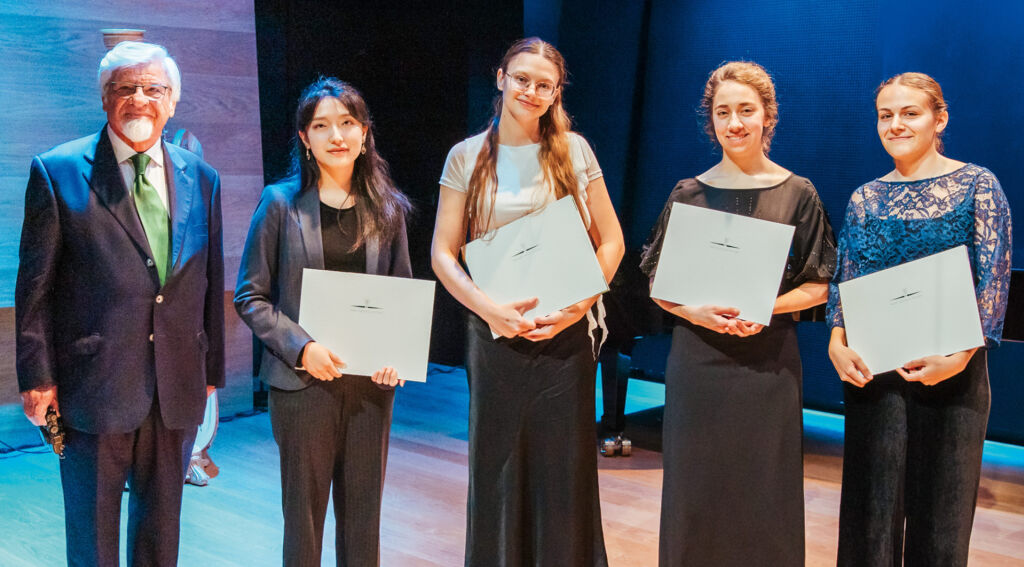
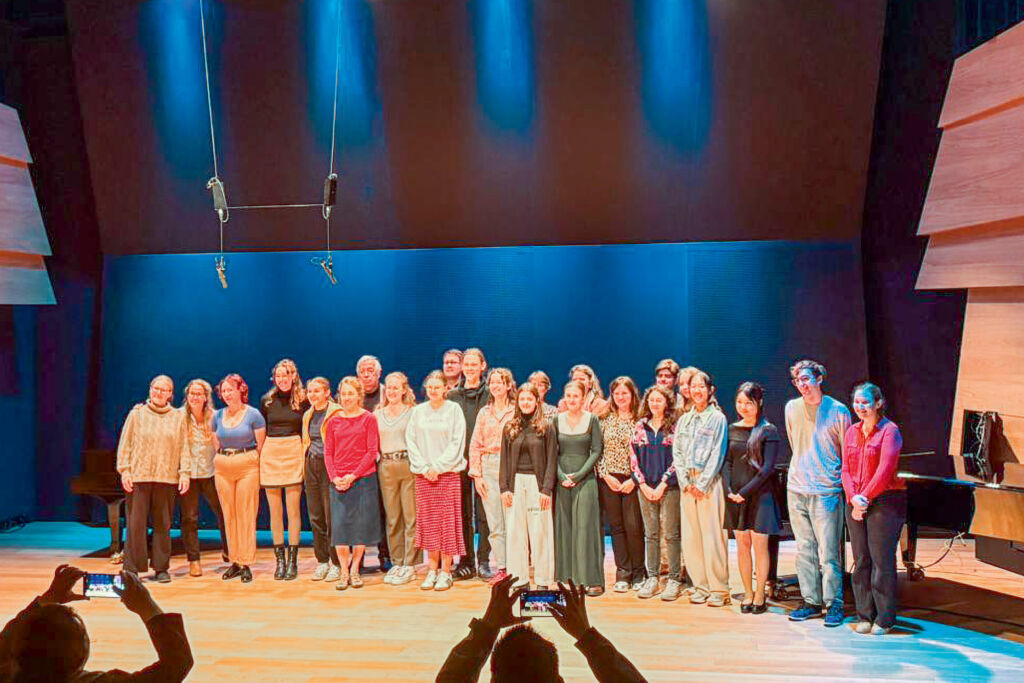
From 24 to 27 September 2025, the mdw’s Future Art Lab hosted the 21st International Harp Competition of the Franz Josef Reinl Foundation. Of the 36 students aged 26 and under from 15 countries on four continents who initially signed up to compete, 21 young harpists ultimately succeeded in preparing their programmes professionally enough to present themselves to the jury onsite in Vienna. Works by Beethoven, Posse, Pepin, Finzi, Renié, and others made up the competition’s challenging programme. The two youngest participants—Charlotte Bommas of Heilbronn, Germany and Margherita Spicci from Italy—were just 16 years old, while the greatest distances by far had been travelled by prize-winners Lauren Ashley Swain (2nd prize) from Pennsylvania and Enzhou Wu from China (Special Prize of the Lions Club Wienerwald) as well as Mizuki Namba from Japan.
From managing registrations and designing flyers and posters to providing snacks and scorecards for the jury, artistic directors Mirjam Schröder and Julia Ostroverkhova from the artistic management offices of the Fritz Kreisler Department and the Leonard Bernstein Department had put in over a year’s worth of preparatory effort—also sending countless e-mails, checking paperwork, compiling Excel spreadsheets, making and changing space reservations, redoing plans, and similar.
With most of the participants slated to arrive without their own instruments, eight harps were made available on location. Good advance organisation was therefore key to the competition’s ultimate success. Which meant: across five practice rooms, a total of 88 practising slots were made available for trying out the competition harps with an additional 117 slots set aside for warming up and practising.
Peter Stenzl and Anita Maric from the Orchestra Office ended up pushing harps between mdw buildings a total of 20 times and shuttling them over 60 times from the Future Art Lab’s practise rooms to its concert hall and back again. Just how helpful disabled-accessible doors and door wedges can be is quickly realised by anyone who pushes a harp from room to room every 20 minutes.
The entire time, four students from the mdw’s harp class were available at the information table in front of the concert hall to replace broken strings, address organisational matters and the participants’ worries and concerns, and organise practice room assignments. The next time these students compete somewhere as players, the experienced gained here will help them better understand how competitions play out behind the scenes. Student Daphne Pirck had the following to say about her experiences: “For me, working backstage at the Reinl Competition was highly instructive and interesting. For the competitors, a competition entails multiple days’ worth of sustained focus and concentration—on themselves and on the repertoire they’ve practised for so long. Especially as a musician, you gain an understanding of precisely what level of tension and concentration competitors will quite necessarily experience right before they perform. Your job here is to be empathetic and supportive, provide encouragement, and create a pleasant atmosphere that avoids subjecting them to additional stress while ensuring optimal support at this important moment. And it goes without saying that after their performances, too, the job is to be someone they feel good with and to make sure they’re optimally supported in every respect.”
The mdw’s YouTube channel carried a live stream of the competition, enabling all those who were interested—not least the participants’ teachers and families, harp manufacturers, and concert organisers—to be present virtually.
This competition would not have been possible without the Reinl Foundation and its president, the retired attorney Dr. Ernst Grossmann. The Reinl Foundation not only provides generous cash prizes (1st prize: EUR 3,000, 2nd prize: EUR 2,000, 3rd prize: EUR 1,500) but also funds the participants’ stays in Vienna. Benefactor Hilde Reinl (1909–1990), the widow of composer Franz Reinl and mother of harpist Hermann Ertl (who passed away at a young age in 1983), bequeathed her financial assets for the purpose of supporting young harpists and composers. Foundation chair Ernst Grossmann, in his words of greeting at the prize-winners concert, spoke about the importance of private sponsorship—without which a huge amount of art would never have come into being. All the better, then, that the prizes of the Reinl Foundation were joined by an additional prize sponsored by the Lions Club Wienerwald and presented by Prof. Thomas Kreuzberger. Looking back upon these three intense days full of harp music, the mdw congratulates the winners and all other participants on their great performances and thanks the jury as well as all those who provided their help.
Watch the The Franz Josef Reinl Foundation Harp Competition at the mdwMediathek.