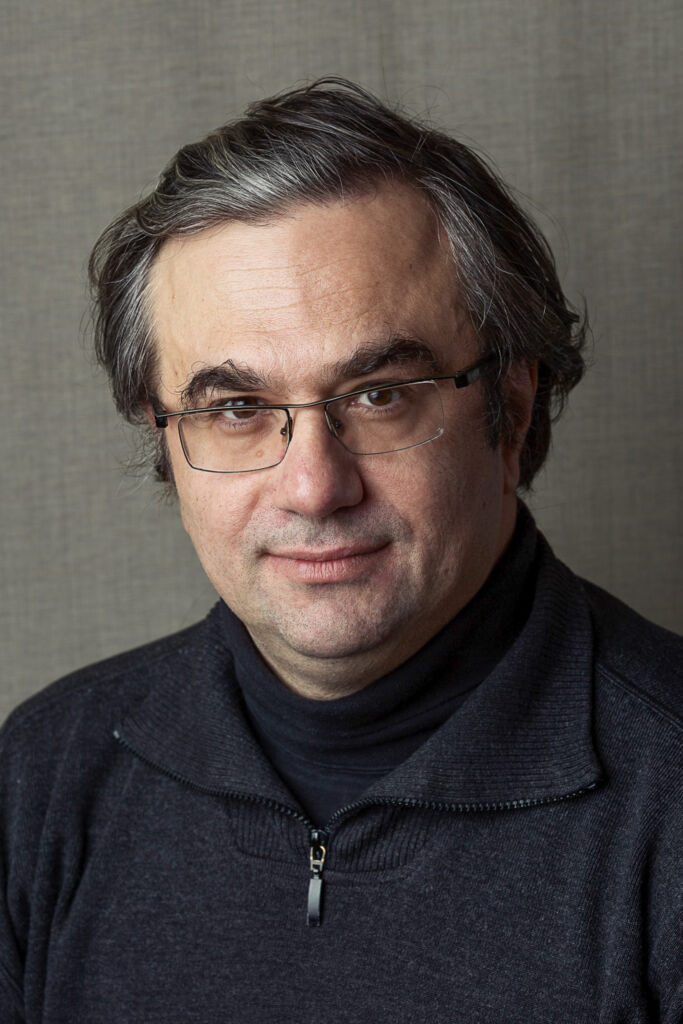
It was in 1994 that Ališer Sijarić, a composing student at the Sarajevo Music Academy, received an mdw scholarship to continue his studies far off from the ongoing war. Now a well-regarded composer and educator, Sijarić is following in some illustrious footsteps as the dean of his Bosnian alma mater.
His father was a well-regarded violinist, his grandfather a famous author—so Ališer Sijarić was awash not only in music but also in literature and other art forms from the very beginning. As a consequence, it was early on that he developed his own penchant for artistic activity. He took his first violin lessons at age five. An interest in composing only developed many years later, however, through engagement with popular music genres such as alternative rock. After graduating from secondary school as well as an intermediate-level music school, Ališer Sijarić continued to follow his calling: he enrolled as a composition and musicology student at the Sarajevo Music Academy and also pursued studies in philosophy and sociology at the University of Sarajevo’s Faculty of Philosophy.
Composing requires a broader view of the world, which is why I also chose to study philosophy.
With the arrival of war, however, the budding composer was faced with a choice: “During the war, doing two degree programmes simultaneously just wasn’t feasible. I ultimately chose composition because the artistic realm was more important to me; philosophy was more about complementing or adding depth to my creative doings than it was a professional prospect.” The outbreak of hostilities in 1992 also saw Ališer assigned to a post in the military orchestra of the Armed Forces of Bosnia and Herzegovina, for which he composed a march and arranged several other pieces of music. “Music and art played a huge role during the Bosnian War. Our own art, which was based on universal humanistic principles, represented a form of resistance directed against the nationalist, blood-and-soil culture of our enemies.” In the face of great danger, thousands of concerts and events were held during the siege of Sarajevo—and teaching at the Sarajevo Music Academy continued as best it could despite the overall adversity. “Back then, many professors left Sarajevo, which was besieged and devastated by the war. That made it difficult to organise lessons and classes,” says the dedicated educator of his student days there. Osman-Faruk Sijarić, Ališer’s father and dean of Sarajevo Music Academy at the time, ultimately concluded an agreement with Michael Frischenschlager, then-rector of Vienna’s University of Music and Performing Arts, that earmarked fifteen scholarships for students from Bosnia whose teachers had fled so that they could continue their studies at the mdw. Thirteen of the scholarship recipients returned to their homeland later on, and some of them now teach at the Music Academy as well as at intermediate-level schools of music.
I think that international cooperation is important on a number of levels. It facilitates the exchange of professional and artistic experience. From a strategic standpoint, it contributes to networking between institutions. And that, in turn, enriches everyone involved—in both a professional and an artistic sense.
“This form of inter-academic assistance contributed in an important way to the reconstruction of Bosnia’s musical infrastructure following the war,” points out the renowned composer. A few years after Ališer’s arrival in Vienna, he became a member of Gegenklang—a group of mdw composition students who banded together with an eye to having their music performed publicly. “We were from all over: four from Austria, one from Luxembourg, one from Venezuela, one from Spain, and myself—a Bosnian. It was a wonderful and very creative time. Looking back, it seems to me that I learned just as much from those interactions with my friends as I did from formal instruction. We’d spend all day and all night preoccupied with compositional and aesthetic concepts in contemporary music.” Thanks to his successes while a student and his artistic doings, the mdw student went on to receive a four-year scholarship from what was then Austria’s Federal Ministry of Education and Cultural Affairs. In 2000, Sijarić returned to his homeland as a well-regarded composer and founded the Society Of New Music Sarajevo – SONEMUS as well as the SONEMUS Festival, whose artistic director he remains today. “SONEMUS made it possible to build up a contemporary music scene in Bosnia that hadn’t previously existed there—and taking advantage of how I was networked with colleagues from Vienna and numerous other musical centres, we were able to attract lots of foreign ensembles to our festival.” Alongside his own widespread artistic activities, the Bosnian composer also devotes himself to budding artists. After having spent many years teaching as a professor of composition at the Sarajevo Music Academy, Ališer Sijarić succeeded his father as its dean in 2020.
My father always said that I should return and rebuild the music and composing scene in my homeland. I marked his words.
“My father was dean of the Sarajevo Music Academy during a very difficult period. He made sure that the Academy survived the war, and it’s hence with a certain sense of responsibility in this regard that I’m now continuing his work. I’ll be doing my best to support and promote this institution in the future, as well.” Despite his obligations as dean, Ališer Sijarić feels that it’s important for him to continue his activities as a well-established artist and educator. “These have always been my two greatest interests, and they’re represented by what I am: a composer and professor.”
Veranstaltungstipp: Re-connecting with Sarajevo Roundtable im Rahmen des reConnect mdw – Alumni Festivals
14. Oktober, 10 Uhr, Seilerstätte 26, Festsaal