Michael Frischenschlager and Clemens Hellsberg speak with mdw Magazine about this once-in-a-century virtuoso and great humanist on the occasion of his 150th birthday in 2025.
Let’s begin with a personal question: How did each of you first get to know the music of Fritz Kreisler?
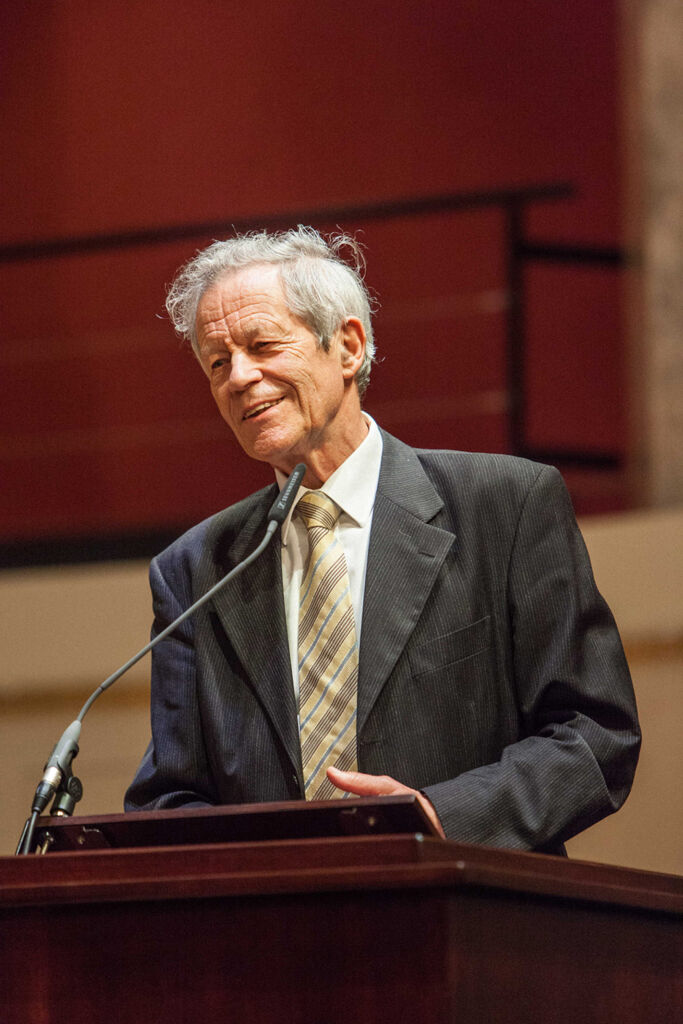
Michael Frischenschlager (MF): It’s a sad story, to be honest. I’d been studying with Theodor Müller at the Mozarteum in Salzburg, right after the Second World War. He was a wonderful teacher and a fantastic pedagogue—but, being a Sudeten German, he was very nationalist in his attitudes. And I’ll say this quite openly: he forbade me to play Fritz Kreisler. As to why, he’d say: “That’s coffee-house music—and he’s a Jew, besides.”
A difficult beginning.
MF: Yes, you could say that. It was only later on, in Cologne, that I was finally allowed to play Kreisler. And that was a true aha moment. His little pieces—like Liebeslied or Schön Rosmarin—are so precisely worked in a compositional sense, with such musicality! Not a whiff of anything trivial. I was instantly taken by it.
Clemens Hellsberg (CH): In my case, it was entirely different. My father (Eugen Hellsberg—Ed.) was himself a musician, born in 1910, and he’d heard Kreisler live in Berlin. I grew up with his music. For me, pieces like Liebesleid and Liebesfreud were standard repertoire from the very beginning. And later on, of course, there were also Kreisler’s cadenzas to the violin concertos of Beethoven and Brahms.
MF: One of the most exciting experiences of my youth was getting to meet Kreisler in person. I played Carnegie Hall as a member of the Mozarteum Orchestra in 1956, Mozart Year. There was a reception afterwards—and it happened that the concertmaster suddenly stood next to me and said: “Come along, Kreisler’s here!” I then got introduced to him. He was sitting there—white hair, frail, but with these unbelievable eyes. It’s a moment that’s stayed with me ever since.
What was it about him that so touched you?
MF: His dignity, his quiet greatness—and his fate. I started asking myself: Why has his music hardly been played at all for so long? Why is he almost forgotten over here—while simultaneously being a legend in America, Asia, and England?
Did his biography play a role in that?
CH: Quite possibly. Fritz Kreisler was a true “Old Austrian”: patriotic, loyal to the monarchy, humanistic. In World War I, he volunteered for combat duty despite how he was already famous. But he took a clear stand against National Socialism even prior to World War II, in 1933. And despite that—or precisely because of it—he was long viewed with ambivalence in Austria.
MF: He was also unbelievably generous. After both world wars, he organised huge relief efforts—donating performing fees, organising shipments of clothing and food—especially for the suffering Viennese populace.
CH: He was at once a moral authority and a musical miracle. Those little pieces, the seemingly easy ones: they’re perfectly constructed. Crystal clear in their composition, schooled in Viennese classicism but always in their own vein.
Wherein does the special challenge of performing Kreisler’s music lie for you?
MF: Precisely in its apparent easiness. It’s music whose effect can quickly flip in the wrong direction: if you play it too sweetly, it’ll sound like kitsch. If you play it too technically, it’ll start sounding trite in short order. So you need to find that sweet spot in the middle—with seriousness, taste, and charm. Kreisler is a training ground for good taste.
CH: And what people often forget is that he had this unbelievable stylistic intuition. Kreisler composed his “Pugnani” and “Tartini” pieces in a baroque style and fooled everyone with them for years. It took a musicologist to figure out that they were actually his own works.
What motivated him to be deceptive like that?
MF: He once said that if he’d played his own works back when he was young, nobody would’ve been interested in them. So he just played them under fake names. Though it was probably also a game of sorts, a provocation aimed at the classical music business and the traditional canon.
What significance do you accord Kreisler in our present era?
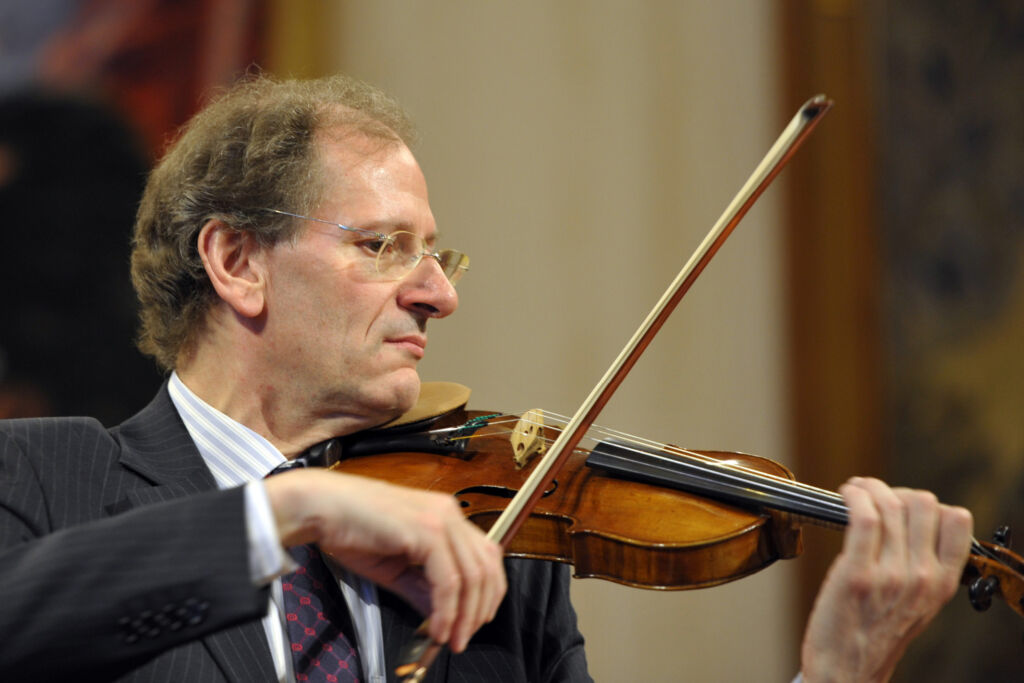
CH: Out there in the world? It’s huge. He’s revered in Asia, America, everywhere. But here? Far too little, unfortunately. That was one of the reasons why we pushed so hard for the establishment of the Fritz Kreisler Competition. Its first edition, which we initiated together with Wolfgang Schneiderhan, took place in 1979.
MF: Vienna needs such a competition. This city has contributed so much to music, and Kreisler numbers among its most important personalities—musically and as a humanist. The competition reminds us that music is not simply art but also encompasses an overall stance.
What can today’s young generation of violinists learn from Kreisler?
CH: A great deal. Technique, articulation, phrasing. And above all: that it’s ok to show your personality. That you can make your instrument sing. That you’re allowed to love music.
MF: And how tradition isn’t a rigid thing but remains lively—as long as you pass it on. The great pianist Bruno Seidlhofer told his students: “I pass Beethoven’s handshake on to you.” And it was in all seriousness that he said it, seeing as he could point to a sequence of direct teacher-student relationships: from Beethoven via Czerny to himself. That’s not a legend; it’s a living line of succession.
CH: In this sense, Kreisler is likewise a central figure. Not just as a musician but also as the bearer of an idea: that music is a space where humanity, humour, profoundness, and beauty come together. Precisely that will remain his great legacy.
Since 1979, Austria’s most important violin competition has upheld the memory of the great violin virtuoso Fritz Kreisler (1875–1962). Michael Frischenschlager (*1935), president emeritus of the Fritz Kreisler Society, spent many years as a professor at the mdw and also served as mdw Rector from 1992 to 1996. Clemens Hellsberg (*1952), the Fritz Kreisler Society’s current president, served as chairman of the Vienna Philharmonic from 1997 to 2014. Together with contemporary historian Oliver Rathkolb, Hellsberg edited the volume Fritz Kreisler: Trotz des Tosens der Kanone. Frontbericht eines Virtuosen [Fritz Kreisler: Despite the Canons’ Thunder. A Virtuoso’s Report from the Front] (Vienna 2015).
The 11th International Fritz Kreisler Violin Competition will take place from 18 to 27 September 2026.
Veranstaltungstipp: Galakonzert zum 150. Geburtstag von Fritz Kreisler
30. Oktober, 18.30 Uhr, Ehrbar Saal