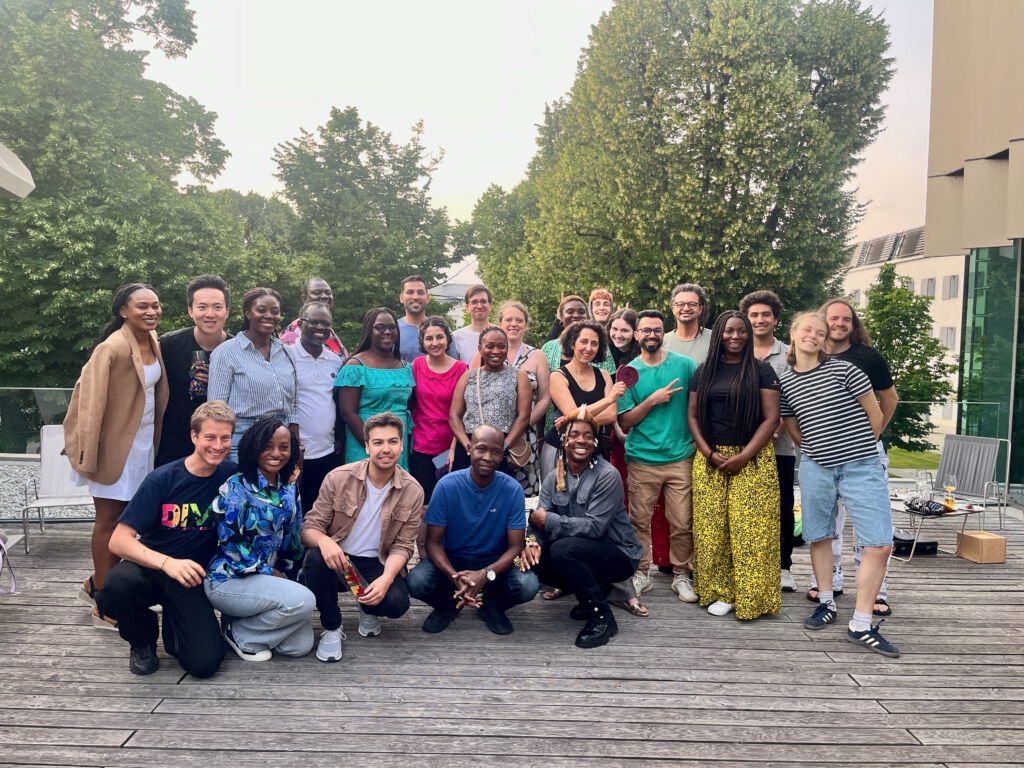
From 30 May to 6 June 2025, the mdw – University of Music and Performing Arts Vienna hosted an international seminar entitled “Quality versus Participation? Politics in Music and Performing Practices”. This week-long event brought together students from the mdw, the University of Cape Coast (Ghana), the University of Maiduguri (Nigeria), the University of Arts Linz, and the Center for World Music (Hildesheim, Germany) as part of the ongoing collaboration with the international graduate school “Performing Sustainability”.
Building on the foundation of the preceding seminar “A Global Classroom”, likewise organised and held by the mdw in April 2024 as part of the international conference “Critiques of Power in the Arts”, this second iteration continued in a blended learning format with online sessions and a shared in-person seminar week in Vienna. The central objective was to critically examine artistic expression’s political significance and explore how art can function as a transformative force in post-conflict societies and perhaps also contribute to the United Nations’ Sustainable Development Goals (SDGs).
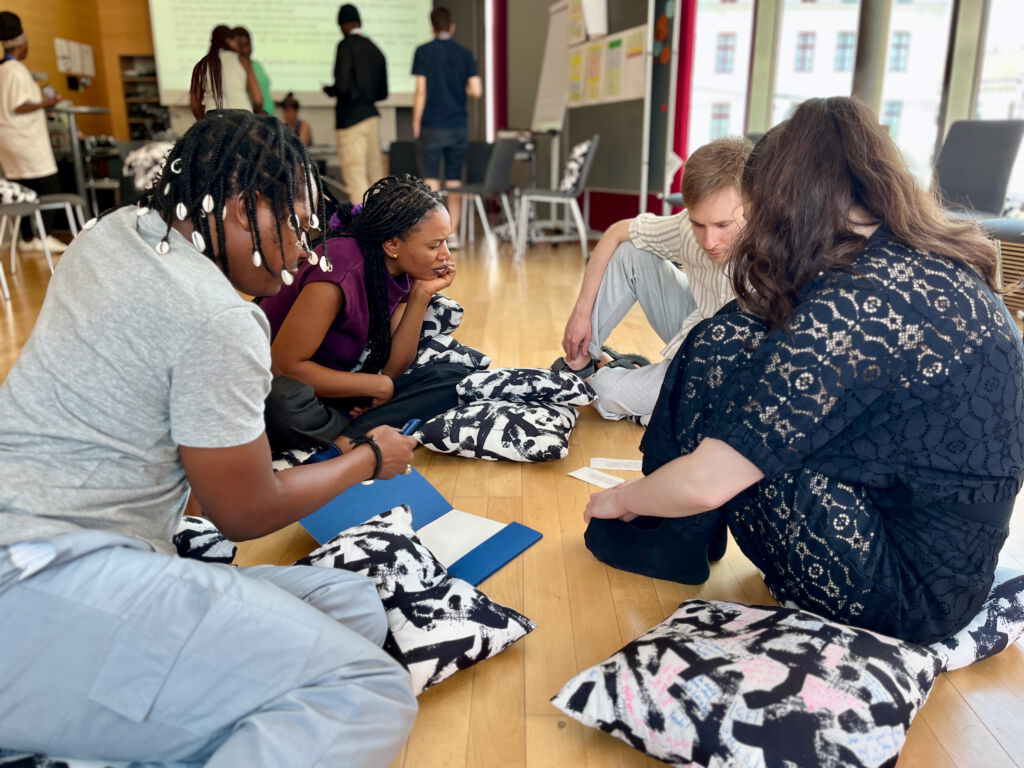
A key component of the seminar was its partnership with the Wiener Festwochen, under the artistic direction of Milo Rau. Together with this festival’s Outreach and Community Building Department, led by Kolja Burgschuld and Eva Wolfesberger, students attended selected Wiener Festwochen performances and took part in structured reflection sessions where they engaged with quite some intensity in discussions concerning various concepts of art, artistic quality, power structures, and participation. The seminar encouraged students to reconceptualise music and performing practices as tools of social engagement and political discourse.
Another focal point of the seminar was critical interrogation of Eurocentric notions of artistic value along with institutional critiques. Both the mdw and the Wiener Festwochen have reflected actively upon their own histories in terms of elitism and cultural politics. The seminar participants were encouraged to challenge traditional definitions of art and develop other perspectives on the role of the arts in societal transformation.
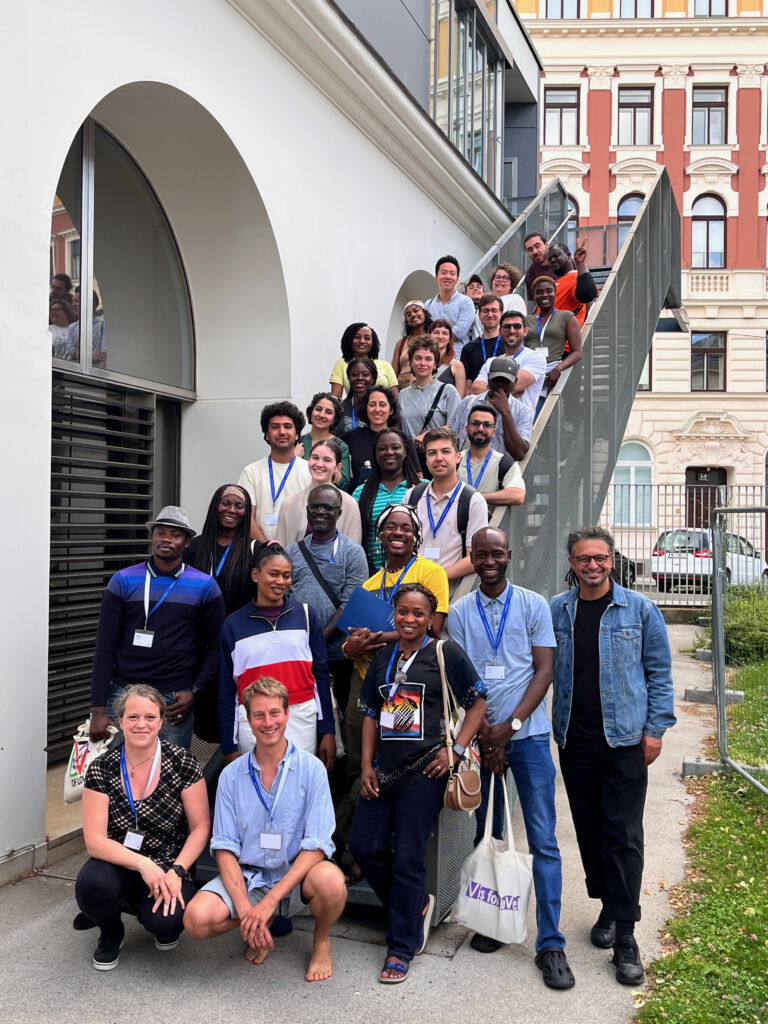
The seminar’s transdisciplinary nature—integrating cultural institutions studies, popular music studies, ethnomusicology, artistic research, cultural policy research, and intercultural philosophy—enabled students to obtain a multifaceted understanding of global cultural phenomena. By bringing together a diverse and heterogeneous group of participants, the seminar fostered meaningful and sustained exchange across cultural and disciplinary boundaries, inspiring students to reflect upon their positions as active contributors in a shared global society.
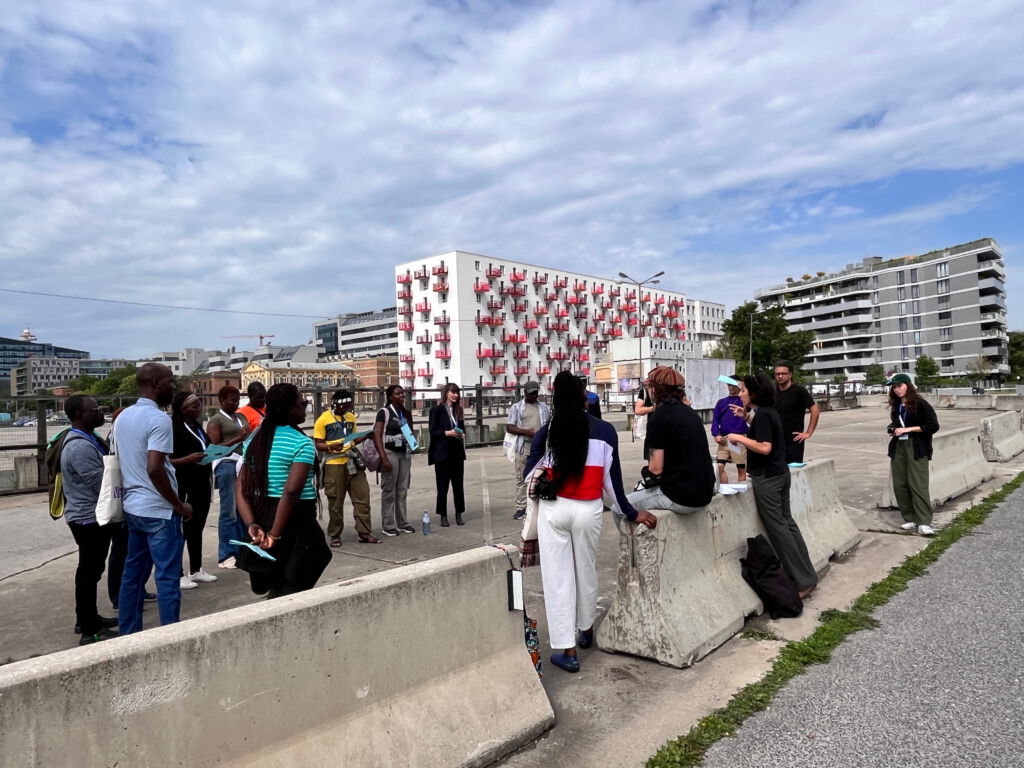
A central aspect of the seminar was its spatial and atmospheric variety, with sessions held not only in classrooms and outdoor spaces on the mdw campus but also at diverse public and institutional venues. Visits to the Wiener Festwochen Center at the Funkhaus along with its garden, to major theatres, and to unconventional sites like St. Marx for All gave rise to shifting perspectives on how space shapes perception and discourse. City walks and informal discussions deepened the impression of Vienna as a stage for social negotiation and artistic intervention, allowing the city to become an active co-creator in the context of the seminar’s critical explorations.
The week opened with a performance by Benjamin Verdonck and Jetse Batelaan that sparked debates on art’s political role, decolonial practices, and global inequalities. Saturday’s eight-hour “Wiener Kongress” (Milo Rau) revolved around cancel culture, artistic freedom, and censorship, shifting the group from consensus toward complex, often conflicting views. The conversation took on still greater depth in the “Curating Change” panel discussion on resisting repression, which was followed by creative reflections upon performances such as Rau’s Burgtheater. Over the days that ensued, participants explored inclusive community spaces, joined “Blind Dates”, and engaged in decolonial critiques of “diversity-washing”. Works like Perzen Triomf van Emphatie and Die weiße Witwe resisted binaries, calling for nuanced engagement with conflict, while sessions on sound, cultural policy, and doctoral research reinforced the need for structural change. The seminar thereby evolved into a space of cross-cultural exchange and for reimagining art’s role in political transformation.
Concepts like “artistic freedom”, “provocation”, and “censorship” were stripped of any fixed meanings as participants weighed the risks of excluding dissenting voices against those of reinforcing power imbalances. Ethical convictions grew more complex, fostering a productive disorientation that embraced contradiction over quick resolution. The seminar became a space where disagreement proved essential, deepening both artistic and political discourse.
The Wiener Festwochen itself highlighted gaps between curatorial intent and audience accessibility. Some productions such as the festival’s pièce commune Ein gefrässiger Schatten catered mainly to culturally and linguistically homogenous audiences despite global themes, raising questions of inclusion. The seminar evolved into a critique of the cultural field’s barriers and blind spots, emphasising how political and participatory art requires institutional self-reflection, structural change, and the courage to replace symbolic inclusion with genuine multiplicity.
Teaching team:
- mdw – University of Music and Performing Arts Vienna, Austria (Lisa Gaupp, Marko Kölbl, Magdalena Fürnkranz)
- University of Arts Linz, Austria (Amalia Barboza, Murat Ates)
- International Graduate School “Performing Sustainability”:
- University of Maiduguri, Nigeria (Naomi Andrew Haruna)
- University of Cape Coast, Ghana (Sabina Appiah-Boateng)
- University of Hildesheim, Germany (Lea Frauenknecht, Arne Nickel, Peter Meister, Maite Herborn)