
How to cite
How to cite

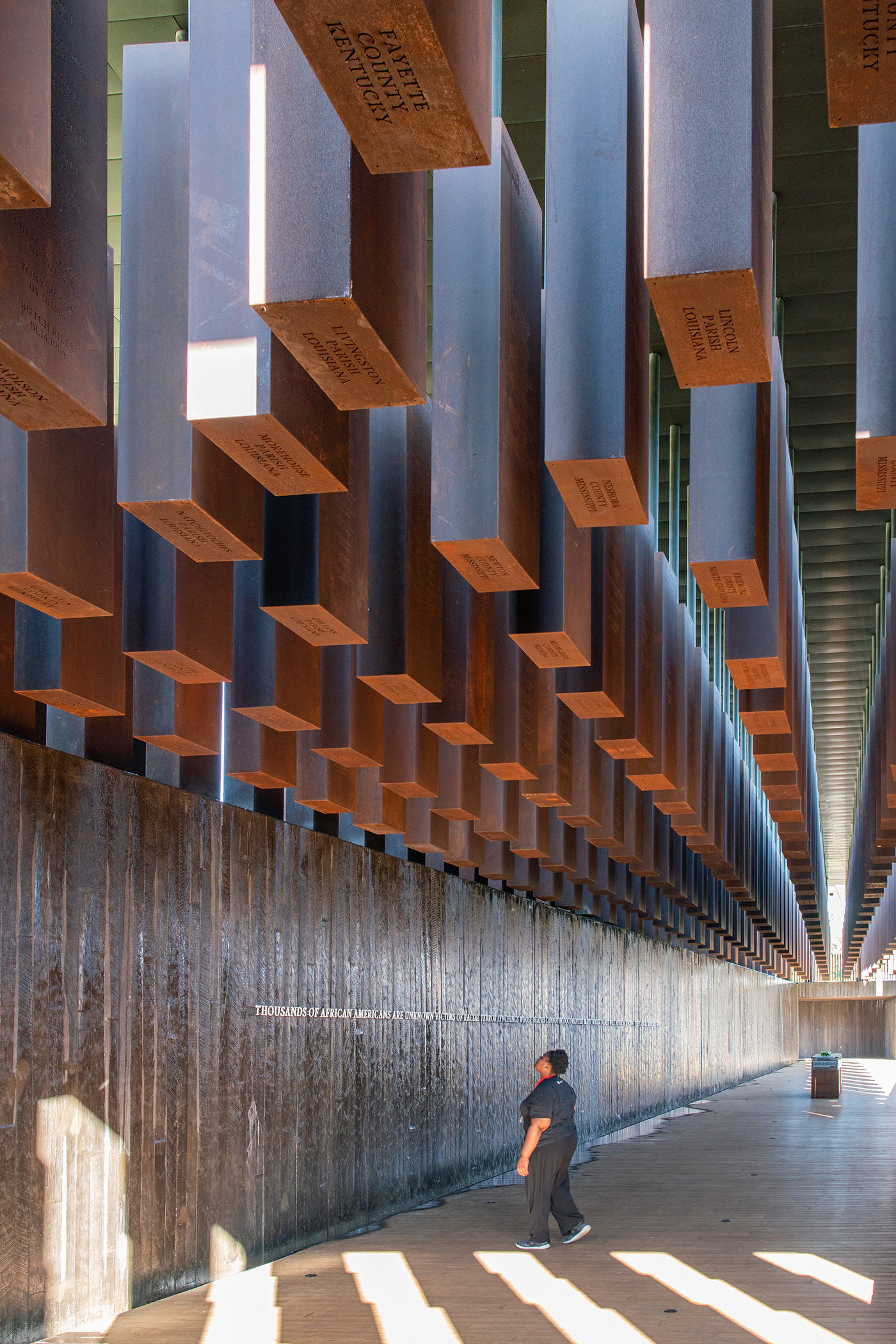
Figure 33 Lynching Memorial, National Memorial for Peace and Justice, Montgomery, 2018. Photo: Alan Karchmer.
In the spring of 2020, medical masks took over public life as the coronavirus pandemic set in. Suddenly, people began showing up in different masquerades in various locations to protest local mask mandates—and to share their photos on social media for maximum attention.387 Throwing together a chaotic repertoire of heavy signs (signes lourdes) in a kind of global contest over iconography, the carnivalesque became politically loaded in a particular way. The headline-grabbing figure of Q Shaman (staged by former actor, the now-pardoned Capitol rioter Jake Angeli) featured a face painted like the Star-Spangled Banner, a fur hat with buffalo horns evoking Playing Indian in Deloria’s terms, and a tattoo of Thor’s hammer across his torso—calling to mind the legacy of old Germanic warriors as imagined in trash action films.388 Yellow stars and similar signs—meant to link mask mandates to Nazism and the Holocaust—were used in the German-speaking context at so-called hygiene demonstrations to frame protesters as victims of a health dictatorship.389 And in both San Diego, California, and Hillenburg, Thuringia, people eventually showed up wearing white hoods, posing for photos in supermarkets or photoshopping themselves accordingly to post their images online.390 While staging themselves as shopping in defiance of local mask rules, they were citing the visual language associated with the Ku Klux Klan.
These forms of making an appearance speak to a media attention economy driven by transgressive insults and operate like extrajudicial court spectacles.391 The reality TV show The Apprentice had already staged a similar mode of address as early as 2004, in what ultimately became a carnivalesque courtroom—a show that shaped Donald Trump’s media persona for more than a decade.392 His recurring TV performances as a boss who loudly humiliates and fires others not only foreshadowed his presidency but also mirror today’s social media appearances, celebrating a carnivalesque authoritarianism as rebellion against “mainstream politics.” Respectively, Trump performing the presidency like a carnival king, has made taboo breaking and putting down others part of a serial carnival routine.
Within this context, the revival of Klan masks—which recall the history of faceless racist terror—signals the persistent afterlife of violence in the play with referential slippery. Masks of this kind may not guard against COVID-19, but they shield their wearers like vigilantes from accountability. And such performances—whether in supermarkets or online—can be read both as carnivalesque commentary on mandated medical masks and as overt threats, aimed not only at pandemic policies but especially at those associated with the victims of the long history of white supremacy that the hoods cite. As masquerades, they are symptomatic of a kind of temporal drag from the political right: the performative transposition of signs from a political violence long thought to have been overcome. Such citations of Klan masks are clearly not a subversive move, but seem to be driven by terroristic, männerbündianfantasies,393 just as this carnivalesque play with historical references is embedded within a global right-wing backlash, where “queer wokeness” has been cast in the role of the police. At the same time, the right-wing appropriation of transgression signals the current shift from neoliberal laisser-faire to illiberal regimes of liberalist economics and their disruptive claim of states of exception.


In its “dragging”—defying rules to contain the coronavirus while visually schlepping along racist terror—the citations of the Klan reveals how performative cultural techniques can be mobilized to cater to the afterlife of white supremacy. People demonstrated how the medical mask mandate could be metapolitically “overperformed.” This right-wing state of exception in drag, then, did not aim for a universal “laughter of the entire people,“394 as Mikhail Bakhtin described the medieval European carnival—that is to say, a temporary overturning of the social order. Instead, this Klan “dragging” in this case deliberately evoked memories of carnivalesque, masked, racist lynching spectacles carried out by faceless vigilantes, who were already subverting “police” control over cultural references in the nineteenth century.395
In the libertarian uprisings for an illiberal order—be it the storming of the Capitol in Washington or the Reichstag in Berlin—masks referencing racism or antisemitism have become iconic signs of today’s regressive, postdemocratic politics. These political performances highlight both the hollowing out of state institutions and the continued legacy of historic violence: the way long-held resentments remain transposable to the present. So what, exactly, do these Klan masks call forth into the present? Following the Civil War in the United States and the fall of slavery, carnivalesque performances in the South quickly turned into terror against Black communities and abolitionists. Meanwhile, the Southern white elite celebrated itself in exclusive carnival balls and parade floats, citing imagery from courtly masquerade traditions. From early on, the right-wing “carnival” took on the form of a vexing signifier, its masking practices swinging between terror and control. When viewed together, these forms of appearing in public reveal the brutal underside of minor mimesis—another kind of dirty dragging, whose legacy continues to endanger conviviality today.
The first section of this chapter focuses on various kinds of masked facelessness and their histories, entangling the exploration of creolization (Chapter 1) and decreolization (Chapter 2). The spotlight shifts here to the South since the Civil War—specifically, the push for new, modern forms of segregation institutionalized as Jim Crow—a term that is historically misleading, that is to say, in its reference to T. D. Rice’s blackface performances of the 1830s. The first groups of Ku Klux Klan, which emerged in the 1860s, offered, I will argue, a blueprint for today’s right-wing carnivalization of politics. That said, their media strategy drew not on visual imagery, but on striking rhetorical fictions, to “contagiously” draw attention to anonymously roaming, carnivalesque mobs and to foment terror. To this end, the Klan drew from Old World European traditions of rural shaming rituals—precisely those “arsenals of masks” outlined in the previous chapter. Nevertheless, to reiterate the point made above: the fraternal Klan marks only one—vigilante—side of contemporary right-wing carnival styles; the other is the elite Southern carnival, with its courtly forms of performing that developed in the later second half of the nineteenth century in places like New Orleans. In this context, Mardi Gras developed as a patriarchal tool of governmentality by a faceless high society that—in staunch opposition to creolized social relations—invented its own lineage, while also foreshadowing the mafia-like dynamics of today’s illiberal politics.
At Mardi Gras, however, these Old World European traditions of masquerade are continually challenged by subaltern gangs who bring different forms of mimetic dragging into play. While their unruly appearances in the back streets have been repeatedly co-opted and folded into city branding campaigns, their repertoire, especially in contrast to the right-wing carnival, still gestures toward the possibility of other ways of relating. That is why the later part of this chapter will engage with “second lining”—the dancing along and behind of Zulu, of the Indians, or the Baby Dolls, that is, of the stock figures of New Orleans’s creolized Mardi Gras.396 In the context of the highly charged visual coding of white and black masks within the United States, I will trace the shift from invisibilization to image proliferation for those subalterns who were never meant to mask themselves under Jim Crow by taking up the question raised at the start regarding Kewpie’s drag scene: what forms of a danced performing otherwise may challenge politics of divide and control? In calling to mind the affective potential of collectively moving bodies, I will return again to context-specific, though related forms of a queer “touching across.”397 Facing today’s identitarian, neoauthoritarian governmentality and ever-increasing surveillance, it is politically vital not to forget the often-overlooked joy of gathering irregularly, relating unpredictably, forging new kinships, making room for another, and moving together in public. Yet nomadic roving has a violent flipside, too.
Terror (Ku Klux Klan)
In 1867, a series of short, puzzling notes appeared in the Pulaski Citizen, a small weekly paper in rural southern Tennessee. “What does it mean?,” or “Kuklux Klan,” they announced—a mysterious series establishing a name without a face. This—as Elaine S. Frantz shows in Ku-klux: The Birth of the Klan during Reconstruction—is how the Klan began: “as a name.”398 In her book, Frantz explores how the first generation of these Tennessee-based vigilantes emerged, how they used performance and media, and eventually became a nationwide, yet decentralized terrorist movement after the U.S. Civil War. To avoid being placed under a military government by the North, Tennessee became the only former Confederate state to ratify the Fourteenth Amendment before Reconstruction, which granted previously enslaved men the right to vote.
In Pulaski—a remote town of about three thousand residents, cut off from new trade and transportation networks, where the South’s failure to modernize was apparent—a self-styled Klan captured new kinds of media attention amid the turbulence of Reconstruction. There, strange newspaper pieces called up carnivalesque parades in a kind of rhetorical masquerade.399 On June 7, 1867, the Pulaski Citizen—apparently issued by Klan kin—ran an article titled “KuKlux Klan: Grand Demonstration Wednesday Night.” The piece already spins a tale of something that retrospectively could be read as right-wing carnival:
About 10 o’clock we discovered the head of the column as it came over the hill west of the square. The crowd waited impatiently for their approach. A closer view discovered their banners and transparences, with all manner of mottoes and devices, speers, sabres, &c. The column was led by what we supposed to be the Grand Cyclops, who had on a flowing white robe, a white hat about eighteen inches high. He had a very venerable and benevolent looking face, and long silvery locks. He had an escort on each side of him, bearing brilliant transparencies. The master of the ceremonies was gorgiously caparisoned, and his “toot, toot, toot,” on a very graveyard-ish sounding instrument, seemed to be perfectly understood by every ku kluxer. Next to the G. C. there followed two of the tallest men out of jail. One of them had on a robe of many colors, with a hideous mask, and a transparent hat, in which he carried a brilliant gas lamp, a box of matches and several other articles. It is said that he was discovered taking a bottle from a shelf in his hat, and that he and his companion took several social drinks together. The other one had on a blood red hat which was so tall that he never did see the top of it. They conversed in dutch, hebrew, or some other language which we couldn’t comprehend. No two of them were dressed alike, all having on masks and some sort of fanciful costume.400
The article about an outlandish procession led by a figure dressed in a billowing robe, with long silver curls and a hat nearly two feet tall, reads like a sketch of a Perchtenzug, a pagan pageant of Old World European figures. This also applies to the grotesquely masked companions in multicolored costumes: one with a transparent cap bearing a gas lamp, matches, and a bottle; another sporting a towering headdress. Through descriptions of their nonsense speech—supposedly including “Hebrew,” that is, signifying incomprehensibility—and a nod to the “graveyard-ish sounding instrument” wielded by the Master of Ceremonies,401 the dance-of-death-like gang was depicted as playing with ambiguous signifiers. Instead of one single face, the Pulaski Citizen gave “Kuklux” a vivid arsenal of imaginary masks—masks whose unruly variety stood apart from the later iconography of the Invisible Empire in white robes and hinted at diverse masking practices from elsewhere.402 The spectacle thus not only blurred the traces of the participants: in the context of mid-nineteenth-century print culture—before its visual turn—it was precisely this mask play that first brought attention to the idea of a mysterious secret society. Although that initial public rhetorical appearance under the label of Ku Klux carried no overt political message, it unmistakably took place in the context of the South’s 1865 defeat in the Civil War.403 The Klan’s media appearance may have been a symptom of political weakness; but its imagined form proved to be an effective weapon. It seemed to downplay the vigilante violence that would soon follow. The article foreshadowed an uprising of a gang of political losers who sought to impose a racially reconfigured order. And indeed, the rhetorical trickery—possibly enacted through real masked demonstrations—spilled over into actual violence.404 Its afterlife gestures toward the terror potential embedded in carnivalesque forms of making a scene in public.
After 1865, the South saw the rise of numerous vigilante groups that refused to recognize new governance. In the postwar chaos—which often left those who had been enslaved without money, education, or work—violence escalated rapidly. This history is powerfully recalled today by the Lynching Memorial in Montgomery, Alabama, opened in 2018 as part of the National Memorial for Peace and Justice.405 It draws on the Apartheid Museum in Johannesburg and Berlin’s Holocaust Memorial. Seemingly endless arrays of steel columns, suspended from the ceiling and marked with the names of sites of terror, evoke the scale of violence unleashed during that era—violence that would later reappear in lynching postcards and live on in carnival.406
What the Pulaski Citizen had described as a performance that seemed both comical and harmless mutated within months into a murderous movement. This “carnival” was never just a form of appearing in the form of play acting: it deliberately folded the death of “the Others,” the unmasked, into its grotesque masquerade. After the Confederacy’s defeat, the collapse of the plantation system with its “belligerent accumulation,” and the fall of Southern white masculine subjecthood, the Klan began surfacing unpredictably across the South as a faceless terrorist force.407 As the name drew wider attention, it became a label for locally driven lynchings. By the latter half of 1867, “Klan” was already regionally linked to terror acts in various parts of the South. It did not signify continuous or centrally organized violence; instead, terror under the Klan’s name kept flaring up in different places, carrying forward the rhetorical game of deniability along with public executions.
In Pulaski, the Klan did not consist of established plantation owners, but of young veterans. Frantz refers to an image of the presumed founding members—faces unmasked, hats crooked on their heads, looking coolly into the camera with guitars.408 She argues that this imagery linked the Klan to the visual repertoire of the minstrel genre. Possessing no resources except access to a local newspaper, the Klan succeeded in establishing its media presence over the next few years through this borrowed, Northern-coined repertoire—celebrating unaccountability. By planting playful “alt facts” in the press, it reshaped how the Northern urban public saw the South. The conspiracies fed by signs and revelations found on today’s social media platforms—pushed by QAnon and others—were in a sense prefigured by these “Klandrops.”409 Shaped by the logic of emerging mass media, the 1860s Klan was, in this light, a distinctly modern phenomenon.
On that Wednesday night described above, if we follow the rhetoric of the accounts mentioned, the vexing signifiers spilled over into something like a staged parade: “All wondered,” the article begins, “and many expressed the belief that it was all a hoax, and that there was no such thing as a kuklux klan.” According to the Pulaski Citizen, flyers of unknown origin had advertised the procession as a celebration of the Klan’s first anniversary. Coded notes containing orders from a Grand Cyclops had allegedly surfaced repeatedly —either left at the paper by another shadowy figure, the Grand Turk, or, as they claimed, mysteriously fluttering in from nowhere:
We are warned not to make an effort to find out the objects of the “mystic klan,” and to allow the Grand Cyclops to issue his orders without molestation. Well, old Cyclops, just issue as many orders as you please, but if we catch your Grand Turk “cyphering” round our door late at night, we’ll upset him with a “shooting-stick.” Look out, old Turk, we are some Cyclops ourself on our own premises.410
A veritable series of brief notices, buried deep in the back pages, introduced these unknown figures as sudden, elusive appearances, as if fact and fiction blurred entirely. Questions about their origins or intentions seemed ultimately unanswerable. The texts advertised the Klan as a haunting specter: uncertain, unplaceable, and impossible to pin down. It remained unclear who, if anyone, was actually speaking in its name:
Will any one venture to tell us what it means, if it means anything at all? What is a “KuKlux Klan,” and who is this “Grand Cyclops” that issues his mysterious imperatives and orders? Can any one give us a little light on that subject? Here is the order: “TAKE NOTICE. — The Kuklux Klan will assemble at their usual place of rendezvous … exactly at the hour of midnight, in costume and bearing the arms of the Klan.
By or of the Grand Cyclops.
The G. T.411
Reporting and the mystic klan’s roving, untraceable apparitions fed off one another. Even its alliterative name scattered clues in every direction. That syncretic name, open to fictional genealogies of all kinds, leaned hard into displaced, nomadic referentiality—unlike the “me as Al Jolson” captioned by Eva Braun (Chapter 2), whose rhetorics remained tightly contained. Richard Wolfram’s research on the afterlife of ritual performances of old Germanic secret brotherhoods, as discussed above, would later lend intellectual cover to the Nazi cult of ancestry and help legitimize state terror as a permanent state of exception. The Klan, by contrast—emerging from the ruins of political defeat—refused any neat origin story or official politics. Its nomadic appearance anticipated how the hoods that would later become its signature reemerged during COVID-era protests and claimed a carnivalesque calendar of ever-possible states of exception along with shifting tales of origin.
Subsequently, even the Klan’s founding date was changed—backdated, seemingly for effect, to Christmas Day 1865. That clearly invoked masked winter rituals among adolescent men, akin to the ones Wolfram later appropriated for the Nazis. The Southern summer parade of the Klan described above can thus also be read in consideration of intimidating rituals and masked masculine processions from the eighteenth and nineteenth centuries as explored in the previous chapter with regard to Schwerttanz und Männerbund. The depiction of the Grand Cyclops—with his silver curls, white robe, and entourage—closely resembles Alpine Saint Nicholas figures, who move from house to house, accompanied by roaring devilish Krampus companions in fur and distorted dark masks, and are part of the broader Perchten tradition.412 Performing rudimentary “Thingspiele” in village parlors, they enacted their own rustic form of justice. A mask now housed in the Chicago History Museum, dated to the 1870s, makes this especially clear. It strongly recalls those Christmastime Saint Nicholas plays in Europe, long reserved for costumed men—indicating the fraternal gendering of this other dirtiness of political violence the Klan unleashed.
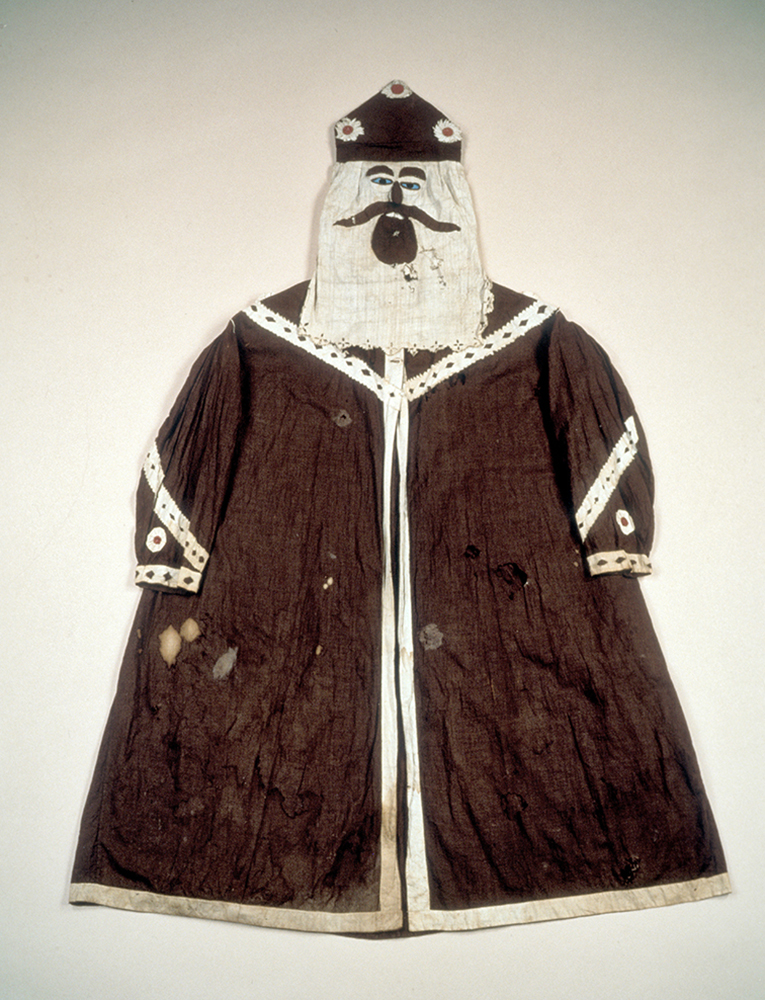
Figure 36 Ku Klux Klan mask once belonging to Joseph Boyce Stewart, 1870s, Lincoln County, Tennessee. Chicago History Museum (ICHI-062420).
In looking at the masking repertoire used by the early Klan, a distant kinship emerges with ritualized rural-fraternal retributive court spectacles in Old World Europe. One cannot say for sure how such a masquerade—reminiscent of Haberer, Glöckler, Krampusse, or Perchten—made its way into the Pulaski Citizen, appeared on the streets of the South, and entered the homes of its victims. It may have arrived via the German New Year’s carnival in Philadelphia, that is, in the North,413 through the Mardi Gras traditions of Memphis or New Orleans, or by means of some other unspecified processions. However, the mention of towering hats evokes the headwear and costumes known also from the Alpine regions. From a comparative perspective, the description of that alleged first Klan parade conjures images of young men dancing through streets and from house to house: white-robed Glöckler with illuminated headwear or Krampusse with dark masks. The garb described in the Pulaski Citizen thus hints at nomadic performative transpositions.414
Citing carnivalesque parades aimed less at “self-indigenization” in claiming an unbroken return of a Germanic Wild Hunt as Wolfram had. Rather, the Klan is foremost a New World phenomenon. The image of bodies lashing out in sudden terror was picked up, but without being contained in a single backstory. Instead, the Klan leaned into an open play with slippery references—translating the Wild Hunt, for instance, into the vigilantes’ claim that they were Confederate soldiers who had returned from the dead. The Klan thus tapped into a motif that Nazis such as Euringer and Wolfram would later project back onto the medieval tradition of the dance of death in claiming its Germanic roots. For the Klan, however, it was rather spectacle than such genealogies that mattered; their performance was all about drawing attention. In that sense, the Klan reflects a kind of modernity that makes it particularly meme-ready for contemporary media. The afterlife of rural European masquerade—which perhaps arrived in Pulaski via its adaptation into the minstrel genre—was thus recast in a locally specific and deliberate way, shaped by the political climate of the time. These young ex-Confederates, having experienced cultural defeat in the Civil War, were carving out a new role for themselves, one that reshaped their militarized masculinity through carnivalesque terror. As Frantz notes, the Klan was not simply about restoring the old plantation order, but about the invention of a fundamentally changed hegemonic white Southern masculinity and the modern fight for attention: “Ku-Klux drew from popular culture to reconstruct their destabilized gender identities and reaffirm the racial dominance at its core.”415 This carnivalesque, terrorist masculinity in minstrel blackface and other disguises aimed to impose the new racist order that would later be known as Jim Crow.
In citing rural European masquerade, however, the early Klan first and foremost brought into play two kinds of masking that were not yet mentioned in the Pulaski Citizen article quoted above but are highlighted by Frantz: cross-dressing and face-blackening.416 Blackface can certainly be seen as a minstrel citation, but the blackened face also functions as a marker of combative masculinity. It taps into performative techniques tied to the heroization of death, the rough justice of militant male bands, and punitive rituals such as tarring and feathering, reframed in the context of the Civil War. This specific blend of spectacle and terror breaks through the boundaries separating gender bending from carnivalesque comedy, lines that would later become sharply drawn, for instance, in SS Volkskunde. As the hoaxes circulated by the Klan demonstrate, the contemporary power of their performance lies in enforcing the carnivalesque play with ambiguity rather than trying to suppress it. In this sense, the Klan’s early appearances are quite literally readable as in drag. And it is precisely this form of public spectacle that now, in the wake of the current right-wing backlash, seems newly appealing to some.
In his book On the Postcolony, Achille Mbembe reads the carnivalesque as the “banality of power,”417 where the obscene and the grotesque serve as intrinsic moments of domination, channeled through noninstitutionalized forms of public performance. But the history of the Klan—emerging on the cusp of Jim Crow and the rise of a modern racist order codified into law after the collapse of the plantation-based slavery regime in the South—makes clear that the relationship between terror and carnival needs to be situated more precisely. It also provokes a deeper look at how specific regimes of domination change over time. The first Klan dissolved in the early 1870s. Its acts of terror faded from view after systematic racism was consolidated through formal state policy. When the Southern states began installing new segregation laws—effectively a form of apartheid aimed to perpetuate the hyperexploitation of Black labor—night-time terror began to die down.418 The Klan vanished just as the paramilitary battle over a racial color line under contemporary capitalism seemed won. In New Orleans—some 750 kilometers south of Pulaski, situated on the Mississippi and a key destination of steamboat tourism—this shift coincided with carnival’s transformation into a mass spectacle. Yet through the carnival masquerade, the Klan’s faceless terror gained an afterlife in a new, governmental form of faceless crowd control in the context of Southern white supremacism.
Control (Comus)
What Errol Laborde and others now call “classic American Carnival”419 may be seen as one of the templates for the early masquerades of the Klan. Yet carnival also absorbed the Klan’s spectacles just as the brief post-Civil War era of democratization and abolition came to a close. Terror thus began to give way to what would become known as Jim Crow. As the white supremacist vigilante movement started to fade, new economic elites rose and found ways to put carnival to governmental use.
The history of New Orleans Mardi Gras—arguably the most creolized and spectacular carnival in the United States—reflects the shift from rural, fraternal vigilantism to urban, paternalistic modes of crowd control. Unlike Pulaski, New Orleans—a major port city where the Mississippi flows into the Gulf of Mexico—has been crucial for North-South commerce since the invention of the steamboat. In the nineteenth century, as carnival and the rise of a new upper class became entangled, Mardi Gras was turned into a tool for governmentality focused on mass tourism, city branding, and the commodification of entertainment. This coincided with the displacement of a fluid caste system. The distinction between the enslaved and gens de couleur libre—some of whom participating in the exploitation of bare labor—was now transformed to conform to a rigid color line.420 Before the Civil War, a rising coalition of mostly Northern white newcomers—benefiting from the Deep South’s connection to the industrial North and the transport revolution—had speculated in goods traded through the plantation economy. They became now tied to shifting market dynamics brought on by the era’s mobility boom.
And even before 1861, when the war broke out, questions of modern urban development were playing a role for those who sought to gain from the transformation of the existing economy.421 As Reconstruction took hold and profit systems collapsed along with the end of slavery, New Orleans required a new commercial model. Until then, it had been the leading hub for the American slave trade and, after the Haitian Revolution around the turn of the century, the central node of sugar commerce across the Black Atlantic. Like Cape Town, New Orleans was plugged into transatlantic trade and had long been a creolized port city with a Romance-style carnival tradition.422 In line with Louisiana’s French and Spanish colonial history, Mardi Gras blended street processions and ball culture, anchored in the Catholic calendar. But even before abolition, shifting internal migration patterns signaled the rise of new social formations, which would also reconfigure carnival.
Standard histories date the start of Mardi Gras in New Orleans to the winter of 1856—1857, when the Mistick Krewe of Comus was founded—the same year Dred Scott failed in his bid for freedom before the U.S. Supreme Court, and eighty years after independence.423 During carnival, Comus staged a kind of roving theater parade—at first with only two floats—and hosted a spectacular, invitation-only ball featuring tableaux vivants.424 The masked secret society was made up of affluent anglophone newcomers, some of whom profited from the sugar trade. With them, a new parade culture emerged after the war—what city marketers would later brand the “greatest free show on earth.” Exclusive balls, meanwhile, served to knit together the new elite. These tableaux-vivants events, and the officially sponsored “elevated carnival” for the masses—especially for the rising tide of tourists—went hand in hand. With them, the newcomers positioned themselves against the longstanding, francophone moneyed elite and their masquerade ball culture.
A drawing of the 1867 Comus Parade, published in an illustrated magazine—Frank Lesley’s Illustrated Newspaper—highlights the recently established divide between the parade and its spectators. This new parade form juxtaposed an unruly, street-level carnival and its moving bodies with public spectacle. Here, masks became signs of faceless authority. Comus thereby invoked an allegorical court masquerade by the London poet John Milton, titled A Maske presented at Ludlow Castle, 1634: On Michaelmasse night, before the Right Honorable, John Earle of Bridgewater, Viscount Brackly, Lord President of Wales, and one of His Majesties most honorable privie counsell. The Milton citation clearly functioned as a marker of bourgeois, anglophone, Protestant distinction—as a display of cultural capital.425 It underscored the ambition to create an alternative high society, separating itself from the creolized, Romance carnival traditions both in the streets and in the long-standing dance halls. In time, its aesthetic would prove especially well suited to the emerging era of mass image distribution. Paradoxically, the citation of a courtly spectacle also helped to establish a “postcolonial,” supposedly genuine American carnival form—though deliberately stripped of its creolized character.
This masquerade spectacle negotiated contemporary claims to power through specific stagings of gender. Comus appeared in an ambiguously masculinist form.
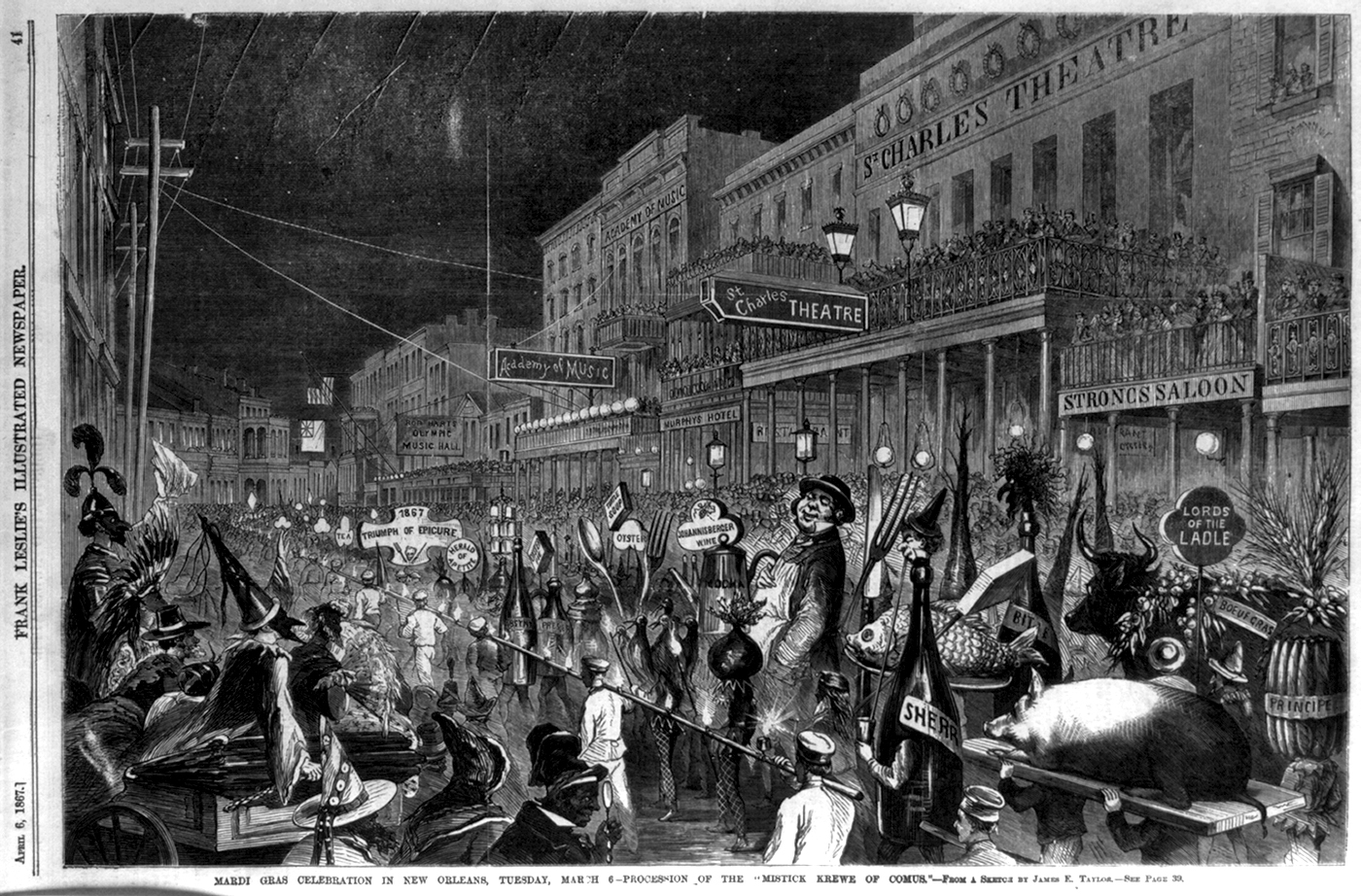
Figure 37: Mistick Krewe of Comus, Mardi Gras Parade, New Orleans, 1867. Frank Lesley‘s Illustrated Newspaper, April 6, 1867: 41. Library of Congress, Washington, D.C. (99614058).
From the outset, Milton depicts the figure who gives the secret society its name as Janus-faced. Its seemingly harmless shepherd’s disguise turns out to be the deceptive flipside of sexualized violence. In Milton’s puritan allegorical play of chastity—a genre pastiche of courtly theatrical forms—the sorcerer Comus, a masked seducer, abducts his counterpart, called the Lady, who stands for spirit and virtue. Dragging her to his castle, he tries to rob her of her innocence. Right in his first entrance, Comus leads a band of wild, beast-faced, noise-wielding monsters, whose appearance first evokes baroque creatures of hell and their colonial-racist transfigurations within the context of British expansion:
Comus enters, with a charming-rod in one hand, his glass in the other; with him a rout of monsters, headed like sundry sorts of wilde beasts, but otherwise like men and women, their apparel glistring; they come in making a riotous and unruly noise, with torches in their hands.426
Even in Milton’s play, the female figure of virtue serves as a trigger for the display of spectacular unruliness, as the first entry of Comus and his “bestial” retinue shows. Transposed into Mardi Gras, figurations of femininity and “bestiality” enabled krewe members to adopt cross-dressing and blackface, bringing into play the image of white femininity as something to be protected—along with the dark threat it supposedly faces.427 Against the backdrop of enslavement and the plantation, these figurations took on a distinct political signification. Milton’s Comus—oscillating between sovereign masquerade and unleashed violence—became the king of the Mardi Gras krewe. After the Civil War, Milton’s rape fantasy—cited to reconfigure carnival—could also be read as a threat of violent transgression onto those cast as a racialized, bestial menace. And it is precisely through this twisting and intertwining of allusions to violence that the history of the Comus Krewe, for their part, resonates in a particular way with the contemporary governmental right-wing carnival—while differing from the Klan’s vexations.
In the end of the play, Milton has virtue and order prevail. And the Comus Krewe, in its own way, nods to a Puritan view of carnival already shaped by Ash Wednesday. Read with Umberto Eco, the Milton citation envisages a temporary form of transgression that serves to amplify an existent regime of domination.428 Unlike the Klan—carnivalizing its calendar and staging a permanent state of emergency—excess is presented here as fleeting and clearly bounded, yet recalling the transformation of militant violence into societal structures potentially reactivated when needed by the new elites.
While Comus’s zoomorphic Mardi Gras personae—often white and female or Black and male figures, all of them played by white men—appeared only briefly every year in what we might call drag, they have a lasting counterpart: a gentlemen’s club founded alongside the krewe, which to this day excludes those who are categorized as Jewish, Black, or women.429 Serving the interests of an elite faction, the carnival of what are now called the Old Liner krewes has increasingly evolved into a vehicle for city branding. After the South’s military defeat, the quoted courtly theatrics was repurposed into a large-scale carnival spectacle—now aligned with modern commercial capitalism and new modes of entertainment. At the same time, Mardi Gras became a tool of contemporary social control.
In Lords of Misrule: Mardi Gras and the Politics of Race in New Orleans, James Gill charts the entanglement of ex-Confederate vigilante groups such as the paramilitary, unmasked White League and the Comus Krewe, despite its Northern background.430 Their “elevated carnival” spectacle of street glamour, Gill argues, lured the bourgeoisie into the streets, making the old, unruly hooliganism—with its flour fights and, most likely, urine bombs—easier to control.431 This new form of Mardi Gras went hand in hand with a retroactive, yet deeply enduring mythologizing of Southernness: “The krewes have played a big part in perpetuating the myth that the South sustained a great civilization until it was destroyed by Yankee vandals.”432
In the guise of Proteus or Momus, by the 1870s—just as the first Klan was winding down—several elite krewes were springing up, modeled on Comus and helping to regulate street carnival with rolling tableaux vivants and living statues.433 The modern version of carnival then finally received a respectable face in Rex, the supposedly universal, white, male Mardi Gras king—ruler of all the krewes.434 Invented in 1872 as a deliberate attempt to jumpstart tourism, Rex became the figurehead of the modernized, “American” carnival. His face is bare, while Comus still hides behind a stiff white mask, punctured with holes. To this day, the Comus Krewe refuses to reveal who appears each year on its behalf, broadcast on television alongside King Rex and exclusively photographed in an ever-same way during the now-traditional Meeting of the Courts on Fat Tuesday. In embroidered royal capes with long trains, Comus and Rex perform their alliance as “Ersatz,” as surrogate, royalty.435 Positioned within the social order of the South, the pairing of white mask and white face comes to expose the link between violence and wealth.
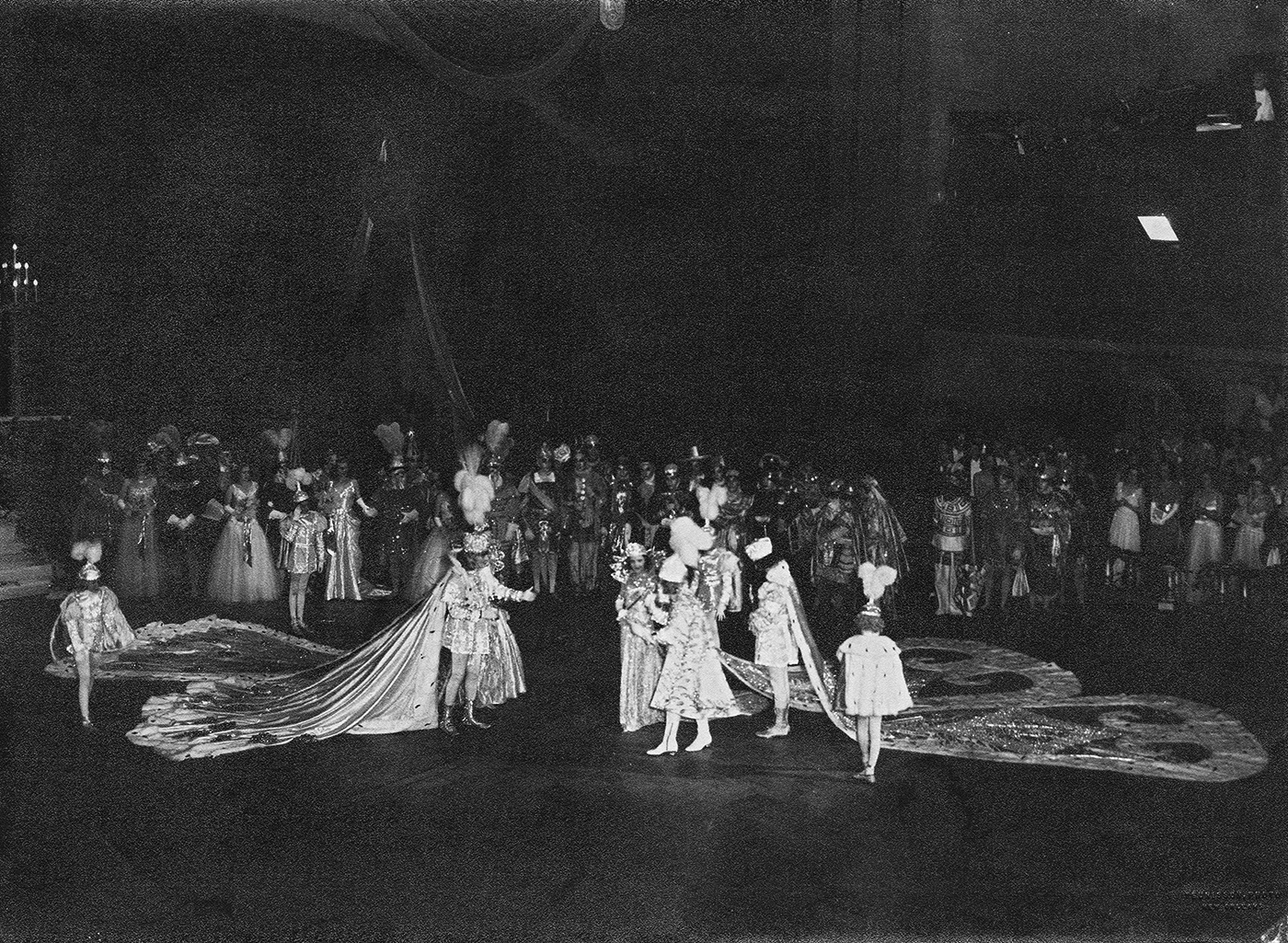
Abbildung 38 »Meeting of the Courts«, Comus, Rex, Mardi Gras 1941, New Orleans. Photo: John N. Teunisson. The Historical New Orleans Collection (THNOC 1985.233.1).
Historical sources already bear witness to this carnival’s deep ties to the Southern myth and to courtly spectacle. A 1941 photograph, taken from a bird’s-eye view by John N. Teunisson, shows the two royal couples with their spectacular trains and entourages approaching one another—surrounded by their exclusive audience. In contrast to today’s tightly controlled close-ups from the Meeting of the Courts, Comus’s perforated white mask, though, is hardly visible in the image. Referring to the courtly appearance of Comus, the Times Democrat remarked on February 25, 1903, with a clear nod to the Civil War:436
Comus had gone by, with his train of mystic pageantry stretching far behind in glowing colors of many hues, and lit with the gleam of a thousand torches … and from the throne room beyond the mystic curtain whisperings of the court drifted out to the waiting multitude.
The ball, with its memories of many other Carnival balls, and with its associations of bravery and skill and of men who have gone forth to die for their country, was decked in the colors of the Carnival.437
As this quote indicates, the emerging form of Mardi Gras in New Orleans gained its political charge through its tight fusion of ballroom culture and militarism in service of the Southern myth. As early as 1873, the Comus parade featured not only overt displays of glamour but also white supremacist satire. Its tool was racist caricature, as shown in Charles Briton’s elaborate watercolors of figures and floats, painted on empty backgrounds, which are now housed in Tulane University’s Carnival Collection.438 While the makeshift street carnival inflected by the creolized ragtag of the Atlantic has left few traces, the New Orleans archives overflow with exclusive artifacts from the so-called Old Liners: drawings, invitations, party favors, décor, and costumes from elite krewes. Among them are the remains of the 1873 Comus parade. Titled The Missing Link to Darwin’s Origin of Species, these artifacts reimagined Milton’s “roughly-headed monsters” as oversized-headed animals meant to parody new political leaders: the president, the governor, the chief of police, and so on.439 By turning politicians into animalized figures, the parade staged a supposed Africanization of governance. Comus drew here on minstrel imagery, as shown in Briton’s depiction of a gorilla playing a banjo, wearing a crooked hat and peacock feather, said to reference a sitting lieutenant governor. As minor, supporting characters, delicate, feminized creatures resembling butterflies appear in Briton’s drawings, often with a stinger, such as the Demoiselle Fly. The krewe members likely performed these roles in blackface and cross-dressed as white women. In portraying such “Others,” the use of masks became a gesture of domination. Black torchbearers and the krewe members’ female relatives, by contrast, were not entitled to wear facial disguises.440 The krewe masks thus worked to legitimize the emerging color line by appealing to the biology of the day, and they ultimately called for a reversal of Reconstruction government.441 This carnival, in other words, played an overtly political role.
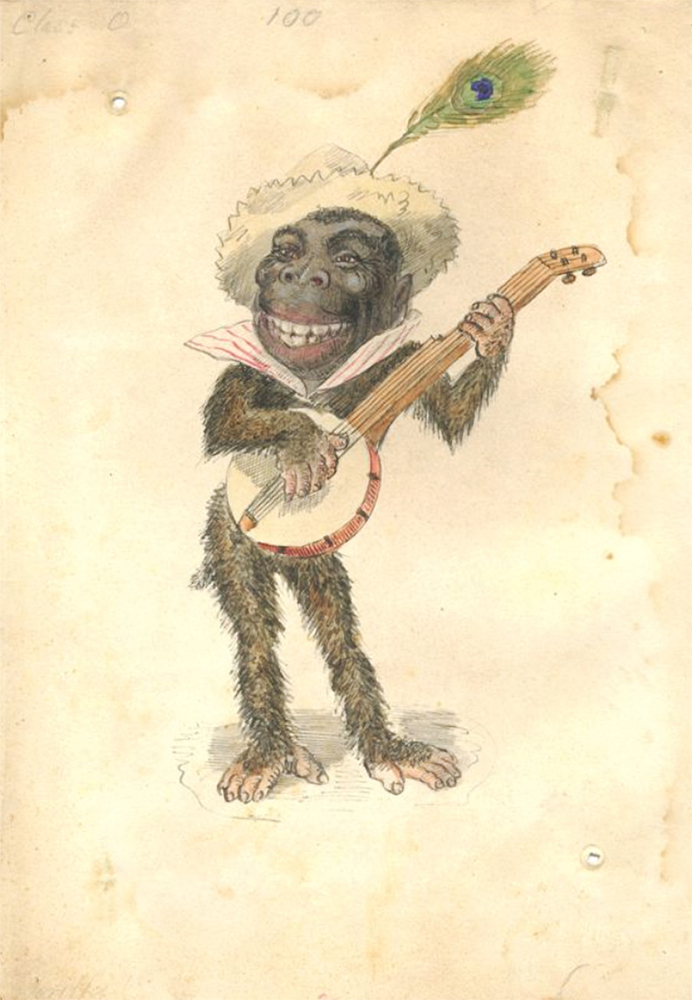
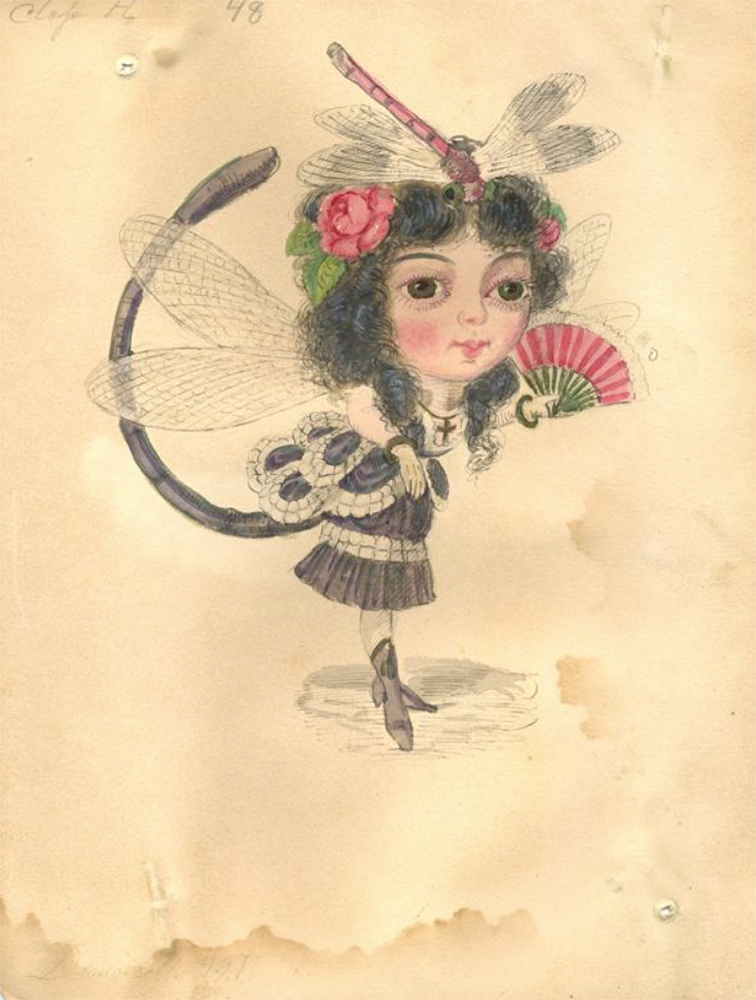
More than a century later, in the early 1990s, those notorious depictions reemerged—this time to give an afterlife to Jim Crow-style segregation. Before Comus, Momus, and Proteus shifted their efforts solely to private, invitation-only balls and canceled their parades in protest over a new city ordinance—requiring the overdue desegregation of all Mardi Gras parade groups—the figures from 1873 were reinvoked in one last public spectacle.442 Once again, the right to remain unseen was tied to a grotesque, hypervisibilization of those othered.
Since then, these Mardi Gras secret societies have limited themselves to a parallel world of ball culture. Overt racist provocations, such as the gorilla imagery of the early 1990s parades, vanished from the public eye. Meanwhile, krewes like Comus have continued to cultivate quasi-oligarchic business networks through their ball circuits, networks that have entrenched local racialized class structures and have contributed to keep broader social change at bay. Unlike the fraternal terror tactics of the antebellum period, this exclusive ball culture was shaped by patriarchal logic. The daughters of otherwise faceless businessmen in “drag” were presented as debutantes of high society: “especially the daughters of the krewe members become living effigies, the overdressed icons of social continuity,”443 as Joseph Roach writes. In her study on gender and Mardi Gras, Karen Trahan Leathem also stresses the role of women related to the krewes, who remained unmasked: “As men disguised their identities, unmasked women representing their families defined elite boundaries.”444
Today, the complicit appearance of these young women, affiliated to the krewes within the quasi-feudal marriage market of elite ball culture can be read as the flipside of police terror aimed at Black men—racialized as public threats—whose mass incarceration and hyperexploitation under the US prison system has come to be labeled the New Jim Crow. 445 This marriage-market, moreover, also shows that the krewes do not operate as fraternities but as patriarchal elite formations. Having long since secured their position, they no longer need to flaunt their wealth and resentment in public. Instead, the very facelessness of their power, its transformation into structural conditions, becomes legible in their withdrawal from the streets. The elite krewes can be read as invisible “war machines”—that is, de- and reterritorializing engines of local governing. “That is why bands in general,” as Deleuze and Guattari write in A Thousand Plateaus, “even those engaged in banditry or high-society life are metamorphoses of a war machine formally distinct from all State apparatuses or their equivalents, which are instead what structure centralized societies.”446 Reading the Klan and the krewes with Deleuze and Guattari as complementary war machines, the kinship between the faceless rule of high society through patriarchal networks and fraternal gangs of terror comes into view.
So what exactly is the relationship between krewe and Klan? A decade after Comus was founded, the Mistick Krewe’s carnivalization of naming was subtly picked up by the Pulaski Citizen calling the local vigilantes a “mystic klan.” And despite the differences between the so-called Old Liner krewes and the early Klan, the carnivalesque functioned as a tool of power for both the hidden elite and the vigilante mob. For the Old Liner krewes, however, this came—even in the 1870s—from a position of local dominance, a dominance that had nonetheless relied on the terror tactics of vigilantes. Accordingly, the Klan’s unruly, mask-blending spectacles in the 1870s folded into what Laborde calls the “classic carnival.” Frantz points to a lynching float in the 1872 Memphis Mardi Gras—featuring Klan supporters restaging their assaults, appearing in blackface and, apparently, playing the roles of their own victims. In Midnight Rangers, she shows how carnivalesque terror shifted, as Reconstruction faltered, to a performative “as if” mode of Mardi Gras spectacle, increasingly interwoven with a rising new high society:
Once southern elites could gather huge crowds to witness large, splashy Mardi Gras celebrations teaming with representations of race, gender, violence, and antinorthern sentiment and could describe them in detail and without fear of reprisal in their increasingly viable newspapers, the actual Klan was of much less use to them. The Klan would dissolve easily back into the cultural realm, where it would have and continues to have an uncanny and undeniable resonance.447
Southern Mardi Gras thus evokes the kind of potential terror that can be reawakened and transposed whenever racial hierarchies are challenged—and which, as seen in the storming of the Capitol or the use of Klan masks in supermarkets, has continually been remade into new forms of right-wing carnival untethered from any calendar. In the context of Trumpism—with its grotesque recasting of the president as the white Carnival King, serving an illiberal identitarian politics of majoritarian resentment and furthering upward redistribution, fueled by a popularity born of reality TV—reading Klan and krewe in tandem opens onto broader questions: how street terror intersects with mafialike “microfascisms,”448 and how carnivalesque terror can be translated into structural, into governmental, violence.
Complicities (Tramps)
Around 1900, as media technologies evolved, the first visual records of a new kind of street carnival began to appear in New Orleans: images that could be read both as signs of revolt against modern crowd control in the wake of an elevated Uptown Mardi Gras, that is, from the American Quarter, and as manifestations of carnivalized complicity with the ruling order. In the same historical moment that images began to proliferate, these early Mardi Gras photographs captured the ambivalence of the carnivalesque. I want to highlight one photo indicative of this ambivalence. It shows a rowdy carnival crew in New Orleans, which takes over the full width of the street like in a protest march. It seems to stage a kind of street-claiming act of revolt, yet probably marks the rear flank of the mobile power architecture of elite carnival and gestures to questions of co-optation.
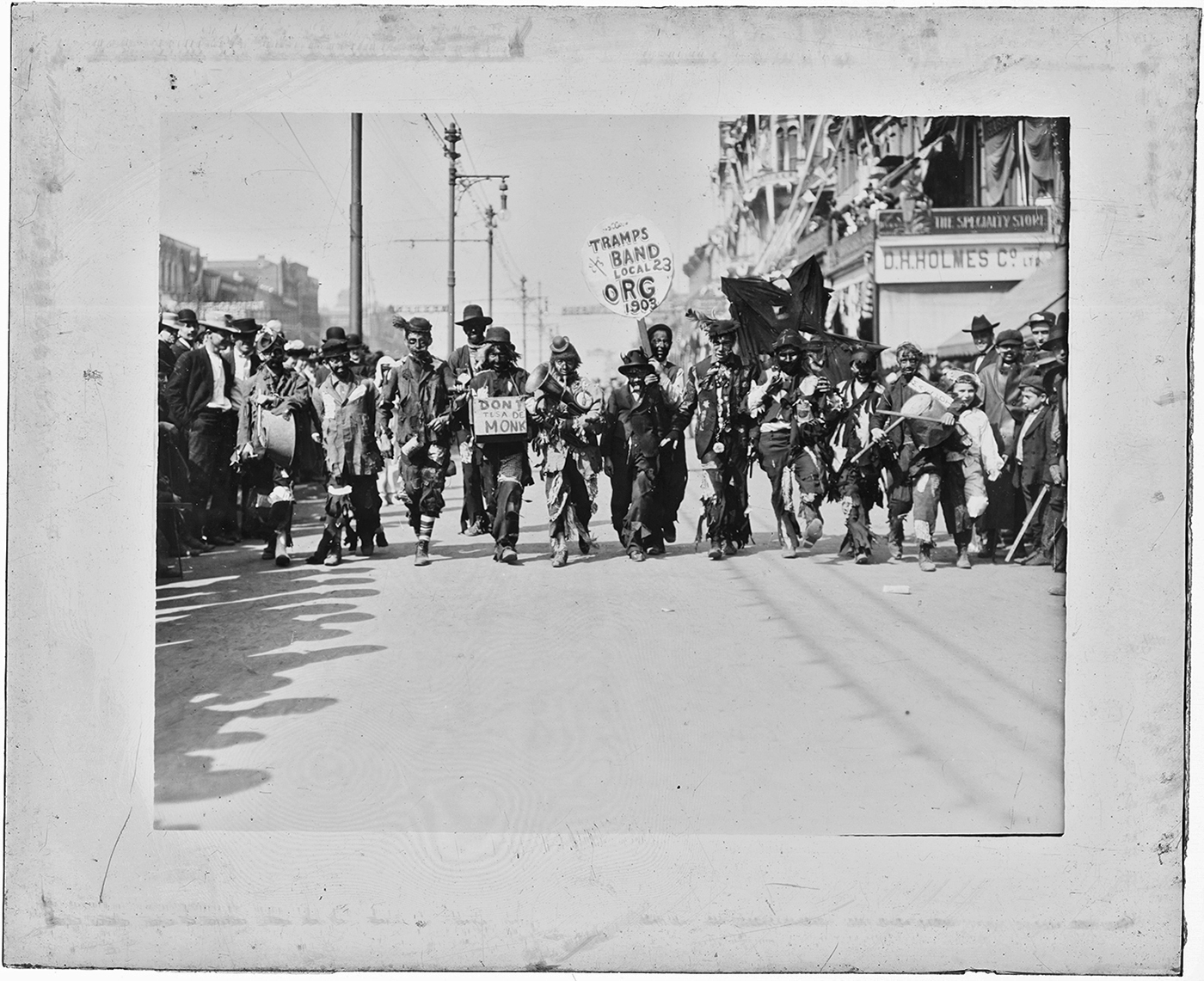
Figure 41: Tramps, Mardi Gras, New Orleans, 1907. The Historical New Orleans Collection (THNOC 1981.261.58, 12.2.1907).
On Mardi Gras Day 1907—February 12—the Tramps Band Local 23 grinned into a camera, wearing torn suits, off-kilter hats (some far too small), and faces variously painted or masked. As they made their way through the streets of New Orleans, they likely played rough music for the onlookers who appear at the edge of the photograph. This ragged, lumpen-looking yet neatly lined-up crew also denotes just how embedded highly gendered forms of blackface were in Mardi Gras around 1900. The street scene features all kinds of minstrel-like and related face-masking: fake beards, blackened eyes, painted faces, veils, and soot smears. In the context of US segregation, it shows how blackface functioned as the comic mask of the precarious—linked, in Achille Mbembe’s terms, to the modern Black conditionof bare labor, the condition of being made into a nonperson.449 A cardboard sign warning not to provoke the monkey links blackface to zoomorphic tropes and taps into the racialized visual regime of the time. The cockeyed hats, torn suits, and metal buckets used as makeshift instruments—hallmarks of this band—also signal connections to minstrel shows. Jim Crow—long associated with the plantation system and the figure of the runaway slave—appears to be collectively recast as a masculinist gang persona allegorizing the segregationist regime now bearing his name.450
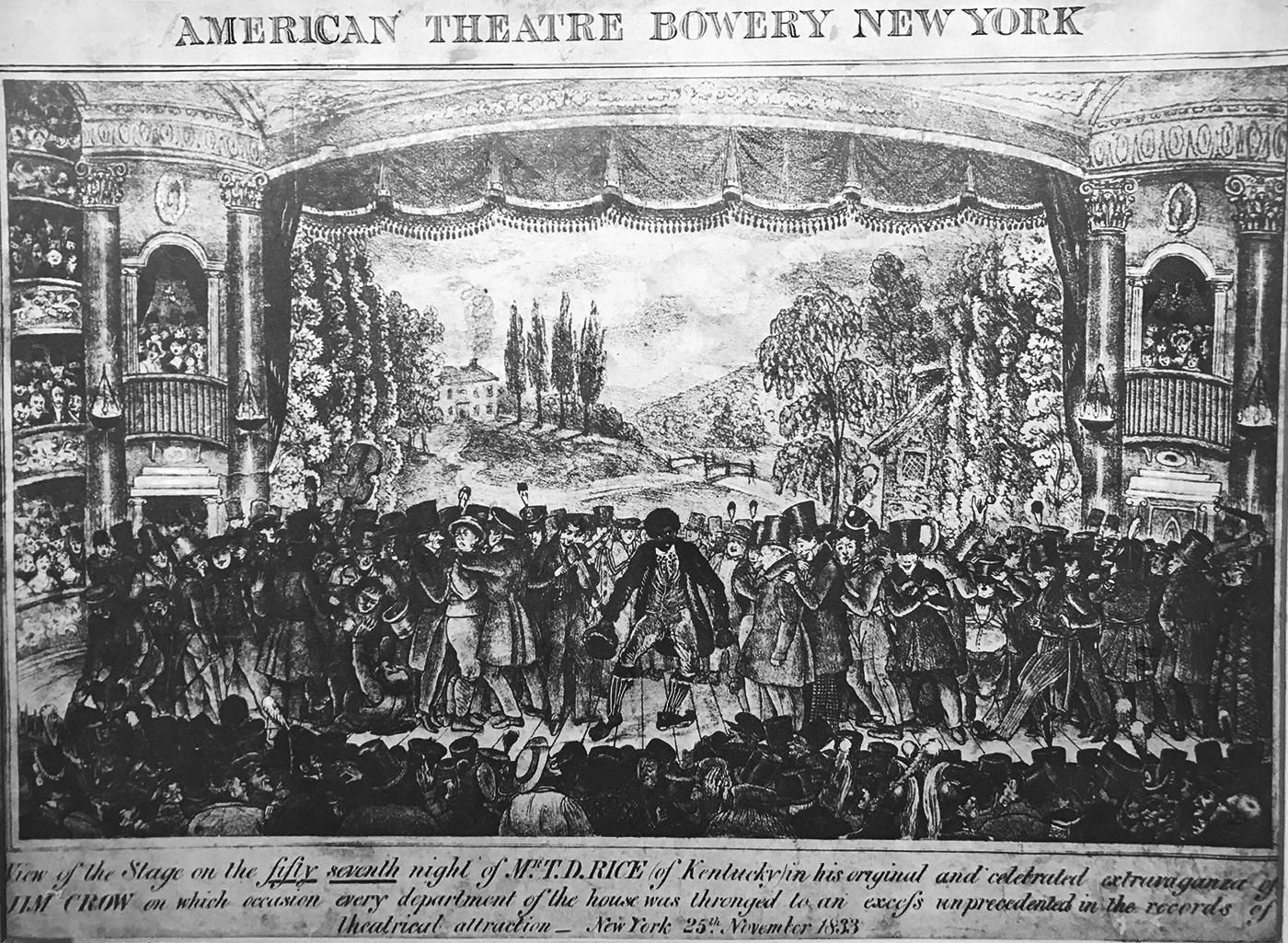
Abbildung 42: T. D. Rice as Jim Crow, with spectators present on the stage of the American Theatre, Bowery, New York, 1833. Harvard Theatre Collection on Blackface Minstrelsy, 1833—1906 (Houghton Library).
In the 1830s, decades before slavery was abolished, T. D. Rice had introduced Jim Crow as a new figure in popular theater. His black-painted persona of a drifting tramp had served as both a trickster figure and a projection screen for a predominantly white audience that was first largely industrial working-class, then increasingly bourgeois—mainly in the urban North, along the border, and eventually overseas. This figure had stood in for an imagined elsewhere—one that invoked the terror of enslavement, but reframed it in carnivalesque terms and infused the supposedly preindustrial setting with nostalgia. Rice’s burnt cork makeup had not yet been grotesquely exaggerated, however, unlike what would later characterize the post-Reconstruction minstrel shows of an era that inherited his character’s name.451 In the Tramps photo, the rowdy, in-between characteristics of this syncopated singer-dancer gained a survie—appearing as “too slippery … to police,”452 to quote Walter Lhamon. The Tramps somehow pulled back the choral, uncontainable, aesthetics of the comic figure, echoing an 1833 image of Jim Crow in the American Theatre on New York’s Bowery, where Rice dances in the middle of a throng onstage. But the 1907 photo of the Tramps gave Jim Crow a collective afterlife in the streets at a time when his name had already come to signify a new form of racist structural violence. This image no longer presented an imagined elsewhere—however problematic—of rural rebellion staged in the city; it marshaled a lineup of carnival revelers in blackface, already loaded with racist stereotypes, situated within a precise historical and geographic context, as the photo’s provenance shows.
Filed under “Tramps Band Local 23,” it entered The Historical New Orleans Collection with no added context. But indirectly, it signals complicity. On the fourth page of the Daily Picayune from February 13, 1907—Ash Wednesday—a photo by C. C. Cook appears at the bottom right.453 Taken from another angle, it again shows the Tramps Band Local 23 walking in the Rex Parade. Respectively, this rowdy, street-claiming gang turns out to be an entourage for the dominant carnival. Like Milton’s “roughly-headed monsters,”454 the Tramps can be read as escorts to the white Carnival King. However bizarre their outfits, they still marched in step along the official routes of a segregated Mardi Gras:
When the sun rose and shone red and then bright he saw various queer-costumed people, little people and big people moving about, dancing and making merry, even as the day began, and as the day advanced their number increased until the whole city seemed turned into a clown’s show, and everywhere there was grotesque figures, groups of figures and queer bands and single musical preparations, making the music that is typical of the Carnival when it is at its height on Mardi Gras.
… St. Charles Avenue, above Calliope, where the parade appeared at 11 o’clock, was thronged with people, including all classes, old and young, men and women and children, maids with babies, fathers and mothers carrying and wheeling their little ones. Every race and nationality of the homogeneous population of the city, mingled with the queer masked figures whose race and nationality, sex and visages all were concealed, and only the general jollity denoted that they also belonged to the happy family of Rex.455
That Mardi Gras, the Daily Picayune’s front page commented on the “queer-costumed people” mingling with “the homogeneous population of the city”—likely with irony, since the ostensibly happy family of Rex and the “homogeneous population of the city” officially excluded the people of the back streets, except in the form of grotesque effigies during the Jim Crow era. The choral, plebeian underside of the Rex Parade captured in the Tramps photo may thus point to a specific function of blackface at the time: negotiating a new idea of white male supremacy. Popular and everyday culture—carnival included—helped stabilize a cross-class pigmentocracy whose ideological veneer, the claim of a homogeneous population, was in fact a racist fantasy.
It was precisely after abolition that blackface took on a distinctly political role. By citing the tramp persona reminiscent of T. D. Rice’s Jim Crow, at a time when that figure in New Orleans had become shorthand for segregation, the masks worn by this male crew had become markers of possible complicity with the modernized racist order of their day. Whoever these men were, the photo gives a glimpse into how the name of a comic carnival figure came, under modern conditions, to stand in for an age of political backlash. Reading the image accordingly offers a path toward historicizing “Jim Crow”—a way to question the kinds of linear projections that treat racialized drag as fixed, as timeless across differing contexts. Hence I would suggest attending to the specific ways modes of drag are cited and the performative transpositions this entails. The Tramps in racialized drag of 1903, viewed in context of the afterlife of terror in segregationist violence, thus already allegorize a kind of new Jim Crow.
Endnotes
-
On the changed media culture of self-publication and the transformation of mimesis, see Balke, Mimesis, 2018: 228—229. On the role of blackface citations, see also Köppert, “Digital Blackface,” 2025.↩︎
-
On Jake Angeli, see https://people.com/politics/justice-dept-walks-back-claim-capitol-rioters-sought-to-capture-assassinate-politicians/, accessed September 24, 2024. ↩︎
-
Costumes in the German-speaking context also include Perchten masks. See preliminary considerations on the protests against government policies to contain COVID-19 in Affekt und Gefolgschaft, 2023; Populismus und Kritik, 2024. See also Nachtwey et al., Corona-Proteste, 2020; Amlinger and Nachtwey, Gekränkte Freiheit, 2022: 247—297 (with reference to Adorno’s studies on the authoritarian character, written in the 1940s and published in English in 1950, German version: 1995); Reichardt, Die Misstrauensgemeinschaft, 2021.↩︎
-
See David Hernandez, “Man Wears KKK Hood While Grocery Shopping,” Los Angeles Times, May 4, 2020, https://www.latimes.com/california/story/2020-05-04/man-kkk-hood-in-santee-san-diego-sparks-outrage, accessed September 24, 2024; https://www.gannett-cdn.com/presto/2020/05/05/USAT/c35db4ec-989e-44da-b9b9-0214718c2f8b-Screen_Shot_2020-05-05_at_5.38.20_AM.png?crop=2205,1240,x0,y0&width=2205&height=1240&format=pjpg&auto=webp, accessed September 22, 2022; Sebastian Haak, “Hassbotschaft unter Mundschutz. Rassistischer Vorfall in einem Supermarkt in Südthüringen,” Neues Deutschland, May 5, 2020: 5.↩︎
-
On resentful forms of mimesis and their connection to today’s media structure, see Vogl, Capital and Ressentiment, 2022; regarding gender politics, Nagle, Kill All Normies, 2017. On corresponding performances of masculinity and their social causes, see for the US—from a prepandemic perspective—Hochschild, Strangers in Their Own Land, 2016 and Kimmel, Angry White Men, 2013.↩︎
-
On Trumpism, see Koch et al., Great Disruptor, 2020.↩︎
-
For the corresponding reformulation of temporal drag see Lott, “Blackface from Time to Time,” 2025.↩︎
-
Bakhtin, Rabelais, 1984, 111. Bakhtin’s view perhaps overly romanticized carnival also in reaction to Stalinism. See, by contrast, Mbembe: “Bakhtin’s error was to attribute these practices to the dominated. But the production of the burlesque is not specific to this group.” Mbembe, Postcolony, 2001, 133. For a critique of Mbembe’s critique see again Crichlow and Northover, Globalization, 2009, 109.↩︎
-
For a critique of vigilantism and its gendering, see Dorlin, Self-Defense, 2022, 82—110.↩︎
-
On the differing and shifting use of creole as a designation for a population group in New Orleans, see the second chapter of Lief, Staging New Orleans, 2011, 14—32; see also Regis, Local, 2019. I refer here instead to Glissant’s understanding of creolization processes, that is, the interweaving of cultural techniques (Introduction, 1996; Poétique de la relation, 1990/Poetics of Relation, 1997). On second lining see Regis, “Blackness,” 2001; “Second Lines,” 1999.↩︎
-
This is Dinshaw’s formulation in Dinshaw et al., “Theorizing Queer Temporalities,” 2007, 178; see also Dinshaw, Getting Medieval, 1999, 3.↩︎
-
Frantz, Ku-Klux, 2015, 27. On the retrospective self-mythologization of the “weird potency” of this previously meaningless designation and the transformation of a loose group in search of entertainment into a “band of Regulators,” see the Klan members Lester and Wilson, Ku Klux Klan, 1905: 56, 73.↩︎
-
On the rhetorical “face of speech,” see Menke, Prosopoiia, 2000.↩︎
-
The Pulaski Citizen, June 7, 1867: 3; https://chroniclingamerica.loc.gov/lccn/sn85033964/1867-06-07/ed-1/seq-3/, accessed September 11, 2024 (all spelling as in the original); see Frantz, Ku-Klux, 2015: 51.↩︎
-
On the significance of whistles, see, from a Klan perspective, Lester and Wilson, Ku Klux Klan, 1905: 59. On the modernity of such sounds, see Lhamon, Raising Cain, 1998: 110.↩︎
-
“Kuklux” is the designation in Lester and Wilson, Ku Klux Klan, 1905: 47. For the history of Klan masks see Frantz, “Midnight Rangers,” 2005; Ku-Klux, 2015; Kinney, Hood, 2016; “How the Klan Got Its Hoods,” 2016, https://newrepublic.com/article/127242/klan-got-hood, accessed September 24, 2024. On the proximity of Klan hoods and carnivalesque appearances in the context of Mardi Gras see Godet, “Multiple Representations,” 2017: 237. That said, Klan hoods—which in the United States paradigmatically signify WASP cultural attributes—recall Catholic penitential robes from southern Europe and thus also testify to the fact that the Klan itself is a creolized phenomenon. ↩︎
-
For the history of the Civil War in the United States and its aftereffects see Masur, U.S. Civil War, 2020; Guelzo, Fateful Lightning, 2012.↩︎
-
On the double character of the German “vexieren” as a term meaning both “playing hide-and-seek” and “vexing,” see Etymologisches Wörterbuch des Deutschen, accessed September 11, 2024.↩︎
-
On the Civil Rights Trail and the privately funded lynching memorial in Montgomery see https://museumandmemorial.eji.org/memorial; https://www.nytimes.com/2018/04/25/us/lynching-memorial-alabama.html, accessed September 24, 2024. Canetti describes the relationship between mob and lynching terror: “In addition there remains to this day one unashamedly primitive pack—the pack which operates under the name of lynch law. The word is as shameless as the thing, for what actually happens is a negation of law. The victim is not thought worthy of it; he perishes like an animal, with none of the forms usual amongst men.” See Crowds and Power, 1973, 117. In German: “Eine unverschämte Art von Meute hat man noch heute in jedem Akt von Lynch-Justiz vor sich. Das Wort ist so unverschämt wie die Sache, denn es geht um eine Aufhebung der Justiz. Der Beschuldigte wird ihrer nicht für wert gehalten. Er soll ohne alle Formen, die für Menschen üblich sind, umkommen wie ein Tier.” Masse und Macht, 1980: 130. ↩︎
-
On the visual politics of lynchings, whose victims are 99 percent men, see Allen and Littlefield, Without Sanctuary, 2000: https://archive.org/details/without_xxx_2000_00_7106, accessed September 12, 2024; Apel, Imagery of Lynching, 2004; Young, “The Black Body,” 2005; on the visual history of violence and the photographs marked by modes of respectability responding to it see also Därmann, Undienlichkeit, 2020: 182—205.↩︎
-
For a respective reformulation of Marx’s notion of primitive accumulation in the context of colonial critique, see the research project of Katja Diefenbach, Ruth Sonderegger, and Pablo Valdivia de Orozco, who organized an international conference on Belligerent Accumulation at the European University Viadrina, Frankfurt Oder, in May 2024: https://accumulation-race-aesthetics.org/belligerent-accumulation/; https://accumulation-race-aesthetics.org/research-statement/, accessed August 13, 2025.↩︎
-
See Frantz, Ku-Klux, 2015: 33; “Midnight Rangers,” 2005: 812; https://external-content.duckduckgo.com/iu/?u=https%3A%2F%2Ftse1.mm.bing.net%2Fth%3Fid%3DOIP.XdwGTN8TaTGeQy_wCpaUawHaEn%26pid%3DApi&f=1&ipt=28b716b0acf7139d9b6dfa7269910355fc65c0fbaebb251fb0a9a2fca6817171&ipo=images, accessed September 11, 2024. ↩︎
-
On the topicality of the postfactual, see Gess, Halbwahrheiten, 2021. Tavia Nyong’o incisively notes: “In times like these, fabulationality is itself due for a certain degree of redress.” See Afro-Fabulations, 2018: 21. On self-reflexive constellations of Afro-fabulations, see Heidenreich, “Whose Portrait?” 2025.↩︎
-
Quoted from an article under the heading “KuKlux Klan” in The Pulaski Citizen, April 5, 1867. ↩︎
-
The Pulaski Citizen, March 29, 1867: 3.↩︎
-
On the relationship between Perchten and St. Nicholas plays, see Kammerhofer-Aggermann, “Sankt Nikolaus,” 2002.↩︎
-
Davis, “Parades and Power,” 1988; on the intertwining of blackface and gender bending in the history of the Philadelphia Mummers Parade, see DuComb, “The Wenches,” 2018.↩︎
-
For the “continued existence of ancient European folk theatricals well into nineteenth-century America,” and the close connection of Klan, minstrelsy, and mumming plays, see Cockrell, Demons, 1997: xiii—xiv; 33, 46, 56.↩︎
-
Frantz, Ku-Klux, 2015: 78.↩︎
-
On the differentiated spectrum of meanings of blackened faces with regard to the Klan in the context of Reconstruction, see Frantz, “Reading the Blackened Faces,” in Facing Drag, 2025. See also Cockrell on “nonracial folk blackface masking” in Demons, 1997: 52; on “Black Gothic,” see Smith-Rosenberg, Violent Empire, 2010: 413. The play with references is also a hallmark of early blackface acts and is adopted by the Klan; on T. D. Rice’s reply signed with Jim Crow to a newspaper review, see Annuß, “Blackface,” 2014.↩︎
-
Mbembe, On the Postcolony, 2001: 102.↩︎
-
On the Jim Crow era and segregation laws, see A. Reed, The South, 2022; on the corresponding “burdened subject no longer enslaved, but not yet free,” see Hartman, Scenes of Subjection, 1997: 206. On the concept of petty apartheid, see Lalu, Undoing Apartheid, 2022. ↩︎
-
As Errol Laborde, contemporary chronicler of the New Orleanian Mardi Gras in the tradition of Perry Young (1969), writes in Mardi Gras, 2013: 81, “With lineage that traces back to Mobile and farther back to the Mummers in Philadelphia, what evolved in New Orleans is the classic American Carnival, which, like many things American, has a touch of European afterlife.” On the colonial prehistory of Mardi Gras beginning around 1700, cf., however, Gill, Lords of Misrule, 1997: 27—44; Godet, From Anger to Joy, 2024; Playing with Race, 2016: 258—260; Sublette, The World, 2008.↩︎
-
On the political history of the color line in New Orleans and its caste system before segregation, see Powell, The Accidental City, 2012; on the three classifications up to the mid-nineteenth century—comparable to Cape Town—see Brook, The Accident of Color, 2019. See also Vidal, Louisiana, 2014; Caribbean New Orleans, 2019. On the exemplary role of New Orleans as a port city in the formation of diasporic communities and the specific function of carnival, see Abrahams, “Conflict Displays,” 2017. With regard to demographic developments and Mardi Gras, see also Gotham, “Authentic New Orleans,” 2007: 22—44; on gender history, the segregation of marriages (1894), and public life (1896), as well as prostitution, see Vaz, Baby Dolls, 2013: 18—19; Roach, Cities, 1996: 224—233. To again quote Gill, Lords of Misrule, 1997: 143, “The few remaining pockets of interracial association disappeared from New Orleans in the 1880s.” On the historical geography of New Orleans, see Campanella, Bienville’s Dilemma, 2008; Cityscapes of New Orleans, 2017.↩︎
-
On the contemporary revolutionization of trade, industrialization, and mobility from a transregional perspective, see Smith-Rosenberg, The Violent Empire, 2010.↩︎
-
On the family resemblance of the creolized port cities Cape Town and New Orleans, see Fredrickson, White Supremacy, 1981: 258; Saunders, “Cape Town and New Orleans,” 2000. With regard to the second half of the nineteenth century in both cities, Bickford-Smith points out “social ‘integration’” as a “lower-class phenomenon”; Ethnic Pride, 1995: 37.↩︎
-
On the Cowbellion de Rakin Society, a carnivalesque and secretive fraternity founded in the 1830s in Mobile, about 150 miles east of New Orleans, with connections to the German carnival of Pennsylvania and from which Comus emerged, see Cockrell, Demons, 1997: 36—37; on Comus and its relation to the New Orleans vigilantes and the Klan, see also Gill, Lords of Misrule, 1997: 48, 77—108.↩︎
-
On the history of mobile platforms—wagons, floats, caravans, and the like—functioning as tribunes in Europe, see Heer, Vom Mummenschanz, 1986: 69.↩︎
-
On the Milton quote as an attempt “to accumulate cultural capital to complement their material success,” see Roach, Cities, 1996: 258.↩︎
-
Milton, Comus, 1921: 10; https://archive.org/details/comuswithintrodn00miltuoft/page/10/mode/2up?ref=ol↩︎
-
On the use of blackface by Comus and later also by Rex, see Felipe Smith, “Things,” 2013: 25—26; revised reprint in Adams and Sakakeeny, Remaking New Orleans, 2019.↩︎
-
See Eco, “Frames,” 1984.↩︎
-
See Gill, Lords of Misrule, 1997: 7. ↩︎
-
On the White League, see Gill, Lords of Misrule, 1997: 106—122; on the 1874 coup and the involvement of Comus members, see also Roach, Cities, 1996: 261; on the Battle of Liberty Place, the 1874 coup by the White League against Reconstruction, see Gotham, “Authentic New Orleans,” 2007: 39.↩︎
-
See Gill, Lords of Misrule, 1997: 36; Young, The Mistick Krewe, 1969: 49—50. On corresponding medieval European carnival battles and their afterlife, see Mauldin’s introduction to ¡Carnival!, 2004: 17. In the Alpine and Tyrolean regions, there are complementary forms of performance involving coal-dust cudgels and soot-smearers.↩︎
-
Gill, Lords of Misrule, 1997: 280.↩︎
-
On the statuary aesthetics of “elevated carnival,” see Young, The Mistick Krewe, 1969: 75.↩︎
-
On the first King Rex, Lewis Salomon, a banker from a Jewish family who converted to Catholicism, see Laborde, Mardi Gras, 2013: 33—34.↩︎
-
On the Meeting of the Courts, which is broadcast in full on local television every year, see Gill, Lords of Misrule, 1997: 11, 13; on its history: 137. See, most recently, https://www.youtube.com/watch?v=46RclbkevBU, accessed September 24, 2024. The white Comus mask also faintly recalls the modern signature hoods of the Ku Klux Klan with its eye holes; on the mask repertoire, see the introduction by Adams and Sakakeeny to Remaking New Orleans, 2019: 16. On the second Klan, founded in 1915, and its visual media politics, see Harcourt, Ku Klux Kulture, 2019.↩︎
-
A photo of the 2022 Meeting of the Courts by David Erath, showing the unsettling masking of Comus, can be found in Nell Nolan’s article “Photos: Rex and Comus Balls and Meeting of the Courts 2022”; https://www.nola.com/multimedia/photos/photos-rex-and-comus-balls-and-meeting-of-the-courts-2022/collection_248d8fee-9b5f-11ec-8c0f-1771c2d8ad3d.html#16; accessed September 24, 2024. It was not possible to obtain current images for this book. A former standard photographer, for example, first wanted to check whether my text aligned with the interests of her “clients.”↩︎
-
Times Democrat, February 25, 1903: 7. The newspaper merged about ten years later with the Daily Picayune, which still exists and maintained coverage during the Katrina disaster in 2005.↩︎
-
See Leathem, Gender and Mardi Gras, 1994: 59.↩︎
-
The phrase is spoken by the Lady in Milton, Comus, 1921: 28.↩︎
-
On the class-specific taboo against wearing masks that applied to white women in the nineteenth century, see Leathem, Gender and Mardi Gras, 1994: 52; see also Young on the nighttime mask ban after the Civil War and the preceding regulations targeting ball culture from the eighteenth and early nineteenth centuries into the 1830s; The Mistick Krewe, 1969: 87, 17—26. On the racist history of mask bans, which began around 1730 under Spanish rule with the Code Noirin force at the time, see Lief and McCusker, Jockomo, 2019: 81—82. See the local Code Noir at https://www.blackpast.org/african-american-history/louisianas-code-noir-1724/, accessed September 11, 2024. On
the Code Noir, introduced in Louisiana in 1724 and in force until the territory was purchased by the United States in 1803—which regulated the status of Blacks and free Blacks, banned intergroup marriage, prohibited enslaved gatherings, enforced Catholicism, and ultimately also excluded Jews—see Palmer, Through the Codes Darkly, 2012. See also Midlo Hall, Africans in Louisiana, 1992. Linebaugh and Rediker point out that the Code Noir did not apply on pirate ships. The transatlantic “hydrarchy,” as they call it, which mixed cultural practices from around the world, functioned more democratically than the dominant conditions on land; the mobile underclass thus became a threat to the slave trade; see Hydra, 2000: 162—167. On pirate cultures and their relation to queer lives, see also Halberstam, Queer Art of Failure, 2011: 18—23.↩︎ -
On the Darwin quote, see Roach, Cities, 1996: 261—269; Gill, Lords of Misrule, 1997: 101—105.↩︎
-
On the persistence of patriarchal ball culture, see also Rebecca Snedeker’s documentary film By Invitation Only, 2006.↩︎
-
Roach, Cities, 1996: 267. By contrast, see Laborde: “the debutante tradition, which at its primal level is as innocent as a proud father honoring his daughter … such traditions involve old-family lineages and customs and are quite healthy for a community.” Mardi Gras, 2013: 61. On the afterlife of killability, see Sharpe, In the Wake, 2016.↩︎
-
Leathem, Gender and Mardi Gras, 1994: 107. On the affirmative function of drag in the context of the elite Mardi Gras, see Ryan, Women in Public, 1990: 29.↩︎
-
See Alexander, New Jim Crow, 2012. ↩︎
-
Deleuze and Guattari, A Thousand Plateaus, 1987: 358.↩︎
-
Frantz, “Midnight Rangers,” 2005: 836.↩︎
-
Deleuze and Guattari, A Thousand Plateaus, 1987: 379.↩︎
-
“The transnationalization of the Black condition was therefore a constitutive moment for modernity, with the Atlantic serving as its incubator”; see Mbembe, Critique of Black Reason, 2017: 15. According to Mbembe, the invention of le nègre (38), the personification of the conditio nigra, is not a prerequisite but a response to the commercialization of the triangular trade; the figure was only biologized in the nineteenth century and, in the context of today’s genome-oriented thinking, is experiencing a comeback (39). For critiques of biological thinking and of notions of indigeneity, see also Erasmus, Race Otherwise, 2017; “Who Was Here First?,” 2020. ↩︎
-
On the connection between loose assemblages and comic figures, see Menke, Der komische Chor, 2023. See also Kirsch on the related nomadism of chorus and Harlekin, Chor-Denken, 2020: 505.↩︎
-
See Annuß, “Blackface,” 2014.↩︎
-
Lhamon, Jump Jim Crow, 2003: 23.↩︎
-
My thanks for this information to Heather Green from THNOC.↩︎
-
Milton, Comus, 1921: 28.↩︎
-
“Rex Entertains the Nations with Pageant and Reception,” front page of the Daily Picayune, Ash Wednesday, February 13, 1907.↩︎