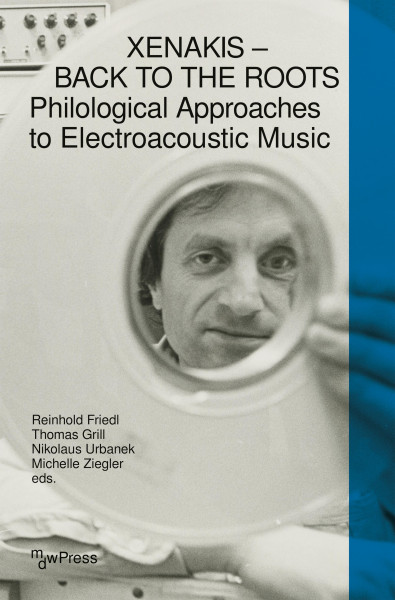
Xenakis’s Œuvre as a Theoretical Challenge
Nikolaus Urbanek 
How to cite
How to cite
Outline
Outline

Even though the catalogue of electroacoustic works represents only a small part of Xenakis’s extensive œuvre, it is nonetheless a very central group of works, to which eminent music-historical significance must be attributed in various respects.1 As he was not bound by instrumental limitations and traditional performance conventions, Xenakis had the opportunity to develop creative ideas and musical concepts with great radicalism. Not least against this background, the discussion of Xenakis’s electroacoustic works remains an extremely productive challenge in several respects. On the one hand, the electroacoustic works of Xenakis reflect in their chronological progression central situations of a history of electroacoustic music that essentially also refers to developments in the field of (studio) technology. On the other hand, the musical, medial and material heterogeneity – ranging from tape compositions with the inclusion of pre-existing acoustic and musical material, to works of ‘musique mixte’ (a combination of tape music with instrumental music), to the great multimedia ‘ spectacles’ that allow space, light and music to interact, to graphically conceived computer music – leads to considerable differences in the given compositional practices – to which the surviving sources, at least, bear eloquent witness.
Back to the Roots? Towards a Philology of Electroacoustic Music
But what do we actually hear when listening to the electroacoustic music of Iannis Xenakis? This challenging question marks the starting point of Reinhold Friedl’s dissertation Towards a Philology of Electroacoustic Music – Xenakis’s Tape Music as Paradigm (cf. Friedl 2019). It is not meant to be a rhetorical question but deals, rather, with a remarkably delicate issue in a very concrete sense: As Friedl has extensively shown, commercially available versions of some works and even official performance versions contain major faults. These faults include the use of incorrect sample rates in the transfer of individual versions, fundamental errors in digitisation (for example, the performance version of La Légende d’Eer was digitised backwards) or the absence of individual tracks or entire passages, etc. (cf. Friedl 2012, 2015, 2019). Friedl develops his diagnosis starting from the obvious irritation of basic observations (e.g., different lengths of different versions) and continues this in the analysis and comparison of diverse sources such as master tapes, official rental material for performance as well as commercially available versions on CD. Finally, the reflections gained from the acoustic sources are discussed on the basis of further workshop materials (sketches, notes on technical conditions, scores, but also letters and ego documents among others), so that Friedl plausibly explains the process of creation of selected works on the basis of the workshop materials and in locating the individual (textual) sources stemmatologically within this. On the basis of his comprehensive research, Friedl succeeds in making clear how profitable it can be to go back to the sources when researching electroacoustic music; this is indispensable in order to be able to secure the foundations, to develop an understanding that there may be not only one original but multiple manifestations of a single work, to identify and eliminate existing errors – ultimately with a view to publishing a critical edition of the works.2
But when do we know that something is an error at all? Symptomatic in this context is Gérard Pape’s response to Friedl’s error diagnoses with regard to the transferring of La Légende d’Eer:
Why does Friedl call it a ‘fault’ that the test tones were left in? (Here I mean in the new master tape that Salabert has published, not in the Mode recording, which does not include these tones.) If they were included on the master tape, Xenakis must have put them there for a reason. In any case, it was quite typical to include such tones for performance reasons at the time (1970s). Anyone that knows Xenakis’ music, even a little, wouldn’t make the mistake to think the test tones are part of his music. (Pape 2015: 123)
Regardless of how the question regarding the error is ultimately to be decided, the strategy of Pape’s argumentation is of considerable interest at this point: It makes clear that the diagnosis of what can be regarded as an error at all can only be made plausible on the basis of intensive philological research, which also refers to theoretical, historical, aesthetic and compositional contexts. Pape’s argumentation is by no means based exclusively on source findings, but also on the intentions (of the composer or the publisher) and the customary practices of the respective environment at the time of the composition. This shows that the first thing to be clarified is whether a certain moment that is assumed to be defective is to be evaluated in the context of “common language usage”, as a remarkable “compositional audacity” or simply as a “textual error” in need of correction (Urbanek 2013: 160f.). The answer to the question of musical error therefore does not result solely from the comparison and analysis of preserved sources3 – the recourse to the preserved sources is a necessary condition, but by no means already a sufficient one. At this point, musical philology comes into play as the scientific discipline that deals with the issue of the error in a methodologically assured manner and develops criteria for higher textual criticism, which ultimately presupposes an interpretation of the sources on the basis of the inclusion of the respective context (cf. Feder 1987; Urbanek 2013; Appel and Emans 2017).
However, it must be noted that a philology of electroacoustic music has not yet been developed to the extent that can be claimed for the general philology of music. Since fundamental questions present themselves differently with regard to electroacoustic music, this also applies to terminological issues and the relation to established musical philology. The endeavour of developing a philology of electroacoustic music can and must take its starting point in the specificity of the sources (but should go beyond that): An essential point in which a specific philology of electroacoustic music will complement the general debates of musical philology concerns the status, function and relevance of the significant sources within the creative processes. Against this backdrop Zattra elaborates
that sources, or ‘texts’ as philologists call them, have a fundamental role for the study of computer music. This type of research already shows an important background of studies, that is the textual criticism, or the philology of music. Musicological investigation of electroacoustic music should start from that and rethink philological methodologies in the light of what an electroacoustic music source could be. (Zattra 2006: 1)
In his discussion of the source situation of La Légende d’Eer, Friedl refers to the specific heterogeneity of sources that must necessarily be included in the analysis of the creative process: “Texts, graphic drafts, scores, realisation sketches from the studio, et cetera, must be taken into account just as much as material tapes, multitrack versions, stereo reductions for CD release, et cetera”4 (Friedl 2012: 33). This is what Zattra systematises in her discussion of the concept of musical sources in the field of creative processes of electroacoustic music:
Nevertheless the text within electroacoustic music is not necessarily a visible or symbolic trace. In the computer music[5] field a witness can indifferently be: 1) the audio source, that is the tape where the computation is analogically converted, or the CD, the mini disc, the memory of the computer; 2) the data storage device containing the digital data and algorithms for any process of synthesis, transformation, spatialization, automatic composition; 3) printed digital scores; 4) traditional scores in the case of mixed music; 5) different sketches by the author; 6) articles dedicated to the piece; 7) mental texts. (Zattra 2006: 2)
Considering the special status of musical sources in the field of electroacoustic music this systematisation is an important starting point. However, the effort to establish a philology of electroacoustic music cannot stop here. In her contribution to this volume, Michelle Ziegler points out a fundamental difference between sources on paper and sources on tape, which is also eminently significant for the development of a philology of electroacoustic music and has to be taken into account: Unlike notations on paper, both production and reception of sonic recordings always require a “technical mediator”. Against this background, Ziegler argues that due to the “challenges of mixed media sources in sketch studies” the philology of electroacoustic music “requires mixed methods and an expansion of traditional sketch studies” (cf. the contribution by Michelle Ziegler in this volume).
With regard to the specific situation of electroacoustic music, the mediality and materiality of the technical equipment of the studios is therefore of particular importance. The necessary inclusion of technical development, i.e., the special consideration of media history, leads to further points worth considering, as Friedl points out:
It is necessary to try to set up a genesis of the production process in respect of the media history, including the distinction between technical and musical signals, considering also text sources and oral history, and last but not least the visualization of the sound files. Also the role of the edition houses is much more important than for example in literature, because of the different legal situation, the access to the archives and the economic difference, a smaller market and a more expensive production. The media history has to be considered especially as regards the media compatibilities, technical conventions such as colours indicating the velocity a tape has to be played at, etc. (Friedl 2015: 122)
The analysis and critique of the preserved sources, which must necessarily be extended to develop a philology of electroacoustic music, raise fundamental questions that touch on far-reaching theoretical and methodological issues:
- Writing Practices: What is the specific role of the different practices of sketching, drawing, recording, electronic editing, manipulation, and programming in the creative processes of electroacoustic composing? In what sense can we speak of practices of ‘writing’ here in an emphatic sense?
- Writing Systems: What changes with the use of recording or writing systems that allow the direct fixation and manipulation of sound on tapes or other media? What are the theoretical consequences of machines (‘technical mediators’) being significantly involved in production and reproduction processes?
- Writing Spaces: To what extent does the space of composing – for example the electronic studio – play an essential role in the creative process?
- Performances: In what sense can we speak of a ‘score’, ‘script’ or ‘text’ in regard to electroacoustic works? To phrase this question slightly differently: Is there a text that is read in order to be sonically realised in a performance? What are the consequences for the performance of electroacoustic music?
Scenes of Musical Writing
The fact that ‘writing’ electroacoustic music posed a new challenge for composers in the middle of the last century is due not least to the fundamental developments in the technical and media fields, which provide new possibilities and evoke new practices of composing. Elena Minetti describes this in her dissertation Schrift als Werkzeug. Schriftbildliche Operativität in Kompositionsprozessen früher musique mixte (1949–1959) as a change in ‘scenes of musical writing’ (cf. Minetti 2023; for a theorisation of the term ‘writing scene’ cf. Campe 1991 and, regarding the field of music, more recently also Celestini and Lutz 2023). As already noted above, the changes in the writing scene of electroacoustic music touch on fundamental issues. First of all, it should be noted that the writing scene of composing electroacoustic music takes place in other spaces: The usual composer’s workshop (be it the usual study room or a ‘Komponierhäuschen’ as Gustav Mahler had during his summer vacations) is joined by the electronic studio as an important place for creative work. Usually, this studio is not situated in the realm of the private but in public spaces such as radio stations or universities. In addition, the practices of composing are also changing significantly. Not only does the use of other tools (tapes, microphones, computers) lead to collaborative forms of composing in the electronic studio, in which sound engineers, for example, can play an eminent role, but it also leads to changes in the actions and practices relevant for composing. Thus, the question arises whether one can or should speak of writing in the sense of ‘inscribing’ (in a way that sufficiently stable material traces are made by writing instruments on a writing media) with regard to the work with sound recordings. Furthermore, a fundamental change can be observed in relation to the material ‘products’ of the compositional creative process: The ‘musical text’ of electroacoustic music does not exist primarily in the form of scores written on paper but in recordings of the sound itself. This has implication for the status of the text, since the question of original and copy arises in a different way when one thinks about versions and multiple sonic formats (4-channel, 8-channel, stereo, etc.), as they were often produced for specific spaces and performances settings. All in all, fundamental questions concerning the relationship between text, recording and performance are at stake.
In numerous conversations and interviews Xenakis addresses fundamental questions of notating, writing and fixing music. Thus, he answers Bálint Andras Varga’s question as to how he arrives at melodic figures with a view to the inadequacies of traditional notation:
The drawing and thinking of the sound-image go hand in hand, the two can’t be separated. It would be silly to leave out of account, when drawing, what will sound in reality. We have also to be able to find on paper the visual equivalent of the musical idea. Any changes and modifications can then be carried out on the drawing itself. This feedback has to operate all the time. What advantage do arborescence have over traditional notation? If I use traditional notation I lose the continuity. Let us say that I have a bush of three lines that stem from the same root. If I map it in the Cartesian system of coordinates I have before my eyes the picture of what it sounds like. If I were to write the same on staves I would have to break it down into many staves and continuity would be lost. The whole thing would be much more complicated. […] While I am composing the rotation has to be quick and easy. After that we can decide on the most practical solution using traditional notation. To help planning I developed with my friends a graphic electromagnetic system at CEMAMu with which we can draw any shape and obtain the corresponding music with the help of a computer. (Varga 1996: 90)
It becomes clear that writing as the visual elaboration of musical thoughts is of considerable relevance for Xenakis, also with regard to the electroacoustic works concerning pictorial or diagrammatic aspects or the specific mediality and materiality between sound recordings and notations. Against this backdrop, it should be called to mind that the 1950s and early 1960s – the phase in which Xenakis enters the stage of music history and also composes his first electroacoustic works – were marked by fundamental debates about musical notation. They were based on the diverse developments in compositional technique and aesthetics that were of central importance in this phase of composing. This holds not only for electronic and electroacoustic music but also for the further development of serial techniques, the inclusion of chance operations, the field of instrumental theatre and (free) improvisation (cf. Borio and Danuser 1997). In addition, there were experiments with notating music in the field of so-called graphic scores (in-depth discussion of recent research into writing, for example concerning Anestis Logothetis and Roman Haubenstock-Ramati: Finke 2019, 2023 and, referring to Sylvano Bussotti: Freund 2022). The (new) notation possibilities were problematised to initiate further debates and documented as a future reference: The annual congress at the Darmstadt Summer Courses in 1964, for example, was dedicated to fundamental questions of musical notation; Earle Brown, György Ligeti, Mauricio Kagel, and Roman Haubenstock-Ramati, important protagonists of the international composer scene, gave lectures (cf. Thomas 1965; Weigel 2023: 12ff.). Haubenstock-Ramati organised an exhibition in Donaueschingen in 1959 with numerous examples of new forms of notation (cf. Zimmermann 2023), and Erhard Karkoschka and John Cage published ‘inventories’ of new forms of musical notation (Karkoschka 1966; Cage 1969). Against this background, it is not surprising that this neuralgic point in the history of musical notation has received particular attention from music-related writing research in recent years (to name a few further research contributions: Czolbe 2014; Czolbe and Magnus 2015; Grüny 2020; Magnus 2016; Schmidt 2020; Zimmermann 2009).
Towards a Theory of Writing Music6
The fundamental questions raised with regard to practices, places, and sources of writing electroacoustic music presuppose, that we take a closer look at the issue of writing music in general. Surprisingly, in the relevant musicological encyclopaedias and lexicons there is no dedicated lemma on the topic of ‘writing music’ (cf. Minetti 2023: 11). This lack of a separate, consistent theorisation in the field of musical writing is quite significant – perhaps one is so sure of the self-evident, that no further explanation is needed. We finally find what we are looking for under the term ‘notation’ – as defined in the New Grove Dictionary of Music and Musicians: Notation is
a visual analogue of musical sound, either as a record of sound heard or imagined […] Broadly speaking, there are two motivations behind the use of notation: the need for a memory aid and the need to communicate. (Bent 2001)
Even if ‘notation’ and ‘writing’ are by no means congruent terms, the reference to their functions as memory aid and communication tool addresses two essential elements that can help us in our thinking about musical writing: Music is a temporary, fleeting, ephemeral phenomenon – as soon as it is heard, it is already gone. The written fixation, on the other hand, enables the archiving, distribution and representation of the ephemeral sound phenomenon; music thus gains an independent presence in its written ‘fixation’ and ‘reification’. With the written capturing of music, cultural techniques have developed in quite different forms, enabling a switch of media from the auditory to the visual realm, thus the transformation from a transient to a permanent phenomenon. In this way, music can be saved in memory and reproduced and played back independently of its immediate context of origin. The written capturing overcomes the ephemeral nature of sound, so to speak; it is written in order to fix, to remember, to archive, to communicate, to transmit.
But is that all that must be taken into account when we discuss writing music? Let’s take a step back and try to look at the obvious: First of all, we should remember that we usually perceive written sources visually. As we can see and read music in its written state, we speak of visual objects. With regard to the ontological status of the ‘text’ of electroacoustic music, which exists for example in the form of tapes, the question of visibility would have to be extended in the direction of (machine) readability. I will return to this central problem in the course of my reflections. Secondly, it is immediately obvious that what is written is always materialised in some way, whether it is written down in pencil on sketch paper, carved in stone with a chisel or fixed within the framework of other writing systems – we therefore always and necessarily speak of material objects when we refer to writing. Beyond that, a fundamental fascination of writing music lies in the fact that not only what is already mentally present is written down, but that through writing, a space of reality that was not there before is created. Loosely formulated, we could perhaps call this process ‘composing’.
Even if we take this into account, we would have to emphatically question once again whether the lexical definition quoted above is sufficient. Is not musical writing, understood as the ‘visual analogue of musical sound’, essentially underdetermined? Do other moments play a role that cannot be considered ‘visual analogues of sound’? A change of perspective in order to expand the observation space and consider hitherto neglected aspects of musical writing is necessary.
A Change of Perspective – Towards a Broader Understanding of Writing
Writing and writtenness have always been the subject of many reflections, especially in the humanities, arts and cultural studies; as a transdisciplinary object of research, this topic is not particularly new or original. In a certain sense, this debate is also a footnote for Plato, since the discussion of writing inherits from him a formative figure of thought: the idea of the subordination of writing to the spoken word (see Plato 1922: St. 274ff.). This very idea has been authoritative in various forms over a long period of time; for example, in Ferdinand de Saussure’s fundamental reflections on linguistics in general, one can read: “Spoken and written language are two different systems of signs; the latter exists only for the purpose of representing the former”7 (de Saussure 2001: 28).
In this powerful tradition of thought, writing is first and foremost written language. As musicians and musicologists, we are by no means unfamiliar with this figure of thought; it not only underpins the definition from the New Grove Dictionary quoted above but is also decisive for the development of musical sketch research and large parts of music philology. According to a traditional understanding, musical writing is considered to be – almost parallel to the definition of writing as written language – written sound. If I were to exaggerate, I might outline the underlying model as follows: The composer has a vivid and complete idea of sound in her or his creative head and puts it down on paper in an ecstatic act of transcription without any loss or alteration. In this interpretation, the media shift from the world of compositional thought to paper is achieved without any difficulties. This perspective can be emblematically illustrated by the traditional description of Wolfgang Amadeus Mozart’s creative process: In great contrast to the ‘titan’ Ludwig van Beethoven, who struggled to write down his works with a pencil and many sketchbooks,8 Mozart was long regarded as a pure ‘brain worker’, whose musical thoughts found their way through the pen into the immediately completely fixed score almost as if by themselves, without any effort of written drafting, sketching, checking, discarding and correcting. The fact that Mozart himself had also worked intensively on paper, as Ulrich Konrad was able to prove in a detailed study of Mozart’s sketches (Konrad 1992), was shocking news for music historiographers. The assumption that musical writing primarily represents ‘written sound’ shows not only a questionable pre-understanding of musical creative processes but also of the traditional idea of the relationship between notation and sounding interpretation: In, or better, through her or his performance, the interpreter reawakens the sound imaginations that have withered in writing to sonic life. (The strange metaphor of a ‘living interpretation’ in contrast to an ‘inanimate writing’ is all too common here and points to the precarious relationship between musical writing and performance.) To cut a long story short: In this scenario, writing is regarded as a sign for something else – musical writing is exclusively an indication of the musical sound. In this traditional interpretation, writing would then be a completely transparent medium that neutrally serves the sole purpose of archiving and communicating pre-existent sound or pre-existent ideas about sound.
In recent years and decades, there have been various changes in thinking about writing, which, for all their differences, do coincide in one aspect:9 It is increasingly being questioned whether writing should really be committed solely to representing signs for something else, or whether it might not be more adequate to think of writing as a medium in its own right (see, e.g., Grube et al. 2005). In order to do justice to the phenomenon of writing as a fundamental cultural technique in its entire breadth, we must take into account that “writings open up possibilities for action that are denied to their oral form”10 (Krämer 2011: 1). Against this theoretical background, special attention to fundamental aspects of writing-specific materiality, the focus on the discussion of the visual perceptibility of musical writing, the consideration of phenomena of performativity inscribed in musical writing systems as well as the analysis of operative moments in the act of writing itself promise particular gain. These four aspects represent constitutive and inescapable moments of musical writing and, moreover, are to be understood to a considerable extent as genuinely writing-bound aspects in which what one might call the inherent capacity of writing manifests itself in a paradigmatic way. These are aspects in which it becomes particularly clear that (musical) writing is not limited to being written language or written sound.
The proposed change of perspective does not seek to deny that different musical sign systems have been developed in the course of music history to ensure fixing, archiving and transmitting the ephemeral musical sound through notation, but points out with emphasis, that musical writing is not limited to the mere “referentiality” of a pure system of communication – musical writing is always more than written sound.
Materiality – Operativity – Iconicity – Performativity
Of course, these four aspects are not symmetrical to each other but intertwined in many ways. I would like to comment on them briefly, in some places referring to specific moments of Iannis Xenakis’s creative processes. By referencing the four aspects of materiality, operativity, performativity and iconicity, I am referring to the aforementioned theoretical approach that has been developed in the Writing Music research project in recent years (cf. Celestini et al. 2020 for further theoretical context). My point in making this reference is twofold: Firstly, the theoretical framework developed here seems to me to offer some productive considerations for approaching the situation of Xenakis’s electroacoustic composing. Secondly, the electroacoustic work of Xenakis seems to me to pose a veritable challenge to a theory of musical writing and in this sense serves as a kind of stress test for the theoretical approach.
Materiality
An indispensable prerequisite without which there can be no writing is the existence of writing materials: Materially available things with which something can be recorded in writing are always needed (for a discussion in the context of general writing research see, e.g, Greber et al. 2002). In this context we differentiate materials that are used for writing and materials upon which writing is done. Writing is bound to the writing materials used in each case: “Writing is done in accordance with the material, i.e., the material is used according to its properties – one does not chisel in paper or dip a pencil into the inkwell”11 (Celestini et al 2020: 15). Writing is dependent on a materially existing flatness, a physical surface. This results in a special spatiality of two-dimensionality, which leads to the temporally ordered succession of sonic events being transformed into a spatially ordered arrangement of written characters on a vertical and horizontal plane. This, of course, also has consequences for electroacoustic composing.
Asked what he had on the table in front of him when he started to write a score, Xenakis replied:
The notes of a scale, for instance. Or a sieve[12]. Or other notations about the synthesis with cellular automata, or pages with staves so that I can start writing, combining the various materials. […] Everything could be useful at any one time. (Varga 1996: 184, 188)
If “everything” can be of use in due course – what does this mean for the musical creative process? What is it that constitutes a source within the framework of a creative process? These first preliminary considerations already suggest that, especially regarding the electroacoustic work of Xenakis, it might be extremely worthwhile to ask to what extent and in what way the materials and tools of writing influence the writing itself, since in this context everything that serves as a tool for composers must be taken into account – therefore, we have to broaden the analytical horizon with respect to the ‘writing’ situation of electroacoustic music: the studio or the software, etc.
Operativity
The concept of ‘operativity’ was coined in the context of current debates on writing and literacy, especially by the philosopher Sybille Krämer, and in its theoretical anchoring it represents a strong argument for the necessary expansion of the understanding of writing in the direction of a non-phonographic concept of writing, because here it can be made clear that in the aspect of operativity a salient feature emerges “where writing transcends language”13 (Krämer 2005: 24): “Writings […] do not only represent something, but also open up spaces for handling, observing and exploring what is represented”14 (Krämer 2009: 104). Writing, including musical writing, serves here as a tool to produce something new; musical writing, as a tool for composing, opens up new spaces for thinking.
In the sense of a ‘diagrammatic operativity’, Xenakis refers to the importance of ‘explorative-epistemic’ writing (cf. Ratzinger 2023; Celestini et al. 2020: 24), for example, with regard to Pithoprakta:
As far as rhythms are concerned, there’s no trace of the golden section; I applied probability theory almost exclusively. I spent many months studying and experimenting in order to be able to keep all that in hand and head. I wrote down parts separately, made diagrams to find the suitable parameters of the formulas. The fact that we know a formula doesn’t on its own ensure that it will achieve our aim. We have to work keeping an eye on the end result. In other words: I had to imagine how all that would sound. And that took a long time. (Varga 1996: 75f.)
In order to clarify this fact, which remains largely unquestioned in its obviousness, from a scriptural-theoretical point of view: Musical writing serves not only the transcriptive representation of already existing sonic imaginations but also the creative production of musical sound events and (sound) phenomena. The neuralgic point of an analysis of the category of operativity within the framework of a theory of musical writing now lies in the fact that moments play a role here that have no direct “equivalent on the sound level” (Raible 1997: 29, quoted in Krämer 2003: 160) or at least on the level of sonic instantiation: What is written – as what is to be read – is available in a completely different way than sound: it can be discarded, deleted, modified, varied, improved, continued, glossed, commented on, etc. These are genuinely script-based moments in which the – ultimately also practical – potential of writings proves itself in a paradigmatic way. A spoken word, a sung sound, cannot be undone – in the realm of writing, however, there is the possibility of deleting, erasing, correcting. Ephemeral sound events, to generalise, become manageable, reflectable and manipulable in their written reification. At this neuralgic point, the study of Xenakis’s (electroacoustic) work (cf. on this issue fundamentally Xenakis 1992) provokes the question of how the theoretical framework expands when, against the background of algorithmic composing, aspects of the (auto)operativity of machine writing are also to be included (cf. with a view to a theory of writing Krämer 2005: 45f.; Grube 2005).
Iconicity
If we assume that notations are visually perceptible objects, it makes sense to also question them with regard to their own pictoriality, their own visual logic (cf. Nanni 2013: 407ff; id. 2015; Nanni and Henkel 2020). What the written actually looks like is thus part of the writing process and not merely an ingredient – the discourse on notational iconicity also opens up a variety of possibilities for connection with regard to the thematisation of musical notations (Krämer and Giertler 2011); writing is characterised by its hybrid character – writing is always a discursive and iconic medium at the same time (cf. especially Krämer 2003, 2006, 2009). The question of iconicity or of visual logic, was traditionally not considered a central aspect of musical notation – epistemic attention was paid not to the how but to the what of what was written.
The field of iconicity seems to be particularly relevant for the discussion of Iannis Xenakis’s composing: In her article “From hand to ear (or seeing is hearing)”, which deals with the ‘visualization of Xenakis’s creative process’, Sharon Kanach describes Xenakis’s creative process as follows:
Graphic, non-musical representation offers Xenakis the immediacy of visual observation of his own creative process, and therefore makes ‘what lies beneath’ conscious and thus analysable. Although Xenakis almost systematically makes use of accurately recorded scores before transcribing them into classical notation, he sometimes delves into the reverse process, that is, transcribing an existing musical work into a graphic representation. His search for universality in the arts, and in music in particular, is thus verified not only by the ear but also by the eye.15 (Kanach 2009a: 212)
This perspective on the relevance of the visual finds support in various interviews and conversations in which Xenakis emphasises the special relevance of the visual for his composing in general.16 Xenakis’s experiences as an architect play a major role in this context – an explanatory pattern that Xenakis research also likes to use (cf. also Kanach and Lovelace 2010):
Graphics are indispensable; there are things that can be more easily manipulated through drawing. I acquired this experience during the twelve years I dealt with architecture with Le Corbusier. (Xenakis 1986, quoted in Kanach 2009b: 90, see also Kanach 2009a: 212)
For the discussion of the significance of the aspect of the iconic in the context of musical writing, Xenakis’s creative processes accordingly present themselves as particularly valuable challenges: In her contribution “Spuren, Linien, Klänge und die graphische Notation als Grenzfall”, which opens the latest volume of the book series on a Theory of Musical Writing (cf. Celestini and Lutz 2023), Sigrid Weigel also points to the special significance of the pictorial, the iconic within the creative process of Iannis Xenakis:
An outstanding, very special example of this are the countless drawings by Iannis Xenakis, in which his music and sound installations first took shape before compositions were generated from them and transferred into the form of a musical notation. Xenakis, whose experience with graphic designs came from architecture during his many years of collaboration with Le Corbusier, saw these drawings as designs and models. In doing so, the composer, who renewed composing on the threshold of electronic music, resorted to mathematical, stochastic models […] to combine definiteness and indeterminacy, timelessness with movement, ‘often by drawing freehand the shape or texture of the sound he was looking for, and then casting about for the mathematical tool that would allow him to fix this shape precisely.’17 (Weigel 2023: 18)
Referring to Xenakis’s ground-breaking ‘glissando composition’ Metastaseis (1953–54) for 61 instrumentalists, Weigel makes the analysis of the creative process of Iannis Xenakis fruitful as an “outstanding, very special example” in order to raise the question as to “the How of Writing Music” in general:
A classic example of this is the composition Metastaseis (1953/54), which caused a sensation in Donaueschingen in 1955: “He began by sketching arcing shapes – ruled parabolas. In this pleasingly mindblending form, lines at right angles drawn at regular intervals produce a graceful curve at their points of intersection. In this composition he assigned each of forty-six ruled lines to separate string instruments – violin, viola, and so on. […] Every detail was carefully plotted out”. […] The draft character of Xenakis’s drawings as a first musical writing in material form, which precedes both the methodical, as it were, technical composition work and the notation intended for the performing musicians, points once more to the fundamental question of the role of writing in the process of generating music, to the How of Writing Music.18 (Weigel 2023: 18f.)
However, we cannot stop here with regard to an approximation to the electroacoustic work of Xenakis. Significant in this context is the anecdote told by Gérard Marino that links the emergence of the UPIC system with the difficulties of notating Metastaseis:
Writing the glissandi in sixty-one different orchestra parts by hand was quite arduous […]. Xenakis had to transcribe the graphic notation into traditional notation so that the music could be played by the orchestra. At this time, he came up with the idea of a computer system that would allow the composer to draw music. Indeed, graphic representation has the advantage of giving a simple description of complex phenomena like glissandi or arbitrary curves. Furthermore, it frees the composer from traditional notation that is not general enough for representing a great variety of sound phenomena. In addition, if such a system could play the score by itself, the obstacle of finding a conductor and performers who want to play unusual and ‘avant-garde’ music would be avoided. (Marino et al. 1993: 259f.; see also Nelson 2010: 374)
Although something can be seen in the creative process of UPIC in the truest sense of the word, (it should be noted that Xenakis himself published images of the ‘score pages’ of Mycènes alpha as visual material, cf. Xenakis 1978), the actual process of reading – in the sense of a ‘trans-lation’ from the visual to the acoustic – is left to the machine. The readability does not aim at a reading interpretation process by a human being, but at a machine readability; a ‘visual logic’ (cf. Celestini et al. 2020: 25ff.) only plays an indirect, mediated role here. This points to the fact that in the field of electroacoustic music, materials that are visible or on which something is visible are by no means the only ones that are relevant, here let us call to mind the specific situation of audio tapes and other electronic or digital storage media. Against this background, the aspect of iconicity thus requires an essential theoretical expansion.
Performativity
Performativity as a specific aspect is of great interest for a theory of musical writing in at least two respects: On the one hand, musical writing is characterised precisely by the fact that it is related to a performative event – in this it differs significantly from non-musical writings; the connection to a performative situation is, in a sense, the differentia specifica of musical notations (cf. Celestini et al. 2020: 37). In this regard, David Magnus plausibly speaks of an ‘aural latency’ of musical writing:
What one looks at are thus aural latencies, optically perceptible figures that, due to their ambiguous visual nature and intended musicality, constantly challenge the gaze anew and demand a performative execution. […] The view of the pictorial score thus resembles an ‘oscillating seeing’ that prepares a tonal realisation between the shape and arrangement of the pictorial elements.19 (Magnus 2015: 127)
Against this backdrop, Xenakis’s electroacoustic work rattles the foundations of traditional performance theories. One does not have to go as far as Gérard Pape implies in regard to performing La Légende d’Eer:
The question of performance model is crucial here. The role of the tape projectionist is much closer to that of a conductor than to a pop music DJ. Here ‘remixing’ the piece is not a question of electronically transforming the 8 tracks into a new entity, but rather trying to bring out the underlying formal structure of the work in a way that is fluid and unique to each musical performance, to each musical space where it is to be performed. (Pape 2010: 369)
But, nevertheless, it should be noted, that a comprehensive explanation of an ‘ontology of the musical text’ of electroacoustic music is needed in order to explain the precarious relationship between recording, written capturing, performance and interpretation in the electroacoustic music of Xenakis; here, the development of the aspect of performativity within the framework of a theory of musical writing could provide essential impulses.
On the other hand, one could speak of a sort of performativity which is embedded in musical notations themselves. As Federico Celestini further explains, musical writing is characterised by a dual character of ‘inscribed corporeality’ and ‘transcribed performance’ (cf. Celestini et al. 2020: 33ff.). As the concept of ‘transcribed performance’20 provides figures of thought that could, for example, give new impulses to a discussion of Xenakis’s UPIC-system, the concept of ‘inscribed corporeality’ could be traced very well in regard of some workshop materials by Xenakis, when – in the context of the interrelation of music and architecture often mentioned in research – the aspect of ‘gesture’ in a visual, musical and corporal sense is made productive:
Compared to phonetic writing, musical writing offers the possibility of graphically representing the course of movement of a gesture through its more pronounced analogue components. If musical writing combines the visual and the acoustic, space and time, the iconic and the syntagmatic, the phenomenon of musical gesture adds the body.21 (Celestini et al. 2020: 33)
Writing Electroacoustic Music
To summarize with a perspective on Xenakis’s creative process what has been developed so far: It becomes clear that the four aspects of musical writing discussed above – materiality, operativity, iconicity, and performativity – play an essential role and can contribute to understanding some moments of Xenakis’s creative process. However, it has also become clear that all aspects as theoretical categories reach their limits when we take into account the specifics of Iannis Xenakis’s creative processes. The sources and compositional tools that witness the ‘writing’ process of Xenakis’s electroacoustic works range from pencil and paper to the computer system UPIC – this raises the question of their specific materiality. It is obvious that questions of performativity are becoming virulent. In addition to what has already been discussed above, I would also like to mention the aspect of notation of space that is known to represent a central issue of numerous (electroacoustic) works by Xenakis. The connection of the aspects of iconicity and operativity seems particularly fascinating: Sharon Kanach has discussed the importance of writing, drawing and sketching in the creative process of Iannis Xenakis as the operative tool (cf. Kanach 2002). In this context she quotes Xenakis himself, who refers to the significance of this visual operativity – it becomes clear that iconic and operative aspects are closely intertwined within his creative process.
In retrospect, I think it was more natural for me to draw. Sometimes, I would draw, and my drawings represented musical symbols. I knew traditional solfège, but a certain freedom of thought could not occur that way. I was convinced that one could invent another way of writing music. I started imaging sound phenomena with the help of drawings: spirals, intersecting planes, etc. (Xenakis 1979 quoted in Kanach 2009b: 90, see also Kanach 2009a: 212)
Although it becomes clear that it might well be quite productive to analyse Xenakis’s composition of electroacoustic music from the perspective of the four aspects mentioned, it also becomes clear that an expansion of the theoretical framework is necessary when we speak about writing electroacoustic music in connection with the œuvre of Xenakis. Thus, on the one hand, it has become obvious that the four aspects are intertwined to a considerably greater degree in the field of electroacoustic music; on the other hand, with regard to the individual aspects, it is necessary to consider further moments: In this sense, a changed status in the field of materiality must be taken into account when – for example, with regard to electronic media and digital data (cf. Münnich 2019) – ‘writing materials’ are used that resist a simple differentiation into materials that are used for writing and materials upon which writing is done and for which fundamental parameters such as a basic two-dimensional flatness are barely relevant. Regarding the aspect of performativity, the status of the ‘text’ of electroacoustic music in particular leads to a fundamental reassessment of the relationship between text and performance. Just as the field of operativity requires a fundamental expansion to include the aspect of machine writing, which also takes into account questions of auto-operativity, the field of iconicity proves the necessity of an expansion to include questions of (machine) readability.
Considering all these very fundamental issues, the question of musical writing is raised with some vigour: It can be assumed that the electroacoustic work of Iannis Xenakis might provide manifold challenges and thus serve as a kind of ‘stress test’ for all considerations towards a theory of writing music. It is the aim of this volume to take up this challenge and to link questions of a philology of electroacoustic music, questions of a theorisation of the foundations of musical writing, and the analysis and historical-technical-medial contextualisation of Iannis Xenakis’s electroacoustic work.
Endnoten
- As James Harley elaborates: “Those works, however, are influential beyond their number. Any history of electronic music must place Xenakis as a central figure, both for his innovations and for the impact his music has had on successive generations. His involvement in the creation of multimedia ‘spectacles’ brought him wide exposure, although his uncompromising aesthetic vision precluded fame and fortune on a popular scale” (Harley 2002: 33).↩︎
- See (and/or listen) for an attempt at a critical edition of the electroacoustic works of Iannis Xenakis: http://www.karlrecords.net/iannis-xenakis-100th-anniversary-box-sets (accessed September 10, 2023).↩︎
- “The question of what constitutes an error is ultimately left to interpretation: Is a technical error to be considered a musical error? Is a release with the wrong sample rate wrong and should accordingly be withdrawn? Or is it simply a matter of transposition, which no one cares about in Schubert songs?” “Die Frage aber, was ein Fehler ist, bleibt schließlich der Interpretation überlassen: Ist ein technischer Fehler als musikalischer Fehler zu werten? Ist eine Veröffentlichung mit falscher Samplerate falsch und sollte demnach zurückgezogen werden? Oder handelt es dabei schlicht um eine Transposition, wie sie bei Schubertliedern niemanden kümmert?” (Friedl 2012: 39) Unless otherwise stated, all translations by the author.↩︎
- “Texte, graphische Entwürfe, Partituren, Realisationsskizzen aus dem Studio et cetera müssen genauso berücksichtigt werden wie Materialtonbänder, Mehrspurversionen, Stereo-Reduktionen zur CD-Veröffentlichung, et cetera.” (Friedl 2012: 33)↩︎
- Under the term ‘computer music’, Zattra understands a historical phase of development from the late 1950s to the 1990s, subsequently replaced by the phase of “digital music” (cf. Zattra 2006: 2).↩︎
- The following preliminary considerations on a theory of musical writing are based on two lectures I gave in Cologne and Frankfurt am Main in autumn 2019. They find their theoretical framing in the introduction to this field of research co-authored by Simon Obert, Federico Celestini and Matteo Nanni (cf. Celestini et al. 2020: 1–50) and take figures of thought from the work of the international research project Writing Music. Iconic, performative, operative, and material aspects in musical notation(s), which – funded by the Austrian Science Fund (FWF), the German Research Foundation (DFG) and the Swiss National Science Foundation (SNF) – was carried out at four locations (Giessen, Basel, Innsbruck and Vienna) from 2018 to 2021.↩︎
- “Sprache und Schrift sind zwei verschiedene System von Zeichen; das letztere besteht nur zu dem Zweck, um das erstere darzustellen.” (de Saussure 2001: 28)↩︎
- Against this background, it is quite understandable that musical sketch research has in principle established itself as a sub-field of Beethoven research and continues to receive the essential theoretical and methodological impulses from there, cf. in this context the extensive and standard-setting project Beethovens Werkstatt – Genetische Textkritik und digitale Musikedition: https://beethovens-werkstatt.de (accessed August 14, 2023).↩︎
- With regard to new impulses in writing research, see, among others, the relevant publications listed in the bibliography, especially: Greber et al. (2002), Grube et al. (2005), Gumbrecht and Pfeiffer (1993), Krämer and Giertler (2011), Krämer and Bredekamp (2003), Krämer et al. (2012), Raible (1999), Strätling and Witte (2006).↩︎
- “An ihrem Anfang stand die Entdeckung, dass Schriften Handlungsmöglichkeiten eröffnen, welche ihrer mündlichen Form versagt bleiben”. (Krämer 2011: 1)↩︎
- “Schreiben geschieht materialgerecht, d.h. das Material wird entsprechend seiner Eigenschaften verwendet – in Papier wird nicht gemeißelt und der Bleistift nicht ins Tintenfass getaucht.” (Celestini et al 2020: 15)↩︎
- Cf. on the concept of ‘sieve’: “Why no new theories? I don’t know. Perhaps because I concentrated on constructing pieces which should be architecturally more … I don’t know how to put it. In all these years I’ve been working on the theoretical construction of sieves – that is, of scales, with the help also of the computer.” (Varga 1996: 199).↩︎
- “Worin die Schrift die Sprache überschreitet: Dies ein Stück weit auszuloten, ist Motiv und Antrieb der folgenden Überlegungen”. (Krämer 2005: 24)↩︎
- “Schriften […] stellen nicht nur etwas dar, sondern eröffnen damit Räume, um das Dargestellte auch zu handhaben, zu beobachten, zu explorieren”. (Krämer 2009: 104)↩︎
- “Graphische, nicht-musikalische Repräsentation bietet Xenakis die Unmittelbarkeit der visuellen Beobachtung seines eigenen kreativen Prozesses und macht daher das, ‘was darunterliegt’, bewusst und damit analysierbar. Obwohl sich Xenakis fast systematisch genau aufgezeichneter Partituren bedient, bevor er sie in klassische Notenschrift transkribiert, vertieft er sich mitunter auch in den umgekehrten Prozess, das heißt, er transkribiert ein vorhandenes musikalisches Werk in eine graphische Darstellung. Seine Suche nach Universalität in den Künsten und insbesondere in der Musik wird so nicht nur vom Ohr, sondern auch vom Auge überprüft.” (Kanach 2009a: 212).↩︎
- “The constraints and spatiality of graphic design seem to be a constant in Xenakis’ creative process. From the steel-reinforcement inspired glissandos in Metastaseis, through the symbolic manipulation of ‘screens of grains’ in Analogique A/B to later works like Evryali, with their less formalized arborescent structures, drawing is a key tool in his compositional process. The graphic possibilities of the UPIC encapsulated this, while at the same time attempting to improve the efficiency of the work-flow.” (Nelson 2010: 376).↩︎
- “Ein herausragendes, sehr spezielles Beispiel dafür sind die zahllosen Zeichnungen von Iannis Xenakis, in denen seine Musik und seine Klanginstallationen zuerst Gestalt gewonnen haben, bevor daraus Kompositionen generiert und in die Form einer musikalischen Notation übertragen wurden. Xenakis, dessen Erfahrungen mit graphischen Entwürfen aus der Architektur während seiner langjährigen Zusammenarbeit mit Le Corbusier stammen, verstand diese Zeichnungen als Entwürfe und Modelle. Dabei griff der Komponist, der das Komponieren an der Schwelle zur elektronischen Musik erneuerte, auf mathematische, stochastische Modelle […] zurück, um Bestimmtheit und Unbestimmheit, Zeitlosigkeit mit Bewegung zu verbinden, ‘often by drawing freehand the shape or texture of the sound he was looking for, and then casting about for the mathematical tool that would allow him to fix this shape precisely’.” (Weigel 2023: 18; quotation in citation: Hewett 2010: 29).↩︎
- “Klassisches Beispiel hierfür ist die Komposition Metastaseis (1953–54), die in Donaueschingen 1955 Furore machte. […] Der Entwurfs-Charakter von Xenakis Zeichnungen als einer ersten musikalischen Schrift in materieller Gestalt, die sowohl der methodischen, gleichsam technischen Kompositionsarbeit als auch der für die ausführenden Musiker bestimmten Notation vorausgeht, verweist einmal mehr auf die prinzipielle Frage nach der Rolle der Schrift im Prozess der Generierung von Musik, nach dem Wie von Writing Music” (Weigel 2023: 18f.; quotation in citation: Lovelace 2010: 40).↩︎
- “Worauf man blickt, sind also aurale Latenzen, optisch wahrnehmbare Gestalten, die aufgrund ihrer mehrdeutigen visuellen Beschaffenheit und intendierter Musikalität den Blick stets aufs Neue herausfordern und einen performativen Vollzug verlangen. […] Der Blick auf die bildliche Partitur gleicht somit einem ‘oszillierenden Sehen’, das zwischen Gestalt und Anordnung der bildlichen Elemente eine klangliche Realisierung herauspräpariert.” (Magnus 2015: 127, cf. also id. 2016).↩︎
- “Musical writing not only brings together different modes of the medial, but also connects the fields of activity of composition and improvisation. Moments of performative practice find their way directly into the ‘happening’ of musical writing.” “Die musikalische Schrift führt nicht nur unterschiedliche Modi des Medialen zusammen, sondern verbindet auch die Betätigungsfelder der Komposition und Improvisation zusammen. Momente der performativen Praxis finden unmittelbar Eingang in das ‘Geschehen’ der musikalischen Schrift.” (Celestini et al. 2020: 34)↩︎
- “Im Vergleich zur phonetischen Schrift bietet die musikalische Schrift durch ihre stärker ausgeprägten analogen Komponenten die Möglichkeit, den Bewegungsverlauf einer Geste graphisch darzustellen. Wenn die musikalische Schrift Visuelles und Akustisches, Raum und Zeit, Ikonisches und Syntagmatisches verbindet, kommt im Phänomen der musikalischen Geste der Körper hinzu.” (Celestini et al. 2020: 33).↩︎
Bibliography
Appel, Bernhard, and Emans, Reinmar, eds. (2017) Musikphilologie. Grundlagen – Methoden – Praxis, Laaber: Laaber-Verlag (Kompendien Musik 3).
Bent, Ian (2001) “Notation”, in The New Grove Dictionary of Music and Musicians, ed. by Stanley Sadie, Macmillan Publishers; https://doi.org/10.1093/gmo/9781561592630.article.20114 (accessed August 17, 2023).
Borio, Gianmario, and Danuser, Hermann, eds. (1997) Im Zenit der Moderne. Die Internationalen Ferienkurse für neue Musik Darmstadt 1946–1966. Geschichte und Dokumentation, Freiburg im Breisgau: Rombach.
Cage, John (1969) Notations, New York: something else press.
Campe, Rüdiger (1991) “Die Schreibszene. Schreiben”, in Paradoxien, Dissonanzen, Zusammenbrüche. Situationen offener Epistemologie, ed. by Hans Ulrich Gumbrecht and K. Ludwig Pfeiffer, Frankfurt am Main: Suhrkamp, 759–772.
Celestini, Federico, and Lutz, Sarah, eds. (2023) Musikalische Schreibszenen | Scenes of Musical Writing, Paderborn: Brill (Theorie der musikalischen Schrift 4).
Celestini, Federico, Nanni, Matteo, Obert, Simon, and Urbanek, Nikolaus (2020) “Zu einer Theorie der musikalischen Schrift. Materiale, operative, ikonische und performative Aspekte musikalischer Notationen”, in Musik und Schrift: interdisziplinäre Perspektiven auf musikalische Notationen, ed. by Carolin Ratzinger, Nikolaus Urbanek, and Sophie Zehetmayer, Paderborn: Fink (Theorie der musikalischen Schrift 1), 1–50.
Czolbe, Fabian (2014) Schriftbildliche Skizzenforschung zu Musik. Ein Methodendiskurs anhand Henri Pousseurs Système des paraboles, Berlin: Mensch und Buch Verlag.
Czolbe, Fabian, and Magnus, David, eds. (2015) Notationen in kreativen Prozessen, Würzburg: Königshausen & Neumann.
de Saussure, Ferdinand (2001) Grundlagen der allgemeinen Sprachwissenschaft, ed. by Charles Bally and Albert Sechehaye, 3rd edition, Berlin/New York: de Gruyter.
Feder, Georg (1987) Musikphilologie. Eine Einführung in die musikalische Textkritik, Hermeneutik und Editionskritik, Darmstadt: Wissenschaftliche Buchgesellschaft.
Finke, Gesa (2019) “Partituren zum Lesen und Schauen. Bildlichkeit als Merkmal graphischer Notationen”, in Zeitschrift der Gesellschaft für Musiktheorie 16/1, 21–39; https://doi.org/10.31751/1001 (accessed August 17, 2023).
Finke, Gesa (2023) “Das Verhältnis der graphischen Notation zur abstrakten Malerei am Beispiel von Roman Haubenstock-Ramati und Anestis Logothetis”, in Musikalische Schreibszenen / Scenes of Musical Writing, ed. by Federico Celestini and Sarah Lutz, Paderborn: Brill (Theorie der musikalischen Schrift 4), 415–434.
Freund, Julia (2022) “Bild und Zeichen in der musikalischen Schrift. Überlegungen zur Interpretation der frühen graphischen Partituren Bussottis im Lichte von Adornos Reproduktionstheorie”, in Dialektik der Schrift. Zu Adornos Theorie der musikalischen Reproduktion, ed. by Julia Freund, Matteo Nanni, Jakob M. Schermann, and Nikolaus Urbanek, Paderborn: Brill (Theorie der musikalischen Schrift 3), 147–189.
Friedl, Reinhold (2012) “Was ist ein Fehler? – Xenakis’ La Légende d’Eer: Versuch einer kritischen Edition elektroakustischer Musik”, in MusikTexte 135, 33–39.
Friedl, Reinhold (2015) “Iannis Xenakis’ La Légende d’Eer: Towards a Critical Edition of Electroacoustic Music”, in Iannis Xenakis – The electroacoustic music, ed. by Makis Solomos, Paris: L’Harmattan, 109–122.
Friedl, Reinhold (2019) Towards a Philology of Electroacoustic Music – Xenakis’s Tape Music as Paradigm, PhD thesis, Goldsmiths, University of London.
Greber, Erika, Ehlich, Konrad, and Müller, Jan-Dirk, eds. (2002) Materialität und Medialität von Schrift, Bielefeld: Aisthesis (Schrift und Bild in Bewegung 1).
Grube, Gernot (2005) “Autooperative Schrift – und eine Kritik der Hypertexttheorie”, in Schrift. Kulturtechnik zwischen Auge, Hand und Maschine, ed. by Gernot Grube and Werner Kogge, Munich: Fink, 87–114.
Grube, Gernot, and Kogge, Werner, eds. (2005) Schrift. Kulturtechnik zwischen Auge, Hand und Maschine, Munich: Fink.
Grüny, Christian (2020) “Scores: Notation zwischen Aufbruch und Normalisierung”, in Musik und Schrift: interdisziplinäre Perspektiven auf musikalische Notationen, ed. by Carolin Ratzinger, Nikolaus Urbanek, and Sophie Zehetmayer, Paderborn: Fink (Theorie der musikalischen Schrift 1), 135–158.
Gumbrecht, Hans Ulrich, and Pfeiffer, K. Ludwig, eds. (1993) Schrift, München: Fink (Materialität der Zeichen 12).
Harley, James (2002) “The Electroacoustic Music of Iannis Xenakis”, in Computer Music Journal 26/1 (In memoriam Iannis Xenakis), Cambridge: MIT, 33–57.
Harley, James (2004) Xenakis: His Life in Music, New York: Routledge.
[Haubenstock-Ramati, Roman (1959)] musikalische grafik [exhibition catalogue, Universal Edition in Donaueschingen], n.p.
Hewett, Ivan (2010) “A Music Beyond Time”, in Iannis Xenakis: Architect, Composer, Visionary, ed. by Sharon Kanach and Carey Lovelace, New York: The Drawing Center (Drawing Papers 88), 17–33.
Kanach, Sharon (2002) “Xenakis’s hand, or the visualization of the creative process”, in Perspectives of New Music 40/1, 190–197.
Kanach, Sharon (2009a) “Sichtbare Musik. Notationsübertragung im Œuvre von Iannis Xenakis”, in Notationen. Kalkül und Form in den Künsten, ed. by Hubertus von Amelunxen, Dieter Appelt, and Peter Weibel, Berlin/Karlsruhe: Akademie der Künste, 212–215.
Kanach, Sharon (2009b) “From hand to ear (or seeing is hearing) Visualization of Xenakis’s creative process: methods and results”, in Iannis Xenakis – Das elektroakustische Werk, ed. by Ralph Paland and Christoph von Blumröder, Cologne: Verlag Der Apfel (signale aus köln | musik der zeit), 83–98.
Kanach, Sharon, and Lovelace, Carey, eds. (2010) Iannis Xenakis: Architect, Composer, Visionary, New York: The Drawing Center (Drawing Papers 88).
Kanach, Sharon, ed. (2010) Performing Xenakis, translated, compiled and edited by Sharon Kanach, Hillsdale/New York: Pendragon (The Iannis Xenakis Series 2).
Karkoschka, Erhard (1966) Das Schriftbild der Neuen Musik. Bestandsaufnahme neuer Notationssymbole. Anleitung zu deren Deutung, Realisation und Kritik, Celle: Moeck.
Konrad, Ulrich (1992) Mozarts Schaffensweise: Studien zu den Werkautographen, Skizzen und Entwürfen, Göttingen: Vandenhoeck & Ruprecht (Abhandlungen der Akademie der Wissenschaften in Göttingen, Philologisch-Historische Klasse 3/201).
Krämer, Sybille (2003) “‘Schriftbildlichkeit’ oder: Über eine (fast) vergessene Dimension der Schrift”, in Bild, Schrift, Zahl, ed. by Sybille Krämer and Horst Bredekamp, Munich: Fink, 157–176.
Krämer, Sybille (2005) “‘Operationsraum Schrift’. Über einen Perspektivenwechsel in der Betrachtung der Schrift”, in Schrift. Kulturtechnik zwischen Auge, Hand und Maschine, ed. by Gernot Grube, Werner Kogge, and Sybille Krämer, Munich: Fink, 23–57.
Krämer, Sybille (2006) “Zur Sichtbarkeit der Schrift oder: Die Visualisierung des Unsichtbaren in der operativen Schrift. Zehn Thesen”, in Die Sichtbarkeit der Schrift, ed. by Susanne Strätling and Georg Witte, Munich: Fink, 75–84.
Krämer, Sybille (2009) “Operative Bildlichkeit. Von der ‘Grammatologie’ zur ‘Diagrammatologie’? Reflexionen über erkennendes ‘Sehen’”, in Logik des Bildlichen. Zur Kritik der ikonischen Vernunft, ed. by Martina Heßler and Dieter Mersch, Bielefeld: transcript, 94–122.
Krämer, Sybille (2011) “Editorial. Vom Nutzen der Schriftbildlichkeit”, in Sprache und Literatur 42, ed. by Sybille Krämer and Mareike Giertler, Paderborn: Fink, 1–5.
Krämer, Sybille, and Bredekamp, Horst, eds. (2003) Bild, Schrift, Zahl, Munich: Fink.
Krämer, Sybille, and Giertler, Mareike, eds. (2011) Sprache und Literatur 42, Paderborn: Fink.
Krämer, Sybille, Cancic-Kirschbaum, Eva, and Totzke, Rainer, eds. (2012) Schriftbildlichkeit. Wahrnehmbarkeit, Materialität und Operativität von Notationen, Berlin: Akademie.
Lovelace, Carey (2010) “How Do you Draw a Sound?”, in Iannis Xenakis: Architect, Composer, Visionary, ed. by Sharon Kanach and Carey Lovelace, New York: The Drawing Center (Drawing Papers 88), 35–84.
Magnus, David (2015) “Aurale Latenzen. Über Gestalt und Operativität in der bildlichen Notation”, in Die Schrift des Ephemeren. Konzepte musikalischer Notationen, ed. by Matteo Nanni, Basel: Schwabe (Resonanzen 2), 111–128.
Magnus, David (2016) Aurale Latenz. Wahrnehmbarkeit und Operativität in der bildlichen Notationsästhetik von Earle Brown, Berlin: Kadmos.
Marino, Gérard, Serra, Marie-Hélène, and Raczinski, Jean-Michel (1993) “The UPIC System: Origins and Innovations”, in Perspectives of New Music 31/1, 258–269.
Minetti, Elena (2023) Schrift als Werkzeug. Schriftbildliche Operativität in Kompositionsprozessen früher musique mixte (1949–1959), PhD thesis, mdw – University of Music and Performing Arts Vienna.
Münnich, Stefan (2019) Musikalische Schrift und ihre Codes. Studien zur Genese, Theorie und Digitalität einer Wechselbeziehung, PhD thesis, University of Basel (print in preparation).
Nanni, Matteo (2013) “Das Bildliche der Musik. Gedanken zum iconic turn”, in Historische Musikwissenschaft, Grundlagen und Perspektiven, ed. by Michele Calella and Nikolaus Urbanek, Stuttgart: Metzler, 402–428.
Nanni, Matteo (2015) “Quia scribi non possunt. Gedanken zur Schrift des Ephemeren”, in Die Schrift des Ephemeren. Konzepte musikalischer Notationen, ed. by Matteo Nanni, Basel: Schwabe (Resonanzen 2), 7–14.
Nanni, Matteo, and Henkel, Kira (2020) Von der Oralität zum SchriftBild. Visuelle Kultur und musikalische Notation (9.–13. Jahrhundert), Paderborn: Brill | Fink (Theorie der musikalischen Schrift 2).
Nelson, Peter (2010) “Performing the UPIC system of Iannis Xenakis”, in Performing Xenakis, ed. by Sharon Kanach, Hillsdale: Pendragon, 373–390.
Pape, Gérard (2010) “Interpretating Xenakis’ Electro-Acoustic Musik: La Légende d’Eer”, in Performing Xenakis, ed. by Sharon Kanach, Hillsdale: Pendragon, 369–372.
Pape, Gérard (2015) “Questions and Remarks on La Légende d’Eer’s versions”, in Iannis Xenakis – The electroacoustic music, ed. by Makis Solomos, Paris: L’Harmattan, 123–124.
Plato (1922) Phaidros, translated, annotated and furnished with a comprehensive index by Constantin Ritter, second revised edition, Leipzig: Meiner.
Raible, Wolfgang (1997) “Von der Textgestalt zur Texttheorie. Beobachtungen zur Entwicklung des Text-Layouts und ihren Folgen”, in Schrift, Medien, Kognition. Über die Exteriorität des Geistes, ed. by Peter Koch and Sybille Krämer, Tübingen: Stauffenburg, 29–41.
Raible, Wolfgang (1999) Kognitive Aspekte des Schreibens, Heidelberg: Universitätsverlag Winter (Schriften der Philosophisch-historischen Klasse der Heidelberger Akademie der Wissenschaften 14).
Ratzinger, Carolin (2023) “Complex Relations. Reflections on the operativity of writing music”, in Musikalische Schreibszenen / Scenes of Musical Writing, ed. by Federico Celestini and Sarah Lutz, Paderborn: Brill (Theorie der musikalischen Schrift 4), 231–249.
Ratzinger, Carolin, Urbanek, Nikolaus, and Zehetmayer, Sophie, eds. (2020) Musik und Schrift: interdisziplinäre Perspektiven auf musikalische Notationen, Paderborn: Fink (Theorie der musikalischen Schrift 1).
Schmidt, Dörte (2020) “Schrift. Werk. Performance. Neue Musik”, in Musik und Schrift: interdisziplinäre Perspektiven auf musikalische Notationen, ed. by Carolin Ratzinger, Nikolaus Urbanek, and Sophie Zehetmayer, Paderborn: Fink (Theorie der musikalischen Schrift 1), 275–300.
Strätling, Susanne, and Witte, Georg, eds. (2006) Die Sichtbarkeit der Schrift, Munich: Fink.
Thomas, Ernst, ed. (1965) Notation Neuer Musik, Mainz: Schott (Darmstädter Beiträge zur Neuen Musik 9).
Ungeheuer, Elena, ed. (2002) Elektroakustische Musik, Laaber: Laaber-Verlag (Handbuch der Musik im 20. Jahrhundert 5).
Urbanek, Nikolaus (2013) “Was ist eine musikphilologische Frage?”, in Historische Musikwissenschaft, Grundlagen und Perspektiven, ed. by Michele Calella and Nikolaus Urbanek, Stuttgart: Metzler, 147–183.
Varga, Bálint András (1996) Conversations with Iannis Xenakis, London: Faber and Faber.
Weigel, Sigrid (2023) “Spuren, Linien, Klänge und die graphische Notation als Grenzfall. Theoretische Überlegungen zur musikalischen Schrift im Anschluss an Derrida”, in Musikalische Schreibszenen / Scenes of Musical Writing, ed. by Federico Celestini and Sarah Lutz, Paderborn: Brill (Theorie der musikalischen Schrift 4), 3–37.
Xenakis, Iannis (1978) “Mycenae – Alpha 1978”, in Perspectives of New Music vol. 25, No. 1/2, 12–15.
Xenakis, Iannis (1979) interview: Rey, Anne, and Dusabin, Pascal: “Si Dieu existait, il serait bricoleur”, in Le monde de la musique 11, 92–97.
Xenakis, Iannis (1986) interview: Clare Rémy: “Sons, probabilités, graphismes. Le mélange étonnant de Xenakis”, in Micro-systèmes 65, 78–82.
Xenakis, Iannis (1992) Formalized Music: Thought and Mathematics in Music, rev. ed., compiled and ed. by Sharon Kanach, Hillsdale: Pendragon.
Zattra, Laura (2006) The critical editing of computer music, EMS: Electroacoustic Music Studies Network, Beijing; http://www.ems-network.org/IMG/EMS2006-LZattra.pdf (accessed August 5, 2023).
Zimmermann, Heidy (2009) “Notationen Neuer Musik zwischen Funktionalität und Ästhetik”, in Notationen. Kalkül und Form in den Künsten, ed. by Hubertus von Amelunxen, Dieter Appelt, and Peter Weibel, Berlin/Karlsruhe: Akademie der Künste, 198–211.
Zimmermann, Heidy (2023) “Mise en page. Roman Haubenstock-Ramati als Initiator editorischer Neuerungen bei der Universal Edition”, in Musikalische Schreibszenen / Scenes of Musical Writing, ed. by Federico Celestini and Sarah Lutz, Paderborn: Brill (Theorie der musikalischen Schrift 4), 181–208.