Interferences Between Music and Movement
Stephanie Schroedter 
How to cite
How to cite
Abstract
Abstract
The following reflections on relations between music/sounds and dance/movements emphasize a sensorimotor and above all kinesthetic mode of listening as essential for those choreographers who start from music in order to “translate” audible phenomena into visible ones. To give this procedure concrete conturs, Elisabeth Schilling’s choreography Hear Eyes Move (2020) based on György Ligeti’s 18 Études pour piano will be analyzed.
In regards to such multisensory translation processes, the primary aim cannot be creating ‘literal’ analogies between the musical and dance parameters. It is also important to emphasize the differences between the various materialities and medialities of the arts, which interfere (e.g. through de-/synchronization processes) as well as they emerge (in our perception). Both artistic research and theories in the field of the so-called “choreomusicology” or a yet-to-be-established research into sound and performative movement can benefit from such aesthetic reflections.
Outline
Outline
Preconditions
Music, Motion, and Cognition
Movements between Listening and Watching—Interdependencies with the Special Case of Interferences
Listening to Music with our Sense of Movement—Understanding Music Kinesthetically
From Music “as” Motion to Motion “as” Music
Translating Music into Movement—Traces for a Sound Performative Analysis

Preconditions
“All music is danceable if you understand what it is about,” emphasizes Lukas Ligeti, whose witty individuality and humorous originality immediately remind one of his father.1 In order to be able to agree with this statement, we need to understand the concept of music that underlies it. Although this concept lies at the basis of our Western musical cultures, it has been fatally pushed into the background, if not largely forgotten.
If we remember that it was primarily through the development of a repertoire of forms drawn from dance music that the instrumental music that we now call “classical” managed to emancipate itself from and become an independent, equal genre in regard to the vocal polyphony that had dominated the Renaissance, the apparent paradox that Ligeti Junior addresses already becomes more understandable. Clear evidence of this is provided by the numerous suites composed since the early sixteenth century in which popular, usually contrasting dances were linked together. Through sophisticated stylizations, these ultimately became the core of chamber and concert music. The irresistible pull of music that is emotionally and/or imaginatively “moving” through well-dosed momentum from dance can also be traced to the obligatory minuet movements of the sonatas and symphonies of the eighteenth century. These resonated in lively scherzi well into the nineteenth century. Finally, up until the twentieth century, extremely successful arrangements of ballet music for the concert hall continued the tradition of dance music intended exclusively for listening. This music inspires our movement imagination even in the absence of any visible physical movement, let alone any movement by the audience.
Also in the theater of the seventeenth and eighteenth centuries, music and dance were closely linked. This had a long-lasting effect in (especially French) opera as well as in “lighter” or more entertainment-oriented musical theater (such as operettas and musicals) and was never questioned. Likewise, pop concerts (understood in the broadest sense as “popular” concerts aimed at a wide audience) are hardly imaginable without movement/dance on stage as well as in the auditorium. “High” bourgeois music culture, which has become increasingly influential since the eighteenth century and has now developed into an elite culture typified by excellent musicians, encourages us to sit still and listen to the music as motionlessly as possible in order to be able to follow the proceedings carefully, preferably analytically. According to this tradition, only through a metaphysically spiritualized abstraction, ultimately a disembodied perception, can enjoyment of the musical arts fully develop. This seems to be the underlying message of this listening culture, in which a (regrettably misunderstood) romantic musical aesthetic continues to have an impact.
For a composer like Lukas Ligeti, who is intimately familiar with African musical practices, such an understanding of music, in which he is undoubtedly rooted, must seem strangely alien. In fact, at this point the question arises as to why our Western-style concert system has moved so far away from a physically moving understanding of music.2 Why it is sometimes assumed that movement is a hindrance to a deeper understanding of music? This situation is all the more strange since our linguistic approaches to music repeatedly resort to movement metaphors, making it clear that we spontaneously and intuitively perceive and understand music “as” a movement. For example, we speak of ascending or descending melodic progressions, although melodies cannot ascend or descend, let alone run. We speak of interval jumps, although intervals do not jump. Performance markings suggest that music can move smoothly (andante), glide up or down (glissando), or accelerate (accelerando). Above all they prove that we (are able to) perceive sound events as, if not visible, at least audible movements in time and space, that differ from each other through diversely nuanced expressive qualities. This perception of musical phenomena as structured movements in space and time goes back to our everyday experiences.3 In this way, music is deeply anchored in our lives and vice versa: experiences of our everyday lives are anchored in our music cultures. Through music that moves us (visibly or invisibly), we can penetrate into a multifaceted emotional, affective and/or imaginary experience that, although it underlies our everyday life, mostly does not penetrate our consciousness. The key to this are movements that—to refer to Daniel Stern—can also be described as dynamic expressions of vitality.4 In this context—that is, from a perspective of perception—music as an audible motion (beyond functionality) comes close to dance, whereas this dance concept is by no means limited exclusively to human bodies and does not necessarily refer to culturally specific forms and styles. In this respect, music and sounds develop into an art of motion that exceeds the limits of our verbalizable imagination, because it continually generates new, dynamic forms of vitality.
Especially in regard to György Ligeti’s compositions and in particular his Études pour piano, which Elisabeth Schilling has “translated” into choreography (a process that will be explained in more detail below), it therefore seems worthwhile to first ask questions about our (possible) perception of music from a perspective that attaches central importance to our body and its movements.
Music, Motion, and Cognition5
I lay my ten fingers on the keyboard and imagine music. My fingers trace this mental image by pressing keys, but the tracing is quite imprecise: a feedback loop occurs between my imagination and my tactile-motor execution. I move through this feedback loop, enriched by provisional sketches, very often. A mill wheel keeps turning between my inner hearing, my fingers and the characters on the paper. The result sounds completely different than my first ideas: the anatomical features of my hands and the configuration of the piano keyboard have reshaped my imagination. Also, all the details of the resulting music have to fit together coherently, like gears meshing together. The criteria for this are only partly in my imagination. Partly they are also in the keyboard. I have to feel them with my hands. György Ligeti (1996)6
From the perspective of cognitive science, György Ligeti’s descriptions of his process of creating the piano etudes are extremely informative. Following his descriptions, he first “felt” the keyboard and then, through tactility, developed “mental” (movement) “images” through which he was able to imagine sounds. This resulted in sonic “fantasy images” that were transformed by concrete sound realization and sketch-like notations that attempted to approach what he heard through abstraction and to capture the listening impression. This process, repeated in a loop, can also be described as a “translation process” (in a broader sense), since it is only through this that the “original”—after Walter Benjamin7—comes to light: an “original” which, in the present case, is expressed sonically and oscillates between imagination (in the sense of artistic-creative fantasy) and notation (in the sense of fixing it in writing).8 The resulting musical structures are then spun out to form a larger web, which, as a whole, expands in space rather than in time—a kind of standstill in motion.9
For Ligeti, composing seems to have been a highly sensorimotor experience: starting from (visual and tactile) ideas of movement, he imagined sounds which were then compared with his auditory perception in order to create a notated composition. The fingers, hands, and ultimately the body of the composer represent a kind of “membrane”10 between the inner and outer world of his music—that is, between his sonic imagination and its audible realization.
Since tactile concepts are almost as important as acoustic ones in decent piano music, I refer to four great composers who thought pianistically: Scarlatti, Chopin, Schumann, and Debussy. We feel a Chopinesque melodic turn or accompanying figure not only with our ears, but also as a tactile form: as a succession of muscle tensions. Well-formed piano writing creates physical pleasure.
One source of such acoustic-motor pleasures is the music of many African cultures south of the Sahara. The polyphonic interaction of several musicians on the xylophone—in Uganda, in the Central African Republic, in Malawi and in other places—as well as the playing of a single performer on the lamellophone (Mbira, Likombe or Sanza) in Zimbabwe, in Cameroon and in many other places have prompted me to search for similar technical possibilities on the piano keys. (I owe much to recordings and theoretical writings of Simha Arom, Gerhard Kubik, Hugo Zemp, Vincent Dehoux and several other ethnomusicologists.)
Two insights were essential for me: on the one hand, the way of thinking in movement patterns (independent of European ways of thinking about rhythm), and, on the other hand, the possibility of obtaining illusionary melodic-rhythmic configurations from the combination of two or more real voices (that are heard but not played). These are analogous to Maurits Escher’s “impossible” perspective images. György Ligeti (1996)11
As striking as the intellectual leap from Scarlatti, Chopin, Schumann, and Debussy to sub-Saharan musical cultures may initially seem, the phenomenon that Ligeti believes he recognizes both here and there is identical: music is not “absolutely” heard,12 but “physically” “felt.” This is not accomplished only by “listening”13—read and be astonished!—but also as a “tactile form” based on a sequence of “muscle tensions.” Ultimately, this refers to a sense of movement for which our sensorimotor system or proprioreceptors and, as a consequence, our kinesthesia is responsible.14 As Ligeti emphasizes, this creates an “acoustic-motor enjoyment” that comes from two sources: on the one hand, from thinking in “movement patterns” and, on the other hand, from (melodic-rhythmic) perceptual illusions through the superposition of “two or more real voices.” From the perspective of Gestalt psychology, one could also speak of acoustic tilting figures that, when heard, oscillate between different possibilities of musical pattern formation as acoustic shapes.15 In this context, it becomes clear once again that our (hearing) perception does not passively absorb stimuli. Instead, we actively select from different perception possibilities and model what is perceived (heard) in order to create meaning—not in semantically charged sense, but as meaningfulness in relation to our perception.16
A sub-area of cognitive science known as enactivism focuses precisely upon this aspect: an active accessing of our senses of the diverse stimuli of our environment for the purpose of adapting what is selected or to its integration into one’s own sense-making. Thus the term: our perception is “enacted”. Just as in embodiment theories of cognitive science, research in the field of enactivism also assumes that perception takes place throughout our bodies and with all of our senses (“embodiment”). Enactivism emphasizes very emphatically that our (physical) body17 is embedded within a physical, social and cultural environment that has an impact on it (“embeddedness”). Accordingly, our body is not only limited to its biological constitution, but can also expand through its integration into this environment (“extension”). In the context of music, the body can be supported by instruments which ideally become a part of ourselves. In this respect, it only makes limited sense to distinguish between an inner and an outer world: all living beings are closely intertwined with their surroundings through permanent exchange processes and are therefore essentially constituted by their environment/world.18
It is tempting to connect such theories, which seek to explain our perception of ourselves in our world, with Ligeti’s compositional process. He also describes a physically anchored (embedded/situated) listening, involving all the senses. Visuality, haptics/tactility19 and kinesthesia are undoubtedly of particular importance here. In this state, one’s own sound ideas or imaginary sound structures (comparable to events in a musical “inner world”) are compared with “real” sound events (the audible “outside world”) through permanent “feedback loops” (comparable to metabolic exchange processes) in order to generate meaningful sound structures. As Ligeti explains in his own, visually descriptive language, “All details of the resulting music [must] fit together coherently, like gears meshing together.” He seems to casually—en passant—refer to deeper meanings here.
Reinhard Meyer-Kalkus attributes this understanding of composition, which is based on ideas of movement that are as fine and subtle as they are complex and structured, to a “motor intelligence” (see below). He refers to the neurobiologist Gerhard Neuweiler, who coined this term. György Ligeti, who is known to have always had a great interest in scientific connections, which he transformed artistically, met Neuweiler during a joint stay at the Science College in Berlin in 2000/01. It is hardly surprising that the neuroscientist with an expertise in intelligent motor skills and the sound acrobat with an affinity for movement immediately discovered how their interests intersected. They entered into an intensive transdisciplinary exchange with one other beyond the boundaries of science and music.20 This was at the same time when Ligeti was working on his eighteenth piano etude entitled “Canon,” which he dedicated to Fabienne Wyler—a Swiss painter who initially trained as a pianist and composer (with Ligeti, among others) and, like Ligeti, “synthesizes” or “synchronizes” auditory and visual impressions; that is, she does not perceive these as categorically separate phenomena.21
Movements between Listening and Watching—
Interdependencies with the Special Case of Interferences
Although Neuweiler’s theses on “humans becoming human through motor intelligence”22 may be controversial in neuroscientific circles, they are undoubtedly stimulating when it comes to explaining the imaginary and (real) tactile and visual movement components ultimately taking acoustic form that are so essential to Ligeti’s compositional process. It is important to Meyer-Kalkus to emphasize that the “enjoyment of physical movements”23 mentioned by Ligeti (also in regard to the interpreters of his music) far exceeds basic human needs. It includes an additional imaginative play instinct (based on perceptual phenomena and curious exploration of the same).
Music is perfected in the inner ear, in the auditory imagination of acoustic fantasy structures. What matters is what sounds, and this can be quite different from what is played and how. […] It is precisely the discrepancy between the patterns of muscle tension and the auditory form that can become a source of enjoyment for the performer. This difference between auditory image and movement image applies particularly to illusionary rhythms, inherent melodies, differential tones and other forms of trompe l’oreille in which Ligeti’s musical œuvre is so rich. It applies even more to the supersignals of formal structure that adhere together from the individual sound events.24
The “discrepancy” mentioned by Meyer-Kalkus between physical movement for the purpose of sound production and the sonic result,25 as well as the “difference” mentioned between sound imagination, sound production (via “muscle tension”) and notation, can also (and in my opinion even more precisely) be described as “interference phenomena.”26 This is because they are not limited to (mostly irritating) desynchronizations, but alternate with (overlapping) synchronizations27 of the audiovisual kinesthetic sensory stimuli in a way that is comparable to synesthetic overlays. Such interference phenomena, which fluctuate between irritation and integration, are reinforced by those perceptual illusions (“illusory rhythms, inherent melodies, differential tones and other forms of trompe l’oreille”—see above), which gave Ligeti a special “enjoyment of physical movements.” Citing the example of “Vertige,” his ninth piano etude, he describes concrete features of this process. In this context, he also speaks explicitly about interference, which, however, he “only” (this limitation is understandable from his perspective) relates to the tonal level:
One of my compositional intentions is to create an illusionary musical space in which what was originally time and movement presents itself as something timeless and immobile.
The basic idea of the ninth etude is a constant slipping and collapsing, whereby the temporal process is frozen and the collapsing becomes a state. Technically, descending chromatic scales form the basis of the piece. But before one such run is finished, the next one begins, so that an interference of wave movements occurs—the individual waves roll over one another. Although the chromatic runs are regular in themselves, their combination results in a chaotic pattern due to the constantly changing intervals. As with a picture puzzle, our perception oscillates between the runs as movement and their interference as a static image.28
A constant changing between synchronization and desynchronization of different, audio-visual kinesthetic stimuli also characterizes the relationship between Ligeti’s piano etudes and their choreographic translation by Elisabeth Schilling. The interferences between (imaginary) listening, touching/feeling, watching and moving in the course of sound creation29 and concrete (sound) realization from which Ligeti’s etudes arise are now magnified audiovisual-kinetic through the choreographic translation or transfer of the composition to a stage. The visible movements not only behave synchronously with the sound events.30 There are also (inevitably) differences between the two arts, whether they arise through selective, targeted alienation or temporally/spatially more extensive and perceptually deeper estrangements. This oscillation between synchronization and desynchronization of the audiovisual-kinetic events or the changing between emergent and difference experiences on the level of perception creates aisthetic31 interferences—even if these are “only” perceptual illusions due to cross-modal or multimodal interweavings of different sensory stimuli.32 From the latter perspective, the choreography is neither dependent on the sound event nor completely independent. Instead, the auditory and visual “sensations” are situated in a relationship of interdependence. The composition can be perceived as a sound event that is just as “present” as the movement event—and vice versa.33
Formulated in Gestalt psychology terms, this structure is characterized by supersummativity. That is, the sum of the structure’s individual elements is more than their “simple” summation—to the extent that such a thing is even possible in artistic creation processes in which different sensory impressions are “intertwined” with one another. Through the interplay of composition and choreography—which refers directly to Ligeti’s compositional process on a conceptual macro level, but for this reason does not attempt to visualize or even illustrate the music on a micro-sound level34—emergence effects come into action. Since the 1950s, these emergence effects have been at the center of systems theory thinking. They are now also being taken up in complexity theory in order to research the interaction of dynamic factors in an interdisciplinary and transdisciplinary manner in the natural sciences, humanities/social sciences, and computer sciences. Basically, it is assumed that a structure that emerges from this background (for example, an organism or a system) is more than or even something new and ultimately completely other than the sum of the components from which it emerges. It is hardly surprising that, at the same time, such emergence phenomena have also been being experimented with in the arts—especially in such event-oriented or performative aesthetic approaches that place the effects and ultimately the possibilities of perception of artistic creations at the center of their interest.35 Correspondingly, a paradigm shift must also be carried out from a choreomusical staging analysis, which primarily examines the development and production of a creation, to research into the interweaving of sound and performative movement, which focuses in particular on the possibly intended effects and modes of perceiving artistic events.
Listening to Music with our Sense of Movement—Understanding Music Kinesthetically
Ligeti’s statement that we “feel a Chopinesque melodic turn or accompaniment figure […] not only with our listening, but also as a tactile form, as a succession of muscle tensions” is much more than the subjective expression of a creative artist. It is, rather—as will be explained in more detail below—a prerequisite for understanding choreomusical or sound performance creation processes. Ligeti describes a connection between listening and the sensation of movement (via tactility and muscular tension) in relation to sound production. This interweaving of different sensory impressions is by no means tied to a specific musical practice (such as composing, improvising or interpreting), as it characterizes our perception of music in general. As already mentioned, music can be perceived “as” motion that takes place (virtually) in space and time.36 In doing so, we draw on the experiences of our everyday life through our moving body in time and space, ultimately depending primarily on our sensorimotor skills and our sense of movement alias kinesthesia.
Arnie Cox emphasizes in his studies on music cognition, that our learning (not only of music) is fundamentally mimetic (“mimetic comprehensions”). He distinguishes between an “overt mimetic behavior,” which he calls “mimetic motor action” (MMA), and a “covert mimetic behavior,” which he describes as “mimetic motor imagery” (MMI):
By imitation I mean not only the overt behavior of “monkey see, monkey do” but also covert imitation that occurs only in imagination. These forms of imitation occur whenever we attend to the behavior of others, whether in the performing arts or athletics, or in learning a particular skill from someone else’s demonstration, or in merely taking an interest in what others are doing. When we imitate overtly or covertly, in effect we are responding to two implicit questions: What’s it like to do that? And its twin question, What’s it like to be that? We answer these questions in part by overtly and covertly imitating the behaviors of others.37
Without going into detail at this point about Cox’s very differentiated arguments, which are always clearly comprehensible despite (or perhaps because of) their considerable abstraction, the shortest possible summary of his statements is that our musical life and understanding of music is fundamentally motivated by motor skills, therefore always motion-based—and that ultimately means: kinesthetically grounded.
At the beginning of the twentieth century, Theodor Lipps had already referred to sensorimotor imitation as a fundamental human “drive,” which in turn was an essential prerequisite for (aesthetic) empathy.38 Applied to musical phenomena, this would mean that we are able to “empathize” with sound events (cf. Cox’ question: “What’s it like to be that”?) through a (quasi-instinctive) sensorimotor rapport in order to understand them as meaningful, i.e. to create meaning in the sense of “cognition”.39 In relation to the topic at hand, the question arises to what extent such explanatory models can also be transferred to our perception of visible movements/dance and, even more, to the interplay of music and dance—choreomusical or sound-performative events such as those created by Elisabeth Schilling to Ligeti’s piano etudes.
More recently, Jin Hyun Kim has built upon Theodor Lipp’s comments on aesthetic empathy in order to establish a specifically kinesthetic understanding of music.40 This approach is very forward-looking in that not only our hearing, but (much more comprehensively) the majority of our sensory perceptions are sensorimotoric—that is, based on sensations of movement. Kim starts from “mental imagery”—mental visual images—and on this basis defines a “kinaesthetic modality of mental imagery” as a central cognitive ability in which sound events are perceived as (one’s own) dynamic movements without necessarily to becoming (externally) visible.
Kinaesthetic imagery which could underlie the imagination of motion, however, is neither necessarily the imagination of previously performed motor action nor the imagination of imitated motor action that could be executed during perception. […] kinaesthetic imagery that is not any imagination of (imitated) motor action is about awareness of self-movement that can be overt or covert. […] kinaesthetic imagery […] can be considered to involve understanding processes, since it can imitatively single out relevant musical properties, such as rhythm and dynamics, in a way that takes a specific perspective and shows a structural correspondence between imagery and perceived musical properties.41
In this context, Kim points out that at the beginning of the twentieth century, Edward Bradford Titchener, in his attempt to translate Theodor Lipp’s epoch-making concept of empathy as “aesthetic rapport”42 into English, made a distinction between a “kinaesthetic image” and a “kinaesthetic sensation,” whereby (according to him) the kinesthetically influenced visual image refers back to an (imaginary) movement experience, while the kinesthetic “sensation” primarily reflects physiological processes.43 Therefore, Kim emphasizes that kinesthetically influenced perceptions can best be described by phenomenologically influenced theories about processes in our consciousness, as they focus primarily on qualitative aspects of our sensory experience:
For instance, when we hear musical sound events, we hear them in such a specifically inward way that we can trace what it is like to hear each event, the transitions between those events, and what it is like to feel those dynamics. Phenomenal consciousness is directed towards those experiential properties, not towards a series of musical events—although there could be a correspondence between musical properties and experiential properties.44
Based on this definition of a kinesthetic understanding of music, Kim develops a far-reaching concept of musical practices, drawing on research by the developmental psychologist Daniel Stern.45
Stern’s forms of vitality address the behavior of living beings as well as artistic phenomena that are constituted by both movements in time and space as well as force and directionality, whereby these parameters relate to one another relationally. They are of particular interest in regard to interactions that involve all sensory modalities to promote the “inter-affectiveness” of interpersonal understanding. These forms of vitality manifest themselves in externally visible movements as well as in mental processes—in invisible dimensions of our aesthetic experience. Above all, they show how life develops relationally in its dynamics, not as a basis to explain what shows up—for example, to describe emotional content or mental concepts as comparatively static states.46 Since Stern initially carried out his investigations into forms of vitality in the area of (child) developmental psychology and only later transferred them to time/space-based arts (performing arts in a broader sense),47 it stands to reason that there is still considerable potential for differentiation.
This is where Kim begins with her concept of musical practices, which focus on coordinated, non-representational forms of vitality (according to Stern). She understands these forms of vitality as structures that are designed through creative processes on the basis of musical material such as timbre, pitch, volume, rhythm, melody, and harmony—whether as composition, improvisation, interpretation, or ritual. These specifically musical expressions of vitality are not to be understood as a sequence of individual elements, but primarily in their Gestalt contours (in the sense of Gestalt psychology). The “holistic” and at the same time “figurative” properties of these figures can be described as their “inner dynamics,” which are not syntactically (not statically) structured, but energetically charged.48
These forms of vitality are coordinated because movements in time and space as well as force or dynamics and directionality work together. They also rely on certain musical processes such as repetition, imitation, variation, sequencing, fragmentation, polyrhythmics, polymetrics, polyphony, heterophony, etc. The musical meaning of these forms of vitality can be understood through an re-enactment of the perceived experience (“experiental re-enactment”)—be it through invisible, kinesthetic re-creation (“covert kinaesthetic imagery”), externally recognizable gestural-vocal activity (“overt gestural-vocal activity”), or through “interactive participation” such as dancing. A direct reference to the world is created—not as a bridge to a supposed “outside world” (separate from the musical “inner world”), but as a perception that goes beyond the self and develops primarily in interaction with musical forms of vitality.
Hence, what musical forms refer to are not the things given in our reality (realitas) separately from the things that do within a world of musical understanding, but rather the world (actualitas) co-constituted while (co)shaping musical forms of vitality.49
This approach can also be transferred to analysis of sound performance events, which is less about describing individual situations and more about examining dynamic developmental processes such as the difference, interference and emergence phenomena described above. In addition, it is more suitable for a sound-performative analysis (research into sound and performative movement) because forms of vitality not only refer to mental images of what is immediately present (so-called “representations” in the sense of neurophilosophy), but also to purely dynamic, content-free forms of expression (without semantic attributions). Kim describes the latter as non-representational forms of vitality.50
It is tempting to speculate about the extent to which choreographies or (dance) improvisations to music/sounds (be they compositions or improvisations) that focus primarily on movement qualities—beyond semantically charged narratives—can be considered audiovisual and in particular sensorimotor-kinesthetically grounded forms of vitality. Based on Kim’s theories, it is necessary to determine the energies and dynamics inherent in these non-representational, coordinated choreomusical forms of vitality with an eye to their specifically sound-performative meaning.51
From Music “as” Motion to Motion “as” Music
When Lukas Ligeti seemingly somewhat jokingly states that “all music is danceable if you understand what it is about,” he not only continues the multisensory approach of his father, but also his father’s scientifically ambitious, analytically permeated understanding of music, though with new means and in his own way. He seems intuitively to allude to a latent, kinesthetically grounded understanding of music in which visible or invisible movements are of essential importance, whether as mimetic imitations (Cox) or as dynamically coordinated, non-representational, kinesthetically grounded forms of vitality (Kim). This latter understanding contains mimetic imitations, but does not primarily focus on them. In this respect, the understanding of music outlined by Kim is much more far-reaching: both through the inclusion of kinesthesia as a source (or essential starting point) for diverse possibilities of expression of musical vitality as well as through the corresponding reconceptualization of musical practices. Starting from the premise that music is heard either directly with the sense of movement, that is, “as” a dynamic movement in space and time (empathically) or understood visibly or invisibly (“openly” or “covertly”), it is, ultimately understood kinesthetically. Finally, the gates are opened to a (very wide) dance-based understanding of music as well as a music-based understanding of dance, which also sees dance practices as coordinated, non-representational expressions of vitality that can be used in choreographies, improvisations, interpretations, or rituals. As a starting point for discussions Jaques-Dalcroze’s components of a “plastique animée” or “moving sculpture” must be recalled, which were formed analogously to musical parameters.52
An understanding of musical elements in dance and vice versa: of dance elements in music—or, more general: music “as” motion and motion “as” music—is at the center of performance analyses, that concentrate on the interweaving of sound and movement. These in no way replace choreomusical (structural) analyses, but seek to expand them, enriched through recent developments in cognitive science and drawing on latest developments in performance art that experiment specifically with the sound and movement.53 An indispensable prerequisite for this seems to be a kinesthetic listening—i.e. a listening that is connected to our sense of movement, which is able to perceive music as a dynamic, if not visible, but at least audible movement in space and time and to relate it to dance (in the broadest sense) as a visible movement.54
Translating Music into Movement—Traces for a Sound Performative Analysis55
In his linguistic-philosophical essay “The Task of the Translator”—a groundbreaking essay for cultural and media translation research—Walter Benjamin56 postulated that an original text and its translations are never congruent and never stand in a relationship of primary and secondary to one another. Instead, there is a constant interrelationship between the two types of text—one could also speak of two or more forms of artistic expression57—in which it is quite possible that something implied but not expressed explicitly, in the original comes into play only through translation. According to Benjamin, it is less about a “literal” translation of the original into another language (or into another artistic form of expression) and more about a (semantic) transparency that strives to translate what is meant into another language (or form of expression). But who decides what is or was “meant,” especially if the author (or composer etc.) can no longer comment on the issue? Can this intention even be determined and defined? Is it not subject to constant change? What’s more, doesn’t it have to change constantly in order to be able to communicate itself in an understandable way (according to our changing times)? And finally—approached in the context of artistic forms of expression, which will be discussed below—is it actually about a (verbalizable) “intention” or rather about artistic designs of dynamics in the sense of forms of vitality that address (multimodal) overarching perception-aesthetic phenomena? The embedding of sound phenomena into synesthetic perception contexts sought by Ligeti Senior and the possibility of tracing music/sound back to dance phenomena/movement mentioned by Ligeti Junior offer insightful clues to answer this question. Elisabeth Schilling’s choreography Hear Eyes Move—an artistic-creative translation of Ligeti’s Études pour piano—offers further insight on this question through its visible, plastic58 and directly kinesthetic dimensions.59 This is the first choreography in which all eighteen etudes of the composition, that Ligeti worked on between 1985 and 2001, are implemented in dance for the first time. Overall, this cycle (divided into three etude collections) is considered Ligeti’s most outstanding late work and a central element of his artistic legacy.60

Figures 1a–e: Translation process from imagination to a fragmentary documentation: Drawings by Elisabeth Schilling as preparation for the creative process (a–d) and table of the overall structure of the choreography (e). © Photo by Stephanie Schroedter with kind permission from Elisabeth Schilling
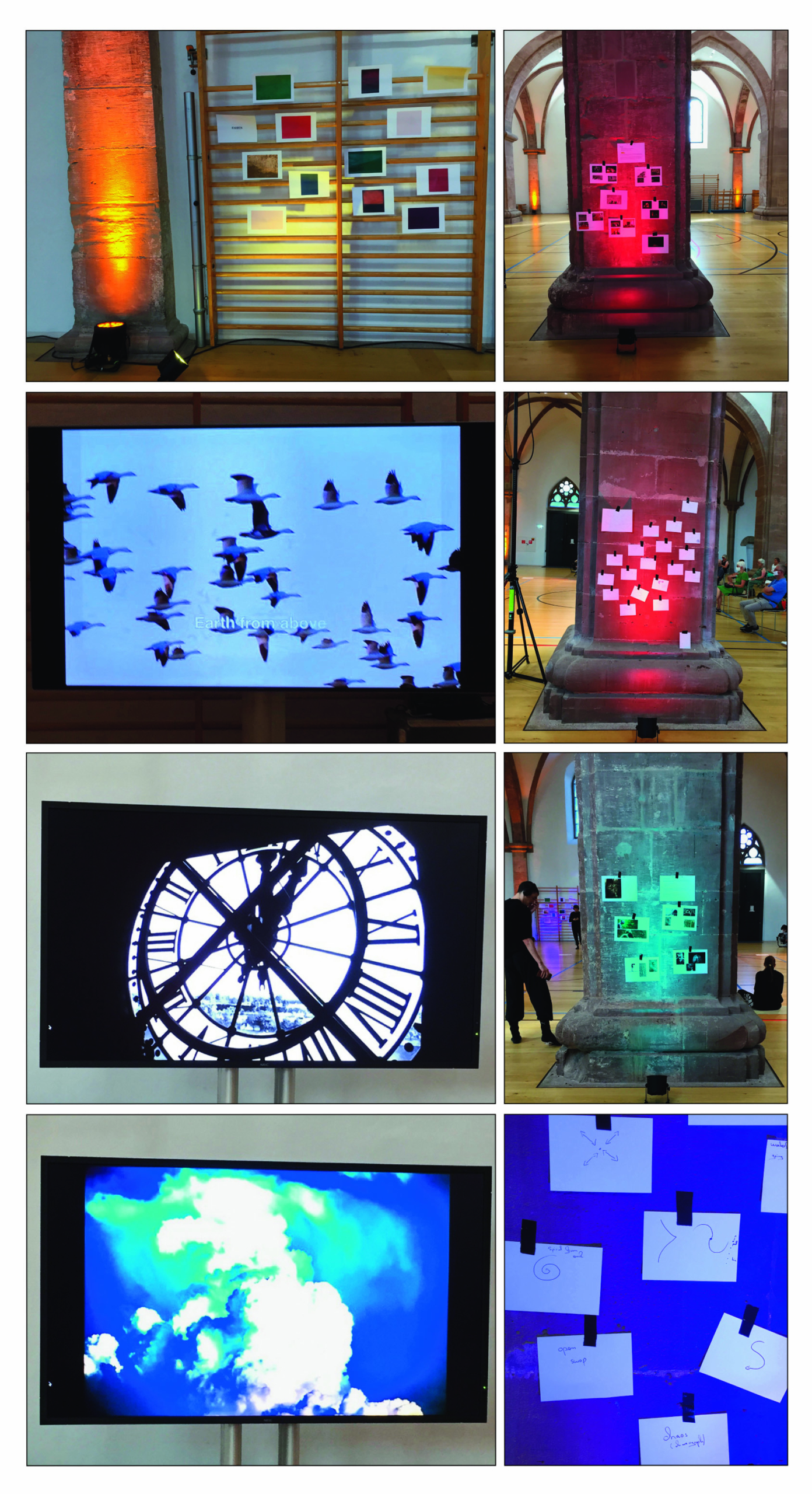
Figures 2a–h Exhibition of material from the research process for the choreography in the context of a first performance of parts of the choreography on August 7, 2020 within the frame of the Mosel Music Festival in the former Church of St. Maximin/Trier. © Photos by Stephanie Schroedter with kind permission of Elisabeth Schilling
Elisabeth Schilling’s engagement with Ligeti’s music began with intensive choreomusical research: not, however, in the sense of a scholarly analysis focused on the relationship between music and choreography61, but as an artistic practice dealing in detail with the score and also with overarching theoretical-aesthetic connections to the composition in order to creatively ‘translate’ it—to be able to transfer it into another artistic form of expression.62 Schilling emphasizes that she first translates the music—one could also say: the musical forms of vitality (according to Kim)—into graphic drawings that reflect textures:
In order to process the music with all senses, I begin to make drawings. These drawings are very intuitive and perhaps one can say that they express the textures that I experience physically two-dimensionally while listening to the music. These drawings may then serve me as an inspiration for both movement and spatial composition during the creative process.63
The fact that music and dance each have their own materiality and mediality makes a “literal” translation impossible: the movements that can be on the one hand heard and on the other hand seen can never be congruent. At most there can be analogies64 between the two arts that “move” in space and time. However, these analogies not only relate directly to concrete musical and dance parameters, but they can (and should) also extend to common, overarching aesthetic concepts of composition and choreography, whereby the dance can become independent of the score and still remain connected to the musical “ideas.” Moreover, from the perspective of audiovisual-kinesthetic perception, it is not the process of creating the production or the choreomusical staging (its “being made”) which is crucial, but rather the actual sound-performative event, with its interweaving of music and dance as audible and visible movements.65
For a choreographic translation work based on such premises, Ligeti’s musical “universe” offers an inexhaustible reservoir. It arises from a multisensory, synesthetically grounded imagination but at the same time requires clear structures—preferably with reference to scientifically researched phenomena that (at least metaphorically) refer to Karl Popper’s thought figures “Clocks and Clouds.”66 They are also echoed in Elisabeth Schilling’s choreography, whereby, as an independent organism, each choreographic etude exhibits its own finely crafted structures interwoven with an inexhaustible movement fantasy.
Schilling speaks of islands on which there are stones, grasses, flowers, fountains, and lumps of ash and which are abstracted through dance—or of villagers who are connected to one another, even if they are far apart.67 Networks develop between plants, living beings, and inanimate things. These trigger chain reactions or fractal-like configurations that give rise to non-linear figurations borrowed from chaos theory. They illustrate socio-political and ecological conflict, but without visualizing them blatantly. There is a characteristic fluctuation between predictable and therefore seemingly calculable elements (“clocks”) and unexpected, quasi-unpredictable, supposedly unstructured elements (“clouds”), constantly lending the event new twists and nuances (like shades of color). This choreographic approach is thus less favoring dance movements that especially trace lines, but more about movement textures which relate to the entire ensemble, merging into an overarching movement corpus that subsumes the individual bodies. This corpus constantly evolves in a kaleidoscopic manner, changing and reacting to the musical textures in order to allow sound-performative dynamics to emerge from them.
Even if rhythmic parameters of the etudes often come to the fore, it is primarily the sounds that open up musical spaces for (wide-ranging) qualities of dance movement. This is because the piano etudes consist of sound fields that overlap one another and constantly change (thanks to their “internal” movements)—insofar as it makes sense to distinguish between rhythm and sound in relation to these compositions and not to speak of sound rhythms in general.68 The choreography develops from a superimposition of movement and sound textures that can (and should) not only be heard and seen, but also kinesthetically understood. They emerge from, interfere with and/or clearly differentiate themselves from one another, as will be shown in the following. This approximately one-hour choreography will be, on the one hand, cursorily summarized in its form and, on the other hand, analyzed more in depth using individual “samples.”
At the outset, three female and two male dancers enter as shadowy figures—almost imperceptibly and barely audibly—into a large, dark stage space with flooring (a dance carpet) extending to the top edge of the back wall (and beyond it, so to speak). The room is thus filled with a generous, gentle curve extending backwards and upwards, ultimately making it appear unlimited. The pianist is at the side, positioned close to the left corner of the back of the stage and sitting in front of her large black concert grand piano, which extends into the stage space. One end of a white runner is rolled up beneath the piano; this extends in an elegant curve, rising slightly diagonally upwards to the far right corner of the stage ceiling. Because of the lighting used at the beginning of the choreography, this element crosses the dark stage space like a bright beam of light.
The piece begins in absolute silence. The first sound is caused by the falling movement of a male dancer positioned centrally at the back of the stage. This is followed by a sound of breathing from a female dancer on the right, which accompanies a downward swinging movement and short sideways movements by a female dancer positioned on the left. This is followed by the stomping of a male dancer standing in the middle of the front of the stage and finally a rolling movement of the male dancer in the background who first broke the silence and triggered this first chain reaction of the movement signals. The entire stage becomes slowly lit and the dancers, initially scattered across the room, come together and form a group. These first gestures and movements already establish the concept that nothing happens here at random and arbitrarily: everything is precisely coordinated, even if this plan is not immediately apparent and the logic of the structures only gradually unfolds.
This mood changes suddenly with the sudden onset of music, the percussively uplifting first etude “Désordre,” which spins a tonal texture of fast runs with penetrating, almost hammering chordal strikes. The initial calm of the scene is broken by angular movements, performed by individual, constantly alternating, dancers and giving the impression of a hectic, pulsating swarm.69 Much use is made of rotations, alternating with upward and downward movements (such as bending/falling and standing up with stretches and backward hyperextensions). This formation works its way diagonally across the stage from the upstage right to downstage left, basically maintaining this movement texture, and then—while the pianist climbs the highest registers of the keyboard—switching to slower and smoother movements. Gliding over the floor, interspersed with swings and spiral movements and loosened by light, gentle touches of movement “color,” the swarm moves across the stage diagonally back to the starting point. Once there, the music stops as suddenly as it started. The chaos (“Désordre”) seen and heard in the choreography is only superficial: in fact, complex structured figurations can be perceived on the levels of movement and sound. Initially they are differentiated significantly one from the other, but increasingly interfere with one another and finally merge into an audiovisual-kinesthetic overall structure. Or have the composer and choreographer deceived us—or has our own perception also done so?
In Ligeti’s second etude, “Cordes à vide,” a female dancer separates herself from the group and develops a web that extends into space with delicate, finely contoured and comparatively linear movements. These gradually develop and condense into polytextures thanks to varied movement qualities, dynamics and orientations. Initially beginning in silence, these movements carefully weave themselves into the sound events by underlining the different musical parameters and setting new accents—that is, interfering, with striking motifs. In this context, the choreographic textures in their microstructure form their own level in relation to the sound event. Through their macrostructure, they create a homogeneous conglomerate of movements and sounds. In this way, sound movements emerge.
This solo also demonstrates Schilling’s body and movement concept of a “manifold body,” which is both constantly in motion (even invisibly) and constantly changing between new and different spatial (alignments), movement qualities and their temporal design—comparable to a marionette whose individual parts can (apparently) move completely independently of each other. It is therefore a constantly changing body of movement in its dynamic forms of vitality (as a soloist or in relation to the entire ensemble), which Schilling developed on the basis of Ligeti’s piano etudes—a dance counterpart to this music.
The “manifold body” is an improvisation methodology that I developed over the last years and which is strongly inspired by Ligeti’s music, but also by artists like William Forsythe, Deborah Hay and the Gaga technique. […] The notion of a “manifold body” originally springs from an attempt to understand the body as a complex whole. Generally speaking, it introduces a set of six interrelated, variable layers: the architectural body, or the body in and as space, the rhythmical body, the timing of the body, its temporality, but also its musicality; the imaginative body, the entire complex of our images, imaginations and associations; the resonating body, all the echoes and reverberations of the world passing through the body through the eyes of the audience; the textural body, the body as a multiplicity of individuating intensities, finally the transitional body, at the threshold between states, a catalyst of creativity at the moment of decision, both closing down and opening up possibilities.
The method posits the body as a manifold of coexisting perspectives, providing inspiration for new forms of movement in a process of continuous becoming. Practising the “manifold body”, the dancer is never still, neither in mind nor in the body. The dancer always is on the move, in creation, in flux. Centres of thought ceaselessly shift, inspirations ceaselessly change, there is no safety, no stability. Visual, sensual, rational and other impulses and stimuli are intertwined and entangled.
In this sense, one could maybe see a relation to the state that the pianist of Ligeti’s Etudes finds himself in: playing Ligeti’s Etudes demand a great amount of technical skill of the pianist. Most of the Etudes keep the pianist on the edge of what is humanly playable on the piano. According to the pianist who works with me on Hear Eyes Move, playing Ligeti’s Etudes never makes you feel safe, but leaves you in a constant state of flux, instability and ceaseless movement in the mind as well as the fingers.
Moreover, similar to Ligeti’s late compositional influences, the “manifold body” encapsulates a manifold of inspirations, often expressed or creatively used in tiny subtle layers which could be of an either technical, performative or compositional nature within a work. The technique of the “manifold body”, its philosophy and consequence in movement and presence forms the basis of all of my work.70
At the choreographic center of the third etude “Touches bloquées” (based on the pianistic technique of silent key blocking) there is initially a duo in which the two participants repeatedly try to reach one another, ultimately in vain. This is perhaps comparable to a courtship dance which is fatefully unsuccessful while latently desynchronized. The irregular rhythm of the wild and unpredictable jumping tonal sequences, permanently interrupted by the key blocking, corresponds to abruptly breaking off, stubbornly contrary and self-shifting movements. In the middle part of the etude, in which the key blocking ceases, these are contrasted by clearly synchronized movements that follow the harsh chord sequences strictly (through dissonant intervals of seconds). This creates short-term homogeneity on the movement and sound level before, in the final section, the entire ensemble weave themselves into the stage action with their initial, highly desynchronized differentiated movements.
The fourth etude, “Fanfares,” is characterized by an ensemble structure that appears to be disjointed across the stage, but whose members are connected to one another by an invisible, yet clearly audible (since strictly rhythmic) network—comparable to a mycelia-like tissue. The initially angular, choppy movements are contrasted in the middle part by decidedly slow, expansive gestures that evoke associations with a ballet adagio. They stand in stark contrast to the fast, consistently sustained ostinato runs of the etude, so that an unmistakable contrast opens between the levels of movement and sound. Finally the net stretched between the dancers—originating in the movement style developed at the beginning—merge with the shrill, fanfare-like melodic phrases.
In contrast, the fifth etude “Arc-en-ciel” elicits a transition to a completely new mood. As at the beginning of the choreography (i.e. the first etude), the entire stage is in deep darkness except for a single beam of light on which the isolated, introspective dancers carefully moving, some on tiptoe. The piece begins and ends with a striking “lamenting gesture” by a male dancer standing at the left downstage of the stage. Looking up towards the stage ceiling, he raises his right arm upwards—perhaps seeking help?—while his left leg is stretched slightly backwards to visually continue the stretch of his extended arm throughout his entire body. The delicate sound figurations of the etude begin in the higher registers and, as the composition progresses, gradually open up the entire tonal range. In contrast, the dancers’ space of movement remains tightly limited—except for the “lament gesture” that points beyond the stage space. This creates a striking audio-visually-kinesthetically perceptible discrepancy between the conception of the sound space and that of the movement space. And while the strictly abstract drama of the stage events in the fifth etude is accompanied by a more atmospheric sound, it is musically developed in much more detail in the sixth etude “Automne à Varsovie,” a “lamento piece,”71 designed as a fugue.
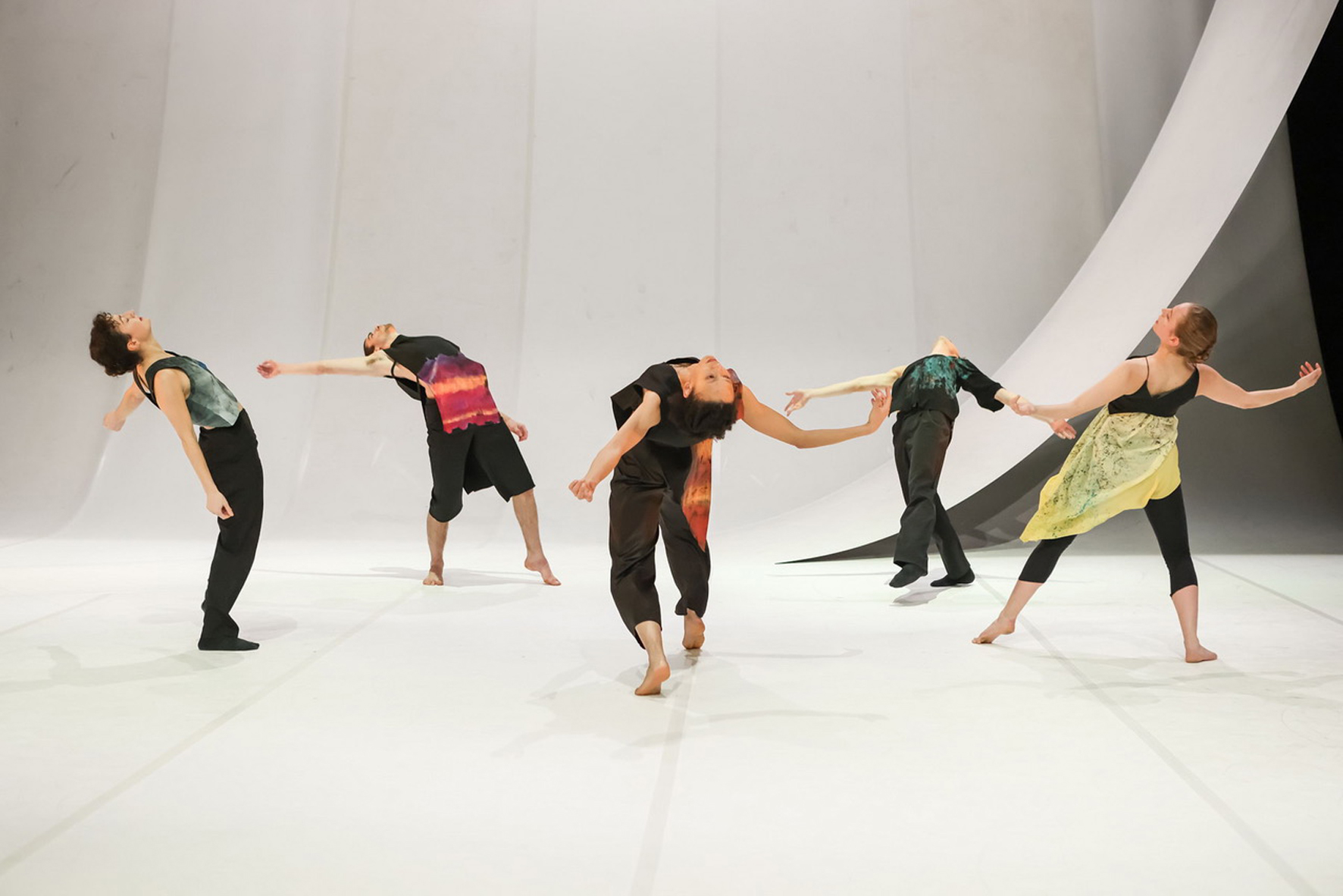
Figure 3: Moment of implosion from “Automne à Varsovie” © Bohumil Kostohryz
Again like the choreography of the first etude, “Désordre,” “Automne à Varsovie” begins in a silence that is only broken by the noises of the dancers. In this way, an arc stretches from the beginning to the end of this collection of etudes (in its choreography), dramaturgically rounding off the first book. In “Automne à Varsovie” music and dance initially confront each other in an affirmative way. Musical accents are given emphasis through dance movements, at first primarily through repeated gestures which vary but tend to be sculptural and related to (mute) choral lament of the whole ensemble. In addition, the fugue structure of the etude is echoed by the canonical movements of the dancers. These are characterized by a minimal time shift, comparable to an echo that is, if not audible, at least visible. Analogous to “Désordre,” the dancers move across the stage in swarm formations that constantly change their contours. They are clearly driven by inner unrest, reeling in fear, desperate and panicked at the same time. A brief moment of respite with heads bowed is deceptive, and nothing more than a brief calm before the next storm. As if struck by lightning and controlled by someone else, the swarm starts moving again, whirling through the room with twisting and swinging movements and forming a circle, the inner tension of which leads to an implosion.
The movement and sound events are driven equally by vibrating, one could say irrepressibly seething forces. These rear up again and again after more subdued moments and finally culminate in a final climax. Then everything abruptly stops and is plunged back into the initial darkness. No matter how abstract this drama may be, it is clearly highly dynamic and energetically charged, and conveyed by musically and dance-nuanced forms of vitality, which (in the case of the sixth etude) differ and interfere only minimally in terms of perception aesthetics. Instead, there mainly emerges a tonally moving conglomerate, pouring lava-like into the auditorium as if after a huge volcanic eruption at the end of this etude—this impression is at least apparent from the perspective of perception, which can hardly escape the “powerful” energy of the dance event.
The choreography of the seventh etude “Galamb Borong,” which opens the second book, refers to colors of Indonesian-African music, which seems to bring Ligeti’s imaginary and fantastic island “Kondortombol”72 to life. The same stage lighting is used as at the beginning of the first book (as well as at the beginning of the fifth etude “Arc-en-ciel”). The grand piano shines on a white runner while the rest of the stage sinks into darkness. All attention is focused on the pianist. The dancers are clumped together on the floor like a coarse-grained sedimentary rock, the contours of which can only be seen vaguely. They only start to move and rise vertically towards the end of the etude.
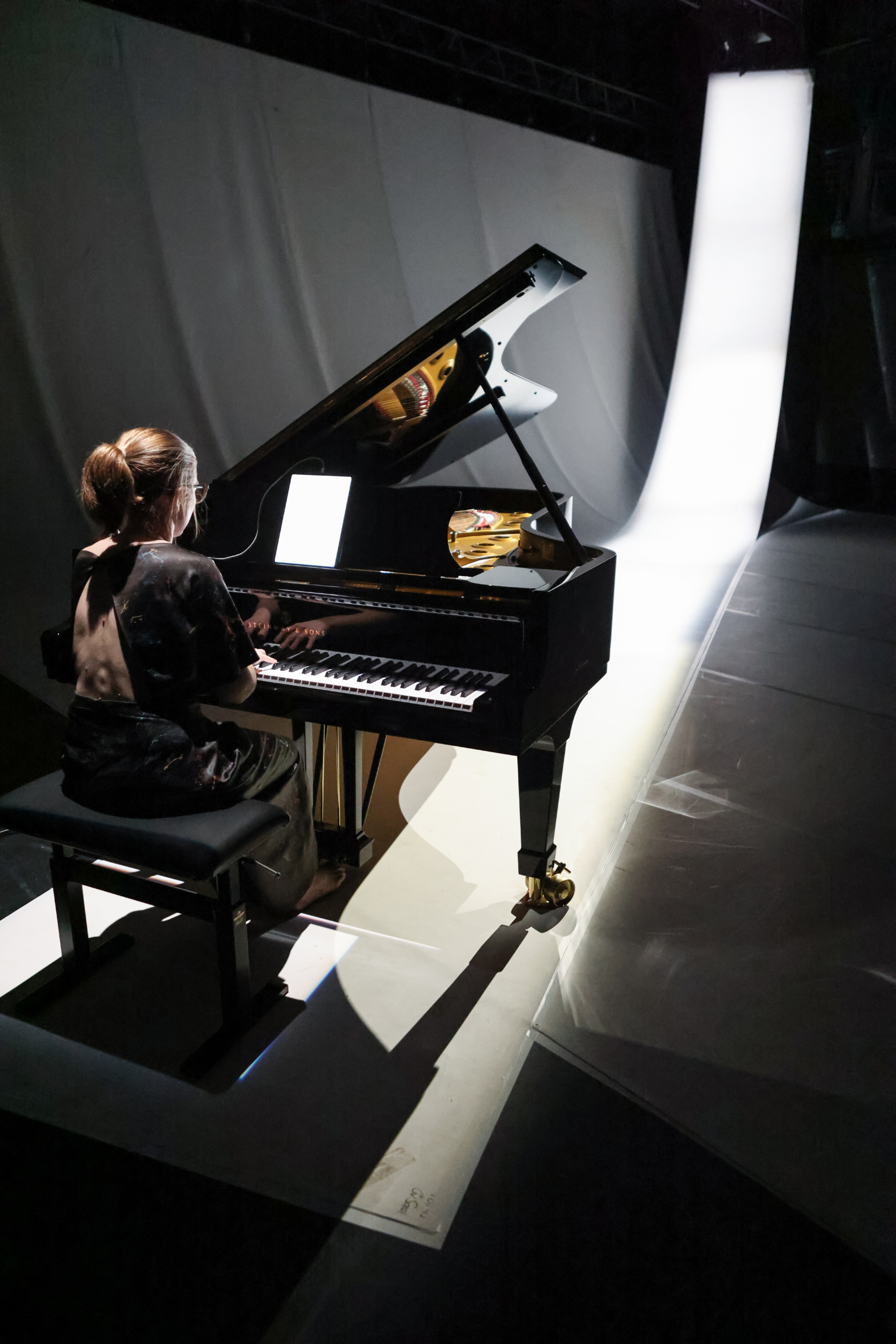
Figure 4: Cathy Krier, the pianist of Hear Eyes Move. Dances with Ligeti © Bohumil Kostohryz
In the eighth etude “Fém,” the stage shines again in bright light and reveals a strictly rhythmic movement game characterized by spiral movements and rotations and underpinned on the sound level by a polyrhythmic texture. It is a game of interference both within the choreography itself and between music and movement. Towards the end, it unmistakably prepares the next etude “Vertige,” in which varied interfering pendulum movements are used. These gradually turn into a feeling of vertigo (“Vertige”) characterized by a far-reaching, expansive oscillation. In the tenth etude, the “Der Zauberlehrling” (“Magician’s Apprentice”), this quality of movement is transformed into a veritable “perpetuum mobile,” the structure of which becomes increasingly dense and finally discharges itself—primarily on the sonic level—in a final concentration of energy. The machine-like musicality is contrasted by a highly virtuosic solo, which presents—from a dance perspective—“diabolical” challenges. Rapid changes between extremely contrasting movement qualities in different rhythms and with permanent changes of direction (within the body as well as in space) require the male performer to possess a level of control that limits consciousness. Ultimately, there unfolds a sound-performative, immersive “magic” on the edge of human possibilities.
On a musical level, the eleventh etude, “En Suspense” (“In Suspense”), plays with complementary opposites that unfold on a polyrhythmically designed web between the two hands, ultimately evoking a floating lightness. The choreography of this etude begins in silence, initially broken only by the movement sounds of a female dancer who gradually separates herself from the ensemble. Her wide arm swings seem to extend the floating sounds into the room, almost giving them wings. This flapping of wings is augmented by the dancers who gradually join in and form, in the twelfth etude “Entrelac” (“Network”), an imaginary bird that continually creates new flight formations and allows itself to be driven by the sounds—that is, the movements and sound events are synchronized.
The thirteenth etude, “L’escalier du diable,” is one of the most dramatic pieces of Ligeti’s etude cycle. According to his descriptions, it deals with his experiences with a wildly raging storm on the California coast. The storm surprised Ligeti on a bicycle tour and he had to fight against it, virtually defenseless, in order to get back home. Ligeti compared this experience to “an endless climbing, a wild apocalyptic vortex, a staircase […] almost impossible to ascend.”73 The composition begins pianissimo in the lower registers and increases to a fortissimo in the high registers, repeatedly peaking at the limits of strength and falling again and again. The choreographic design of this etude unmistakably references “Automne à Varsovie.” In both pieces, the stage is only illuminated by a diagonal beam of light on which a large part of the movement occurs. At the same time, movement motifs from “Désordre” are used (partly in inversion or choreographic retrograde) and now dramatically brought to a head. Regardless of the dark mood on both the movement and sound levels, the choreography engages the musical feats of strength with a gradual reduction of the movement material, ending with a seeming powerless exhaustion of the dancers’ movements, and culminates in a final collapse, making the greatest possible contrast to the sound event—a true anticlimax.
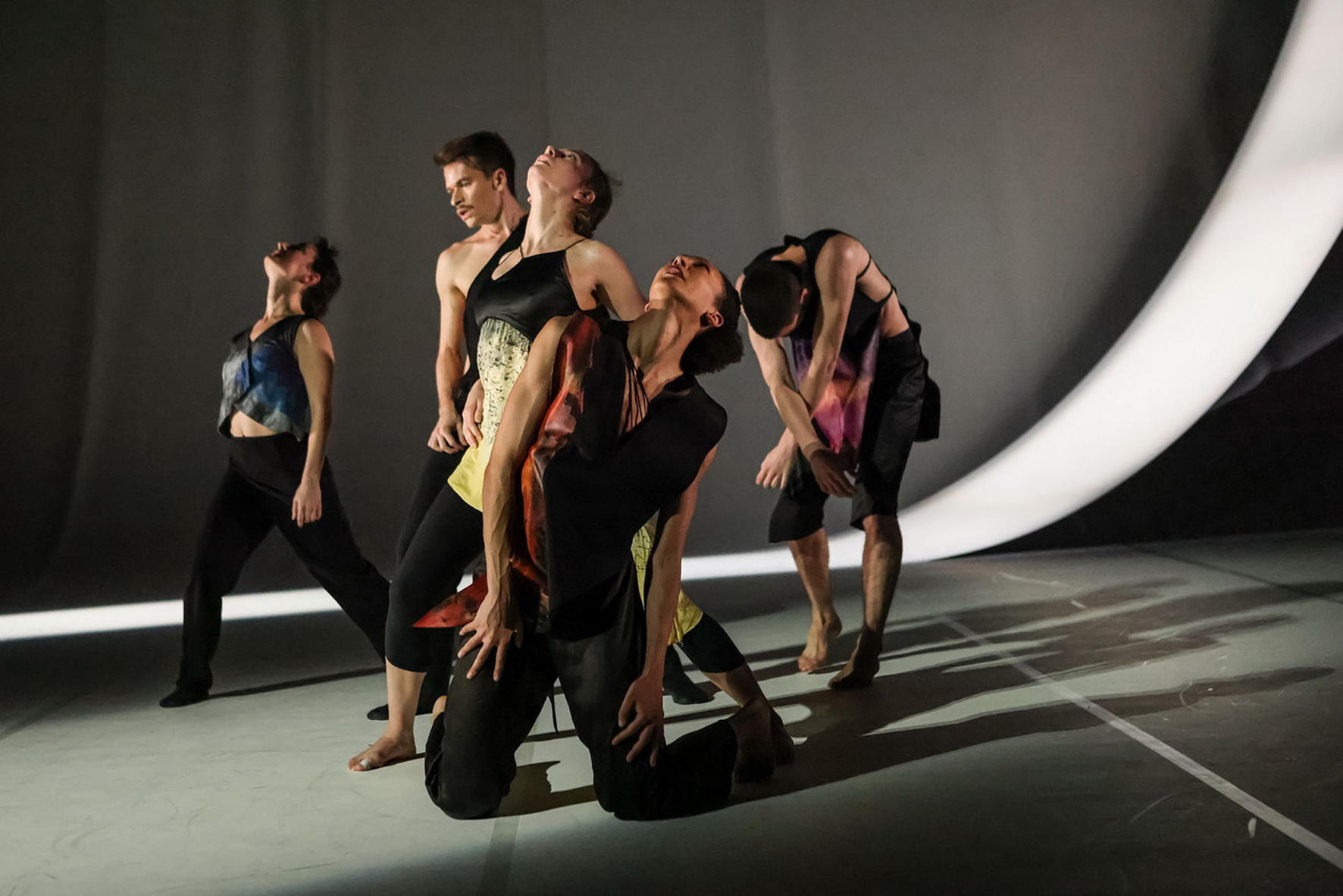
Figure 5: Ensemble with Cree Barnett-Williams (front), Elisabeth Christine Holth and Brian Caillet (behind), Piera Jovic (left) and Valentin Goniot (right) in “L’escalier du diable” © Bohumil Kostohryz
The fourteenth etude “Columna infinita” is also initially characterized by minimal use of movement, even including to a (seemingly) lifeless stay on the stage floor. Then the music intensifies monumentally (an acoustic counterpart to the sculpture of the same name by the Romanian sculptor Constantin Brâncuși), reaching threatening masses of sound. Here, too, the greatest possible difference between the movement and sound increases the intensity of the audiovisual-kinesthetic scenery. It is in no way leveled out.
With “White on White,” the fifteenth etude, in which only white keys are used, a calmer, peaceful mood sets in. This marks the beginning of the third book and prepares the three following pieces that conclude this cycle of etudes, all of which retain this basic affect. Aggressively rising sound cascades that oscillate between presto and prestissimo are now replaced by more conciliatory, subtly dissonant, grounded melodic lines that interweave with one another, mostly canonically. The choreography of these last etudes often draws on movement motifs and formations from the previous pieces. Seen from a perceptual-aesthetic perspective, these are, however, changed in quality and given new nuances through the new acoustic contextualization. The familiar is thereby alienated and the known acquires new facets that alienate it from its origin and transform it into the unknown—comparable to a memory that opens up new spaces of experience and, as it were, allows us to look both backwards and forwards.
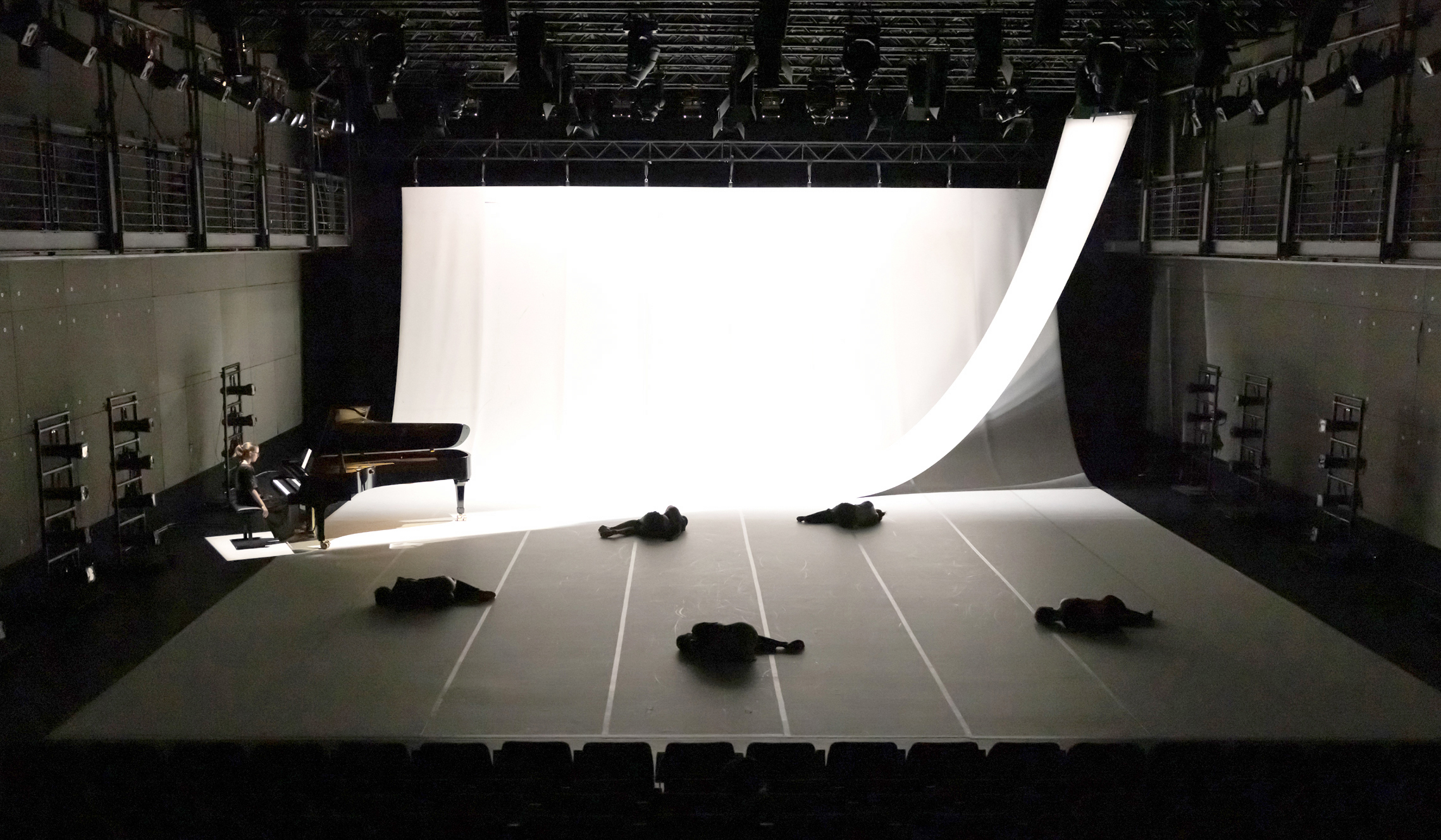
Figure 6: Ensemble with the pianist Cathy Krier in “Columna infinita” © Bohumil Kostohryz
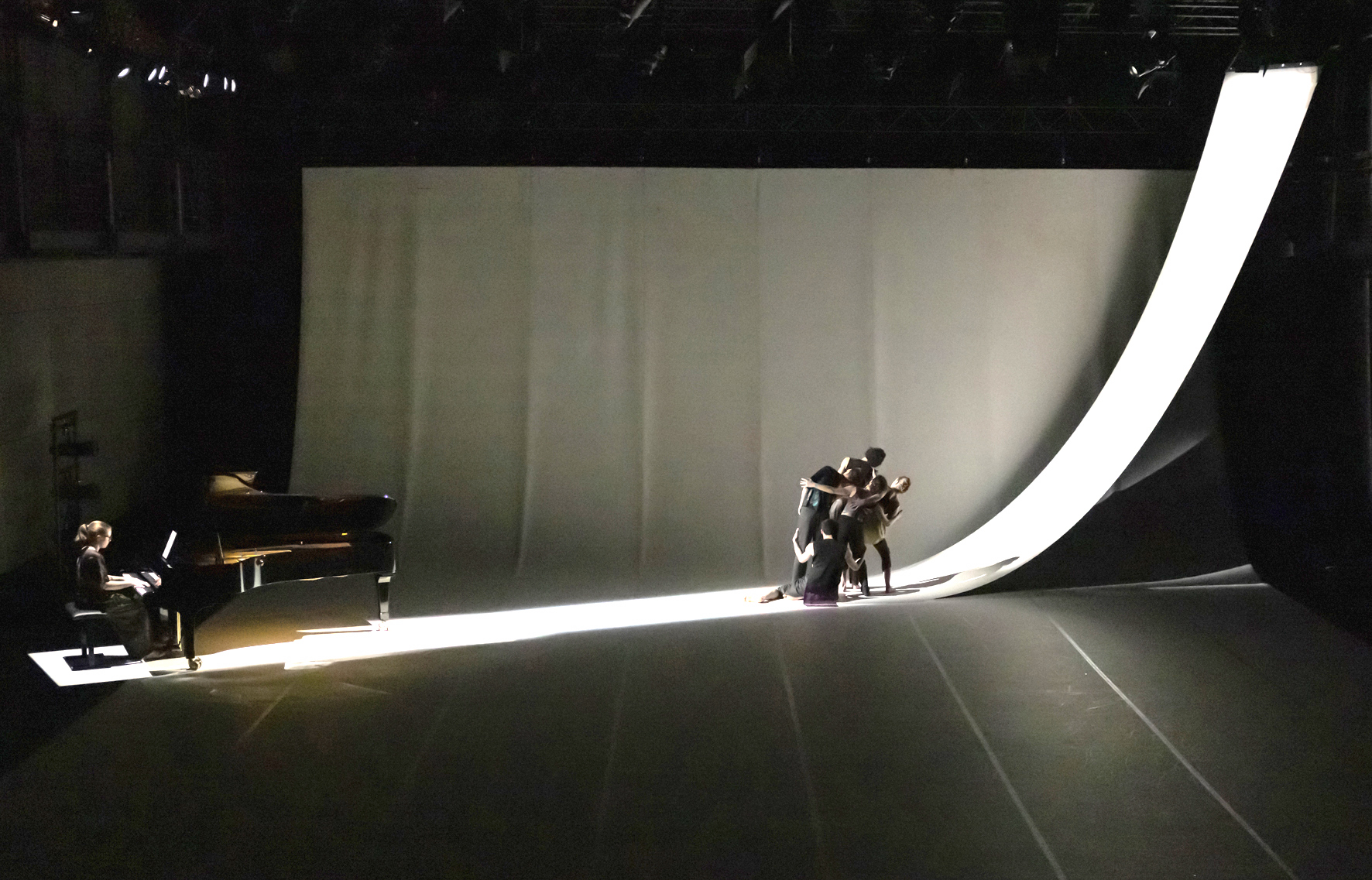
Figure 7: Finale of the last etude “Canon” with the same lighting as at the beginning of the first etude “Désordre”, but now with the dance ensemble on the white runner, which is illuminated like a bright beam of light © Bohumil Kostohryz
-
It is worthwhile to cite the context of this quotation, with which Markus Deisenberger begins his “Portrait” of Lukas Ligeti in an article for the Austrian Music Information Center (mica): “‘Jede Musik ist tanzbar, wenn man versteht, worum es in ihr geht’, sagt der in Wien geborene und in New York lebende Komponist und Percussionist Lukas Ligeti. Wirklich jede Musik? Auch eine Klaviersonate von Boulez? ‘Ja!’ Die Überzeugung, mit der er einem dieses ‘Ja’ entgegen schmettert, verwundert, ist letztlich aber nur einer von vielen Gründen, weshalb es sich lohnt, den Spezialisten in Sachen afrikanische Musik und rhythmische Polyphonie zu treffen. Wer mit ihm plaudert, taucht unweigerlich tief ein in einen Kontinent voller Geheimnisse und voller Magie.” https://www.musicaustria.at/spurensuche-lukas-ligeti-im-portraet/ (28 December 2010, accessed 8 February 2024). “‘All music is danceable if you understand what it is about’ says percussionist and composer Lukas Ligeti who was born in Vienna and lives in New York. Really all music? Even a piano sonata by Boulez? ‘Yes!’ The conviction, with which he shouts this ‘Yes’ is astounding, but only one of many reasons why it is worthwhile to meet this expert in the fields of African music and rhythmic polyphony. If you speak with him, you automatically enter deep into a continent full of secrets and magic.” Translated by Michael Schnack.↩︎
-
A change can be observed in New Music and its discursivation as well as generally in musicology and music pedagogy. See Jörn Peter Hiekel, ed., Body Sounds. Aspekte des Körperlichen in der Musik der Gegenwart (Mainz: Schott, 2017); Lars Oberhaus and Christoph Stange, eds., Musik und Körper. Interdisziplinäre Dialoge zum körperlichen Erleben und Verstehen von Musik (Bielefeld: transcript, 2017); Karolin Schmitt-Weidmann, Der Körper als Vermittler zwischen Musik und (all)täglicher Lebenswelt. Distanzauslotungen am Beispiel ausgewählter Werke der Neuen Musik (Bielefeld: transcript, 2021); Christine Hoppe and Sarah Avischag Müller, eds., Music in the Body—The Body in Music. Körper an der Schnittstelle von musikalischer Praxis und Diskurs (Hildesheim: Olms, 2021); Nadine Scharfetter and Thomas Wozonig, eds., Körper(lichkeit) in der Musik des 20. und 21. Jahrhunderts (Bielefeld: transcript, 2023).↩︎
-
Inspired by metaphor theories developed in the field of linguistics, which examine language in order to deeply explain how we think. These theories were substantially developed by Mark Johnson and George Lakoff in Metaphors We Live By (Chicago: University of Chicago Press, 1980; for more recent scholarship: Ezequiel A. Di Paolo, Elena Clare Cuffari, and Hanne De Jaegher, Linguistic Bodies. The Continuity between Life and Language, Cambridge, MA: The MIT Press, 2018). The last decades have seen a cognitive science oriented music theory arise that focuses on analytical approaches to our perception of music and our “musical thinking.” See Lawrence Zbikowski, Conceptualizing Music. Cognitive Structure, Theory, and Analysis (Oxford and New York: Oxford University Press, 2002); Foundations of Musical Grammar (Oxford and New York: Oxford University Press, 2017); Arnie Cox, Music & Embodied Cognition. Listening, Moving, Feeling, and Thinking (Bloomington and Indianapolis: Indiana University Press, 2016). See also my introduction to this volume, especially notes 9-12.↩︎
-
See Daniel Stern, Forms of Vitality. Exploring Dynamic Experience in Psychology, the Arts, Psychotherapy, and Development (Oxford and New York: Oxford University Press, 2010). See also note 45 below.↩︎
-
In order to clarify this very broad and often misunderstood term, I cite Arnie Cox’s definition of “cognition”: “I am taking cognition to be the sum of the process of coming-to-know and coming-to-understand and to thus subsume all forms of perception, comprehension, and conceptualization.” Cox, Music & Embodied Cognition (see note 3), 15.↩︎
-
Translated by Michael Schnack after György Ligeti, Gesammelte Schriften, ed. Monika Lichtenfeld, vol. 2 (Mainz and Berlin: Schott, 2007), 288: “Ich lege meine zehn Finger auf die Tastatur und stelle mir Musik vor. Meine Finger zeichnen dieses mentale Bild nach, indem ich Tasten niederdrücke, doch die Nachzeichnung ist sehr ungenau: Es entsteht eine Rückkoppelung zwischen Vorstellung und taktil-motorischer Ausführung. So eine Rückkoppelungsschleife wird, angereichert durch provisorische Skizzen, sehr oft durchlaufen. Ein Mühlrad dreht sich zwischen meinem inneren Gehör, meinen Fingern und den Zeichen auf dem Papier. Das Ergebnis klingt ganz anders als meine ersten Vorstellungen: Die anatomischen Gegebenheiten meiner Hände und die Konfiguration der Klaviertastatur haben meine Phantasiegebilde umgeformt. Auch müssen alle Details der entstehenden Musik kohärent zusammenpassen, wie Zahnräder ineinandergreifen. Die Kriterien dafür befinden sich nur zum Teil in meiner Vorstellung, zum Teil stecken sie auch in der Klaviatur—ich muß sie mit der Hand erfühlen.”↩︎
-
See Walter Benjamin, “Die Aufgabe des Übersetzers” (1923), in Gesammelte Schriften, vol. IV.1, ed. Tillman Rexroth (Frankfurt a.M.: Suhrkamp, 1971), 9-21; also Antoine Berman, Isabelle Berman, and Valentina Sommella, eds., The Age of Translation: A Commentary on Walter Benjamin’s “The Task of the Translator,” translated and with an introduction by Chantal Wright (Abingdon and New York: Routledge, 2018).↩︎
-
See also, from inter- and transdisciplinary perspectives: Susana Zapke, ed., Notation, Imagination und Übersetzung (Wien: Hollitzer, 2020); Fabian Czolbe and David Magnus, eds., Notationen in kreativen Prozessen (Würzburg: Königshausen & Neumann, 2015).↩︎
-
See Ivanka Stoïanova, “Über Klang-Verästelungen und über die Form-Bewegung,” in György Ligeti. Personalstil—Avantgardismus—Popularität, ed. Otto Kolleritsch (Wien and Graz: Universal Edition, 1987), 222-32. In regard to this topic see also note 68.↩︎
-
The term “interface” could also be used here. But the metaphorical description of the composing body as a “membrane” seems to me more appropriate, especially in this particular case. This term is organic, not media technical, and thus is not only closer to Ligeti’s imagined world but also refers to the neurobiological foundations of cognitive science.↩︎
-
Translated by Michael Schnack after Ligeti, Gesammelte Schriften (see note 6), 288f.: “Da in adäquater Klaviermusik taktile Konzepte fast so wichtig sind wie akustische, berufe ich mich auf die vier großen Komponisten, die pianistisch dachten: Scarlatti, Chopin, Schumann, Debussy. Eine Chopinsche Melodiewendung oder Begleitfigur fühlen wir nicht nur mit unserem Gehör, sondern auch als taktile Form, als eine Sukzession von Muskelanspannungen. Der wohlgeformte Klaviersatz erzeugt körperlichen Genuß. Eine Quelle solcher akustisch-motorischen Genüsse ist die Musik vieler afrikanischer Kulturen südlich der Sahara. Das polyphone Zusammenspiel mehrerer Musiker am Xylophon—in Uganda, in der Zentralafrikanischen Republik, in Malawi und an anderen Orten—sowie das Spiel eines einzigen Ausführenden am Lamellophon (Mbira, Likombe oder Sanza) in Simbabwe, in Kamerun und in vielen anderen Gegenden haben mich veranlaßt, ähnliche technische Möglichkeiten auf den Klaviertasten zu suchen. (Viel verdanke ich dabei den Aufnahmen und theoretischen Schriften von Simha Arom, Gerhard Kubik, Hugo Zemp, Vincent Dehoux und mehreren anderen Ethnomusikologen.) Zwei Einsichten waren für mich wesentlich: zum einen die Denkweise in Bewegungsmustern (unabhängig vom europäischen Taktdenken), zum anderen die Möglichkeit, aus der Kombination von zwei oder mehreren realen Stimmen illusionäre melodisch-rhythmische Konfigurationen zu gewinnen (die gehört, doch nicht gespielt werden), analog etwa zu Maurits Eschers ‘unmöglichen’ perspektivischen Gestalten.”↩︎
-
Here not only designating “absolute listening” but also “absolute music.” See Carl Dahlhaus, Die Idee der absoluten Musik (Kassel: Bärenreiter, 1978).↩︎
-
Ligeti’s statement that we can “feel” with our sense of hearing is not as strange as it might seem. Our vestibular organ is located in the inner ear. Responsible for our sense of balance, and equipped with receptor cells for the perception of movement, especially the position of the body in space, it is closely linked to our hearing nerve (Nervus vestibulocochlearis). Thus the connection between hearing and moving as well as perception of movement—or, hearing and a “feel” for movement—has a physiological basis.↩︎
-
For a current discussion of the term “kinesthesia,” see Maxine Sheets-Johnstone, “Kinesthesia: An Extended Critical Overview and a Beginning Phenomenology of Learning,” in Continental Philosophy Review 52/2 (2019), 143-69, here 144, https://doi.org/10.1007/s11007-018-09460-7. In this essay, Sheets-Johnstone, an established expert in this field, forcefully underlines the difference between proprioception and kinesthesia. This difference is often overlooked and leads to confusion. The receptor cells for proprioception are located in outer, visible organs in order to pass on information about our body and its position in space. Kinesthesia, on the other hand, collects information about the body’s own feeling “through internally-mediated neuro-muscular systems, hence systems that are not dependent on external stimuli but that are anchored in and register a continuous sensitivity to movement.” Ibid., 144f., especially 145. Cf. for this topic also my introduction to this volume, especially notes 5 and 31.↩︎
-
See also Dylan van der Schyff, Andrea Schiavio, and David J. Elliot, Musical Bodies, Musical Minds. Enactive Cognitive Science and the Meaning of Human Musicality (Cambridge, Mass. and London: The MIT Press, 2022), here especially 76ff.↩︎
-
See also note 51.↩︎
-
This term denotes here the physical body which also includes a phenomenological body: that is, our body as an organ of perception. Concerning the terminology of the phenomenological body, see Emmanuel Alloa, Thomas Bedorf, Christian Grüny, and Tobias Nikolaus Klass, eds., Leiblichkeit. Geschichte und Aktualität eines Konzepts (Tübingen: Mohr Siebeck, 2012).↩︎
-
Drawn from these four terms used in enactivism (“embodied,” “embedded,” “extended” and “enacted”), we speak of “4E Cognition,” which designates a more specific form of “embodied cognition” that contradicts mechanistic, ultimately symbolic as well as linguistically determined, so-called “representational” models for explaining our understanding. Cf. with regard to musical phenomena: van der Schyff, Schiavio, and Elliot, Musical Bodies, Musical Minds (see note 15), especially 48f.↩︎
-
In the research literature, haptics (as active grasping and touching) is mentioned as a generic term to which tactility (as a more subtle touching and feeling) is subordinate. Cf. for example Sebastian Sprenger, Haptik am User Interface. Interfacedesign in der zeitgenössischen Medienkunst zwischen Sinnlichkeit und Schmerz (Bielefeld: transcript, 2020), 31 (chapter “Ist es noch Taktilität oder schon Haptik?”).↩︎
-
For documentation of this stimulating exchange, see Reinhard Meyer-Kalkus, ed., György Ligeti, Gerhard Neuweiler. Motorische Intelligenz. Zwischen Musik und Naturwissenschaft (Berlin: Wagenbach, 2007).↩︎
-
See Manfred Stahnke, György Ligeti—eine Hybridwelt. Umkreisungen (Norderstedt: Books on Demand, 2022), 69ff.↩︎
-
Cf. the postface by Reinhard Meyer-Kalkus in the volume Motorische Intelligenz. Zwischen Musik und Naturwissenschaft (see note 20), 79.↩︎
-
Ibid., 81.↩︎
-
Translated by Michael Schnack after ibid.: “Musik vollendet sich im inneren Ohr, in der Hörvorstellung akustischer Phantasiegebilde. Entscheidend ist, was erklingt, und dies kann durchaus unterschieden sein von dem, was und wie gespielt wird. […] Gerade die Diskrepanz zwischen den Mustern der Muskelanspannung und der auditiven Gestalt kann für den Ausführenden zur Quelle des Genusses werden. Diese Differenz zwischen Hörbild und Bewegungsbild gilt besonders für illusionäre Rhythmen, inhärente Melodien, Differenztöne und andere Formen des Trompe-l’oreille, an denen Ligetis musikalisches Œuvre so reich ist, und sie gilt erst recht für die Supersignale der Formstruktur, die aus den klingenden Einzelereignissen zusammenschießen.”↩︎
-
As a reminder: Ligeti spoke in this regard of “illusory melodic-rhythmic configurations […] that are heard, not played” (see quotation at note 11).↩︎
-
In the field of physics, the term “interference” describes the change of the amplitude of a wave due to the overlaying of two or more sound, light or material waves. A comparable phenomenon—the synchronization of differing bio-rhythms—is described in the field of chronobiology as entrainment. In recent dance research, these and similar terminologies (such as that of entunement) are transferred to choreographic design. They are well suited for the analysis of music-choreographic and sound performative phenomena. Cf. Gabriele Brandstetter, “‘Wirbel der Zeit.’ Synchronisierungen in Work/Travail/Arbeid from Anne Teresa de Keersmaeker,” in De/Synchronisieren? Leben im Plural, ed. Gabriele Brandstetter, Kai van Eikels, and Anne Schuh (Hannover: Wehrhahn, 2017), 153-69; Elizabeth Waterhouse, “Entrainment und das zeitgenössische Ballett von William Forsythe,” in ibid., 197-219; Dominik Mohs, Kinästhetische Interferenzen. Körpertechnik und Tanznotation im Entwurfsprozess architektonischer Räume (Bielefeld: transcript, 2021).↩︎
-
In addition to the anthology mentioned in note 26, Brandstetter, Eikels, and Schuh, eds., De/Synchronisieren, see—for comparable phenomena in the field of art—also the publication by Robin Curtis, Gertrud Koch, and Marc Siegel, Synchronisierung der Künste (München: Fink, 2013); and for everyday and therapeutic fields: Thiemo Breyer, Michael B. Buchholz, Andreas Hamburger, Stefan Pfänder, and Elke Schumann, eds., Resonanz—Rhythmus—Synchronisierung. Interaktionen in Alltag, Therapie und Kunst (Bielefeld: transcript, 2017).↩︎
-
Translated by Michael Schnack after Ligeti, Gesammelte Schriften (see note 6), 294 (“Vertige” [Nr. 9]): “Eine meiner kompositorischen Intentionen ist die Erzeugung eines illusionären musikalischen Raumes, in dem sich das, was ursprünglich Zeit und Bewegung war, als etwas Zeitloses und Unbewegliches darstellt. Die Grundidee der neunten Etüde ist ein ständiges Abgleiten und Einstürzen, wobei der zeitliche Vorgang eingefroren, das Einstürzen zu einem Zustand wird. Technisch bilden abwärts laufende chromatische Skalen die Basis des Stückes. Doch bevor noch ein solcher Lauf beendet ist, beginnt schon der nächste, so daß eine Interferenz von Wellenbewegungen entsteht—die einzelnen Wellen überschlagen sich. Die chromatischen Läufe sind zwar in sich regelmäßig, doch ergibt ihre Kombination, aufgrund der ständig wechselnden Einsatzabstände, ein chaotisches Muster. Unsere Wahrnehmung pendelt, wie bei einem Vexierbild, zwischen den Läufen als Bewegung und ihrer Interferenz als statischem Bild.”↩︎
-
See Denys Bouliane’s contribution, which provides a detailed analysis of this phenomenon: “Imaginäre Bewegung. György Ligetis Études pour piano,” in MusikTexte 28/29 (März 1989), 73-84.↩︎
-
Originating in film music, the term “Mickey Mousing” has also become established in choreomusical research to designate music and dance which are meticulously coordinated with one other—primarily rhythmically, but also melodically and/or tonally/harmonically—and thus appear “synchronized,” even though in films the music is usually added later, whereas in dance the choreography is largely created against an existing musical template (as in our current example, Elisabeth Schilling’s choreography to Ligeti’s piano etudes). See Barbara White, “‘As if they didn’t hear the music,’ Or: How I Learned to Stop Worrying and Love Mickey Mouse,” in The Opera Quarterly, vol. 22, no. 1 (2006), 65-89, https://www.doi.org/10.1093/oq/kbi108, as well as the contribution by Philipp Feeney in this volume.↩︎
-
For the term “aisthesis” compare the contribution of Birgit Abels to this volume.↩︎
-
Cross-modal or multimodal perception is first and foremost a very general term for the interaction of different sensory systems. The interaction of intermodal features that are present in several modalities quickly leads to the integration of different sensory stimuli. Interference, on the other hand, arises from the interaction of different sensory stimuli, which, due to their overlap, create a new or different sensory impression in which the two initial stimuli can no longer be separated (the so-called McGurk-effect, see for an introduction: Ulrich Ansorge and Helmut Leder, Wahrnehmung und Aufmerksamkeit [Wiesbaden: Springer, 2011], 135ff.; one could also speak here of emergence effects: see note 35 below). With regard to the interaction between listening and watching, it is worth noting that, depending on the disposition of the perceiver, either the auditory or the visual stimulus is perceived more strongly and influences the overall impression accordingly: listening changes watching and vice versa, whereby both what is heard (that is, music) as well as what is seen (that is, dance) change and no longer correspond to the perception of the composition without the choreography or the choreography without the composition. For discussion of this perception phenomenon known as “auditory capture” as opposed to “visual capture” in the context of music-choreographic analysis, see Allen Fogelsanger and Kathleya Afanador, “A Mirror in Which to Dance: Actions and the Audiovisual Correspondences of Music and Movement,” in Bewegungen zwischen Hören und Sehen. Denkbewegungen über Bewegungskünste, ed. Stephanie Schroedter (Würzburg: Königshausen & Neumann, 2012), 129-49.↩︎
-
From a perspective of production aesthetics, this is a choreography made to pre-existing music—a composition created previously and not originally intended to be implemented in dance. Therefore it cannot enter into a “relationship” with the stage event. This point of departure is of fundamental importance for a choreomusical (staging) analysis, but not for performance analysis focusing on the interweaving of movement and sound, which concentrates on perceptual-aesthetic phenomena.↩︎
-
On the difference between choreographic music visualizations and music illustrations see Stephanie Schroedter, “Musik als Bewegung. Transformationen musikalischer Energetik im Tanz,” in Energie! Kräftespiele in den Künsten, ed. Katrin Eggers and Arne Stollberg (Würzburg: Königshausen & Neumann, 2021), 369-81.↩︎
-
A paradigmatic example of this—drawn from the field of the interaction of music/sound and dance/movement—are the Variations V, based on a composition by John Cage (1965: with the participation of David Tudor, Gordon Mumma, Billy Klüver, Stan VanDerBeek, and Nam June Paik, among others); the Merce Cunningham Dance Company participated in its performative implementation. See Leta E. Miller, “Cage, Cunningham, and Collaborators: The Odyssey of Variations V,” in Musical Quarterly, vol. 85, no. 3 (Fall 2001), 545-67, or with regard to overarching contexts: Julia H. Schröder, Cage & Cunningham Collaboration. In- und Interdependenz von Musik und Tanz (Hofheim: Wolke Verlag, 2011). For a more recent, comparable experimental arrangement in this context in which a complex interface was developed with the generation of digital notation processes in order to create an interdependent connection between instant choreography and instant composition, see Penelope Wehrli and Vera Pechel, eds., Eadweards’ Ear—Muybridge Extended. Environment für Tänzer, Musiker und Interface. Gespräche, Überlegungen, Notizen (Basel and Berlin: Edition Achsensprung, 2022); Stephanie Schroedter, “Interactions and Correspondences between Music/Sound and Dance/Movement as Permanent Negotiations of Translation Processes,” in Music, Dance, and Translation, ed. Helen Julia Minors (London and New York: Bloomsbury Academic, 2023), 49-62.↩︎
-
See note 3 above.↩︎
-
See Cox, Music & Embodied Cognition (see note 3), 11f.↩︎
-
See Theodor Lipps, “[Der Begriff der Einfühlung],” in Schriften zur Einfühlung, ed. Faustino Fabbianelli (Baden-Baden: Nomos Verlag, 2018), 678.↩︎
-
Cf. notes 5.↩︎
-
Jin Hyun Kim, “Kinaesthetic Musical Imagery Underlaying Music Cognition,” in Music and Mental Imagery, ed. Mats B. Küssner, Liila Taruffi, and Georgia A. Floridou (Abingdon/Oxon: Routledge, 2023), 54-63, https://www.doi.org/10.4324/9780429330070-6.↩︎
-
Ibid, 58f.↩︎
-
Theodor Lipps, “Aesthetische Einfühlung,” in Zeitschrift für Psychologie und Physiologie der Sinnesorgane, 22 (1900), 415-50; as well as, “Einfühlung, innere Nachahmung, und Organempfindungen,” in Archiv für die gesamte Psychologie, I (1903), 185-204.↩︎
-
Edward Bradford Titchener, Lectures on the Experimental Psychology of Thought-Processes (New York: The Macmillan Company, 1909); cited here from Kim, “Kinaesthetic Musical Imagery Underlaying Music Cognition” (see note 40), 56.↩︎
-
Kim, “Kinaesthetic Musical Imagery Underlaying Music Cognition” (see note 40), 56.↩︎
-
Jin Hyun Kim, “Musicality of Coordinated Non-Representational Forms of Vitality,” in Journal of Comparative Literature and Aesthetics, vol. 46, no. 1 (spring 2023), 175-85; relating, among others, to: Stern, Forms of Vitality (see note 4).↩︎
-
Ibid., especially 178.↩︎
-
See especially the fifth chapter of Stern’s Forms of Vitality (see note 4): “Vitality Forms in Music, Dance, Theater, and Cinema,” 75.↩︎
-
This energetic property of music was already described by Ernst Kurth as dynamic movement (in Grundlagen des linearen Kontrapunkts [Bern: Max Drechsel, 1917]) and by Hans Mersmann as organic strength (in “Zur Phänomenologie der Musik,” in Zeitschrift für Ästhetik und allgemeine Kunstwissenschaft, vol. 19 [1925], no. 1-4, 372-88), as mentioned by Kim, who thus refers to early psychological and aesthetic approaches within German-speaking musicology: Kim, “Musicality of Coordinated Non-Representational Forms of Vitality” (see note 45), 180. See also for the immediately following ibid., 181.↩︎
-
Ibid., 182.↩︎
-
Ibid.↩︎
-
Not understood in the sense of linguistic semantics (as an assignment of meaning), but as a specifically musical sense or logic—for example, comparable to the interlocking of “gears” in a composition as described metaphorically by Ligeti.↩︎
-
For more information, see Stephanie Jordan, Moving Music. Dialogues with Music in Twentieth-Century Ballet (London: Dance Books, 2000), 15; available in German in Émile Jaques-Dalcroze, Rhythmus, Musik und Erziehung. trans. Julius Schwabe (Basel: Verlag Benno Schwabe & Co, 1921), 169. Cf. for this topic also Juliet McMains and Ben Thomas, “Translating from Pitch to Plié: Music Theory for Dance Scholars and Close Movement Analysis for Music Scholars”, in: Dance Chronicle, 36:2, 196-217, https://www.doi.org/10.1080/01472526.2013.792714.↩︎
-
Stephanie Jordan has pursued this approach in her third monograph, dedicated to choreomusical analysis methods, in which she examined the artistic œuvre of the exceptionally musical choreographer Mark Morris: Mark Morris: Musician—Choreographer (Binsted: Dance Books, 2015), especially chapter 4: “A Framework for Analysis,” 91-123 (see note 61).↩︎
-
For this purpose, music and movement pedagogy—known as “rhythmics,” founded by Émile Jaques-Dalcroze (see notes 52 and 58)—offers professional training enabling artistic-creative, resilience-strengthening practical use in all “agogic” fields and contexts: pedagogical, andragogical, geragogic, and cross-generational. Elisabeth Schilling worked with students of the Department of Music and Movement Education/Rhythmics (mbp) at the University of Music and Performing Arts Vienna (mdw) to create a choreography to the opening of the first Ligeti etude (“Désordre”), which was presented as part of my inaugural lecture on 25 Oktober 2022.↩︎
-
On the term “trace” as a methodical approach see: Sabine Karoß and Stephanie Schroedter, eds., Klänge in Bewegung. Spurensuchen in Choreografie und Performance (Bielefeld: transcript, 2017), especially my contribution “Audiovisuellen Bewegungen auf der Spur. Zum Konzept eines klangperformativen Spurenlegens und Spurenlesens,” 25-44 as well as the introduction 9-22. Although this article is also “searching for traces,” this approach—explained in detail elsewhere—will not be discussed here in depth.↩︎
-
See note 7 above.↩︎
-
On further choreomusical or dance-related approaches within translation studies, see Helen Julia Minors, Music, Dance and Translation (London and New York: Bloomsbury Academic, 2023) as well as her contribution: “Translations between Music and Dance: Analysing the Choreomusical Gestural Interplay in Twentieth- and Twenty-First-Century Dance Works,” in Translation and Multimodality: Beyond Words, ed. Monica Boria, Ángeles Carreres, María Noriega-Sánchez, and Marcus Tomalin (London and New York: Routledge, 2019), 158-78; additionally, relating to artistic research at the Tanztheater Wuppertal and its “afterlife”: Gabriele Klein, Pina Bausch und das Tanztheater: Die Kunst des Übersetzens (Bielefeld: transcript, 2019), in English translation: Pina Bausch’s Dance Theater: Company, Artistic Practice and Reception (Bielefeld: transcript, 2020) as well as the anthology she edited, cross-culturally conceptualized around the example of tango: Tango in Translation. Tanz zwischen Medien, Kulturen, Kunst und Politik (Bielefeld: transcript, 2009), and her contribution with Marc Wagenbach, which deals especially with socio-political aspects in the context of dance and performance, “And so You See … On the Situatedness of Translating Audience Perceptions,” in Situated in Translation. Cultural Communities and Media Practices, ed. Michaela Ott and Thomas Weber (Bielefeld: transcript, 2019), 191-213.↩︎
-
Émile Jaques-Dalcroze, with his pedagogically and didactically oriented concept of “plastiques animés” (three-dimensional “plastic” or “sculptural” music visualizations using various exercises) sought primarily to promote musicality. Although the subject he founded (and the field which has been built upon it) are called “rhythmics,” he was by no means only concerned with “rhythmic” parameters, but equally with melodic, harmonic and dynamic ones. In addition, he was by no means concerned with dance training as such, even if his exercises proved also to be very helpful for those dancers seeking to engage intensively with music in their choreographic work. This approach—more or less referring to Jaques-Dalcroze’s “plastiques animés”—continues to be important in the field of music and movement pedagogy/rhythmics. See Jaques-Dalcroze, Rhythmus, Musik und Erziehung (see note 52), especially chapter 19 “Rhythmik und bewegte Plastik” (1919), 166-85.↩︎
-
While Ligeti’s music, starting with the resounding success of Stanley Kubrick’s A Space Odyssey (1968/2001), was often used in “soundtracks” for film productions (see the extensive filmography at: http://www.gyoergy-ligeti.de/filmographie/index.html, accessed 25 March 2024), it is less well-known that his music is also often used for choreographies—as musical “pre-scripts,” so to speak. Though no list of such choreographies exists, a few prominent examples must be mentioned: Karole Armitage’s Ligetis Essays on Sippal, dobbal, nádihegedüvel (With Whistles, Drums and Reed Violins) for mezzosopran and percussion, Harom Weöres-dal (three songs based on texts by Sándor Weöres) for singing voice and piano, as well as Négy lakodalmi tánc (four Wedding Dances) for three singing voices and piano (New York 2007), also the choreographies by Martin Schläpfer Musica ricercata (Mainz 2003), Ramification (Mainz 2005) and Lontano (Amsterdam 2009) (each to Ligeti’s composition of the same name). Compositions by György Ligeti (Volumina for organ from 1962 as well as Coulée, the second etude for organ from 1969) were also used in Boris Charmatz’s “choreographic Happening” Wundertal/Sonnborner Straße (Wuppertal 2023). Also noteworthy is the cross-disciplinary “Education-Projekt” to Ligeti’s Piano Etudes, premiered in 2014 as part of the Ruhr Piano Festival: https://www.klavierfestival.de/education/projektdokumentationen/2014-ligeti-etudes/, accessed 25 March 2024.↩︎
-
At this point it is not possible to go into further detail about the reception of this composition in the extensive literature on Ligeti. It should be mentioned, however, that Elisabeth Schilling sought contact with the relevant Ligeti expert Jean-François Boukobza in order to obtain detailed information about the analytical and aesthetic aspects of this composition. See Jean-François Boukobza, György Ligeti. Études pour piano (Genf: Éditions Contrechamps, 2019).↩︎
-
Stephanie Jordan has provided essential foundations for specific music choreographic research—referred to as choreomusicology—that is currently establishing itself in Anglo-American musicology (see notes 52 and 53). She is currently working on the choreomusical œuvre of Richard Alston (see her contribution in this volume).↩︎
-
The following statements are based on my week-long observation of rehearsal work and the visit to a final public performance (significantly limited due to Corona-related restrictions) of parts of the choreography on August 7, 2020 within the frame of the Mosel Music Festival in the former Church of St. Maximin/Trier. Elisabeth Schilling presented her choreography in great detail at a symposium I organized entitled Musik als Experimentierfeld für Bewegung, which took place from September 14th to 16th, 2020. In addition to this, from January 5th to 8th, 2023 there was an intensive meeting exclusively to discuss the choreography. I would like to thank Elisabeth for her patience and generosity in giving me this comprehensive insight into her artistic work.↩︎
-
Citation from an interview which Elisabeth Schilling gave with me at the Symposium Musik als Experimentierfeld für Bewegung (see note 62) on September 15th, 2020.↩︎
-
On this theoretical approach see Lawrence Zbikowski, “Music and Movement: A View from Cognitive Musicology,” in Bewegungen zwischen Hören und Sehen (see note 32), 151-62, as well as his “Points of Contact: Bases for Translations between Music and Dance,” in Music, Dance, and Translation (see note 35), 29-48; as well as, bedded in a comprehensive music theory concept, his Foundations of Musical Grammar (see note 3).↩︎
-
This fact, which is by no means insignificant for the analysis, has already been mentioned above (in note 33) and will be further elaborated in the following, so that it has to be emphasized again here.↩︎
-
See Karl Popper, “Of Clocks and Clouds. An Approach to the Problem of Rationality and the Freedom of Man,” in Popper, Objective Knowledge. An Evolutionary Approach (Oxford: Clarendon, 1972), 206-55; as well as Ligeti’s composition Clocks and Clouds for twelve-voice women’s choir and orchestra (world premiere: Graz 1973).↩︎
-
Allusions to the Corona pandemic, which was virulent at the time of the production, cannot be ruled out.↩︎
-
This has already been suggested in a quote by Ligeti above (see note 28). For a detailed presentation of Ligeti’s musical spatial concepts in relation to their temporal structuring, see Christian Utz, “’Plastisch greifbare Präsenz’: Raum-zeitliches Klang-Denken bei György Ligeti und seine musikhistorischen Konsequenzen,“ in Jahrbuch des Staatlichen Instituts für Musikforschung 2023, edited by Simone Hohmaier, Berlin 2025, 6–30, https://doi.org/10.71046/simjb.2023.12.↩︎
-
On swarm movements in choreography and performance as well as movement research including (socio-)political and ecological contexts see Gabriele Brandstetter, Bettina Brandl-Risi, and Kai van Eikels, eds., Schwarm(E)Motion. Bewegung zwischen Affekt und Masse (Baden-Baden: Rombach Wissenschaft, 2007).↩︎
-
Excerpt from the interview mentioned in note 63.↩︎
-
This description comes from Ligeti himself. See Hamburger Jahrbuch für Musikwissenschaft 11 (1991), 362.↩︎
-
See Constantin Floros, György Ligeti. Jenseits von Avantgarde und Postmoderne (Wien: Lafite Verlag, 1996), 185.↩︎
-
Cited in Richard Steinitz, György Ligeti. Music of the Imagination (London: Faber and Faber, 22013), 308.↩︎