Sophie Benn 
How to cite
How to cite
Abstract
Abstract
In early twentieth-century France, a trend emerged of films that relied on comic dancing, often through the portrayal of choreomania. This chapter examines the role of dance and music in such films, arguing that the medium of silent film allowed for an expansive, playful relationship between music and gesture that augmented the humor of these works. The relationship between film and comedy in early twentieth-century aesthetics is defined through reference to writings by Henri Bergson and Georg Lukács. The chapter then examines how depictions of dance could be used to generate a unique form of active viewing for unsynchronized film, building on Dominique Nasta’s theory of subception, considerations of musical accompaniment in film screenings, and period accounts of filmic spectatorship. A close reading of Le Piano irrésistible (Gaumont, 1907, dir. Alice Guy Blaché) illustrates these arguments regarding music, humor, and disordered movement. Finally, this chapter considers the role of sound in forwarding the racial and political valences of choreomania, examining how music-dance disunion in silent film could further the subversive effects of choreomaniacal movement.
Outline
Outline

The film Le Piano irrésistible (1907), produced by the studio Gaumont and directed by Alice Guy Blaché, depicts a situation that would have appealed to working-class Parisians grappling with an increasingly dense and noisy city: two movers set down an upright piano in an empty apartment, guided by its new occupant.1 The tenant takes off his top hat and begins to play. While the movers continue their work, their motions are transformed. They no longer walk with gruff, workaday purpose, instead adopting the fancier footwork of a skip as they move chairs around (figure 1a). Downstairs, a middle-aged genteel couple are having a meal, served by their maid. They hear the music upstairs. At first, they are outraged, but then, seemingly against their own will, all three are carried away in hypnotic delight to dance to the music (figure 1b). They rush upstairs and confront the pianist, who is oblivious to their arrival. The trio expresses their indignation at the racket, but their attitude quickly transforms and they resume their dance. The pattern repeats: soon a working class couple joins, as does a dressmaker’s shop full of seamstresses. The music levels all differences of economic status, age, or sex, and each person who hears it is pulled into the same wild dance in the pianist’s apartment. Even the stiff policeman making rounds on the street is unable to deny the music’s pull, and executes a manic, awkward shuffling step before storming up to the apartment. At last, the pianist falls off his stool, exhausted, into the crowd—and they pull him back to the piano to compel him to play once again, now complicit and willing participants in their own choreomania (figure 1c).
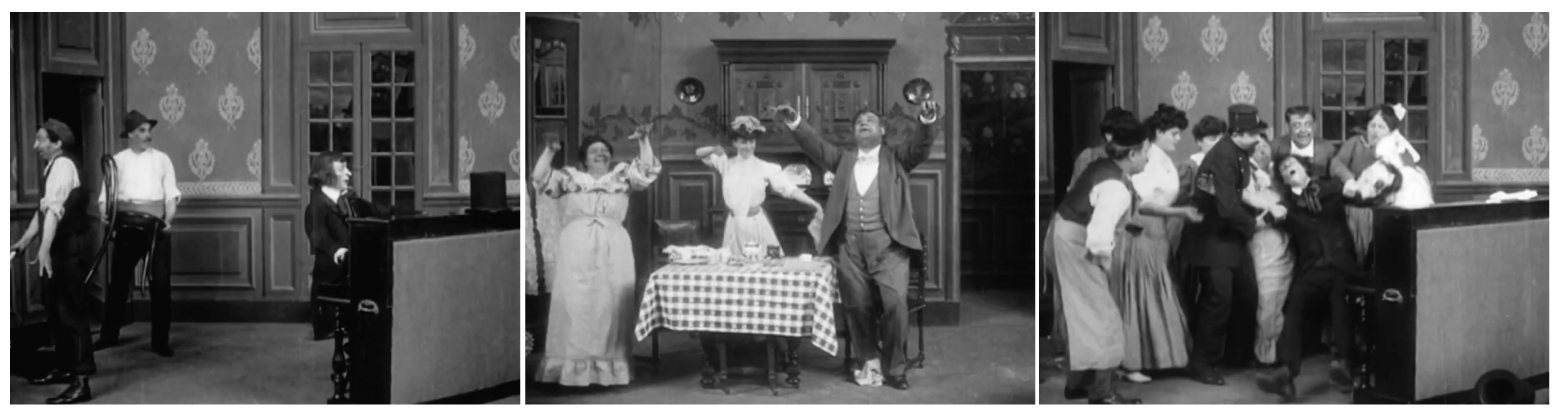
Figures 1a–c: Dancing takes over in Le Piano irrésistible. Creative Commons Public Domain Mark 1.0. Video stills from https://archive.org/details/le-piano-irresistible.
The scenario of Le Piano irrésistible hinges on a truth that many of us hold in our bodies: that music has the capacity to make us lose control. The dancers’ highly individual reactions to their own gestures, which range from anger to delight, show how bodily responses to music often transgress deeply held notions of taste or propriety. On multiple levels, the humor of the film raises questions of agency. The film not only challenges the power of the dancers to control their own motions, but also plays with the dynamics of control that are involved in the theoretical relationship between music and dance. In French comedy of the early twentieth century, agency and its loss was a common motif, and in this chapter I examine how dance films could be used as a vehicle for this preoccupation. Indeed, scenes of choreomania such as that found in Le Piano irrésistible were extremely common in early twentieth-century comic cinema. Film scholar Kristina Köhler identifies this film as an early iteration of a trend of films on both sides of the Atlantic that portrayed dancing manias, later examples of which include La Bous Bous Mie (Gaumont, 1909), Gavroche et la valse obsédante (Éclair, 1913), Turkey Trot Town (Thanhouser, 1914), The Epidemic (Essanay, 1914), and He Danced Himself to Death (Ralph Ince, 1914).2 I argue that silent film proved to be an exceptional medium for choreomaniacal comedy because—in tension with the dance it depicted—film separated the senses in a way that allowed for the playful reinterpretation of music-dance connections. Drawing on film scholar Dominique Nasta’s concept of subception, theoretical writings of the period that address the relationship between film and its spectators, and considerations of in-theater musical accompaniment, I describe how directors could use dance on screen to conjure musical sounds in the imaginations of audience members. These speculative sounds provided an opportunity for play while also offering commentary on the forces that act on human bodies. I conclude by addressing the racialized and politicized nature of these forces, arguing that the medium of silent film could heighten choreomania’s perceptual roots in pathology, racial alterity, and the subversion of hierarchy.
Bergson, Lukács, and Choreomania
In the early twentieth century, comedy was often connected to the body and its movements. In his collection of essays Le Rire (1900), Henri Bergson describes comedy in terms that would be familiar to the viewer of Le Piano irrésistible. For him, humor is rooted in the physicality of the comic subject. Even more than so than the physical form of the body, qualities of gesture are at the heart of Bergson’s comedy: indeed, he argues that “if we wished to define the comic by comparing it with the body, we should have to contrast it with gracefulness even more than with beauty.”3 Ungainly movement was an integral component of Bergsonian concept of comedy because it “suddenly recalls” the viewer’s attention away from the soul and toward the corporeal form. In ideal, non-comic circumstances, the soul was shown to be “kindled within us by a higher principle and perceived through the body, as if through a glass.”4 Humorous movements clouded this glass, asserting the body’s presence in a scene. Le Piano irrésistible’s humor is nothing if not physical: the improvised motions of the dancers erupt spontaneously, unmoored from any notion of grace.
Creating emotional distance between the spectator and the comic subject was also crucial for Bergson’s comedy. Laughter is accompanied by the absence of truly profound feeling, and “the comic demands something like a momentary anesthesia of the heart.”5 To view an otherwise serious situation as comedy, Bergson argues that we merely need to “step aside [and] look upon life as a disinterested spectator.”6 In Le Piano irrésistible, one of the ways this disinterestedness is generated is through a separation of dance from music: the close connection that the two art forms enjoy in live performance is severed by the lack of synchronized sound in this silent film. Without synchronized music, the dancers’ gestures lack any motivation, making them appear all the more baffling, mechanical, and puppet-like. In fact, Bergson provided something of an explanation of Guy Blaché’s joke avant la chose: “It is enough for us to stop our ears to the sound of music, in a room where dancing is going on, for the dancers at once to appear ridiculous.”7
It is important to remember, however, that music existed in non-phantasmagorical forms in many screening venues of the period. Scholars have challenged the impression that films of this period were truly silent, and it is clear that the term “silent film” is both a misdirection and an anachronism that dates from the introduction of sound to cinema. In the first two decades of film, a variety of accompaniment practices could be employed to fill the sonic space at screenings. In many instances, in-theater musicians or sound effects outfits would use moments that suggested the presence of music to great effect, supplying some sound that heightened the representative and affective potential of the film. Film and music scholar Rick Altman identifies the piano playing in Le Piano irrésistible specifically as a signal that would have invited an in-theater pianist to play a cue.8 He argues that the performance would function as a sound effect rather than an immersive musical selection. For the audience, the pianist’s live performance would invoke the timbre and volume of the instrument on screen, but the music’s semiotic content and “musical” meaning would be subdued, including its role in accompanying dance. Altman demonstrates this by highlighting a critique published in Views and Films Index which he asserts was based in the scenario of Le Piano irrésistible. The anonymous author opines that
there are some films which cannot be shown to good advantage without [sound] effects […] Anybody witnessing the portrayal of an excited musician, as he bangs in fury at a piano and storms and rages around the studio, would certainly not appreciate the film if the attacks on the keys brought forth no sound, and the statuary which is smashed falls to the floor without the necessary crash.9
An in-theater pianist’s exact choice of music was less important than its presence as a sound object, connecting theater audiences to onscreen visuals. In the view of the critic from Views and Films Index, the piano music would serve an identical function to, for example, the noisy crash of a breaking statue. Due to the live music’s status as a sound effect, it is possible that even basic considerations of musical meaning, such as tempo and meter, would not be held as sacred. While a piano could be an expected accompaniment throughout the film, a pianist would not expect to synchronize the pulse with the gestures of the dancers—indeed, given their erratic rhythms, synchronization would be nearly impossible. The audience would understand that the theater pianist would not necessarily be playing the same music as the pianist onscreen, and theater music would serve to augment, not ameliorate, the sense of disconnect between sound and visual.
A connection between disinterested spectators, such as those described by Bergson, and the lack of sound in silent film was articulated by others in the early twentieth century. In one article from 1911 (expanded in 1913), a young Georg Lukács connects an absence of human agency, presence, and soul specifically to the medium of cinema.10 He argues that “the ‘cinema’ presents mere action but no motive or meaning. Its characters have mere movement, but no souls, and what occurs is simply an occurrence, but not fate.”11 This soullessness is the reason “that the scenes of the cinema are silent” rather than any technological limitations of the medium.12 In terms that recall Bergson’s understanding of the bodily dimension of comedy, Lukács links this lack of sound to a crucial quality of lightness in the cinema. The removal of the soul from film that Lukács describes means that the characters are seen as hardly human, but instead pure physical form: in the cinema, he writes, “[m]an has lost his soul; in return, however, he gains his body.”13 For Lukács, film feels the way it does “because there are only movements and actions of people—but no people” depicted onscreen.14 Motion is of central importance in film; indeed, “[t]he essence of the ‘cinema’ is movement in itself, an eternal variability, the never-resting change of things.”15
Connecting these two sources, we can see how film in Lukács’s formulation was an ideal medium for Bergsonian comedy. Both authors emphasize that there is an essential difference between the human body and the soul. The soul and its fate are the domain of serious art; the absence of these features therefore belong to comedy. As with Bergson, Lukács conceives of comedy as reliant on human physicality, which he argues is heightened in film. When depicted through the medium, “[man’s] greatness and poetry lie […] in the way in which his strength and skill are able to overcome physical obstacles. And comedy arises when these obstacles are insurmountable.”16 Lukács argues that the physicality of film renders it essentially lighthearted and inextricably linked to its silence: “[t]he withdrawal of the word, and with it of memory, of truth and duty to oneself and to the idea of one’s selfhood renders everything light, bright, and winged, frivolous and dancing.”17 Lukács’s paired observation that film is both frivolous and dancing is appropriate in light of this exploration of the early comic dance film: Lukács uses dance as metaphor for pure movement and shape, away from any logical underpinning, rendering dance a true companion to frivolity in many forms. The pairing also underscores how an emphasis on the body in film makes it an ideal medium for both the type of physical comedy that Bergson describes and for the depiction of human gesture, including dance. Le Piano irrésistible and other comic films that center on dancing, particularly through the portrayal of choreomania, united the features of film described by Lukács in a way that also satisfies Bergson’s definitions of comedy.
Bergson also asserts that humor stemmed from qualities of movement that are mechanical or rigid because they highlight the involuntary nature of comic gesture. He dwells on this fact, framing it as a “law which seems to govern” all comic phenomena: “the attitudes, gestures, and movements of the human body are laughable in exact proportion as that body reminds us of a mere machine.”18 Like clumsiness, mechanical motions in a biological subject draw attention to the body, the root of Bergson’s comedy. Mechanical gestures have no free will to underpin them, and he uses the metaphor of childhood games to clarify his approach toward mechanical movements. For example the Dancing-Jack, a simple marionette toy, demonstrates how humor stems from a loss of control. “All that is serious in life comes from our freedom,” Bergson tells us, and to transform a situation into comedy is simply a matter of imagining “that our seeming freedom conceals the strings of a dancing-Jack, and that we are, as the poet [Sully-Prudhomme] says, ‘… humble marionettes / The wires of which are pulled by fate.’”19 The Dancing-Jack amuses the child because it appears that the Jack assumes he is acting of his own volition, while the spectators and manipulators of the puppet are aware that he is not.
Choreomania was one popular manifestation of Bergson’s Dancing-Jack phenomenon and certainly defines the gestures found in Le Piano irrésistible. Choreomania has been investigated most fully by Kélina Gotman, whose diachronic exploration of the concept folds it into older epistemic studies of madness, coloniality, and the body, including those by Michel Foucault and Edward Said.20 Gotman frames choreomania in late nineteenth-century Europe as a “counterpart” to modernity’s “brave new world,” of “rapidly escalating and (it seemed to many) increasingly efficient pace.” At the nineteenth century’s close, scientists and medical researchers alike found renewed interest in creating efficient forms of motion that reduced extraneous energy expenditure and overwork, all while maximizing productivity.21 In the popular press and in medical circles, choreomania came to be seen as the opposite of these idealized motions: erratic, unstable, disorderly, and pathological. As Rae Beth Gordon has demonstrated, multivalent connections exist between Bergson’s conception of comedy and the disordered movements of choreomania; Bergsonian comedy was undeniably influenced by these perceptions surrounding choreomania and pathology.22 Bergsonian comedy can thus be productively connected to Le Piano irrésistible and films like it in two directions: first, through Lukács’s comments on the representational essence of film; and second, through the subject of choreomania.
Absence Makes the Ear Grow Sharper
Scenes of choreomania seem to mimic the effects of the cinema itself, transforming the characters onscreen into Dancing-Jacks, entirely out of control of their own destinies or desires. Films that took choreomania as their subject in the early twentieth century were made all the more illogical due to the fact that the music that motivates their mania was open to interpretation: films without synchronized sound dislodged dance from the rationalizing force of music. Just as Lukács positions film as an inherently lighthearted medium, the subject of choreomania was brought to its fullest expression through silent film. Sound in these films is caught between presence and absence, a state which could be exploited by film directors and appreciated by audience members.
Certain qualities of film spectatorship that were acknowledged in the period and which have been since revisited by film scholars indicate that a spectator could imagine musical content for the characters to be dancing ‘to.’ Nasta has explored how film directors of pre-1915 cinematic melodramas often relied on sound to intensify the viewer’s engagement through what she describes as a psychological process of “subception,” or subliminal processing that serves to justify the missing sounds.23 Nasta argues that this procedure results in an “authentic double discourse” in which sound is presented externally through visual markers that the audience processes internally as important emotional catalysts for a melodramatic narrative.24 In Nasta’s process of subception, sound activates our imaginations, deepening investment in the film. In order to complete the scene, we must imagine what the accompanying sound might be. “Even if the message is not complete” in a film, “the whole is still recognizable and can be interpreted,” she argues.25 Nasta highlights how early twentieth-century film directors valued visualized sound effects because they helped convey narrative and could invite the spectator into a more active form of spectatorship with the film. Audiences of the period also acknowledged the ambiguous position of sound in films. In one 1912 article, the French critic who went by the pseudonym Yhcam argued that the “effect produced by the characters’ silence” created a dynamic interchange between audience and screen, a psychological effect that was surely “one of the most fascinating aspects of the cinema-theater,” and is not unlike Nasta’s process of subception.26 Yhcam focused on the lack of spoken dialogue:
The spectator does not perceive that the character is mute for, through a particular form of psychism, through an auditory allusion, he senses the sentence that he himself puts in the mouth of the character. The spectator in some way hears himself speak, and the impression is all the stronger because he himself imagines the sentences of silent dialogue.27
For Yhcam, the silence of film afforded the audience an intimate and active relationship with the screened images, providing a space for them to imagine themselves in the story. Yhcam argues that this effect is central to the cinema’s appeal; in fact, “there is no popular spectacle in which the imagination of the spectator plays a greater role than in the cinema-theater.”28
While Yhcam’s preoccupation is spoken dialogue and Nasta’s is sound effect, Le Piano irrésistible demonstrates that the same principle could hold for music as well, particularly in the context of dance. The film exploits sound in the terms that Nasta describes nearly from the start, as the pianist sits down and begins to play in his new apartment. Soon, the film cuts to the apartment of the neighbors. While we no longer see the pianist playing, we can intuit that he has not stopped due to the enraged gestures of the neighbors. They look at the ceiling, and we know that they are downstairs from him. When they begin to dance, sound is still removed: we do not hear it, nor do we see its source, but the presence of dancers is enough for us to understand that the music must be continuous throughout the scene. When the dancers go upstairs to confront the pianist, they locate the source of the sound, and the film’s audience witnesses the unification of the dancers with the source music, providing a visual metaphor for the inviolable bond between music and dance that drives the work.29
Because of the likely presence of in-theater accompaniment and the subceptive potential of the motions of the dancers and pianist onscreen, the presence of two musical sources remains an important possibility to consider. It is my contention that these two musics may not have been the same, which could result in wondrous, playful ambiguity. In instances where musical and danced pulses did not align, audiences would have been confronted with two competing senses of musical time. For audiences who were experiencing subception, the selection performed in the theater could contradict the music that they supplied cognitively. In-theater sound effects or music employed to accompany screenings of Le Piano irrésistible thus further complicate questions of control and agency.30 The competing temporalities provided by the in-theater musicians, the onscreen dancers and pianist, and the audience’s subceptive reactions demonstrate the complex dynamics of power that always exist between music and dance. Does the onscreen pianist manipulate the in-theater musicians? Do the dancers regulate the audience? Does the audience control the dancers? A circular, recursive chain of agents—or lack thereof—contributes to the scene’s humor. Every character, audience member, and musician becomes one of Bergson’s marionettes, indebted in understandings of pulse and temporality to some external element that is out of their control.
The Pianist and the Dance
In Le Piano irrésistible, both the comedy of the situation and the hypnotic power of the music are augmented by the fact that the viewers are unable to hear what the pianist is playing. They must rely on the visual cues provided by the film and any in-theater accompaniment to decode what kind of music would hold such a forceful sway over the inhabitants of the building. However, the music implied by the visual content of the film is open to interpretation. Throughout Le Piano irrésistible, Guy Blaché guides us through an instance of subceptive play, providing multiple solutions at once to the riddle of the pianist’s musical choices. These competing interpretations would also be available to any in-theater musicians, who may see themselves as providing some insight into the pianist’s music even if exact pulse or musical phrase were not synchronized. This ambiguity is generated by two contradictory elements in the film: the visual appearance of the pianist, and the wild, uncontrolled reactions of the dancers.
The music that robs the dancers of their autonomy emanates from the actions of a single figure, the pianist, and his appearance may provide some clues in filling in the musical content of the film. In the establishing shot, the pianist carefully removes a large, imposing top hat from his head and places it in pride of place on the piano’s lid. The hat will proceed to oversee the musician’s actions, marking his piano as a space in which the hushed formality of the concert hall reigns. The top hat also suggests what we will soon discover: that this pianist is no mere café entertainer but instead is a magician, whose mysterious power comes from his musical talents. The man is a curiosity in other ways too, and is dressed in a formal, somewhat old-fashioned style. He has an air of a solitary genius about him, and clearly wants to be left alone at his work. As he continues to play, the pianist remains wrapped up in his art, oblivious to the destruction building about him once the dancers begin to invade his apartment. In form, dress, and action, the character most resembles Franz Liszt, and an anonymous advertising poster for the film further exaggerated this visual similarity by emphasizing the character’s windswept hair, large bow, and aquiline nose (figure 2). In particular, the poster illustrator seems to have taken a cue from Joseph Danhauser’s well-known 1840 painting of Liszt surrounded by luminaries of French nineteenth-century salon culture (figure 3). The poster foregrounds the top hat, increasing its size and placing it at the center of the piano, creating a visual rhyme between this object and the bust of Beethoven in Danhauser’s painting. The character could well be Liszt himself at the height of his powers, transported through the magic of film to contemporary Paris before the audience’s eyes.31 As a man who in his lifetime was known for his almost supernatural musical talents—and the ability to induce his own form of mania in audiences—Liszt is an apt choice as a model for this character. We can also easily imagine what kind of music might be conjured by such a figure: likely a piano showpiece of stunning virtuosity based in dance rhythms such as a waltz or, as he appears to play in duple meter, a galop or an excerpt from one of his Rhapsodies hongroises.
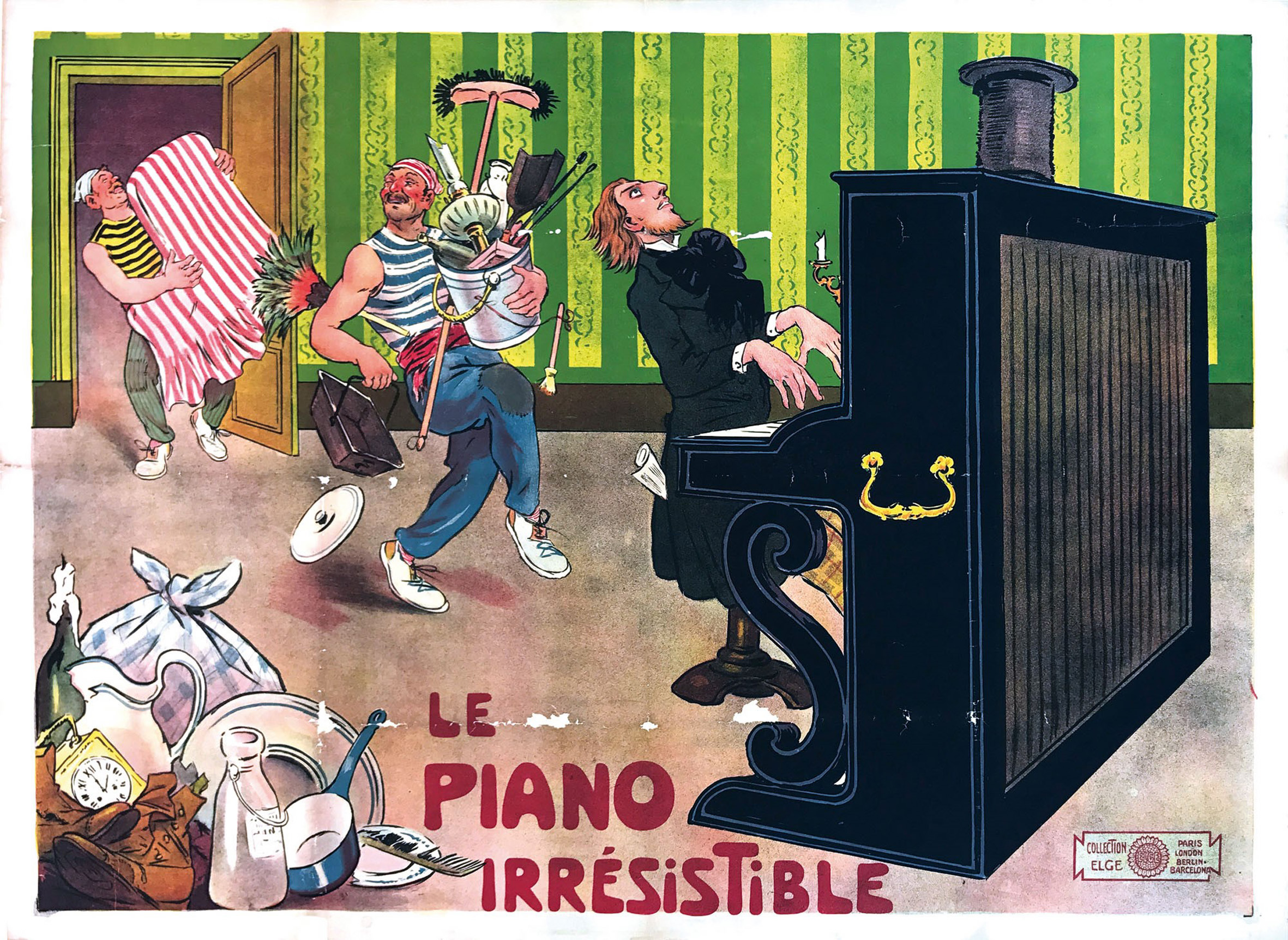
Figure 2: Advertising poster for Le Piano irrésistible. Private Collection. Public Domain.
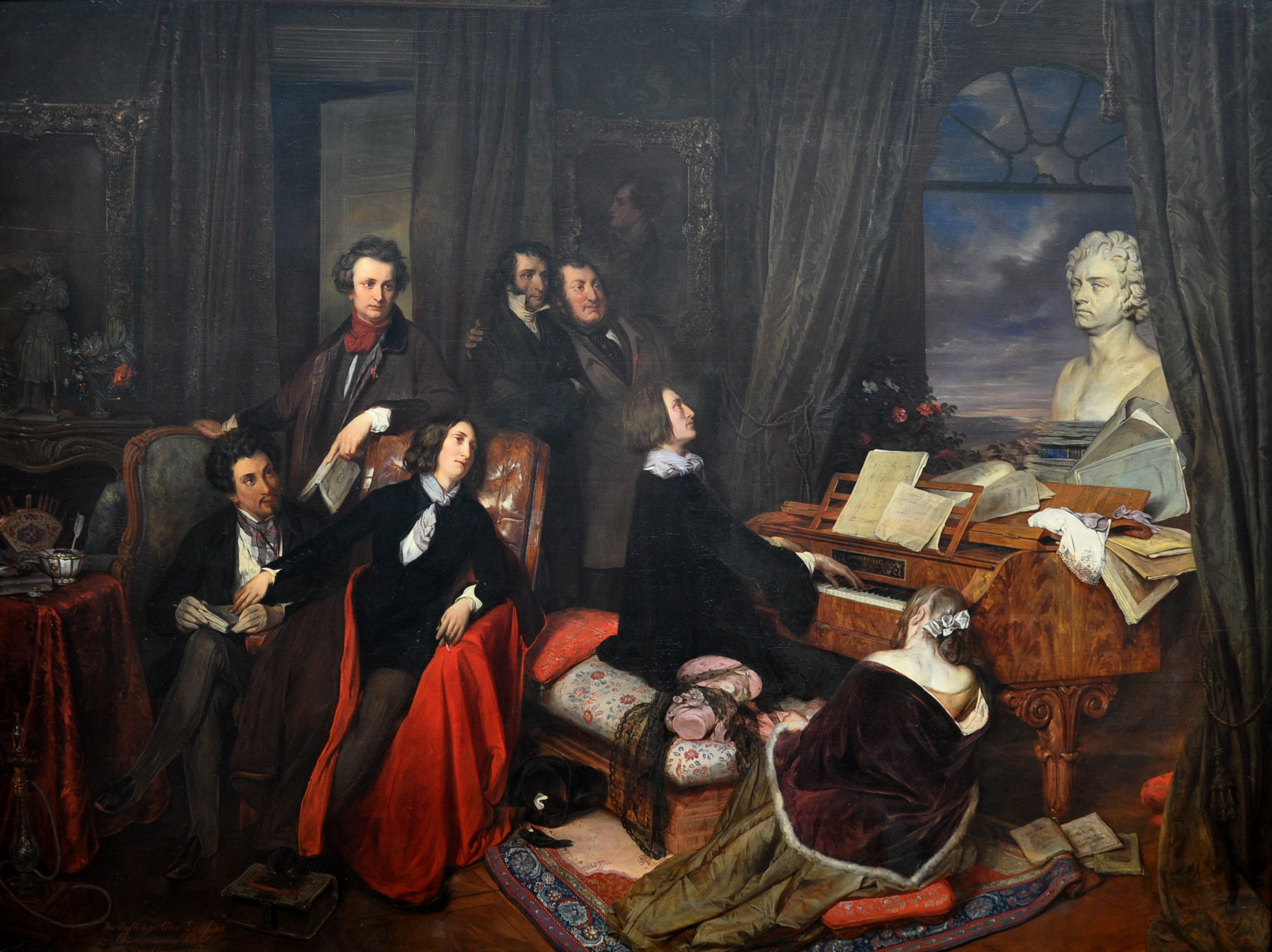
Figure 3: Josef Danhauser, Liszt am Flügel (1840). Alte Nationalgalerie Berlin, FV42. Creative Commons Public Domain Mark 1.0, https://id.smb.museum/object/968187
But other clues in the film suggest that the music performed is in an entirely different style—something more modern, such as ragtime. The step vocabularies of the dancers in Le Piano irrésistible are improvised, highly variable, and intentionally erratic. They also borrow some of the characteristic gestures of the cake walk, the first dance associated with ragtime to achieve popularity in France, having reached Parisian audiences in late 1902.32 For example, the elderly couple who begin to dance first prominently suspend their arms in front of the body, in a gesture that signals the loss of control (see again figure 1b), as does the woman in the second couple to dance. This same gesture was widely known as a signature motion of the cake walk—for example, it was a central feature of the dance as described by Gabriel Astruc in November 1902:
The dancer launches his body forward and turns his shoulders back, curving like a bent bow. He raises his arms horizontally, folds them in on themselves and simultaneously shakes them in jerks. Posed like that, with unstable balance, he throws one foot and then another out in front of him in alternation while raising the knees as high as possible.33
In addition to precise choreographic alignment with the cake walk, considerations of class and age may help decode the scene: while the first couple, middle-aged and financially secure, are outraged by the music’s intrusion into their lives, the young working-class seamstresses smile in delight as they begin to move. Perhaps the sounds are more palatable to a younger, female, and poorer audience, which would accord with ragtime’s associations with popular culture, vulgarity, and the lower classes.
As Gotman describes, ragtime and its related dance crazes, from the cake walk to the animal dances, were central to the discourse surrounding choreomania in the early twentieth century both on and off the cinematic screen.34 In France, the cake walk was often associated with danses épileptiques that had been popular on café-concert stages in decades prior, which were in turn influenced by research into hysteria and other choreic diseases by doctors such as Jean-Martin Charcot. This gave the ragtime fad a pathological flavor for many French audiences.35 Due to its origins in the dances of enslaved people on plantations in the American South, the cake walk was also highly racialized. Gotman describes how these associations merged with the medical connotations of the danses épileptiques to create a popular understanding of the new dance craze—and all the ragtime dance crazes to follow—as a “popular and social plague emphasizing youth culture and the contamination of black (as well as occasionally Latin) moves among primarily white people,” signaling a “racially marked hyper-locomotion and extreme gregariousness.”36 Depictions of choreomania often used the dancing body to both comic and subversive ends at the same time in ways that relate to choreomania’s racialized and politicized connotations that extended beyond its associations with ragtime specifically. Drawing on the metaphors of contagion described by Barbara Browning37 and Gordon’s work on pathological dancing in French culture, Gotman describes how the end of the nineteenth century saw an increased political charge to choreomania: that “[c]horeomaniacs were increasingly described as the social under-class, restless and uncontained” in ways that also played into common European anxieties concerning race and colonial control.38 Political and hierarchical subversion abounds in Le Piano irrésistible: for example, the head seamstress is enraged by the effect the music has on her delighted workers, a representation of choreomania’s power to subvert capitalist production. And when the policeman begins to dance on the street, a symbol of urban control and force is disarmed by the music, rendered just as silly and useless as any of the film’s other marionette-dancers.
The contradiction between the expected musical output of the Lisztian man and the modern choreic reactions of the dancers adds to the hilarity of the scene by creating further layers of dislocation and the subversion of expectations. By leaving the film open to an ambiguous musical meaning, the lack of synchronized sound removes a clear sense of musical agency from the dancers’ motions, heightening choreomania’s qualities of illogicity and disorder. Subception and live screening accompaniment could attempt to resolve this disjunction, but the contradictory cues in the visuals make any one interpretation unable to mitigate the tension between the pianist and the dance. This music-dance disunion furthers the illogical, subversive implications of choreomaniacal movement, and Le Piano irrésistible also politicizes the dealignment of music and dance by associating it with choreomania: freed from the regulative logic of a musical frame, dance becomes even more anarchic and able to wreak havoc on the structures of society.
Le Piano irrésistible ought to be viewed as one of a larger matrix of choreomaniacal and cake walk films that proliferated in the first decade of the twentieth century on both sides of the Atlantic—some of which offer alternate windows into the connections between dance, music, and disorder in ways that speak directly to the racialized associations of dancing manias. Many feature dancers in blackface such as Le Cake-walk infernal (Star, 1903), while The Dancing Nig (Essanay, 1907) largely shares the plot of Guy Blaché’s film and features a stock character drawn from the minstrelsy tradition.39 Other films of the period also depict a musician with the power to induce states of choreomania much like the pianist in Le Piano irrésistible. For example, we can look to The Hypnotist’s Revenge (American Mutoscope and Biograph, 1907), for which Gordon provides a synopsis: a hypnotist, intent on controlling a difficult man, plays violin at a dance, and the man
falls to the floor, jumps up and down like a monkey, lies on his back and rises kicking in an epileptic version of a Russian Cossack dance, leaps and jumps like a caf’conc’ performer, grabs a woman, then a valet, whom he spins wildly around by the waist, their feet off the ground, finally dragging a man onto the floor, until the horrified spectators are turned into “wild people.”40
Rather than viewing any of these dance films as truly silent, it is instructive to examine the role of generative sound in them as the source of their chaotic effect. By forcing dance apart from music and inviting the active participation of both in-theater musicians and audience members, these films challenge notions of agency and control in ways that mimic the disorderly, subversive movements of the dancers themselves.
-
An earlier version of this chapter appeared as: Sophie Benn, “‘… humble marionettes / The wires of which are pulled by fate’: Visuomusicality in Early French Comic Film,” in La Méthode graphique: Dance, Notation, and Media, 1852–1912 (PhD dissertation, Case Western Reserve University, 2021), 144-190.↩︎
-
Kristina Köhler, Der tänzerische Film: Frühe Filmkultur und moderner Tanz (Marburg: Schüren, 2016), 316-23; a version of Köhler’s arguments is also published in English as “Tango Mad and Affected by Cinematographitis: Rhythmic ‘Contagions’ between Screens and Audiences in the 1910s,” in Performing New Media, 1890–1915, ed. Kaveh Askari et al. (Bloomington, IN: Indiana University Press, 2014), 203-14.↩︎
-
“Si donc on voulait définir ici le comique en le rapprochant de son contraire, il faudrait l’opposer à la grâce plus encoure qu’à la beauté.” Henri Bergson, Le rire (Paris: Félix Alcan, 1900), 29; English translations are from Bergson, Laughter, trans. Cloudesley Brereton and Fred Rothwell (New York: Macmillan, 1911), 29.↩︎
-
“[…] allumée en nous par un principe supérieur, et aperçue à travers le corps par un effet de transparence.” Bergson, Le rire, 51; Bergson, Laughter, 49.↩︎
-
“[…] pour produire tout son effet, quelque chose comme une anesthésie momentanée du cœur.” Bergson, Le rire, 6; Bergson, Laughter, 5.↩︎
-
“Détachez-vous maintenant, assistez à la vie en spectateur indifférent.” Bergson, Le rire, 5; Bergson, Laughter, 5.↩︎
-
“Il suffit que nous bouchions nos oreilles au son de la musique, dans un salon où l’on danse, pour que les danseurs nous paraissent aussitôt ridicules.” Bergson, Le rire, 5; Bergson, Laughter, 5.↩︎
-
Rick Altman, Silent Film Sound (New York: Columbia University Press, 2004), 209-10.↩︎
-
Anonymous, “Exhibitions with Sense,” in Views and Films Index (4 January 1908): 11, quoted in Altman, Silent Film Sound, 209. Although Altman connects this quotation to Le Piano irrésistible in particular, the plot alluded to here is not that of the film, in which the pianist bangs at the piano only, and any property destruction occurs at the hands (and limbs) of the dancers. Perhaps the author was referring to another film or conflating Le Piano irrésistible and a companion film recorded on the same set in the same year, Le Frotteur (1907), which depicts much more violent property destruction.↩︎
-
Subsequent citations of this source: Georg Lukács, “Gedanken zu einer Ästhetik des ‘Kino’” (1911/1913), repr. in Kino-Schriften 3. Jahrbuch der Gesellschaft für Filmtheorie (Vienna: Verlag der wissenschaftlichen Gesellschaften Österreichs, 1992), 233-41; English translations are from Georg Lukács, “Thoughts toward an Aesthetic of the Cinema” (1913), in The Promise of Cinema, ed. Anton Kaes, Nicholas Baer, and Michael Cowan, trans. Janelle Blankenship (Oakland, CA: University of California Press, 2016), 377-81.↩︎
-
“Das ‘Kino’ stellt bloß Handlungen dar, nicht aber deren Grund und Sinn, seine Gestalten haben bloß Bewegungen, aber keine Seelen, und was ihnen geschieht, ist bloß Ereignis, aber kein Schicksal.” Lukács, “Gedanken zu einer Ästhetik des ‘Kino,’” 237; Lukács, “Thoughts toward an Aesthetic of the Cinema,” 379.↩︎
-
“Deshalb—und bloß scheinbar wegen der heutigen Unvollkommenheit der Technik—sind die Szenen des ‘Kinos’ stumm: was an den dargestellten Ereignissen von Belang ist, wird durch Geschehnisse und Gebärden restlos ausgedrückt, jedes Sprechen wäre eine störende Tautologie.” Lukács, “Gedanken zu einer Ästhetik des ‘Kino,’” 237; Lukács, “Thoughts toward an Aesthetic of the Cinema,” 379.↩︎
-
“Der Mensch hat seine Seele verloren, er gewinnt aber dafür seinen Körper.” Lukács, “Gedanken zu einer Ästhetik des ‘Kino,’” 237; Lukács, “Thoughts toward an Aesthetic of the Cinema,” 379.↩︎
-
“[…] sie eben nur Bewegungen und Taten von Menschen sind, aber keine Menschen.” Lukács, “Gedanken zu einer Ästhetik des ‘Kino,’” 235; Lukács, “Thoughts toward an Aesthetic of the Cinema,” 378.↩︎
-
“[…] das Wesen des ‘Kino’ ist die Bewegung an sich, die ewige Veränderlichkeit, der nie ruhende Wechsel der Dinge.” Lukács, “Gedanken zu einer Ästhetik des ‘Kino,’” 236; Lukács, “Thoughts toward an Aesthetic of the Cinema,” 378.↩︎
-
“[…] seine Größe und Poesie liegt hier in der Art, mit der seine Kraft aber keine Geschicklichkeit physische Hindernisse überwältigt, und die Komik besteht in seinem Erliegen ihnen gegenüber.” Lukács, “Gedanken zu einer Ästhetik des ‘Kino,’” 237; Lukács, “Thoughts toward an Aesthetic of the Cinema,” 379.↩︎
-
“Die Entziehung des Wortes und mit ihm des Gedächtnisses, der Pflicht und der Treue gegen sich selbst und gegen die Idee der eigenen Selbstheit macht, wenn das Wortlose sich zur Totalität rundet, alles leicht, beschwingt und beflügelt, frivol und tänzerisch.” Lukács, “Gedanken zu einer Ästhetik des ‘Kino,’” 240 fn 31, Lukács, “Thoughts toward an Aesthetic of the Cinema,” 379; emphasis in original.↩︎
-
“Les attitudes, gestes et mouvements du corps humain sont risibles dans l’exacte mesure où ce corps nous fait penser à une simple mécanique.” Bergson, Le rire, 30; Bergson, Laughter, 29.↩︎
-
“Tout le sérieux de la vie lui vient de notre liberté […] Il faudrait se figurer que la liberté apparente recouvre un jeu de ficelles, et que nous sommes ici-bas, comme dit le poète, … d’humbles marionnettes / Dont le fil est au mains de la Nécessité.” Bergson, Le rire, 80; Bergson, Laughter, 79.↩︎
-
Cf. for this and the following: Kélina Gotman, Choreomania: Dance and Disorder (New York: Oxford University Press, 2018), 30.↩︎
-
For more, see Anson Rabinbach, The Human Motor: Energy, Fatigue, and the Origins of Modernity (New York: Basic Books, 1990); Felicia McCarren, Dancing Machines: Choreographies of the Age of Mechanical Reproduction (Palo Alto, CA: Stanford University Press, 2003), 9-41.↩︎
-
Rae Beth Gordon, Why the French Love Jerry Lewis: From Cabaret to Early Cinema (Palo Alto, CA: Stanford University Press, 2002), 14-7.↩︎
-
Dominique Nasta, “Setting the Pace of a Heartbeat: The Use of Sound Elements in European Melodramas before 1915,” in The Sounds of Early Cinema, ed. Richard Abel and Rick Altman (Bloomington, IN: Indiana University Press, 2001), 95-109. Nasta had previously developed her theory of subception in Meaning in Film: Relevant Structures in Soundtrack and Narrative (Bern: Peter Lang, 1991).↩︎
-
Nasta, “Setting the Pace of a Heartbeat,” 96-7.↩︎
-
Nasta, Meaning in Film, 93.↩︎
-
Yhcam, “Cinematography,” in French Film Theory and Criticism: A History/Anthology 1907–1939, vol. I, ed. and trans. Richard Abel (Princeton, NJ: Princeton University Press, 1988), 69.↩︎
-
Ibid.↩︎
-
Ibid.↩︎
-
My thanks go to Wayne Heisler, who so eloquently articulated the significance of this feature after my presentation of this material at the annual meeting of the American Musicological Society in 2020.↩︎
-
For more on choreography, agency, and control, see Gotman, Choreomania, especially 15-20, 196-8, 271-84.↩︎
-
Here I am thinking of Mary Ann Doane’s arguments regarding the cinema’s unusual relationship with time and the medium’s function as an archive or other means to access the past. Mary Ann Doane, The Emergence of Cinematic Time: Modernity, Contingency, the Archive (Cambridge, MA: Harvard University Press, 2002).↩︎
-
There is a robust literature on the cake walk craze in France; for example, see Jody Blake, Le Tumulte Noir: Modernist Art and Popular Entertainment in Jazz-Age Paris, 1900–1930 (University Park, PA: Pennsylvania State University Press, 1999); Davinia Caddy, “Parisian Cake Walks,” in 19th-Century Music, vol. 30, no 3 (Spring 2007): 288-317; Rae Beth Gordon, Dances with Darwin, 1875–1910: Vernacular Modernity in France (London: Routledge, 2009), 145-97.↩︎
-
“Le danseur lance le corps en avant et rejette les épaules en arrière, prenant la courbe d’un arc bandé. Ce pendant, il élève les bras horizontalement, les tient repliés sur eux-mêmes et les agite simultanément par saccades. Ainsi posé, surveillant son équilibre instable, il lance alternativement un pied, puis l’autre, au devant de lui en haussant le genou autant que faire se peut.” Surtac [Gabriel Astruc], “Le ‘Cake-Walk,’” in Le Figaro (15 November 1902): 1.↩︎
-
Gotman, Choreomania, 271-97.↩︎
-
To this point, Gotman is mobilizing more research from Rae Beth Gordon: Gordon, “Les rythmes contagieux d’une danse noire: Le cake-walk,” in Intermédialités 26 (2010): 57-81; see also Gordon, Dances with Darwin, 14-97.↩︎
-
Gotman, Choreomania, 275.↩︎
-
Barbara Browing, Infectious Rhythm: Metaphors of Contagion and the Spread of African Culture (New York: Routledge 1998).↩︎
-
Gotman, Choreomania, 196.↩︎
-
For more on The Dancing Nig and other films with plots that revolved around sound from 1907 and 1908, see Altman, Silent Film Sound, 211-4.↩︎
-
Gordon, Why the French Love Jerry Lewis, 157.↩︎