Creative Practices of Early Tape Music
Michelle Ziegler 
Michelle Ziegler
How to cite
How to cite
Outline
Outline

The first issue of the American magazine Tape & Film Recording addressed a wide-ranging readership covering both “home” and “professional” sound recording (Mooney 1953). It portrayed the heterogeneous use of tape records in industry and leisure-time activities in 1953. Recording sounds and voices in home, office, plant, school or church served to preserve family memories of children’s voices or wedding ceremonies, provide party entertainment, overseas exchanges in “tape clubs” and the documentation of meeting notes in offices. They were also used in highly professional music productions. At the time, different production lines of tape machines – portable or installed, luxurious or functional, with new push buttons, microphones, cords and reels – already catered to the different needs of various individuals using tapes professionally or privately. The size and weight of the portable tape recorders allowed the user to record any kind of sound anywhere. In contrast to the established disc records, the medium of the tape not only simplified recording and playback, but it also made sound manipulation possible during and after the recording process itself by means of cutting, splicing and the use of loops, overdubbing and reverberation. A great variety of practices can also be found in the early artistic use of the tape machine, and it is documented in some of the preserved collections of tape records in composers’ archives. In this article I will argue that for a comprehensive evaluation of the compositional processes of early tape music, these sketches on tape have to be considered in connection with sketches on paper: Both reveal integral parts of the creative process.
Sources on Paper and on Tape: Visibility and Audibility
The main difference between music sources on paper and on tape lies in the perceptibility of the inscriptions for the human being: Whereas writing on paper can be perceived visually through reading, the core information of audio recordings is revealed in aural perception through listening.1 Writing on paper needs specific tools (pen, pencil, eraser, etc.) connected to specific uses in cultural techniques (see Schuiling and Payne 2022); the perception of the written signs and graphics usually does not require a technical mediator (apart from a light source and, if necessary, glasses). The musical realisation of the notation requires voices or instruments and knowledge of turning signs into sounds in the act of performance. Recording on tape however relies on technological equipment both in the process of inscription and playback (in the transformation of magnetic material on a tape by an electric current of an audio signal and in the reverse process of a magnetic imprint inducing voltage changes that are subsequently transformed into sound): The acts of writing and reading are transferred to a machine. The specific affordances of tape include the possibilities of instant playback, erasure and reuse. The procedures of writing on paper and recording on tape share core attributes as reproduction techniques; they can be regarded as an “intermedial field” (Celestini et al. 2020: 30) and a material practice. They entail transformations from one medium to another and capture an ephemeral phenomenon – sound – on a carrier, thereby fixing it in an appearance that is stable (at least for a limited moment in time). Due to their unique medial transductions,2 they both afford a whole set of unique operative possibilities which make them not only objects of communication, but tools with creative, explorative and cognitive potentials. The operativity of writing and recording has been explored in recent musicological and interdisciplinary research projects, which have revealed specific properties of both procedures as creative practices.
Recent studies have endeavoured to investigate the specific and unique visibility of music writing.3 References to the theories of notational iconicity (e.g., Krämer 2009) instigated an epistemological shift revealing the explorative and cognitive dimensions of music writing due to its materiality, operativity, performativity and iconicity. The element of operativity in this complex allows us to focus on the specific properties of writing that are connected to its materiality and visibility. Writing as an “explorative, productive, and self-reflexive tool” allows us to arrange, organise, hierarchise, add and delete on a writing surface, where the visual display lets us “evaluate and reflect” upon the notated (Ratzinger 2023: 242). Furthermore, this shift encompasses a great variety of music writing – and especially the heterogenous notations of the 20th and 21st centuries – including not only the various signs, like letters, numbers and other codified shapes of traditional European music notation, but also graphics and drawings. However, the visibility of music notation is a specific one: Writing and reading in the context of music imagination, composition, performance and analysis are always closely connected to thinking, hearing and performing sound. They reveal a unique bond between the visual elements and their aural equivalents: A “tipping” (Krämer 2009: 117) that is unique to music notation. Moreover, music writing as an element of a performative art captures musical gestures of melodies, inscribes the corporality of the performative act and transcribes performance (Celestini et al. 2020: 33f.). Intertwined in specific music practices, writing is determined by the aesthetics, compositional practices, specific historical moment and cultural practices of a given writer. The visibility of music writing is therefore specifically coined due to its proximity to sound and its embeddedness in specific performative, creative and historic practices.
It is evident that the new medium of the tape and its specific characteristics as an audio source gave rise to new compositional practices. The “expansion of organology” has projected writing “beyond its flat graphic dimension” towards new creative outlets that were born “from the relationship with the medium itself” (Cossettini and Orcalli 2017: xii). Two aspects unique to the new medium and echoing in the major shift from “symbolic” to “signal inscription” (Magnusson 2019: 13) are the disconnection of sound from its source and the importance of listening within the process of composition. Whereas in the act of reproduction entailed in writing on paper any given object – be it a sound, an image or another phenomenon – can be conveyed only in processes of translation into language, symbols and graphics; the phonograph and the tape allowed for recorded sounds to be dislocated from their original place and brought into ateliers, living rooms and auditoriums. Instant playback options invigorated creative practices by facilitating aural control. “Discrete histories” of the magnetic tape have recently highlighted such specific affordances and challenged a broader “phonographic regime” (Bohlman and McMurray 2017: 7). However, recording on tape did not only bring novelties into the creative processes. The change from one medium to another in artistic practices has to be understood as a process of mutual contagion; recording on tape protracts previous processes of writing on paper. Some early experiments in the electronic studios reveal an even higher reliance on prescriptive tools in the form of writing on paper compared to non-electronic music (De Benedictis 2004: 250) – a development that is rooted in the serial compositional techniques that were deployed at the time. It underlines the historical dimension of creative practices: In the act of composition, past techniques can be continued or transformed and new orientations can be sought. The artistic engagement implies both looking back and looking forward; in a “web of retention and protention” the “recursive, bidirectional temporal relation” of the act of creation allows routines, but also innovation (Born 2021: 10).
Challenges of Mixed Media Sources in Sketch Studies
To date, relatively little musicological research has been conducted on the magnetic tape as a creative means and analyses of compositional processes of early tape music are still rare – even if the equipment and technological affordances are attracting more and more interest in the field of media archaeology and edition philology (e.g., Cossettini and Orcalli 2017; Pasdzierny 2019). An inquiry into tape editing procedures has additional potential: The practices of montage and sound manipulation and the importance of listening in creative processes are precursors of current practices in electronic music, pop music and the digital arts. Tape manipulations are still not broadly considered an artistic practice because of reductions of historiographic narratives, aesthetic prioritisations and imbalances due to canonisations, social hierarchies and separations between so-called art music and popular music and due to the approach to the sources and their handling. Even if the access to the sources and the analytical tools to investigate them have improved significantly within the last two decades, there are still some challenges for studies of sources on tape (and on paper). One challenge lies in the sources on tape themselves, another one in the method of sketch studies and the imbalanced consideration of written and recorded sketches.
Already in the early 2000s, when the influences of the technological equipment on the creativity of composers of early electronic music started to be studied more widely, the preservation of the sources was considered a big challenge (Manning 2006: 81). The situation has improved noticeably in the meantime, thanks to the digitisation of big corpora of primary sources, the increased processing in archives and the expanded focus on a wider range of actors. However, the archival sources for tape music are still often scant and the preservation of the tapes is challenging. The conservation of analogue tape poses problems due to abrasions, mould and chemical processes that destroy the material. The disintegration of the tapes and the detachment of layers over the years lead to damages such as the vinegar syndrome (due to the breakdown of cellulose acetate in early tapes) and the sticky shed syndrome (due to hydrolysis in polyester-based tapes from the 1960s onwards). The standard procedure in archives is to sort out the damaged tapes immediately after arrival, restore the unharmed ones and digitise them, which creates another challenge. Even when all the tapes of a composer are available, the identification of tapes belonging to one composition can be difficult due to sketchy indications on labels or a lack of inventories. Many production tapes are overlooked, because they are not labelled. The only solution is to listen to all the tapes of a specific collection4 – and also: to listen to them in full length (because of the practice of reusing tapes, which sometimes leaves fragments of earlier recordings at the end of a superimposed passage). In short, listening becomes an important part of the research process.
In the analysis of the compositional process of tape music, sketches on paper and sketches on tape should be related to each other. This requires mixed methods and an expansion of traditional sketch studies (e.g., Zattra 2011). Since sketch studies have been historically established with written paper sources, the methodological framework subsequently still largely disregards other media. This, of course, is mainly due to the research focus on music of the 18th and 19th centuries (especially Beethoven), when paper was the main carrier medium for reproduction. Even recent approaches of genetic criticism focus on handwritten paper sources (Appel 2016: 1). But there is also a shift from this emphasis due to the change of the notion of a musical text and the improvements of analytical tools. In the process of relinquishing the bias of understanding the “work” of music solely as (written) “text”, all music information on traditional and non-traditional support materials such as magnetic tape, LPs, CDs and digital devices are considered a “musical text” (De Benedictis and Scaldaferri 2009: 82f.). Monographic studies of the music of the late 20th and 21st centuries strengthen this perspective by examining other technical means like floppy discs and software. Parallel to this change of the ontological understanding, the analysis of non-written sources has profited from a growing field of performance and popular music studies and from aural analysis in research on instrumental and electroacoustic music (e.g., Couprie 2016; Bonardi et al. 2017; Sudo 2021; Battier 2022). Furthermore, audio-visual documentations are crucial to empirical studies of the creative process of both electronic and popular music (Donin 2012; Acquavella-Rauch 2020). All in all, this expansion of the focus concerning the materiality of sources has contributed to a wider understanding of what constitutes a creative process.
Based on this short methodological outline, this article will now explore specific working practices, in which writing on paper and recording on tape play specific roles. Three examples show different relations between sketches on paper and on tape: 1) The separation of the two sketching practices (Bebe Barron and Earle Brown, respectively) 2) The interdependences of paper and tape sketches (Edgard Varèse) 3) Paper sketches supplementing the understanding of tracks on tape (Iannis Xenakis).
Separation of two Sketching Practices: Earle Brown’s Octet (1952–53)
Earle Brown created the piece Octet for 8-track tape in a specific work environment: The so-called Project for Music for Magnetic Tape (1951–54) was initiated by John Cage, who had tried for some time to establish a centre for experimental music with infrastructure for experiments with electronic music. In 1951, Cage convinced the architect and arts patron Paul Williams to finance the production of tape music within the project that he was going to conceive and organise together with David Tudor (Austin 2004: 193). Around the same time Cage and Tudor met the couple Bebe and Louis Barron, who had acquired an AEG tape recorder in 1948 and installed a studio in their apartment in Greenwich Village in New York in 1950. In this studio the Barrons would later create the iconic soundtrack for the science-fiction film Forbidden Planet (1956). Cage and Tudor approached them to work as sound engineers for the Project for Music for Magnetic Tape. They were hired to collect and record a library of six categories of sounds: “city sounds”, “country sounds”, “electronic sounds”, “manually produced sounds”, “wind-produced sounds” and “small sounds (requiring amplification)”. The Barrons also created their own tape composition For an Electronic Nervous System No. 1, which was premiered in March 1953 as part of the Festival for Contemporary Arts at the University of Illinois, Urbana, together with new tape works by Christian Wolff, Cage and Brown (Austin 2004: 193).5 Conceived initially as a creative partnership, Cage eventually preferred a decentralised model with a clear separation of labour (Iverson 2021). Whilst the Barrons contributed the sounds on tape, Cage, Brown, Feldman and Wolff elaborated scores, which Cage, Tudor and Brown realised later, spending hours cutting and splicing the tapes.

Figure 3.1: Earle Brown, Octet, score, p. 1, Paul Sacher Stiftung, Earle Brown Collection. Annotation by the author.
Even if the project was designed as an uneven partnership, both parts of the creative process need to be investigated in order to understand the making of these early tape pieces: the recording and combination of the sounds on tape by the Barrons and the scores and realisation by the four composers. However, the example of Octet by Earle Brown shows that an appropriate study of both processes is nigh on impossible due to an imbalance of documentation. The creative process of the Barrons to date can only be interpreted based on testimonies of the protagonists due to a lack of access to tapes and paper sources,6 whereas the composition of Brown is documented with a substantial number of sketches on paper preserved in the archive of the Paul Sacher Stiftung in Basel. Both of these processes are worth considering in an analysis of the creative process of the piece.

Figure 3.2: Earle Brown, Octet, detail of “Tape Score 8 Tracks (?)”, Paul Sacher Stiftung, Earle Brown Collection.
The working practices of the Barrons were built on substantial musical and technical experience. Both had a background in music: Bebe had studied piano and composition at Minneapolis University; Louis had been a music student at the University of Chicago. After using their recording equipment to publish audiobooks with “Sound Portraits” of Anaïs Nin, Aldous Huxley and Henry Miller, they soon realised that the tape recorder could be more than a device for recording sound. It could also be a creative tool to obtain unheard sounds by manipulating and reversing tapes and varying the playback speed (Brend 2012: 54). Later on, inspired by Norbert Wiener’s cybernetics, Louis built electronic circuits. By deliberately overloading them, the couple created new sounds, thus introducing a random element into their electronic music. Bebe was responsible for the compositional task, she listened to the tapes, then selected and combined the sounds (Eichenberger 2019: 43). For the Project for Music for Magnetic Tape, the Barrons created field recordings and collections of sounds according to the specifications of the composers (Straebel 2012: 108). In the process of restoring Williams Mix, one of Cage’s pieces created during the project, Larry Austin identified the “city sounds” as traffic noise punctuated by car horns, the “country sounds” as recordings of birds, crickets and frogs, the “electronic sounds” as high and low sine and pulse waves, the “manually produced sounds” as jazz piano and the “wind-produced sounds” as human voices (singing as well as spoken words, e.g., from film scenes with Humphrey Bogart). The “small sounds” were the most difficult to identify (Austin 2004: 209).
In contrast to the Barrons’ field recordings on tape, Brown’s composition was created on paper. In a score of 151 pages he defined the length and position of the sounds and the specific cutting and splicing techniques to be used for each of them (see Figure 3.1). A sketch indicates ten different cuts and eight different splices (see Figure 3.2). For the choice of the tapes from the Barrons’ library he essentially followed a recycling procedure; he used the tape scraps left over from the work of the other composers. The sketches and notes stored in the composer’s archive at the Paul Sacher Stifting bring to light the use of statistic procedures for defining the points of entrance of the sounds during the total time span of 3,000 seconds (divided into 30 sections of 100 seconds each) and their specific characteristics (length, cuts and splices). Brown stated in a description of the piece that the construction was “based on a ‘Table of Random Sampling Numbers’[7] such as those used in experimental scientific work” (quoted after a description of the Octet without title in the Earle Brown Collection). The specific sets of numbers determining each individual sound can be found in long lists. For example, the series “1, 3, 6, 5, 4(2), 8, 5, 8, 6” defines a sound on page 1 in track 3 (marked with an arrow in Figure 3.1). After the indication of the page (1) and the track (3), the subsequent numbers specify the starting point (at the fifth tenth of second number 6), the approximate overall duration (4 × 2 seconds), the specific ending point (before the eighth tenth of second number 14), the splice (no. 5 = “diagonal fit”, see Figure 3.2), and the cuts for attack and decay (cuts 8 and 6 = broken and straight diagonals, see Figure 3.2). On the basis of this specific cutting and splicing plan, Cage, Tudor and Brown realised the tape composition using what was left over from the tapes that the Barrons had created for the Project for Music for Magnetic Tape. Overall, the creative process was divided into sound production (a sound library realised on tape by the Barrons), composition on paper (a precise plan by Brown) and the production of the tapes (the cutting and splicing of tape by Cage, Tudor and Brown). It gave rise to a piece with extreme textural variety and density of sounds, which are perceived as subtle noise changes.
Interdependences of Paper and Tape Sketches: Edgard Varèse’s Déserts (1952–54)

Figure 3.3: Edgard Varèse at the Ampex tape recorder, Paul Sacher Stiftung, Edgard Varèse Collection.
For Edgard Varèse the search for new technologies to create music was a long and arduous path: Already in 1916, he told a journalist that he was looking for “new mechanical mediums which [would] lend themselves to every expression of thought and keep up with thought” (Varèse 1916: 6). Till the mid-century, his search for new sound resources was a long succession of disappointments and failed collaborations. In spring 1953, his situation changed when he got a tape recorder thanks to the support of the painter and doctor Alfred L. Copley (see Meyer 2006: 332). The Ampex 401 was installed in his studio in the spring of 1953 (see Figure 3.3) and Varèse started to record sounds in factories, sawmills, churches and on the street. He used these sounds for the tape interpolations of Déserts for winds, piano, percussion and tape (1952–54), but also for two short pieces of music he produced for the film Around and about Miró (1955) by Thomas Bouchard and for the Poème Electronique (1958). Déserts was premiered at the Théâtre des Champs-Elysées in Paris, and the tape interpolations prompted the famous scandal – not least due to the programme placement between Mozart’s overture in B-flat and Tchaikovsky’s Symphonie Pathétique in a regular concert series.
The tape part of Déserts has an eventful history: Varèse finished the first interpolation and a part of the second one in New York with the assistance of the sound engineer and composer Ann McMillan. He was then invited by Pierre Schaeffer to work at the GRMC (Groupe de Recherches de Musique Concrète/Studio d’Essai) in Paris, where he finished the second and created the third interpolation. After the premiere, Varèse altered the interpolations several times, first in Paris at the GRMC just after the premiere, presumably in 1958 in the Philips Studios in Holland while working on the Poème, and finally in 1960 at the Columbia-Princeton Electronic Music Center – creating “one of the most complex” corpora of audio sources in the history of electronic music (Cossettini 2017: 112).
The sources of the interpolations of Déserts stored in the Paul Sacher Stiftung and the Library of Congress show the interdependences of sketches on different carriers.8 The steps documented on tape comprehend the collection of sounds, their subsequent manipulation (especially in the third interpolation) and the process of revision. Varèse recorded different categories of sound: instrumental sounds (organ, flute, percussion) and environmental noises (machines in factories or traffic). Some of the remaining production tapes store collections of these sounds: the organ in the Church of Saint Mary the Virgin in New York, a percussion ensemble, noises from factories like Westinghouse, Disston, and Budd Manufacturers (tapes TS 42–44, 46–47, 51, 1001, 1003, 1010, 1016, 1018–19, 1038–39, 5008). Some drafts on paper defining the volume levels of the first and the third interpolation are connected to the sketching process on tape (see Figure 3.4). They indicate not only the variety of sounds used, but also show Varèse’s sound descriptions like “wailing” or “stuttering” including references to the origin of the sounds like “riveting” and “steam hammer”. On the first page, for example, the term “swishing” refers to one of the factory noises that is dominant in the first interpolation. These noises are combined with instrumental sounds like percussion (track 1 in blue at the beginning) or flute (track 1 in blue at second 20).

Figure 3.4: Edgard Varèse, Déserts, form plan of the first tape interpolation, Paul Sacher Stiftung, Edgard Varèse Collection.
The tapes show the composer’s special interest in this new medium, but also reveal parallels between the compositional procedures for tape and those for the instrumental parts of Déserts. Varèse created motivic connections inside the instrumental part by carefully integrating rhythmic cells of the percussion into the parts for wind instruments (see Ziegler 2022). He also wrote sections for percussion for the interpolations, recorded them and subtly combined them with the tape sounds of different origins. To sum up, the tape and paper sketches document compositional approaches connected to the new medium and show his general artistic concerns at the time: The integration and organic combination of noises and instrumental sounds. Hence, the sketching on tape and paper has to be considered in connection with the general compositional practices, techniques and aesthetics of the composer.
Paper Sketches Supplementing the Tapes: Iannis Xenakis’s Bohor (1962)
Iannis Xenakis already had substantial experiences as a composer of electronic music when he composed Bohor for 8-track tape in the professional studio of the GRM (Groupe de recherches musicales) in Paris. Bohor has been listed as the first 8-track composition of the GRM. However, it was still too early for it to be realised on 8-track tape, as 8-track tape machines were not available yet, so Xenakis used four stereo tape machines and created four stereo tapes. The composition portrays a “single, slowly evolving gesture” (Harley 2002: 39) and the entries of sounds are most likely conceived not by mathematical calculations but through close listening (Gibson 2015: 88). Xenakis’s approach shaped the piece’s historically novel sound characteristics, and it can be traced back to the sketches on tape and paper.

Figure 3.5: Iannis Xenakis, Bohor, scheme, Collection Famille Xenakis DR, OM 33–11, p. 10.
The sketches on paper in the archives of the Collection Famille Xenakis in Paris show two concerns that support the interpretations of the sources on tape. The first one is the use of recorded sounds of four different origins and the subsequent manipulation of them. Xenakis called the four tracks of the piece “piano”, “orgue”, “Byzantium” and “Irak” (see Figure 3.5). Reinhold Friedl has revealed that these terms may indicate the source of the sounds, but the piano might be a piano-tige, the organ is certainly not an organ but a Laotian mouth organ, etc. He argued that most likely Xenakis didn’t use a piano for the sounds of the first stereo tracks, but a Baschet instrument called piano-tige; those were instruments that were frequently used at the GRM at the time (Friedl 2019: 88). The label “organ” refers to Laotian mouth organ material; “Byzantium” and “Irak”, mostly to sounds of jewellery and bracelets from those countries and often bell-like sounds. Xenakis then manipulated the sounds: He transposed them by changing the playback speed of the tape machine, layered them and used echo, reverberation and filters in order to create a dense, constantly shifting sound environment. It allows the listeners to be immersed in sounds. In his scheme we can see the nuances of volume that Xenakis determined for the four tracks (see Figure 3.5).
The second aspect of note is the spatialisation, which was a concern in the whole creative process and led to new adaptations for performances in different concert halls (see Gibson 2015: 95). While working with Le Corbusier to create the pavilion for the 1958 Brussels World’s Fair and the “sound routes” that were built for Varèse’s Poème électronique and Xenakis’s Concret PH with over 400 loudspeakers, Xenakis had experienced the possibilities of sound spatialisation by electronic means first hand. In Bohor, the space as a compositional parameter is already considered in the choice of the aural characterisations of the four stereo tracks. The positions of the loudspeakers and the distribution of the eight tracks in concert halls is then carefully arranged. Although the scheme in the performance material of Éditions Salabert indicates that the stereophonic tracks are to be placed opposite each other, some sketches show that Xenakis made changes for some concerts after the first performance (see Figures 3.6a and 3.6b), adopting a circular or rectangular arrangement of the channels distributed to the loudspeakers. The spatial distribution of the channels is part of the interpretation, it has to be adapted in each performance of the piece according to the shape and the specific acoustics of a concert hall. By providing a range of different possibilities, the sketches of Xenakis’s own solutions give insights for the interpretation of the tape sources.
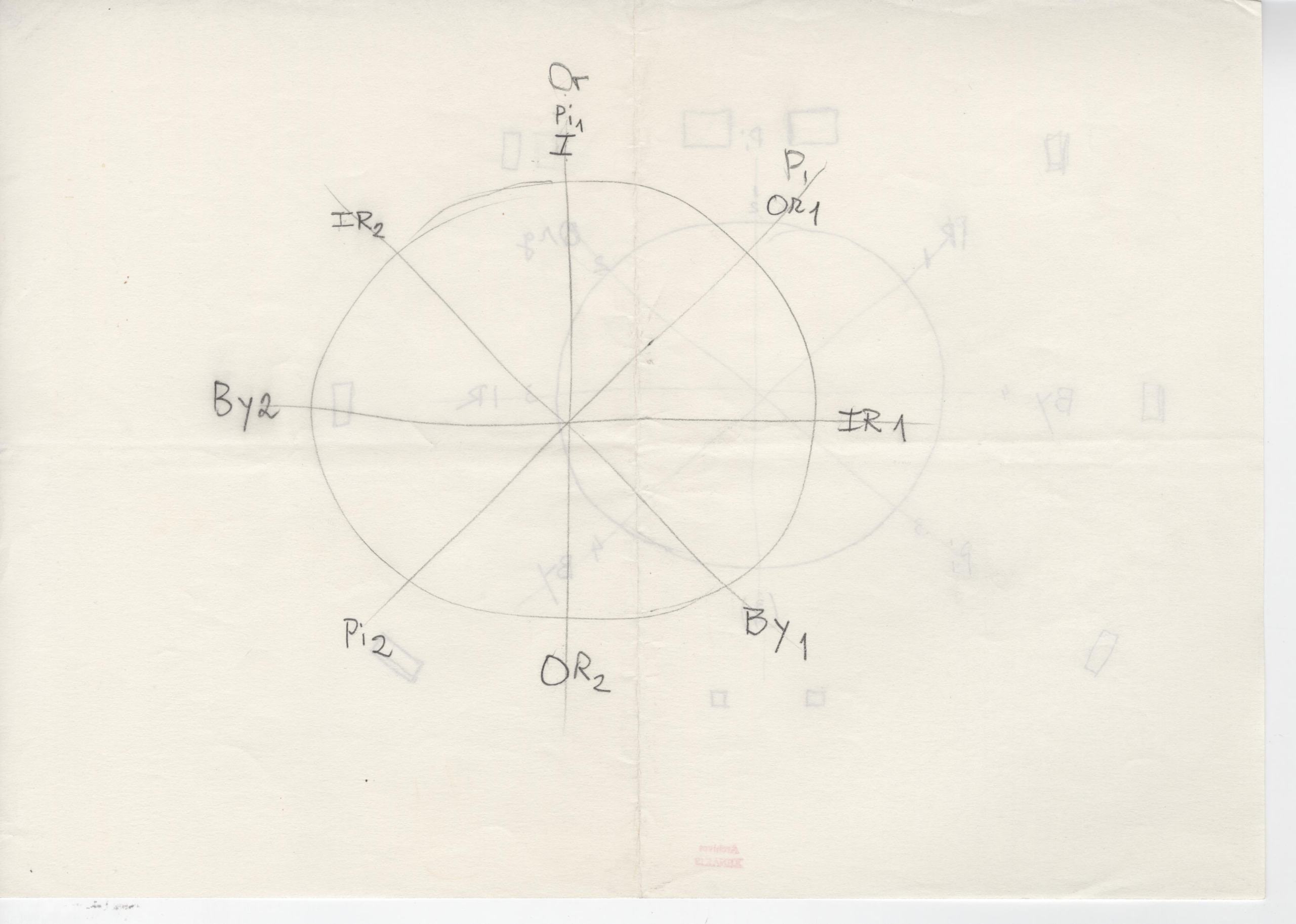
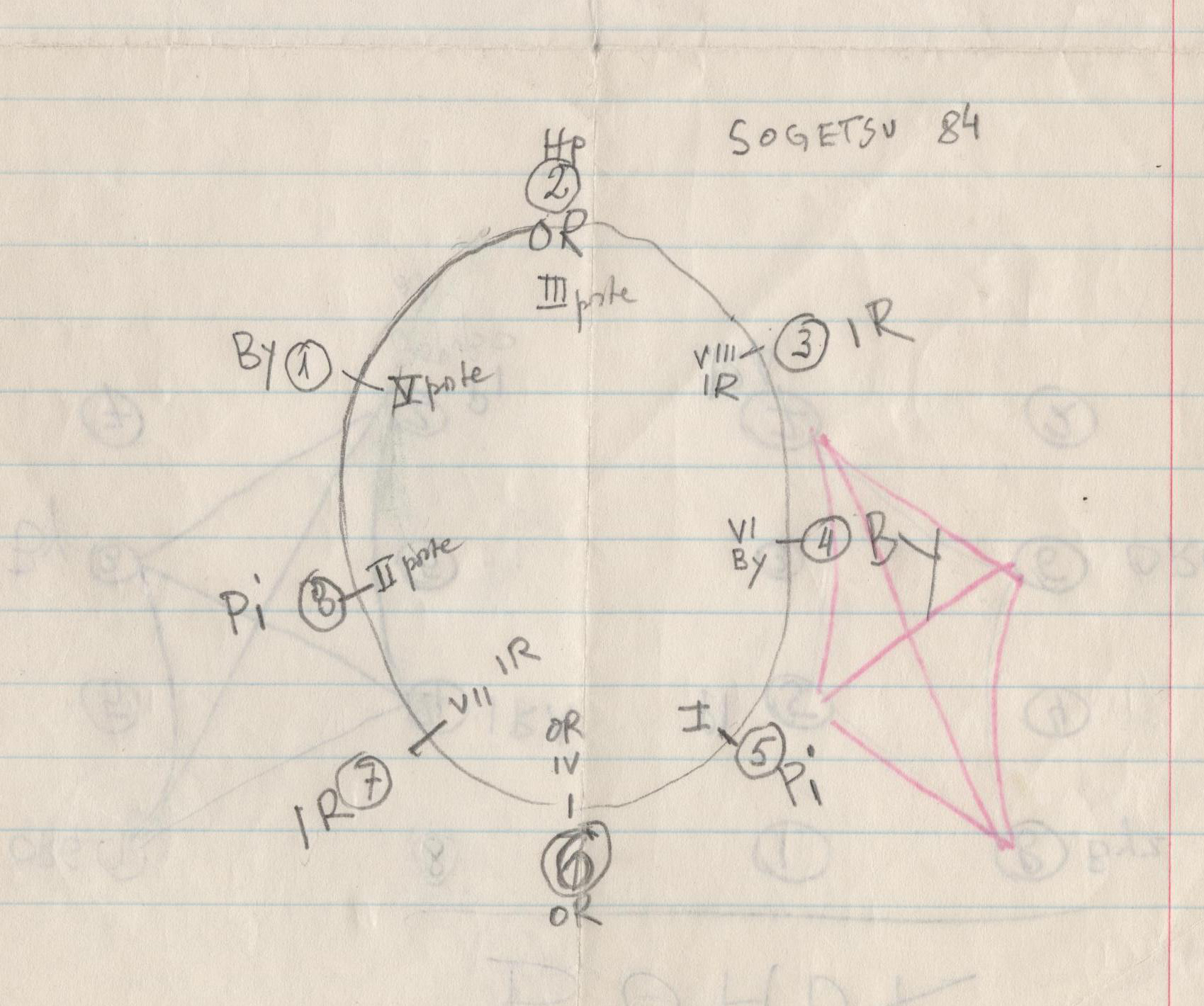
Figures 3.6a and 3.6b: Iannis Xenakis, Bohor, spatialisation sketches, Collection Famille Xenakis DR, OM 33–11, p. 6v, p. 14.
Conclusion: Expanded Sketch Studies and the Laboratories
of Early Tape Music
The inquiry into the compositional processes of tape music requires an approach that considers sources on tape and on paper. Listening, in this procedure, becomes a more important part of the analytical toolbox and complements the traditional reading of written sources. The sources then have to be interpreted in the context of the compositional practices of the composer at a certain time, which reveals, for example in the case of Varèse and Xenakis, new procedures due to the new medium of the tape, but also their general interests and habits both for instrumental and for electronic music at a certain time. Finally, this again has to be put into perspective by considering the specific projects or studios in their “manifold networks” (Goldman, Gribenski and Romão 2020: 641). The example of Brown shows that the composers had to adapt to the working procedures and the specific equipment; they aligned their own ideas with the given aesthetic, technical and structural setting of certain work environments. By opening the perspective from the sources to individual creative actors and to networks of actors, we get a glimpse of the full scope of the new artistic processes based on the technical reproduction of sound on tape. The proposition for expanded sketch studies, therefore, aims at an integrated approach to sketches on different carriers. It enquires into the studio as a working environment and into collective working practices. The goal is to understand the creation of early tape music as a heterogenous activity in a network of actors: a dynamic laboratory of sound.
***
This article is an outcome of my research on the materiality of notation in the DACH project Writing Music. Iconic, performative, operative, and material aspects in musical notation(s) at Paul Sacher Stiftung and a preparatory study for a project on tape music continued subsequently at the chair of History of Technology at ETH Zurich. I am grateful for the exchanges in both research projects and would further like to thank Simon Obert, Angela Ida De Benedictis, David Gugerli and the teams of the Paul Sacher Stiftung and the Collection Famille Xenakis for their support.
Endnotes
-
This general difference of course does not take into account the fact that writing as a material process entails accompanying aural elements (perceivable for example in the noisy process of the destruction of a draft on paper by crumpling or tearing and musically portrayed in the orchestra piece Schreiben (2003–04) by Helmut Lachenmann) and that tapes can be perceived and manipulated visually (for example due to the analogy of tape length and sound length or through the visualisation means of sonograms).↩︎
-
For the use of the term ‘transduction’ for processes of music writing: see Münnich 2019; for the interpretation of the term in Gilbert Simondon’s writings: see Assis 2017.↩︎
-
See the publication series “Theorie der musikalischen Schrift” of the project Writing Music. Iconic, performative, operative, and material aspects in musical notation(s), e.g., Celestini et al. 2020.↩︎
-
In certain cases, the sources are also accessible for computer analysis, in which the identification is supported through automated processes and search algorithms (see e.g., Grill 2012).↩︎
-
The pieces premiered in the concert were Williams Mix (1951–53) by John Cage, For Magnetic Tape (1952) by Christian Wolff, Octet (1952–53) by Earle Brown and For an Electronic Nervous System No. 1 (1954) by Louis and Bebe Barron. Two further compositions, Imaginary Landscape No. 5 (1952) by Cage and Intersection (1953) by Morton Feldman, were created in the course of the project.↩︎
-
This might change in the near future, as the Barron Electronic Music Archive is currently in the process of being digitised and made available for research.↩︎
-
Brown used Maurice George Kendalls and Babington Smiths Tables of Random Sampling Numbers (published by Cambridge University Press in 1951) in the compositional process of Octet, Twenty-Five Pages (1953) and Indices (1954).↩︎
-
Considering the high amount of analysis of the piece, it is startling that the sketches on tape have been examined only once in the analysis of the compositional process and only partially (Vernooij 2013: 153–157).↩︎
Bibliography
Acquavella-Rauch, Stefanie (2020) “Musikalische Schaffensprozesse 2.0 – Inkorporation audiovisueller Medien der populären Musik in Methoden der digitalen Edition”, in Brückenschläge zwischen Musikwissenschaft und Informatik. Theoretische und praktische Aspekte der Kooperation, ed. by Stefanie Acquavella-Rauch, Andreas Münzmay, and Joachim Veit (Musikwissenschaft: Aktuelle Perspektiven. Bericht über die Jahrestagung der Gesellschaft für Musikforschung 2019 in Paderborn und Detmold 3), 115–122; https://doi.org/10.25366/2020.101 (accessed December 11, 2022).
Appel, Bernhard R. (2017) “Beethovens Werkstatt. Genetische Textkritik und Digitale Musikedition”, in Wege der Musikwissenschaft. Beiträge zum Internationalen Kongress der Gesellschaft für Musikforschung 2016, ed. by Gabriele Buschmeier and Klaus Pietschmann, Mainz: Schott Campus; https://schott-campus.com/beethovens_werkstatt (accessed December 11, 2022).
Assis, Paulo de (2017) “Gilbert Simondon’s ‘Transduction’ as Radical Immanence in Performance”, in Performance Philosophy 3/3, 695–716.
Austin, Larry (2004) “John Cage’s Williams Mix (1951–3): the restoration and new realisations of and variations on the first octophonic, surround-sound tape composition”, in A Handbook to Twentieth-Century Musical Sketches, ed. by Patricia Hall and Friedemann Sallis, Cambridge: Cambridge University Press, 189–213.
Battier, Marc (2022) “Analyzing Electronic Music. Uncovering the Original Conditions of Production”, in Teaching Electronic Music. Cultural, Creative, and Analytical Perspectives, ed. by Blake Stevens, New York: Routledge, 58–74.
Bohlman Andrea F., and McMurray, Peter (2017) “Tape: Or, Rewinding the Phonographic Regime”, in: Twentieth-Century Music 14/1, 3–24.
Bonardi, Alain, Bossis, Bruno, Couprie, Pierre, and Tiffon, Vincent (2017) Analyser la musique mixte, Sampzon: Éditions Delatour France.
Born, Georgina (2021) “On Genre, History, and Invention in the Analysis of Creative Processes in Music”, in The Oxford Handbook of the Creative Process in Music, ed. by Nicolas Donin, 1–24; https://doi.org/10.1093/oxfordhb/9780190636197.013.4, (accessed December 11, 2022).
Brend, Mark (2012) The Sound of Tomorrow. How Electronic Music was Smuggled into the Mainstream, New York: Bloomsbury.
Celestini, Federico, Nanni, Matteo, Obert, Simon, and Urbanek, Nikolaus (2020) “Zu einer Theorie der musikalischen Schrift. Materiale, operative, ikonische und performative Aspekte musikalischer Notationen”, in Musik und Schrift. Interdisziplinäre Perspektiven auf musikalische Notationen, ed. by Carolin Ratzinger, Nikolaus Urbanek, and Sophie Zehetmayer, Paderborn: Wilhelm Fink (Theorie der musikalischen Schrift 1), 1–50.
Cossettini, Luca (2017) “Tracks in the deserts. Studying the electronic music by Edgard Varèse”, in Sounds, Voices and Codes from the Twentieth Century. The critical editing of music at Mirage, ed. by Luca Cossettini and Angelo Orcalli, Mirage: University of Udine, 109–136.
Cossettini, Luca, and Orcalli, Angelo, eds., (2017) Sounds, Voices and Codes from the Twentieth Century. The critical editing of music at Mirage, Mirage: University of Udine.
Couprie, Pierre (2016) “L’analyse de la musique mixte: vers une redéfinition des ‘workflows’ en musicologie”, in Regards sur les musiques mixtes, ed. by Marc Battier, Paris: INA (Portraits Polychromes 23), 231–247.
De Benedictis, Angela Ida (2004) “Scrittura e supporti nel novecento. Alcune riflessioni e un esempio (‘Ausstrahlung’ di Bruno Maderna)”, in La scrittura come rappresentazione del pensiero musicale, ed. by Gianmario Borio, Pisa: ETS, 237–291.
De Benedictis, Angela Ida, and Scaldaferri, Nicola (2009) “Le nuove testualità musicali”, in La Filologia Musicale: Istituzioni, Storia, Strumenti Critici, vol. II, ed. by Maria Caraci Vela, Lucca: Libreria Musicale Italiana, 71–116.
Donin Nicolas (2012) “Empirical and Historical Musicologies of Compositional Processes: Towards a Cross-fertilisation”, in The Act of Musical Composition – Studies in the Creative Process, ed. by Dave Collins, Farnham: Ashgate, 1–26.
Eichenberger Tatiana (2019) “Wie klang die Zukunft? Forbidden Planet und der Einzug elektroakustischer Klänge in den Science-Fiction-Film der 1950er Jahre”, in Lied und populäre Kultur. Jahrbuch des Zentrums für Populäre Kultur und Musik 64, ed. by Knut Holtsträter, Tarek Krohn, Nina Noeske, and Willem Strank, Münster/New York: Waxmann, 31–48.
Friedl, Reinhold (2019) “Performances in lannis Xenakis’s electroacoustic music”, in Exploring Xenakis. Performance, Practice, Philosophy, ed. by Alfia Nakipbekova, Delaware: Vernon Press, 69–87.
Gibson, Benoît (2015) “A propos de Bohor (1962) de Iannis Xenakis”, in Iannis Xenakis, La Musique électroacoustique, Proceedings of the International Symposium 23–25 May 2012, ed. by Makis Solomos, Paris: HAL, 83–96.
Goldman, Jonathan, Gribenski, Fanny, and Romão, João (2020) “A Connected History and Geography of Studios”, in Contemporary Music Review 39/6, 639–647.
Grill, Thomas, (2012) Perceptually Informed Organization of Textural Sounds, PhD thesis, University of Music and Performing Arts Vienna.
Harley, James (2002) “The Electroacoustic Music of Iannis Xenakis”, in Computer Music Journal 26/1 (In memoriam Iannis Xenakis), Cambridge: MIT, 33–57.
Iverson, Jennifer (2021) “Unstable Modernism in the Barron Studio”, in Modernism/modernity 6/2; https://doi.org/10.26597/mod.0215 (accessed December 11, 2022).
Krämer, Sybille (2009) “Operative Bildlichkeit. Von der ‘Grammatologie’ zu einer ‘Diagrammatologie’? Reflexionen über erkennendes Sehen”, in Logik des Bildlichen. Zur Kritik der ikonischen Vernunft, ed. by Martina Hessler and Dieter Mersch, Bielefeld: transcript, 94–123.
Magnusson, Thor (2019) Sonic Writing. Technologies of Material, Symbolic, and Signal Inscriptions, London/New York: Bloomsbury Academic.
Manning, Peter (2006) “The significance of techné in understanding the art and practice of electroacoustic composition”, in Organized Sound 11(1), 81–90.
Meyer, Felix (2006) “Varèse and his tape recorder”, in Edgard Varèse. Composer, Sound Sculptor, Visionary, ed. by Felix Meyer and Heidy Zimmermann, Woodbridge: Boydell & Brewer, 332.
Mooney, Mark, ed. (1953) Tape & Film Recording, 1/1.
Münnich, Stefan (2019) Musikalische Schrift und ihre Codes. Studien zu Genese, Theorie und Digitalität einer Wechselbeziehung, PhD thesis, University of Basel.
Pasdzierny, Matthias (2019) “Tonband, Partitur, Aufführung: Medien- und musikphilologische Überlegungen zur Edition von Bernd Alois Zimmermanns Requiem für einen jungen Dichter”, in Aufführung und Edition, ed. by Thomas Betzwieser and Markus Schneider, Berlin/Boston: De Gruyter, 217–232.
Ratzinger, Carolin (2023) “Complex Relations. Reflections on the operativity of writing music”, in Musikalische Schreibszenen / Scenes of Musical Writing, ed. by Federico Celestini and Sarah Lutz, Paderborn: Wilhelm Fink (Theorie der musikalischen Schrift 4), 231–248.
Schuiling, Floris, and Payne, Emily, eds. (2022) Material Cultures of Music Notation. New Perspectives on Musical Inscription, London/New York: Routledge (Music and Material Culture 1).
Straebel, Volker (2012) “The Studio as a Venue of Production and Performance: Cage’s Early Tape Music”, in Cage & Consequences, ed. by Julia H. Schröder and Volker Straebel, Hofheim: Wolke, 101–109.
Sudo, Marina (2021) The Nature of Noise. An Aural Analytical Inquiry of Noise in Contemporary Musical Practice: Xenakis, Lachenmann, Ablinger and Merzbow, PhD thesis, Katholieke Universiteit Leuven.
Varèse, Edgard (1916) interview, “Composer Varèse to Give New York Abundance of Futuristic Music”, in New York Review (March 11, 1916), 6.
Vernooij, Eveline (2013) L’organizzazione del suono in Déserts di Edgard Varèse. Implicazioni analitiche di una critica delle fonti, PhD thesis, Università degli studi di Udine.
Zattra, Laura (2011) Studiare la computer music: definizioni, analisi, fonti, Padua: Libreria Universitaria.
Ziegler, Michelle (2022) “Material – Prozess – Werkkontext. Eine Skizze zu Edgard Varèses Déserts”, in Mitteilungen der Paul Sacher Stiftung 35, 36–41.
List of Figures
Figure 3.1: Earle Brown, Octet, score, p. 1, Paul Sacher Stiftung, Earle Brown Collection. Annotation by the author.
Figure 3.2: Earle Brown, Octet, detail of “Tape Score 8 Tracks (?)”, Paul Sacher Stiftung, Earle Brown Collection.
Figure 3.3: Edgard Varèse at the Ampex tape recorder, Paul Sacher Stiftung, Edgard Varèse Collection.
Figure 3.4: Edgard Varèse, Déserts, form plan of the first tape interpolation, Paul Sacher Stiftung, Edgard Varèse Collection.
Figure 3.5: Iannis Xenakis, Bohor, scheme, Collection Famille Xenakis DR, OM 33-11, p.10.
Figures 3.6a and 3.6b: Iannis Xenakis, Bohor, spatialisation sketches, Collection Famille Xenakis DR, OM 33–11, p. 6v, p. 14.