Resonance, Affect, and Resistance in Open-Form Music–Dance Performance
Jan Schacher 
How to cite
How to cite
Abstract
Abstract
This chapter explores how sounding and moving mirror each other, how dancers and musicians rely on the same perceptual and affective phenomena. And equally, how for the viewer and listener, being connected to the performers is through a phenomenon of corporeal resonance.
Beyond the idiomatic elements of dance and music, intentions are transmitted through common bodily patterns. The artist’s inner states are completed and reconstructed by audiences and co-performers. The key element enabling the connection is Resonance, an intertwining in mutual adaptive oscillations by impulses, phrases, actions, and perceptions.
Resistance appears as a necessary catalyst and effort generator for heightened awareness states and tensions that contribute to a transformative performance. Pushing with body against body, through an ecological, embodied relation, the self, its agency, and the perception of time condense into a complex manifold that is negotiated by performers and audience alike.
Outline
Outline
Introduction
Sound can be perceived as movement, action, and intention, particularly when set in a frame that says “music,” “performance,” “stage,” and above all, “listen to me.” And movement may be perceived as sound, resonance, and vibration, as an enveloping action that creates a space of echo, melody, and rhythm. From the performer’s perspective the entanglement between making sounds and moving is central—between listening to and feeling oneself and the other, in proximity and intimately shared space.
In this chapter, I explore how the perceptions of sounding and moving mirror each other.1 I try to bring out what the experience of the combined performance and its inner traces can show that is not immediately apparent and measurable, but may appear to the outside viewer and listener through a phenomenon of resonance. I ask how the performer’s intentions are transmitted, how concentration and inner states of perception can and will be felt, completed, and reconstructed by the attentive audience or co-performers. I will draw from first-hand experience in a collaborative performance mode between sound and movement in an open, improvised form. I will also draw from literature on the subjects of the self, perception of agency, and the perception of time and memory, and will use the concepts of affect and resonance as lenses through which to study this particular state of affairs. With this frame I will attempt to contextualize tacit knowledge and experience gained in performance and to articulate and explicate it while looking for specific insights.
Our basis for sounding and moving in expressive and intentional ways is anchored in a sense of time and intensities that originates from our embodied nature. Somatic practices teach us how to listen to the body, sounding practices teach us how to listen to our actions, and both emphasize the relation to our environment and to the other. Awareness of both domains alters the way we prepare, perform, and think about the moments of sensory folding and compression during a sound-movement performance. Applying an embodied perspective when reflecting on music and dance, sound, and movement—considering them as twins intertwined on a corporeal level—can provide a key to understanding multimodal perception and expression.
Any performance with sound or movement is active in more than just the domain of their principal focus. A musician’s performance is tied to bodily actions and movements in the same way a dancer’s body is tied to melodies and rhythms. Translations occur, or rather shifts between explicit expertise and imprinted patterns. The movement dynamics in a dance phrase are tied to feelings of dynamic shaping of time, drawing on musical capabilities; the fluently executed instrumental phrase is drawing on integrations active on a somatic level (the sonic imagination of such a phrase, even, can originate from movement dynamics inscribed in the body).2 The multimodality doesn’t stop here.
Visual, spatial, kinesthetic, tactile, and other sensory channels are equally involved, and contribute to the density, or “thickness”3 of the performance. Their contributions are more difficult to discern, and their cross-domain effectiveness stays more hidden than the domains apparent on the surface. Nonetheless, it is only by taking into account and understanding the entanglement of all of the possible sense-modalities that the connection between sounding and moving should be approached. The question is for whom these entwined senses and schemata are active and how. It is evident that when talking of a performance situation, the artists are in focus: that is, musicians and dancers. But the performance situation is always a relational social moment, where the presence of audience represents a constituting factor. Co-performance arises not just between the artists but also between the audience and the performers. The sharing mechanisms at play between these actors may be resonance, embodiment, and affect, as will be discussed in the following sections.
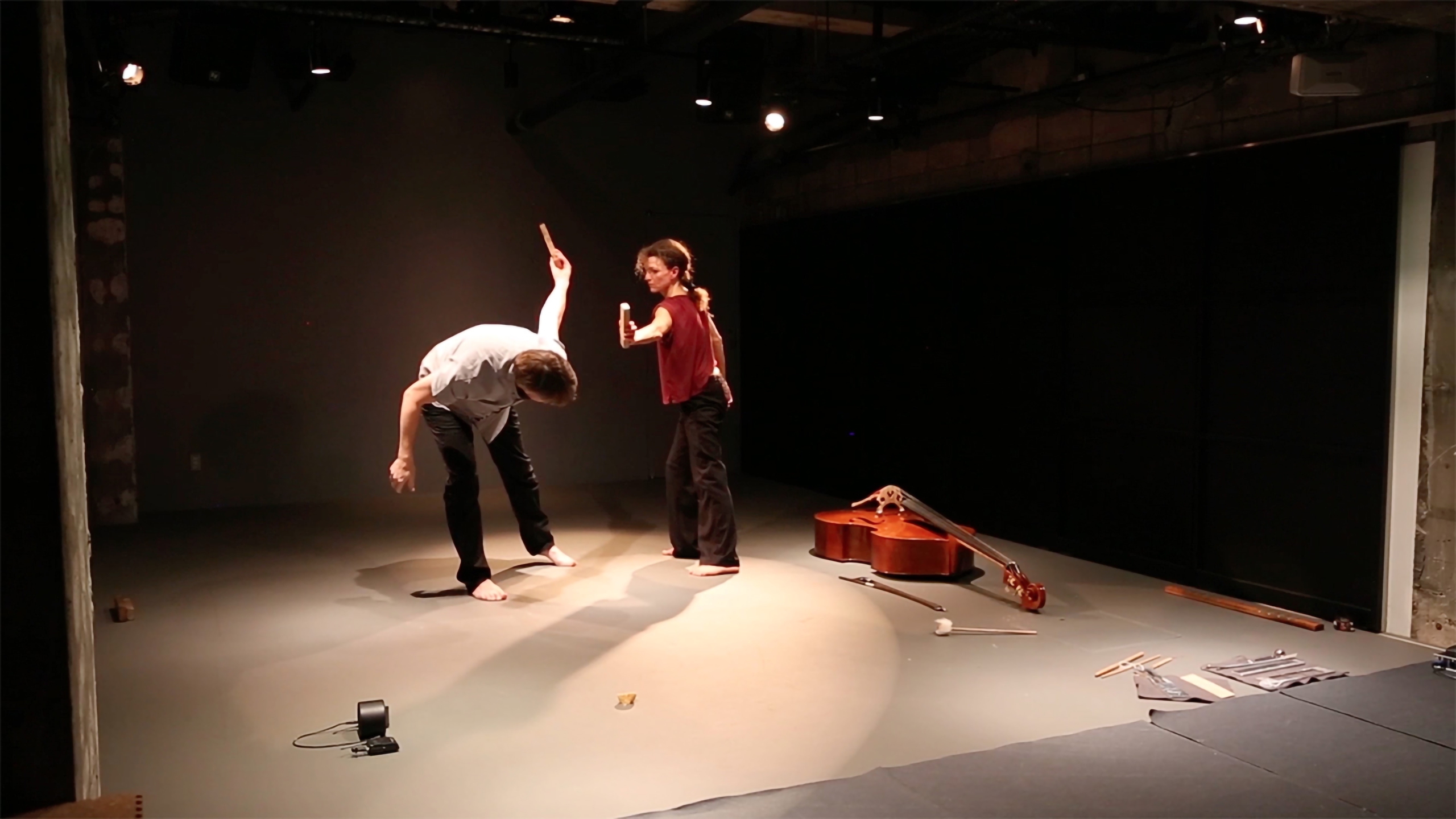
Figure 1: One hand clapping: Angela Stoecklin, Jan Schacher. 18.12.2015 Shinjuku, Tokyo, Japan. © Jan Schacher
Resonance
When a field of resonance is rolled out, an entanglement of sonic relations can take place. Through embodied interaction we are able to attune ourselves to one another in dynamic connections that run simultaneously in various directions, in a rhizome of affective and affinities connections.4
Resonance is a phenomenon known from physics, where an object or space enters into oscillation in response to a cyclical energy-input, be it through a sound wave or physical contact that excites the oscillation. In common language, resonance also denotes a person’s response to a communication or experience, resulting in an expression. Etymologically it is derived from the Latin sonare and might be translated as “re-sounding.” The central process of oscillation or vibration is qualified by an isomorphic or reciprocal response. The resulting relation is the central characteristic of resonance and is also why it functions so well metaphorically.5 Arguably, affective impacts in general and emotional responses in particular represent a bodily resonance response to a perceived event. Therefore, inter-personal kinesthetic responses represent resonance phenomena, albeit effective on a pre-reflective and somatic level, in a “tactilely and kinesthetically resonant” mode.6
For a performer, in the moment of adaptive self-control, when listening to and perceiving oneself in the context of action, a type of self-oscillation arises that acts as a regulation and energizing factor. Adaptive feedback and oscillations do not necessarily become conscious but have an impact on the performer’s self-perception and appraisal of the situation—perceived as the energy level of a performance and potentially distorting time perception.
For the public, the primary resonance is set in place when attention is given to the performance. The viewer’s and listener’s perception—in particular of bodily states, tensions, and dynamics constituting the action—is elicited by entering into resonance and empathy with the performer. For movement-based practice, this connection can give rise to perceivable bodily sensations in the viewer; in the auditory domain, the effect of sound dynamics is more subtle, but also present for the listener.
The presence of instruments as sound producers adds to the entwining, since playing them requires a bodily action. If sound is produced in a technologically mediated form, detached from a visible causal action, auditory perception still attempts to reconstruct the source of sound and produces a physiological response to it. This culturally acquired capacity is integrated to such a degree that the effect resembles that of a direct experience and can be leveraged as if the sound performance were immediate, for example in club dancing. When the cause of a sound is directly visible and attributed to a physical action, such as in a live performance, the physiological resonance will synchronize itself with the performer’s actions.
The act of listening demands an opening up and entering into a mode of resonance, which by itself already precludes an exclusive attentional focus.
To listen is to enter that spatiality by which, at the same time, I am penetrated […] it opens me inside me as well as outside, and it is through such a double, quadruple, or sextuple opening that a ‘self’ can take place.7
And even though focused listening resembles the act of pointing at something, the periphery’s presence remains much stronger than in the visual mode.8 Furthermore, listening is not merely a function of the ears; the entire body takes part in it as well, and is even capable of providing, if not a focal, then a very distinct global perception of the immersive aspects of sound through our capacity for vibratory perception. “Sound permeates and penetrates my bodily being. […] Listening begins by being bodily global in its effects.”9
Body and Environment Entwined
Through the body the world comes into focus and can be experienced. The experience of actions and their outcomes during dancing and music making, for example, are based on the education and acculturation processes acquired in childhood. They are also leveraging fundamental properties given by the body, such as creating a site where all the capabilities, impulses, and resonances come together, are filtered, channeled, and transformed by intentions. As Varela et al. state, the directed action with its intentionality is constituted by the potentials given by the situation.10 The entwining of body and environment form the basis for what is termed “enaction.” Sensorimotor “enactivism” claims that action, perception, and experience are intrinsically interlinked and co-dependent. The claim is that “perceiving is a kind of skillful bodily activity,”11 where the mastery of navigating the environment generates emergent experiential capabilities without the need for top-down cognitive input. The relation between sensory experience and movement, mediated by the skillful use of implicit, practical, and non-propositional knowledge generates perceptual experiences. In the continuous feedback loop between behavior and sensory stimulation, experience is inscribed on a pre-reflective, sub-personal level. Through the continuous and direct interaction with the context and by leveraging the practical knowledge obtained, experience of how sensory perception is generated and modulated as a function of engagement is accumulated into a guiding structure.12
The repeated process generates a habit13 that develops during and because of prior experiences,14 which is what produces practical knowledge in the form of the sensorimotor contingencies15 or affordances. The contingencies inform “the ways in which stimulation in a certain sense modality changes,”16 and are based on the active engagement of the organism, a fact that becomes central during intentional shaping of sound and movement.
Instead of internal representation through a type of cognitive model, by virtue of the enactive interweaving, the world itself becomes “an external memory” that is “probed at will by the sensory apparatus,”17 “guided by practical knowledge of the effect movement will have on” the sensory stimulus.18 In the different sensory modalities, different dependencies on patterns of contingencies exist. These patterns inform how “perceptual experience emerges from the continuous and reciprocal (non-linear) interactions […] and is thereby constituted by motor behavior, sensory stimulation and practical knowledge.”19 The sensorimotor position insists that there is no propositional or conceptual knowledge involved in generating an experience, and that having expectations—sub-personal protensive capabilities—concerning the variations effected by movement constitutes the central element of practical knowledge.20 Thus the “embodied” relationship with the environment obviates the need for internal symbolic representations.21
Rather than being based on propositional knowledge of a representational model of the world, so-called practical knowledge—that is, the imprint through continuous, adaptive, and reinforcing action-perception loops—can be considered to emerge out of a resonance phenomenon. The perceiving organism, through the repeated process of adapting to external impulses and the resulting environmental changes of its own action in a looping manner, enters into a resonance with its context. In fact, from its first engagement onwards, the perceiving organism never leaves the resonating relationship with its world; through its history of interactions it obtains a sensitivity to the changes in the environment, in a state of “attunement.”22 Through this interactional relationship that is taking place in a continuously self-reinforcing cycle, the adaptation to external environmental conditions serves to coordinate the behavior in the face of stimulation. Above all, it enables anticipation or expectation, which is the essential skill necessary to effectively negotiate changing situations. Experience can therefore be described as modulating patterns inscribed in the organism, where even “without being representational, these changes can still retain their causal power and allow for a bridge between the past and the present.”23
Affective Connections
As we have seen, relationality is the central element of performing between sound and movement, because the two disciplines activate perception and sensation on multiple sensory levels and invoke a number of basic social and cultural schemata. We can consider the two disciplines as a unified space with diverging manifestations, united by the underlying dynamic schemata, the cultural links of tradition, and the notion that despite the difference in “instrument,” dance and music evoke the same effects in performers and public. Both disciplines operate on the kinesthetic and energy levels, where an impulse and dynamic shape—a phrase, both sounding or moving—may trigger a response in the co-performer and partaking audience. This affective resonance
is not only a synchronization of performers’ articulations and expressions, perceived and contemplated by listeners. It is a convergence of many people’s experiences of being in the middle of a dynamic, interactive situation, where sense-making is formed at the intersection of moving (expression) and being moved (affect).24
Based on affect and pre-reflexive automatisms, interactions between performers and the transmission between performer and audience have their primary impact on the sub-personal, even physiological level; they often remain below the threshold of conscious perception. Affect in this situation denotes the physiological reaction to a stimulus; it forms the basis for feelings and emotions,25 but does not necessarily lead to them. The elusive affective qualities arise from
activation contours of the discrete affects26 and qualify the discrete affects, corresponding to the pace of rising and falling levels of their arousal […] [and thus] incite our own bodies into immediate mimetic response.27
The affective response through mimesis forms the basis for synesthetic sensations that arise when sound and movement are perceived as synchronous and analogous. The multimodal nature of perception reinforces the affective impact and linking of synchronous sound-movement pairs, in particular when they are temporally locked, i.e., in rhythmical synchrony.28 The fusion of two elements as a unified or dynamic “Gestalt”29 can also occur with mixtures between aspects other than the audio-visual. Furthermore, the fusion even occurs in contrasting situations, when only a few aspects correspond (such as timing, intensity, phrasing, or just shared space) and the principal ones diverge.
Simulation and mimesis represent the fundamental principles of connection through affects, reaching from biological, physiological processes to the social and cultural dimensions of the performance space; from core consciousness to the autobiographical self,30 on towards communication through social signifiers and codified situations.31 On these higher levels of integration, the implicit and pre-reflective processes given by affective linking still exert their power and are a precondition for subjectivity: “A long chain of affects, linking primordial biological emotions with social emotions and eventually with feelings, accompanies and structures the formation of subjectivity.”32
The affect relation that emerges from the (mimetic or voluntarily resisting) interaction in sound-movement performance in particular, is driven by the subjective position, yet extends to become an inter-subjective relation, a link that mixes mimesis, simulation, and projected intentionality.
Within these mixed capacities of the in-between, […] something emerges, overspills, exceeds: a form of relation as a rhythm, a fold, a timing, a habit, a contour, or a shape comes to mark the passage of intensities […] in body-to-body/world-body mutual imbrication.33
In the relationship with the other the aim is not knowledge, but communication as the primary form of interaction. Thanks to the affective, effective, transformative, yet elusive relationality of resonance,34 meaning arises from the other’s actions and triggers immediate responses without requiring a recourse to reflection. By the same token, the field that is established by social interactions is always-already present and intrinsically linked in the same manner as the link to the natural world. As embodied subject and relational being,35 the performer is always-already situated relative to the social world; the social dimension existing before being made aware, even if only “obscurely and as a summons.”36 In performance, then, these aspects are intensified and may be considered driving forces of the entwined involvement through action. There is no need for an “abstraction from the world;”37 meaning arises from those habits that have been cultivated and form a common ground.
Practice Modes and Attention
The practice of improvised performance, be it in music, sound, dance, or movement, detaches itself from central structuring techniques defined in the canon of performing arts. Although the practice remains strongly based on a person’s cultural background and previous dance, movement, and musical experience, many prescriptive norms and power relations are removed (e.g., musical score, fixed choreography, dependence on musical structure for dance structures, etc.). Instead, the practice of improvisation adds a different focus and puts additional demands on the performers. Compounding these demands, the synchronous, boundary-crossing sound-movement forms of joint music-dance improvisations increase the complexity but also the potential for compact, synchronous moments which are not possible with any other approach. The flow of elements and the chaining of actions creates a coherence, particularly through the multi-layered, situational links that the improvisors use to negotiate the space, which becomes more and more marked and filled with points of reference.
Bound, channeled, and helped by these resistances, in control of the direction or merely tumbling from one moment to the next, the improvising performer creates a continuously becoming present moment,
an unbroken now—something akin to what Gertrude Stein called a ‘prolonged present’38 to what William James […] called ‘a specious present’39 and to what Henri Bergson called ‘a live present’40—an ongoing flow of movement from an ever-changing […] world of possibilities.41
At the same time, the increased accumulation of knowns (experience) in the unfolding performance demands a movement away from certainty and fixity towards more unmarked space or towards a point of balance between the two. It “presses us to extend into, expand beyond, extricate ourselves from that which was known. It encourages us or even forces us to be ‘taken by surprise.’ Yet we could never accomplish this encounter with the unknown without engaging the known.”42 That which is present prior to the beginning of a performance serves to frame the improvisation, the situation, the life-state; it removes the existential threat that truly unknown situations pose, which would force the individual to act in modes of mere survival.
The “impossibility of improvisation”43 brings to the foreground the unavoidable influence of the already inscribed and pre-programmed that cannot be evaded. Qualitative differences arise in the balance between the known and the unknown, the amount of unmarked space and the situational demands. They reside on a sliding scale between reproducing or recreating the pre-given and the cliché of the well-established forms, and the materials and open spaces that exist without templates.
All improvisation takes place in relation to the known, whether the known is traditional or newly acquired. The only real difference lies in the opportunities […] to renew or change the known and so provoke an open-endedness which by definition is not possible in idiomatic improvisation.44
The task is therefore, as we are made to understand from Bailey’s statement, to push towards the open-ended, the re-configuration and translation of the given, rather than chasing after a clean-slate “new” which cannot exist.
Improvised performance inherits all the characteristics of performatively charged, ritual significations that are attributed to performances in general. However, given improvisation’s focus on recombining and recreating the given into something “new,” the demands on the attention of the performer and the audience are intensified and more resources need to be invested in order to fulfill the aesthetic, situational, social, and individual ideas, goals, and expectations. The highly concentrated state of the performer, for whom the challenge of the situation and the skills available should be in a balanced state,45 increases awareness and mobilizes more perceptual resources.
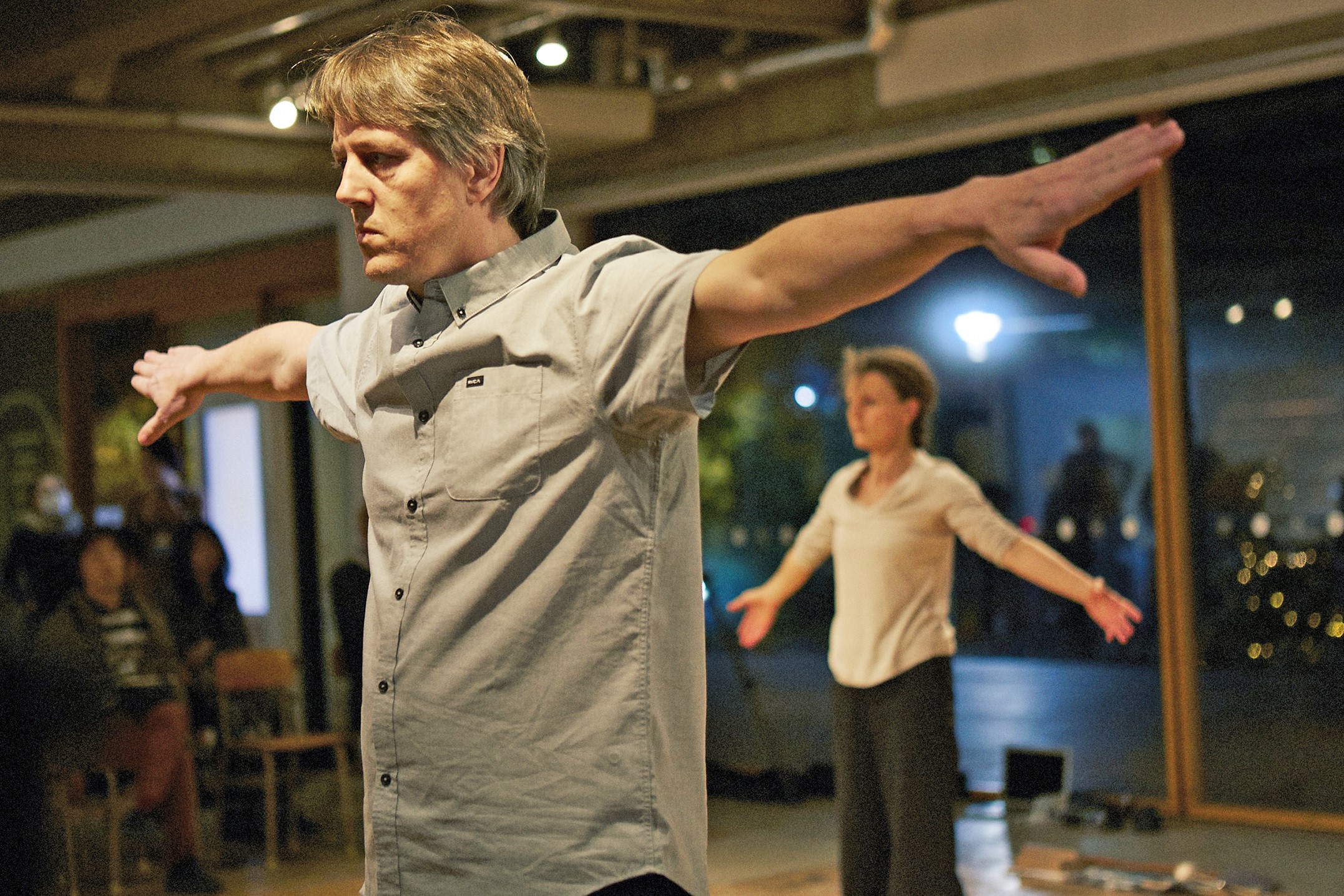
Figure 2: One hand clapping: Angela Stoecklin, Jan Schacher. 17.12.2015 Tokyo, Japan. © Jan Schacher
The concepts, specific forms, and preoccupations that inform and accompany the practice of improvised performance constitute a frame within which to inquire about those qualities that are at the core of experience. The core that is subjected to scrutiny lies in the experience of the artists, a perspective that is delicate, personal, subjective, and difficult to grasp.
From the Inside: Traces and Focal Points
The collaborative project “one hand clapping” took a practice-centered as well as dialogical and discursive approach to experiencing the encounter between music and dance. It did so by selecting improvised performance as the experience format, but also by actively investigating the states of presence, the shaping of compositional or choreographic form, time, and space on stage.
Through the cyclical process of doing and discussing, of experimenting, experiencing, and unfolding reflection, each artist and the project as a whole moved forward. The exchange between the artists, by sharing experience from two distinct disciplinary backgrounds, by sharing experiences from residencies and intercultural encounters, and by developing other projects in parallel, indeed generated some of the deepened understanding that was sought. As the fabric of experience grew, the unreflected aspects of the practice diminished and a strengthened knowledge of the other (discipline) developed.
The non-textual, non-discursive, irretrievable states and situations that formed the improvised actions exposed the intrinsic qualities of the shaped time-space and the materiality of the body. Embedded within the event of each performance they were indeterminate, excessive, and affective: indeterminate because they contained no narrative or representational intention; excessive because in their densely compressed, enfolded situations, more was contained than could be apprehended and extracted; affective because their signification and logic functioned more intensely on the level of kinesthetic, pre-reflective corporeal response than cultural meaning.
Nevertheless, performances in this mode are also always the site of knowledge. Some of the encapsulated knowledge is only ever present in the contingent, multi-layered, complex fabric that is made of the timespan, attention, tension, communication, and action within the performance. This “knowledge” or “know-how” is embedded within the practice and is about dynamics, shaping time, tension, bodies, sounds, and it develops with moving, sounding, relating, listening, watching, doing: a representation of a non-representational activity that resists, yet also depends on allusions and narrative references. Through this secondary, dialogical mode of performance, the knowledge situated in jointly performed dance and music is extended, even if only for us artists.
During an improvised performance, with a heightened state of attention and presence, different elements move into perceptual focus. A multi-focal field becomes activated that encompasses all the perceptual elements that are present and all the elements with which an active engagement is undertaken. The field is continuously shifting.
The following observations are based on memories written down immediately after improvised performances.46 “The attention cannot be fixed on a single focus for an extended time-span. The perceptual field is extended in different modalities at the same time, mostly in a peripheral, non-reflective way.” Even if engaged with one thing or activity, “the focal point may wander from space to situation, from sound-material to instrument (for a musician), from perceiving the inner affect and emotional effect to the outer, from the tension of the moment to the awareness of the overall shape of the elapsed time span, from the perception of my corporeal position and feeling to the relationship to the others.” Dividing up the senses in such a manner is not per se a problem. On the contrary, it is a necessary strategy to deal with the unforeseeable contingencies of the situation. The “squint-eyed” peripheral perception may take away concentration from a single point and distribute awareness more evenly. “The focal point is less acute, less exclusive, this gives more room to the surrounding field of elements.” Maintaining several domains in a peripheral awareness allows to switch rapidly and engage with a newly important level almost immediately. It also allows for engagement with multiple aspects in the field simultaneously, sharing the cognitive load across a wider range and “switching which layer the focal attention is oriented towards—it’s not really a continuously shifting attention, more a jump-like shift, attaching the attention to the dominant element, the one that demands the most attention.”
The performer’s perspective represents a subjective position where different levels of self-perception coexist: “Self-perception changes, I’m not self-aware but rather focused on the situation and the way the elements are intertwined.” Levels of self-perception range from an outward-looking, experientially transparent “being-in-the-moment,” to a diffuse perceiving of one’s own bodily state, to a more abstract observational state, that may include a self-narrative. The basis for these perceptions is to be sensitive to active components in the situation: “[I perceive] myself, the other, taking up the space, the initial impulse.” This grounds perception and the subsequent action in a relational field which is framed by intentions, affordances, and the other: “the initiative is with the other, I wait, find the impulse, it’s a shape, the beginning of a movement, is it an action? No instrument at hand but the body, still, I act with what there is, the hands—there is, will be a lot of body, shapes, actions, places … always in relation … to the other’s presence, to the other’s flow of energy and my own …” The different types of perceptual directedness that are pointing inwards or outwards engender varying perceptions and therefore provoke action or movement patterns that correspond to the site of attention. An example everyone recognizes from their own childhood is proprioceptively motivated swaying and spinning: “I discover the spin, I discover that by closing my eyes, I sway and that this is sufficient as an action for a while, standing still and doing nothing but swaying, until the urge to break out of this static situation arises—I take a few steps, everything changes, I do the same some more, it has intensified?”
Self-perception also extends to abstract, analogous, and image-based sensation: “The space envelops us, gives us a ‘shell,’ a skin to enter/play the game of inter-acting/inter-relating not with words and concrete meanings, but with more basic elements such as movement, sound, body-spaces-shapes, signs, rhythms, blocks of time, tension, receiving/giving impulses from within and without.” The experiences of the materiality of sound or the way that space envelops the doing are rooted in actual bodily elements. These perceptions, however, are not entirely based on imagery. Rather, they are based on resonance with known effects on corporeal equivalents, which get projected onto abstract, less immediately accessible aspects of the performance environment, as a kind of perceptual surrogate. This transfer enables a pragmatic handling of abstract environmental elements with the same perception and behaviors that are active for actual bodily experiences.
Space has different meanings during the performance. Naturally, the immediate surroundings and architectural characteristics inform and constrain the doing: “I remember being in the space and the light coming in through the large windows, the tan cork-floor and the white walls, serene, quiet space.” The presence of other performers, materials, props, walls, and specific features of the space create a secondary space, within which they are actively exerting forces of attraction or repulsion. The spatial relationship between each element creates tension, locations, and points in space that are mirrored in time. “Perceiving the other and what she is offering, perceiving my space and materials/instruments” guides the attention towards the physical anchors, which in turn trigger temporal points. By “giving attention to the junction points, [I perceive] the decision points that demand to be expected, anticipated, realized, perceived, and acted upon.” The blending of the architectural space with the action space as well as the temporal space—that is, the durational extent—represents a tiered space that is structured and subdivided in the same manner as the inner space of attention: “There must be at least three levels of perception: my stuff, the other’s stuff, and our stuff together, all packaged as one.” This highlights the similarities and differences between moving and sounding, between being “in space” and being “in sound.”
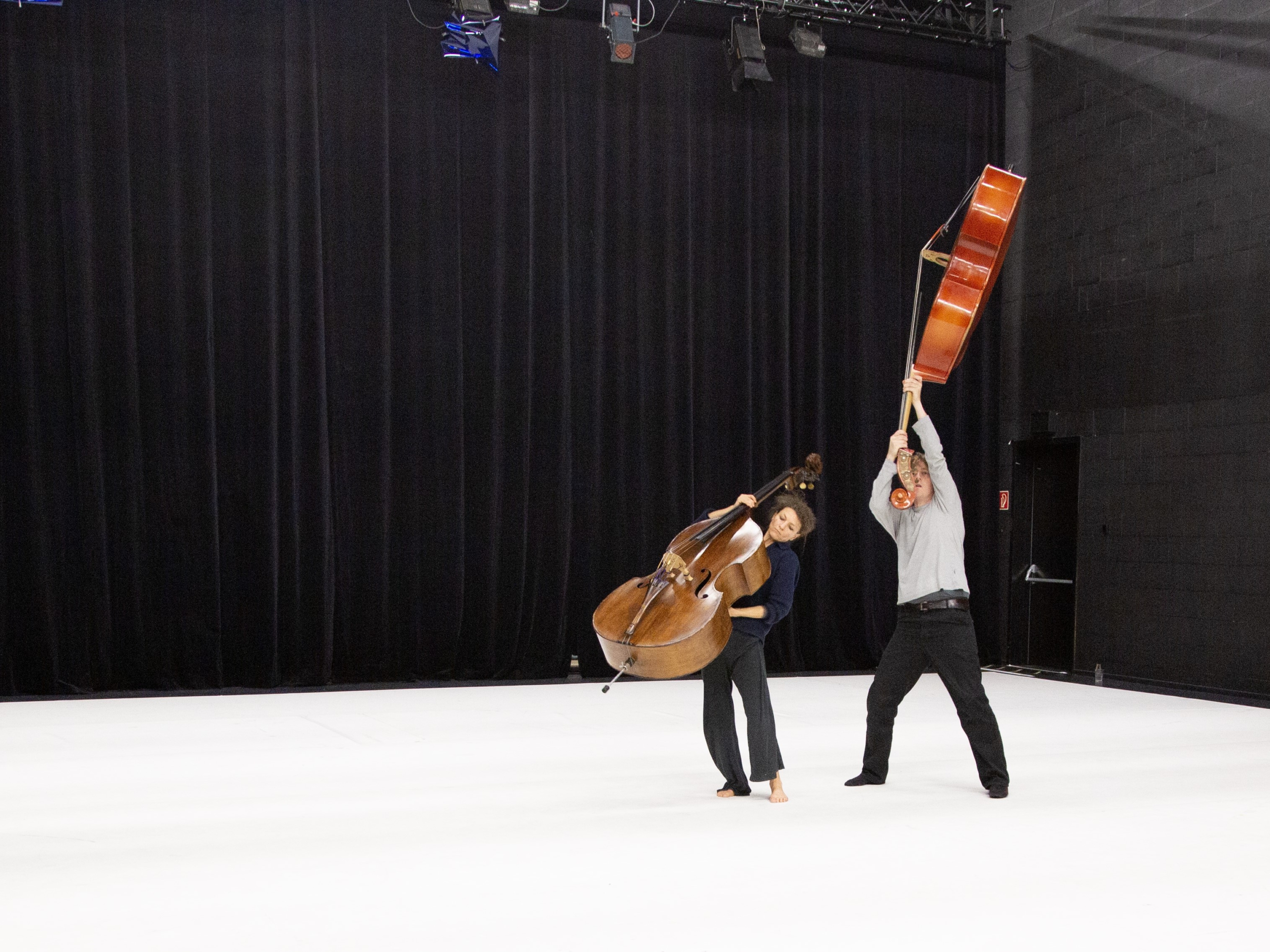
Figure 3: Angela Stoecklin, Jan Schacher. 09.01.2014 Bregenz, Austria. © Jan Schacher
Corporeal presence is the foundational focus of perception for both the performer and the audience, already active before attention is diverted to materials and forms of sound and movement. Each improvised performance begins by deliberately placing the performer’s body in space, by establishing physical presence as a primary material and significance. Colored by this precedence, all other physical elements, and in particular a human-sized object such as the double bass, inherit the perceptual focus on presence: “body, figure, object in space; the instrument can become a third body in space.” Playing the instrument as a source of sound immediately shifts its significance; object perception moves back to that of an instrument or tool. Even if the categorical character of the instrument determines “the difference between architectural object (a box), an unspecified object (a woodblock), and the highly culturally specific object of the instrument,” the intentional relationship determines the perception of its role and presence in the situation. This poses the question: to what extent “the instrument is a body, [and how it] can […] be perceived as an ‘agent’ or ‘figure’ as opposed to an object?” And “if the [double-bass] can have its own space and presence without me playing it, [is it] integrating into my body (extended) and my space [?]” Traditional instruments, in particular those with a figure-of-eight morphology, are immediately seen as figures, where “the contrast to the woodblock is quite striking, mainly because as an instrument, the woodblocks are relatively unspecific, whereas the double-bass is very highly specific and culturally charged.” If the instruments and objects have an independent presence, in relation to the human performers in a stage situation that is defined and established as space for interplay between bodies, the instruments and objects can obtain an agency and “figure”-hood that affects the performers and the audience alike.
Mediated Relationships
The most “immediate” or “un-mediated” type of a performer’s presence resides in the body and gets generated through physical presence. But is the body’s physical presence truly “immediate,” without any interspersed agencies? Can a musician’s body be perceived and understood without considering the role of the instrument and sound? And a dancer’s without the notion of technique?
For a musician, the instrument exists between body and sound, and always functions as a conduit and mediator between intention and expression. This “organum,”47 in some instances even the vocal tract, interjects transformations between the subject’s intentions and the sounding result. As with any tool, the instrument takes up the place of the performer’s own physical capabilities, and extends them; the technicity of instruments is therefore no different from that of any tool.48 The instrument mediates the musician’s corporeal actions, and enables the listener to recognize in the perceived sound—through knowledge of the sonic and timbral signature of the instrument and sound production physics in general—the goals and intentions expressed by the musician.
In sound’s presence, we recognize not only the contact between the performing body and the instrument, but also the sound intentions with which the music-making body makes his or her instrument resound. […] It is because of the intentional sound nature of the contacts between the performing body and the instrument that the morphology and the mechanics of the instrument can become a determining factor in the identity of the music-making body.49
By contrast, for dancers, movement, space, the body’s materiality, and its potential shapes in a dynamic flow are more “immediate.”
Nevertheless, translations are at work here as well, be it when considering the body as a material, when developing a semantic relationship to movement through choreography, through the historical relationship with style, and through the prior experiences that reside in a dancer’s movement skills and body techniques. In contemporary forms of dance and movement performance, the body often functions as medium and material as well as a signifier of sociality. It transforms the relation to itself and alters its own status, on several levels at once, not the least being the ethical dimension:
If dance is gesture, it is so, rather, because it is nothing more than the endurance and the exhibition of the media character of corporal movements. The gesture is the exhibition of a mediality: it is the process of making a means visible as such. It allows the emergence of the being-in-a-medium of human beings and thus it opens the ethical dimension for them.50
The directness of the dancer’s actions does not detach or remove the layers of signification and projection from the body. Therefore, perhaps, the dancer’s presence is only marginally more immediate than that of the musician with an instrument.
Resistance, then Connecting through Listening
Resistance is the complementary counterpart to resonance. When in a mode of resistance, the body not only does not willingly enter into sympathetic oscillation with an outside impulse, but it even blocks or diverts that energy. The transmission of an intention or an expression is diminished, and this in turn provokes a reaction. Where affective and effective forms in sound and movement constitute the basis for transmitting a performance’s impact, resistance is a necessary obstacle to create tensions, inflection points, and compression, and to move decision-making into unexpected, surprising, and less easily anticipated directions. Resistance can take on the form of a refusal to engage in a proposed interaction by the other performer. It may ask the performer to push through an uneasy situation. The increased effort necessary for dealing with resistance potentially heightens presence, urgency, and intensity. Invariably, the dynamics of the performance change; the “compositional” form obtains a defining edge.
But of course, claiming an antagonistic relationship between the principles of resonance and resistance does not do justice to the actual negotiation that is taking place. The creative frictions51 and the inter-individual differences between the musicians’ and the dancers’ states that are at play during a performance constitute one of its driving forces. Listening and sounding, kinesthetic and somatic proprioception, and movement expression are not always mirroring each other. They function as analogues and are always already present to different degrees in each individual, including both performers and audience members.
In the auditory sense modality, and building on the body’s resonating capacity, to be listening is to be (in-)tending “toward a present sense beyond sound,”52 where meaning develops. Listening bases itself on the will to understand, with the intentional component of experience. By the nature of sound, however, which constitutes as much the limit as the content, listening reaches “an edge, an extremity, a margin”53 and is reflected. If sound’s principal characteristic is that it exists through “a coming and a passing, an extending and a penetrating,”54 then its absent state, the edge of its manifestation at the auditory horizon is an essential component that is necessary for generating its meaning and sense in resonance.
The physiological, somato-sensory level of pre-reflective awareness may only generate a diffuse sense of self, but in an ecological, embodied manner55 engenders a “core self.”56 Reflective or explicit body perception builds on this level in order to contribute to constituting a sense of identity and providing the sense of “being-in-the-world.”
During a performance the musician oscillates between three modes of consciousness of self.57 The primary sense of self, which is embedded within the experience of the environment and the actions, is an indispensable and essential form of presence, and not just on stage. The performance is built on the foundation of a primary, pre-reflective, sub-personal awareness of the performing body and its extended body-schema which includes the instrument. In parallel, reflective awareness and attention gets focused on the intentional contents of the music, letting the body frame the experience in a “transparent” manner. Finally, the body can become the focus of awareness itself—an object in the shape of a represented body-image—constituted through a conscious reflection on the corporeal activity and the emerging resonances with the environment.58
Intertwined, enmeshed, the practice of improvised performance in the exploratory mode uses movements, sounds, actions, reactions, inter-subjective tensions, resistances and opening up through listening to give rise to a moment of intense becoming. The intensity resonates, affects, and motivates us to keep going, despite the uncertainties and risks caused by relinquishing control.
-
Parts of this chapter were previoulsy published in: Jan Schacher, Sound Presence, Performing with Bodies and Technologies, PhD thesis, Royal Conservatoire and University of Antwerp, Belgium (2017).↩︎
-
Beau Sievers, Larry Polansky, Michael Casey, and Thalia Wheatley, “Music and Movement Share a Dynamic Structure that Supports Universal Expressions of Emotion,” in PNAS 110, no. 1 (2013): 70-5, accessed 24 July 2022, https://doi.org/10.1073/pnas.1209023110.↩︎
-
Clifford Geertz, “Thick Description: Toward an Interpretive Theory of Culture,” in The Interpretation of Cultures (New York: Basic Books, 1973), 3-30.↩︎
-
Juliana Hodkinson, “Moving and Being Moved, Affective Resonance at Play in Sonic Performances,” in Performance, Subjectivity, and Experimentation, ed. Catherine Laws, Orpheus Institute Series (Leuven: Leuven University Press, 2020), 45.↩︎
-
The difference with re-flection is of course crucial as well. The optical phenomenon implies an active engagement with something past, a “turning back one’s thoughts.” Rodolphe Gasché, The Tain of the Mirror: Derrida and the Philosophy of Reflection (Cambridge, MA: Harvard University Press, 1986), 16. As an optical term, “reflection” describes the process of mirroring light and images.↩︎
-
Maxine Sheets-Johnstone, “Kinesthetic Memory,” in The Corporeal Turn: An Interdisciplinary Reader, ed. Maxine Sheets-Johnstone (Upton Pyne, UK: Imprint Academic, 2009), 265.↩︎
-
Jean-Luc Nancy, Listening, trans. Charlotte Mandell (New York, NY: Fordham University Press, 2007), 14.↩︎
-
Don Ihde, Listening and Voice: Phenomenologies of Sound, 2nd edition (Albany, NY: SUNY Press, [1976] 2007).↩︎
-
Ibid., 45.↩︎
-
Francisco Varela, Evan Thompson, and Eleanor Rosch, The Embodied Mind: Cognitive Science and Human Experience (Cambridge, MA: MIT Press, 1991), 206.↩︎
-
Alva Noë, Action in Perception (Cambridge, MA: MIT Press, 2004), 2.↩︎
-
Ibid., 119.↩︎
-
Maurice Merleau-Ponty, Phenomenology of Perception (London and New York: Routledge & Kegan Paul, 1962), 177.↩︎
-
Erik Myin and Jan Degenaar, “Enactive Vision,” in The Routledge Handbook of Embodied Cognition (London and New York: Routledge, 2014), 94.↩︎
-
J. Kevin O’Regan and Alva Noë, “A Sensorimotor Account of Vision and Visual Consciousness,” in Behavioral and Brain Sciences 24, no. 05 (2001): 939-73.↩︎
-
Daniel D. Hutto and Erik Myin, Radicalizing Enactivism: Basic Minds without Content (Cambridge, MA: MIT Press, 2013), 25.↩︎
-
O’Regan and Noë, “A Sensorimotor Account of Vision and Visual Consciousness,” 946.↩︎
-
Ibid., 970.↩︎
-
Evan Thompson, Mind in Life: Biology, Phenomenology and the Sciences of the Mind (Cambridge, MA: Belknap Press of Harvard University Press, 2007), 256.↩︎
-
Noë makes this point clear with the claims that “the work of the enactive approach is done by the perceiver’s expectations of the sensory effects of movement, not their knowledge of those effects.” Noë, Action in Perception, 119.↩︎
-
Myin and Degenaar, “Enactive Vision,” 90.↩︎
-
Ibid., 93.↩︎
-
Ibid., 94.↩︎
-
Hodkinson, “Moving and Being Moved,” 33.↩︎
-
Antonio Damasio, The Feeling of What Happens: Body, Emotion and the Making of Consciousness (New York: Vintage Books, Random House, 2000).↩︎
-
Silvan S. Thomkins and Carrol E. Izard, Affect, Cognition, and Personality: Empirical Studies (London: Tavistock Press, 1966).↩︎
-
Anna Gibbs, “After Affect, Sympathy, Synchrony, and Mimetic Communication,” in The Affect Theory Reader, ed. Melissa Gregg and Gregory J. Seigworth (Durham and London: Duke University Press, 2010), 192.↩︎
-
Jessica Phillips-Silver, C. Athena Aktipis, and Gregory A. Bryant, “The Ecology of Entrainment: Foundations of Coordinated Rhythmic Movement,” in Music Perception 28, no. 1 (2010): 3-14.↩︎
-
Rolf Inge Godøy, “Knowledge in Music Theory by Shapes of Musical Objects and Sound-Producing Actions,” in Music, Gestalt, and Computing (Cham, Switzerland: Springer International, 1997): 89-102.↩︎
-
Damasio, The Feeling of What Happens.↩︎
-
Jean-Luc Nancy, Corpus, trans. Richard A. Rand (New York: Fordham University Press, 2008).↩︎
-
Adrian Johnston and Catherine Malabou, Self and Emotional Life: Philosophy, Psychoanalysis and Neuroscience (New York: Columbia University Press, 2013), 33.↩︎
-
Melissa Gregg and Gregory J. Seigworth, The Affect Theory Reader (Durham, NC: Duke University Press, 2010), 13.↩︎
-
Hartmut Rosa, Resonance: A Sociology of Our Relationship to the World (Cambridge, UK: Polity Press, 2019).↩︎
-
Max Van Manen, Phenomenology of Practice (Walnut Creek, CA: Left Coast Press Inc., 2014), 225.↩︎
-
Merleau-Ponty, Phenomenology of Perception, 422.↩︎
-
Nick Crossley, “Phenomenology and the Body,” in Routledge Handbook of Body Studies, ed. Bryan S. Turner (London: Routledge, 2012), 137.↩︎
-
Gertrude Stein, Composition as Explanation, Second Series (London: Hogarth, 1926), 16-7.↩︎
-
William James, Principles of Psychology, vol. 1 (London: Macmillan, 1890), 609.↩︎
-
Henri Bergson, Matter and Memory (London: George Allen and Unwin Ltd., 1911), 176.↩︎
-
Maxine Sheets-Johnstone, “Thinking in Movement,” in The Corporeal Turn: An Interdisciplinary Reader, ed. Maxine Sheets-Johnstone (Exeter: Imprint Academic, 2009), 30.↩︎
-
Susan Leigh Foster, “Taken by Surprise: Improvisation in Dance and Mind,” in Taken by Surprise: A Dance Improvisation Reader, ed. Ann Cooper Albright and David Gere (Middletown, CT: Wesleyan University Press, 2003), 3-4.↩︎
-
Jacques Derrida, “Psyche: Inventions of the Other,” in Reading de Man Reading, ed. Lindsey Waters and Wlad Godzich (Minneapolis, MN: University of Minnesota Press, 1989), 28.↩︎
-
Derek Bailey, Improvisation: Its Nature and Practice in Music (Ashbourne: Da Capo Press, 1992), 142.↩︎
-
Mihaly Csikszentmihalyi, Flow: The Psychology of Optimal Experience (New York: Harper & Row, 1990).↩︎
-
For documentation of these performances see https://www.jasch.ch/one_hand_clapping.html and https://www.researchcatalogue.net/view/269265/272401 (URIs valid in November 2022).↩︎
-
Peter Szendy, Membres Fantômes, Des Corps Musiciens (Paris: Les Éditions de Minuit, 2002), 126.↩︎
-
Gilbert Simondon, On the Mode of Existence of Technical Objects (Paris: Editions Aubier-Montaigne, 1958).↩︎
-
Paul Craenen, Composing Under the Skin: The Music-Making Body at the Composer’s Desk (Leuven: Leuven University Press, 2014), 105.↩︎
-
Giorgio Agamben, “Notes on Gesture,” in Means without End: Notes on Politics (Minneapolis, MN and London: University of Minnesota Press, 2000), 57.↩︎
-
Stefan Östersjö, Listening to the Other, Orpheus Institute Series (Leuven: Leuven University Press, 2020), 89.↩︎
-
Nancy, Listening, 6.↩︎
-
Ibid., 7.↩︎
-
Ibid., 13.↩︎
-
José Luiz Bermúdez, The Paradox of Self-Consciousness (Cambridge, MA: MIT Press, 2000), 131.↩︎
-
Damasio, The Feeling of What Happens, 17.↩︎
-
Guy Pinku and Joseph Tzelgov, “Consciousness of the Self (COS) and Explicit Knowledge,” in Consciousness and Cognition 15, no. 4 (2006): 655-61.↩︎
-
Jin Hyun Kim and Uwe Seifert, “Embodiment musikalischer Praxis und Medialität des Musikinstrumentes—unter besonderer Berücksichtigung digitaler interaktiver Musikperformances,” in Klang (ohne) Körper, Spuren und Potenziale des Körpers in der elektronischen Musik, ed. Michael Harenberg and Daniel Weissberg (Bielefeld: transcript, 2010), 105-17.↩︎