Materialities of Dance Practices in Metal during COVID-19
Daniel Suer  and Florian Heesch
How to cite
How to cite
Abstract
Abstract
Our chapter focuses on dance practices in metal in times of COVID-19 by way of a case study. Of particular interest are tables, which serve diverse functions and contribute to the materiality of dance practices as well as their modification. The case study concert featured table pits as modification of common circle pits. The chapter asks: How can we analyze what people were doing at this concert? How did fans, sounds, things, and more interact? What might this teach us about the relation of materiality and immateriality in (popular) cultural practices? Our analyses focus on how the table pits start, how they relate to circle pits, and how table pits relate to musical form and other body movements, highlighting the heterogeneous elements that factor into dance practices. We argue that table pits illustrate a tactical logic of action. Finally, we propose a co-constitutive relation between the tables’ materiality, their discursive constructions, and their use by fans.
Outline
Outline

Introduction
Among the numerous practices that constitute popular music cultures, dancing seems to belong to those that are generally less dependent on material things. In contrast to practices such as DJing and other instrumental activities, mediatized listening, or production practices, the materiality of dance, not unlike singing, mainly relies on moving bodies—although clothing, hair styles, jewelry, and footwear (or their absence) are also relevant. In cases in which people actually dance around a certain thing, this thing is usually inscribed with significant cultural or even ritual meaning such as a maypole, a Christmas tree, or the Old Testament’s golden calf. Keeping this in mind, we would consider an observation we made during the COVID-19 pandemic in the summer of 2020 to be an oddity: At one of the few live events of the time—in this case a one-day metal festival—the audience danced around ordinary tables that are commonly found in beer tents. Originally, these tables were intended to ensure a safe distance between audience members due to the ongoing pandemic but, beyond that, they became part of the audience’s dance practices. Within our current research project on the relation of music and dance in heavy metal,1 this phenomenon caught our attention as it represented a fascinating constellation and entailed—as far as dance is concerned—a previously irrelevant actor in the form of the tables that turned out to be highly significant for the dance. We chose this event as a case study because we believe it provides us with insights into the flexible use of material things within music cultures and, despite it being a rather exceptional phenomenon, we can learn something about metal’s “regular” dance culture. In order to better understand what we observed, our article is guided by the following questions: How can we meaningfully describe and analyze what people were doing at this concert? What role did material elements such as tables play? Or to put it differently: How did music fans, sounds, things, and other elements interact? What might this teach us about metal culture? And what can we learn about the relation of materiality and immateriality in (popular) cultural practices?
In what follows, we will provide a more detailed, yet broadly focused, ethnographic account of the event in question, before zooming in on the specific dance practices we observed and their relation to the music and the tables. Building on these analyses, we engage in a discussion of our guiding questions in the conclusion. First, though, we will turn to our theories and methods to clarify our basic approach to research, how we conceive of music and dance as phenomena at the center of our investigations, which perspectives guided our view during field work, and how we went about analyzing our empirical material. All of these aspects are based on the notion that the phenomena we study and indeed our knowledge (not just concerning these phenomena) are characterized by their ineluctable situatedness.2
Theories and Methods
We conceive of dance as a practice that is performed in specific situations and which demands an accordingly situating and situated analysis. To do so, we use Situational Analysis (SitA), a methodological approach which was developed by Adele Clarke as a modification of Grounded Theory Methodology by incorporating postmodern lines of thought.3 SitA is a methodology which aims at capturing the complexity, heterogeneity, and situatedness of a phenomenon.4 In pursuit of this aim, Clarke proposes to focus on the situation as unit of analysis. Her specific conception of “situation”—building on theorizations from social sciences, pragmatist philosophy, and feminism5—goes beyond an everyday notion of the term by way of a partial dissolution so as to include an array of different elements and their relations spanning different times and places:
To clarify, in SA, a situation is not merely a moment in time, a narrow spatial or temporal unit or a brief encounter or event (or at least rarely so). Rather it usually involves a somewhat enduring arrangement of relations among many different kinds and categories of elements that has its own ecology. It usually includes a number of events over at least a short period of time, and can endure considerably longer.6
While Clarke states that the situation is not limited exclusively to individual points in time, her concept is also characterized by a high degree of elasticity which allows for different foci.7 Accordingly, researchers can zoom in on narrowly delineated moments (such as a single song at a concert or a single movement) or they can zoom out (to focus on different movements across different concerts, for example). As we investigate an aesthetic-performative case study in this article—as opposed to Clarke and colleagues who engage with aspects of the US-American health system—we make use of the former. This choice considers and is in line with established performance aesthetics that emphasize the transient and unique quality of each performance.8
The last aspect of the situation we want to point out in the limited space of this article is the co-constitution of the situation’s elements. Since our article (and this volume) is dedicated to investigating relations of music and dance, it seems important to us to clarify co-constitution as a heuristic device for the conceptualization of relationality. The elements that make up a situation are not completely isolated phenomena that simply accumulate in a situation, but they are entities that mutually constitute each other in the first place. As a result, this relational understanding dismisses the differentiation between a phenomenon or text and its context since all of the elements are part of the situation. This is how Clarke and her co-authors put it:
In SA the conditions of the situation are in the situation. There is no such thing as ‘context.’ The conditional elements of the situation need to be specified in the analysis of the situation itself as they are constitutive of it, not merely surrounding it or framing it or contextualizing it, or contributing to it. They are it.9
Applied to our research this means that a single element, e.g. the dance or the music, is not considered by itself with other elements simply surrounding it. Instead, these elements are viewed as constituting each other in situated interactive relations. When applied to dance, this means that dance is not just given movement but it comes into being through the relationality of bodies, movement, space, time, sound, media, light, and more. Accordingly, such a relational and situating notion does not construe music as isolated and given text. By considering its situatedness, heavy metal music becomes dance music, for example when people dance to it at a concert.
As researchers in the fields of science and technology studies, and sociology of health, Clarke and her colleagues are not primarily interested in aesthetic aspects.10 Our focus on music and dance, on the other hand, explicitly engages with our situation’s aesthetics, and to account for this difference we want to briefly point out our theoretical extensions of SitA. As stated above, we consider performance aesthetics to account for the fleeting character of the case study and the specificities of its bodily co-presence. Additionally, especially Fischer-Lichte’s deliberations of performances’ materiality offer us further sensitizing concepts for what kinds of elements participate in the situation and constitute it. These concepts include corporeality, spatiality, tonality,11 and temporality.12 In order to analyze music as an element of the situation, we make use of tools for the analysis of metal music developed by Dietmar Elflein13 as well as Allan Moore’s14 approach to rock music analysis, depending on which is rather suited for the musical material. With respect to dance movements we rely on a descriptive approach as found in literature from popular dance studies.15 While the former approaches rather tend to focus on the sounding music exclusively, we aim to observe it in relation to dance practices and other relevant elements, keeping co-constitution and a situation’s relentless relationality in mind. In order to heuristically conceptualize this relation, our last theoretical addition to SitA consists of Tia DeNora’s notion of affordance.16 Put briefly, musical affordances are music’s actionable qualities that are realized by people engaging with the music. According to this view, material objects lend themselves to certain actions more readily than to others based on their material properties.17 A ball, for example, lends itself to the action of rolling more readily than a cube. This concept was first developed in the realm of visual perception by psychologist James Gibson,18 and was appropriated by DeNora in a sociological fashion which posits the use of the object as paramount to what it affords. Applied to music, this means that music’s affordances do not reside in a musical text but are instead dependent on “the ways that those who hear it respond to it; how they incorporate it into their action; and how they may adapt their action […] to its parameters and qualities.”19 One example of what music might afford is that it can structure modes of embodiment. As a quite vivid example, DeNora describes what rhythm might afford:
Different types of rhythm may afford particular types of bodily movement. […] Rhythm may be said to ‘afford’ movement to the extent that it is perceived as profiling specific types of movement (e.g., tempos, energy levels, styles of movement) and these are acted upon to the extent that actors entrain their bodily movements to its properties.20
So, listening to a metal riff which consists of more than just rhythm, fans might headbang, body bang, mosh, or something similar according to what the music’s properties afford them. Importantly, music may afford all these actions, but it does not necessarily do so—music does not cause specific actions. This aspect is crucial in order to account for the variability of an audience’s movement behavior because it enables us to understand that the music might afford some audience members to move in a certain way while it does not to others. Since DeNora’s approach considers music’s materiality as well as its use by people, it shares common ground with Clarke’s notion of a materialist social constructivism. According to this view, Clarke argues, our analyses need to account for the material world while also considering how this material world is interpreted and ascribed meanings to by people.21 In that sense Clarke’s approach suggests the co-constitution of the material world as well as the discursive, ideological, or symbolic. In our view this compatibility facilitates the extension of SitA to include DeNora’s notion of affordances.
As we stated at the outset of this subchapter, we conceive of dance as a practice that is performed in specific situations and which demands an accordingly situating and situated analysis. In order to provide said analysis we opted for ethnographic participant observations of several events, one of which we want to focus on in this article. Daniel attended two out of three days of the Dong Moshbox and observed dance practices and their relations to the music and other elements. Since some of our earlier field studies have shown that the relations between music and dance in particular are too complex to rely only on committing them to memory and writing everything down after the event, we decided to film parts of the concert with a camera phone. In our experience it has become a common practice among audiences at metal concerts to record the event with a smartphone, so this did not seem as invasive to the field as a conspicuous camera set-up even if this would have yielded higher quality results. The recordings have proven to be immensely useful because, firstly, details in music and movement can be revisited; secondly, different dancers located at various positions within the concert space can be analyzed as they move differently to the same music (which was simply impossible in real time perception); and finally, the situated live performance of the songs can be analyzed regarding potential differences to the studio version and their possible relevance for the dance. Yet, the recordings also have their limits in terms of what frames and sections of the entire concert they grant us repeated access to. Therefore, we did not rely only on those recordings but also on field notes which were written down immediately after the event and contained, among other things, descriptions of portions of the event that were not captured on camera as well as the subjective experience of participating in the concert. Besides participation, field notes, and recordings, our analytic material also included the organizers’ communication with the audience before and after the event which mainly took place via their website and social media channels.22 This communication had noticeable consequences for the dance practices and is therefore part of the situation in question. In analyzing our empirical material, we made use of SitA’s so-called mapping strategies—especially situational and relational maps—which, put briefly, prompt researchers to map all of the elements pertinent to a situation and systematically investigate the relations among them.23 Now that we have laid out how we generated and analyzed our data, we will next take a closer look at the event on which these data are based.
The Dong Moshbox
The Dong Open Air is an annual metal festival founded in 2001 that takes place near Neukirchen-Vluyn, a rural area located in the west of Germany. In August 2020, the COVID-19 pandemic necessitated the reduction of the three-day festival to three consecutive but separate events with two bands each which was called the Dong Moshbox.24 Due to the uncertain development of the pandemic and resulting regulations, the event could only be announced a mere eleven days in advance via several online channels.25 Yet, while the pandemic was still ongoing and continuing to cause various restrictions in public life, the Dong Moshbox was permitted under the conditions of safety regulations because August 2020, in hindsight, was situated between the first and second “waves” of COVID and saw low infection rates. The safety measures, as legally prescribed by the state of North Rhine-Westphalia,26 and the ensuing adaptation of the Dong Open Air had several consequences for the situation we wanted to investigate. Located upon pithead stocks which were turned into a natural reserve and now function as recreational area, the Dong Moshbox took place outdoors which made the event possible in the first place since indoor events were prohibited at the time.27 The open air setting renders the weather a relevant factor, also for the dance. This could be observed at the Dong Moshbox by comparing the two days Daniel attended. The first day (which is our main focus in this article) saw mostly nice weather with sunshine and warm temperatures during the day and was accompanied by people strolling about, moving freely within the confines of the COVID regulations, and dancing. The weather on the second day, on the other hand, included repeated bursts of rain which immediately prompted many audience members to put on rain jackets and ponchos or, if available, gather under umbrellas. This in turn limited mobility as audience members seemed to be mainly concerned with not getting wet and less with dancing in the rain. While the first day’s weather certainly cannot be said to have “caused” movement and dance, we would state that at least it did not inhibit dancing as the weather did on the second day.
The organizers of the Dong Moshbox converted the federal and hence rather general COVID-regulations into an instruction manual that was tailored to the event’s specificities and which was mainly concerned with the spatial arrangement of human and non-human actors.28 This was picked up on again a week after the event when the organizers published a statement on their website, thanking all of those involved—not least the audience—for contributing to the success of the event under COVID-conditions.29 This claim to success strategically laid a foundation for potential future instances of the format should COVID still be an issue. Taking a step back again, what did the spatial set-up look like in 2020? The stage at the Dong Moshbox was positioned within a quasi-amphitheater that consisted of a circular flat space in front of the stage and which was surrounded by a rising crest. According to the organizers’ instructions, attendance was limited to 250 people, a distance of four meters was to be kept from the stage, single groups were not allowed to consist of more than ten people, and a safety distance of one and a half meters among audience members had to be kept at all times possible, except for the members within a single group.30 Besides written instructions in advance, the organizers made use of material means during the event, such as distance markers on the floor and tables and seating opportunities, to facilitate the spatial arrangement: “We want to make following the rules as easy as possible, so we’ll be setting up a number of tables around which you can gather.”31 Tables are by no means unheard of at metal concerts—usually they are placed in lounge sections or similar areas that are rather removed from the space immediately in front of the stage where the audience stands and dances. Significantly, this was different at the Dong Moshbox as almost the entire circular space in front of the stage was crowded with oblong tables and benches that would fit up to ten people.32 Instead of a rather free audience area, the spatial arrangement was dominated by the tables and mobility was limited to the alleys between them. These measures that aimed at regulating the actors’ spacing to minimize potential COVID infection risks—and which thereby turned something so seemingly profane as tables into hygienic agents—suggested consequences for the dance in advance which made it such an interesting case study.
We want to focus on the first of the two days Daniel attended the Dong Moshbox, when the two bands Crossplane and Rage performed. Despite the fans’ tangible enthusiasm and excitement to finally be able to listen to live music again, the audience adhered to the COVID regulations and mostly kept their distance from one another, aided by the tables. As soon as the first band, Crossplane, began, large portions of the audience stood up. During the first couple of songs, most people stood listening to the performance and the only movements were ones that did not require bodily proximity to other people and which could be performed by individuals on their own. These included conventionalized metal movements such as pumping fists or horns33 into the air in a rhythmically synchronous fashion, nodding one’s head or clapping, for example, and were performed with varying intensity throughout the entire evening. Addressing the audience in an announcement, the vocalist of Crossplane, Marcel Mönnig, stressed the importance of everyone complying with the COVID regulations, as did both bands several times during their performances. They argued that everyone present bore responsibility for possible future iterations of the Dong Moshbox and the wider metal scene, thereby echoing a widely dispersed discourse at the time surrounding large-scale societal responsibility in light of COVID. This included modifications to metal concerts and while the above-mentioned forms of movement remained untouched, adaptations included the impossibility of mosh pits and circle pits. Mosh pits are circular performative spaces that usually emerge in the audience in close proximity to the stage and in which moshing takes place. Moshing comprises several different movement interactions of audience members such as running seemingly chaotically across the space of the pit, running and jumping into each other, pushing each other, and more. Circle pits are similar performative spaces but instead of the mosh pit’s rather individualized interactions, the participants of a circle pit collectively run in a circle, most commonly counterclockwise. While there remain individual differences such as the running speed or single people who run in the opposite direction (i.e. clockwise), the majority of the members in a pit move rather similarly. Bearing the COVID regulations in mind, mosh and circle pits were not an option at Dong Moshbox if the audience was to comply with the rules. In that sense, all of the involved core actors—musicians, audience members, and organizers—had to constantly negotiate conventionalized practices that are part of metal concerts with what was acceptable regarding the COVID regulations. A creative outcome of this negotiation was a modified version of circle pits that was possible within the confines of the regulations and which was first encouraged by Mönnig: he asked the audience to do small circle pits around the tables. After the next song started with a four-bar guitar intro, most groups put that idea into action as soon as drums, bass, and vocals entered, and people started running around their tables. These table pits—a term coined later that evening by the vocalist of the second band, Rage—bore a striking resemblance to circle pits in that they also consisted of a circular, mainly counterclockwise collective motion, yet they also had a different quality. They seemed rather unwieldy, maybe even slightly clumsy, and lacked some of the flowing quality of circle pits which was probably partly due to the limited range of movement and the obstruction presented by the tables. Additionally, they also had a somewhat comical character as many jeans- and leather-clad, long-haired, and beer-drinking metal fans orbited around tables. The image also seemed to speak to the audience’s sense of humor as Mönnig’s initial demand for table pits was met with laughter and cheers by the audience. Additionally, the table pits made the impression of “domesticated” circle pits since there was no pushing or collisions of dancers within the rather orderly alternative, thereby lacking some of a circle pit’s transgressive character. Articulating that impression, Crossplane’s guitar player remarked that the table pits looked like the audience was engaging in musical chairs. The humorous quality was further exaggerated by a small group of people who ran around the entire amphitheater, inverting the distorted dimensions of the small table pits by turning the entire concert venue into one giant circle pit. Yet, from our perspective this comical character did not ridicule what the audience was doing. Instead, there seemed to remain a simultaneous sense of genuine bodily pleasure and appreciation since the table pits maintained corporeal similarities to circle pits such as plain exhaustion and the collective quality of the movement. Most of the table pits ran counterclockwise and most of the circular area in front of the stage was transformed into table pit areas. While the area covered by table pits exceeded that of circle pits we observed at pre-COVID concerts, there was a similarity in the location of the action. Mosh and circle pits tend to form close to the stage; similarly, the few tables at Dong Moshbox that did not perform table pits were located in the back of the circular space and hence in greater distance to the stage. Some of the table pits lasted remarkably long, ranging from about one minute to some that were maintained throughout an entire song. While that may not seem particularly long, it should be taken into account that it is quite exhausting to continuously run around in circles (as a counterpart to such continuous movement, regenerative phases such as announcements in between songs or intermissions in between bands are probably important). Considering the pandemic situation, it is noteworthy that hygienic masks were almost completely absent. Only a few crew members wore masks when moving through the audience. This probably supported the long duration of the table pits as masks make it more difficult to breathe and hence would have further increased the dancers’ exhaustion. Although the table pits were performed with enthusiasm by those participating in them, they occurred rather rarely throughout the performances, accompanying only two songs by each band: “I Will Be King”34 and “Dance with the Devil”35 by Crossplane, and “Black in Mind”36 and “Wings of Rage”37 by Rage. Other songs were met with less or even no movement at all.
Audience members used the tables in different ways besides table pits. Some audience members, for example, climbed upon tables in the course of the event, partly apparently to get a better view, partly to use them as stage of their own on which they played air guitar and performed other movements such as the already mentioned pumping fists. Finally, they were also used, as is usual in everyday life, as convenient seating opportunities and to place items upon such as beer bottles or phones. This in turn was commented on by Rage’s singer, Peter ‘Peavy’ Wagner, as reminding him of a beer tent and the popular Austrian/German music TV show Musikantenstadl,38 thereby once again emphasizing the comical aspect.
As we tried to illustrate with this short description of the Dong Moshbox, the table pits and the dance practices in general were situated within an arrangement of numerous elements that interacted with each other. There were certainly more elements that made up the Dong Moshbox (e.g. further actors such as fire fighters, food vendors, etc.), but we wanted to limit our focus to those that made a difference to the dance which is itself an element of the situation. The relevance of other elements to the dance is not always immediately obvious (although at times it is) but when attended to, we can grasp the contribution of factors such as whether the concert takes place within an outdoor or indoor setting, the weather, the addition of federal, regional, and event-specific COVID regulations, bodies, music, human and non-human actors and their spatial arrangement, musicians’ announcements, discourses that extend beyond the Dong Moshbox as an event, pleasure, appreciation, exhaustion, (the absence of) masks, or tables. The tables in particular illustrate that single elements in themselves can be surprisingly complex and need to be situated with respect to how they are used. Apart from serving as a piece of furniture around which people gather, the tables at Dong Moshbox were used as hygienic agents that were supposed to ensure safety distances, as objects that signify practices beyond metal such as a children’s game or Schlager music, as performance stages for audience members, and—most important to us—as an integral part of dance practices. Metal dance and its adaptation during COVID was possible at the Dong Moshbox through the incorporation of the tables into the dance and the resulting transformation of circle pits into table pits.
Music and Movement
Until now, we have described the situation at the concert with regard to some of the most important elements that interact in initiating the dance with the tables. What still remains open in our analysis is a closer look at the movements and the music and how these two relate to each other: How do people actually move in that somehow experimental practice that is labeled “table pit”? And how are these movements related to the music? As these questions lead to the core of our research interest, we are going to spend particular attention to them. We do not aim to privilege the aesthetic aspects of dance and music over the other elements of the situation. Rather, and in synch with the concept of SitA, we understand them as being closely intertwined in the interaction of all elements. At the same time, we read SitA as a challenge to take all relevant relations within a situation into consideration, hence even the as yet hardly investigated relation of heavy metal music and dance.
As described above, table pits did not happen during the whole event, but only during the performances of two songs by the bands Crossplane and Rage. To analyze the relation of movements and these songs, we rely on a mixture of empirical data including (1) Daniel’s field notes, (2) his video recordings from a certain point close to the back of the amphitheater, (3) additional footage of the same event published on YouTube by an audience member from a perspective close in front of the stage, and (4) studio recordings of the relevant songs. Although in general, no live performance can be memorized or documented in its entirety for a later analysis,39 combining the diverse mentioned empirical materials proved to be helpful for an approximate performance analysis, because they allow a view of the event from multiple angles, each of them providing certain details.
How the Table Pits Start
During the performances of both bands of relevance here (Crossplane and Rage), the initial impulse for starting table pits came from their respective singers. As Crossplane opened the second day of the festival, the band’s singer Marcel Mönnig played a crucial role as individual actor at the event since—a few songs into their set—he introduced the idea of table pits to the audience as an unusual but legitimate type of collective movement under the pandemic circumstances at the time. At some point of Rage’s later performance, their singer Peavy Wagner referred to the same practice introduced earlier as something worth trying out again with one of their own songs. Although the audience showed a positive response to these verbal announcements by cheering, the actual table pit movement did not start until the music afforded it. Hence, the start of the table pits resulted from the interaction of the singers’ announcements, the driving rhythm of the music, and the people in the audience who decided to get into action (i.e., move their bodies in a way that can in short be described as a table pit).
Moving in a table pit basically means to run around the table together with the other persons at that table, hence keeping—more or less—the prescribed distance from each other which results in—again more or less—coordinated group movement without (ideally) any bodily contact. Regarding the direction of the running and thus where people turn their faces and bodies, we observed most pits moving counterclockwise while two or three ran clockwise. Tempo matters, too, being a basic element of body movement; before commenting on this however, we would like to elaborate a bit more on the beginning of the pits. While the actual movement may look simple to perform, it is remarkable how quickly a relatively large number of audience members started moving together. Particularly in the case of the first table-pit song, “I Will Be King” by Crossplane, we could hardly observe any gradual build-up process but rather an almost immediate collective start of the table pit in sync with the entrance of drums, bass, and vocals after four bars of guitar-only introduction. Since the involved people did not show any insecurity about when to start with which movement in spite of the new, unusual nature of the table pit, we conclude that (1) the affordance of the music included a sufficient impulse for getting into action and (2) the verbal reference to the culturally established term “circle pit” in the singer’s announcement evoked a certain cultural knowledge in the dancers that worked as basic instructions for their movements even though they had to adapt their knowledge to the new situation. In both respects the audience performed its belonging to the metal culture, because otherwise it would not have worked like this. With regard to the co-constitutional character of this situated practice, it is also important to mention the style of dress (many band t-shirts or vests with patches, black or denim pants, a few black or leather dresses, heavy boots or dark sport shoes) and hair (many long-haired men and women, bald heads on some men, and beards). While these stylistic features certainly influenced the movements—and as it seems mostly in a non-obstructing way—they also visually marked the people as members of the metal culture who can be relied on having some knowledge about circle pits and being motivated to move along to metal music.
Table Pits in Relation to Circle Pits: Aspects of Body Contact, Shape, Spatiality, and Tempo
At first glance, it seems plausible to describe table pits just like singer Marcel Mönnig did in his call to the audience, namely as “circle pits around the table.” Although that verbal announcement functioned as an important impulse and instruction, and although the basic principle of a group of people running in circles (either counter-clockwise or clockwise) along to fast metal music is common to both forms of dance, table pits deviate from circle pits at least in the aspects of body contact, shape of the circle, their relation to the audience space and their tempo. As stated above, the avoidance of bodily contact was a direct result of COVID regulations. Audience members were obliged to stay at “their” tables, and were thus not allowed to mingle like in usual circle pits. And while the very nature of the latter involves intense and often violent bodily contact, table pits had to avoid any kind of contact. We like to describe them as a metallic experiment of balancing cultural participation and the pandemic situation; their non-contact aspect resulted from hygienic regulations, and was also in sync with the daily experience and pandemic-induced habitus of avoiding any contact with other bodies outside the most intimate relationships. As a side-effect of that, it is of note that the absence of violence in table pits may have contributed to their attractiveness or inclusivity for certain groups of people.40
Regarding the shape of the pits it goes without saying that table pits were table-shaped, while circle pits can—even within a single event—increase or decrease in size and oscillate between actual circles or rather oval shapes, not least in relation to the relatively flexible amount of involved dancers. Their flexibility also includes the placement within the audience space. Although the level of energy, commitment, and endurance of the table pits was generally higher the closer the tables were placed to the stage and thus similar to the tendency of circle or mosh pits to evolve in the front part of the audience, table pits could not move around. Circle pits, on the other hand, usually have this flexibility which even includes the potential of combining two pits into a larger one or splitting-up into smaller ones. However, there was even an interesting exception among the table-pit dancers, namely one group of four to five men (they could originally have been the “line-up” of a single table, but we cannot tell exactly on the basis of our observations and videographic documents) who at a certain point within the first table-pit song left their table in order to run around (almost) the whole audience circle. In doing so, they used a crest that formed a semi-circle around the center part of the audience space, thus being reminiscent of an amphitheater’s structure. Gradually ascending from the bottom line of the audience space on the left and right, that crest offered an easily accessible way to circle around the rest of the audience. Because of how that spatial structure was used by these dancers, we chose to call their variant of the table pit the amphitheater pit. In a certain way, the amphitheater pit implies the flexibility that is inherent to any pit dancing. Seeming like a spontaneous variant, it shows that even table pits can be adapted to larger shapes as well—as long as these variants do not result in prohibited bodily contact.
The question of how table pits and circle pits deviate from each other with regard to tempo is a relatively complex one. While the aspects of bodily contact or its avoidance, as well as shape and spatiality of the circles can be grasped in a rather straightforward manner, the aspect of speed needs a more complex discussion, not least because it is closely related to diverse affordances of the music. What holds for any metal circle, be it a circle pit or a table pit (or even an amphitheater pit), is that all participants move quickly, by either running or bouncing, with nobody just walking. However, while the movement tempo in circle or mosh pits is often in a relatively loose relation to the rhythm of the music, table pits showed a remarkable tendency to synchronize with the music. It is important to note here that the first part of that observation has to be stated with care because it is less based on comprehensive data than being a preliminary observation with implications for further research. Hitherto existing scholarly and popular literature also suggests that pits do generally get faster and more frantic in sync with the music’s broad character, but not necessarily with steps being synchronized with the music’s rhythm. In his rather uncritical study of the mosh pit, Joe Ambrose gives this rough, but indeed generally suitable description: “The circle turns faster and faster as the music picks up speed.”41 Although the possibility for comparison with circle or mosh pits in this regard is somewhat limited due to the hitherto limited state of research, our focus on table pits in this study does include clear observations of a tendency to synchronize the pace with the music.
For instance, in the case of Crossplane’s “I Will Be King” most people generally moved roughly in sync with the meter of 134 bpm that is established by the combination of the guitar riff and the drum pattern (live version and album version are in the same meter). This is also true for the amphitheater-pit dancers.
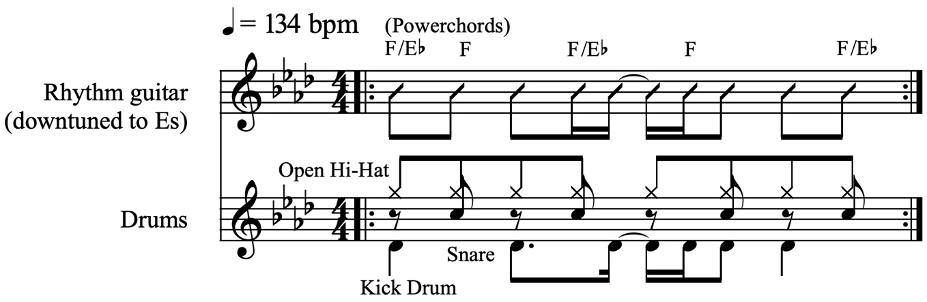
Music example 1: Basic riff and drum pattern in Crossplane, “I Will Be King.” © The Authors
When the audience moved again in a table pit to the song “Dance with the Devil” by the same band, they tended to synchronize to the now clearly faster tempo of 202 bpm. Once again, not everybody seemed to move exactly in sync with the music’s meter. Hence, we prefer not to speak of a proper synchronization of movements and music, but of a tendency towards synchronization. The table pits during performances of the band Rage confirmed that observation. In that case, the tempo relation between movements and music tended to be even looser than before, but the tendency towards synchronization was still clearly noticeable.
Relating table pits to circle pits proves to be a productive method for understanding them. While the singer’s verbal announcement suggested a similarity that functioned as an instructive impulse for the audience, the actual practice of table-pit dancing deviated clearly from that of circle pits in terms of bodily contact among participants as well as in terms of shape and spatiality of the pits; according to our limited research thus far, even the tendency towards synchronizing leg movements to the musical rhythm seems to mark a difference from usual circle-pit dancing. Hence, the status of the circle pit as element in the analyzed situation is twofold: On the one hand, its presence in the verbal call was clear, working mostly as a reference to cultural knowledge among metal fans; on the other hand, the actual practice of circle-pit dancing was rather an absent element that proved to be useful for a comparative approach to describing what table pits are.
Table Pits in Relation to Musical Form and Other Body Movements
As we have described with regard to aspects of tempo and of starting the movements, table pits related to the music in a specific way. While it may seem self-evident that the music had to be some kind of energetic metal, as it is best-liked by audience members to afford pit dancing, a closer look reveals that it was even significant which song was played and how its form was structured. Regarding the choice of songs, we assume that several aspects are of importance including, among others, the dancers’ affective relations to the songs. Generally, people are inclined to dance to music they already know and like. In our case study, that general observation was confirmed from its negative side, namely an absence of dancing activity during the performance of a song by Rage that had, like other songs before, been announced with a clear call for table pits. Certainly, the rhythmic affordances of “Wings of Rage” might have been experienced as less “affording” than those of the previous song “Black in Mind” and physical exhaustion might also have weakened the motivation for dancing at that relatively late moment in the event. However, the fact that the song is relatively new in contrast to the “classic” status of “Black in Mind” within Rage’s repertoire should not be underestimated here.
While the affective relation of (potential) dancers to a certain song is of general importance with regard to dancing and presumably also with regard to the energy dancers put into their movement, the musical form of the song is important, too. Table pits did not just start and stop with the beginning and ending of the song; rather, they often interacted with the change of the song’s different parts. This observation is particularly clear in the case of Crossplane’s song “I Will Be King” which is comprised somewhat expectably of two verses, a chorus, third verse, and two more choruses with an instrumental part (guitar solo) in between and an outro in the end. Strikingly, after four bars of guitar-only introduction, all dancers started immediately with the entry of the drums, bass, and vocals and continued running around the tables exactly until the end of the second verse. Now, with the start of the chorus, most table pits came to a stop; the people at those tables stopped running and stretched or threw one or both arms up. During the third verse, most of the audience moved relatively little except for one table on the left side in front of the stage which kept circling. Then, exactly when the next chorus entered, a small group dissolved from that relatively active part of the audience and started the amphitheater pit as described above. It is important to remark that the singer, who seems to have played an important role in instigating the beginning of the table pits, did not give any further signal or cue regarding the movements during the course of the song. Hence, the audience synchronized their change of movements only by ear. We can state that the dancing was in clear sync with the audible form of the song.
That said, it is worth taking a closer look into how the form actually manifests musically in order to get a better picture of which movements related to which sounds. For a general approach to Crossplane’s music, we consider it helpful to describe its style as close to a pastiche of the internationally famous British band Motörhead. While having achieved an outstanding status in the globalized metal scene, Motörhead have successfully shaped a “rock ’n’ roll” image that, in addition to lifestyle aspects, includes a musical style that blends elements of hard rock with rock ’n’ roll-based forms and riffs.42 The band would make sure that nobody who attended their concerts had any doubts about that image by regularly shouting out their “trademark” line: “We are Motörhead and we play rock ’n’ roll.”43 Crossplane explicitly subscribes to their ideal by adapting the line and even incorporating it into merchandise such as t-shirts: “We’re Crossplane and we play rock ’n’ roll.”44 While not covering original Motörhead-songs, Crossplane produces music that often—and obviously not unintentionally—resembles that of Motörhead, sometimes even in a soundalike manner. In the case of “I Will Be King,” “Ace of Spades”—one of Motörhead’s most famous songs from their eponymous album Ace of Spades45—can be regarded as a model with its fast backbeat-oriented rhythmic pattern in a similar tempo (146 bpm) and a similar riff on a semitone detuned guitar, also circling around tonic and minor seventh. Although riffs are important in the rock ’n’ roll-based music of Motörhead and Crossplane, they do not regularly function as main elements of the musical form as Elflein has established being a characteristic of metal music’s style.46 Rather, the actual form in the named bands’ music is regularly based either on typical elements of rock songs (various combinations of verses and choruses, often with a pre-chorus and/or bridge as additional parts) or on variations of blues schemes. In “I Will Be King,” the change between verse and chorus is basically marked by two elements: a harmonic change, namely a sudden shift from F minor to G major, whereby the major third of the new key is played by the lead guitar, performing the second element of change here. Otherwise, the reduced and plain instrumentation with the fast back-beats continuing on the snare drum during all parts of the song do not allow much more contrast between different song parts. It is indeed remarkable then, that the dancing audience clearly interacted not only with the rhythm of the music but also with its harmonic structure.
While the dancing to “I Will Be King” can be described as a highly energetic collective relation of music and table-pit movements, the slightly different example of Rage’s “Black in Mind” helps to draw a more detailed picture of the complex co-constitution of movements and sounds during the event. In terms of genre and style, Rage differs from Crossplane in that the former band’s thrash metal style includes the genre-typical aspect of song forms being based on a sequence of different riffs that don’t necessarily parallel conventional song parts like verses or choruses. In the performance of “Black in Mind,” we once again observed the table pits starting almost immediately with the entrance of the first riff that follows after a brief opening unison introduction in that case. At this point, we consider it revealing to zoom our observation in on an individual dancer. A male participant of one table pit in the center of the venue slowed his running down in sync with the other persons at the table after about one minute during the first part of the chorus. As soon as the song entered the second part of the chorus (Riff E, 01:07-01:15), characterized by sixteenth notes that include syncopated accents and a double-time backbeat, the man started headbanging, partly along to the backbeat, partly along to the downbeat quarter notes, and partly somewhere in between (start of headbanging at 01:08, so immediately after the onset of Riff E). By engaging in a brief air drum fill immediately before the break he anticipated the change of form parts. He continued headbanging with short interruptions. Next, he joined a person beside him and several other audience members in performing a kind of arm pumping with impulses that synchronized with the sung words “black” and “mind.” Furthermore, he engaged in air guitar playing. About two and a half minutes into the song, he stopped moving along to the music for a while and stood by the table drinking beer instead. Towards the end of the song he started headbanging again, and it is remarkable that he synchronized a short break in his movements precisely with the final rendition of the first riff just to continue to headbang until the song was over (see figure 1a-c).
Regarding the dancer’s interaction with the table, it is remarkable how he combined the two functions of the table during the course of the song. While participating in the table pit for about one minute, he held his half-full glass of beer in his hand, probably to avoid losing it or confusing it with another person’s glass. As soon as he arrived back at his original position, he put the glass on the table which allowed him to engage in air guitar and air drum playing with both hands as well as in energetic headbanging. Furthermore, dancing close to the table enabled him to interrupt his dancing movements to grab his glass and drink beer. While usual concerts without tables afford a change of place between dancing (in front of the stage) and drinking (at the bar) the tables at that special event during the pandemic offered a rather new combination of both practices without changing places. In a sense, this unusual concentration of different actions in a relatively small space is similar to behavior many people have gotten used to during the pandemic. In order to avoid infections, movements have become regulated in a way that many of them are allowed only as long as they can be conducted within a limited space. While the tables at the concert have been construed discursively as contributing to the enforcement of such a regulation, they obviously kept functioning as common tables, hence affording the possibility of putting beer glasses on them.
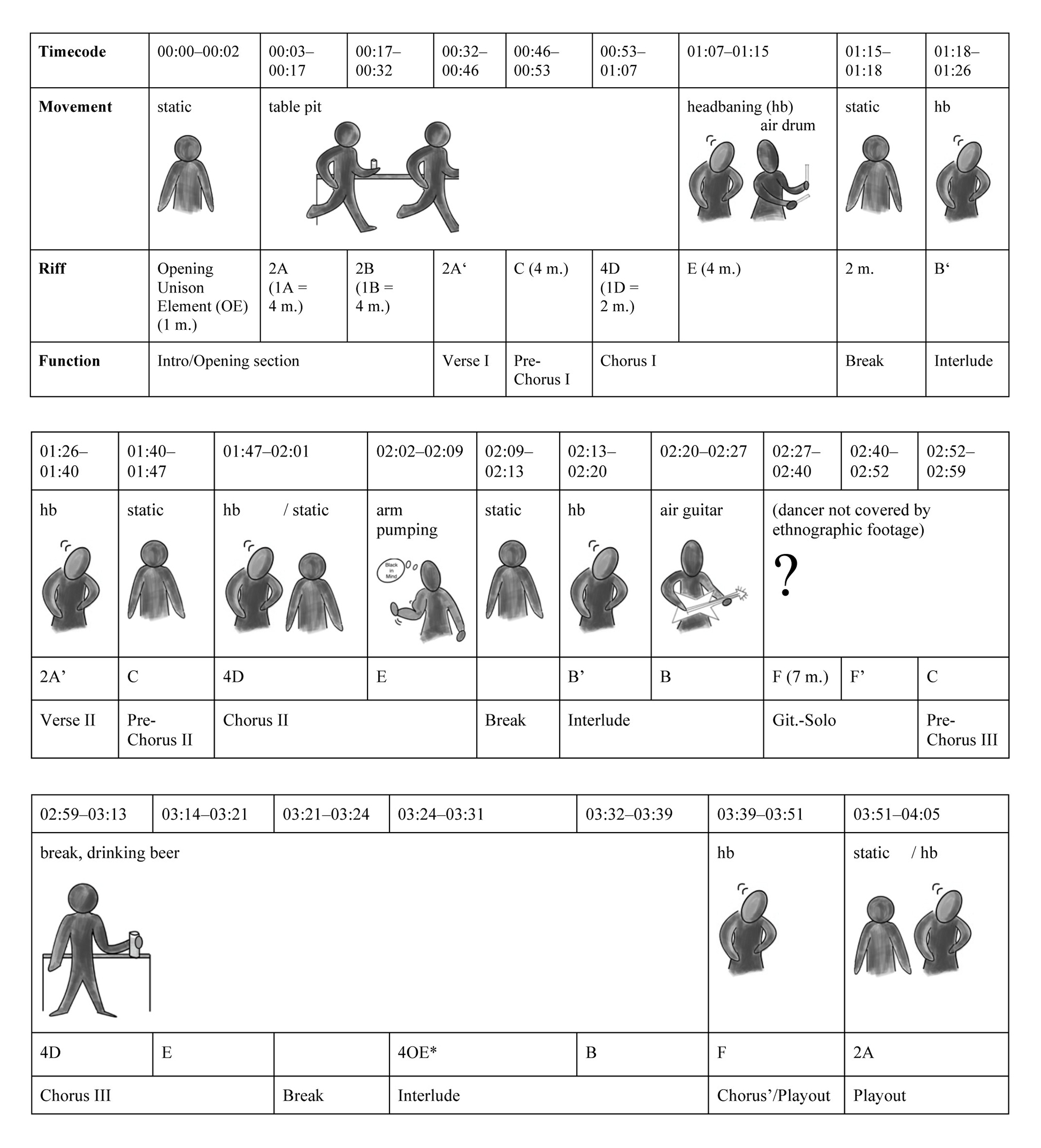
Figure 1a-c: A single dancer’s movements in interaction with riffs/form parts of the song “Black in Mind.” Schematic visualization. The riff analysis is a modified version of Elflein’s model. © The Authors
Conclusion
As we draw towards our conclusion, we want to return to our initial concerns. With respect to the question of how to approach this phenomenon and investigate it in an academically sound way that enables us to consider its complexity, we think that our modified version of SitA was a suitable avenue. We would also claim that it is not limited to this rather unusual performance but can be extended to further instances of (metal) dance. SitA seemed especially beneficial to us as it enabled us to grasp the complex constellation in which various elements assemble in order to make it possible for audience members to dance during the COVID pandemic. It made the various human and non-human actors and the diverse routes and loops of communication among them visible which were required to negotiate between metal’s dance conventions and the confines of the pandemic: The federal government decreed general regulations which were converted into specific instructions tailored to the setting of the Dong Moshbox by the event’s organizers. They in turn communicated these instructions to their (potential) audience via online channels several days prior to the event. Immediately before the concert, musicians clarified with the organizers on site whether table pits would be an admissible modification of mosh and circle pits and were assured that this would be within the bounds of the safety measures. During the event, band members on stage not only repeatedly asked the audience to abide by the instructions, but they also encouraged the audience to perform table pits while explicitly noting that these were permitted by the organizers. After these various communicative efforts, audience members decided to put the demanded table pits into action. In doing so, they oriented their movements towards the music’s tempo and formal structure and incorporated the tables into their dance practice. SitA’s open notion of situation was useful to us in understanding the Dong Moshbox in two ways: Firstly, its concern for a diverse range of elements sensitized us to the importance of aspects beyond bodies and music and highlighted that many elements actually make a difference. Secondly, the temporal extension of “situation” beyond the immediate event moved the manifold actions into view that lead up to it as well as the discursive prolongation of the event through the organizers’ comments afterwards. It thereby allowed us to situate the table pits and similar practices more precisely while a sole focus on the moments of dancing would have rendered these aspects invisible.
The modification of SitA—through the inclusion of DeNora’s concept of affordance on the one hand, and modes of aesthetic analysis on the other—facilitated a more detailed analysis of the elements and their relations. Assuming an automated or simply mechanic influence the music has over the dancers’ movements would have been incompatible with our empirical observations of diverse movements among the audience. Instead, the perspective of affordance enabled us to account for the similarities as well as the differences in how audience members danced to the same music, thereby conceptualizing a more varied and fluid relation between music and dance. While, for example, some dancers mainly engaged in a table pit with varying intensities throughout an entire song, others, as the selected dancer from our example illustrates, exhibited a more varied movement repertoire. Hence, the music afforded them different movements. Nevertheless, our analyses suggest that the respective dance styles can be tied back to the music in that it is the music’s materiality that affords the dancers their actions. At this point our other modification of SitA, the incorporation of aesthetic analyses, was necessary and helpful as it entailed a more detailed study of the materiality of the music and the movements. Although, as we pointed out, music and movement are not the only relevant elements, they are crucial ones and music and movement analyses provided us with a better grasp on them. This allowed us to connect the music’s materiality to the dance practices and better understand, for example, that and how dancers orient their bodily actions towards those qualities of songs that constitute their tempo and formal structure (e.g. rhythm, instrumentation, and harmony during Crossplane’s “I Will Be King”).
If we further focus on elements and their relations, the Dong Moshbox illustrates the active and flexible use of and interaction with non-human actors such as tables in metal. Considering the event’s range of elements and comparing it to similar events pre-COVID, we can grasp which new elements enter the situation (e.g., the corona virus, resulting regulations, tables) and which consequences they have for the dance (e.g., the ban of mosh and circle pits). This may conflict with the actors’ interests—keeping bodily distance vs. the bodily intimacy of metal’s dance conventions—in which case they are required to develop creative means of dealing with the elements and their consequences. At the Dong Moshbox one solution to the conflict consisted of adapting the established dance practice of circle pits so as to incorporate tables and generate table pits as a new dance form. This creative maneuver resembles what Michel de Certeau called a tactic, a calculus which “is always on the watch for opportunities that must be seized ‘on the wing.’ […] It must constantly manipulate events in order to turn them into ‘opportunities’.”47 Crucially, these opportunities are specific to the situations (in a narrower sense than Clarke’s) in which they emerge.48 In our interpretation, the comparison to de Certeau’s tactic clarifies two things, the first being that audience members are active and not passive actors. While the above description of the loops of communication might make the impression that the audience simply did what it was told after other actors had decided that it was okay for them to do so, that is not the case. This holds for the audience’s adherence to the regulations and for the performance of modified dance practices. Concerning the compliance with the regulations, audience members actively decided to do so, not only because of the musicians’ and organizers’ remarks but also because they were assumedly aware of large-scale societal pandemic discourses that stressed the responsibility of each individual and society as a whole in lowering infection risks and rates. Similarly, the audience actively decided to seize the situation’s opportunity and perform table pits. This aspect of the audience’s agency was further highlighted by a contrasting case later that evening in which the audience decided not to engage in table pits even though the singer of Rage encouraged the audience to do so and claimed that the song was well suited for it (ascribing certain affordances to the music the audience apparently did not perceive). Another example of the audience’s active contribution that places the instigating musicians even further in the background is the spontaneous, audience-induced modification of table pits that were turned into an amphitheater pit. These instances show that the dancers at the Dong Moshbox were far from passive, and instead that the creation of these opportunities were a joint effort of the various actors present.
The second aspect the comparison to de Certeau’s tactic clarifies is that from a different perspective, the table pits are not necessarily the rare oddity they might seem to be at first glance. While tables are very uncommon right in front of the stage and the table pits were the first ones either of us had ever observed, the ability to maneuver emergent situations is a requisite with which most if not all people, including metal fans, have abundant experience.49 So, the table pits surely are an oddity but as a result of a tactical logic of action they also illustrate an aspect that is quite common to musical cultures and everyday life. Furthermore, this tactical competence is not the only kind of preexisting cultural knowledge the actors make use of, as the comparison of circle pits and table pits made clear, for example.
While our conclusion so far has rather focused on human actors and their interaction with various elements, we finally want to shift our perspective so as to center on the most prominent non-human actors of the event: the tables. They were actively involved in the negotiations between metal’s dance conventions and COVID-regulations described above and they supported the adaptation of the dance practices to the pandemic situation—therefore, audience members did not dance around or on top of tables but with them. Since the tables posed material obstacles that impeded practices such as moshing (although they did not render them impossible), the tables’ materiality emphasized their agency as hygienic agents. Yet, a deterministic impression would be misleading here because, after all, the tables did not force a specific form of conduct on audience members. The audience could have just cleared the area in order to have more room for mosh pits, for example. With reference to DeNora we would rather argue that audience members made use of and adapted their actions to the tables’ material qualities.50 Keeping Clarke’s material social constructivism in mind, we would add that the communication prior to the concert and the entailed meanings ascribed to the tables also contributed to the audience’s specific use of them. Hence, materiality and immateriality can be conceived of as co-constitutive: Discursive constructions of the tables by the organizers of the Dong Moshbox (i.e., as comfortable distancing assistance) were based on the materiality and on preceding cultural constructions and uses of the tables. Due to their size, stability, solidity, etc., they were suited to aid people in keeping their distance from one another. As a kind of “beer furniture” (the German term for the specific tables and benches at the event is Biergarnitur and they can be found in the huge beer tents at Oktoberfest and similar festivities) they were at least partially compatible with metal culture and its affinity for alcohol.51 Yet, musicians’ remarks such as the comparison with the Musikantenstadl indicate that at least in this specific set up there seemed to be a certain friction. The discursive constructions lead to different forms of material-practical uses of the tables that performatively confirmed and extended the discursive constructions (i.e., as distancing assistance, as an opportunity to sit down or place objects such as bottles or phones, and as a stage). This represents a co-constitutive and continuously processual interweaving of materiality and immateriality that destabilizes a rigid, dichotomous juxtaposition of the two: material tables afforded immaterial-discursive constructions which in turn informed the material-practical interaction with tables, which in turn (re-)spawned immaterial-discursive constructions.
Concerning the future developments of the COVID-19 pandemic, we cannot say for sure whether our observations can be transferred to similar events or if there will even be concerts that necessitate these kinds of adaptations.52 Nonetheless, we think that the study of music and dance greatly benefits from a focus on their situatedness. Besides its documentary value for the COVID-related oddity of table pits, such a perspective enables research a more thorough understanding by tracing the numerous and complexly related elements that factor into the constitution of a specific dance practice. At the same time, as we hope to have shown in this article, this does not exclude the possibility to make analytical observations that reach beyond this immediate phenomenon and grant us further insights into the wider culture of which music and dance are a part.
-
“Das Verhältnis von Musik und Tanz im Heavy Metal. Entwicklung eines Analysemodells zur situierenden Beschreibung ästhetisch-performativer Praktiken auf der Grundlage qualitativ-empirischer Erhebungen aus historischer und gegenwartsorientierter Perspektive—The Relation of Music and Dance in Heavy Metal. Developing a Method of Analysis for the Situating Description of Aesthetic-Performative Practices on the Basis of Qualitative-Empirical Investigations from Historical and Contemporary Perspectives,” University of Siegen, funded by the DFG (454261397) 2021-2023.↩︎
-
Donna Haraway, “Situated Knowledges: The Science Question in Feminism and the Privilege of Partial Perspective,” in Feminist Studies 14, no. 3 (1988): 575-99.↩︎
-
Adele E. Clarke, Situational Analysis. Grounded Theory After the Postmodern Turn (Thousand Oaks: Sage, 2005); Adele E. Clarke, Carrie Friese, and Rachel S. Washburn, Situational Analysis. Grounded Theory After the Interpretive Turn, 2nd ed. (Los Angeles: Sage, 2018).↩︎
-
Adele E. Clarke and Reiner Keller, “Engaging Complexities: Working Against Simplification as an Agenda for Qualitative Research Today. Adele Clarke in Conversation with Reiner Keller,” in Forum Qualitative Sozialforschung / Forum: Qualitative Social Research 15, no. 2 (2014): Art. 1.↩︎
-
Clarke, Friese, and Washburn, Situational Analysis, 68-71.↩︎
-
Ibid., 17.↩︎
-
Ibid.↩︎
-
For a theater studies perspective cf. Erika Fischer-Lichte, The Transformative Power of Performance: A New Aesthetics (New York: Routledge, 2008). A musicologically oriented overview is given in Nicholas Cook, “Music as Performance,” in The Cultural Study of Music. A Critical Introduction, ed. Martin Clayton, Trevor Herbert, and Richard Middleton, 2nd ed. (New York: Routledge, 2012), 184-94.↩︎
-
Clarke, Friese, and Washburn, Situational Analysis, 46.↩︎
-
Cf. ibid., 269-312 for SitA’s engagement with visual materials which might be said to include aesthetic considerations. Yet, sonic aesthetics are absent.↩︎
-
Tonality is not meant in a music theoretical sense but more generally comprises a performance’s aural components (cf. Fischer-Lichte, The Transformative Power of Performance, 120-30). In the German edition, it is not Tonalität but Lautlichkeit (Erika Fischer-Lichte, Ästhetik des Performativen, 10th ed. [Frankfurt am Main: Suhrkamp, 2017], 209-27).↩︎
-
It might be argued that these concepts are partially redundant because Clarke et al. also explicitly mention bodies, spatial and temporal elements (cf. Clarke, Friese, and Washburn, Situational Analysis, 45) but Fischer-Lichte approaches them from an aesthetic perspective.↩︎
-
Dietmar Elflein, Schwermetallanalysen. Die musikalische Sprache des Heavy Metal, Texte zur populären Musik 6 (Bielefeld: transcript, 2010).↩︎
-
Allan F. Moore, Rock: The Primary Text. Developing a Musicology of Rock, 2nd ed., Ashgate Popular and Folk Music Series (London: Routledge, 2016).↩︎
-
Sherril Dodds, Dancing on the Canon. Embodiments of Value in Popular Dance (Basingstoke: Palgrave Macmillan, 2011), 141-3.↩︎
-
Tia DeNora, After Adorno. Rethinking Music Sociology (Cambridge: Cambridge University Press, 2003).↩︎
-
Tia DeNora, Music in Everyday Life (Cambridge: Cambridge University Press, 2000), 39.↩︎
-
James J. Gibson, “The Ecological Approach to the Visual Perception of Pictures,” in Leonardo 11 (1978): 227-35.↩︎
-
DeNora, After Adorno, 48.↩︎
-
Ibid., 47.↩︎
-
Clarke, Friese, and Washburn, Situational Analysis, 26f.↩︎
-
This pool of various forms of data is enabled by SitA’s openness and its ability to integrate heterogeneous empirical materials (cf. ibid.).↩︎
-
Ibid., 127-46.↩︎
-
“Rage und Long Distance Calling in der Moshbox!,” Dong Open Air, accessed 16 December 2021, https://www.dongopenair.de/de/news/post/rage-und-long-distance-calling-in-der-moshbox.↩︎
-
The concert Daniel attended took place August 1, 2020 and was publicly announced July 21, 2020 via the Dong Open Air’s website (ibid.), facebook page (“Rage und Long Distance Calling in der Moshbox!,” @DongOpenAir, accessed 16 December 2021, https://de-de.facebook.com/DongOpenAir/), twitter account (“Rage und Long Distance Calling in der Moshbox!,” @DongOpenAir, accessed 16 December 2021, https://twitter.com/dongopenair?lang=de), and instagram account (dong_open_air, accessed 20 October 2021, https://www.instagram.com/dong_open_air/?hl=de).↩︎
-
“Verordnung zum Schutz vor Neuinfizierungen mit dem Coronavirus SARS-CoV-2 (Coronaschutzverordnung – CoronaSchVO). Vom 1 Juli 2020,” Ministerium für Arbeit, Gesundheit und Soziales des Landes Nordrhein-Westfalen, accessed 16 December 2021, https://recht.nrw.de/lmi/owa/br_show_historie?p_id=24319.↩︎
-
For further information about the location as well as visual impressions without the Dong Moshbox setup cf. “Die Halde Norddeutschland in Neukirchen-Vluyn,” Halden Ruhr, accessed 26 August 2021, https://www.halden.ruhr/halde-norddeutschland.html.↩︎
-
“The Rules of the Moshbox,” Dong Open Air, accessed 16 December 2021, https://www.dongopenair.de/en/news/post/the-rules-of-the-moshbox.↩︎
-
“Ein großes Dankeschön aus der Moshbox!,” Dong Open Air, accessed 23 December 2021, https://www.dongopenair.de/de/news/post/ein-grosses-dankeschoen-aus-der-moshbox.↩︎
-
“Rules of the Moshbox.”↩︎
-
Ibid.↩︎
-
For visual impressions of the Dong Moshbox setup as well as for some glances at the dance forms we refer to in this article, cf. “DONG OPEN AIR MOSHBOX 2020,” HMHTVchannel, video, 09:41, accessed 16 December 2021, https://www.youtube.com/watch?v=PFBneB8_e8c.↩︎
-
There are different terms for this hand gesture which is formed by extending the index and little finger while the thumb, middle and ring finger are bent into the palm of the hand. For an overview of its meanings within heavy metal cf. Adam E. Nowakowski, “‘Horns Up!’ The Horned Hand as the Emblematic Gesture of the Metal Subculture,” in Półrocznik Językoznawczy Tertium. Tertium Linguistic Journal 5, no. 2 (2020): 62-82.↩︎
-
Crossplane, Class of Hellhound High, CD (7Hard, 2013).↩︎
-
Crossplane, Backyard Frenzy (7Hard, 2017).↩︎
-
Rage, Black in Mind (BMG/GUN, 1995).↩︎
-
Rage, Wings of Rage (Steamhammer, 2020).↩︎
-
Long-standing TV show on Schlager music (cf. Susanne Binder and Gebhard Fartacek, eds., Der Musikantenstadl: Alpine Populärkultur im fremden Blick, Kulturwissenschaft 13 [Wien: Lit, 2006]).↩︎
-
Fischer-Lichte, The Transformative Power of Performance.↩︎
-
We cannot discuss aspects of inclusivity further within the confines of this article. For an investigation of female participation in mosh pits that are marked as male homosocial space cf. Gabrielle Riches, Brett Lashua, and Karl Spracklen, “Female, Mosher, Transgressor: A ‘Moshography’ of Transgressive Practices within the Leeds Extreme Metal Scene,” in IASPM Journal 4, no. 1 (2014): 87-100.↩︎
-
Joe Ambrose, Moshpit. The Violent World of Mosh Pit Culture (London: Omnibus Press, 2001), 3. A similar assessment with a focus on hardcore is given in Katharina Inhetveen, “Gesellige Gewalt. Ritual, Spiel und Vergemeinschaftung bei Hardcorekonzerten,” in Soziologie der Gewalt, ed. Trutz von Trotha (Opladen: Westdeutscher Verlag, 1997), 235-60.↩︎
-
Elflein, Schwermetallanalysen, 173-204; Daniel Suer, “Kilmister, Ian,” in MGG Online (Kassel, Stuttgart, New York: Bärenreiter, Metzler, RILM, 2018), accessed 10 January 2023, https://www.mgg-online.com/mgg/stable/394455.↩︎
-
E.g. Motörhead, We Are Motörhead (Steamhammer, 2000); Motörhead, The Wörld Is Ours—Vol 1. Everywhere Further Than Everyplace Else (UDR, Motörhead Music, EMI, 2011).↩︎
-
“About Us,” Crossplane, accessed 28 December 2021, https://crossplane.de/bio/; “Merch,” Crossplane, accessed 28 December 2021, https://shop.art-worx.de/bands/crossplane.↩︎
-
Motörhead, Ace of Spades (Bronze, 1980).↩︎
-
Elflein, Schwermetallanalysen, 300.↩︎
-
Michel de Certeau, The Practice of Everyday Life (Berkeley: University of California Press, 1984), xix.↩︎
-
Ibid., xx.↩︎
-
For an influential though not uncontroversial application of de Certeau’s theories to different instances of popular culture cf. John Fiske, Reading the Popular (London: Unwin Hyman, 1989) and John Fiske, Understanding Popular Culture (London: Unwin Hyman, 1989). Coggins, in his study of mysticism, ritual, and religion in drone metal, focuses on the interlocked rather than dichotomous relation between production and consumption which is inherent to de Certeau’s thoughts on tactics (Owen Coggins, Mysticism, Ritual and Religion in Drone Metal, Bloomsbury Studies in Religion and Popular Music [London: Bloomsbury Academic, 2018]).↩︎
-
DeNora, After Adorno, 48.↩︎
-
Sarah Chaker, Schwarzmetall und Todesblei. Über den Umgang mit Musik in den Black- und Death-Metal-Szenen Deutschlands, Wissenschaftliche Reihe 10 (Berlin: Archiv der Jugendkulturen Verlag, 2014), 167f., 304f.↩︎
-
Yet, that possibility seems feasible since at the point of writing, Germany is witnessing its fourth “wave” of COVID and public restrictions have begun to tighten again.↩︎