A Musical-Gestural Perspective
Winnie Huang 
How to cite
How to cite
Abstract
Abstract
In the contemporary music performing arts world, an increasing number of “musical-gestural” works are being composed and performed. The interest in these pieces necessitate investigation from an artistic researcher’s perspective, in the hope of providing insight and agency for future artists and academics.
Through an autoethnographically reflective investigation, this article aims to examine the musical-gestural perspective—how pieces are learned, performed, and composed through an exploration on the various skill sets, performance practice methods, and the physical states a performer adopts. It hopes to explore how the performer inhabits the artistic body during the whole compositional/performative process including the exploration on presentness.
Through proactive embodied research, the emergence of new pathways, and collaborative/transmissive experiences, this reflection hopes to expand the collective knowledge gained through a musical-gestural perspective.
Outline
Outline

Some view their body as their temple—something one treats with respect, adorns or decorates with beauty, and celebrates in this mortal realm. It is what gives us a sense of agency. But for others it feels like a prison—a life sentence with this material matter. An incarceration within an object that doesn’t fully represent who we are, our potential, and upon which we are judged so heavily that it hinders our possibilities—a corporal limitation from which we can never escape. On most days, we float somewhere in between these two perspectives. My body is all these things: an open curious matter, seeking ways to taste, hear, see, smell, and touch unexplored territory. It is also the shell from which I sometimes wish to escape, one that can bore me with its repetitive necessary demands and calls for attention. This achy, creaky, bulging, languid, selfish, greedy mass. But it is also the only beautiful body I have, and I’m grateful I can call it my own. With it I get to experience every experience, and it will be what remains with me for the longest time. With it, I communicate, connect, and participate in my community. With it, I hear and I am heard, I see and I am seen, I give and I receive. I participate in this constant exchange that is living.1
For this artistic research, the body is the principal medium. It is both the means and the end, participant in the process and in the performance. Sound, movement, and drama are inextricably linked, since to generate sound we require movement; and through moving, almost always, we produce some version of noise, and in each performative act, there will always be an element of dramatic delivery.
This artistic research defines the pragmatic musical-gestural artist researcher’s identity by drawing upon all aspects of their past and current embodied knowledge, in attempts towards a successful creative act. I explore how the musical-gestural artist researcher transcends traditional boundaries and relationships of the mind/body. When taking on this initial research, I clearly saw myself as a performing artist, a musician interested in exploring further afield. As a classically trained violinist, I had viewed my musical instrument as a tool—one which I have spent the most time “studying.” My early approach to that ideal in classical performance exposes my body as an instrument to service the violin which in turn produces the music. I identified as a translator of the score and/or of the composer’s intentions and felt subject to the requirements necessary in performing the Western classical and modern canon: a sort of slave trapped inside the mechanics of this body which had to coordinate every single articulation so as to produce the perfect balance of contact, speed, and weight to yield the ideal sonic phrase, delivered in a way which had to display charm, spontaneity, and fantasy. For a long time, this body—the one that is there to serve the violin (and therefore that whole history that comes with it)—was a heavy burden. A paralyzing responsibility that I consciously or subconsciously needed to find a way out of.
However, I was so fortunate to have been surrounded by the right group of people at the right time: a group of like-minded misfits who wanted to make weird projects in Paris. We formed our ensemble soundinitiative, and over the years I instinctively made myself most available to all the physically dominant performances, which required less violin, and more of what I was simply born with: my performative body. Certain side projects also developed because of that—professional and personal ones. I delved wholeheartedly into yoga and long-distance running, and into absorbing multidisciplinary content from dance, drama, and the performing arts world. When this research strengthened, it reinforced the culmination of what I was experiencing in art and life—endurance, virtuosity, physicality, performability, curiosity, connection, intimacy, and a link between sound, movement, and emotivity.
This article is called “Mutated Manipulations,” a title chosen intently to evoke the imagery of changes within the contemporary musical scene. Deeply personal and subjective, my method is self-observational and self-reflective—an autoethnographic inquiry of my own thoughts, movements, critique, aims, introspections, dialogues, and creative acts over the last years. These challenges, which I fully accepted, allowed me to celebrate this body as never before. I entirely embraced what I seemed capable of doing while acknowledging the limitations that were obvious. I became a creative artistic body, realizing that what was once perceived as weakness is in fact a superpower.2
Musical-gestural works continuously encourage me to experiment with my boundaries; they convince me that it is from innovative and imaginative processes, derived from my experience as a performer and creative artist, that I gain artistic agency in this world, including the agency to compose my own works. In identifying the multifaceted aspects of this field of study, highlighting the constant interplay between known experience and experimental inquiry, musical-gestural works encourage artists to find their versions of their current truths by constructing meaning during their own processes. Through instinctively proactive embodied research, the emergence of new pathways, and the collaborative and transmissive experiences these works afford the artists and audience alike, this critical reflection showcases the expanding nature of these works for all participants.
Musical-Gestural Definition
In the contemporary music world of the performing arts, an increasing number of musical-gestural works are being composed and performed. The rise of these pieces, composers’ curiosity in creating them, and the growing demand for these types of performers necessitate investigation from an artistic researcher’s perspective, in the hope of providing insight and agency for future creators, artists, and academics in this field. In identifying what a musical-gestural artistic researcher is, it is necessary to first define these components.
Many forms of artistic genres or technical emergences have granted various titles to these types of works, including Music Theater, New Discipline, Instrumentales Theater, and post-instrumental practice just to name a few. I, on the other hand, do not present the term “musical-gestural” as a defined genre, but propose it as a perspective of how one can view, absorb, perceive, learn, compose, think about, speak about, and perform these contemporary works. Musical-gestural pieces touch upon almost all aspects of music-theater, performance art, contemporary dance, classical instrumental performance and theatrical drama. Certain works lean more heavily on certain arts, or blend two or more disciplines, and I believe therefore lend themselves to be analyzed or perceived differently by other artists of other disciplines. Despite our expressions comprising of an amalgamation of multifaceted sensorial qualities, our dependence on language means that defining, categorizing, and determining ideas, and the way we use our definitions both clarify and restrict how we can speak about art that straddles the boundaries generally accepted as music, dance, theater, or even the art of the everyday. Therefore, I tentatively use the term “musical-gestural” as a quality towards a practice of creating expression and perceiving expression in certain works. My research is based on my foundation which is rooted in music performance. I chose the word “musical,” as music is a perception of how meaning is added to sound. The word “sound” contains a certain neutrality linked to the physical ability—the sense of hearing we humans have—but music is a subjective perspective based on what meaning we make out of those sounds. Whether or not that meaning is useful for each individual or is meaningful at all, is not for me to decide, but it is the notion that music does not hold the same connotation as the word sound that made it more important for me to specifically choose that word.
I chose the word “gestural,” as it encompasses so much more than just a movement. A gesture is a movement, but gestures are also concepts of social and cultural behavior—a meaningful physical, mental, and emotional act that cannot be easily removed from connotations.3 An abrupt gesture to hit someone, a punch for example, is not the same concept as speaking of someone’s charitable donation as a gesture of kindness. The way both these words accommodate connotations of intent, meaning, narrativity, expressions of physical sensations and acts, is exactly why I chose to group them together and call the works I am focused on “musical-gestural works”—works that explore sound, movement, intent, story, meaning, and expression, and all the connotations that sit with these words. For myself as the artist, this definition helps me to work with and through this perspective in understanding how I create, view, perform, embody, and comprehend the pieces.
The Evolution
Over the course of the twentieth century, the changes in ideas, values, and possibilities, cross-influenced by the socio-economic-political landscape, saw the rise of avant-garde movements such as Dada, Surrealism, Postmodernism, Futurism, Bauhaus, Fluxus, and many more. These thinkers and doers of all varied vocations radicalized all production in a multitude of domains. The artistic world saw an explosion of profound transformations. The blossoming of musical-gestural works, which we see in today’s concert stages and festivals,4 can be viewed as an evolution in multidisciplinary arts. From the abandoning of the arduous world of ballet into embracing the naturalistic properties of the body in movement, to the emergence of performance art as a defined discipline, and to the creative exploration of experimentation, improvisation, and the general broadening of the concept of sound creations, these fundamental revolutions within each self-contained artistic discipline, including music5, were also bleeding into other arts.
Today many composers and performers have leaned further into a range of hybrid creations, forming new mutations of multidisciplinary works, alongside the incorporations of changing technologies and radical thought of the last decades. Certain contemporary composers are interested in the acknowledgement of the performers’ body on stage,6 using it as a tool and part of the medium of expression, collaborating with the performing musician by homing in on their specific musical and performing skillsets to create truly interdisciplinary expressions. Select festivals and institutions have also encouraged the expansion of this creative field,7 with the inclusion of artistic platforms, themes, or concepts to especially include multidisciplinary works, with music as the main perspective from which it is presented. Artists themselves have also self-inquired by defining their own genres, from “post-instrumental practice”8 to “The New Discipline Manifesto.”9
Identity through Embodiment
My musical-gestural artistic researcher identity is one of a continually proactive, analytical, explorative, critical, and reflective artist, who values the creative process and who recognizes the importance of knowledge gained through the ongoing creative experience. As a performer, my process has been based on what I have learned in all aspects of life, including the interpretation of others’ works. This process heavily leans on an embodied practice, the discipline, techniques, and skillset I have gained throughout my life so far, and how to use various tools for the successful delivery of my ideas. Through adapting skills from other crafts and by studying and applying daily life experiences, I develop a deeper vocabulary and lexicon during the process of transmission and gain a greater specificity in matters of physical energies and movements. I have come to understand that every part of my living and performing is about diverse types of energy and that the performance experience is a process whereby we forge an adaptable dialogue, creating an energy of sorts between audience members and performers—a communal conversation, a sharing of energies.
For me, embodiment is not just a physical corporal awareness, not simply what some call muscle-memory, and definitely not a separation of the mind and body, but rather every aspect of my learned experience within this existence with this body I have. Because I am a human and because I have a mind and body, my experience is embodied. How I live my life—what I learn, what experiences I choose or choose not to have, what I feel is present or absent, how I situate myself within this world—is all embodied knowledge. Ben Spatz, lecturer and practitioner in drama, theater, and performance explains:
Thought and language are fully embodied processes. Therefore, when I refer to embodiment and embodied practice […] I mean to include all of the following: thought, mind, brain, intellect, rationality, speech, and language […] everything that bodies can do. In addition to the physical, this space of possibility includes much that we might categorize as mental, emotional, spiritual, vocal, somatic, interpersonal, expressive, and more.10
Accepting this definition of embodiment and of an embodied practice, whereby we are made up of embodied and personal knowledge, extends further to that of knowledge and experiences of our own cultures, our societies, and our interactions. Researcher Kathleen Coessens supports this view of the embodied practice for the musician and defines it as a “web of artistic practice, woven and re-woven by the artist over multiple phases of education, exploration, and creation.”11 The musical-gestural artist’s embodied practice is developed with these learnings and techniques. These developed techniques are a “fundamental dimension of embodiment,” as they provide “a range of relatively reliable pathways through any given situation.”12 Through invested development in specific techniques with a clear intent, the creation of a practice is made. Researcher Joost Vanmaele identifies a similar kind of performance practice specifically for score-based musical performers through his thesis on a Bio-Culturally informed Performers’ Practice (BciPP), which he defines as
an interconnected array of activities and understandings within the broader category of score-based performership that is underpinned by a shared and active interest in information on generics and particulars in musical action and interaction as a factor in creating a sonic environment from which musical experiences can evolve.13
From my perspective, these theories can apply to all forms of practice, be it a daily yoga practice or a violin practice. I integrate my own studied theoretical, empirical, and practical understandings of the body to help with how I live, think about, make, and perform my work. I constantly meditate on the most fundamental fascinations of the human experience, from our voice and sounds, to our gestures and movements, to our ability to connect through reaching out with our senses. Telling stories, touching, dancing, smelling, smiling, kissing, fighting, etc … I ruminate on how I could communicate these elements of human expressions, from my bones, my muscles and skin, my clothes and posture. I question how to create phrases or structure with this body I have through my musical lens, and what tools I can gain to get me there. This means taking a certain responsibility in how I choose to critically reflect on what I do, how to continuously educate myself, and in which state of mind and body I learn and execute these acts.
Most clearly demonstrative of this is the piece tend by Charlie Sdraulig (2019) for gesturing, vocalizing performer, and single audient—an intimate work which explores non-verbal gestural communication and changes of atmosphere through non-spoken interactions. Composed through understanding my past experiences in different vocations, all requiring non-verbal communication and “reading” people, Sdraulig places the performer in a dark space for an audient, in which the results performed both affect and are affected by the audient’s presence.
Presentness
The reason I bring up the idea of a state of mind and body is because this is a factor that seems to surround the magic of performance. Many refer to the idea of having a sort of “presence,” a powerful and elusive state of magnetism on stage perceived by others, allowing them to feel “present” in the moment with the performer, and felt by the performer as to hold the attention of all watching or listening—a “presentness,” a term I have often used when explaining it to others. Personally, I have never romanticized this idea as an “x-factor” or a talent where you either have “it” or not. Though I do respect that technique is something that can be continually developed, I also recognize there are subjective differences between a performance that is captivating where a presentness has been displayed, and one that needs more attention on that aspect, and I do not believe that one is always capable of achieving the same type of presence as another, no matter how hard we train.
How this presentness is developed and crafted seems to resemble what British theater coach and director Patsy Rodenburg calls the “Second Circle.” A theory she has worked on for a large part of her life, we share the philosophy that “all is energy” and she also questions the idea of “talent […] presence … so-and-so just hasn’t got it …” proposing that “through formal exercises, I began to grasp that the energy of presence could be developed, understood, and enhanced. My instincts and my own fears told me that the energy of presence could only be cultivated and thrive in a safe arena.”14 In believing that all basic movement is energy, she does not diminish the ranges of energies but rather proposes that certain energies are better for certain moments and situations.
Through respecting and appreciating all aspects of embodied knowledge, and through understanding and honing the skills and techniques that form a healthy practice, alongside a power that comes from understanding how to use Rodenburg’s circle theory, a musical-gestural artist can create dialogues, collaborations, practice processes, and performances that use the whole mind-body as an exciting tool for innovative and deeply fulfilling art making. Forever a work in progress, we can use our stories and experiences—past, present, lived or dreamed future ones—to tell new stories and experiences.
Multiple Disciplinarities
Sound, movement, drama, and performance are undeniably linked, though sometimes this multisensorial awareness is forgotten in the all-consuming training and specialization of one socially/culturally identified discipline. In the acceptance that they are in fact all interconnected, if approached and applied in a healthy manner (meaning with care to the individual’s mental and physical wellbeing), furthering knowledge through conscious attention in other disciplines would deeply assist in one’s primary craft and provoke and promote innovative methods and processes that tend towards the multidisciplinary nature.
Diverse disciplines were approached which led to the accumulation of experience which is therefore techniques and knowledge. By participating in a session of week-long theoretical, analytical, and practical training in various methods, such as Rudolf von Laban’s (1879-1958) concise and comprehensive Laban Movement Analysis (LMA) classes, I formulated a better understanding in how to crystalize the thought of creating meaningful gestures, and developed the mechanisms with which to articulate both verbally and physically the intent behind movements in musical-gestural works. This incredibly rich foundation for movement inquiry assisted me in other traineeships in dance, acting, performance art, and general physical awareness: from week-long professional dance workshops with leading Belgian contemporary dance company Ultima Vez, to attending classes for professional actors at L’École Internationale de Théâtre Jacques Lecoq, to spending time with Austrian performance artist Mikki Malör, to becoming a certified yoga instructor, to having a private dance class with Kenneth Ard—an American dancer, choreographer, actor, and teacher from the famous Alvin Ailey American Dance Theater—to online lessons in Gaga movement technique during the pandemic, and running marathons in pre-pandemic times.
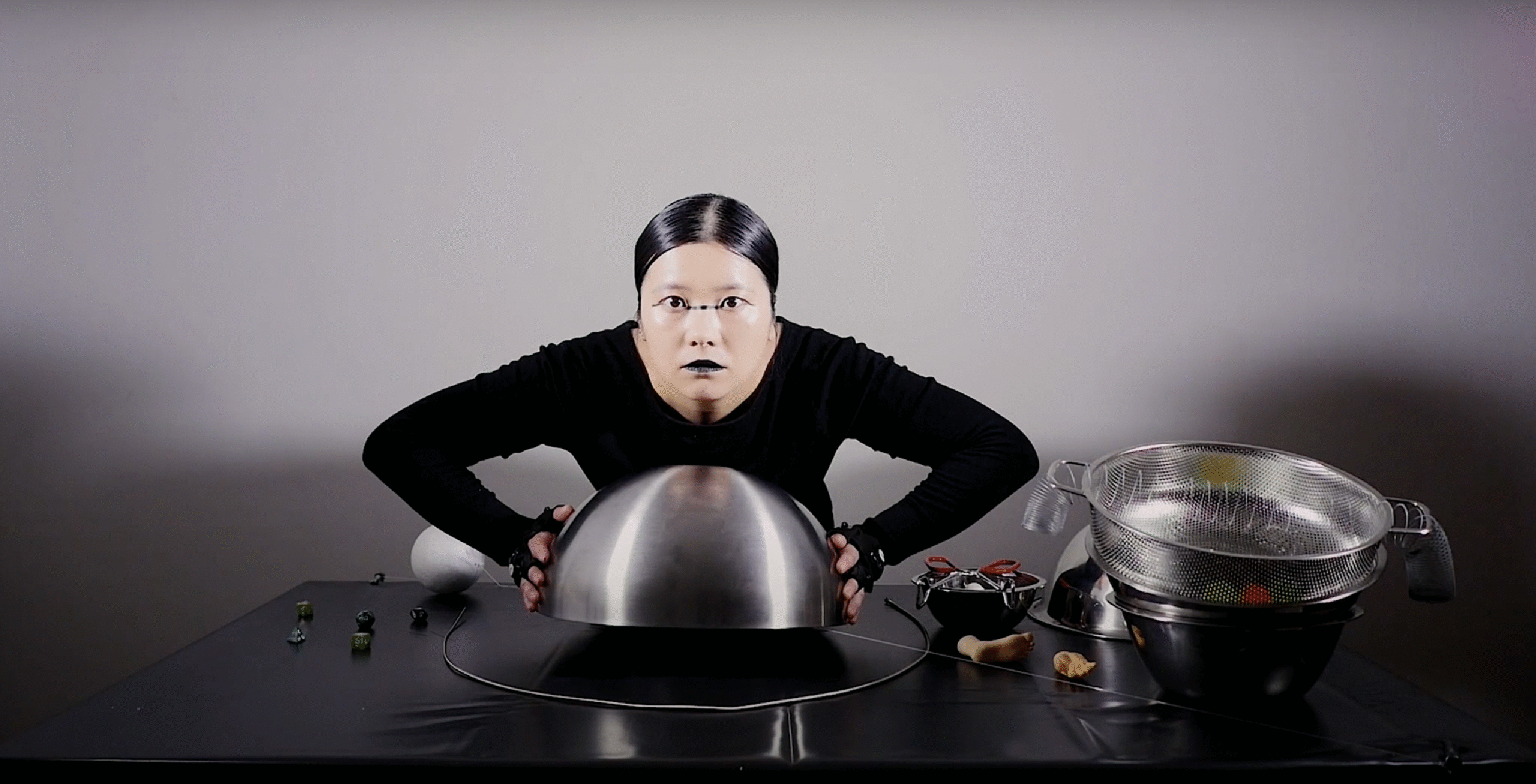
Figure 1: How to Make a Monster by Sivan Cohen Elias, performed by Winnie Huang;
link to video https://youtu.be/3W6Bwetm7RU. © Winnie Huang
This continual diverse interdisciplinary training deeply satiated a desire to approach understanding and utilizing the body in a way classical music training does very rarely. A key element that permeated all these workshops and lessons was the willingness to appreciate the possibilities and limitations of one’s body. Energy and intent were running themes throughout all the interdisciplinary research: how does one exert a certain energy, but also what is the intent, the meaning, the effort behind that action. Every action, every gesture can be delivered with a certain emotive state, and this can also be contrary to the actual perception of the audience. How a performer thinks and feels, and what they choose to make perceivable to another is part of the responsibility of the artist. These elements of preparation and premeditation at such an obsessive level of craft is completely in line with musical performance, and to have the opportunity to train the same ideals on the body is invaluable to the musical-gestural artist. Through a deeper understanding of these elements of diverse disciplines, I was able to draw richer material out of existing works and newly developed ones, adding layers to what I thought was originally possible. Especially clear in this regard was my own process with Sivan Cohen Elias’ piece How to Make a Monster (2017) for solo performer with objects and live electronics, a piece which uses objects in a way that merges between visual dramatic expression and sound production, with exchanges that generate numerous references and associations that evoke various forms of monsters.
In these multiple disciplinary trajectories, what was becoming clearer was not that art forms were so dissimilar, but rather that certain disciplines had more concentration on distinct processes aimed at similar shared values. My own entry into these fields permitted more access to those processes, like the adding of salt to a broth or the inclusion of more pigments in paint, it was a deepening of flavors and colors for the identity of the musical-gestural artistic researcher. Familiar themes of multi-sensorial knowledge collection through multi-layered perspectives, and the mind-body correlation while participating in society supports the idea that
whether we speak of body-mind or body and mind, we are dealing with what is fundamentally shaped by culture. For culture gives us the languages, values, social institutions, and artistic media through which we think and act and also express ourselves aesthetically […] that shape not only our bodily appearance and behavior but also the ways we experience our body.15
Musical-Gestural Composition
For around two decades, British musicologist Nicholas Cook has argued for music to be viewed “as” performance, moving beyond the score and considering music “as,” not just “and,” performance emphasizing its social characteristics and how we “think of performers as creating meaning within the structural affordances of compositions.”16 In my own experience as a musical-gestural performer, this supports my past perspectives within projects, but in my own increasingly evolving identities and changing roles, the concept of music has become more aligned to a means of categorizing a certain quality of acts perceived as expression in society, performance being just one of the most obvious acts. The concept of music is not just a piece conceived by a composer but rather an experience, a technique, a process, and a perspective in which to view this world.
The collaborations, themes, ideas, techniques, skill sets, and multiple disciplinary practices are all integral in the conceptualization of a musical-gestural composition. They require such incredibly varying specificities obliging the process and methods used to also be collaboration/material/piece-specific. The search and curiosity for how every theme, gesture, sound can have meaning and provoke meaning, and how that can be imagined as a composition or for an audience is questioned from a creator, performer, and audience perspective. It is deeply part of what constitutes a composition. As Lydia Goehr states, “There is nothing about the concept of a work, the relations between works and performances, or works and scores, or works and experiences of them, that is going to tell us where the locus of musical meaning ‘really’ resides.”17
Composition as a New Composer
In recognizing how all-encompassing a composition is from the human interactions, collaborations, thematic materials, resources, notation possibilities, and performance, entering my own compositional experiment did not feel so alien. After a resistance to identify as a composer, rooted in a lack of confidence and legitimation, my own musical-gestural compositional path embraced the broad embodied practice, accepting Coessen’s “web” of artistic practice, and psychologist Keith Sawyer’s approach. He identifies the necessity to analyze artistic creativity from a multitude of disciplines including psychology, biology, sociology, art history, and anthropology. In approaching the artist’s work and creativity from these diverse angles, he argues against the assumption that creativity somehow magically blossoms from some spontaneous spirit, but rather it is based on formal training and deliberation, skillful, hard, and conscious work, developed through traceable mental processes.18
I am fortunate because as an artist, I am granted the position to provoke, to try different things, and I am allowed, almost expected, to be outlandish—to tell diverse stories that are not the same as the one I told before or to be inconsistent with what I share. My compositional pathway was created because so much of the experience of defining oneself as a composer had been experienced for me already as a musical-gestural performer. In being permitted and required to question so much so intricately, taking on the title of composer was only one extra step in the path I was taking. Because I am a work in progress as a composing performer, there is no fundamental purity of form in my work. Even my notational systems have been a mutation of my own multidisciplinary experiments.19
As a musical-gestural artist, I identify as a sonic, moving body, a performative truth searching storyteller, who continually adapts and modifies behavior for each work performed, through the figure of the performer. “The artistic process is an amalgamation of creative and social aspects, between planned and spontaneous musical activities, and the relationships that occur between students, teachers, audiences, peers and other communities around the artist.”20 My compositions, both the process and the performance, are experiences; these experiences and experiments offer new opportunities, inputs, and challenges.
Works and Case Study
While having the opportunities to learn about my sounding and performing body through other new and existing compositions, the desire to make original work of my own was ignited. My experience grew over many years, in working on pieces such as the soloist role in INORI (1973-74) by Karlheinz Stockhausen (1928-2007), How to Make a Monster (2017) by Sivan Cohen Elias, tend (2019) by Charlie Sdraulig for one audience member and works by Jennifer Walshe, Steven Takasugi, and Richard Barrett, but it was particularly my very special collaboration with Jessie Marino and her works that instigated the real insistence to compose.
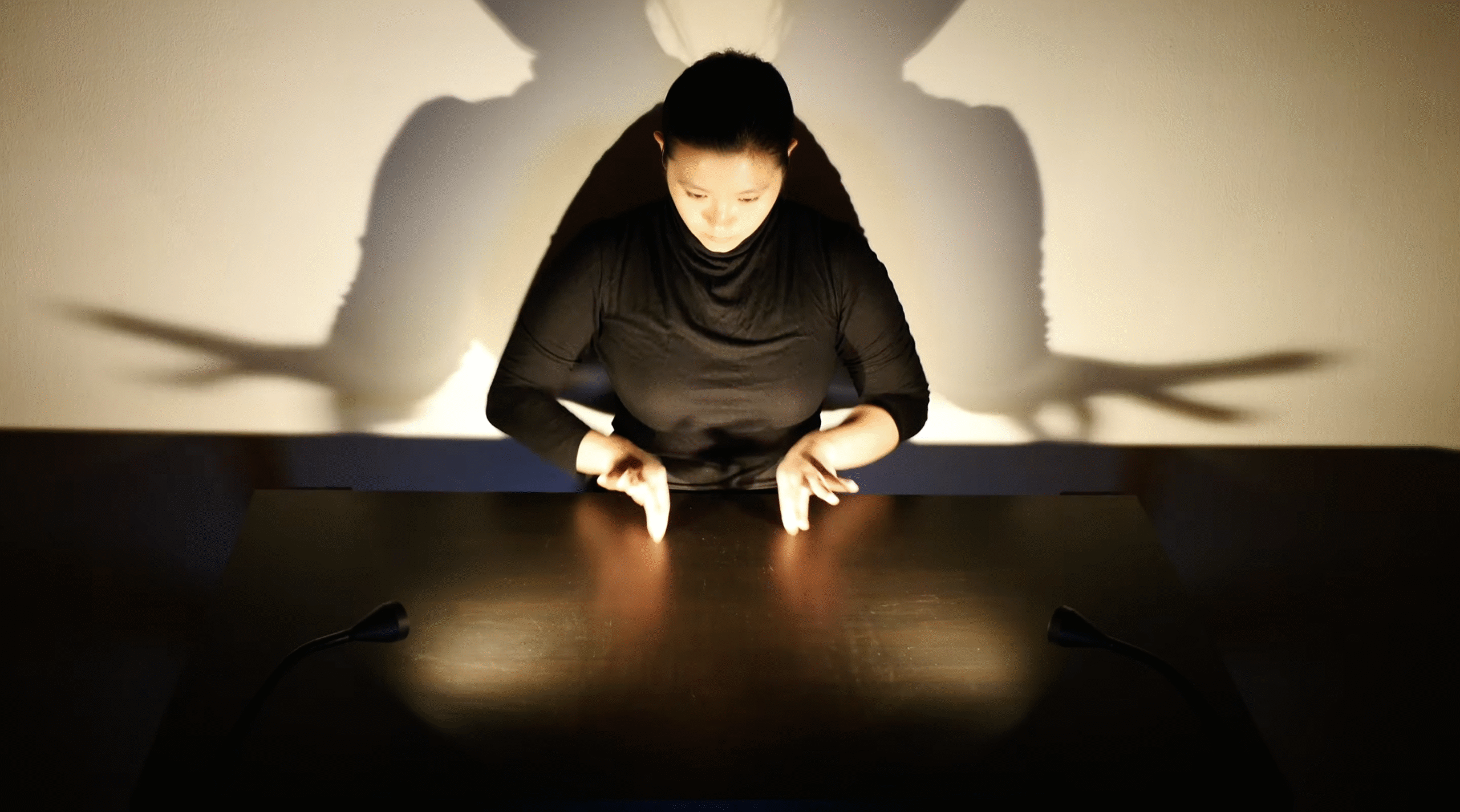
Figure 2: Savoiardi Dance by Jessie Marino, performed by Winnie Huang;
link to video https://youtu.be/9yMJQIO-6zY. © Winnie Huang
Through working with her on existing works, and through collaborating with her on a new piece, Savoiardi Dance (2019), I watched, learned, and was encouraged by her to start composing for us, first as a duo and then to expand out to other formats. I will always be so grateful for this collaboration and how it provided me with the support and generosity to feel legitimized in calling myself a composer and calling the works I produce my compositions.
During the pandemic, my ensemble soundinitiative allowed me the intriguing opportunity to try to work with many sounding bodies as a medium for compositional creation. The idea was to curate a performance piece of self-created musical sounds and specialized physical choreography specific to many physical bodies. Using interdisciplinary skills, pushing different boundaries for myself and other performers, trying various types of notations, exploring changing roles and expectations, and examining performance dynamics, I wanted to use my creativity to take on a new and exciting challenge.
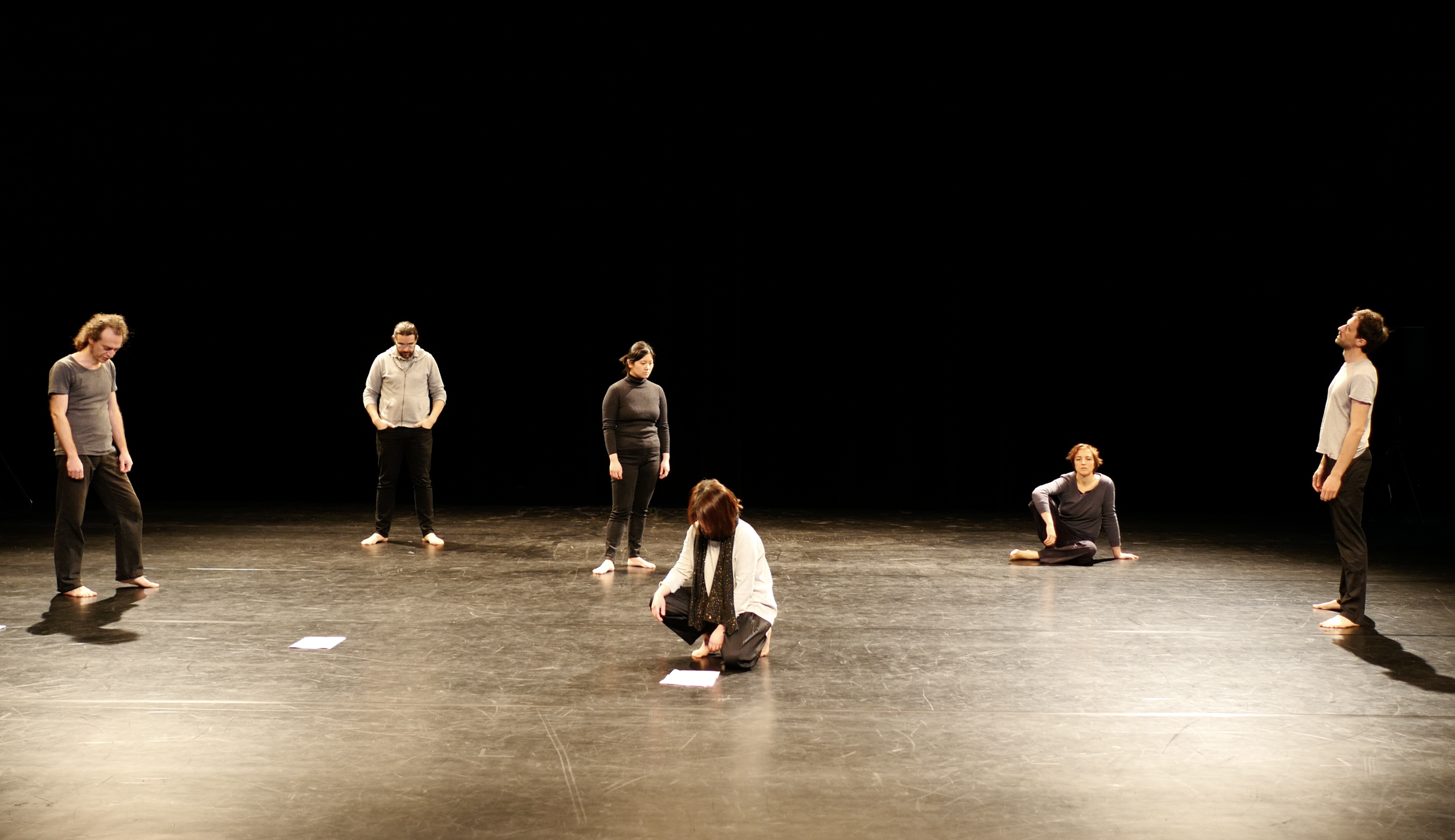
Figure 3: tick tock iiiiii composed by Winnie Huang, dedicated to and performed by soundinitiative;
link to video https://youtu.be/nx6RARFQtWo. © Winnie Huang
tick tock iiiiii is a composed and scored interdisciplinary piece exploring the concept of “masking.” Masking is a habit where an individual changes or “masks” their usual personality to either conform to or disassociate from social and environmental pressures, expectations, abuse, or harassment. In today’s world, we both choose to create our behavioral and material masks, but we are also taught, through daily encounters, to expect to be “masked,” sometimes even to the safety that masking gives. We all “mask”—but why, why not, when, where, how, with what kind of mask, and how does it feel to “mask”? Inspired by many thoughts and concepts that had been present in my mind, I tried to create a work not based on a narrative but on abstract references—the physical masks worn during the pandemic, the “neutral mask” of Lecoq’s work, the masks women are asked to wear when they are told to “smile,” the stiff masks of bravery when living through trauma, the withdrawn masks of fear when confronted with racism, etc. This piece is also exploring all these factors reflected in the power of social media (referencing the application tiktok in the name) and the ongoing cycle of absurd repetition that is life as the piece ends in the same way as it begins, ready to recommence the same actions again.
Composed over the course of two sessions of workshops and rehearsals one month apart, for six hours in February 2021, I developed ideas, gestures, and abstract narrative elements mixed with known musical structures (such as canons, fugues, sonata form, dance structures etc.) and workshopped with five other members of soundinitiative to develop three rough large segments of the piece that would become tick tock iiiiii. One month later, over the course of three rehearsals, we practiced the cleaner versions of these segments I had developed in our time apart. What did become apparent is seeing how certain performers of soundinitiative were more at ease with certain types of direction or overall rehearsal structure. Very much aligned to contemporary performer and researcher Ine Vanoeveren’s theory of “Knitters versus Sculptors,” I also worked to balance the needs of how these performers learned. Whereby the Sculptors desired to “first practice the main aspects of the entire piece, to get an understanding of the general structure,” and the Knitters preferred to “practice a piece in detail from the beginning, bar by bar, and only advancing to the next bar when the previous one is completely learned.”21 Making sure everyone felt attended to and respected in their needs was, for me, imperative towards a positive rehearsal process.
After each rehearsal day, a run-through of the whole work was video recorded, and time was made for us all to watch it together. This method of sharing the watching experience allowed for self-critique and appreciation of how one or another performs the same gesture. I learned to use this method from my experiences with Inori, as a means of teaching or guiding others, without having to verbally explain how someone could handle their body more precisely, myself included. More often than not, the person quickly watches how others are doing a certain action, and with a bit of extra support, whether that is actual verbal teaching or just watching and doing it a few extra times, individuals can achieve a better result whilst maintaining a positive moral for the whole group. As positive, open, eager, and communicative participants are necessary in group scenarios for effective productivity, a consciously constructive way in which we transmit information and guide a rehearsal experience is also imperative.
The whole process of tick tock iiiiii felt incredibly satisfying—a piece in which the performers enacted gestural, dramatic and musical elements with coherence, followed more or less the intended changes of energies, and touched upon the themes as I envisioned. It was musically together in the pitch and rhythm when indicated and was enjoyable to perform and watch, as I composed movements in appreciation of each individual performer’s instinctive ticks, styles, and manners of performance. I wanted to use this piece as a framework to capture the beauty in how we all translate certain actions slightly differently, with varied intent, effort, and energy levels. Just like in Laban Movement Analysis, a simple kick has so many variants of speed, direction, effort, time and space, and I wanted to celebrate that instead of creating uniform synchronicity. In creating this framework, the notation was made more like a bird’s eye-view dance placement notation, with descriptions of what happens in each stage movement, and people-specific notation such as “the Szymon,” a gesture inspired by one of the performers of soundinitiative. In performing “the Szymon” every performer learned how to enact the gesture in terms of which muscles to move, but ultimately were free to decide in what quality of intensity they wanted to perform it. Some moved very slightly while others used large shoulder movement, some turned their palms to face the audience while others to face the back. Though these tiny discrepancies seem odd in a moment of group synchronization, in reality, by synchronizing only the speed/freeze and level of presentness of the performers, the difference of slight physical variances brought about more charm and beauty than if they were robotically the same. During the workshops I created a range in notation and learning experience which emphasized all experiences in our lifetime as knowledge; therefore all movement, no matter how easy or mundane is an appreciated technique, a technique that has been mastered by each individual.
Psychology, physical culture (both athletics and somatics), religious ritual, and even the technique of everyday life are now understood as part of what an actor brings to performance. They can, therefore, be considered as part of the training and preparatory work of actors.22
Through encouraging all movement as artistic movement, there was no resistance in doing any gesture I suggested and therefore so many more suggestions were provided for material from the performers as they saw what they wanted to individually contribute to be valuable.
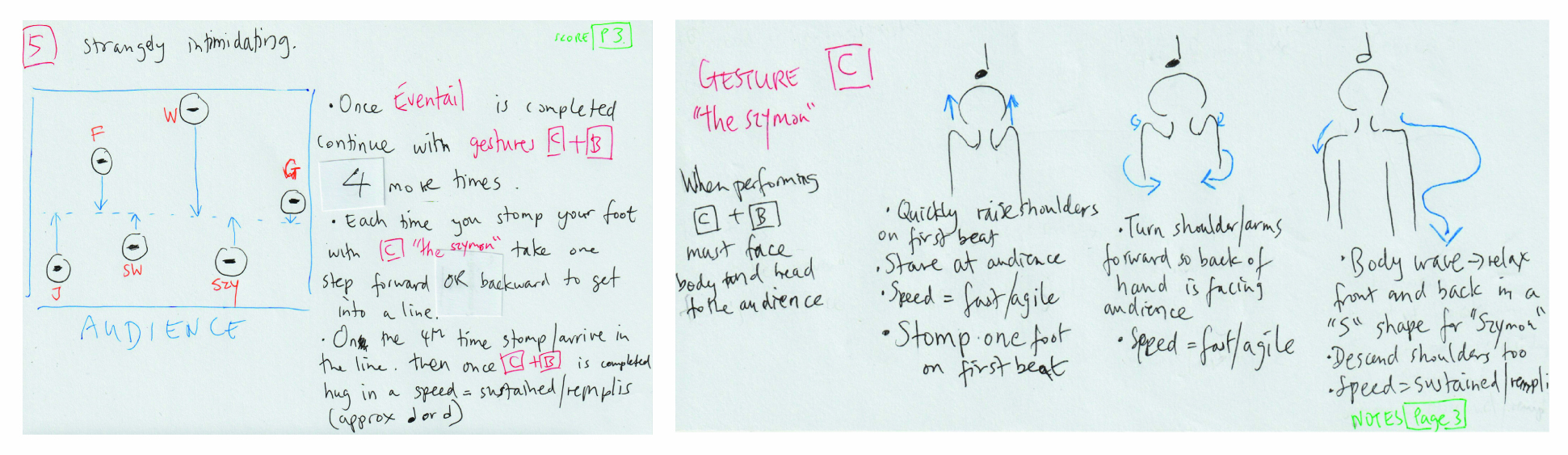
Figures 4a and b: tick tock iiiiii notation, composed by Winnie Huang. © Winnie Huang
This desire to showcase the diversity in each person’s individuality, through displaying the unique ways in which each person chooses to do certain actions, also brought about an immediate instinctive quality in the performances of each movement and therefore the whole work. In acting comfortably, within their natural instincts and being encouraged to express more of themselves, not trying to emulate some mold I had for them, they performed each gesture with a presence and honesty as if it was their own gesture.
Presence does not make something extraordinary appear. Instead, it marks the emergence of something very ordinary and develops it into an event: the nature of man as embodied mind. To experience the other and oneself as present means to experience them as embodied minds; thus, ordinary existence is experienced as extraordinary—as transformed and even transfigured.23
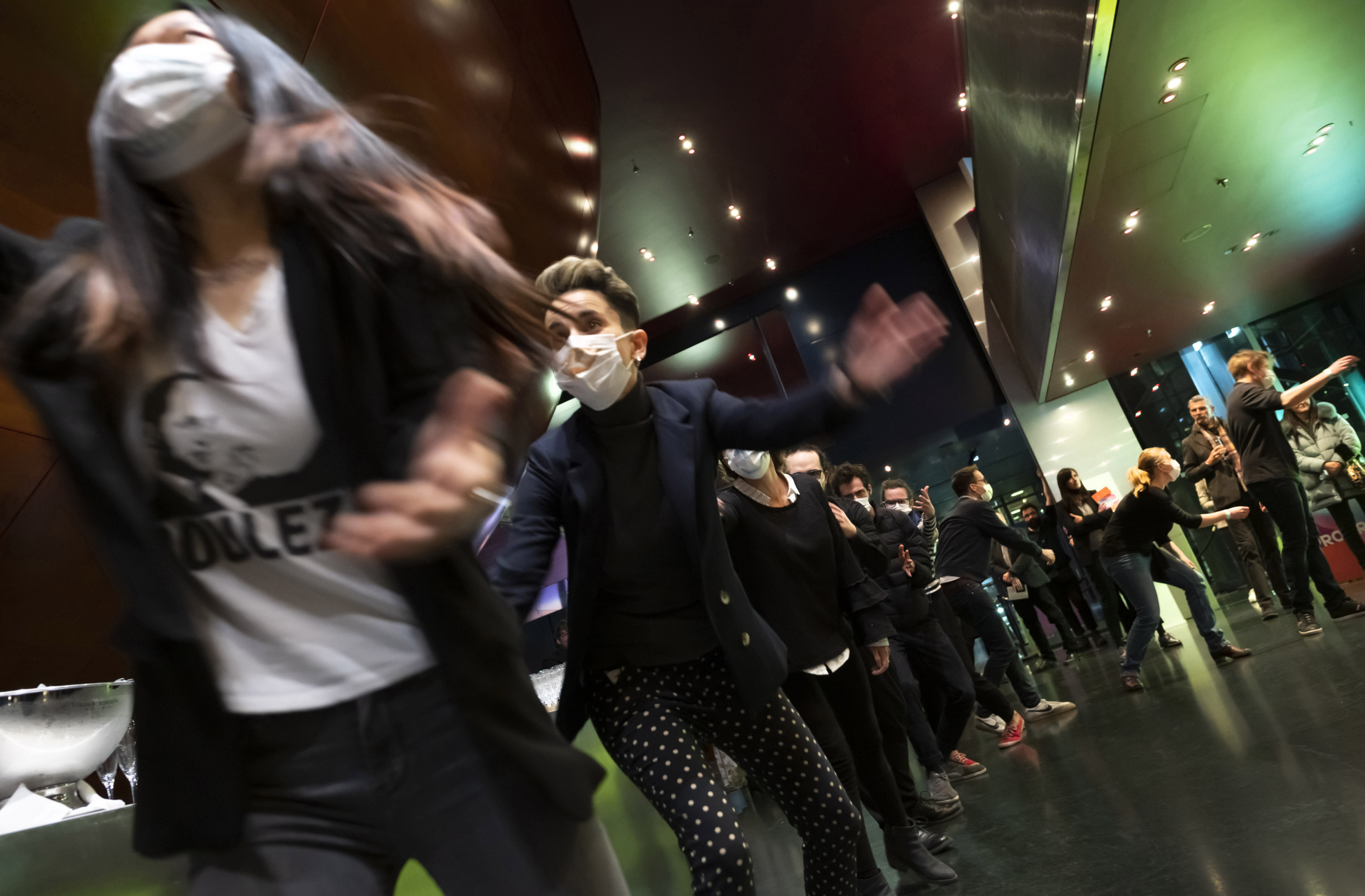
Figure 5: tick tock iiiiii for twelve performers in flash-mob style in the foyer of the KKL Lucerne at Lucerne Festival Forward 2021. © Priska Ketterer/Lucerne Festival
As a composer of the piece and director of the workshops and rehearsals, my experience with transmission of information, the manner in which one conducts a rehearsal and how to support or decline suggestions or questions, was so important. This refers back to the open attitude in Rodenburg’s second circle: “you might know that deep, active, and thorough learning only takes place when teacher and student are both in Second Circle,”24 and I’m incredibly grateful to soundinitiative’s belief in me and patience with me during those sessions. tick tock iiiiii has now been premiered for six performers at the CDA Enghein-les-bains (FR) in July 2021.
Due to various artistic reasons, I also was granted the opportunity to reconsider the piece in multiple formats, with fewer or more performers, in teaching in my own workshops/lectures or for people to perform who are not professional musicians or performers.
In reflecting on the site-, people-, piece-specific needs for every work I have touched upon in this research, and realizing how to communicate to people in a more adaptable manner in order to transmit the information more clearly, the knowledge gained in appreciating exactly that allowed me to create a more open score. Through breaking it down into themes and ideas based around these structured musical ideas, it has been performed for five performers at Berlin (DE) in October, for twelve performers at Lucerne Festival Forward in November and for three performers at Bologna (IT) in November 2021.
Conclusion
I have been so fortunate to be allowed to take alternate paths, from the privilege of having a body that is non-disabled, to being permitted a comprehensive education in classical instrumental performance, to collaborating with others using my body as my instrument, and finally to be creating my own works for my own body and the bodies of others—to have been given these opportunities, to have been allowed to collaborate, to mutually give and receive so much support and to have been championed, and to champion others. It is in these exchanges that I have experienced communication, connection, and most importantly the sharing of empathy, of sincerity and of love.
I explored how my body afforded me a chance to transform, and how, in better understanding my embodied practices and even more importantly, seeing and listening to others’ embodied experiences, I am evolving. A site of trouble that allowed me in some ways to transcend to new territory. In working with others, negotiating the pathways, I try to celebrate my own versions of my current truths in all melodic movements which I create.
Over the course of this artistic research, I have so deeply felt how musical-gestural works encapsulate the elements of human interests. As a participant of this life, I find or develop meaning in what I make, and that becomes the truth I currently choose. So many unknowns can propel a paralyzing identity crisis. My aim in this research is to attempt to engage with these questions and contribute to the current research on contemporary interdisciplinary art from the musical perspective, to encourage more multi-sensorial understanding of these boundary-blurring works, to demonstrate the need for a profound understanding of multiple disciplines in order to be compelling across disciplines, and to showcase the deeply intimate and personal experience that is performing, composing, and creating musical-gestural works.
Characteristic of artistic research is that art practice (the works of art, the artistic actions, the creative processes) is not just the motivating factor and the subject matter of research, but that this artistic practice—the practice of creating and performing in the atelier or studio—is central to the research process itself. Methodologically speaking, the creative process forms the pathway (or part of it) through which new insights, understandings, and products come into being.25
-
The following chapter is partly taken from my Ph.D thesis Sonic silhouettes: musical movement investigating the musical-gestural perspective, Antwerp: University of Antwerp, Faculty of Arts, ARIA , 2022, https://hdl.handle.net/10067/1870980151162165141↩︎
-
In the following, I am also referring to the online extract of my Ph.D thesis Sonic silhouettes: musical movement investigating the musical-gestural perspective, https://www.researchcatalogue.net/view/605865/605866 (last access: 29 September 2022)↩︎
-
The concept of gesture and its varied connotations within music is explained by various researchers including Richard Middleton, “Popular Music Analysis and Musicology: Bridging the Gap,” in Popular Music 12, no. 2 (1993): 177–90, 186.↩︎
-
Many festivals are including a variety of interdisciplinary works that require performances from a musical-gestural perspective, including Ars Musica, Holland Festival, Spor, Borealis, Donaueschinger Musiktage Festival, Musikfest Berlin, Manifeste, Eavesdropping London, Lucerne Festival, Klang Festival, Bludenzer Tage zeitgemäßer Musik, Internationale Ferienkurse für Neue Musik in Darmstadt, Festival Automne, Ruhrtriennale, BIFEM, Warsaw Autumn among many others.↩︎
-
Composers including Mauricio Kagel, Karlheinz Stockhausen, Dieter Schnebel, Luciano Berio, John Cage, Georges Aperghis just to name a few.↩︎
-
Jennifer Walshe, Jessie Marino, Steven Takasugi, James Saunders, Matthew Shlomowitz, Neo Hülcker, François Sarhan to name a few.↩︎
-
Darmstadt (DE), Borealis (NOR), Klang (DEN), Musica (FR), BIFEM (AUS) to name a few.↩︎
-
As defined by percussionist in his doctoral writings: Håkon Stene, “This Is Not a Drum.” Towards a Post-Instrumental Practice (PhD dissertation, The Norwegian Academy of Music, 2016), accessed 25 August 2022, https://nmh.brage.unit.no/nmh-xmlui/handle/11250/2379520.↩︎
-
Composer/Performer Jennifer Walshe’s writings: Jennifer Walshe, “The New Discipline,” in Milker Corporation, accessed 30 January 2022, http://milker.org/the-new-discipline.↩︎
-
Ben Spatz, What a Body Can Do (London: Routledge, 2015), 11.↩︎
-
Kathleen Coessens, “The Web of Artistic Practice,” in Artistic Experimentation in Music, ed. Darla Crispin and Bob Gilmore (Leuven: Leuven University Press, 2014), 69–82, 70.↩︎
-
Spatz, What a Body, 26.↩︎
-
Joost Vanmaele, The Informed Performer: Towards a Bio-Culturally Informed Performers’ Practice (PhD dissertation, Leiden University, 2017), accessed 25 August 2022, https://scholarlypublications.universiteitleiden.nl/handle/1887/59504, 284.↩︎
-
Patsy Rodenburg, The Second Circle: How to Use Positive Energy for Success in Every Situation (New York: W.W. Norton & Company, 2008), 11–3.↩︎
-
Richard Shusterman, “Thinking through the Body, Educating for the Humanities: A Plea for Somaesthetics,” in Journal of Aesthetic Education 40, no. 1 (2006): 1–21, 3.↩︎
-
Nicholas Cook, Beyond the Score: Music as Performance (New York: Oxford University Press, 2014), 68.↩︎
-
Lydia Goehr, The Imaginary Museum of Musical Works: An Essay in the Philosophy of Music (Oxford: Oxford University Press, 2007), 278.↩︎
-
As presented in Keith Sawyer’s writings; Keith Sawyer, Explaining Creativity: The Science of Human Innovation (New York: Oxford University Press, 2006).↩︎
-
Investigations in animated scores, sonic scores, Beauchamp–Feuillet Notation, Labanotation, Benesh Movement Notation, Eshkol-Wachman Movement Notation just to name a few.↩︎
-
John Rink, Helena Gaunt, and Aaron Williamon, Studies in Musical Performance as Creative Practice—Musicians in the Making Pathways to Creative Performance (New York City: Oxford University Press, 2017).↩︎
-
Ine Vanoeveren, Tomorrow’s Music in Practice Today—a Practical Guide Towards Deciphering Contemporary Music (Antwerp: University Press Antwerp, 2018), 171.↩︎
-
Spatz, What a Body, 131.↩︎
-
Erika Fischer-Lichte, The Transformative Power of Performance: A New Aesthetics (London: Routledge, 2008), 99.↩︎
-
Rodenburg, The Second Circle, 202.↩︎
-
Henk Borgdorff, The Conflict of the Faculties: Perspectives on Artistic Research and Academia (Leiden: Leiden University Press, 2012), 146.↩︎