On the Choreographies Séquence and Recueil by Jean Cébron
Anja K. Arend  and Matthias Geuting
How to cite
How to cite
Abstract
Abstract
Jean Cébron (1927-2019) was one of the most influential professors of modern dance at the Folkwang University of the Arts and one of the main figures in keeping the Jooss-Leeder method alive. But besides this pedagogical impact he was also a unique dancer and choreographer. His artistic personality and career was not only shaped by a very personal and forward-looking movement language, it was also highly influenced by contemporary music. In particular, the composer Juan Allende-Blin (b. 1928), was an important teacher, collaborator and discussion partner for him. By taking a closer look at two choreographies, Séquence (1962) and Recueil (1965), and its two associated compositions Distances and Profils that arose out of a collaboration between Cébron and Allende-Blin, this paper will focus on Cébron as a young and innovative artist who not only danced and choreographed but also composed.
Outline
Outline
On the morning of October 28, 2020, composer Juan Allende-Blin and dance scholar Ricardo Viviani meet for a talk at the library of the Folkwang University of the Arts in Essen. The framework is set by a cooperative project of the three dance archives in North Rhine-Westphalia (Archive of the Institute for Contemporary Dance at the Folkwang University of the Arts, Deutsches Tanzarchiv Köln, Archive of the Pina Bausch Foundation)1 which aims to highlight the history of dance in North Rhine-Westphalia in the years 1959-1969. It is intended as an oral history interview that should enrich the multitude of primary sources dealt with in the mentioned project with personal memories. Juan Allende-Blin, born in Santiago de Chile in 1928 and resident in the Federal Republic of Germany since the early 1950s, is today one of the last remaining members of a generation of composers who represented a musical awakening in the years after the Second World War and National Socialism. After his studies in Detmold, the young composer attends Olivier Messiaen’s composition class at the International Summer Courses for New Music in Darmstadt. He builds ties with the contemporary composing scene, with Pierre Boulez, John Cage, György Ligeti, Dieter Schnebel, and Mauricio Kagel—but soon his work represents his own path, one that also incorporates older, sometimes even neglected compositional traditions. A few years ago, the now Essen-based composer was awarded the Chilean National Prize for Music.2 An important part of the about eighty-minute conversation with Ricardo Viviani is Allende-Blin’s manifold connections to the dance world of the 1960s, which also influenced some of his compositions. One dancer and choreographer stands out as being particularly important: Jean Cébron.
Jean Cébron, born in Paris in 1927, professor of modern dance at the Folkwang Hochschule in Essen (now University of the Arts) from 1976 to 1993, is nowadays primarily recognized in dance education, dance research, and dance in general in relation to the Jooss-Leeder method. His Etudes are not only an important part of teaching among prominent practitioners of the Jooss-Leeder method (such as Stephan Brinkmann, Barbara Passow, Beatrice Libonati, or Olimpia Scardi, to name just a few), they also often serve as a starting point for artistic-pedagogical projects.3 Cébron himself thus primarily appears in this context as a pedagogue. This is especially recognizable because many theorists and dancers coming from and working in the field of Jooss-Leeder method point out the importance of combining teaching and creating art as Stephan Brinkmann writes:
The relationship between a school of movement and its artistic application is a decisive motor for the development and continuation of both the Jooss-Leeder method and the dance techniques originating in America […], because their representatives are thereby perceived as educators and creative artists at the same time and the teaching can always be associated with a performance practice.4
However, the artistic is here also considered pedagogically relevant. For all the charisma that Jean Cébron’s work as a dance pedagogue has always had and still has, this pedagogue and dance educator nevertheless was also an ambitious, internationally active choreographer whose artistic work was seen as trend-setting in modern dance already in the early 1950s, as a review by Walter Terry impressively shows:
Jean Cébron is one of the most exciting new dance figures to appear on the American scene. […] He has an individual form of dance expression, a sense of dedication, fluidity in a highly personal style with an air of ballet, torso strength of modern, and gestural beauty of oriental dance.5
Cébron performed his solo and chamber pieces in France, Chile, the United States, and Germany. But he never choreographed for a large ensemble: Even when a larger group of dancers is involved, only a few performers appear on stage in the different parts. This young and outstanding dancer and choreographer knew how to combine abstraction and narration, structure and emotion in a very unique way. And, less well known, he also experimented in other artistic disciplines: as draftsman, poet—and composer.
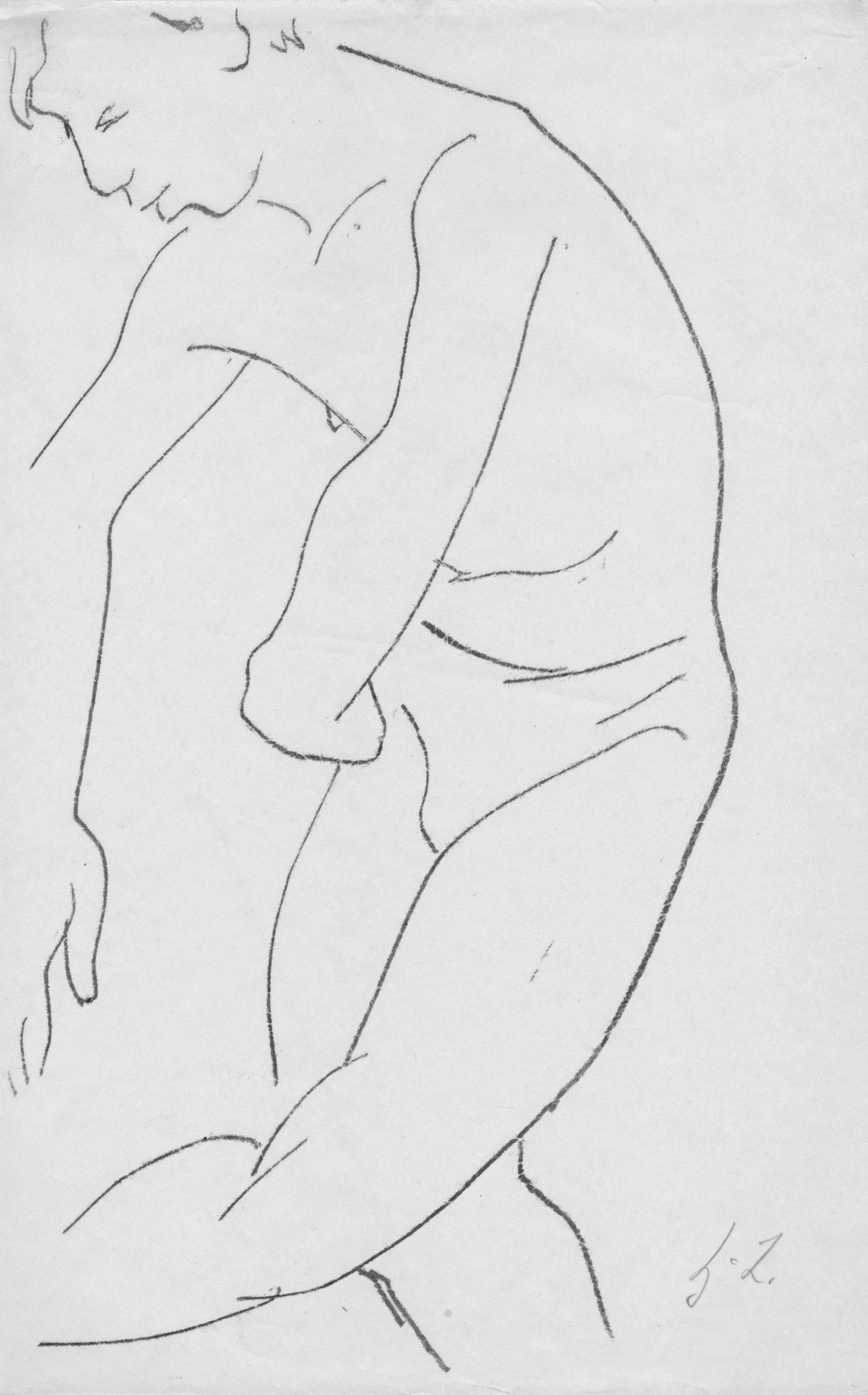
Figure 1 Sigurd Leeder, Jean Cébron in his piece Aquatic, drawing, 1957. © SAPA, Nachlass Sigurd Leeder
All this was on the agenda of Ricardo Viviani and Juan Allende-Blin’s talk on October 28, 2020. This interview is already accessible online,6 but it still awaits an elaboration of its contents. It provides a source that sheds light on Cébron’s early choreographic years in the 1950s. It also focuses on the choreographer-composer collaboration between Cébron and Allende-Blin, which has received little attention in dance and music studies yet. Based on the mentioned interview, this article will take a closer look at certain aspects of the artistic collaboration between Cébron and Allende-Blin, and will also discuss Cébron’s general approach to music, which is remarkable itself. This article thus derives its structure from this new and so far unexplored source and aims to propose approaches for a comprehensive appreciation of the choreographer Jean Cébron, which has yet to be done.
Jean Cébron and His Approach to Music
Juan Allende-Blin and Jean Cébron met in Santiago de Chile in 1948. Cébron was visiting as a guest dancer with Kurt Jooss for a staging of Jooss’ choreographies with the Ballet de la Escuela de Danza of the University of Chile. He danced the part of “junger Arbeiter” in Kurt Jooss’ ballet Großstadt to music by Alexandre Tansman—a performance that is still inscribed in Allende-Blin’s memory. At that time, a private and artistic friendship arose between the two men, which was to be continued years later in Essen. While in Santiago, Cébron took composition lessons from his friend, who had received excellent training through studies with Pedro Humberto Allende Sarón, a student of Claude Debussy. Through European emigrants who frequently visited his parents’ house, Allende-Blin had access to the hard-to-reach scores from Arnold Schoenberg’s circle, such as those by Anton Webern, whose subtle and complex tonal language he tried to introduce to Cébron. The outcome of these studies are two quite original compositions by Jean Cébron himself, written in 1952: Pièce pour trois pianos, and the quarter-tone Pièce pour violoncello.7 Cébron came across the quarter tones while he was learning on his own to play the violoncello. His fascination for these minimal changes in pitch corresponded with his passion for detail in movement very well. Allende-Blin sums it up perfectly in the interview: “This millimeter work interested him not only in the movements of the hands and the whole body, but also in the music.”8 The music for three pianos, in turn, shows unmistakable echoes of the music by Olivier Messiaen, whose organ pieces Allende-Blin and Cébron studied with four hands at the piano.
Allende-Blin describes his friendship with Cébron as an extremely beneficial constellation: he, who was also studying mathematics and architecture at that time, gained deep insights into dance and the spatial thinking associated with it, and even made attempts to design his own dance notation with the support of his friend. In turn, the dancer and soon-to-be choreographer Cébron developed an astonishing understanding of the compositional métier, which in turn inevitably influenced his choreographic work. And both of them looked for relationships that seemed to connect all these art forms on a fundamental level.
Many of Cébron’s early solo works were created without music and, according to Allende-Blin’s memories, were presented to a small interested public in the context of private solo evenings. The young composer did not miss music in these choreographies, because he saw it integrated into the movements themselves: “He showed me his dances and his dances were without music. His music was in the dance. In the dynamics of his movements.”9
Allende-Blin was particularly impressed by Cébron’s Vision Aquatique, created in 1948. Here, too, he emphasizes in the interview the musicality in the dancer’s movements, especially those of the hands: “You could feel in every movement of every limb, the fingers and so—they were in the right place at the right moment. There didn’t need to be any music there.”10 This detailed use of hands and fingers, and in general a strong focus on the placement of the extremities, can be found throughout Cébron’s choreographies. This may have something to do with his dance training, which included studies in Javanese dance with Djemil Anik and Indian dance with Ram Gopal, in addition to classical ballet, an intensive study of the Cecchetti system, and studies at the Sigurd Leeder School in London.11
In later pieces, Cébron did use music. It is hardly surprising that almost all of the music was by contemporary composers. Thus, music by Jess Meeker was heard in Instant Absolument Vierge, by Edgar Varèse in Poeme Danse, by Karlheinz Stockhausen in Struktur, by Celso Garrido Lecca in Time-Destruction, by Jay Watt in Two Poems and, last but not least, by Juan Allende-Blin in Séquence and Recueil.12 The latter will be examined more closely as case studies in the following text. It remains to be verified which of the aforementioned performances were realized with live music—an ideal to which Cébron likely felt committed. The already mentioned collaboration with Stockhausen was apparently inspired by a suggestion from Allende-Blin. The piece Struktur (1960), a choreography based on Stockhausen’s Elektronische Studie Nr. 1 (1952), can be seen as a kind of augmented canon between three performers, each movement imitating the previous one with a precisely defined degree of temporal stretching, thus allowing the audience to experience the same movement structure at a successively decreasing tempo.13 Such procedures of mathematical precision were familiar to Cébron from his study of Olivier Messiaen’s compositions—of course passed on to him by Allende-Blin, who carefully and in a well-structured manner introduced his friend to the fundamentals of composing: starting with melody and proceeding via counterpoint to harmony, always keeping an eye on the developments in music history. In his talk with Ricardo Viviani, Allende-Blin names Aristotle’s Drama Triangle as well as the Golden Ratio as essential principles of artistic composition. A conscious use of tension and release and above all an “economy of resources”14 are two practices that are also reflected in Cébron’s choreographies.15 The link back to well-established compositional principles, together with a tendency towards abstraction and the simultaneous search for new, contemporary possibilities of expression, seems to connect the entire œuvre of the two artists like a hidden parenthesis. In Allende-Blin’s descriptions, we can clearly see the image of Jean Cébron as a choreographer who treated music in his works with particular sensitivity, and who furthermore knew how to transfer musical-compositional structures to his own work, thus reaching a degree of reflection in the union of music and dance that was not entirely common in his time.
Séquence/Distances
Already in Chile, Allende-Blin and Cébron had begun working on a piece together. In the early 1950s, however, both moved to Germany at different times, which meant that the collaboration was temporarily interrupted. But at the beginning of the 1960s they both resumed their thoughts and the choreography Séquence was premiered on June 15, 1962 at the Akademie der Künste in Berlin.
What is remarkable about this first collaboration is the idea of an independent working process that composer and choreographer agreed on. One consequence of this is that the stage work and the composition have different titles: The choreography created by Jean Cébron with music by Juan Allende-Blin is called Séquence. The composition by Allende-Blin, on the other hand, is entitled Distances and was also performed under this title independently from the dance. It is a collaboration in the “sense of John Cage,”16 which Allende-Blin describes as follows:
We agreed that if he does choreography and I write music to go with it, there should be no agreement that the rhythm of the music is taken over by the choreography or vice versa. Rather, it should be in counterpoint. Of course, the music is created in the spirit of the choreography, but not, let’s say, as a reproduction of the dynamics, the rhythm, the choreography. Rather, it uses its own laws of music and its own laws of choreography in dance. […] But, as I said, always very conscious of the form, how you construct something and what dramaturgy a piece must have—both as dance and as a piece of music.17
Two aspects in particular are remarkable about this statement: Firstly, despite the independence of music and dance, there is a broad conceptual agreement; secondly, Allende-Blin seems to proceed quite naturally from the assumption that the music arises in reaction to the choreography. In this, he refers to a procedure that was used for a long time in the field of theatrical dance, in which a composer who often was specialized in dance carried out the musical ideas of the choreographers. This procedure can still be found in modern dance to some extent. Today, this way of working is rather rare, as most choreographers use pre-existing music, which means that the choreography is largely oriented on the music. The fact that in Séquence/Distances this independence or equality of the two art forms is the starting point of the artistic collaboration not only indicates a great trust in both art fields, but also shows an approach to art in general that is based on taking risks and experimenting.
The available material for Séquence is limited, as there seem to be no video recordings and the accessible photographic material is also very fragmented. However, the Archive of the Institute for Contemporary Dance | Folkwang Dance Archive contains a handwritten and annotated score of Distances18 and a kinetogram of Séquence,19 two very rare and most interesting sources. Research into the metadata of both sources has not yet been completed. For example, the authorship of the kinetogram has not yet been identified, and a detailed evaluation of the kinetogram by kinetographers is also yet to be done. Nevertheless, both materials already allow us some insights into this almost unknown piece of dance.
The kinetogram is noted in a checkered notebook with the title CÉBRON and on some single sheets. It is written in pencil in both versions. The notebook contains fifty-two unnumbered pages. Corrections, crossed-out figures, and annotations indicate that it is a working material and not a clean copy. There is a note in the booklet that contains the cast of the different parts. According to this notebook, Séquence is a choreography “en 6 episodes.”20 Each episode has its own title, resulting in the following order: Oracle, Dialogue, Eclat, Distance, Fauve, Oracle. This structure is somewhat reminiscent of the Aristotelian Drama Triangle mentioned by Allende-Blin with its build-up of tension, climax, and release. The cast changes in the single parts from solos to duets and small groups up to five dancers. The second kinetogram has thirty-two double pages and seems to be somewhat more elaborate than the booklet. Here too, there are some notes, but fewer corrections. This version is also preceded by the cast of the parts. However, the title addition “en 6 episodes” is missing. The following cast is mentioned below the noted date of the Berlin premiere:
ORACLE Pina Bausch ou Loni Harmssen
DIALOGUE Christa Schwertfeger ou Hiltrud Blank et Dieter Klos
ECLAT Eckard Brakel, Michael Diekamp, Jean Cébron
DISTANCE Christa Schwertfeger ou Hiltrud Blank, Dieter Klos, Erika Fábry, Gustav Hempel
FAUVE Jean Cébron ou Michael Diekamp
ORACLE Pina Bausch ou Loni Harmssen, Eckard Brakel, Jean Cébron, Michael Diekamp, Gustav Hempel21
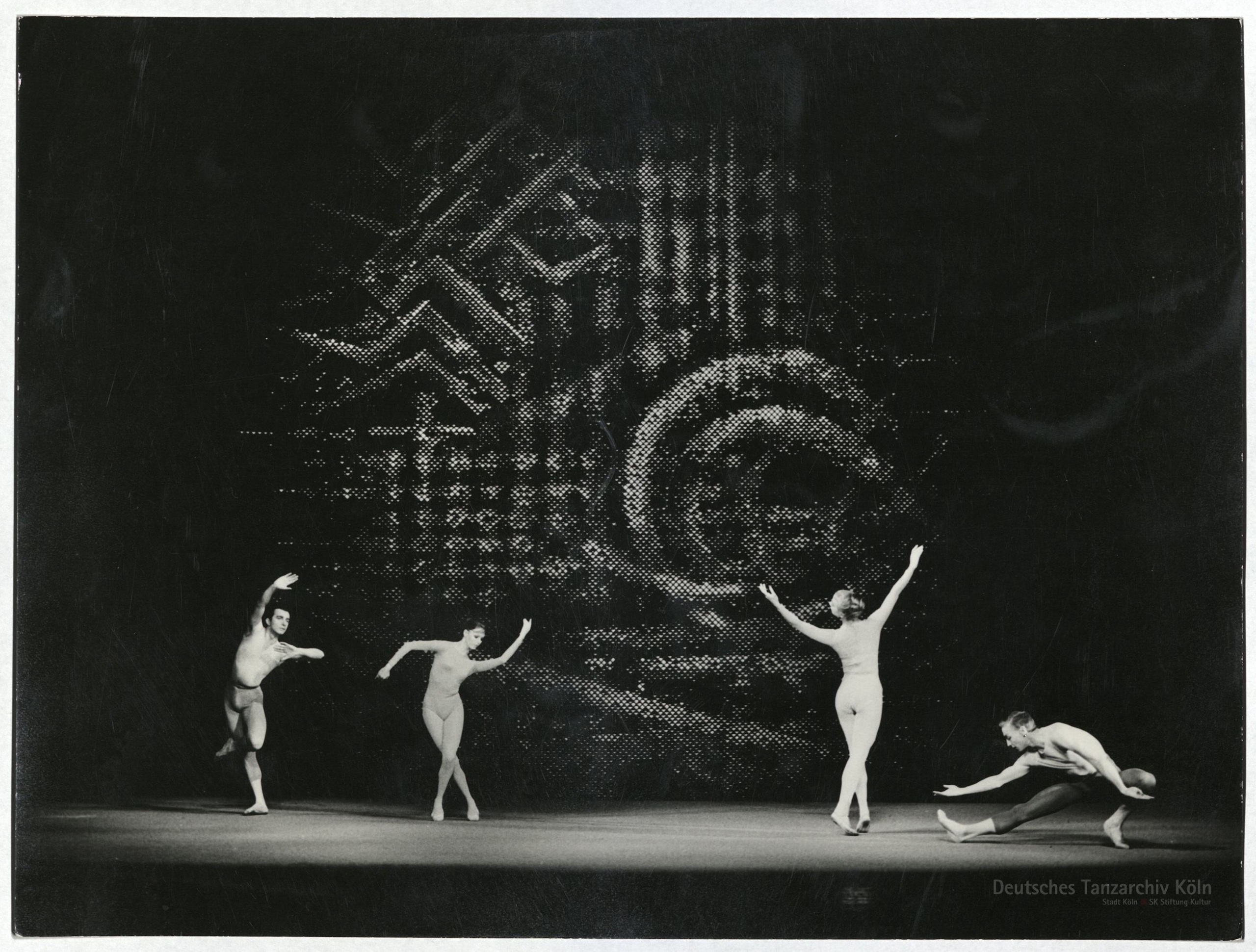
Figure 2 Scene photography of Séquence by Jean Cébron, dancers Gustav Hempel, Loni Harmssen, Christa Schwerdtfeger, Dieter Klos. © Sven Håkansson | Deutsches Tanzarchiv Köln, DTK-TIS-16193-1
Occasionally the kinetograms also contain notes on staging, for example when the use of light is placed next to the movements. Hermann Markard was responsible for the décor and costumes. This information contradicts Allende-Blin’s recollection, who says that although Markard designed a stage set, it was not used in the end and only a black curtain was installed. The costumes, however, remained colorful and were chosen by Cébron and Markard together: “The [costumes] were of a simple color, but the colors were important. The colors were chosen specifically—a very particular color for everyone. And that was all.”22 Unfortunately, the colors of the costumes cannot be traced via the black-and-white scene photos from Séquence available in the German Dance Archive in Cologne.23 All the costumes are tight-fitting, the men wear leggings with a T-shirt, the women full-body leotards. All wear ballet slippers. In these photographs, however, a stage set or rather a prospectus with abstract, large-scale patterns can be seen in the background. Whether the stage scenery changed in the course of various performances or whether, in this case, Allende-Blin’s memory is deceptive, must remain an open question at the moment.
If we take a closer look at the photographs from the German Dance Archive in Cologne and add some photographs from the Folkwang Dance Archive that were presumably taken during rehearsals, we get an initial idea of the movement language used. All the photographs show several dancers clearly positioned in relation to each other. Although there is no contact, the dancers’ relationships to each other are very clear and become visible not only through the spatial constellation, but also through the copying of individual movements or their continuation from one body to another. Couple constellations dominate over group arrangements. Many postures are in plié, thus bringing the body into a middle spatial plane. Only the men leave this plane in powerful, high jumps. Generally, the men’s leg positions are open, while the women’s seem to be dominated by more spiral-like turns in the body. The upper bodies are often tilted to the side. In addition to round postures, the extremities are seen often in angled shapes. The bodies show clear spatial directions. Intensive work with the gaze supports the multidimensionality of the movements. Overall, the choreography fits aesthetically into the other known pieces by Cébron. However, the use of a somewhat larger number of dancers is noticeable.
The third source already mentioned for Séquence is an annotated score of Distances, which was used for the rehearsal and tape recording of the piece (with an ensemble from the Folkwangschule conducted by Hans-Jürgen Knauer). Under the title is written “(La brise chantante d’oiseaux P. [= Paul] Eluard) Ballet pour 3 danseurs.”24 The score, handwritten in pencil, is signed by Juan Allende-Blin and dated “Essen-Werden, 13.1.1961; Hamburg, 24.1.1961.”25 It contains some corrections added with a different pencil. But above all, it contains entries with an unmistakable reference to the choreography, such as the marking of the moment when the dance begins. Individual rhythms are again noted separately, individual bars are circled. Particularly noteworthy are the dancers’ counts inserted over long sections. All this suggests that Jean Cébron was working with this score and was certainly looking for ways to create a relatively close link between dance and music. Although the composition and choreography were created independently of each other, they were not isolated.
But what other impulses—beyond what has been mentioned so far—could have emanated from the music to the performance? For now, this question can only be answered speculatively, and in any case it would require a more thorough examination. Nevertheless, a practiced score reader such as Cébron would surely not have missed essential structural moments of the musical discourse, the purposeful alternation of tension and relaxation in calculated proportions, which is typical of Allende-Blin’s music in general. Apart from that, the music seems to have been crafted carefully to avoid anything showy, forced or constricting, and on the contrary, allows the dance to take its own space at all times. The music maintains a “distance” from the stage action and does well to do so. The unusual instrumentation constellation with its rich sound mixtures catches the listener’s attention: If one looks at the instruments involved and their respective roles, the first thing that strikes the listener is the flute’s expansive melodic curves, which break off and restart from time to time, and which are also partly taken up by the other instruments. The noisy accents or splashes of color in the percussion, which contribute significantly to the special tonal atmosphere of the piece, form a counterpoint to the melodic lines, whereas the vibraphone and harp are in a tonally mediating position with regard to color and expression. It would be fruitful to search for analytical criteria with which to objectify the astonishing depth of the music and its extremely nuanced colorfulness. For example in the dynamics: “The gradation in loudness have the effect of suggesting a space, with the indication of a curvilinear perspective,” as the composer put it.26 The choreographer and composer are likely to have discussed the concept of space at length, each from their own perspective. The title chosen by Allende-Blin for his music, Distances (with which the piece, regardless of its original role as music for dance, was premiered at the Grillo Theater in Essen in 1962 and with which it continues to live a life of its own), suggests that the idea of spatial distances—for example, as relationships of points in an imaginary sound space—represented a kind of conceptual starting point. Far from a merely tautological relationship, the encounter of dance and music seems to aim quite deliberately at an emerging “third” which as a contrapuntally conceived unity nevertheless dialectically preserves the autonomy of the two art forms.
Recueil/Profils
The second joint project was created according to a similar process. Once again, both artists agreed on a relative but not total independence of music and dance as a fundamental concept of the creative process. Commissioned in 1965 by Kurt Jooss during his tenure as head of the Folkwang dance department, Juan Allende-Blin this time composed a chamber music piece for five instruments (clarinet, trumpet, trombone, violoncello, and percussion).27 The dual nature of the piece—on the one hand as music for a choreography entitled Recueil, on the other hand as an independent music piece named Profils—once again provides an indication that the music should in any case be perceived as an art form in its own right. The title and basic structure of the piece are explained by the composer in the Essen interview as follows:
My music consists of parts that are precisely structured—in French: confrontation et profile. Confrontation as the word is also called in German [or English]: it is a being against; one group stands against another group, so to speak in counterpoint and in a certain contrast. And profile always means music that is in one part—with many instruments, but it is like a profile, a minority of melodies that alternate. And then there is another confrontation and once there are two profiles in a row—once for solo clarinet and once for solo percussion.28
For the premiere of the choreography in Essen in 1965, the composition was used as a tape recording performed by members of the NDR Symphony Orchestra under the direction of Gerd Zacher.29 However, Jean Cébron made some cuts for Recueil after consulting the composer. If one follows Allende-Blin’s indications, the synchronous creation process of choreographed dance and composed music also took place here in an informal manner: both worked autonomously, but with the knowledge of certain structural pre-decisions of the other. Dance may have provided a certain initial impulse, especially since Allende-Blin remembers occasionally attending rehearsals by Cébron and taking some impressions, moods, and inspirations from what he saw. The fact that he deliberately refrained from taking precise notes fits into the overall context, since he felt it was important to rely on his own experience and to use only “what I had retained in my memory”30 for processing and realizing the music. The common starting point in the working process is described by Allende-Blin in the following words:
There is no symmetry or, let’s say, concordance where the dance would take over the rhythms of my music. But the rhythmic spirit in these movements also exists in my music—without having a strict parallelism. It’s more of a curvilinear parallelism.31
Allende-Blin locates this “curvilinear parallelism,” which characterizes the special dialogue between the art forms of dance and music as a whole, firstly in his special attention to detail, and secondly in the way he deals with time:
There are movements of the hands by both [Jean Cébron and Pina Bausch] that are very, very precise and in which every movement has a meaning. And in my music there are parts where something like that also occurs: Either it is rhythmic, metronomic—to put it that way; or there are parts where time builds a curve—that is, the tempo slows down, slows down or it speeds up, speeds up and comes back to the starting point. And that can be found in the movements of the choreography as well as in my music.32
Of course, one could also go further here and analyze Allende-Blin’s music beyond the aspects mentioned in the interview with regard to its sound-spatial disposition as well as its possible influence from the choreographer, Jean Cébron’s spatial conception (in the tradition of Rudolf von Laban or Kurt Jooss). To what extent would a kind of “diagonal listening” be adequate for his music, as he once suggested elsewhere? As in the previous piece Distances, a certain key role in Profils—whose multi-layered sound seems to be designed from the contrast between the groups of winds, strings, and percussion—is probably assigned to the differentiated percussion, whose functionality includes the whole spectrum from rhythmic accompaniment to solo, with all the intermediate levels and nuances that result from the chosen instruments and performance techniques.
The reverse question of the degree to which the choreographic realization incorporates elements of the music could be approached using a video recording of Recueil, which was filmed in May 1993 on the occasion of a Cébron retrospective in the Neue Aula of the Folkwang Hochschule.33 Cébron himself was responsible for the rehearsal, with Amaya Lubeigt and Enrico Tedde dancing:
The stage is dark. Suddenly a mixture of sounds breaks the silence. The repetitive short melodic fragments sound almost searching, interspersed with soft, wooden percussion. A short pause, two spotlights are directed at a male and a female dancer. She in a calf-length thin flowing turquoise dress, he in brown leggings and bare-chested, both in ballet slippers. Sitting on the floor, their backs turned slightly diagonally to each other, their drawn-in knees locked. They look like two solitary, introverted individuals. His gaze goes forward, hers back. Two bodies that are far away from each other and yet seem to be connected across all distance. Creating their own little cosmos. A high clarinet note, upper bodies moving slowly, arms stretching. Still on the ground, the two slowly move towards each other with spiraling movements that open and close again and again. Circling each other until they finally find one another. Without any touch. Connected by the common flow of movement and almost architecturally designed postures that flow from one body to the other.
Dramaturgically, Recueil can be divided into four parts, separated by short pauses in the light; alternatively, a six-part structure is recognizable, which is oriented towards the alternation of duet and solo. A classical dramaturgical line spans the entire fourteen-minute piece, which begins with the couple approaching each other, leads to a joint dialogue with solos, and finally ends in a seated position again, but this time in a corresponding pose and next to each other. In the movement, this dramaturgical line is primarily constructed through the use of the spatial planes. While the choreography begins on the lower spatial level—positions and movements in a sitting position, on the knees, or in a very low plié dominate—the solos are choreographed in an upright standing position and include single jumps and lifting figures. The dancers then slowly move back towards the floor to finish in a seated position, thus closing the cycle.
The movement vocabulary is particularly characterized by its fluidity. Although the choreography contains many moments of pause that could seem almost pose-like or static, it nevertheless remains in a continuous flow of energy. The movements are inscribed on the dancers’ bodies with a high degree of precision and focus. Almost as if with an accurately guided pencil, abstract three-dimensional figures are drawn into the space by bodies. Both dancers are clearly related to their kinesphere, which they seem to expand over and over again. This tendency to expand one’s own kinesphere, combined with postures that are matched to each other in form, creates a communication between the dancers’ bodies entirely without physical contact. The clear direction of the arms, legs, and especially the hands and feet create a narrative and add an emotional level to the rather abstract design, a combination that runs through the whole choreography. It is particularly obvious here that the focus of the movement design is on a varied and detailed choreography of the extremities. The torso is included repeatedly, especially with bends and curves, but it supports the movements of the arms and legs more than developing an independent expressive quality. Although there is no division between the male and female body that characterizes the whole piece, different qualities of movement are discernible, especially in the solos. While the female dancer’s movement language is characterized by a rather upright stance, soft transitions, and spirals, the male dancer moves more angularly and plays with the contrast of tension and relaxation. Even in his jumps, the use of muscular tension and relaxation predominates over the idea of an explosive use of energy to move upwards away from the floor. The choreography almost completely avoids a presentational mode. The couple seems to create a space of their own around themselves, into which the audience can glimpse from the outside while remaining unnoticed.
Music and dance both get their own place in Recueil. In the manner of the collaboration described by Juan Allende-Blin, two independent pieces have been created here that nevertheless complement each other in a convincing way. Thus, despite the independence of both arts, a close connection between dance and music is also evident, which is to be seen entirely in the sense of the “common spirit”34 emphasized by Allende-Blin in Séquence as well. If one looks from the music to Cébron’s dance, as it can be relived on the basis of this video recording from 1993, it is not surprising that the choreographer refrained from obvious congruencies with the music and its temporal arrangement, but rather aimed to create a complex relationship between sound and movement. In this piece, too, the subjects of “space” and “relations” seem to have been central to choreographer and composer. Allende-Blin uses compositional tools to create spaces of sound and listening, just as Cébron works with the kinesphere of the dancers and sets them in relation to each other. Although Cébron’s movements are oriented towards the different spatial directions, they do not establish a clear relationship to the stage space. The dancers’ kinesphere dominates the action. The external space in which the dancers move, on the other hand, is created by the music. Both are thus in relation to each other, refer to each other and yet remain independent at their essence.
A Beginning …
These first considerations on the artistic partnership between Jean Cébron and Juan Allende-Blin not only take a look at a close collaboration between choreographer and composer that was rare in the twentieth century, but also at two artistic personalities who are unique in their own œuvre and who have so far received little attention from dance and music scholars. At the end of these remarks, all that remains is: … to be continued.
-
Euphorie und Aufbruch. Eine Geschichte des Tanzes 1959–1969, a cooperation project by the Institute for Contemporary Dance, the Deutsches Tanzarchiv Köln and the Pina Bausch Foundation. The project was funded by the Ministry of Culture and Science of the State of North Rhine-Westphalia. The results of the project are presented on the website https://euphorie-und-aufbruch.de (accessed 2 July 2022).↩︎
-
For an introduction to the life and work of the composer, see: Christian Esch and Frank Schneider, “Immer auch ein politischer Impuls.” Juan Allende-Blin im Gespräch mit Christian Esch und Frank Schneider (Altenburg: Kamprad, 2017) and Stadtbibliothek Essen, Verena Funtenberger, ed., Juan Allende-Blin. Komponist und Musikchronist. Verzeichnis der Werke, Rundfunkproduktionen, Tonträger, Texte (Brühl: Edition Gravis, 2020).↩︎
-
For example the restaging of Jean Cébron’s Etüde Starting Point 2016 (see: Stephan Brinkmann and Henner Drewes, “Notation Reflexion Komposition: Die Etüde ‘Starting Point’ von Jean Cébron,” in Tanzpraxis in der Forschung—Tanz als Forschungspraxis: Choreographie—Improvisation—Exploration, ed. Susanne Quinten and Stephanie Schroedter [Bielefeld: transcript, 2016], 73-85). Or the project Hommage an Jean Cébron by Olimpia Scardi and Francesca Mommo 2020/21 (see https://www.francescamommo.com/hommage-an-jean-cebron/ [accessed 2 July 2022]).↩︎
-
Stephan Brinkmann, Bewegung erinnern. Gedächtnisformen im Tanz (Bielefeld: transcript, 2013), 233 (English translation by the authors): “Die Beziehung zwischen einer Bewegungsschule und ihrer künstlerischen Anwendung ist sowohl für die Jooss-Leeder-Methode als auch für die […] aus Amerika stammenden Tanztechniken ein entscheidender Motor für deren Entwicklung und Fortschreibung, weil ihre Vertreter dadurch als Pädagogen und gestaltende Künstler gleichzeitig wahrgenommen werden und der Unterricht immer mit einer Aufführungspraxis in Verbindung gebracht werden kann.”↩︎
-
Walter Terry, in Herald Tribune, July 4, 1957. Many thanks to Ricardo Viviani for sharing information on his research about Jean Cébron in different archives in the United States.↩︎
-
Juan Allende-Blin interviewed by Ricardo Viviani at Folkwang University of the Arts, Essen, October 28, 2020, video, 1:18:48, accessed 2 July 2020, https://timeline.euphorie-und-aufbruch.de/media/pbf/video/20201027_juan_allende-blin_0000.mp4. The interview was conducted in German. All the translations used in this text are by the authors.↩︎
-
The scores are in private ownership. Both pieces were performed in May 1993 during an evening for Jean Cébron: Tanz und Komposition. Choreographien und Kompositionen von Jean Cébron aus den Jahren 1952-1964 at the Neue Aula at the Folkwang University of the Arts. The performers were Klaus Marx (violoncello), Tatjana Dravenau, Thomas Schäfer, and Thomas Günter (piano). A video recording of the evening is stored in the Folkwang Tanzarchiv. It remains to be researched whether more compositions by Jean Cébron can be found and in which context his music for The Ambiguous Monster (1955) could be situated.↩︎
-
Allende-Blin, interview: “Diese Millimeter-Arbeit interessierte ihn nicht nur in den Bewegungen der Hände und des ganzen Körpers, sondern auch in der Musik.”↩︎
-
Allende-Blin, interview: “Er zeigte mir seine Tänze und seine Tänze waren ohne Musik. Im Tanz war seine Musik. In der Dynamik seiner Bewegungen.”↩︎
-
Allende-Blin, interview: “Man spürte bei jeder Bewegung jedes Gliedes, der Finger und so—sie waren an der richtigen Stelle im richtigen Moment. Da brauchte keine Musik dabei zu sein.”↩︎
-
Exploring these dance-technical and intercultural influences in Jean Cébron’s choreographies in detail promises to be a fruitful approach to understanding his movement language. Ricardo Viviani has already started to do so in a seminar “Finding Your Own Voice” at the Institute for Contemporary Dance of the Folkwang University of the Arts in winter semester 2020/21. A deepening and expansion of this work is in preparation.↩︎
-
This information, especially the English spelling of the titles, refers to the Jacob’s Pillow Dance Archive database. Jean Cébron performed there repeatedly in the 1950s and 1960s.↩︎
-
Esch and Schneider, “Immer auch ein politischer Impuls,” 17.↩︎
-
Allende-Blin, interview: “Ökonomie der Mittel.”↩︎
-
On Cébron’s thoughts about tension and relaxation in dance, see also: Jean Cébron, “Das Wesen der Bewegung. Studienmaterial nach der Theorie von Rudolph von Laban,” in program for the symposium “Folkwang Tanz,” October, 13-15, 2017, Folkwang University of the Arts, ed. Stephan Brinkmann and Henrietta Horn (Essen: Folkwang University of the Arts, 2017): 22-30.↩︎
-
Allende-Blin, interview: “[…] im Sinne von John Cage.”↩︎
-
Allende-Blin, interview: “Wir haben uns geeinigt, dass, wenn er eine Choreografie macht und ich eine Musik dazu schreibe, es keine Übereinkunft geben sollte, dass die Rhythmik der Musik von der Choreografie übernommen wird oder umgekehrt. Sondern es sollte im Kontrapunkt sein. Die Musik entsteht natürlich im Geiste der Choreografie, aber nicht, sagen wir, als Reproduktion der Dynamik, der Rhythmik, der Choreografie. Sondern es werden eigene Gesetze der Musik benutzt und eigene Gesetze der Choreografie beim Tanz. […] Aber, wie gesagt, immer sehr bewusst, was die Form betrifft, wie man etwas konstruiert und welche Dramaturgie ein Stück haben muss—sowohl als Tanz, als auch als Musikstück.”↩︎
-
Juan Allende-Blin, Distances, autograph score, 1961, Folkwang Tanzarchiv, FTA_EA_22.↩︎
-
Kinetogram Séquence, autograph, Folkwang Tanzarchiv | Kinetographie-Archiv, FTA_EA_18_KA.↩︎
-
Ibid.↩︎
-
Kinetogram Séquence.↩︎
-
Allende-Blin, interview: “Die [Kostüme] waren von einfacher Couleur, aber die Farben waren wichtig. Die Farben wurden gezielt ausgesucht—für jeden eine ganz bestimmte Farbe. Und das war alles.”↩︎
-
This analysis is based on five stage photographies (Deutsches Tanzarchiv Köln, signatures: DTK-TIS-16192, DTK-TIS-16193, DTK-TIS-16194, DTK-TIS-16195, DTK-TIS-16196) and two photographies from rehearsals (Folkwang Tanzarchiv, signatures: FTA_EA_14-1_HR, FTA_EA_14-2_HR).↩︎
-
Allende-Blin, Distances. For a recording see Juan Allende-Blin, “Distances (1961) for flute, harp, vibraphone, and percussion,” in Künstler im Gespräch—Juan Allende-Blin und das Ensemble, Cybele 3SACD KiG 007, E-MEX Ensemble, 2016, super audio compact disc.↩︎
-
Allende-Blin, Distances.↩︎
-
Juan Allende-Blin, “Works 1961-2010,” CD-booklet, in Künstler im Gespräch—Juan Allende-Blin und das Ensemble, Cybele 3SACD KiG 007, E-MEX Ensemble, 2016, super audio compact disc, 37.↩︎
-
For the commission see the letter by Kurt Jooss, March 22, 1965, Folkwang Tanzarchiv, FTA_EA_16_AK88.↩︎
-
Allende-Blin, interview: “Meine Musik besteht aus Teilen, die genau gegliedert sind—auf Französisch: confrontation et profile. Konfrontation wie das Wort auch auf Deutsch heißt: Es ist ein Dagegensein; eine Gruppe steht gegen eine andere Gruppe, sozusagen im Kontrapunkt und in einem gewissen Kontrast. Und profile meint immer eine Musik, die einstimmig ist—zwar mit vielen Instrumenten, aber es ist wie ein Profil, eine Minderheit der Melodien, die sich abwechseln. Und dann kommt wieder eine confrontation und einmal kommen zwei profiles hintereinander—einmal für Klarinette solo und einmal für Schlagzeug solo.”↩︎
-
The concert premiere of the complete score (with the title Profils) took place some thirty years later, on May 22, 1993 in Essen.↩︎
-
Allende-Blin, interview: “[…] was ich in meinem Gedächtnis behalten hatte.”↩︎
-
Allende-Blin, interview: “[E]s gibt keine Symmetrie oder, sagen wir: eine Konkordanz, wo der Tanz die Rhythmen meiner Musik übernehmen würde. Aber den rhythmischen Geist in diesen Bewegungen gibt es auch in meiner Musik—, ohne dass das eine strenge Parallelität hat. Es ist eher eine kurvige Parallelität.”↩︎
-
Allende-Blin, interview: “Es gibt Bewegungen der Hände bei beiden [Jean Cébron und Pina Bausch; AKA], die sehr, sehr genau sind und in denen jede Bewegung einen Sinn hat. Und bei meiner Musik gibt es Partien, in denen so etwas auch vorkommt: Entweder ist es rhythmisch, metronomisch—um das so zu sagen; oder es gibt Teile, in denen die Zeit eine Kurve zeigt—das heißt, das Tempo wird langsamer, langsamer, oder es wird schneller, schneller und kommt wieder zurück zum Anfangspunkt. Und das ist sowohl bei den Bewegungen dieser Choreografie als auch bei meiner Musik zu finden.”↩︎
-
Video recording of the dance evening Tanz und Komposition. Choreographien und Kompositionen von Jean Cébron aus den Jahren 1952-1964, May 14/15, 1993, Folkwang Tanzarchiv.↩︎
-
Allende-Blin, interview: “gemeinsamen Geists.”↩︎