How to cite
How to cite
Outline
Outline
Liumin: Floating Migrants in Pre-modern China
Folk songs: A “Wild Zone” for Women in Patriarchal Contexts
Sour and Bitter Songs: The Musical Expressions of “Left-Behind Women” outside the Patriarchal Norms
“Sing a Song to Broaden the Heart”: Male Migrants Borrowing Women’s Songs, and Roundabout Ways of Musical Expression

A group that is silenced and disadvantaged in one social environment may enjoy privileges as the dominant group and manipulate the voices of those with less power in other contexts. As scholars point out, power imbalances shift in the migratory process and go beyond the hosts-migrants dichotomy (Glass and Peggy 2022; Avelino, Flor, and Rotmans 2009). In rural patriarchal societies, males are granted the dominant roles in their families and impose a set of feminine ethics upon their female partners. Being excluded from decision-making processes and silenced in many social spheres, their female partners use folk songs to complain and to persuade. Once these males become marginalized outsiders in the urban settings, they tend to borrow the songs of their silenced wives to vent emotional desires.
Females played peripheral roles in the music performances of floating migrants I participated in and observed in 2011–2013 and 2016–2018. The state-sponsored art groups represented mainly heavy manual workers—the very professions for which the cities are experiencing shortages, and which the state wanted migrants to take up in order to minimize infrastructure construction costs. Although female performers participated to ensure gender-balanced representation, they mostly performed in choirs or as backup dancers, supporting the male leads who sang as spokesmen for construction and factory laborers. Likewise, male migrant musicians dominated rock performances of migrant bands, whether on mainstream and televised stages or small-scale community concerts. Although the wives of these migrant rockers might have certain musical skills, they voluntarily or forcibly assumed the duties of caring for children, cooking for the band members, cleaning the performance and rehearsal venues, and preparing the equipment out of the spotlight.
In the introductory chapter of this book, where I present the second snapshot of the migrants’ urban musical life, I documented a customary musical practice I observed among male floating migrants from Middle and North China. These migrants performed folk songs written in female voices to express and vent in both private and collective life. “Walk through the Western Pass” (Zou Xikou), sung by Lao Wu in the snapshot, was one of these women’s songs:
My brother,1 you are walking through the Western Pass,
Anguish wrings my heart.
When will you return?
Please don’t make me wait until my hair turns white.I grabbed your sleeves tightly with my hands,
My tears are flowing into my heart.
Although I have a thousand words,
I know I can’t persuade you to change your mind.
I only hope you will come back soon.2
Lao Wu was not the first migrant to sing this song into my recorder. I still remember my first encounter with this song: on a rainy early summer afternoon in Beijing, accompanied by the sound of water dripping from the leaky roof onto an aluminum washbasin. This sweet, sad folk song, apparently meant to be sung by women, flowed from the mouth of a male migrant, who seemed introverted and even a little aloof, yet filled it with deep, honest emotion. “Walk through the Western Pass” was not an outlier, as my research found dozens of similar songs that were centuries-old or bearing twenty-first-century features, composed for women’s voices but popular among the male-dominant migrant community. What qualities of these women’s songs fascinated male floating migrants to accept and circulate them in a strange city? This is the question I was curious about at the time, attempted to explore throughout my research, and will discuss in this chapter.
Liumin: Floating Migrants in Pre-modern China
In the twenty-first century, the folk songs borrowed and circulating among floating migrants may have existed for centuries. The phenomenon of the floating population emerged after the 1980s, when biased policies and their attendant imbalanced modernization and economic growth drove rural residents to temporarily migrate to cities for work. Nonetheless, the history of China, a country that has existed for thousands of years, is replete with waves of temporary domestic migrants. Before the twentieth century, these migrants were commonly called liumin (literally “floating people”).3 One of the main types of these liumin were male rural laborers from the Central China Plain who left their families behind to make a living in another social setting (Xu 2009; Jiang and Sun 2001). The left-behind wives of these migrants created folk songs, some of which have been handed down from generation to generation and were later borrowed by floating migrants in the twenty-first century. “Walk through the Western Pass” is one of these songs. To facilitate the understanding of this musical tradition, it is necessary to provide some historical and socio-cultural context that gave rise to these songs.
In A History of Chinese Liumin, Jiang Lihu and Sun Hongtao (2001) provide a widely accepted definition of the first wave of floating migrants: “A liumin is a type of migrant who, influenced by certain factors, spontaneously moves to another region but does not settle there” (3). In the existing body of literature about Chinese migration, scholars summarized three basic features of the liumin: voluntariness, randomness, and temporariness. These features distinguish them from the other two major categories in the history of Chinese domestic migrants: those who were forced by the government to move from one place to another, and those who picked their destination after careful deliberation and tended to settle down there permanently (see, e.g., Ding and Wang 1997; Ge, Cao, and Wu 1993). In his seminal work A Theory of Migration, Everett Lee (1966) conceptualizes migration as involving two main factors: pull factors, which are associated with the area of destination and act to attract people to it; and push factors, which are associated with the area of origin and tend to repel them (see Urbański 2022 and Parkins 2010 for recent applications of the terms in scholarly works). In the following section, I apply Lee’s classical binary division as a way to locate the practitioners of the folk songs.
In the history of Chinese domestic migration, a liumin wave has always been caused by a combination of push and pull factors. However, push factors played a leading role in migratory decision-making in many cases, such as: when the revolutions or rebellions overthrew the old regime but failed to build a new one; when the state was invaded and lost its political and military control over the territory; when the country broke apart into smaller kingdoms, which kept fighting and absorbing each other; or when natural disasters struck (Zhang 1996). In these cases, thousands of families fled their hometowns, which were conquered, colonized, became battlefields, or were seriously damaged by floods and earthquakes, and started their floating journey to and among numerous other regions. Different from permanent migrants, who usually chose their destinations deliberately, the migration of these liumin families was primarily a response to emergencies; they often returned to their homeland as soon as it was restored to its former tranquility (see, e.g., Li Deyuan 2004; Liu Yajun 2002).
On the contrary, liumin populations driven by pull factors were dominated by male migrants and had commonalities with modern floating migrants. These liumin were attracted to the destination mainly by the economic opportunities it could provide. These pull factors were largely shaped by an imbalance in economic development across regions. When a certain area, rural or urban, achieved relatively rapid economic growth for some reason (such as abundant natural resources and favorable government policies), a large number of surplus laborers from other areas were attracted by better opportunities for jobs and wealth creation in general (Ge 1997). Unlike those liumin who usually uprooted their whole families to escape disasters, these young male laborers left their wives, children, and aged parents behind, with the intention to rejoin them in their hometowns as soon as they earned enough money.
Why were these male “floating migrants” reluctant to settle down? An idiom, antu zhongqian, frequently appears in the existing scholarly publications that try to answer this question. This idiom is from Han History, a work written during the East Han Dynasty (25–220 A.D.), and can be loosely translated as “to be content in one’s homeland and be serious about moving.” Scholars point out that ancient China was a self-sufficient agricultural society where the relationship between the people and their land was very intimate. They further argue that this intimate relationship has been cultivated into a pronounced homeland-loving sentiment that is widely spread among Chinese people, particularly the Han Chinese people living in the ancient territory of China (now the Shaanxi, Shanxi, Hebei, Henan and Shandong provinces; see e.g., Sun Wei 2009; Tu 1996). In Street Criers, Hanchao Lu (2005) further elucidates this sentiment of the Chinese people’s “genuineness and belonging to their homeland” with a quote from Hermann Keyserling’s The Travel Diary of a Philosopher (1925) as follows:
Here the whole of life and the whole of death take place on the inherited ground. Man belongs to the soil, not the soil to man; it will never let its children go. However much they may increase in number, they remain upon it, wringing from nature her scanty gifts by ever more assiduous labour; and when they are dead, they return in childlike confidence to what is to them the real womb of their mother. (Lu 2005: 19)
The earliest musical activities of these liumin and their left-behind wives can be traced back to the Chunqiu period (770–476 B.C.). During that period, the government’s land privatization policy led the ruling classes to encroach on cultivable land. As a result, waves of surplus laborers left their hometowns to become tenant-farmers in other rural regions (Liang and Sun 2001). These male floating laborers produced songs whose texts were documented in The Book of Odes (Shi Jing), an anthology of selected songs compiled in the 8th century B.C.:
Yellow birds, listen to me
Don’t gather on my mulberry tree.
Don’t eat my corn.
You are like the people of this land,
Who are dishonest and hard to get along with.
I miss my home.
I want to return to my father and brothers…
Above is an excerpt from “Yellow Birds” (Huang Niao), a song whose lyrics have been preserved in the “Lesser Court Hymns” (Xiao Ya) section of The Book of Odes (see Heng 1980: 261). In this song, earliest liumin complained about the people they encountered in the host settings and expressed their eagerness to return to their hometowns and their families there.
The section “Airs of the States” (Guo Feng) of The Book of Odes (see Heng 1980: 18) features preserved texts of a few songs from women who were left behind by their migrating husbands. “Grass Insects” (Cao Chong) is a representative one:
“Yao! Yao!” the grass insects are chirping.
“Ti! Ti!” the crickets are hopping.
While I do not see my husband,
My anxious heart is filled with worries.
Let me see him.
Let me join him.
My heart will soon be pleased.
Unfortunately, the melodies of these songs were drowned by the tides of history, such that these musical expressions survive only as texts.
A considerable portion of the surviving folk songs from ancient liumin and their left-behind wives were associated with the migration wave of “Walk Through the West Pass” (Zou Xihou)— one of the largest population movements in China’s history, spanning from the 16th century up to the early 20th century. In the 16th century, after hundreds of years of efforts to extend the borders and to absorb neighboring small states, the Han-led Ming Dynasty finally took control of the Hetao region (now the Western part of Inner Mongolia), a region that was rich in natural resources and farmland, scarcely populated, relatively economically developed, yet lacking manpower (Robinson 2020). These pull factors attracted many surplus laborers from the Central Plain, where economic development was slowing, the population was growing sharply, and the available cultivable land was declining (Dardess 2012).
Xikou, literally the “Western Pass,” refers to one of the main passes of the Great Wall. As a series of fortifications constructed to protect the state against incursions by northern nomadic tribes, the Great Wall winds for over 6,000 miles along the northern border of the old Chinese empire, separating the Chinese Central Plain from the Ordos Plateau (today’s Inner and Outer Mongolia) and Manchuria. A few passes (kou) were built into the Great Wall—the Western Pass, located in the northeast of Shanxi Province and connecting the Central Plain with the Hetao region of the Ordos Plateau, is one of them. These heavily guarded passes served as secure gates in ancient China and allowed passage only to troops, along with a small number of registered traders and travelers. After the government finally annexed the Hetao region and relaxed restrictions on population movement and access to the wall, numerous laborers and traders began to flow from China’s heartland into Hetao. The Western Pass was a key pass that they had to traverse. This migration phenomenon is therefore referred to by Chinese people and scholars as “Walk through the Western Pass” (see, e.g., Wang Yi 2021).
Many of these migrants were from Shanxi Province, a region characterized by stony, infertile land, acute water shortage, and numerous hills, where agriculture was supplemented with commerce and the rearing of cattle and goats. However, since the late Ming Dynasty in the 16th century, Walk through the Western Pass became a new option for ambitious, energetic young men. This trend was documented by Dongyang Li in Collected Statutes of the Great Ming Dynasty:
It was a densely populated region. Roughly 80 to 90 percent of the population was farmers, and 10 to 20 percent was traders […] In recent years, a lot of laborers rush to the other side of the Great Wall. They go there with ploughs and plowshares in the spring, and often return after autumn harvests with bags filled with money and grain. When I first arrived in this region, I was afraid that these people would settle down there for good. But then I learned, through my investigation, that these laborers are mostly from large and poor families. These families send healthy, strong men outside the Pass to feed the unproductive children and the elderly back home.(Li [1576] 2007)
These liumin were called “wild geese” (yanxing ke) because they usually left their hometowns in the spring and returned at the end of the fall, similar to bird migration (Liu and Liu 2010; Shijie Bolan 2007). According to the local gazetteers4 published by the home counties of these “wild geese,” they “effectively improved the lives of their families” and “were the actual reason why the [home] county became rich.” (Taigu County 1931: 868) Some liumin established themselves as traders after they reached Hetao, trading and peddling Han Chinese goods with Mongols, setting up stores, and “making a fortune hundreds of miles away from their hometown” (Wang 1780: 23). The success of these early “wild geese” encouraged more and more young men to cross the Western Pass to find better opportunities. According to The Veritable Records of the Emperor Ren of Qing, written around 1810, “the number of people who went through the Pass reached over ten million,” and in some regions, “the people who were working or doing trade outside the wall accounted for half of the [county’s total] population” (Shuo County Gazetteer 1988: 58).
Living in a patriarchal Chinese society where male supremacy ruled, wives of male liumin had no right to question the decisions made by their husbands and had no alternative but to respect and support their choices to “walk through the Western Pass.” To comply with social norms and their domestic roles, they could not expose themselves to the outside world or leave their home communities to follow their husbands (Goldin 2002). The songs that documented the experiences and expressions of these left-behind women were then borrowed and performed by the male migrants who traversed through and worked out of the Western Pass. Handed down through generations in both their hometowns and the places where these male migrants stopped (Yan 2004), these songs are the backbone of the musical culture of modern floating migrants with similar experiences.
Folk songs: A “Wild Zone” for Women in Patriarchal Contexts
For the left-behind wives of male floating migrants in ancient China or in twenty-first-century rural villages, folk songs were among the few means to voice their opinions and experiences. Gender division and hierarchical relations exist in almost every culture in the world and penetrate all aspects of social life. In civilizations where patriarchal ideology has been rooted for millennia, traditional norms and values granted the male members of society the privilege to direct symbolic cultural expressions and to marginalize females in the social discourse. As early as 1975, the anthropologist Shirley Ardener drew academic attention to the “deafness” of men and the “mutedness” of women in socio-cultural communication and narratives with her seminal work Perceiving Women. Her “muted-group theory” was later summarized by Cheris Kramarae (1981) as follows:
-
Women perceive the world differently from men because of women’s and men’s different experiences and activities rooted in the division of labor.
-
Because of their political dominance, the men’s system of perception is dominant, impeding the free expression of women’s alternative models of the world.
-
In order to participate in society, women must transform their own models in terms of the received male system of expression.
-
Females are likely to find ways to express themselves outside the dominant public modes of expression used by males in both their verbal conventions and their nonverbal behavior. (Kramarae 1981: 21–22)
Over the past decades, ethnomusicologists have revealed the vital yet often silent roles and hidden contributions of women in male-dominated musical practices and traditions (see, e.g., Shelemay 2009; Koskoff 1989).
In pre-modern China, feudal societies operated according to Confucian patriarchal values and male-centered social and family organization. Women did not receive equal education opportunities because it was considered to be “a virtue for a woman to have no knowledge and ability” (nvzi wucai buanshi de).5 A set of male-imposed norms confined most women within the domestic sphere and excluded them from political activities and mainstream art fields such as poetry, painting, calligraphy, and sculpture. They were subjects and topics portrayed in the arts but were seldom given opportunities to express themselves and create in artistic domains (see Attané 2013; Gao Xiongya 2003).
However, music is one of the few art forms where women’s voices were not completely erased. In pre-modern China before the twentieth century, the boundaries of four main domains were clearly marked in the realm of music by the practitioners and audience members: intellectual music (wenren yinyue), religious music (zongjiao yinyue), court music (gongting yinyue), and folk music (minjian yinyue, see Zang 2022; Zheng 1998). Intellectual music was composed and performed mainly by upper-class, male literati and officials as tools to educate themselves and cultivate their manners and spirituality (see Cai 1995; Yuan 1981). Religious musical activities were regarded as holy and practiced by monks and high-ranking disciples, in accordance with Confucian, Buddhist, and Taoist ethics and thought (Yuan 2011; Wang and Du 2004). Female practitioners were excluded from these two domains.
Women’s participation in folk music and court music was conditional and limited. In the rigidly stratified imperial court, female musicians were little more than beautiful marionettes, controlled by their male masters and forced to cater to the tastes of emperors and nobles (Yi 2011; Xu Dayin 2003). In the terrain of folk instrumental and operatic music, where practitioners must devote considerable time to mastering essential skills, some women have gained access to resources and opportunities to perform as professionals on stage (yuan 2023; Jones 1998). But even today in rural regions, most women are heavily burdened with housework and family responsibilities, which prevents them from acquiring the necessary skills and participating in amateur folk instrumental and operatic performances as part of entertainment or local communal life.
However, folk song, a musical form reserved for genuinely underclass voices in Chinese traditional societies, became a “wild zone” (evoking Shirley Ardener’s use of the term [1975: 24]) in which women could break certain norms without being punished. Caifeng, a tradition established by Confucius (551–479 B.C.), facilitated the formation of this wild zone. In the name of caifeng, various Chinese regimes sent teams of fieldworkers to collect folk songs from the people as a way to gauge their real opinions about the state’s current social and political situation (see, e.g., Liao 2002). This tradition has been maintained to this day by the communist regime. Thus, the realm of folk songs has been an intentionally reserved zone where censorship is loosely applied, where rule-breaking ideas and ways of expression are tolerated, and where the voices of marginalized and disadvantaged people can be heard (see, e.g., Liu 2010; Shan 1998). Besides, folk song performance does not require sophisticated musical techniques or long-term practice and rehearsals and can be performed almost anytime and anywhere. Folk song has thus been one of the very few forms of cultural expression accessible to ordinary women in traditional societies. In folk song, the female partners of liumin or twenty-first-century floating migrants could escape temporarily from male-imposed “women’s virtues” and patriarchal social norms. This means they could express their love, hate, hope, and anger freely and contribute their own messages through musical compositions and lyrics.
Sour and Bitter Songs: The Musical Expressions of “Left‑Behind Women” outside the Patriarchal Norms
Over the past two decades, I conducted intermittent ethnographic research on folk music traditions in the rural regions of China’s Central Plain, where patriarchal ideology remained dominant and where relatively slow economic growth gave rise to a surplus of male labor. As observed in my research, folk songs by or about temporary migrants, be they the ancient liumin or the modern floating migrants, were mostly drawn from a genre that had existed for centuries. This genre had different names in different geographic areas: shanqu (literally “mountain tunes”) in Shanxi Province, xintianyou (literally “roaming the sky,” also translated as “causal singing”) in Shaanxi Province, huaer (“flower song”) in the Ningxia and Qinghai provinces, and pashandiao (“climbing-mountain tune”) in Inner Mongolia. Although this genre varied from one region to the next, several of its features remained remarkably stable over space and time. These are a free rhythm; a half-improvised, high-pitched melody; a simple musical structure, and colloquial, emotional lyrics (see also Li 2004). In the following sections of this chapter, I will choose one of these names, “mountain tunes,” to refer to this genre, namely because Shanxi Province was where I conducted most of my ethnographic and oral history research with and about the left-behind wives of floating migrants.
The still-existing mountain tunes about migrants and their families, whether from the past or present, can be divided into two types of songs. The first type are songs filled with bold expressions of love and customarily called suanqu. Suanqu is a compound word composed of suan and qu. The word qu means song or tune, and the word suan, when used as an adjective, means “sour.” In this context, suan points to the “taste” of the songs. Like the pleasant sour flavor in Chinese dishes, the implicit or explicit affectionate expression of these songs adds savor and color to the rugged, tedious life. The second type of song is one that complains about unpleasant life experiences. It is commonly called sukuge, which literally means “songs narrating the bitterness of life.”6 These songs were used by both floating migrants and their wives to describe their suffering and hardships. At times, both the sour and bitter expressions appeared in the same songs.
The earliest written record about these mountain tunes was preserved in The Mountain Songs and the Life in Hequ,” a fieldwork report written collaboratively by a group of communist ethnographers. In the 1950s, eight members of the Central Conservatory of Music’s Ethnic Music Research Institute arrived in Hequ County, Shanxi Province, to investigate and collect folk songs. These ethnographers brought recording devices, yet the majority of the local villages had no electricity. Despite this obstacle, these ethnographers managed to transcribe over 400 folk songs and collect the lyrics of more than 4,500 songs, which they archived at the Central Conservatory of Music (Sun Xiaohong 2009). These ethnographers interviewed some women whose husbands used to be floating migrants and who sang songs that documented their hard lives when their husbands were away and when they had to shoulder all family responsibilities:
I invited several women and talked with them about their past experiences. One of them reminisced about what happened during those hard days. She couldn’t help but gather tears in her eyes and sing out these songs. As she sang, she was getting more and more emotional, and her voice was choked with tears. All the women present started sobbing simultaneously, because they had similar experiences. I was moved by and soaked in the atmosphere created by these songs. I was surprised by how a short song, with only a few phrases, was brimmed with deep sentiment, in a soul-moving and charming way. (Xiao 1956: 46)
During my short research trip to Shanxi in 2012–2013 and 2015–2016, I also witnessed the power of these mountain tunes to bring tears. During the interviews or informal conversations about their previous or current experiences of being a left-behind wife, women paused occasionally, because they “couldn’t find proper words” (buzhidao shuoshenme hao). Sometimes they sang songs as a replacement for words they could not find, usually accompanied by tears that sometimes turned into sobbing. Why something that is hard to put into words can easily be sung, and why people become emotional when they are singing these songs—these are issues that deserve attention and discussion.
In traditional Chinese societies, ranging from ancient monarchical empires to rural villages in the 2010s, the deeply rooted Confucian ideology promoted asymmetrical husband-wife relations, which gave rise to gender-biased ethics and norms to regulate the thoughts and behaviors of female members. Such unequal husband-wife relations were highlighted throughout the surviving works of ancient Chinese literati and politicians, such as in A Collection of Ritual Observations, written by Dai De in the late Western Han period (around the 1st century B.C.):
Men are the ones who carry the principles of heaven and earth and nourish everything under the sun. This is the reason why they are called zhang-fu [husband]. […] They always know what they should do and should not do, and what they should say and should not say. Wisdom is one of their main attributes. […] Women are the ones who have to be educated by men to know the heavenly principles. They are called fu-ren [women, or wife] because they are less wise than men and have to submit to men. This is the reason why the rule of “Three Obediences” exists for women. A woman must obey her father before marriage, obey her husband during her marriage, and obey her son[s] in widowhood, and should not make decisions for herself. They should not step out of the gate of their chambers and should only do work relating to food and bed.7
While the “Three Obediences” (Sancong) requested a female to be submissive to her husband, “The Four Virtues” (Si-de) summarized the basic principles that guide a woman’s conduct: (1) fu-gong (“efficiency in domestic work”), requiring women to be skillful in household duties and to be willing to do such chores; (2) fu-rong (“modest manner”), demanding that women maintain proper, gentle behavior and tranquil, calm temperament (see also Bailey 2007); (3) fu-de (“fidelity”), requesting women to be unconditionally faithful to their husband; and (4) fu-yan (literally “propriety in speech”), demanding women to be careful in words, to speak “properly” (Robin Wang 2003).8
These imposed virtues excluded wives of male migrants from decision-making processes within families and broader society. They were required to show absolute faith in, and blind obedience to, their husbands. In pre-modern China, a woman who failed to observe these rules would be socially marginalized, expelled from her family, and disowned by her family of origin (see Hinsch 2018). Even as late as the 2010s, female villagers in many rural villages in North and South China did not have the right to obtain a government-allotted piece of land, and thus have no place to live if they ever get a divorce. At the same time, these women suffered the agony of loneliness when their men were away and were forced to assume the husband’s share of domestic work—raising children, taking care of parents, chopping firewood, repairing the house, arranging weddings and funerals for family members, and even engaging in agricultural work on the family lands (see also Jun 2008; Yang 2003).
Therefore, for these left-behind women, folk songs became a “wild zone” where they could temporarily escape the male-imposed restrictions. Through the bitter songs, these left-behind wives depicted how they were run down from heavy, toilsome work and expressed unwillingness to shoulder their husbands’ share of household duties: “Who pities me, a woman who cuts firewood in the mountain? […] I fetch water from the deep river but can’t climb up the steep riverbank. In this world, no one is more miserable than me.”9 Although these women tended to swallow doubts and discontentment in the interviews and informal conversations, they pronounced complaints about marriage and the absence of a husband in these folk songs: “I’m a wild chrysanthemum blooming on the cliff. Why I married you and live like a widow.”10
At the same time, the interviewed females realized that complaints and criticisms would not persuade the men to change their minds. Therefore, some women stopped openly expressing their negative feelings. Instead, they attempted to influence their husbands by breaking another sort of restriction, as recounted in the sour song “Everyone is Here Except You” (Renjia Douzai Ni Buzai): 11
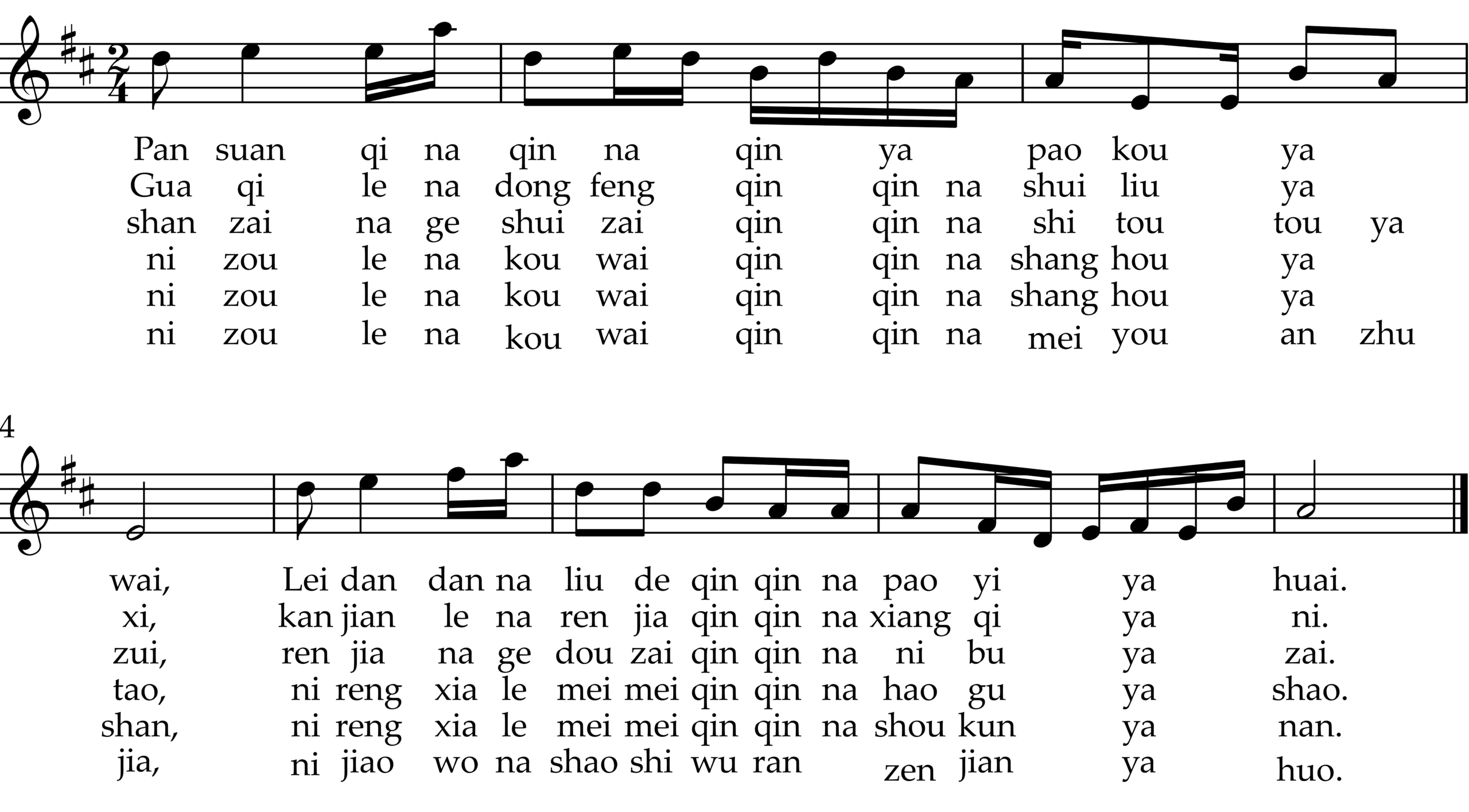
Music Example 6: Mountain Song “Everyone Is Here Except You,” as performed by Lin Yufen and transcribed by the author in Hequ, August 2013.
Translation of the lyrics:
-
I’m thinking about you, my sweetheart,
You went through the Pass.
My tears flood my eyes,
And wet my sleeves. -
The east wind blows,
And the water flows towards the West.
When I see others, my sweetheart,
I think of you. -
The Mountain is here, the water is here,
And the stones are also here.
Everyone is here, my sweetheart,
But you are not here. -
You went through the Pass,
To the other side of the Wall
When you left without your sister, my sweetheart,
I feel lonely. -
You went through the Pass,
To the other side of the Wall.
When you left without our sister, my sweetheart,
I suffer hardships alone. -
You went through the Pass,
You cannot take care of the household.
My sweetheart, without food and firewood,
How could I live?
Passed down through generations in rural Shanxi and still frequently performed by local women in the twenty-first century, this song embodies characteristics shared by mountain songs. First, it is written in the first person and describes personal experiences and feelings. Second, the bi-xing (“analogical-association”) mode, one of the basic structural and rhetorical modes (or principles) of traditional Chinese poetry and song lyrics, was employed: a line (or several lines) describing the surrounding natural scenes, everyday objects, or facts as they occur in a person’s mind is followed by a line of emotional expression that is similar to, associated with, and aroused by these scenes, objects, and facts (see also Wang and Xiao 2009). Third, it embodies a melodic feature widely shared by mountain songs: high-pitched tones and leaps occur at the beginning of the song and are revisited in the singular measures throughout the simple, strophic musical form.
The melody of “Everyone is Here Except You” was written in the Yu scale, one of the five basic pentatonic scales in the traditional Chinese musical system. It consisted of five consecutive pitches derived from the circle of fifths, which were rearranged into a sequence of intervals: minor third, major second, major second, minor third, and major second.

Music Example 7: The basic structure of the Yu scale, transcribed by the author.
As early as ancient times, Chinese philosophers and music theorists connected these five basic scales to the different sentiments and their expressions. This tendency was initiated by the Book of Documents (Shang Shu, a Confucius classic produced around 1,000 B.C.; see Gu and Gu 1996) as well as the I Ching (Yi Jing, also called Zhou Yi, a classic acknowledged by both Taoism and Confucianism; see Huang and Qi 2008), according to which all aspects of the natural world and social life are reduced to five basic parts that correspond to a framework of five elements, being gold, wood, water, fire, and earth. The Inner Canon of Yellow Emperor (Huang Di Nei Jing) (Huang and Qi 2008) continued to corroborate the links between the five basic musical scales and human voices and emotions. Below is my summary of these links in table form.
| Five Elements | Five Voices | Five internal Organs | Five Sentiments | Five Musical Scales |
|---|---|---|---|---|
| Gold | Weeping | Lung | Sadness (You) | Shang |
| Wood | Roaring | Liver | Anger (Nu) | Jue |
| Water | Moaning | Kidney | Fear (Ju) | Yu |
| Fire | Laughing | Heart | Delight (Xi) | Zhi |
| Earth | Singing | Spleen | Anxiety (Si) | Gong |
Table 1: The Correlations between Five Elements, Five Voices, Five Internal Organs, Five Sentiments, and Five Musical Scales
Chinese scholarly publications have demonstrated that compositions written in certain scales can alleviate corresponding emotions (Wang 2009; Huang 2005; Sun 2004). Consciously or subconsciously, the writer chose the Yu scale, associated with human sounds of moaning and the emotion of fear, to describe her tears and pain and to express her worry about foreseeable hardships and suffering. The initial leaps to high-pitched tones were followed by descending motion to convey expressions of worry and pain.
However, this and other sour songs violated the imposed feminine ethics not only through complaints but also through bold expressions of love, which were regarded as inappropriate in their regular social contexts, albeit acceptable and attractive to their male partners. These songs were bold enough to subvert the stereotypical conservative images of Chinese women. Indeed, they even contrast with the everyday behavior of the more modern left-behind women who were singing these songs in the 2010s. In the villages I visited during my research, the terms and phrases relating to sexual and affectional desires and relations were regarded as “incompatible with the etiquette” (shi li); and even loving words between husband and wife were seen as “offensive to public morals” (youshang fenghua) and avoided in public occasions. Therefore, it is surprising how these shy and abstinent women perform sour songs, in which “sweetheart” (qinqin) is nearly the most frequently used term (see Music Example 6).
Through these sour songs, left-behind women not only sang out loud, inappropriate, and loving words but also portrayed rule-breaking behaviors and blunders: “I miss you in the daytime, and I climb up the wall.”12 “I miss you so much my sweetheart that the flowers in my heart are disarranged.”13Although these minor breaches of the rules violated the wifely principles established in social contexts, they were not offensive to their male partners, the target audience for these songs. I will discuss these songs in detail in the next section of this chapter.
“These [sour] songs are about love and hard life, but not just about love and hard life,” said Fang Wang, a middle-aged female peasant whose husband was floating in Beijing and who was trying hard to draw him back from the colorful outside world:
I think these [sour] songs are more about responsibility […] the responsibility of a man and a husband […] I sang these songs to my husband before he left and when he returned home last year during the Spring Festival break to remind him that money does not mean everything. I want him to know that his wife will always be waiting for him at home. He should not let his woman experience this hard life alone. (Interview, Shanxi, June 29, 2013).
“Sing a Song to Broaden the Heart”: Male Migrants Borrowing Women’s Songs, and Roundabout Ways of Musical Expression
In the urban slums of Beijing, Shenzhen, Tianjin, and Xian in 2011–2013, I met many male migrants who were brought up in patriarchal socio-cultural contexts in rural North and Middle China and still saw themselves as the “master of the family” (yijia zhizhu). Nonetheless, some of them maintained customary musical practices of singing women’s songs, or to be more specific, the songs written as the narratives of females, when they were floating hundreds, even thousands of miles away from their wives and hometowns. The obvious feminine qualities of these songs did not obstruct men from borrowing these songs to release their long-suppressed emotions in private occasions. Neither did these feminine qualities hinder them from becoming understandable and acceptable modes of expression among males and from being shared and circulated in collective gatherings. Why did these floating migrants select these female voices to express themselves? What are the main features that led to the selection of these songs? These are the questions that will be answered in the following section of this chapter.
Roundabout Ways of Affection Expression
To understand the male migrants’ practices of singing women’s songs, it is necessary to discuss a deeply rooted tendency to express affection in roundabout ways. In traditional societies where sets of behavioral codes are prevalent to control the speech and action of their members, people always find ways to circumvent the barriers (Åberg 2015; Stern and Hassid 2012). In the case of males in traditional Chinese societies, from ancient China to some rural villages in twenty-first-century China, what they needed to find a way around is the restrictions on expressing emotional connections to and affectional desires for their female partners.
According to Confucian norms, which were still prevailing in rural Middle and Central China during my research in the 2010s, men are forbidden from making their female partners an indispensable part of their lives. “Siblings are hands and feet; wives are just clothes” (xiongdi ru shouzu, qizi ru yifu) is a Chinese maxim that appeared in and circulated with Romance of the Three Kingdoms and has been officially recognized as one of the Four Great Classical Novels of Chinese literature since the late twentieth century (see also Hsu 1985). Six Virtues (Liu De), a Confucian treatise written around the 4th century B.C., generalized basic social relations into “six positions” (liu wei)—husband, wife, father, child,14 monarch, and (the monarch’s) subject. This classic further divided these six positions into two categories: the more important “insider positions,” including father, child, and husband; and the less important “outsider positions,” comprising monarch, subject, and wife. In this sense, husband, father, and children should be equally important for a woman, whereas, for her husband, she is less important than blood relatives. Therefore: “One could kill his monarch for his father but is not supposed to kill his father for his monarch. One could abandon his wife for his brother but is not supposed to abandon his brother for his wife” (Li 2001: 65). Influenced by this Confucian doctrine, men in traditional Chinese societies are brought up to respect their parents, love their siblings, be ready to sacrifice for their clan, but at the same time to treat their wives as accessories (see also Xie 2012).
In 2013–2014, I conducted archival research at Harvard-Yenching Library on the pre-modern songs and poems preserved in surviving publications. In these surviving works, I found several song lyrics and poems in which male migrants straightforwardly express emotional desires for blood relatives, such as the song lyrics preserved in The Book of Odes:
The thread in the hands of my mother,
Made the clothes on the body of her traveling son
How should I requite the love of my mother,
Which is like the sunshine in the spring?15
Or in a more recent poem:
I have to part with my brothers,
Just like ripping flesh off my bone.
My heart is sad and sorrowful.
But how can I send my words to them?16
At the same time, in these surviving works, males rarely expressed emotional desire for their (alive) wives in a direct manner. Instead, male migrants portrayed the distress, agony, and sadness of their female partners caused by separation and how the females wanted, needed, and missed them:
I came to the Eastern Mountain.
I haven’t returned home for a long time,
The birds are crying on the hill,
My wife is sighing in our house.17
In the following excerpt, the poet began by quoting from his wife to suggest that she was the one who wanted his return, and then he portrayed a warm image of reunion with a tone of comforting an anxious wife:
You asked me when I would be back, but I don’t know.
It is a rainy evening here in Ba Mountain, and the pools are filled with autumn streams.
On the day when we reunite and trim wicks together by the window,
I will tell you about the Ba Mountain and how beautiful today’s rain is.18
In these songs and poems, males, who occupied the dominant, decision-maker position in a family, depicted their wives as having the more proactive position in the affectional relationship. Such portrayals not only highlighted the attraction of men but helped them escape from being accused of “indulging in women’s beauty” (chenmi nvse, see also Li 2024).
Male-Selected Female Voices and the Idealized Images of Women
In patriarchal contexts since the pre-modern period, women used folk songs to attract their floating husbands back to the hometown. Their husbands established the tradition of borrowing these women’s songs to express themselves in their host environments. The songs and the tradition were disseminated by these floating migrants to the places they stopped at and handed down from generation to generation by people with similar experiences (see also Xie 2011). In twenty-first-century Chinese cities, male floating migrants carried forward this customary musical practice. The women’s songs they selected and borrowed reflected their idealized expectations concerning what constitutes a good wife. It is always hard to identify the creator of a folk song, particularly one that has circulated for generations and spread across multiple territories. Although some songs were written in the first-person narrative of women and were described by their transmitters as women’s songs, it is still arbitrary to conclude that these songs were created by women. Therefore, I will avoid speculating about the intentions of the creators of the folk songs and will focus on how male floating migrants used these songs in the cities.
Although left-behind wives used mountain songs to voice grievances about their difficult lives in rural hometowns, songs containing such bitterness, along with women’s opposition to their husbands’ decisions, were excluded from the male-dominant world of floating migrants. As I observed in Chinese cities between 2011 and 2013, the songs written in women’s voices and performed by male migrants were mostly sour songs filled with expressions of love and longing. Rather than criticizing men’s choices to leave home and float in the cities, these songs depicted women’s thoughtful understanding of their absence in a servile manner:
I don’t mind that you can’t give me good food and good wine,
All I hope is your safe return.19
as well as their solemn pledges of unshakable fidelity:
The snowflakes melt when they hit the ground.
But I will be waiting for you, my brother, unless I die.20
In reality, left behind women were forced to shoulder the heavy burden of household responsibilities and to engage in backbreaking labor in the fields. But in the idealized images constituted by the male-selected women’s songs, loneliness seemed to be the only thing bothering these women, and waiting for their husbands was their primary task in daily life. “Longing in Heart for My Sweetheart” (Xiang Qinqin Xiang zaina Xin Yanyan Shang), a sour song widely embraced among male migrants, can serve as a typical example.
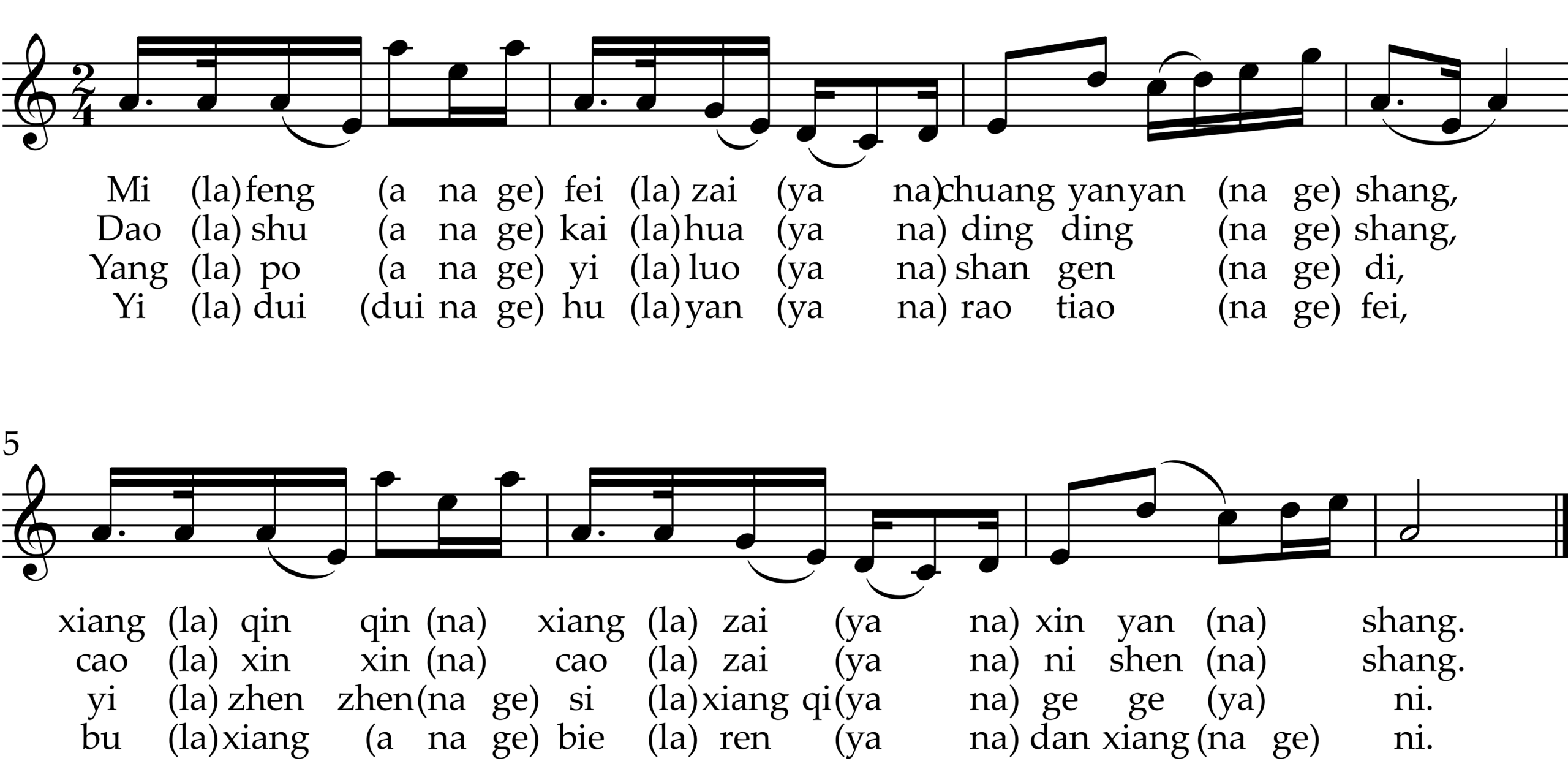
Music Example 8: Mountain song: “Longing in Heart for My Sweetheart,” sung by Fang Guizhi in rural Xinzhou in August 2012, transcribed by the author.
Translation of the lyrics:
Bees are flying upon windows,
I have longing in heart for my sweetheart.
Rice flowers are blooming on their tips,
I worry and only worry about you.
The sun is setting towards the roots of mountains,
I’m thinking and thinking of you.
A pair of swallows are flying around the sky,
I’m longing for no one but you.21
In rural Xinzhou in summer 2012, I worked with an amateur ensemble consisting of middle-aged females, some of whom were wives of floating migrants. With the mission of protecting mountain tunes as a collective legacy, these females made efforts to perform some folk songs in its traditional ways. They told me that “Longing in Heart for My Sweetheart” not only was performed by left-behind wives but also by ordinary females who broke the norms to boldly express love for their husbands. Like many other mountain songs, this piece features high-pitched tones, melodic leaps, and the “analogical-association mode” (bi-xing, for an explanation, see page 111). Although this song was also written in the Yu scale, it is livelier than the bitter songs and those that combine sour with bitter elements, such as “Everyone is Here Except You” (see Music Example 6). Rather than opening with wide leaps followed by stepwise descent, this song creates a more dynamic contour with bold jumps in both directions. Descriptions of natural scenes and emotional expressions are adorned with syllables such as “na,” “na ge,” and “ya na.”
Although the women’s songs selected by male migrants for performance in the cities contained some descriptions of norm-violating behaviors or minor breaches of the rules, these descriptions were attractive rather than offensive to males. This is because these improper but innocuous breaches manifested the women’s distress and anxiety following separation from their husbands more so than they expressed disagreement or resistance.
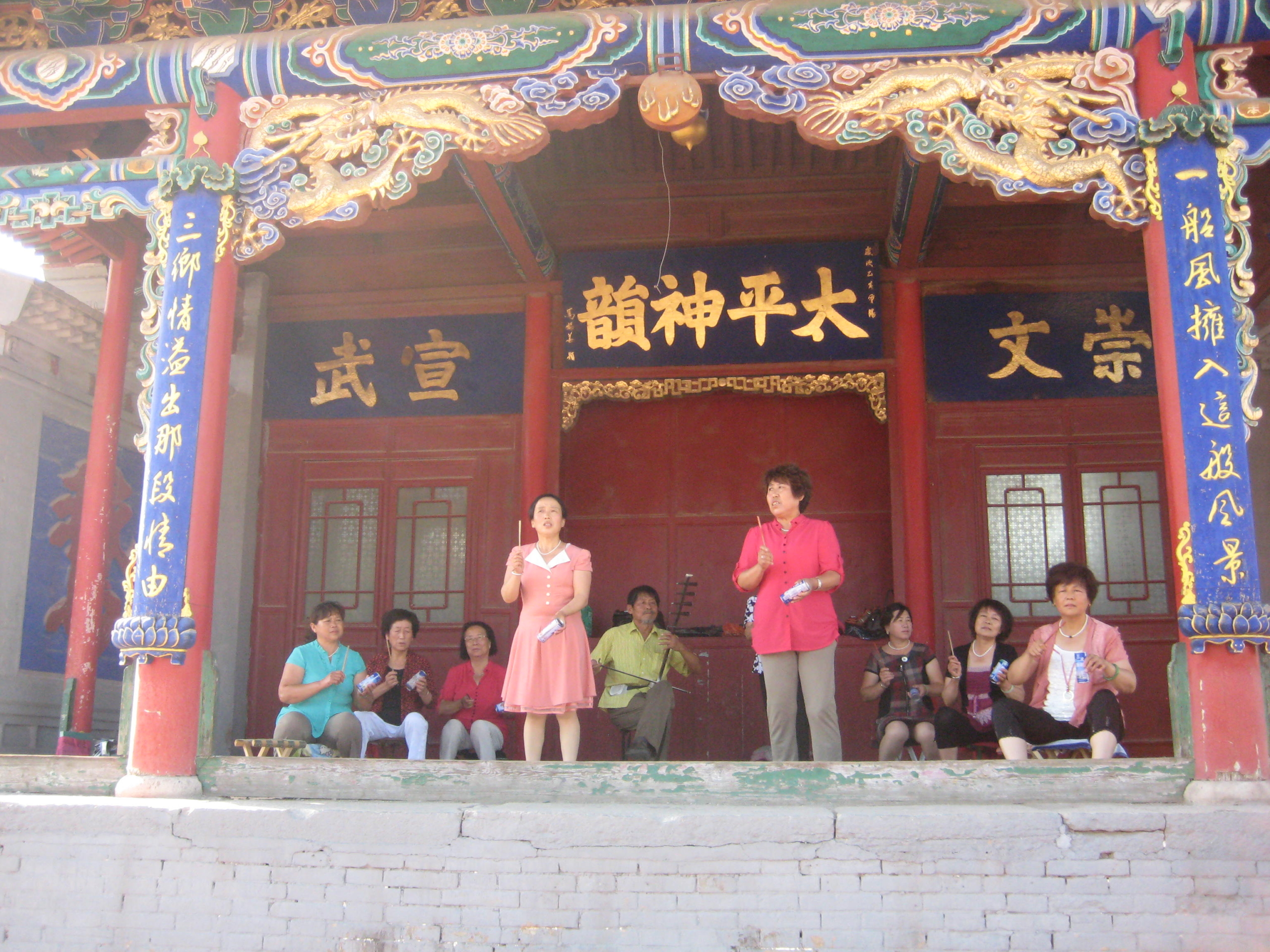
Figure 8: Local women performing mountain songs at a renovated outdoor theater in Hequ, Shanxi Province. Photographed by the author in August 2012.
I miss you so much my sweetheart that I feel weak at my wrist,
I cannot carry my chopsticks, and I can’t hold the bowl.
I miss you so much, my sweetheart, that the flowers in my heart are disarranged,
I wanted to cook dumplings, but I put potato in the pot.22
More norm-violating behaviors occurred at the moments of parting, which was another frequent theme in the women’s songs borrowed to perform in the cities when I conducted research in 2011–2013. “Walk Through the Western Pass,” a song that I mentioned at the beginning of this section, depicts such a moment in which a left-behind woman was seeing her husband off. For interviewed male migrants, that was a familiar scene that they had experienced personally and had trouble forgetting. Huang Baogen, an eighty-seven-year-old man who was once a liumin, recalled how this song aroused sympathy among them:
It reminded us of our wives and of the moment when we parted. It was a really hard moment, hard but warm and sweet, for all of us … It was warm and sweet because at that time you knew someone loved you and cared about you. But when that moment ended and you walked out of your village, you became a “wild goose.” You could earn a lot of money, you could get sick, and you could die, but who cared? You are alone … I remember that on that day [I left home], my wife wore a red shirt. She smiled but I saw the tears in her eyes. Whenever I sang this song, her smiling face, tears, and red shirt appeared in my head … It made me feel warm inside, and less lonely. (Interview, Jinzhong, June 26, 2012)
For Lao Li, the floating migrant whose singing of “Walk Through the Western Pass” was mentioned at the beginning of this chapter, the moment of parting is painful: he ends his relatively comfortable life in his hometown and begins a tough, lonely floating journey. Although he spent over twenty minutes in an interview detailing his wife’s flaws, he told me that he could not forget the moment he was sitting on a moving train, watching his wife cry on the platform. When singing the women’s songs, which were borrowed not from his wife but from other female folk singers in his village, he attempted to relive such a moment. He in fact experienced more idealized scenes of that moment in which women’s love and desire were demonstrated with inappropriate behaviors:
You are walking through the Western Pass,
I am climbing up to the roof.
I grasp the chimney and tears flow down.23I hold your arm, and I grip your sleeves,
I really want to follow you.24
During my research in 2011–2013, I met with male migrants who were from Shanxi, Shaanxi, Hebei, Inner Mongolia, Ganxu, and other parts of China but practiced the same tradition of borrowing women’s songs to express and to vent. The songs they performed had the same names and themes but different lyrics and melodies. For example, I found at least ten versions of “Walk Through the West Pass” from different provinces. People from Middle Shanxi performed a version of “Walk Through the West Pass” differently from those from Shaanxi and North Hebei. The lyrics of “Casual Singing,” performed by Lao Li and quoted above, differed from those in North Shaanxi. Although Lao Li and migrant Chen Minghao are from the same region, they performed “I Really Want to Follow You” (whose lyrics are quoted above) with different melodies. This is the reason why I chose to focus my discussion mainly on Shanxi and individual migrants in this chapter.
Nonetheless, interviewed male migrants rarely argued with each other about which version was the original and authentic one. Instead, they listened to and embraced different versions of sour songs, through which they constructed idealized mental images of home while floating in the cities. Different from their real home, which consisted of a shabby house, starving children, sick parents, and a woman burdened by poverty and arduous physical labor, this imaginary home contained only their pleasant recollections of family life and their hometown: warmth, love, understanding, closeness, and comfort. This utopian home gave hope, blissful anticipation, and energy to floating migrants who were striving to support their families and encountered various difficulties and discriminations in a strange city.
Imagining a Floating Community
Based on my observations in Beijing, Xian, and Tianjin in 2011–2013, 2016, and 2018, male floating migrants’ singing of these borrowed women’s songs can be broadly classified into two main patterns: singing in private spaces and singing in collective activities.
“Singing a song to broaden heart” (changqu kuanxi) and “drowning all unhappiness and sorrow in liquor” (jiejiu jiaochou) were two of the common things to do when floating migrants got together with close friends. They considered such close-friend gatherings as taking place in private spaces. After I obtained their permission to attend such private gatherings, some migrants told me that they also sang these songs to themselves when they were alone. In this way, I had the privilege to follow their everyday activities and witness their sentimental singing. “Broadening heart” is a Chinese expression and means “feeling relieved” or “feeling free from anxiety.” Being marginalized and disadvantaged in urban societies, some floating migrants chose rock music to vent their anger and to motivate others to join a movement of resistance. But others, like Lao Wu and Lao Li, chose a safer way to express their negative emotions by singing borrowed sour songs that could help them temporarily escape urban reality and relive affectionate interactions with family members for whom they work hard (interview, Beijing, March 24, 2012). When singing these songs, restrictions are violated and negative emotions—the depression triggered by discrimination, worries about the future, and the distress of separation—are alleviated and calmed. And as positive emotions are aroused and restored by warm, bright melodies, and as the sweet words of love are sung aloud, hope is ignited in the heart, giving people the courage to carry on with a hard life.
The performances of these borrowed female songs at private occasions placed primary emphasis on the naturalness of the delivery and the sincerity and depth of emotional expression rather than on a beautiful voice or technical virtuosity. Audience members—if there were any—usually showed their approval and praise through nods, sighs, or clicking beer bottles instead of applause. They rarely made loud noises during the performances. The singing was typically done without accompaniment at these private events. All these elements combined to create a calm, peaceful, and even lonely atmosphere where everyone was absorbed in their own memories and emotional worlds.
Meanwhile, these borrowed songs were also performed at collective gatherings attended by male migrants who might or might not share the same geographical origin. In the hometown-fellow gatherings, floating migrants from the same village, county, or province performed these borrowed sour songs more to strengthen the existing social bonds than to cure their spiritual pain. Although the attendees of these gatherings might never have met one another before, they quickly formed bonds by speaking in hometown dialects, commenting on hometown foods, sharing news about their hometowns, or singing a nostalgic song together. The collective singing often began with the host, who chose a song that, in his opinion, would be familiar to the attendees. If the song was familiar, the attendees would join him in singing the song one after another, but if it was not familiar, he would finish the song himself and invite others, guests, to suggest another one. They would comment on the performances, tell anecdotes about the songs, and exchange toasts between songs until everyone got slightly drunk. These performances usually did not carry the same sentiments as those held in private spaces, and the comments sometimes included sex-related jokes. While these performances might have evoked a wide range of sentiments among individuals, they seemed to be mostly about creating a sense of hometown brotherhood and building a reciprocal network to make life easier in the city.
The performances of these borrowed songs also reinforced bonds among migrants from certain rural regions of North and Middle China. Chinese ethnomusicologists have demonstrated how some sour songs traveled via liumin into Inner Mongolia, Shaanxi, and Gansu provinces, as well as other areas where they stopped and worked. Although local communities reworked these songs, some elements—such as topics, melodic themes, narrative styles, and names—remained consistent. In the twenty-first century, as surplus rural laborers from these regions moved into Chinese cities, these shared musical elements helped them transcend geographical boundaries and come together. In Imagined Communities (1991), Benedict Anderson discusses how shared cultural practices foster collective identities and create a sense of community. Ethnomusicologists also note how musical activities contribute to group cohesion, articulate differences, and establish “social boundaries both within the group and with those outside of it” (Shelemay 2001: 367; see also Stokes 2020; Turino 1993). The performances of these borrowed women’s songs served not only as collective expressions of existing social groups but also to generate and sustain new collectivities.
At the events attended by migrants from all parts of China, these songs helped attendees imagine a larger community, regardless of their age, occupation, and hometown. Unlike rock songs that signified an urbanized identity and state-sponsored musical representations, sour songs belonged only to floating migrants. Different from regional folk genres featuring dialects and symbolic expressions that could only be understood by people of the same origin, these borrowed sour songs aroused collective sentiments rooted in shared floating experiences. Therefore, these songs occupied a special position in the musical world of floating migrants, who believed that these songs could only be truly appreciated by their own people, as the only ones who knew what was happening in and behind the songs. To make the songs more accessible and enticing to all attendees, singers often performed them in standard Mandarin. By performing these songs, they marked the symbolic boundary of the imagined community, opening it up to all floating migrants and people with similar experiences. At the same time, they drew a boundary that excluded urbanites. Zhang Yuanchao, a floating musician and construction worker who often performed sour songs at dinner gatherings with his workmates, expressed this as follows:
They [urbanities] call us waidi’ren [outsiders]. And they act like this [city] is their territory … But when we perform these songs, we shut them out of our territory … because they don’t know what and why we are singing, and do not understand the meanings [of the singing] and our feelings. Then, it’s their turn to become waidi’ren [outsiders].” (Interview, Beijing, October 2, 2012).
Endnotes
-
In China, especially in rural areas, young couples always refer to each other as “brother” and “sister.”↩︎
-
This song is widely circulated among floating migrants and in some regions of Shanxi Province. The text and score of this song have been documented in detail by folk musician Yunde Han. According to Han, this song has a history of over two hundred fifty years.↩︎
-
To avoid confusion in this chapter, I will use the original term liumin to refer specifically to the temporary domestic migrants before the establishment of PR China. And the term “floating migrants” will refer to all Chinese temporary domestic migrants, including both the ancient liumin and modern floating migrants.↩︎
-
Local gazetteer (Difangzhi) is a type of official document that is published by Chinese counties (or villages) that records what goes on in a county politically, socially, and culturally. These gazetteers are updated regularly by local literati and were preserved in the “Official Archives” of each county. However, after 2000, the local gazetteers of some regions (such as Shanxi, Shaanxi, Hebei, Gansu, and Hunan provinces) were moved into the National Library of China.↩︎
-
This is a saying that first appeared in An De Chang Zhe Yan, a book of family instructions from the Ming Dynasty written by Chen Jiru (1558–1639).↩︎
-
I will describe these songs as “bitter songs” hereafter.↩︎
-
Quoted in Huaixin Huang, Dadai Liji Huijiao Jizhu [A Collection of Ritual Observations] (Shanxi: Sanqin Press, 2005: 37).↩︎
-
See also the Confucian classics, such as Etiquette and Ceremonial and A Collection of Ritual Observations.↩︎
-
“No One Is More Miserable Than Me in This World” (Chenshi Shang Kumingren Shaoyou Wo), a song from pre-modern period but still widely circulated in Shanxi Province. The lyrics were provided by the folk singer Jia Deyi in August 2013 and translated by the author.↩︎
-
“Plowing Song” (Tiange), a song sung by Wang Aihong, a female who was residing in rural Xinzhou and whose husband was a floating migrant in Taiyuan City. The song was transcribed and translated by the author in December 2012.↩︎
-
“Everyone Is Here Except You” (Renjia Douzai Ni Buzai) is a song that has circulated for generations in Shanxi and still being performed by the female partners of floating migrants today. In Shanxi, different folk singers performed this song with melodies slightly different from one another. Here I show a version from Lin Yufen, which I transcribed in August 2013. See https://www.ximalaya.com/sound/104015114 (accessed on August 7, 2026) for another version of this song performed by a professional folk singer.↩︎
-
An excerpt from the song “I Miss You at Night, but I Can’t Do Anything about It” (Yeli Xiangni Mei Banfa), documented by Jia Deyi (a Shanxi folk song singer) in his manuscript and translated by the author.↩︎
-
An excerpt from the song “Missing My Sweetheart” (Xiang Qinqin), a song sung by Gu Fengyuan in Beijing in December 2012; the lyrics were transcribed and translated by the author.↩︎
-
Here, “father” and “child” are used to signify the blood relations.↩︎
-
“Song of a Floating Son” [Youzi Yin] by Jiao Meng (751–814), documented in A Collection of Selected 300 Poems of the Tong Dynasty.↩︎
-
This is an excerpt from the folk song “Kudzu Vines” (Ge Lei), recorded in the section of “Airs of the States,” The Book of Odes. See also the example of “Yellow Birds” (Huang Niao), mentioned at the beginning of this section.↩︎
-
“The Eastern Mountain” (Dong Shan), an ancient song whose lyrics were documented in The Odes of Bin.↩︎
-
“Written on a Rainy Night” (Yeyu Jibei), a poem written in late Tang Dynasty by Shangyin Li (812–858).↩︎
-
“Thirty Miles Mountain and Twenty Miles Water” (Sanshili Mingshan Ershili Shui), sung by migrant Wang Fengyuan in Xian. The lyrics were transcribed and translated by the author.↩︎
-
“Missing My Sweetheart” (Xiang Qinqin), sung by Meng Xingguo in Xian. The lyrics were transcribed and translated by the author.↩︎
-
Translated by the author. See https://www.kugou.com/mixsong/1r7xxcb1.html (accessed on August 11, 2026) for an audio recording of a local folksinger’s performance of the song.↩︎
-
An excerpt from the song “Missing My Sweetheart” (Xiang Qinqin), a song sung by migrant Liu Feng and the lyrics were transcribed and translated by the author.↩︎
-
A partial translation of the sour song “Casual Singing” (Xintianyou), sung by Lao Li in Beijing, the lyrics were transcribed by the author.↩︎
-
A partial translation of “I really want to follow you” (Zhixiang Genzheni), sung by Lao Li and Chen Minghao in Beijing, the lyrics were transcribed by the author.↩︎