Between Keyboard Pedagogy and Performance Practice
Edoardo Belotti (†)
How to cite
How to cite
Outline
Outline

Foreword
For many centuries, composer and performer were very often the same person. Especially for a keyboard player, improvising was the normal way of performing. Very rarely was he requested to perform music composed by others and, when he did that, he played music of his time. The music of the past was studied only as a model to be analysed and imitated in order to acquire the necessary tools and competences to become a musician. Performing music from the past is a practice that originated in the late 18th century and developed during the 19th century. The rediscovery of Bach is probably the most famous example, followed by many others. Composer-performers like Mendelssohn or Liszt included compositions of the past in their recital repertoire, in transcription, reductions, or elaborations.
It was not until the second half of the 20th century that the ‘historical perspective’ became very important. Keyboard music, like most other areas of music, was dragged into a revolutionary storm engaged by the rediscovery and the restoration of historical instruments, organs, harpsichords, clavichords, and fortepianos. A new sound, very different from the sound of a grand piano or a modern pipe organ, was imposing substantial changes on the performance of the keyboard music of the past. This created the need to publish more accurate and correct scores, with the aim of assisting the performer in developing a more nuanced understanding of the music. The well-known Early Music Movement advocated the historically informed performance practice in reaction to romantic or modernist interpretations in use in the 20th century. The use of period instruments, original or copies, and of Urtext editions became extremely important. Every organist or harpsichordist in the early eighties was fascinated not only by the way the music of Bach, Handel, Vivaldi sounded on an period instrument, but also by the rediscovery of many forgotten composers, whose music was given new life by its performance on the appropriate instruments.
The beauty of the sound of original instruments and the result of performances in accordance with the original scores and practices has paved the way for a new phase in the rediscovery of the music of the past: modern instrument makers wanted to study and imitate the processes used by the old masters. They wanted to understand how these processes could lead to such amazing results, and to discover the reasons for such a lively and rich sound. The reconstruction of the Arp Schnitger organ in the Örgryte Church in Goteborg, based on an instrument destroyed during the Second World War, was among the first results of this investigation and, together with other research projects on organs, clavichord, harpsichord and fortepiano, opened a new era in the approach to, and performance of, the music of the past.
In the 21st century something similar started in the field of music theory. Theorists and musicologists began studying and publishing treatises and educational sources of the past. These sources, made available in several recent editions, enlighten us on musical pedagogy: how people learned to play, improvise, and compose, and how these three processes were closely and inseparably conjoined. A well-known example is given by the Neapolitan partimenti, a method of learning music currently attracting a growing interest among theorists and musicologists. But in turn, the Neapolitan partimenti, which seem to have strongly influenced music theory and pedagogy in the 19th-century French Conservatoire, are based on a long tradition of teaching and practice discoverable in Renaissance and Baroque sources. Some of those sources are now available through modern editions or facsimiles, such as Il Transilvano by Girolamo Diruta1, L’Organo suonarino by Adriano Banchieri2, the Instructio nova pro pulsandis organis, spinettis et manuchordis by Spiridion a Monte Carmelo3, and the Wegweiser […] die Orgel recht zu schlagen based on the lost Ars cantandi by Giacomo Carissimi.4
It is my contention that this rediscovery of a substantial unity and consistency among the historical pedagogical sources, is now ushering in a new period, marked by the need to redesign our approach to music, the way we learn, perform, and deliver it. I discussed this fascinating process in a lecture in May 2016 at the University of Rome Tor Vergata with the title Music-Museum or Creative-Music, a Baroque Antithesis? One of the challenges of classical music in the 21st century is the rediscovery of creativity, an aspect that other kinds of music, such as jazz, have never lost. In the context of classical music, extemporaneous creativity has been preserved in the art of continuo playing and in the use of embellishments or adding diminutions of a melodic line which, as we shall see, has to do with the contrapuntal training in which every professional musician was educated. But, despite the prevailing opinion today, being a good continuo player requires much more than a basic knowledge of harmony. As Banchieri states, basso continuo is strongly related to the other ways of playing (fantasia, spartitura, intavolatura)5 and to approach it correctly many elements are needed. These include knowledge of counterpoint, knowledge of the cadences for the different church tones, knowledge of how to make imitations, canons and fugues, and memorisation of patterns and formulae learnt through the study of the music of the past. In other words, a comprehensive and integrated approach that seamlessly integrates theoretical and practical perspectives is essential.
Today the question is increasingly insistent: how has this conjoined vision of theory and praxis, creation and delivery, composition, and performance, worked so successfully for at least three centuries? This paper is part of a larger research project focusing on the teaching of keyboard instruments between 1500 and 1700: how was music – and keyboard music in paticular – taught and learnt? I believe that understanding the teaching methods of the past not only offers us better answers concerning performance practice, but also makes us question our modern methods of teaching music and offers opportunities to improve them.
The following pages examine the interrelationship between counterpoint and rhetoric (as an art presiding over both creation and delivery) in 16th-century keyboard music.
1. Exordium. Invertible Counterpoint
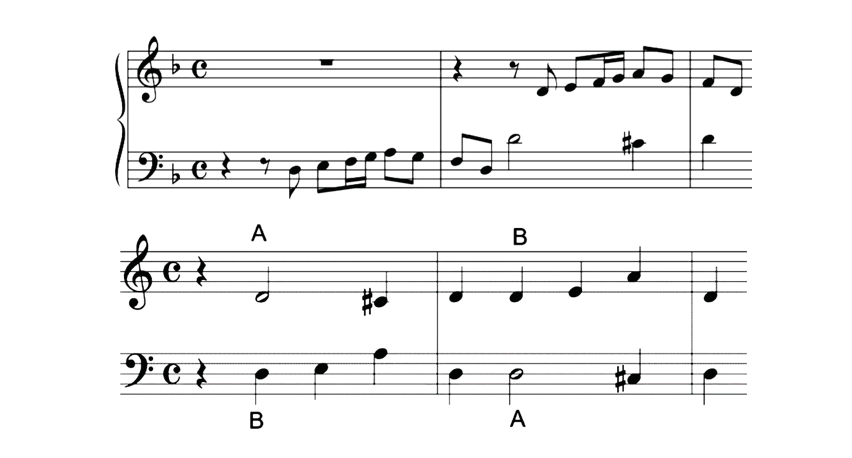
Example 1: Theme from Johann Sebastian Bach, Toccata (BWV 913).
Renaissance and Baroque musical sources highlight the importance of learning invertible counterpoint as one of the cornerstones of a musician’s training. Even the young Bach, as Ex. 1 shows, experimented in a practical way with the treatment of a subject and took his first steps towards fugal imitation through familiarity with invertible counterpoint. Both the second and the fourth sections of Toccata BWV 913 are built on two short themes in invertible counterpoint. Invertible counterpoint is an important element in cadences and sequences too. In the ‘Sonata ottava in aria francese’ in L’Organo suonarino, Banchieri condenses all the necessary practical rules for imitative and fugal counterpoint – exposition, answer, stretto and invertible counterpoint in cadences – into a few bars, as Ex. 2 shows.
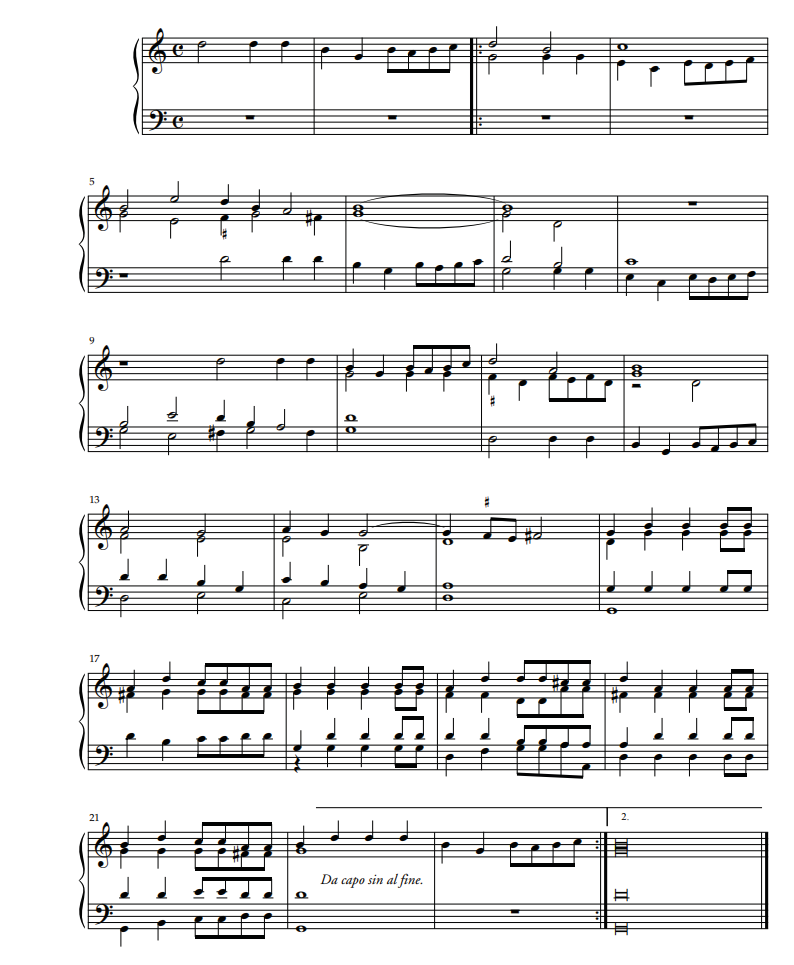
Example 2: Adriano Banchieri, ‘Sonata ottava, in aria francese’ from L’Organo suonarino (Venice, 1605), 36–7.
The following table (Ex. 3) shows the structure of the two cadences, with the motion of the three involved voices.
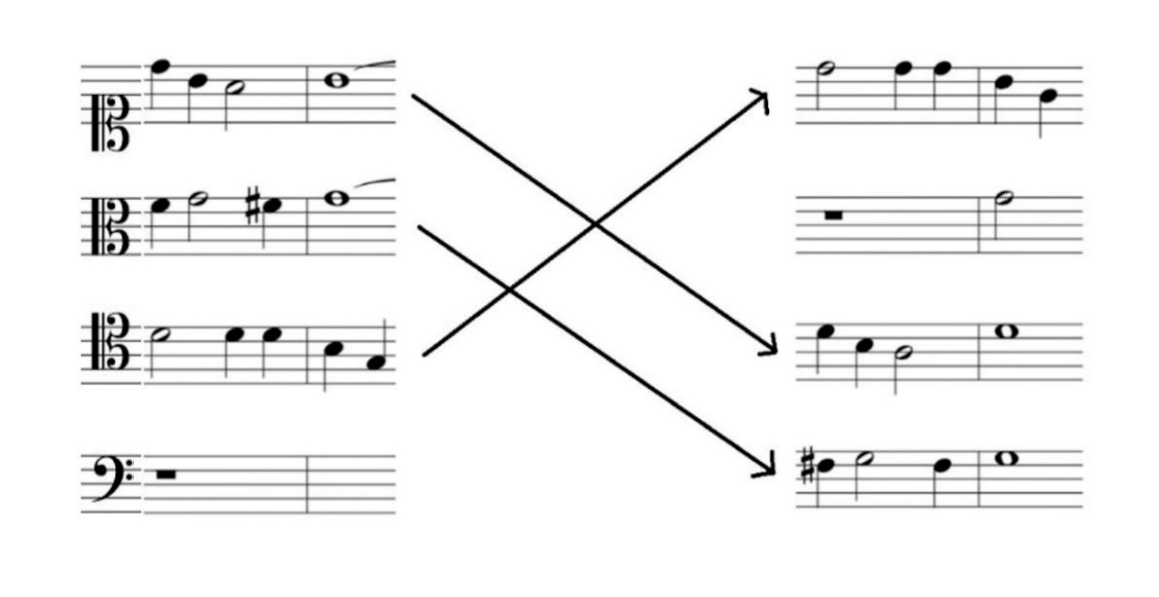
Example 3: Invertible counterpoint in the two cadences (Banchieri, ‘Sonata ottava in aria francese’), bb. 5 and 9.
If, as seems to be the case, this was the normal approach to music creation, then certain questions immediately arise: What was musical education like in the 16th century? And more specifically: how were harpsichordists and organists trained and how was counterpoint (particularly invertible counterpoint) taught and learned?
Before going in search of answers, some terminological clarifications are necessary, particularly with regard to the words armonia and accordo. Throughout the 16th century, the term armonia (harmony) referred to the contrapuntal construction of the piece and the term accordo (better translated as agreement, concordance) to the set of well-organised, concordant voices and/or instruments. As is widely acknowledged, the concept of the harmonic triad did not yet exist at the time.6
2. Medium. Teaching/Learning Counterpoint in Sixteenth-Century Sources
In the 16th century the teaching and learning of counterpoint was conducted through singing. Numerous examples of bicinia can be found in sources that are to be performed by a teacher and a pupil, in many cases as a canon either read from a score or improvised. This topic has been the object of extensive studies and research7 and is not the subject of this article. In regard to keyboard music, the information is derived from three types of sources:
- Treatises and handbooks for keyboard players
- Collections of pieces for beginners
- Written compositions
In this paper, due to the limitations of space, we will focus on a select few examples from the following sources:
- Tomás de Santa María, Libro llamado arte de tañer fantasía (Valladolid: Francisco Fernandez de Cordova, 1565)8,
- Hernando [Antonio] de Cabezón, Obras de música (Madrid: Francisco Sánchez, 1578) (RISM 158724)9,
- Girolamo Diruta, Il Transilvano Dialogo sopra il vero modo di sonar organi, & istromenti da penna / Seconda parte del Transilvano Dialogo diviso in quattro libri (Venice: Giacomo Vincenti 1593 and 1609),
- Adriano Banchieri, L’Organo suonarino (Venice: Ricciardo Amadino, 1605),
- Music examples by Andrea Gabrieli (c. 1532–1585) and Antonio Valente (c. 1520–1601).
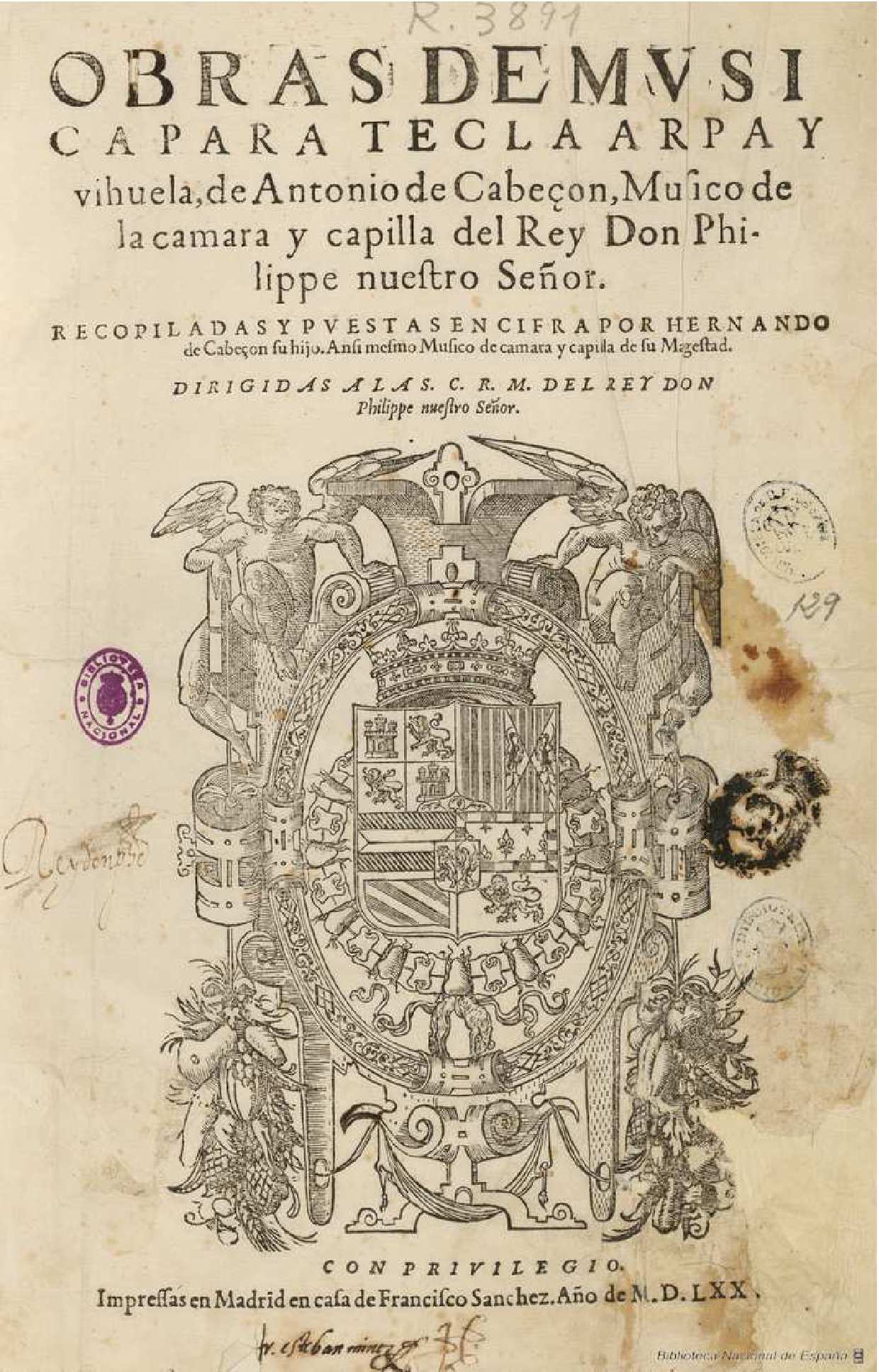
Figure 1: Frontispiece of Hernando de Cabezón, Obras de música (Madrid, 1578).
In 1578, Hernando de Cabezón published a large collection of music, according to the title page, for keyboard, harp and vihuela in Madrid, consisting mainly of music composed by his famous uncle Antonio. Following vocal practice, the collection opens with Duos for beginners. The Duo no. 1, reproduced in full in Ex. 4, is an extended exercise in which the student learns a series of fundamental elements of musical composition:
- bb. 1–6: first species counterpoint. The two voices can also be inverted: it is a clear example of invertible counterpoint.
- bb. 13–16: canon based on the movement of the descending third and ascending second.
- bb. 17–19: two-voice cadence.
- bb. 19–24: third species counterpoint. On the main accent of each bar the upper voice, with its movement of crotchets, starts on a different interval above the lower voice: unison, fifth, major sixth, minor sixth, major third, octave. Variety in the use and alternation of intervals is in fact a fundamental element of counterpoint. The same happens in bb. 25–29, in which the lower voice is moving with crotchets.
- bb. 30–33: second species counterpoint. Imitations between the two voices in invertible counterpoint.
- bb. 34 to the end: florid counterpoint.
- bb. 41–52: two points of imitation on a subject separated by a cadence: in the first imitation the upper voice starts, in the second the lower voice starts.
- bb. 65–71: two points of imitation on a different subject.
- bb. 72–75: motion in parallel thirds.
- bb. 76–78: final cadence.
- bb. 80–82: supplementum.
Even though the duo is a didactic piece, it must be noted that its structure, organised according to the principles of counterpoint, also follows a precise rhetorical project:
- bb. 1–18: exordium, opened by the first species counterpoint and closed by the cadence.
- bb. 19–72: medium, opened by the crotchets and closed with the last imitation.
- bb. 72–82: finis, starting with the passaggio doppio, preparing the cadence of b. 78, followed by the supplementum.
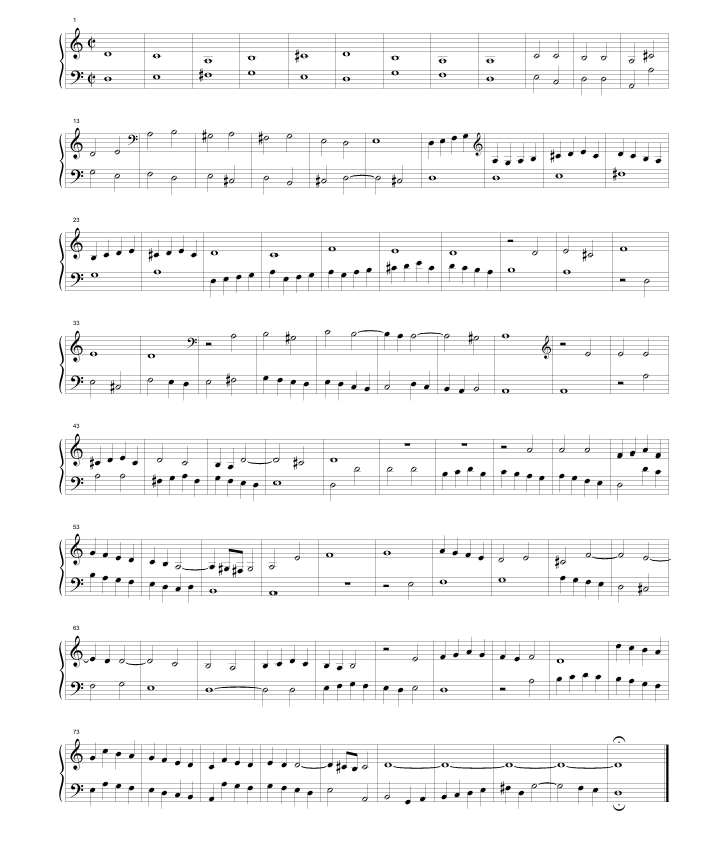
Example 4: Antonio de Cabezón, First ‘Duo’ from Obras de música (Madrid, 1578), fol. 1r.
What appears in Cabezón’s duo allows us to outline a training path corroborated by sources from the 16th century, as follows:
1) Learning cadences: the 8 modes and their characteristics (Zarlino, Istitutioni harmoniche, Ortiz, Tratado de glosas,Diruta, Il Transilvano, Banchieri, L’Organo suonarino).
Cadences are the supporting elements of the musical structure. Each of the eight church tones has its own principal corde (axes) on which the three cadences are built: the middle cadence generally on the fifth degree of the modal scale, the second cadence (which Banchieri defines as indifferente, because it can be used optionally) generally on the third degree and the final cadence, the most important, on the finalis or fundamental note of the tone.10 Ortiz’s Tratado de glosas opens with a large collection of cadences and some explanations of their use. Keyboard players could realize the same cadences for two, three and four voices.
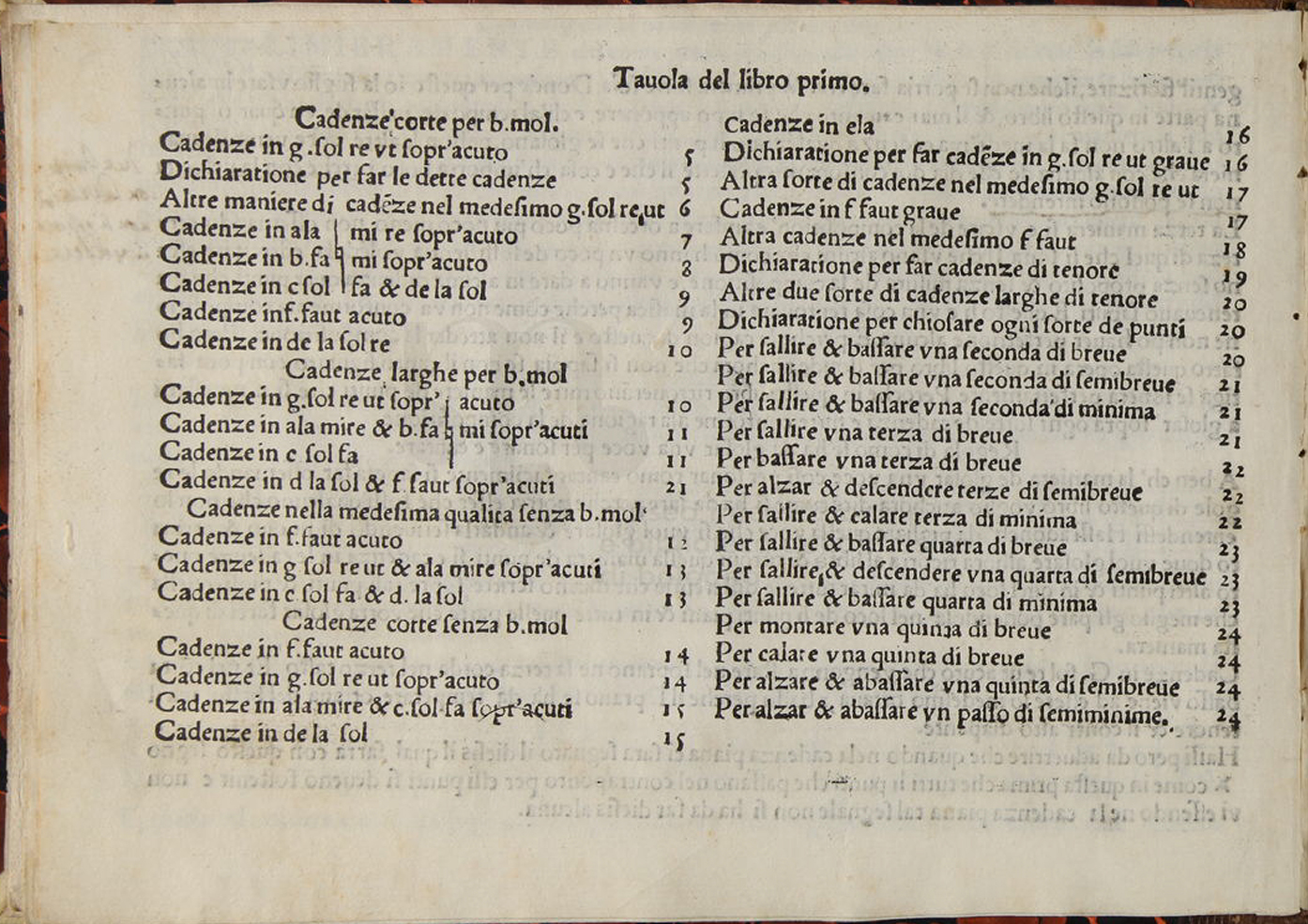
Figure 2: Diego Ortiz, Tratado de glosas sobre clausulas y otros generos de puntos en la musica de violones / El primo libro […] nel qual si tratta delle glosse sopra le cadenze & altre sorte de punti in la musica del violone (Rome: Valerio & Luigi Dorico, 1553), table of contents, fol 4r, <http://bdh-rd.bne.es/viewer.vm?id=0000037748> (accessed on 17 July 2024).
Equally the Fundamenta and manuals for organists from the late 15th and early 16th centuries present collections of cadential formulas, often organised according to the eight church tones.11
Tomás de Santa María dedicates a few pages to the clausulas, specifying where they must be placed in each tone.12 Adriano Banchieri offers a collection of hundred cadences in two, three, four and five voices at the end of his Cartella musicale nel canto figurato, fermo e contrapunto (Venice, 1614).13
2) Two-part counterpoint (with invertible solutions): exercises based on Bicinia (all the sources).
As a complement to his explanation of modal theory, Zarlino, in his Istitutioni harmoniche (Venice, 1558), proposes twelve short ricercares for two voices, as models for learning the character of each church tone and the main formulas of counterpoint.14
3) Schemata (based on the character of intervals): progressions, canons (Cabezón, Obras de música, Ortiz, Tratado de glosas, Santa María, Arte de tañer fantasía, Banchieri, L’Organo suonarino).
Even before his presentation of the church tones, and the different kinds of cadences, Tomás de Santa María provides several examples of two-voice canons based on ascending and descending movements.15 (Ex. 5 shows a Duo in which the canon is based on the commonly used schema of an ascending third followed by a descending second.
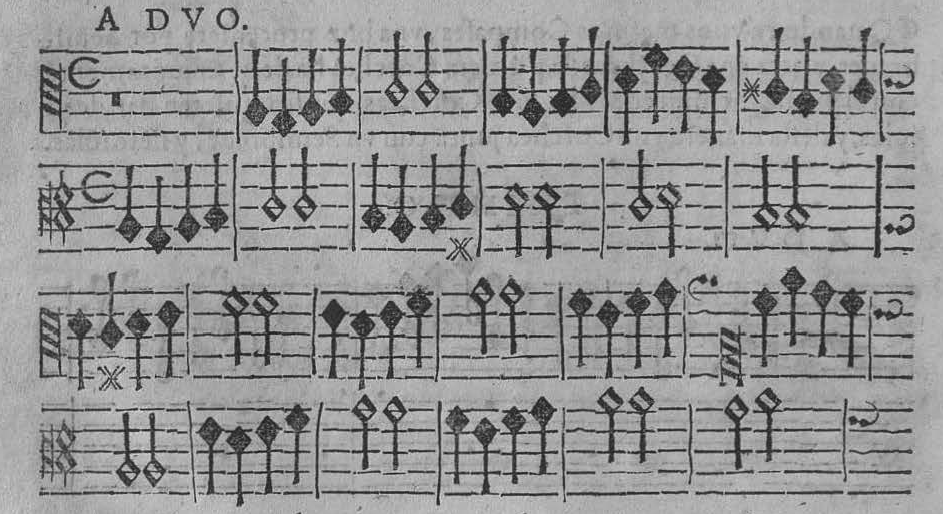
Example 5: ‘Duo’ from Tomás de Santa María, Libro llamado arte de tañer fantasía, i, fol. 54v.
4) Counterpoint on cantus firmus or tenori and three/four-voice ricercari (Ortiz, Tratado de glosas, Cabezón, Obras de música, Diruta, Il Transilvano, Banchieri, L’Organo suonarino).
Following the collection of Duos para principiantes, Cabezón introduces two-voice pieces based on a liturgical cantus firmus, such as an Ave maris stella. The cantus firmus is placed first in the bass and subsequently in the soprano. The next step entails the introduction of three-voice pieces in which the cantus firmus is alternately placed in all three voices.
5) Fauxbourdon (all the sources).
In the chapter ‘favordones de todos los ochos tonos’ (‘Fauxbourdons in the eight church tones’) Cabezón documents the process of learning fauxbourdon technique and memorising its related patterns. The fauxbourdon was one of the most used pedagogical tools for teaching diminution. Each Fabordon is followed by three versions in which respectively cantus, bassus and tenor are enriched by glosas (diminutions). Ex. 6 shows the first Fabordon in the first tone and Ex. 7 its version with diminutions in the bass.
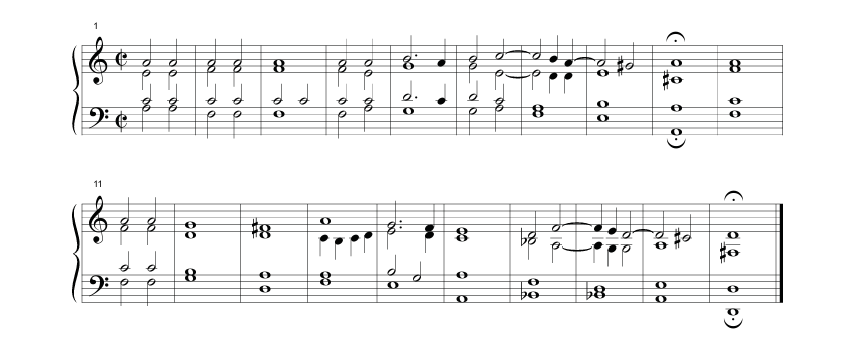
Example 6: Antonio de Cabezón, ‘Fabordon del primer tono’ from Obras de música (Madrid, 1578), fol. 13r.
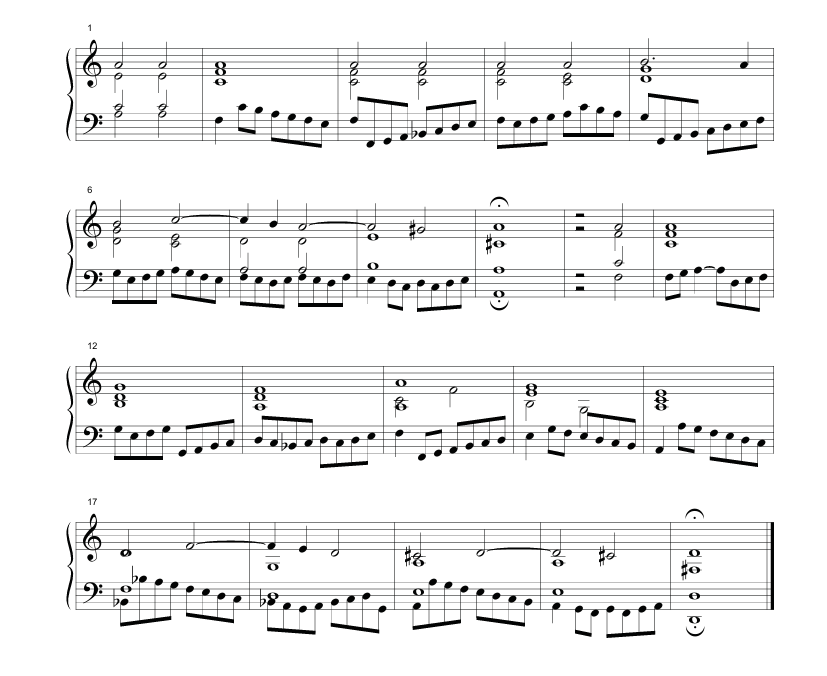
Example 7: Antonio de Cabezón, ‘Fabordon del primer tono’ [‘Glosado con el contrabaxo’] from Obras de música (Madrid, 1578), fols. 13r-v.
6) Imitative counterpoint (all the sources). In general, most of the examples given consist of collections of verses, generally grouped in church-tone order. We will return to such verses later.
The cadential formulas, schemes for invertible counterpoint, and patterns for canons and imitations listed in treatises and handbooks can be widely identified in the keyboard repertoire. This research intentionally focused on the repertoire in which counterpoint has a greater importance, excluding other musical forms such as dances and variations. Five examples have been chosen from compositions by the Venetian Andrea Gabrieli and the Neapolitan Antonio Valente.
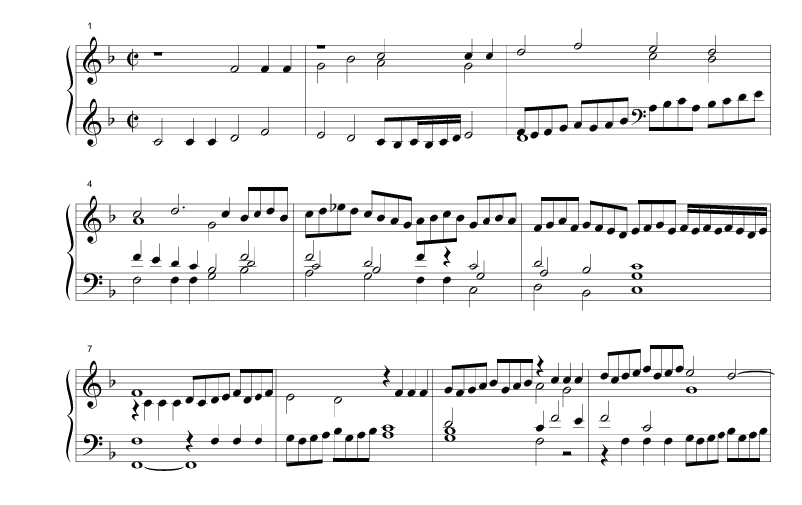
Example 8: Andrea Gabrieli, ‘Canzon ariosa’, bb. 1–10, from Il terzo libro de ricercari (Venice: Angelo Gardano, 1596) fol. 30r-v (author’s transcription), <https://doi.org/10.3931/e-rara-55399> (accessed on 27 August 2024).
The Canzon ariosa is one of Gabrieli’s best-known pieces, included in several printed and manuscript collections.16 It is a perfect example of counterpoint and brilliant use of diminutions. The short subject, with a dactylic incipit, is stated in stretto format in the first four bars and again, from b. 7 to b. 10 with some coloratura. The two expositions are connected by a richly ornamented cadence (see Ex. 8).
The second example is the ‘Ricercare del quinto tono’ from Gabrieli’s Libro secondo published posthumously in 1595. Two short subjects, based mainly on stepwise motion, are presented one after the other by the tenor, while the soprano states the two answers in melodic inversion (see Ex. 9). This contrapuntal strategy initiates a series of imitations that occupy the entire first part of the composition.
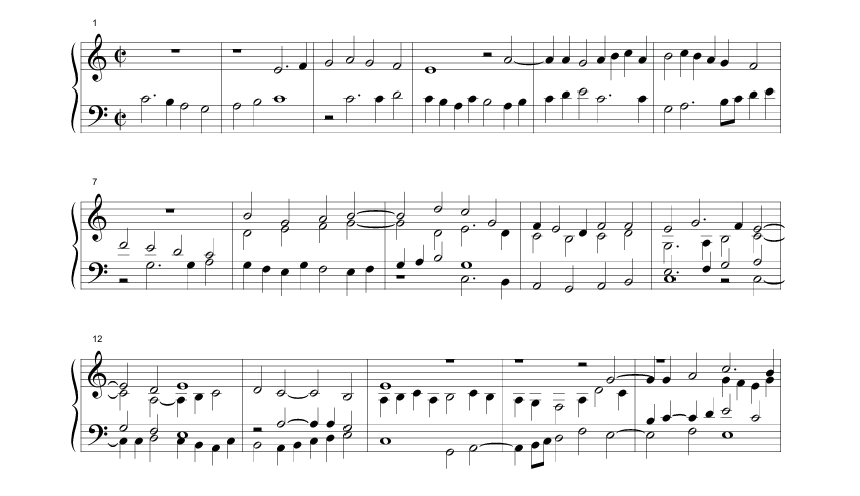
Example 9: Andrea Gabrieli, ‘Ricercare del quinto tono’, bb. 1–16, from Ricercari di Andrea Gabrieli […] libro secondo (Venice: Angelo Gardano, 1595), fol. 17v (author’s transcription), <https://doi.org/10.3931/e-rara-56111> (accessed on 17 July 2024).
The remaining three examples are taken from Versi spirituali sopra tutte le note, published in Naples in 1580, the second printed collection by the Neapolitan Antonio Valente, organist in Sant’Angelo a Nilo.17 A collection of verses, i.e. short compositions, with the practical purpose of responding to the plainchant during the rites, is of particular importance. Although often overlooked due to its brevity (which makes it unsuitable for concert performance), the verse condenses the best melodic and contrapuntal solutions of the time and is therefore a precious didactic testimony. Very often, in fact, the same elements already present in the structure of a verse are employed to create more complex compositions such as ricercari and canzoni. Renaissance repertoire enumerates a large collection of verses: in addition to the prints by Cavazzoni, Andrea and Giovanni Gabrieli, Merulo, Cabezón and Valente, verses are found in the manuscripts of Castell’Arquato and in the German tablatures preserved in Turin and Berlin. Beyond its liturgical duty, the verse had an important didactic function, even at the end of the seventeenth century, as the large autograph collection of verses by Bernardo Pasquini attests. The composer used this material to teach counterpoint and composition to his nephew Bernardo Ricordati.18
This paper considers three of the verses by Antonio Valente. His Verso Primo sopra dell’Ut (Ex. 10) offers a clear example of canonic imitation, based on the movement of the rising fourth and falling third in invertible counterpoint.
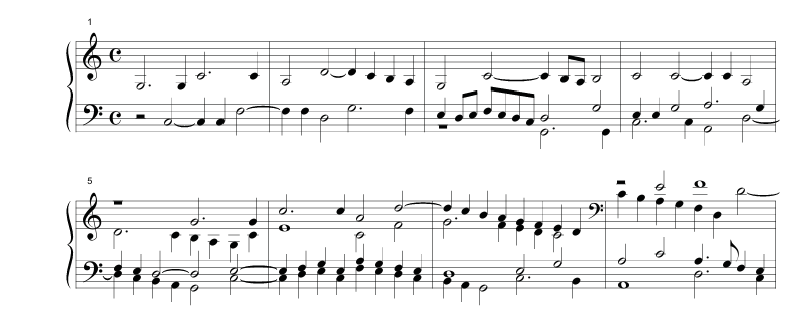
Example 10: Antonio Valente, ‘Verso primo sopra dell’Ut’, bb. 1–8, from Versi spirituali sopra tutte le note (Naples, 1580), 1.
In bb. 1 and 2 the canon is introduced by the tenor and the alto, while the bass presents the entire subject from the middle of b. 3 and the soprano does the same from the middle of b. 5. The four descending crotchets in the alto voice in b. 2 are then taken up for further imitations and for parallel third movements in bb. 6–8.
Verso sesto sopra il Re presents a double pair of voices in canonic imitation: the canon at the fifth between bass and tenor runs through the entire verse, while the subject is freely imitated in alto and soprano. Ex. 11 presents the first five bars of the verse.
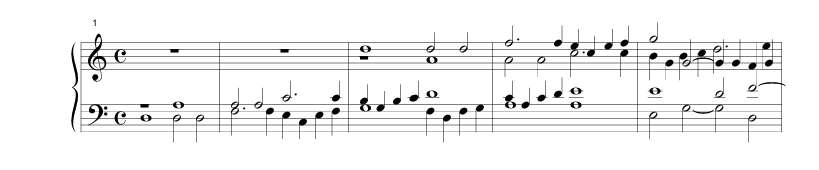
Example 11: Antonio Valente,‘Verso sesto sopra il Re’, bb. 1–5, from Versi spirituali sopra tutte le note (Naples, 1580), 30.
In the Verso quarto sopra il Re (Ex. 12), there is a subject covering an interval of a seventh, an apparently unusual extension. The theme, all in eighth notes, is made up of two elements, a circulo covering an interval of a third and an ascending tirata covering the remaining fifth. In this way the subject touches all three corde (axes) of the first tone (re-fa-la) to end up on the note c, i.e. the fa of the new hexachord in which the answer enters. The imitation between soprano and alto in the first five bars is repeated identically by tenor and bass in the following five bars. The imitations based on the descending tirata in bb. 4–5 are again repeated an octave lower in bb. 9–10. The economy of material and procedures constitutes the basis of the entire verse.
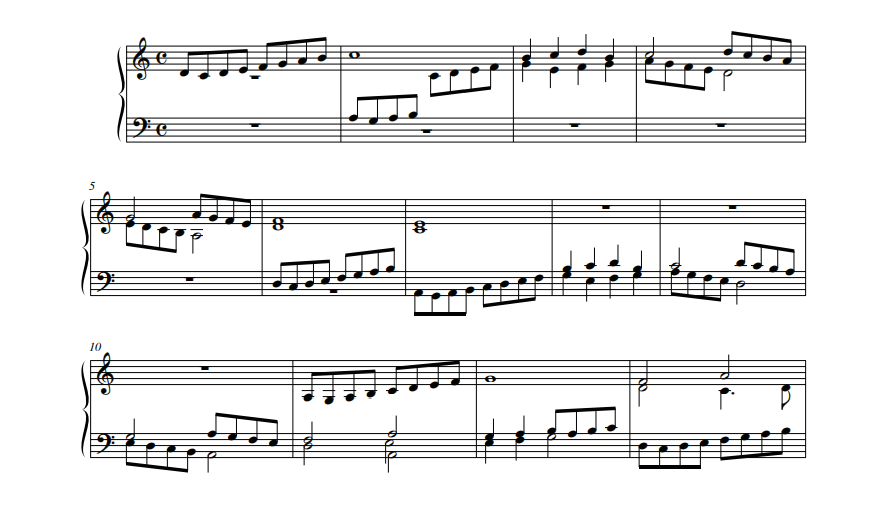
Example 12: Antonio Valente, ‘Verso quarto sopra il Re’, bb. 1–13, from Versi spirituali sopra tutte le note (Naples, 1580), 23.
A subject like the previous one is found in Adriano Willaert’s Ricercare I,which opens Musica nova, a collection of ricercari published in Venice in 1540.19 As in Valente’s verse, soprano and alto state the subject and answer in the first five bars, while tenor and bass repeat the same imitation in the following five bars (see Ex. 13).
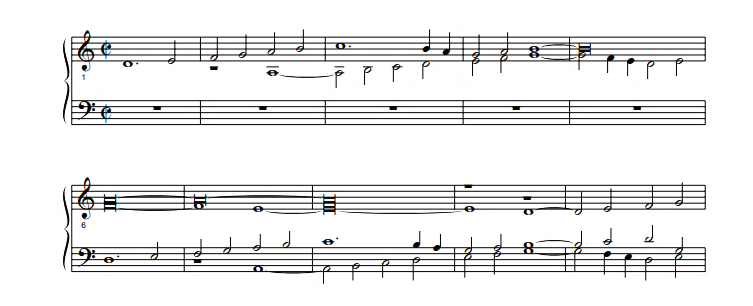
Example 13: Adriano Willaert, ‘Ricercare I’ from Musica nova (Venice, 1540) / Musicque de joye (Lyon, [1544]), bb. 1–10.
In all the examples above, with the exception of Valente’s Verso secondo, the interval of a fourth seems to be preferred in the creation of subjects. The most commonly used patterns can be reduced to four schemes, shown in Ex. 14. Scheme 4, based on the motion of an ascending fourth and a descending third (as well as their inversions), was very frequently used in the construction of canons.
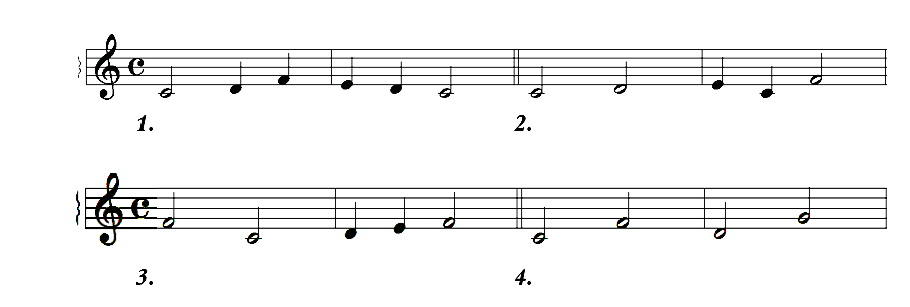
Example 14
In Diruta’s Transilvano, under the name of Accadenzie di Gabriel Fattorini, a large collection of four-part formulas based on invertible counterpoint is presented. Each of these is amusical box that can be opened to create an entire composition.20 Ex. 15 shows this kind of contrapunto trasportato in tutte le parti (counterpoint transposed in all parts). Scheme no. 176 features four melodic lines overlapped in four-voice counterpoint. In schemes nos. 177, 178 and 179 the same melodic lines are exchanged between the voices: the soprano of 176 becomes the alto in 177 and the bass in 178, while the bass of 176 becomes the soprano in 177 and the tenor in 178, etc.
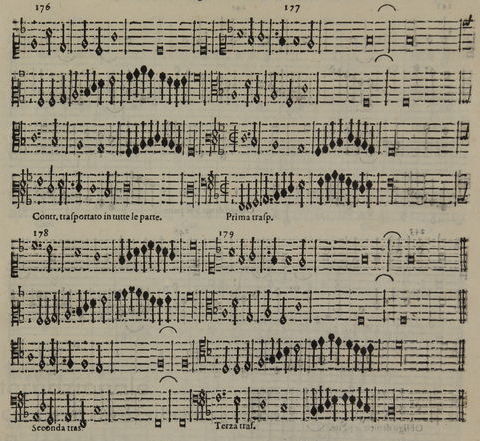
Example 15: ‘Accadenzie di Gabriel Fattorini’ from Diruta, Seconda parte del Transilvano (Venice, 1609), lib. ii, p. 19.
3. Finis. Counterpoint and Rhetoric
Having analysed the way counterpoint was taught and learnt, it is now necessary to consider its rhetorical function in Renaissance musical composition. Humanism led to the rediscovery of the classical world and particularly of the Greek theatre. Interest in Greek music and theatre was cultivated throughout the 15th and 16th centuries, particularly in Italian humanistic circles. In the Greek world, music and poetry formed one whole, while in the following centuries they came to be separated, giving rise to autonomous disciplines. Humanistic circles, in their attempt to recreate Greek theatre, sought a new way of unification between music and poetry, and found it in the concept of imitatio. Two of the most influential exponents of humanistic culture, both from Venice, were Pietro Bembo and Gioseffo Zarlino. Through the concept of imitation, the first elaborated a musical description of poetry, the second a poetic description of music. In Prose della volgar lingua (Venice, 1525), Bembo writes:
Da sciegliere adunque sono le voci, se di materia grande si ragiona, gravi, alte, sonanti, apparenti, luminose, se di bassa e volgare, lievi, piane, dimesse, popolari, chete: se di mezzana tra queste due, medesimamente con voci mezzane e temperate […].21
(‘One must, therefore, when speaking of lofty matters, choose voices that are grave, high, sonorous, striking, luminous; for low and mean matters, light, flat, humble, common, quiet [voices]: if in the middle between these two, likewise with middling and temperate voices […].’)
Zarlino in the Sopplimenti musicali (Venice, 1588) writes:
Si com’al Poeta è concesso d’imitar le cose con parole accomodate nel Verso […] così è concesso al Musico & Melopeio, imitar con la Modulatione & con l’Harmonia, con quel modo migliore ch’ei può fare, quello che esprimono le parole contenute nell’Oratione.22
(‘Just as the poet can imitate things with words organised in verse […], so the musician and Melopeio can imitate with Modulation and Harmony, in the best way he can, what the words contained in the oration express.’ [Translation by the author])
Imitation is the key to understanding music and poetry. Poetry expresses the content through an appropriate choice of sounds, exactly as music makes a choice of modes, intervals, and figures, in relation to the content to be transmitted. Consequently, the formal organisation of a poetic text, as well as a musical score, is based on rhetoric. The entire creative process in music, as in poetry, is inspired by the canons of classical rhetoric, which humanism had rediscovered and reworked.
It should be noted, however, that this reworking of rhetoric is proposed not without contention among theorists. The performers (musicians, but also actors, poets, and artists in general) spontaneously implement it through experience directly received from their respective teachers and matured in the heat of the performance.23
The creative process in music, as in other arts and in language, can be summarized as follows:
- The choice of the subject/s, or inventio: This could be derived from a cantus firmus (plainchant) or a secular tenore (Bergamasca, Ruggiero, Romanesca etc.) This process requires analysis of the structure and recognition of the mode, with its related cadences and sequences. Alternatively it could be freely created by the composer, a process called fantasia by Banchieri. In this case the subject must be short, and prevalently within the range of a fourth or a fifth.
- The organisation of the piece, or dispositio: This must follow the mode, with the correct order of cadences and the most suitable progressions. It involves the creation of a second subject with invertible counterpoint.
- The choice of figures and ornaments, or elocutio: Intervals, figures, and diminutions or ornaments must be chosen in accordance with the topic and the character of the piece.
- The memorisation, or memoria: Memorisation is an important part of music education: it is the best way to collect ideas, schemes, patterns, melodies, and canons, which can all become part of a personal database. For a keyboard player, memorisation is a physical process involving fingers, hands, and posture, as well as a mental one. A correct fingering was – and still is – the best way to memorize patterns and to facilitate their transpositions.
- Finally the performance, or actio: The art of delivery of a piece of music involves choice of the instrument, registration, articulation, tempo, dynamic etc. In Italy theatre and music have always given great importance to this final element. From the middle of the 16th century onwards, the performer delivering the message of the text, music, and action to the public gained an increasing importance, almost equivalent to that of the composer. This was especially the case of singers, as Bottrigari writes:
[…] della espressione degli affetti & della pronuntia delle parole; dalle quali, & massimamente essendo bene imitate dall’Eccellente Musico nella sua cantilena, veramente deriva il maggiore di tutti i commovimenti de gli animi delle persone ascoltatrici.24
(‘[…] of the expression of the affects and the pronunciation of the words; from these, especially when well imitated by the Excellent Musician in his song, does there truly derive the greatest stirring in the souls of the listeners.’ [Translation by the author])
In the field of keyboard music, as already observed in the foreword, composer and performer were very often the same person, and the performer has a similar duty to that of a good orator who deeply moves his listeners through a skillful delivery of his speech.
Afterword
For over three centuries, the entire musical education was based on the study of counterpoint, which was learned in a practical way. A substantial body of research conducted in recent years has already highlighted the techniques which enabled the extemporaneous contrapuntal vocal improvisation practiced by the scholae in the 16th century.25 Singing was also an essential component of keyboard player’s education. Various sources discussed above present us with special techniques of direct learning on the keyboard that can be applied to this context. The teaching method was based on the imitation and memorisation of formulas. With this process the student presented with a theme or cantus firmus was immediately able to recognize its fundamental elements and, consequently, to add other voices, which in turn led to the construction of a complete musical piece. The methodology was identical to the one we use today to learn a language: memorisation and repetition of words, phrases and formulas through activity or conversation. Grammar comes later. This approach invites us to review our educational and performance practices.
Musical study is still too preoccupied with a dichotomy between theory and practice, adhering to a somewhat museum-like approach to compositions. The methodology develops reading and performance techniques and devotes very little attention to the way in which these compositions were constructed, composed, and improvised. Performance practice focused on the actio without an attentive study of the other moments of musical creation (inventio, dispositio, elocutio) prevents an adequate interpretation of the content of the scores and the meaning of the musical signs and figures contained therein. This in turn affects the quality of performance.
Harmony studies should be preceded by counterpoint studies, concretely applied in an active experience at the keyboard. The study of the musical building blocks as described in the cited sources, therefore allows us not only to improve our understanding of the repertoire, but also to develop a more creative way of teaching of music for the benefit of the new generations and to increase their interest in the world of classical music.
Endnotes
-
Girolamo Diruta, Il Transilvano Dialogo sopra il vero modo di sonar organi, & istromenti da penna / Seconda parte del Transilvano Dialogo diviso in quattro libri (Venice: Giacomo Vincenti 1593 and 1609), <http://hdl.loc.gov/loc.music/muspre1800.100422> (book of 1593), <http://www.bibliotecamusica.it/cmbm/viewschedatwbca.asp?path=/cmbm/images/ripro/gaspari/_D/D019/> (book of 1609) (accessed on 25 July 2024).↩︎
-
Adriano Banchieri, L’Organo suonarino (Venice: Ricciardo Amadino, 1605), <https://books.google.at/books?id=yzYzAQAAMAAJ&hl=de&pg=PA36 – v=onepage&q&f=false> (accessed on 25 July 2024). Modern edition: L’Organo suonarino (Venezia 1605), ed. Edoardo Bellotti, Tastata 31 (Latina, 2014).↩︎
-
Spiridion a Monte Carmelo, Instructio nova pro pulsandis organis, spinettis, manuchordiis etc.(Bamberg: Johann Georg Seuffert / Johann Jacob Immel, 1669–1672) (VD17 14:705645R), <https://imslp.org/wiki/Nova_Instructio_(Spiridion)> (accessed on 25 July 2024). Modern edition: Spiridionis a Monte Carmelo Nova instructio pro pulsandis organis, spinettis, manuchordiis etc., ed. Edoardo Bellotti, Tastature 11 (Colledara, 2003).↩︎
-
This Handbook for organists has been reprinted several times between 1668 and 1718. Rudolf Walter discusses the question in his preface to a modern edition that unfortunately collects only the music examples and completely omits the didactical chapters: Orgelstücke aus der Orgelschule Wegweiser (Augsburg 1668). Kurze und leichte Präambula und Versus in den acht Kirchentonarten, ed. Rudolf Walter, Süddeutsche Orgelmeister des Barock 8 (Altötting, 1964), 3–4. A modern edition of the 1692 reprint is available: Elinore Barber and Walter B. Hewlett, ‘Riemenschneider Bach Institute Vault Holdings, facsimile series: … Wegweiser … die Kunst die Orgel recht zu schlagen, Part i–vi’, in: Bach. Journal of the Riemenschneider Bach Institute 18 (1987), no. 1, 25–36; no. 2, 4–35, 37–63; no. 3, 11–37; no. 4, 29–54; 19 (1988), no. 2, 25–56; no. 3, 19–74. A digital copy of the edition of 1689 is available on: <http://data.onb.ac.at/rep/10597330> (accessed on 26 July 2024).↩︎
-
Adriano Banchieri, Conclusioni nel suono dell’organo (Bologna: Giovanni Rossi, 1609), 24–5, <https://imslp.org/wiki/Special:ReverseLookup/115414> (accessed on 8 August 2024).↩︎
-
In his Istitutioni harmoniche (Venice, 1558) Zarlino declares that music is composed of two elements: armonia and numero. By armonia he means the contrapuntal construction and by numero the rhythmic/metric structure. Cf. Paolo Cecchi, ‘Il rapporto tra testo letterario e intonazione musicale nei teorici italiani di fine Cinquecento’, in: Claudio Monteverdi: Studi e prospettive: Atti del convegno, Mantova, 21–24 ottobre 1993, ed. Paola Besutti, Teresa M. Gialdroni and Rodolfo Baroncini (Florence, 1998), 549–605. For further discussion of this topic see Edoardo Bellotti, ‘Basso continuo e contrappunto nelle fonti seicentesche: un moderno approccio alla didattica musicale’, in: Basso Continuo in Italy: Sources, Pedagogy and Performance, ed. Marcello Mazzetti (Turnhout, 2023), 265–84.↩︎
-
The educational production of duos is endless. A large collection can be found in Andrea Bornstein, Two-Part Italian Didactic Music: Printed Collections of the Renaissance and Baroque (1521–1744), 3 vols. (Bologna, 2004). Peter Schubert has studied Renaissance vocal practice extensively, emphasising its didactic importance. See Peter Schubert, ‘Counterpoint Pedagogy in the Renaissance’, in: The Cambridge History of Western Music Theory, ed. Thomas Christensen (Cambridge, 2002), 503–33; and idem, ‘From Improvisation to Composition: Three Sixteenth-Century Case Studies’,in: Rob C. Wegman, Johannes Menke and Peter Schubert, Improvising Early Music,Collected Writings of the Orpheus Institute 11(Leuven, 2014), 93–130.↩︎
-
<http://bdh-rd.bne.es/viewer.vm?id=0000158382&page=1> (accessed on 25 July 2024).↩︎
-
<http://purl.org/rism/BI/1578/24> (accessed on 25 July 2024).↩︎
-
Diruta and Banchieri provide a table with all the cadences organised into the eight tones. Cf. Diruta, Seconda parte (see n. 1), lib. iii, 2–3. Adriano Banchieri, L’Organo suonarino, ed. Edoardo Bellotti (Latina, 2014), 28–9. Cf. Edoardo Bellotti, ‘Adriano Banchieri and the Theory and Practice of Counterpoint and Basso Continuo in the Seventeenth Century’, in: The Organ Yearbook 47 (2018), 49–78.↩︎
-
Cf. Mariateresa Muttoni, ‘Modi dell’improvvisazione nelle intavolature tedesche per organo fra Quattro e Cinquecento’, in: Sull’improvvisazione, ed. Claudio Toscani (Lucca, 1998), 11–62; August Valentin Rabe, ‘Singing, Reading, Writing, Playing: Practising with Tomás de Santa María’, in: ‘Universum rei harmonicae concentum absolvunt’: The Harpsichord in the Sixteenth Century, ed. Augusta Campagne and Markus Grassl (Vienna, 2024), 66–78, <https://www.mdw.ac.at/mdwpress/mdwp03-singing-reading/> (accessed 13 Oct. 2025); August Valentin Rabe, ‘Benutze nun die Tafeln selbst’. Sammeln, Schreiben, Lehren und Üben mit einem Fundamentum (ca. 1440–1550), Wiener Forum für ältere Musikgeschichte 14 (Vienna, 2025).↩︎
-
Tomás de Santa María, Libro llamado arte de tañer fantasía (see n. 8), i, fols. 62r–64r. ↩︎
-
Adriano Banchieri, Cartella musicale nel canto figurato fermo e contrapunto (Venedig: Giacomo Vincenti, 1614), 236–48, <https://imslp.org/wiki/Special:ReverseLookup/158853> (accessed on 17 July 2024).↩︎
-
Gioseffo Zarlino, Le istitutioni harmoniche (Venice, 1558), 320–35, <https://archive.org/details/leistitutionihar00zarl> (accessed on 17 July 2024).↩︎
-
Tomás de Santa María, Libro llamado arte de tañer fantasía (see n. 8), i, fols. 53v–55v.↩︎
-
E.g. in: Johannes Woltz, Nova musices organicae tabulatura (Basel: Johann Jacob Genath, 1617), part III, no. 49, <https://mdz-nbn-resolving.de/details:bsb00050860> (accessed 13 Oct. 2025). For a complete list see Giuseppe Clericetti, ‘Le composizioni per strumenti a tastiera di Andrea Gabrieli. Catalogo, bibliografia, varianti’, in: L’Organo 25/26 (1987/88), 9–61, at 21–2.↩︎
-
Antonio Valente, Versi spirituali sopra tutte le note, con diversi canoni spartiti per sonar negli organi […] libro secondo (Naples: Eredi di Mattio Cancer, 1580), <https://imslp.org/wiki/Special:ReverseLookup/907887> (accessed on 17 July 2024). The first collection of Valente, titled Intavolatura de cimbalo, recercate, fantasie et canzoni francese desminuite con alcuni tenori, balli et varie sorte de contraponti (Naples: Gioseppe Cacchio dall’Aquila), was printed in 1576. On this collection see the contribution of Paola Erdas in this volume. ↩︎
-
Bernardo Pasquini, Opere per Tastiera. Vol VII: London, Bl Ms.Add. 31501, II–III, ed. Armando Carideo, Tastata 19 (Latina, 2006).↩︎
-
Musica nova accomodata per cantar e sonar sopra organi (Venice: Andrea Arrivabene, 1540) (RISM 154022, Brown 15403). As is well known, only the bass part book of this print has survived (in I-Bc). Yet, nineteen of twenty-one compositions including the Ricercare by Willaert, were reprinted in Musicque de joye (Lyon: Jacques Moderne [1544]) (RISM c.155024, Brown 154?6), <https://imslp.org/wiki/Musicque_de_joye_(Moderne,_Jacques) – IMSLP58337> (accessed on 17 July 2024).↩︎
-
Cf. Massimiliano Guido and Peter Schubert, ‘Unpacking the Box in Frescobaldi’s Ricercari of 1615’, in: Music Theory Online 20 (2014), <https://mtosmt.org/issues/mto.14.20.2/mto.14.20.2.guido_schubert.html> (accessed on 15 July 2024).↩︎
-
Pietro Bembo, Prose […] della volgar lingua (Venice, 1525), fol. xxiiiv, <https://mdz-nbn-resolving.de/details:bsb10142586> (accessed on 17 July 2024). Modern edition: Prose e rime di Pietro Bembo, ed. Carlo Dionisotti (Turin, 1966), 137. Translation by Candace Smith.↩︎
-
Gioseffo Zarlino, Sopplimenti musicali (Venice: Francesco de i Francesci Senese, 1588), 316, <https://gallica.bnf.fr/ark:/12148/bpt6k582296/f25.item> (accessed on 7 August 2024). Paolo Cecchi discusses these issues extensively in ‘Il rapporto tra testo letterario e intonazione musicale’ (see n. 6).↩︎
-
The necessarily formal and theoretical study that we are conducting inevitably risks distancing us from the living context of musical production, making us forget that in the 16th century music, like any other artistic form, was learned in the workshop, through an interaction between master and disciple: the pupil not only received lessons but was present (and very often helping the master) during any direct realisation of the artistic-musical event.↩︎
-
Ercole Bottrigari, Il Desiderio overo de’ concerti di varij strumenti musicali (Venice: Ricciardo Amadino, 1594), 12, <https://gallica.bnf.fr/ark:/12148/bpt6k58168t> (accessed on 17 July 2024).↩︎
-
Cf. Peter Schubert,‘Teaching Theory Through Improvisation’, in: Studies in Historical Improvisation: From Cantare super Librum to Partimenti,ed. Massimiliano Guido (New York, 2017), 175–84. To delve deeper into the theme of imitation and the creative/compositional process in the Renaissance cf. Honey Meconi, ‘Does Imitatio Exist?’, in: JM 12 (1994), 152–78, and the studies of Philippe Canguilhelm respectively, especially: L’improvisation polyphonique à la Renaissance (Paris, 2015), and: ‘Singing upon the Book According to Vicente Lusitano’, in: EMH 30 (2011), 55–103. Concerning rhetoric in music cf. the contributions in: Rhetorik. Ein internationales Jahrbuch, vol. 35: Rhetorik und Musik, ed. Hartmut Krones (Berlin/Boston, 2016).↩︎
Bibliography
Adriano Banchieri, Cartella musicale nel canto figurato fermo e contrapunto (Venedig: Giacomo Vincenti, 1614), <https://imslp.org/wiki/Special:ReverseLookup/158853>
Adriano Banchieri, Conclusioni nel suono dell’organo (Bologna: Giovanni Rossi, 1609), <https://imslp.org/wiki/Special:ReverseLookup/115414>
Adriano Banchieri, L’Organo suonarino (Venice: Ricciardo Amadino, 1605), <https://books.google.at/books?id=yzYzAQAAMAAJ&hl=de&pg=PA36 – v=onepage&q&f=false>
Adriano Banchieri, L’Organo suonarino (Venezia 1605), ed. Edoardo Bellotti, Tastata 31 (Latina, 2014)
Elinore Barber and Walter B. Hewlett, ‘Riemenschneider Bach Institute Vault Holdings, facsimile series: … Wegweiser … die Kunst die Orgel recht zu schlagen, Part i–vi’, in: Bach. Journal of the Riemenschneider Bach Institute 18 (1987), no. 1, 25–36; no. 2, 4–35, 37–63; no. 3, 11–37; no. 4, 29–54; 19 (1988), no. 2, 25–56; no. 3, 19–74
Edoardo Bellotti, ‘Adriano Banchieri and the Theory and Practice of Counterpoint and Basso Continuo in the Seventeenth Century’, in: The Organ Yearbook 47 (2018), 49–78
Edoardo Bellotti, ‘Basso continuo e contrappunto nelle fonti seicentesche: un moderno approccio alla didattica musicale’, in: Basso Continuo in Italy: Sources, Pedagogy and Performance, ed. Marcello Mazzetti (Turnhout, 2023), 265–84
Pietro Bembo, Prose […] della volgar lingua (Venice, 1525), <https://mdz-nbn-resolving.de/details:bsb10142586>
Andrea Bornstein, Two-Part Italian Didactic Music: Printed Collections of the Renaissance and Baroque (1521–1744), 3 vols. (Bologna, 2004)
Ercole Bottrigari, Il Desiderio overo de’ concerti di varij strumenti musicali (Venice: Ricciardo Amadino, 1594), <https://gallica.bnf.fr/ark:/12148/bpt6k58168t>
Hernando de Cabezón, Obras de música (Madrid: Francisco Sánchez, 1578), <http://purl.org/rism/BI/1578/24>
Philippe Canguilhelm, L’improvisation polyphonique à la Renaissance (Paris, 2015)
Philippe Canguilhelm, ‘Singing upon the Book According to Vicente Lusitano’, in: EMH 30 (2011), 55–103
Paolo Cecchi, ‘Il rapporto tra testo letterario e intonazione musicale nei teorici italiani di fine Cinquecento’, in: Claudio Monteverdi: Studi e prospettive: Atti del convegno, Mantova, 21–24 ottobre 1993, ed. Paola Besutti, Teresa M. Gialdroni and Rodolfo Baroncini (Florence, 1998), 549–605
Giuseppe Clericetti, ‘Le composizioni per strumenti a tastiera di Andrea Gabrieli. Catalogo, bibliografia, varianti’, in: L’Organo 25/26 (1987/88), 9–61
Girolamo Diruta, Seconda parte del Transilvano Dialogo diviso in quattro libri (Venice: Giacomo Vincenti, 1609), <http://www.bibliotecamusica.it/cmbm/viewschedatwbca.asp?path=/cmbm/images/ripro/gaspari/_D/D019/>
Girolamo Diruta, Il Transilvano dialogo sopra il vero modo di sonar organi, & istromenti da penna (Venice: Giacomo Vincenti, 1593), <http://hdl.loc.gov/loc.music/muspre1800.100422>
Andrea Gabrieli, Ricercari […] libro secondo (Venice: Angelo Gardano, 1595), <https://doi.org/10.3931/e-rara-56111>
Andrea Gabrieli, Il terzo libro de ricercari (Venice: Angelo Gardano, 1596), <https://doi.org/10.3931/e-rara-55399>
Massimiliano Guido and Peter Schubert, ‘Unpacking the Box in Frescobaldi’s Ricercari of 1615’, in: Music Theory Online 20 (2014), <https://mtosmt.org/issues/mto.14.20.2/mto.14.20.2.guido_schubert.html>
Honey Meconi, ‘Does Imitatio Exist?’, in: JM 12 (1994), 152–78
Musica nova accomodata per cantar e sonar sopra organi (Venice: Andrea Arrivabene, 1540) (RISM 154022, Brown 15403)
Musicque de joye (Lyon: Jacques Moderne [1544]) (RISM c.155024, Brown 154?6), <https://imslp.org/wiki/Musicque_de_joye_(Moderne,_Jacques) – IMSLP58337>
Mariateresa Muttoni, ‘Modi dell’improvvisazione nelle intavolature tedesche per organo fra Quattro e Cinquecento’, in: Sull’improvvisazione, ed. Claudio Toscani (Lucca, 1998), 11–62
Orgelstücke aus der Orgelschule Wegweiser (Augsburg 1668). Kurze und leichte Präambula und Versus in den acht Kirchentonarten, ed. Rudolf Walter, Süddeutsche Orgelmeister des Barock 8 (Altötting, 1964)
Diego Ortiz, Tratado de glosas sobre clausulas y otros generos de puntos en la musica de violones / El primo libro […] nel qual si tratta delle glosse sopra le cadenze & altre sorte de punti in la musica del violone (Rome: Valerio & Luigi Dorico, 1553), <http://bdh-rd.bne.es/viewer.vm?id=0000037748>
Bernardo Pasquini, Opere per Tastiera. Vol VII: London, Bl Ms.Add. 31501, II–III, ed. Armando Carideo, Tastata 19 (Latina, 2006)
Prose e rime di Pietro Bembo, ed. Carlo Dionisotti (Turin, 1966)
August Valentin Rabe, ‘Benutze nun die Tafeln selbst’. Sammeln, Schreiben, Lehren und Üben mit einem Fundamentum (ca. 1440–1550), Wiener Forum für ältere Musikgeschichte 14 (Vienna, 2025)
August Valentin Rabe, ‘Singing, Reading, Writing, Playing: Practising with Tomás de Santa María’, in: ‘Universum rei harmonicae concentum absolvunt’: The Harpsichord in the Sixteenth Century, ed. Augusta Campagne and Markus Grassl (Vienna, 2024), 66–78, <https://www.mdw.ac.at/mdwpress/mdwp03-singing-reading/>
Rhetorik. Ein internationales Jahrbuch, vol. 35: Rhetorik und Musik, ed. Hartmut Krones (Berlin/Boston, 2016)
Tomás de Santa María, Libro llamado arte de tañer fantasía (Valladolid: Francisco Fernandez de Cordova, 1565), <http://bdh-rd.bne.es/viewer.vm?id=0000158382&page=1>
Peter Schubert, ‘Counterpoint Pedagogy in the Renaissance’, in: The Cambridge History of Western Music Theory, ed. Thomas Christensen (Cambridge, 2002), 503–33
Peter Schubert, ‘From Improvisation to Composition: Three Sixteenth-Century Case Studies’,in: Rob C. Wegman, Johannes Menke and Peter Schubert, Improvising Early Music,Collected Writings of the Orpheus Institute 11(Leuven, 2014), 93–130
Peter Schubert,‘Teaching Theory Through Improvisation’, in: Studies in Historical Improvisation: From Cantare super Librum to Partimenti,ed. Massimiliano Guido (New York, 2017), 175–84
Spiridion a Monte Carmelo, Instructio nova pro pulsandis organis, spinettis, manuchordiis etc.(Bamberg: Johann Georg Seuffert / Johann Jacob Immel, 1669–1672), <https://imslp.org/wiki/Nova_Instructio_(Spiridion)>
Spiridionis a Monte Carmelo Nova instructio pro pulsandis organis, spinettis, manuchordiis etc., ed. Edoardo Bellotti, Tastature 11 (Colledara, 2003)
Antonio Valente, Versi spirituali sopra tutte le note, con diversi canoni spartiti per sonar negli organi […] libro secondo (Naples: Eredi di Mattio Cancer, 1580), <https://imslp.org/wiki/Special:ReverseLookup/907887>
Kurtzer jedoch gründlicher Wegweiser […] die Orgel recht zu schlagen (Augsburg: Jacob Koppmayer, 1689), <http://data.onb.ac.at/rep/10597330>
Johannes Woltz, Nova musices organicae tabulatura (Basel: Johann Jacob Genath, 1617), <https://mdz-nbn-resolving.de/details:bsb00050860>
Gioseffo Zarlino, Le istitutioni harmoniche (Venice, 1558), <https://archive.org/details/leistitutionihar00zarl>
Gioseffo Zarlino, Sopplimenti musicali (Venice: Francesco de i Francesci Senese, 1588), <https://gallica.bnf.fr/ark:/12148/bpt6k582296/f25.item>