Sabine Reiter
How to cite
How to cite
Outline
Outline

Constanze Wimmer initiated Austria’s first university music mediation programme, Musikvermittlung – Musik im Kontext [Music Mediation – Music in Context], at the Anton Bruckner Private University in 2009:
At the time, university programmes and the Netzwerk Junge Ohren [Network Young Ears] had already existed in Germany for ten years. Around the same time, a sort of cultural mediation platform was established in Switzerland, and the Zurich University of the Arts already had a continuing education programme as well. We clearly had to ask ourselves how we should approach music mediation in Austria; we needed something of our own to give us a sense of identity. (mica n.d.)1
Three years later, in 2012, the two of us founded the Plattform Musikvermittlung Österreich (PMÖ) [Platform Music Mediation Austria] located at mica – music austria, Austria’s music information centre. My primary goal at the time as director of mica was to support mediation activities around contemporary classical music, in order to follow up on the KIangnetze [Sonic Networks] project that had been discontinued in 2001. This groundbreaking project was launched in the 1990s, conducted by the Austrian Cultural Service and supported by Lothar Knessl and Christian Scheib, who were the music curators in the cultural ministry at the time. It was a unique and relevant music mediation project to bring contemporary music into schools, offering pupils new experiences in creating and listening to music. After its demise, nothing comparable had taken its place.
More than 50 people took part in the foundational meeting for the PMÖ on September 12, 2012. The idea of collaboratively developing guiding topics and a variety of offerings was a central point of departure; the German Netzwerk Junge Ohren, founded in 2007, was also present at the conference. Three working groups of music mediators considered the question of which issues the initiative should take up in the future, settling on education (including continuing education), communication, and public relations, as well as lobbying and advocacy. It was further decided that a biennial conference should take place in cooperation with Austrian music universities, with the conference themes decided upon democratically – the PMÖ was born.
Since that time, mica has operated as a sponsoring organisation, responsible for providing infrastructure in various forms, including a dedicated online channel for music mediation. This channel reports on current projects and job opportunities and also features music mediators in interviews. As of 2024, the PMÖ has a newsletter with over 1,500 subscribers; and an active Facebook page. Mica also manages the platform’s administrative and organisational activities. An advisory board with experts from numerous fields of music mediation meets occasionally to plan conferences and continuing education offerings and to discuss current developments and possible activities, such as open letters.
The platform offers workshops, usually in the years between conferences, focusing on work-related subjects such as presentation formats, communication with audiences, aspects specific to music theatre and theatre pedagogy and legal questions. These workshops are often conducted in cooperation with other institutions, such as the Department of Music Education Research and Practice at the mdw – University for Music and Performing Arts Vienna, the association auf:takt Kultur [up:beat Culture] and OeAD, the Austrian Agency for Education and Internationalisation.
Conferences and Key Issues
The conferences, a primary focus of the PMÖ’s founding meeting, have taken place every two years since 2013 and have been a notable success. The combination of project presentations, performances, practice-oriented workshops, and – most of all – discourse and networking components have offered participants the opportunity to experience a variety of views on the conference themes.
The inaugural conference, titled Kulturen.Vermitteln.Musik [Cultures.Mediating.Music], took place in 2013 at the Anton Bruckner Private University in Linz, in cooperation with the Music Theatre Linz, the Bruckner Orchestra, Assitej Austria, and Shäxpir – Theater Festival for Young Audiences. It focused on the socio-politically urgent themes of migration and inter- and transculturality, issues affecting all areas of music mediation. Projects with strong sociocultural and inclusive components – building bridges between people with different cultural backgrounds and facilitating intercultural encounters – were presented and discussed.
The theme of the next conference, held in 2015 at the Mozarteum University in Salzburg, was also quickly agreed upon by the music mediation community: interdisciplinarity, the basic requirement for every mediation activity. Musik in Szene – Szenen in Musik. Interdisziplinäre Aspekte der Musikvermittlung [Music in Scene – Scenes in Music: Interdisciplinary Aspects of Music Mediation] was the title of the conference, which focused on projects working substantially with the methods of other artistic disciplines, such as dance or multimedia concert performances. Making-of workshops showcased the practical aspects of projects with experimental sound design, graphic notation, and combinations of music and visual art, such as soundpainting; a marketplace offered the chance for participants to learn about and discuss additional projects.
In 2017, the University of Music and Performing Arts in Graz invited the platform to hold the conference there. This time, the title was Neues Hören für Erwachsene. Publikum für Neue Musik gewinnen [New Listening for Adults. Winning Audiences for Contemporary Music]. Presentations included themes of contemporary music and mediation formats for adult audiences, an amusement-park carousel playing contemporary compositions at the musikprotokoll festival, the mediation of contemporary music on the radio, and dramaturgical aspects of presenting contemporary music at festivals. Practice-oriented workshops shared a variety of mediation approaches to contemporary music.
In 2019, digital media took centre stage: under the title Digital – Partizipativ – Sozial. Musikvermittlung 4.0 [Digital – Participative – Social. Music Mediation 4.0], and in collaboration with the Anton Bruckner Private University and Ars Electronica Center, the possibilities of digital media for music mediation were examined for the first time. Apps and tools for music-making, composition and mediation were presented; controversial questions were discussed in lectures on democratisation, digitalisation, and arts mediation. Hörminute [Listening Minute], an online music mediation project created by mica for elementary schools, was also introduced.
Music Mediation at Universities
A further focus of the platform’s work, defined at the founding meeting, has also born fruit: the quest to strengthen music mediation at the university level, improving awareness for the professional field in relevant curricula (instrumental and vocal studies and music education, for example), and promoting the understanding of music mediation as an educational principle. The first programme specifically dedicated to music mediation was launched in Germany at Detmold University of Music in 1998. However, it was not until 2009, when Constanze Wimmer initiated the first programme in Austria. In subsequent years, similar programmes were established at other Austrian universities: the Music and Arts University of the City of Vienna now offers a Master of Arts Education (MAE); the University of Music and Performing Arts Graz offers a master’s degree programme in Music and Theatre Mediation, the mdw – University of Music and Performing Arts Vienna is home to the master’s programme in Contemporary Arts Practice (CAP), and the Mozarteum University in Salzburg offers a programme in Music Theatre Mediation. In summary, tertiary education offerings for music mediation have improved considerably in recent years – which, of course, also contributes to a substantial professionalisation of the field. At the time of the foundation of the PMÖ in 2012, only a single music mediation programme existed in Austria, namely at the Bruckner Private University in Linz. In 2024, music mediation is represented at every music university in the country.
Foundation of the IG Musikvermittlung
As strong as the sociopolitical engagement of music mediators is, their working conditions are far from being appropriate. This issue had not yet become clear at the PMÖ’s foundation; the founding members’ interest in lobbying and advocacy at the time was focused more on improving funding opportunities and public visibility for music mediation.
Even before the COVID-pandemic, the poor wages, often inferior status, and lack of respect that music mediators were confronted with in their organisations were becoming increasingly clear, as were the precarious working conditions of self-employed mediators. Two studies painted a dramatic picture: firstly, a study on the social situation of artists and arts and cultural mediators in Austria (Wetzel 2018), and secondly, a survey by Netzwerk Junge Ohren and Educult (2020).
As with digitisation, the pandemic also stimulated developments in this area: the Austrian State Secretary for Arts and Culture made fair pay in publicly funded arts and cultural organisations a focus of his department’s work. In 2021, an initiative with the cultural departments of the individual states was set in motion and a fair pay strategy was agreed upon with regional authorities. The event introducing the arts and cultural strategy of the Federal Ministry for the Arts, Culture, Public Service and Sport (BMKÖS) effectively secured a central position for arts and cultural mediation in future cultural policy, granting it substantial space and noting the founding of an umbrella organisation for cultural mediators in all branches of the arts. It became clear that music mediators needed a formal interest group of their own that goes beyond the rather informal network of PMÖ. The fundamentally democratic attitude of the mediators shaped the foundation of this organisation as well: in 2022, an initial poll was conducted to find out whether mediators were generally interested in founding an interest group and what they considered to be the most urgent problems of their profession. The results were unambiguous: 86% of the respondents were prepared to join and pay membership fees, over 75% held political representation to be a necessity, and nearly 60% were prepared to be active in the organisation. The poll identified the key issues facing the profession as the following: funding opportunities, fair payment, social security (pension and unemployment insurance), social insurance subsidies via the Artists’ Social Insurance Fund (KSVF), and the formulation of fee recommendations for the field. The time was clearly at hand. In the course of several networking meetings, the structure and focus of the IG Musikvermittlung [Interest Group for Music Mediators] were defined, and the organisation was officially founded on September 11th in 2023.
Looking Ahead: The Sociopolitical Potential of Arts and Cultural Mediation
Among other results, the considerable professionalisation and institutionalisation, including the establishment of university curricula for music mediation over the last decade, has led to the universities taking over the organisation of future conferences, rather than the PMÖ. The effects of the pandemic, the growing polarisation of society, and the rise of diversity and sustainability movements have triggered a pronounced shift in the focus of recent conferences toward the sociocultural potential of music mediation.
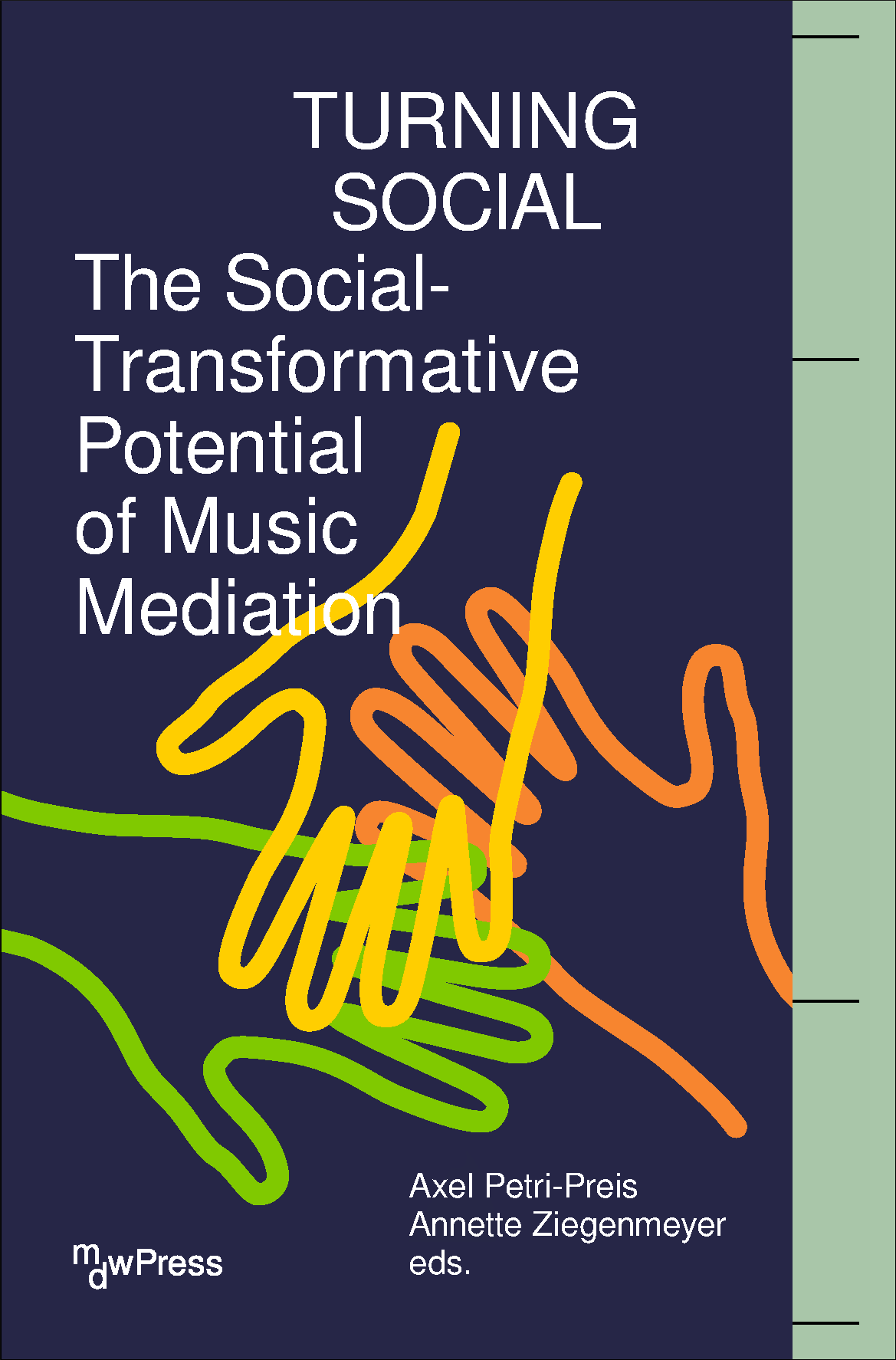
The 2021 conference Rethinking Classical Music Practice: Audience and Community Engagement in Classical Concert Life took place entirely online in the midst of the pandemic. It was organised by the mdw – University of Music and Performing Arts Vienna and curated by Axel Petri-Preis and Constanze Wimmer. The presentations and workshops focused on the question of how the anchoring of classical music in society could be rethought for the 21st century. A central element of community engagement is music-making together by professional and non-professional musicians, inclusively and without prerequisites. It is decidedly political, intended to encourage processes of social change, both individual and societal. Participation – not just taking part but also giving part – is a central element, with substantial sociopolitical potential. The following conference, in 2023, intensified the focus on this subject: Turning Social: On the Social-Transformative Potential of Music Mediation, organised by Axel Petri-Preis and Sarah Chaker, again at the mdw – University of Music and Performing Arts Vienna, was explicitly devoted to power-critical, anti-discriminatory, diversity-reflexive, and decolonial thinking. The idea of cultural democracy, advocated by François Matarasso in his keynote, defines the vision of comprehensive cultural participation for everyone: “Cultural democracy is the right and capability to participate fully, freely and equally in the cultural life of the community, to enjoy the arts and create, publish and distribute artistic work.” (Matarasso 2019, 77)
From its inception, the PMÖ has viewed music mediation in a larger context. Marketing aspects – capturing and developing new audience segments for the future – have been explored at conferences, of course, but space has always been given to the societal potential of music mediation, its sociopolitical and democracy-strengthening power, and the discourse on quality: good practice in music mediation, learning from one another, networking, and the exchange of ideas. The Turning Social conference dramatically highlighted the sociopolitical potential of music mediation. Artistic activities that incorporate ideas drawn from community music and co-creation are a sociopolitical statement per se – the germ of a small revolution, the power of which is released simply by taking part in such projects. In order for cultural democracy to flourish, the discourse has to be carried beyond the bounds of academia and the music mediation community, to cultural institutions and cultural policy.
In addition to the traditional notion of artistic excellence, which must naturally retain its place, would it not be wonderful if all the institutions of music life – opera houses, concert venues, and freelance event organisers – featured community projects as a regular, prominent part of their programming? Such a transformation must proceed from cultural institutions if it is to obtain structural significance and have a broad social effect. Beyond the artistic excellence that we value and honour, we desperately need another kind of inspiration – exactly this social turn, embedded in a larger societal context and accomplished together with partners from diversity and sustainability movements worldwide.
Endnotes
-
Translation by the author.↩︎
Bibliography
Educult, and Netzwerk Junge Ohren, eds. 2020. Arbeitsbedingungen für Musikvermittler*innen im deutschsprachigen Raum. Hochmotiviert, exzellent ausgebildet, prekär bezahlt. Berlin: Netzwerk Junge Ohren.
Matarasso, François. 2019. A Restless Art: How Participation Won and Why it Matters. London: Calouste Gulbenkian Foundation.
mica – music Austria. n.d. Accessed April 14, 2025. https://www.musicaustria.at/musikvermittlung/ich-glaube-dass-in-diesem-netzwerk-eine-seismografische-qualitaet-steckt-constanze-wimmer-und-sabine-reiter-im-mica-interview/.
Wetzel, Petra. 2018. Soziale Lage der Kunstschaffenden und Kunst- und Kulturvermittler/innen in Österreich. Ein Update der Studie ›Zur sozialen Lage der Künstler und Künstlerinnen in Österreich‹ 2008. Wien: L&R Sozialforschung.