Karin Harrasser 
How to cite
How to cite
Outline
Outline

In this article, I discuss a possible deep history of the practice of “dressing up as Indian,” a deep history of adorning oneself with borrowed plumes. Who does it do, when and where and for what purpose? I argue that this history of appropriation should start in the early modern period, long before the modern, romanticized nineteenth-century image of “the North American Plains Indian” accompanied real fierce resistance to genocide all over the Americas. The first part of the chapter will engage with what could be called a drag appearance of an aristocrat as allegory of Lady America. It was staged and performed as part of European diplomatic encounters in the late sixteenth century. I will unfold the circumstances and intentions of this appropriation of the Indigenous “Other” in European cultural techniques of court diplomacy. A second part will look into what I tentatively call “Jesuit drag.” I will comment on the accommodation strategy of Jesuit missionaries, especially their appropriation of indigenous concepts and figures for the sake of conversion in South America in the seventeenth and eighteenth centuries. The later subsections will also discuss cases of counterappropriation of Jesuit performance culture by indigenous people. I shall conclude with reflections on contemporary versions of the excess of mimesis that Édouard Glissant characterized as central for a “Baroque abroad in the world” (Glissant 1997, 77).
Borrowed Plumes: Duke Frederick Dresses Up as Lady America
In a carnival procession and as part of a “ring race,” a tournament in medieval style, the protestant duke Frederick I of Württemberg presented himself in 1599—about one hundred years after the first contact with Abya Yala1—to guests from the German countries as a powerful and sexually attractive, naked and tattooed, Lady America. The event is fairly well documented: we have drawings of the planned scenes that are archived in the graphic collection of the Stiftung Weimarer Klassik and a detailed description of the event by the schoolmaster M. Jacob Frischlin from 1602. Frischlin recorded what he saw (at least he gives us the impression of having been an eyewitness) in rhyme. Frischlin’s description largely coincides with the drawings, giving us quite a vivid picture of the actual event.
Part of a diplomatic encounter of the German Protestant nobility, the ring race opened with scenes depicting adventurous encounters with Abya Yala. This theme was followed by other costumed performances of characters including the Assyrian King Ninus, the Persian King Cyrus, Alexander the Great, and Julius Caesar, as well as marches of Swabian peasants, Capuchin monks, etc. Frischlin opens onomatopoeically, echoing drum and pipe sounds, thereby dramatizing Frederick’s entry as America:
Vide pomp / pim / pom / vide / pomp / pim / pom / Hertzog Friderich komt / pom / pim / pom / Hertzog Friderich / Friderich kompt / er kommet / er kompt / America kompt / sie kompt / sie kommet / America kompt / die Könige kompt / sie kompt / sie kompt / das pimperle pom / das pimperle pom / pom / pom / Vide pomp / Vide pomp / das pomperle pom / pomp pimp pomp / etc. (Frischlin quoted after Bujok 2004, 14)2
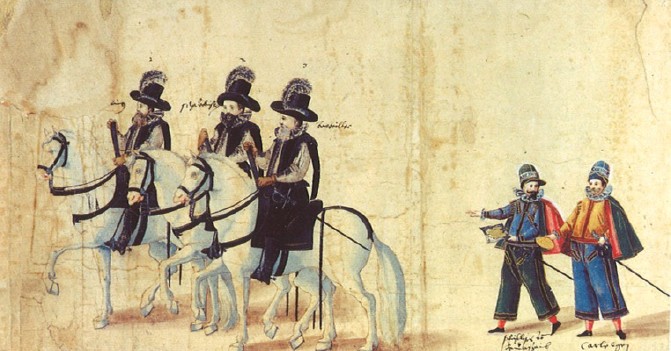
Figure 1. Scene with Christopher Columbus and Amerigo Vespucci at the Stuttgart Court, Carnival 1599 (Stiftung Weimarer Klassik, from Elke Bujok, Neue Welten in europäischen Sammlungen; Africana und Americana in Kunstkammern bis 1670, Berlin, Reimer 2004, Abb. 1/1).
The characters leading the procession are noblemen in costumes of the explorers, Christopher Columbus and Amerigo Vespucci.
Frischlin reports and comments:
|
Derowegen wir … Christophorum Columbum & Vespucium Americum … beruffen lassen Mit dem Begeren … daß sie uns … als erfahrne Pelotten zu unser Schwester begleyten wölten welches sie ohn einig Beschweren bewilligt. Den Indianern ähnlich schier Trugen gar seltzam Kappen auff Gelb und blaw Taffet underm Hauff. Der erst Columbus sich nennet Auß America sonst erkennet Juncker Philip von Lamersheym Führt mit sich und in gleichem Schein Dann Carle Egen war der andr Americam welchr thet durchwandrn Weil er drey Jahr drinn gwesen ist. (Frischlin quoted in Bujok 2004, 15) |
Therefore we … Christophorum Columbum & Vespucium Americum … allow to ask With desire … that we may … as experienced travelers join our sister which she approved without any complaints. Resembling the Indians They wore strange caps Yellow and blue taft under feathers. The first called himself Columbus Beyond America he was known as Juncker Philip of Lamersheym He carries with him and in the same semblance Carle Egen, the other Who had travelled in America He was inside for three years. (Trans. KH.) |
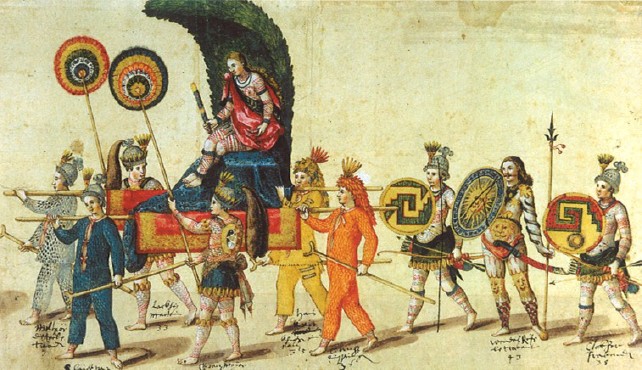
Figure 2. Frederick I performing Lady America, Carnival 1599 (Stiftung Weimarer Klassik, from Elke Bujok, Neue Welten in europäis n Sammlungen: Africana und Americana in Kunstkammern bis 1670, Berlin, Reimer 2004, Abb. 1/6).
Frischlin’s comment is interesting insofar as he informs the readers that Columbus and Vespucci—the Europeans with their borrowed plumes—looked exotic enough to “pass” as “Indians.” Also, we know from his descriptions which real person portrayed which character. In the case of Carl Egen, who performed as Amerigo Vespucci, we learn that he had been to Abya Yala in real life and was probably chosen for this role because of this fact.
The next scene or image in the parade was a mythical water tree, from which it was said that water flowed all by itself. Theodor de Bry’s Arrival of Columbus in the New World (1594/96) served as the basis of this image. As Elke Bujok (2004) has demonstrated, images from de Bry’s publication provided the templates for much of the performance in general.
This is followed by the entrance of America, ergo Frederick I:
|
Die Künigin war also bkleydt Wie ich ungefehrlich dich bescheidt Auff ihrem Häupt hatt sie ein Cron Auß Federn gmacht wie ich verstohn Von Papengäy blaw, grün und rot Gleich wie ein schöner Krantz auffstoht: Die Schämen oder Masca war Eim schönen Weibsbildt ähnlich gar Darnach der Leib und gantze Wath Wie eins nackenden Menschen stath Leibfarb mit schönen gülden Stucken Verschnürt war als wer es trucken Und glatt an Leib hinan geleimt Hat hüpsch von weitem her gescheint: Die Brüßt der Königin sah man hangn Damit sie zierlich thete prangen In Händen führt sie einen Stab Das Regiment ich gsehen hab Von Papengäy Federn gemacht Nach Königlichem Zier und Pracht. (Frischlin quoted in Bujok 2004, 18) |
This is how the queen was dressed I will inform You honestly On her head she had a crown Made from feathers as I understand From Papagai Blue, green and red High standing like a wreath Her mask resembled a beautiful woman Her whole body Appeared as if it was naked Painted and with golden pieces That were laced very close And smooth to the body And from far appeared very pretty: The bosom of the queen that hang Emblazoned and petite In her hands she carried a staff Decorated with feathers of a Papagai According to Royal Ornament and splendor. (Trans. KH.) |
The performance is spectacular concerning gender codes even if we take into account that inversion and playfulness with regard to ethnic otherness and gender were part of the rhetoric of carnivalesque costuming in the early modern period (Christadler 2005). We have learned to read allegoric depictions of America as a seductive woman as an image legitimizing the colonizers’ lust for conquest.3 In the case of Frederick I, however, the case is more complicated: the ruler himself embodies America, wearing foreign tattooed skin and foreign feathers, which frame his/her appearance as a demonstration of power. Frischlin emphasizes how Frederic energetically swings himself onto a horse at the end of the performance and—still masked as America—opens the ring race, not showing the lightest trace of weakness. Nothing in the reports and depictions hints towards an ironic performance. Lady America is both attractive and powerful.
The framing story of the diplomatic encounter as a whole was that of a diplomatic mission of Lady America. It is documented in the acts of the event. The invitation letter to the other German nobles develops the narrative: it informs the prospective guests that America has come to Europe voluntarily and out of curiosity. The aim of her mission is to maintain good relations with the European courts and to improve knowledge about America in Europe:
|
… und sie zu wahrer Fortsetzung biß daher gehabter guter Correspondentz zwischen unser allerseits underhabenden Völckern in der Person freundtlich zu besuchen damit nicht allein jnen und jren Eynwohnern unser Gelegenheit desto besser bekandt werde sondern auch wir hingegen augenscheinlich sehen und erfahren was von jhrem rühmlichen Thun und Wesen [uns] mehrmahlen fürkommen ist. (Frischlin quoted in Bujok 2004, 21) |
… and to visit them in person for the true continuation of the good correspondence that has existed between all our peoples, so that not only will our lifestyle be better known to them [Europeans] and their residents, but also that we on the other hand will see and learn about their praiseworthy actions and characters and about events there. (Trans. KH.) |
This is the reason why the diplomatic host Frederick shows an affirmative, even idealizing identification with America. The male ruler performs as Lady America as he wants to be seen as representing progress and interest in new knowledge. Interestingly, the narrative was taken up enthusiastically by the guests and then spun on in a playful manner. In the letters of reply from noble visitors stored in the files, guests frame their appearance in relation to America’s mission. Joachim Carlin von Braunschweig, for instance, replies in his future role of Julius Caesar. He narrates his planned visit as a diplomatic time travel. He writes that he (as Caesar) will gladly visit Stuttgart to fulfill his desire to become acquainted with beautiful America, and because he is curious to see how Germany has changed in the last 1,600 years. In this letter, overseas travel and time travel coincide. Frischlin, in turn, extends this diplomatic fiction into the semantics of courtly love: a type of affective language to talk about the (mostly nonsexual) relationship with a noblewoman to prove loyalty to the lady’s noble house. In his version, America had informed Caesar about her trip to Germany and Stuttgart, about her participation in the ring race, and had asked him to accompany her as a knight. Caesar is said to have granted her request, having burst into “gantze Lieb” (“full love,” Frischlin quoted in Bujok 2004, 23) for her. An overlapping of semantics of sympathy: diplomacy between the German states framed as a courtship spanning across times.4
The staging of Frederick I as America was intended to surprise and amuse the visiting nobles and envoys and that was, of course, eminently political: the Protestant sovereign presented himself as self-confidently forward-looking in his identification with the “New World” and its inhabitants. The performance was also pointedly anti-Catholic and anti-Spanish, the identification with the “Indians” was deliberately targeted against the alleged (and de facto) oppression of the inhabitants of the new Catholic territories. On another occasion, Frederick I had a monastery and members of the Jesuit order set ablaze as part of a pyrotechnical spectacle in his Lustgarten (Weber-Karge 1989). That the Jesuit order was the focus of anti-Catholic propaganda is obvious, since the Jesuits were not only present as advisers at the Catholic courts, but also the organizers of the inquisition and therefore an important pillar of the papacy and of Spanish rule in Abya Yala. But they themselves made use of cultural appropriation and masking as part of the missionary methods.
Jesuit Strategies: Accommodation and Regulation
With this background of an identificatory, temporary incorporation of the “Other” in Europe in mind, I will now turn to the missionary methods of the Jesuits in Abya Yala. The Jesuit order (Compañía de Jesus) played a major role in the evangelization of Abya Yala, and for the production of knowledge about indigenous peoples in Europe. It has been argued that the Jesuits might have developed the first global, company-like structure, with a strong headquarters in Rome and independently acting franchises in many corners of the world, which were nevertheless linked back to the center via reports and other forms of written communication (Friedrich 2011). Recent research has shown that it was the elaborate channels of communication and the continuous exchange of reports that made the order such an important player of early modern globalization. These communications formed an epistolary empire of letters and reports, deeply embedded in the Catholic sphere of power and domination (Fechner 2015).
The question I want to address first, is why and how mimetic techniques were used to communicate the new faith in Abya Yala, and insofar the evangelization of indigenous peoples favored the transmission of European aesthetics. The Jesuits indeed developed a very efficient and sustainable form of what they called “conquista espiritual.” The catchphrase was coined by the chronicler and first provincial of Paraguay Antonio Ruiz de Montoya. The Jesuit strategy consisted—as is quite well known, not least because of the Jesuits own apologetic publications—in “culturalizing” the indigenous people into the new faith. The Jesuits employed a strategy of inculturation that, conversely, meant that they were to accommodate themselves to the symbolic and linguistic systems they encountered. They were to adhere, at least in part, to the cultural norms of their “target groups,” that is, to adapt to their way of life. In China, for instance, the Jesuits dressed as Buddhist monks, in Chiquitos—the region of my own research (Harrasser 2021)—they imitated spiritual (shamanistic) practices already in place. Jesuit padres were also the first ones to translate the Bible into native languages and to produce grammars (dictionaries) of the multiple languages they encountered and learned. It would be incorrect to say that physical violence played no role in the mission: there are quite a few testimonies indicating that (and how) duress, coercion, and threat were routinely used by the missionaries; but artistic and communicative means were more important—architecture, images, and especially: theater and music.
Respectively, Cosme and Bartolomé Bueno document a festive event in a Paraguayan mission in the eighteenth century, of course in an idealizing way:
This multitude of nations began to be brought under the rules of society [the Societas Iesu, KH] around the middle of the last [seventeenth, KH] century, by means of presents, persuasion and promises. Through the constancy of the missionaries in their endeavors and exertions, and at the cost of the lives of some of them, these wild beasts were tamed. They managed to make men out of them in order to make them Christians. In the process of reduction ample and regular towns were built … magnificent temples were erected with beautiful ornaments, in which on festive days one can hear an excellent music of voices and instruments: organs, harps, harpsichords, violins string bases [violones], flutes, shawms, etc. (C. & B. Bueno quoted in Waisman 2011, 210)
Central recurring motifs in the reports on the so-called reductions, i. e., Jesuit settlements, are condensed here; and they are interwoven with the mimetic practices I will focus on: the ability of the Jesuits to construct a regulated and productive community, expressed in a musical performance of great virtuosity. Another motif is the formation of the settlements from a “multitude of peoples,” that is, from culturally and linguistically diverse indigenous groups that henceforth were subject to only one law. Another topos is the Jesuit strategy of evangelization with “gifts, persuasion, and promises” as an alternative strategy to forced conversion and threat of physical punishment. The idea and rules of the reductions, however, did not originate genuinely from the Jesuits. This form of settlement had already been tried out by other orders, e. g., by the Dominicans in Julí in the Andes (today Puno, Peru), and was desired, even prescribed by the Spanish empire. The reductions were—and this is the important political background—a measure for the Spanish king and his administration to gain an advantage in the ongoing conflict of interests between the Spanish crown and the conquistadores and the capitalist entrepreneurs, the encomenderos. As early as in the beginning of the sixteenth century, with the Leyes de Burgos(1512), the Spanish crown prescribed laws to protect indigenous individuals and communities from the most excessive forms of exploitation by the settlers. The conquistadors and colonial entrepreneurs opposed these laws in many places of South America. On the other hand, the leyes were meant to produce loyal subjects to the crown. As a consequence, the lives of indigenous people living in the Jesuit settlements were heavily regulated and controlled. In the sixth volume of the Leyes de Indias of 1681, it is then stated that “los Indios” were considered persons and that they could not be enslaved, that Spain was responsible for their protection from slave traders, as well as from exploitation in the encomienda and mita, the two forced labor systems. Furthermore, the law is supplemented by regulations on the way of life in the “Indian” settlements. It is stated that the reductions are
the most convenient means to instruct the Indians in the holy Catholic faith and Christian laws, so that they forget the errors of their ancient rituals and ceremonies and live together policed. Reductions are the solution, so that the Indians are gathered in villages, no longer scattered and separated by hills and mountains.5 (Paredes 1681, 6/II, trans. and emphasis KH)
The act of “reducing” was conceived of as an act of gathering heterogeneous indigenous populations scattered throughout the countryside, with the aim of making them manageable and orderly subjects to the law of the king. The new order and the forced “forgetting” of idolatrous practices went hand in hand with policía and concierto, with government and community. The architectural layout of the settlements operationalized this comprehensive idea of “good government.” The settlements were built according to urban patterns, as evidenced by the checkerboard layout of the villages, which was common for colonial urban foundations.6 The Leyes de Indiasenvisioned the construction of a church with a door and lock as the first building activity (since the “Indians”were thought to lack awareness of property). Spatial and temporal discipline was considered central to the new order (e. g., Furlong 1962). Village settlements looked like European miniature towns organized around a main square and church. A sundial and a bell tower were erected with the church to fight the imputed indifference to organized work. Legal discipline was considered equally as important: respect for authority, the establishment of a firm social hierarchy, and gender relations. This included the introduction of a new form of family organization, namely, monogamy. Reading and writing were considered prerequisites of “buen policía,” of good conduct. Local caciquesand important families were given administrative responsibilities (e. g., in local jurisdiction) and played an important role in the local enforcement of Spanish law.
Since the reductions were conceived of as culturalization projects, the aim was to increase material well-being and to practice religion in an aesthetically advanced way. A great deal was invested here: the churches were magnificently decorated, musical instruments were brought to remote places, and workshops were quickly equipped to produce high-quality works of art for the churches, as well as musical instruments (trumpets, violins, even organs) (Waisman 2011, Toelle 2024).
If we take into account that the dominant model of the political economy of colonial biopolitics in many places was the violent enforcement of interests, enslavement, and extraction of bare life, even at the cost of the destruction of human life, the reductions appear as surprisingly early examples of a life promoting, an—in Foucauldian terms—”governmental” mode (Foucault 2004). However, the fact that the Jesuits operated less extractively in the reductions and governed less via coercion does not mean that they did not perform colonial power. Rather, the reductions can be conceived as experiments of a new form of government that combined rational planning, pastoral soul guidance, and cultural performance. It is important to embed such a Foucauldian reading of the reductions within a broader colonial perspective, as this demonstrates that the colonies provided a testing ground for both extractivist modes of politics that viewed life as a killable resource and life promoting modes of governance that were supported by mimetic techniques and cultural export (Harrasser and Rath 2016). The governmental mode relies heavily on knowledge about the culture and society one intends to transform and to include in the empire.
Ideas of good government as combined with politics of culture are at stake when dealing with the function of music as “softpower” in the Chiquitos region of Bolivia. Music was, as already mentioned, omnipresent in the reductions. It structured days, weeks, and yearly cycles, ecclesiastical celebrations, and commemorations, but it also accompanied the encounter with official visitors.Music was a means to literally incorporate basic attitudes and structures, and it was a tool to create new sensibilities. Anton Sepp and Martin Schmid, two Jesuit musicians, give lively impressions of the elements of music education in the reductions (Schmid 1988, Sepp and Böhm 1696): to incorporate a time structure, to learn to deal with written text as an authority, to exercise patience when copying scores, and, very centrally: to learn physical discipline in order to make controlled use of voice, muscles, extremities, breath, etc., according to Christian ideas of modesty and faithfulness. Music was seen as the royal road to experience the new religion as a conduct of life, which expresses an order of the whole creation as a harmonious cosmos. I also have the impression that music was used decidedly as a community-forming instrument to overcome linguistic differences, if one considers that in a reduction up to ten different languages (in the so-called parcilidades) were spoken. I want to stress that the experience of practicing music together operated as the enactment of Christian ideas of the cosmos and of creation in which everybody (or: every body) had their specific place. Musicmaking was employed to produce a sense for the common, a common sense and a hierarchy that connected remote villages with the Emperor in Spain and in heaven.
Imitatio: Jesuit Drag and Becoming Enemy
This brings me to the reactions of those who were to be converted to Jesuit attempts to implement a new faith, a new kind of society and rule. For it is clear that such forms of transmission work both ways, even if they involve hierarchical means of power. A major problem to trace these interactions is, that we do not have too many sources that speak about the indigenous perspective. But that the mission was quite successful, especially viewed in the longue durée, is evident: in the majority of areas where the Jesuits were active in the seventeenth and eighteenth century, Christianity remained dominant, even after the Jesuits were expelled from the country in 1767. It is immensely difficult to determine precisely why this is the case, and also, to what an extent the Christian doctrine was incorporated.
One explanation for the Jesuits relative “success” refers to commonalities in beliefs and social norms before the missionaries arrived, so that the new religion was able to “dock in” and produce an accommodated version. Let’s look into music and dance. What kind of music and dance did the Jesuits encounter when they came to Chiquitos? Music, dance, and the enjoyment of chicha (corn beer) were part of rituals performed by experts within the communities. The Jesuits called these experts “sorcerers” or “priests”; we nowadays call them shamans. One padre, Juan Patricio Fernández (1729, 293—303), reports the practices of such an expert of the Maniacas community in detail: By exercising physical and spiritual techniques one becomes a mapono, a sorcerer/priest: by fasting, by consumption of drugs; by contact with animal spirits, such as bats; and by the illuminating experience of illnesses. The Jesuit talks about the mapono’s, the shaman’s “exercises and extasy” (ibid. 305). This vocabulary is exactly the one that is used for a Jesuit that goes through the famous Ignatic exercises: a Jesuit performing the exercises would fast and meditate, and probably he would flagellate himself with a whip. Also, the mapono uses gestures familiar to the European observer. For example, he sprinkles things and people with holy fluids. The Maniacas also organized elaborate “masses” for a “trinity,” albeit not for the Christian trinity, but for what the padre calls a “trinity of devils”: they report the trias of Omequeturiqui (Father), Urasana (Son), and Uropo (Holy Spirit).
For the ritual, “the temple” is divided in two parts, like a Catholic church. A curtain of twigs and leaves separates the zone where the villagers sing, dance, and drink. Only the shaman is permitted to enter the sacred area behind the curtain. He, like the Jesuit priest, delivers the pleas of the villagers, but he can also fly with the gods; he would fly, for instance, lying in the lap of Urasanas mother, an analog to the Holy Virgin. Sometimes, Fernández tells us, the whole building would rise in the air and land again with a big noise. All of this, taken together, results in a scenario that resembles the performances and images of Jesuit Catholicism.
On the other hand, for the Maniacas, the Jesuit padres must have resembled their own holy men: the padres cultivated sexual abstinence, prayer, meditation and spoke with God in an ecstatic manner. And when seen as powerful shamans, they made use of it and used their shamanistic authority. As a consequence, the Jesuit padres were at times feared as powerful magicians, “great shamans” (Griffiths 2006, 191) or “God’s sorcerers” (Griffiths 2006, 190). Scholars nowadays therefore call the religious practices of the Jesuits in South America “Christian magic” (Griffiths 2006, 208).
It seems likely to me that, relatively independent of content, there existed shared practices, such as practices that have been called cultural techniques of “mimetic ceremony” (Hanns-Werner Heister and Deborah Singer 2013), such as the techniques of imitatio christi, the reenactment of his tortures, as part of the Jesuit exercises; for Chiquitos I have not encountered a clear evidence of it, but among the Guaraní, there is evidence that imitation of godly behavior and divine entities played an important role—especially in ritual anthropophagy that was conceived as a worldly version of the foreseen and a much feared act of devouring the dead by the gods. The Christian rituals around the host, around the devouring of Christ’s body, must have resonated with this. The complex of anthropo- and theophagy gives some clues concerning how Guaraní people might have conceived of the padres both as enemies and of culture-bringers. As Eduardo Viveiros de Castro (1992) has pointed out, in Guaraní cosmology the enemy is conceived as the radically other, but in his radical otherness the enemy resembles the Gods; humans and gods are conceived to be of the same substance; and because the enemy and God are structurally similar, missionaries could be feared and worshipped, but when they acted worldly (e. g., when they started to do business, when they had sex), they were killed without much ado.
One of the few ways of becoming immortal during a lifetime was to kill an enemy in order to become the enemy. It was necessary to incorporate the enemy to become godlike and not to be eaten by the gods after death. The community participated in the act of incorporation through ritual anthropophagy; Viveiros de Castro documents the incorporation of the enemy by the killer for the Araweté as follows:
After killing or simply wounding an enemy, the killer dies (umanun).
As soon as he gets back to the village, he withdraws into his house and lies as if unconscious for several days without eating anything. His belly is full of enemy blood and he vomits continually. This death is not a mere disembodiment, although he must undergo the shamanic imone operation; it is a state in which he actually becomes a corpse. … He feels “as if he is rotting” … and his bones become soft. (Viveiros de Castro 1992, 240)
After his isolation, after he became the enemy, a ritual with dance and singing is performed. The incorporated enemy now has the function of bringing new songs to the community:
Thus, the dead enemy is the one who “makes the killer get up” to dance. … He is literally behind them. … Indeed, the dead enemy is called the “song teacher.” … Prompted to rise up by the enemy, the killer gathers around himself all the men for a commemorative dance when he utters the songs that were revealed to him. … Seen from his good side—his dead side—the enemy is the one who brings music. (Viveiros de Castro 1992, 241)
This type of music is called Maraka nin. This translates as “music of the future,” “music to be.” So the padres, even when conceived as enemies, even when killed, will have brought the music of the future. Divine processes of becoming enemy, via enactment, incorporation or vestment, can therefore be considered as an excess of imitation; an excess of imitation that Glissant and other authors of Neobarocco saw as decisive moment (Glissant 1997, 77) for its South American version. Becoming the Other in one’s flesh is of course an extreme form of imitation. At the same time indigenous cultural techniques of becoming the Other (the enemy, the divinity) are mirrored and extended in Christian cultural techniques: both the devouring of the host and performances that include costumes and vestment, e. g., the ritual dressing up of statues of a tortured Jesus, part of the Corpus Christi yearly ceremony.
Resistance: Dressing Up as Priests
Additionally, we can find explicit acts of indigenous resistance that deliberately make use of Jesuit cultural techniques. The already mentioned Antonio Ruiz de Montoya (“conquista espiritual”) reports a conspicuous counterappropriation of the Jesuits’ musical and theatrical practices. He reports an uprising led by the caciqueMiguel Artiguaye in the early seventeenth century that climaxes in an exodus out of a village. The uprising begins with an ecstatic speech by Artiguaye in which he accuses the padresof stealing the people’s freedom; moreover, the priests brought not God but the devil. The exodus of 300 villagers is then carried out with great, almost Jesuitical, theatricality: everyone gathers in the plaza, adorned with feathers, bows and arrows, and the whole village leaves with great pomp, accompanied by flutes and drums (Ruiz de Montoya 1639, 135).
Moritz Bach, a German who worked as an administrative officer in Chiquitos that was then already Bolivia, described more worldly appropriations of the Christian repertoire in the 1840s. His protoethnological report appeared in 1843 (that is, 76 years after the expulsion of the order and 244 years after the spectacle at the court of Württemberg). It was written on a trip with the botanist Alcide Dessalines d’Orbigny. Moritz Bach reports, on the one hand, of still very elaborate musical performances in the villages with which the travelers were received, of a mixture of Baroque and indigenous art, of orchestras and ritual dances. But he also tells of satirical plays that were part of the Corpus Christi celebrations:
In Barbero, a boy is carried into the theater to represent San Juan de Dios; a light is held under his nose and on his hands, which he blows out and flings away; then he gives absolution with his left hand and with his feet, and finally he pours a gourd of chicha on the barber, who has drunk himself to death and is lying on the floor, whereupon he comes back to life and all those present shout “Miracle! Miracle.” (Bach 1843, 57, trans. KH)
It is difficult to say exactly when the satirical plays were adapted for local use (already at the time of the Jesuits or afterwards?). The narrative material comes from European theater of the eighteenth century. In the performance documented, Christian elements—self-sacrifice of Jesus Christ, the host—overlap with indigenous customs: chicha, a drink made from fermented corn, was consumed ceremonially by the Chiquitos, as part of cures or in order to ceremonially seal political agreements. That Saint John performs a chicha baptism toraise a drunken man from the dead is as syncretic as it is audacious: a parodic inflection of Christian notions of life and death in the medium of European theatrical conventions bended by indigenous healing practices. It is all the more remarkable that this disobedience by imagining otherwise made its way on stage as part of the Corpus Christi celebrations. We can conclude that the very theatricality with which the Jesuits proselytized enabled not only an inner but also a public distancing from the Christian religion. This becomes clear, too, in the following episode, also reported by Bach: “In the [play] San Justo y Pastor, the two murdered boys of that name are pulled up to heaven with ropes; I once watched them kicking violently and shouting loudly: Los lazos me cortan, no quiero irme al cielo [The ropes cut me, I don’t want to go to heaven]” (Bach 1843, 57, trans. KH).
Édouard Glissant has argued, that the Baroque arts, especially their versions “abroad in the world,” were an immense motor of “rerouting” European rationalism. While modern thought conceptualized nature as something that could be known and reproduced, Baroque techniques turned reproduction into mimicry and knowledge-as-depth into expansion, thereby creating vast patterns of métissage that could be used both in hegemonic and antihegemonic manner(Glissant 1997, 77—99). Jesuit drag, the accommodation “method,” was appropriated as a tool of satire and—in the case of Artiguaye—for manifest resistance.
Dragging behind the Remnants of Baroque Mimicry
If we—to conclude—take a brief look into the European and Bolivian present, what kind of cultural practices of “dressing up as Indian” do we encounter? In Europe, “dressing up as Indian” is a common carnival-practice both for children and grown-ups. One could say it is the popularized, mass-culture-compatible, residual version of Frederick’s corporeal representation of Lady America: idealizing and exotifying an “Other” who has seized to exist, or rather, has never existed, as Lady America was nothing more than an allegory in the flesh of a protestant aristocrat. Deeply embedded in the imaginary of the Global North this type of borrowed plumes for temporary incorporation are the type of one-sided appropriation that “drags behind” both idealization and genozide (in the sense of “everything but the burden,” Tate 2023).
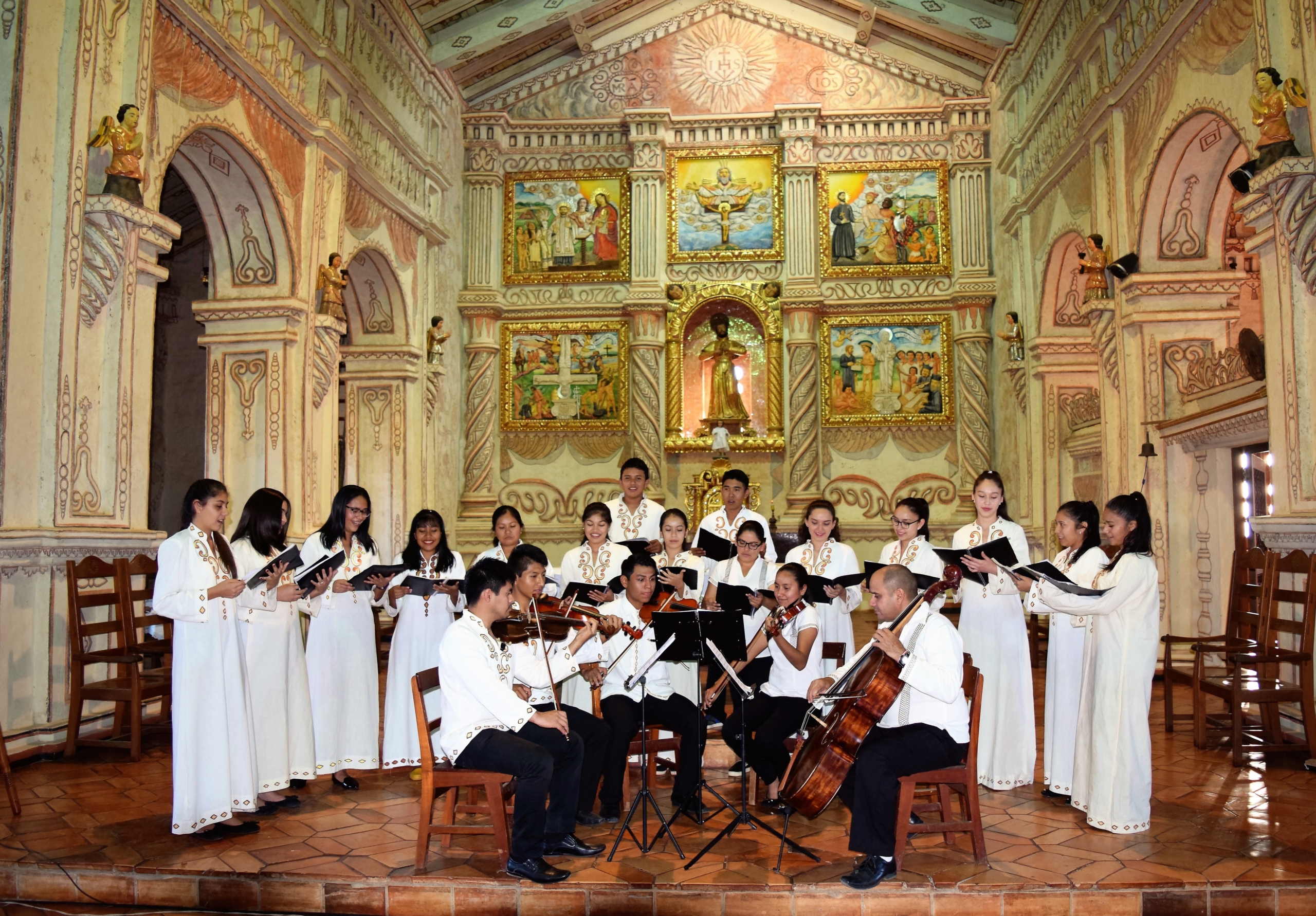
If we consider festive cultures in the region of Chiquitos today the “bitter, uncontrollable residue” (Glissant 2020, 7) of cultural colonization “dragged behind” becomes more complex and contradictory. We find, on the one hand, a festival for Baroque music, taking place in the renovated mission churches biannually. It is a festival staged for a predominantly whiteaudience from the Americas and Europe. It features musicians from the Global North playing music from the Chiquitos’ repertoire and local choirs and orchestras, formed by young people for whom musical education might open a door to higher education, an option that is not available otherwise. For these performances, people from the villages, the former reductions, dress up in the way, the Jesuit padres of the eighteenth century would have wanted them to look like: they wear long, plain, simply ornamented dresses. Their performance enables the white audience to meet its own history (Baroque musique, pious Christians) in the rainforest—everything of colonial history but the burden, still, again.
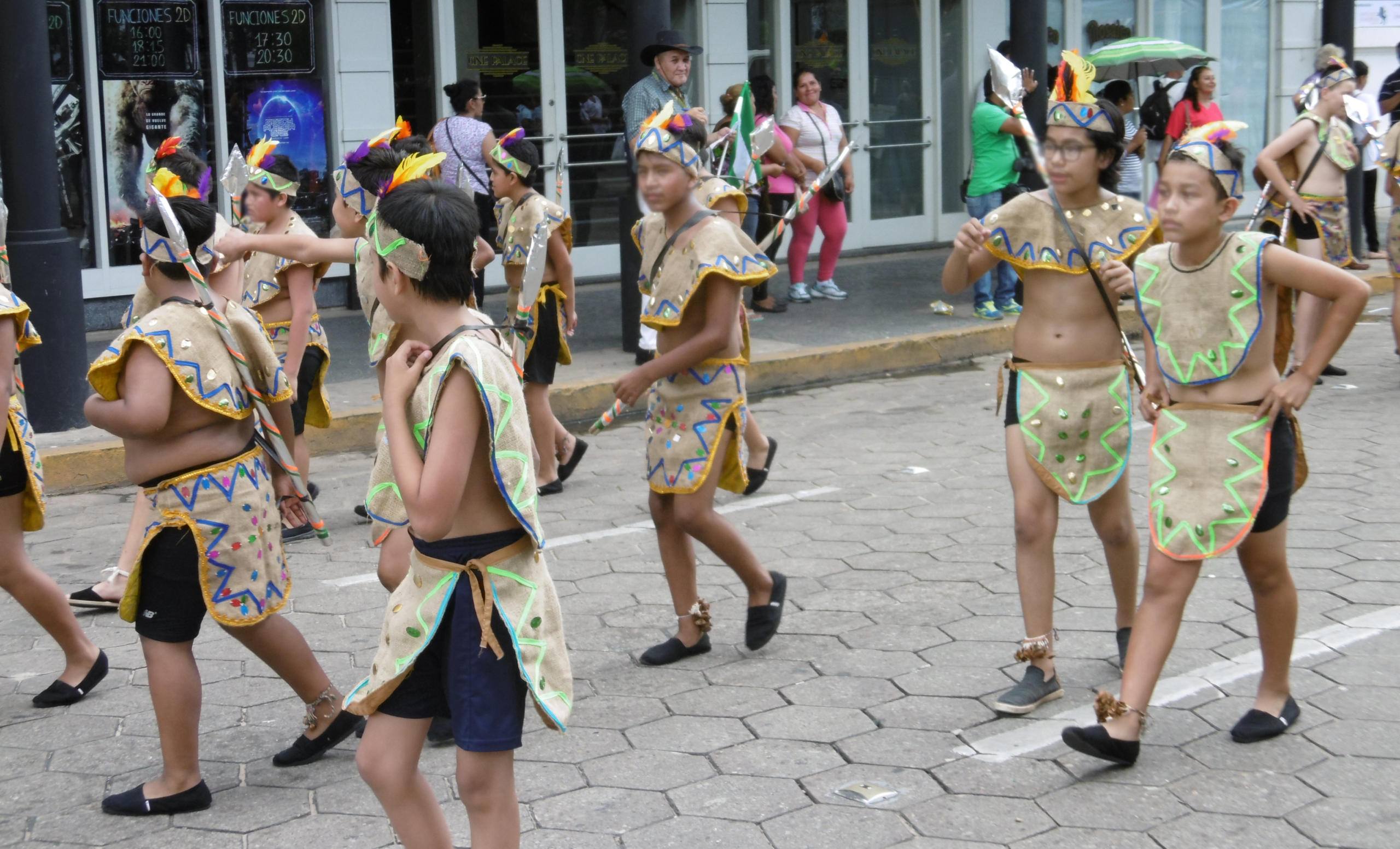
Figure 4. Children representing colonial history, April 23, 2018 Santa Cruz, Bolivia. Photo: Karin Harrasser.
But then, there are other performances, performances that are not fashioned for a white public. In 2018 I witnessed a parade of schools from around Santa Cruz (the capital of the province). Pupils from different schools had rehearsed historical scenes to be performed in the street, around the plaza mayor. They showed mostly group choreographies, performed in costume. And they all came: children dressed as Jesuit priests or conquistadors, as violin-playing church musicians, indigenous students wearing costumes that resemble “Indian-costumes” children would wear in Austria or Germany in carnival. Not only the bitter residues of colonial power are being performed here, but also the remnants of acts of counterappropriation, of wild imitation and of resistance—the “uncontrollable” part of that what is dragged along in the popular imaginary. Violence and hope reside side-by-side in the long history of colonization.
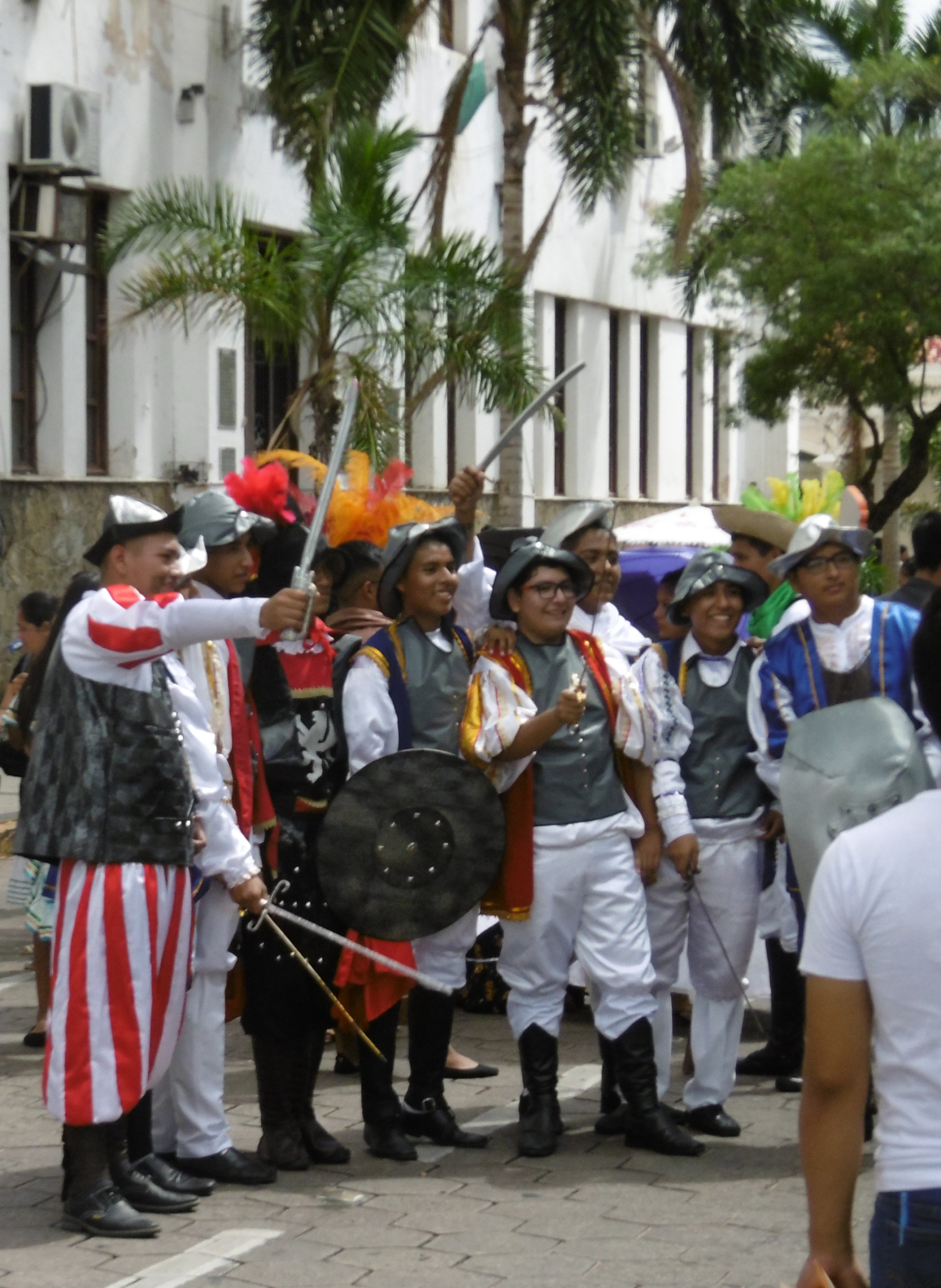
Figure 5. Children representing colonial history, April 23, 2018 Santa Cruz, Bolivia. Photo: Karin Harrasser.
Endnotes
-
I use the term Abya Yala as is suggested by decolonial authors such as Silvia Rivera Cusicanqui. The term aims to correct the misnomer America for the double continent and is used by the Kuna of Panamá (see Cusicanqui 2020).↩︎
-
The arrival of Frederick as America is framed rhythmically, with evoked drumming sounds (pom, pomp, pomperle). The designations “Frederick” and “America” are used synonymously.↩︎
-
See Michel de Certeau’s seminal analysis of Jan van der Straet’s allegory of America, which depicts Amerigo Vespucci dressed in full ornat, carrying a flag and navigating instruments an America naked in a hammock (Certeau 1992, xxv—xxvi).↩︎
-
The event has remained present in museum objects until today: the “Aztec” feather shields that were carried in the parade at the time (as documented in the acts) are still on display at the Landesmuseum Württemberg. https://de.m.wikipedia.org/wiki/Datei:Landesmuseum_W%C3%BCrttemberg_-_Kunstkammer1171.jpg, accessed October 27, 2023.↩︎
-
“Los medios mas convenientes, para que los Indios sean instruidos en la Santa Fé Catolica, y Ley Evangelica, y olvidando los errores de sus antiguos ritos, y ceremonias vivan en concierto, y policia, … resolvieron, que los Indios fuessen reducidos á Pueblos, y no viviessen divididos, y sepearados por las Sierras, y Montes” (trans. KH).↩︎
-
For the nexus between theatrical/musical practices and urban design see Baker and Knighton 2011, especially Baker’s introductory essay.↩︎
References
Bach, Moritz. 1843. Die Jesuiten und ihre Mission Chiquitos in Südamerika: Eine historisch-ethnographische Schilderung. Edited and with a preface by Georg Ludwig Kriegk. Leipzig: Mittler.
Baker, Geoffrey and Tess Knighton, eds. 2011. Music and Urban Society in Colonial Latin America. Cambridge: Cambridge University Press.
Bujok, Elke. 2004. Neue Welten in europäischen Sammlungen: Africana und Americana in Kunstkammern bis 1670. Berlin: Reimer.
Certeau, Michel de. 1992. The Writing of History. Translated by Tom Conley. New York: Columbia University Press.
Cusicanqui, Silvia Rivera. 2020. Ch’ixinakax utxiwa: On Decolonising Practices and Discourses. Translated by Molly Geidel. Hoboken: Wiley.
Christadler, Maike. 2005. “Die Häute der ‘Anderen’: Indianerkostüme am Württembergischen Hof.” Frauen Kunst Wissenschaft 40: 18—26.
Fechner, Fabian. 2015. Entscheidungsprozesse vor Ort: Die Provinzkongregationen der Jesuiten in Paraguay (1608—1762). Regensburg: Schnell & Steiner.
Fernández, Juan Patricio. 1729. Erbauliche und Angenehme Geschichten derer Chiquitos, und anderer von den Patribus der Gesellschaft Jesu in Paraquaria Neu-Bekehrter Völcker. Vienna: Paul Straub.
Foucault, Michel. 2004. Security, Territory, Population: Lectures at the Collège De France 1977—1978. New York: Palgrave.
Friedrich, Markus. 2011. Der lange Arm Roms? Globale Verwaltung und Kommunikation im Jesuitenorden 1540—1772. Frankfurt am Main: Campus.
Furlong, Guillermo. 1962. Antonio Sepp S. J. y su ‘gobierno temporal’ (1732). Buenos Aires: Ediciones Theoría.
Glissant, Édouard. 1997. Poetics of Relation. Translated by Betsy Wing. Ann Arbor: University of Michigan Press.
Glissant, Édouard. 2020. Introduction to a Poetics of Diversity. Translated by Celia Britton. Liverpool: Liverpool University Press.
Griffiths, Nicholas. 2006. Sacred Dialogues: Christianity and Native Religions in the Colonial Americas, 1492—1700. London: Lulu Enterprises.
Harrasser, Karin and Gudrun Rath. 2016. “Arbeit und die Grenzen des Lebens: Zur Kolonialität und Modernität von Plantage und jesuitischer Reduktion.” Historische Antropologie 24, no. 2: 218—240.
Harrasser, Karin. 2021. “Sweet Trap, Dangerous Method: Musical Practice in the Jesuit Reductions of Chiquitos and Moxos in the Eighteenth Century.” In Connect and Divide: The Practice Turn in Media Studies, edited by Erhard Schüttpelz, Ulrike Bergermann, Monika Dommann, Jeremy Stolow, and Nadine Taha, 209—225. Berlin: Diaphanes.
Heister, Hanns-Werner and Deborah Singer. 2013. “Mimetische Zeremonien und andere gewaltarme Herschaftsmethoden [sic]: Zur Rolle der Musik in den Guaraní-Reduktionen der Jesuiten in Paraguay im 17. und 18. Jahrhundert.” International Review of the Aesthetics and Sociology of Music 44, no. 2: 213—238.
Recopilación de leyes de los reynos de Las Indias. 1681. Madrid: Julian de Paredes.
Ruiz de Montoya, Antonio. 1989 (originally published 1639). Conquista espiritual hecha por los religiosos de la Compañía de Jesús en las provincias del Paraguay, Paraná, Uruguay y Tapé. Reprint. Rosario: Equipo Difusor de Estudios de Historia Iberoamericana.
Schmid, Martin. 1988. Pater Martin Schmid SJ, 1694—1772: Seine Briefe und sein Wirken. Edited by Rainald Fischer. Zug: Kalt-Zehnder-Druck.
Sepp, Anton and Anton Böhm. 1696. Reißbeschreibung: Wie dieselbe aus Hispanien in Paraquariam kommen: Und kurtzer Bericht der denckwürdigsten Sachen selbiger Landschafft, Völckern und Arbeitung der sich alldort befindenten PP Missionariorum. Nuremberg: In Verlegung Joh. Hoffmanns.
Tate, Greg. 2003. Everything But the Burden: What White People Are Taking from Black Culture. New York: Broadway Books.
Toelle, Jutta. 2024. Mission durch Musik: Stimmen und Klänge in der europäischen Missionierung Hispanoamerikas. Münster: Waxmann.
Viveiros de Castro, Eduardo. 1992. From the Enemy’s Point of View: Humanity and Divinity in an Amazonian Society. Translated by Catherine V. Howard. Chicago: The University of Chicago Press.
Waisman, Leonardo J. 2011. “Urban Music in the Wilderness: Ideology and Power in the Jesuit Reducciones, 1609—1747.” Music and Urban Society in Colonial Latin America, edited by Geoffrey Baker and Tess Knighton, 208—229. Cambridge: Cambridge University Press.
Weber-Karge, Karge. 1989. “… einem irdischen Paradeiß zu vergleichen …”: Das Neue Lusthaus in Stuttgart; Untersuchungen zu einer Bauaufgabe der deutschen Renaissance. Sigmaringen: Thorbecke.