Black “Female Impersonators” in 1940s to 1960s New Orleans
Aurélie Godet 
How to cite
How to cite
Outline
Outline
Limits of Gay-Centered or Regionalist Approaches to Black Drag Performance in New Orleans
Excavating Black Queerness from the New Orleans Archival Record
Resurrecting the Lives of Black Female Impersonators: Archival Challenges
Three Profiles in Courage
Reading the Performance
Perception of Black Female Impersonators across the Color, Gender, and Sexual Lines
Conclusions
References

While Judith Butler’s and Marjorie Garber’s works have been invaluable for challenging the supposedly natural relationships between the sex binary, gender, and sexuality, their theoretical insights have sometimes been criticized for their apparent disconnection from specific sociohistorical contexts in which “gender trouble” (Butler 1990) and “category crises” (Garber 1993) may emerge.1 This chapter investigates one such context: that of mid-twentieth-century New Orleans, a city often described as a “mecca” for sexual dissidents or a “Southern Babylon,” due to its supposedly“lax moral code, its situation as a port and its association with customary port vices, its openness to nonconformists, its regional and national reputation as a sin city—a reputation both deplored and carefully nurtured—and its exoticism” (Mitchell 1995, 141).2 Using a combination of photographic, textual, and oral evidence, I investigate the ways in which Black “female impersonators,” i. e., artists who practiced the male-female reversal as part of a usually professional comic act (Newton 1972, 3),3 challenged the gender, sexual, and racial norms of Cold War America through performance, built community in spaces that may have appeared “queer-resistant,” and ultimately transcended contextual constraints to become celebrated figures on the local (and national) stage. In so doing, I attempt to resist the imposition of contemporary gender and sexual identities onto past cross-dressing practices by shifting attention away from a metaphoric use of drag or a recognizable gender-bending figure to multiple gender-bending practices in one specific locale.
Limits of Gay-Centered or Regionalist Approaches to Black Drag Performance in New Orleans
While clearly lacking nuance,4 the association between female impersonation and homosexuality is deep-rooted. English poet Edward Carpenter, credited with the earliest use of the term “cross-dressing” in the Oxford English Dictionary, stated in 1911: “Cross-dressing must be taken as a general indication of, and a cognate phenomenon to, homosexuality” (“Cross-dressing” n. d.). In 1971, an article in Lee Brewster’s Drag Queens magazine characterized the drag queen as a “homosexual transvestite” who is hyperfeminine, flamboyant, and militant (Brewster 1971, 11—12).
In New Orleans, drag certainly played a key role in the emergence of a gay community, as Howard Philips Smith recently summarized: “This inversion dominated the early gay balls in New Orleans, where almost every costume was either camp or ultrafeminine drag. These balls united gay men, who became swept up in the Carnival season, and became a source of fierce competition and pride” (Philips Smith 2017, 323). The label “gay,” however, does not do justice to the complexity of impersonations of femininity in New Orleans. One needs to beware especially of conflating gender expression and sexual orientation when discussing these ball or nightclub performances.
Similarly, one needs to beware of regional essentialization that, for instance, connects the appeal of drag in New Orleans with an ongoing fascination with the mythical Southern figures of “the lady” and “the belle” that came to embody the area’s conservative sexual identity after the Civil War.5 Indeed, while the recurrence of Southern belle imagery in queer culture is corroborated by archival evidence from the 1950s to the 1970s (see Figs. 1 and 2), this explanation overlooks the history of Black drag shows in New Orleans, for whom Southern white femininity was, if not exactly ignored,6 at least just one inspiration among many.
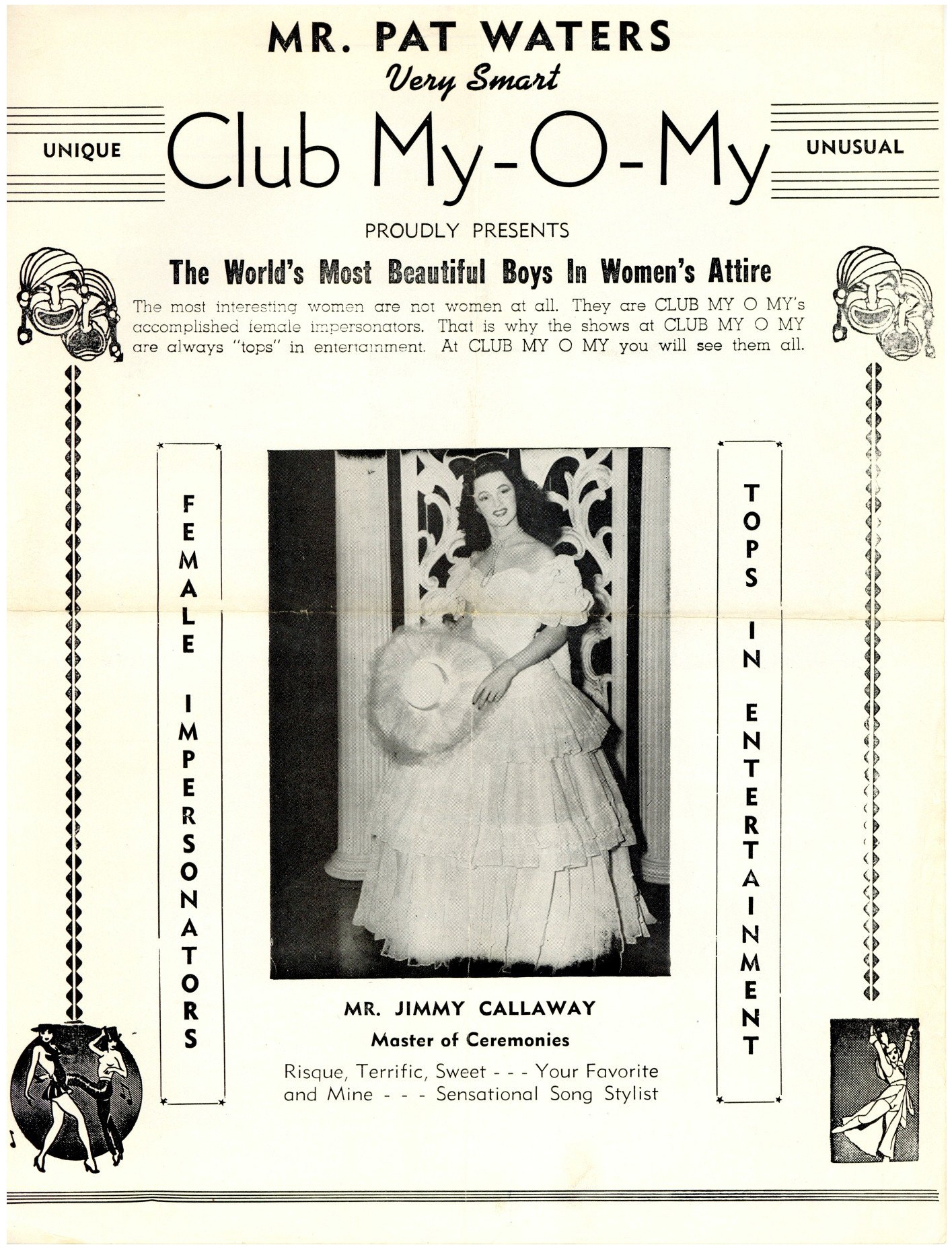
Figure 1. Jimmy Callaway, a white New Orleans female impersonator working at Club My-O-My, performing in “Southern belle” garb on April 12, 1951 (“Mr. Pat Waters” 1951).
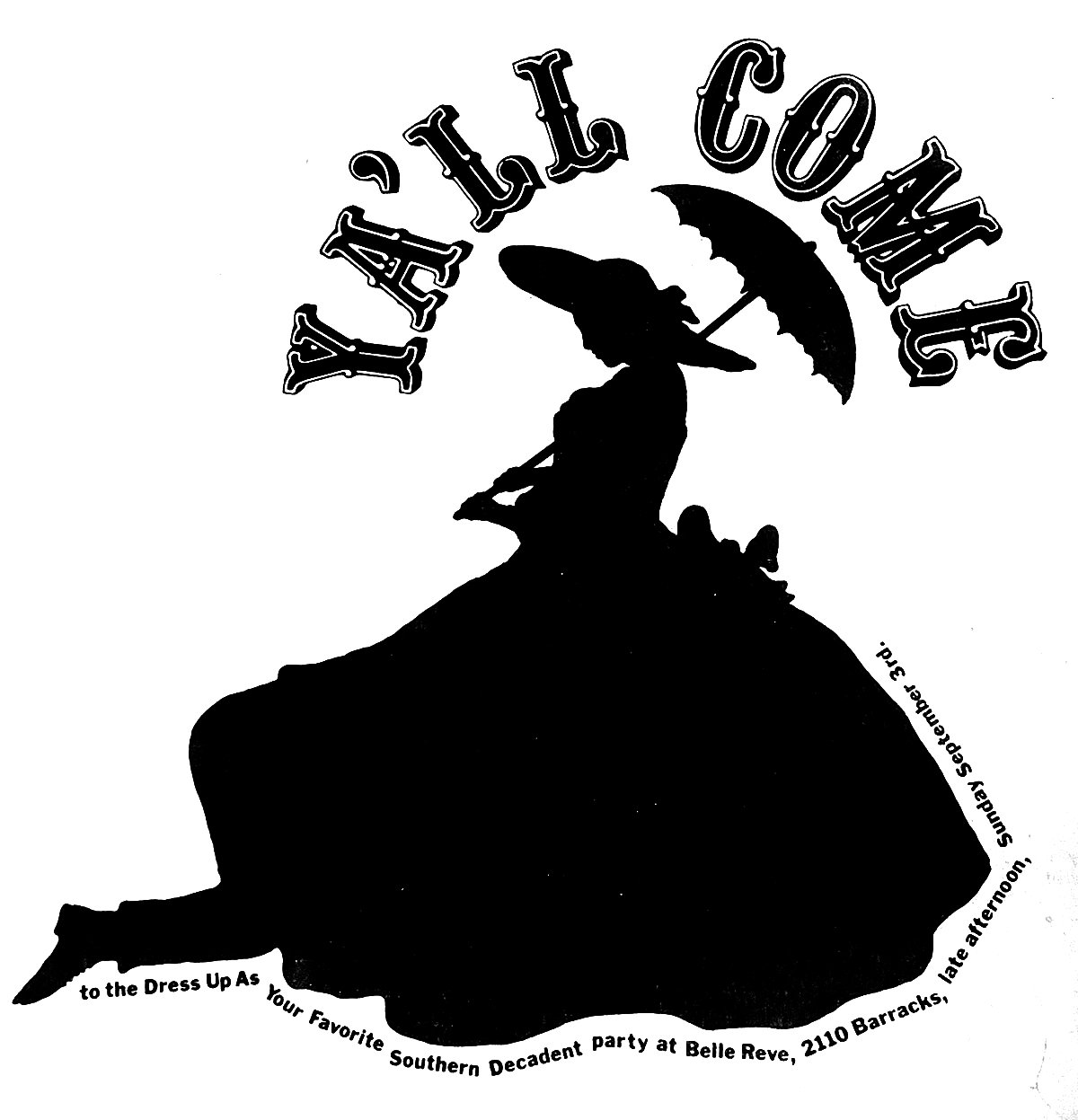
Figure 2. The biggest LGBT+ festival in New Orleans today, Southern Decadence, started as a simple costume party on Labor Day weekend 1972 for which the following invitation—designed by Robert Laurent and featuring a libertine Southern belle—was issued (“Southern Decadence Party Invitations” n. d.).
The converse notions that the South was essentially inhospitable to queer identities or that Black communities there have been largely and consistently homophobic must also be shed (for a refutation of this thesis see hooks 1989, 120—126; Constantine-Simms 2000, 211—225). In other words, before the question of what drag meant to mid-twentieth-century Black performers of New Orleans can be addressed, one must first mine the archival record for snippets of information about nineteenth- and early twentieth-century Black queer lives.
Excavating Black Queerness from the New Orleans Archival Record
Little is known about the queer Black men who inhabited antebellum New Orleans. While it is assumed locally that the keeping, by many white men, of free women of color as mistresses found a parallel, albeit smaller, in some white men’s keeping of free Black youths, there is (so far as I know) no material evidence for it. Abolitionist literature produced in the early nineteenth century, however, was quite prolix about the ways that “oppression under slavery c[ould] queer gender identities and marital and family relations, including driving enslaved people to acts of cross-dressing in order to escape white surveillance and the South itself” (Bibler 2013, 192).7 Some works, such asFrederick Douglass’s novella The Heroic Slave (1852), even mobilized explicitly homoerotic forms of sentimentality to attract white men to the abolitionist cause.
In the late nineteenth century, discourses of race, gender, and sexuality increasingly deployed models of codified identity categories that defined individuals as discrete and immutable types, giving rise to the split between “heterosexual” and “homosexual” at the same time as Southern authorities instituted stricter methods for segregating “white” from “black.” While certain literary works such as The Adventures of Huckleberry Finn (1885) and Pudd’nhead Wilson (1894) by Mark Twain challenged accepted boundaries by linking scenes of racial and gender disguise with male homoeroticism, the romanticized attachments between former slaves and their white masters in the works of Thomas Nelson Page and Joel Chandler Harris were clearly more about reinforcing social and racial divides (Gebhard 1997, 132—56).
In the early twentieth century, most interracial same-sex relations occurred in a context of prostitution. In their study of turn-of-the-century New Orleans, Katy Coyle and Nadiene Van Dyke have argued that many of the African American and Black Creole prostitutes who sold sex to the city’s white elite engaged in lesbian sexual practices both professionally, for their clients’ voyeuristic pleasure, and privately, for their own pleasure (Coyle and Van Dyke 1997, 54—72).
New Orleans’s famed vice district, Storyville (1897—1917), also included a male brothel run by a burly madam named Big Nellie, in which white customers often solicited Black young men. There, performers with names such as Lady Richard, Mammy George, and La Sylvester, who sang, danced, and dressed in imitation of women, constituted a significant part of the entertainment (Rose 1974, 15).As Black newspapers suggest, such acts soon gained a national audience. The Freeman, for instance, followed the career of adopted New Orleanian Augustus Stevens,8 who danced the cake walk in various Black traveling shows (Fig. 3). And, as shown by Eric Lott, nineteenth-century minstrel shows notoriously included homosexual imagery (Lott 2013, 27, 55—6, 90, 126, 168—171).
Religious authorities were powerless against it, as suggested by a lawsuit filed by a Black church (the Union Chapel Methodist Episcopal Church) against the City of New Orleans in the late nineteenth century (Long 2005, 128—139). Ultimately, it was the U. S. Navy that closed Storyville in 1917, claiming that its proximity from the naval training station was a “bad influence” on recruits.
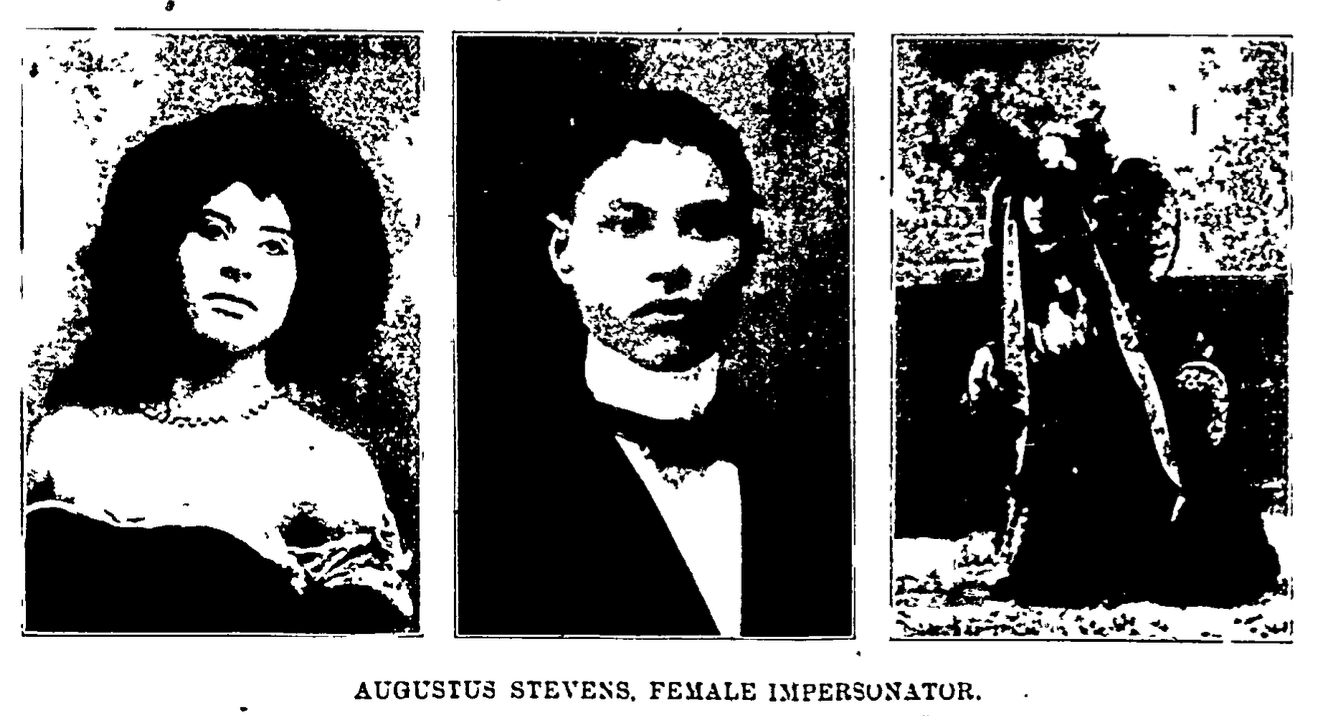
Figure 3. Photographs of Augustus Stevens in The Freeman (1901). Stevens started his career in a Chicago medicine show that established him “as one of the best female impersonators in the country,” before joining A. G. Allen’s New Orleans Minstrels and performing under the name Papinta.
Following the discontinuation of the Storyville experiment, many Black male prostitutes found new employment opportunities in music and night clubs. Many of these clubs were located on Rampart Street, a site immortalized in Ida Cox’s song Blues for Rampart Street (1923) and in the comedy song Saturday Night Fish Fry (1947), in which Cox claimed the street for Black New Orleanians: “Rampart Street in New Orleans town, / Known to everyone for miles around. / Colored music and real jazz bands, / That’s the best spot in all the land” (quoted in Simmons 2015, 70). Meanwhile, New Orleans was also the site of drag balls similar to those organized in New York and Chicago during the 1920s and 1930s.9 Though the connection between New Orleans Black impersonation of femininity with this national phenomenon was not always acknowledged in the print culture of the period, it is hard to ignore today.
During World War II, queer Black soldiers were able to maintain a vibrant subculture. A crucial testimony in this regard is that of George Eagerson, a. k. a. “Countess Vivian” (1912—2012). When he was interviewed by E. Patrick Johnson in 2005, just a week before Mardi Gras, the former nurse at Charity Hospital lived alone in a “shotgun” house (i. e., a house with a hallway at the center, down which you can see the back door) just one block from where St. Ann intersects Bourbon Street, marking the divide between its “straight” and “gay” ends. Before evoking his experience in the U. S. Army, Eagerson told Johnson about Black gay life in the 1920s and 1930s, emphasizing its almost complete separateness from New Orleans white gay life:
[G.E:] [A]t that time I did not know or realize that they had white sissies … ‘cause everything was segregated. And over here, the only time you would come over here [in the French Quarter] would be if you was working.
[E. P.J:] And so there were lots of black gay bars?
Oh yeah, I hope to tell you, there was a whole lot of them. … Just like they have gay bars, white queer bars today and black gay bars, there were black gay bars then. And, of course, the only difference was the black stayed in their place, the whites stayed in their place. (Johnson 2008, 483)
He mentioned the existence of Black drag queens, “more than a couple of them,” including one Julia Pimpay whom I have not been able to track down. He added that they “used to dress, put on dresses and dance and hustle at night” and that they lived in precarious conditions: “They wouldn’t have nothing in the room but the bed and the one chair” (ibid.). Later, when Johnson asked him if he met other gay men in the army, he answered that there were in fact “God knows how many of them” and that they would always recognize one another: “They had their hats, those little caps that we used to wear, fixed all kinds of ways on their head and everything else, child. And you could tell that they were, of course, like me” (ibid.). This correlates with the findings of Allan Berubé who, in Coming Out Under Fire, has revealed that “soldiers shows” put on by both Black and white soldiers during World War II (independently, since the armed forces were still segregated) were fertile ground for the exploration of new gender or sexual identities (Berubé 2020).10 Wartime media reviews of these numbers helped to counter potentially negative reaction by reframing the discussion on these drag performers as ordinary male soldiers doing their duty to entertain their peers and promote good morale among the troops. Thanks to this inadvertent patronage, the shows “opened up a social space in which gay men expanded their own secret culture” (Berubé 2020, 72). There were limits to this official tolerance, however. Proposals to detain homosexuals in camps were secretly discussed by Navy officials at least twice during the conflict. The second time was in July 1944, when the commandant of the 8th Naval District in New Orleans, A. C. Bennett, sent a confidential letter to Secretary of the Navy Frank Knox in which he depicted the discharge of gay servicemen as a threat to civilian society and recommended that “homosexuals and/or perverts … be segregated … for the duration of the war … for the good of the military service but also [as] an obligation which the Navy owes to society generally” (quoted in Berubé 2020, 215). Knox ultimately rejected the proposal, but the language in which the letter was couched clearly foreshadowed the antiqueer climate of Cold War New Orleans.
During the so-called Lavender scare of the 1950s, undercover cops entrapped gay patrons in Crescent City bars, queer bashing became a popular pastime of drunken fraternity members,11 and visible signs of effeminacy (dress, makeup, even gestures) could get men arrested. Paradoxically, however, the queer world also “enjoyed an openness and exuberance that seemed to defy the national postwar atmosphere of suppression” (Philips Smith 2017, xiv).
When queer Black soldiers returned to preintegration New Orleans, some of them were able to find work as musicians and waiters in the newly established white gay bars of the French Quarter, so long as they entered clubs via back doors and took their breaks in back rooms and off side streets (Eric Seiferth, quoted in Walker 2020). Yvonne “Miss Dixie” Fasnacht, the owner of Dixie’s Bar of Music (established in 1939 as a straight bar on St. Charles Avenue, before relocating to Bourbon Street where it became a hub of queer life, with a side door “For Male Bachelors Only”), famously employed gay Black bartenders, all wearing traditional waiter outfits (Philips Smith 2017, 307).
There were also music and night clubs that featured queer performers. Compared with Detroit (1937) or Baltimore (1938), no police commissioner’s edict or law banning female impersonators from appearing in night spots across the city to cut down on “sex crimes” was ever voted (Gallon 2018, 391), and female impersonators were therefore able to make a living in New Orleans beyond the 1940s, whereas they disappeared from clubs in most cities after World War II. Though legally segregated, the Dew Drop Inn, the Caledonia Inn, Club Desire, and Club Tiajuana12 featured such extraordinary talent that white music enthusiasts occasionally infiltrated them, at risk of arrest, which is why the New Orleans Police Department occasionally conducted raids to uphold segregation laws.13 And though they mostly catered to a heterosexual audience, they became sites of queer desire and gender-nonconforming expression in Black life, thus functioning as “interzones,” the concept that Kevin Mumford has used to refer to sex districts in turn-of-the-century Chicago and New York City (Mumford 1997).
Resurrecting the Lives of Black Female Impersonators: Archival Challenges/h4>
According to E. Patrick Johnson, “Neglect on the part of historians of the South, black sexual dissidents’ complicity of silence around issues of sexuality, and Southerners’ habitual taciturnity on things of a ‘private nature,’ all have colluded to keep the stories of Southern black gay men’s lives ‘hidden in plain sight’” (Johnson 2008, 5). Without necessarily agreeing with Johnson’s essentializing perspective on the South (or on sexual orientation), I have found the process of gathering information on the Black female impersonators who worked at the Dew Drop, Caledonia, Club Desire, and Club Tiajuana quite painstaking indeed.
Magazines featuring female impersonators, including Letters from Female Impersonators, published by Nutrix Co. from 1961 to 1963, were of no big help, for instance, as their New Orleans contributors or interviewees were exclusively white (Letters from Female Impersonators 1962). The discovery of Thomasine Marion Bartlett’s dissertation, titled “Vintage Drag, Female Impersonators Performing Resistance in Cold War New Orleans,” initially lifted my spirits (Bartlett 2004). However, while it includes short sections on the Dew Drop Inn and the Caledonia Inn, it mostly sheds light on the history of three white clubs: the Powder Puff, the Wonder Club (on the levee of Lake Pontchartrain), and its successor Club My-O-My.14 The rich collection of oral testimonies gathered by the author in the early 2000s does not include any Black performer, as they regretfully acknowledge (Bartlett 2004, 39).
Fortunately, the Black press of the mid-twentieth century (at least, until the mid-50s15) covered female impersonators more so than white newspapers, thus providing a wealth of information about Black New Orleans performers—though necessarily incomplete as it did not encompass the private space of the home as a site of Black queer sexuality.16 The typical article on 1950s female impersonator shows in publications like Ebony, Jet, the Pittsburgh Courier, the Baltimore Afro-American, and The Louisiana Weekly passed no negative judgments, and often included detailed descriptions of the performers’ outfits. Intentionally or not, this attentive coverage called into question the respectable heterosexual identity constantly extolled in the Black press as a long-standing institution of racial uplift.
Over the course of my research, I also benefited from the wonderful Ralston Crawford Collection of Jazz Photography acquired by Tulane University in 1961, as well as from the interviews conducted by Jason Berry, Jonathan Foose, and Jeff Hannusch in the early 1980s (Berry, Foose, and Jones 1986, 54—64, 88—91; Hannusch 2001, 135—38) and by anthropologist Nick Spitzer in 2016 (Spitzer 2016). Together, these resources convinced me that important questions about how Black female impersonators understood their relationships to local Black communities, how they experienced and resisted racial oppression, and how they dealt with pressures to adhere to gender and sexual norms were perhaps not as unanswerable as I initially thought. Before dealing with these questions in more detail, however, I propose to flesh out three of these performers’ biographies so as to identify possible commonalities.17
Three Profiles in Courage
Irving Hale, a. k. a. Patsy Vidalia (1921—1982)
Irving Hale was born in Vacherie, Louisiana, midway between New Orleans and Baton Rouge—a sugarcane-centered agricultural community from where Antoine “Fats” Domino’s family also hailed. After his father died, he moved to New Orleans with his mother and became fascinated by the local female impersonator scene. In 1947 he started working at the Dew Drop Inn at the request of Frank Pania who had seen him perform at Club Desire. There, he became the club’s resident emcee—a gig that included a room at the club—and hosted an annual Halloween Ball as Patsy Vidalia (after the mild-flavored Vidalia onion that was also slang for sex workers), Valdez, or Valdelar (the name he chose when he recorded for the Mercury label in 1953). He also worked as part-time bartender and singer in a drag troupe called the Valdalia Sisters.
Interviewed in 1981 by Jason Berry, the self-proclaimed “Toast of New Orleans” remembered introducing the Dew Drop Inn variety shows with a sonorous “Ladies and Gentlemen, it’s showtime at the Dew Drop!” (quoted in Berry, Foose and Jones 1986, 62). Patsy’s theme song was a raunchy shake dance titled “Hip Shakin’ Mama” (first recorded by Chubby Newsom). Comic acts, shake dancers, and novelty skits wove in and out of numbers played by the home band: “Everybody came and did a number, singing and dancing” (ibid.). The schedule of entertainment would continue until hours that ranged from 2:00 to 4:00 in the morning. According to musician Charles Neville (1938—2018):
Patsy served the same function as a majordomo would serve at a supper club. He was that, plus he was a big part of the entertainment. He also worked as a waitress. I’ve seen him behind the bar. I’ve seen him really dressed up at the door bringing people to the tables, and he could do that with dignity, man; then at showtime he would become the MC. There was no caste difference. (quoted in Berry, Foose, and Jones 1986, 58)18
More recently, local musician Deacon John Moore (b. 1941) referred to the Halloween Ball hosted by Patsy as the place to be:
That was like the big event of the year you know—the most talked about show of the year: Patsy’s annual gay ball. People from all walks of life. And everybody would be piling in there, because every year Patsy would try to outdo herself from the previous year and everybody couldn’t wait to see what she19 was gonna wear … (quoted in Spitzer 2016).
In 1953, Patsy Vidalia was featured in a rhythm-and-blues package show that toured the North and Deep South, including cities like Mobile, Alabama, for example, where she had a reportedly “smashing” two-week engagement. Indeed, the Dew Drop Inn doubled as a booking agency, sending bands to perform at other venues across the region. Her performances were a strong influence on Little Richard, for whom the Dew Drop Inn became a second home in his eight years as a touring musician.
Irving Hale stopped performing regularly at the Dew Drop in the mid-1960s but became the first Black female impersonator to break the color line in the 1970s, when he took over as host at Club My-O-My (Bishop 2025). His last public appearance was in 1980 when he participated in Jazz Fest’s late-night “Dew Drop Revisited” concerts alongside other club alumni like Walter “Wolfman” Washington (1943—2022) and Charles Neville (1938—2018). He died at home in New Orleans in 1982.
Richard Penniman, a. k. a. Princess Lavonne, a. k. a. Little Richard (1932—2020)
Kicked out of his home in Macon, Georgia, at the age of fourteen, Richard Penniman flourished onstage as “Princess Lavonne,” a minstrel-show drag queen, and by eighteen he was a fixture of the variety shows and revues that toured the South, learning the tricks of his trade from female impersonators who danced and sang alongside him (Hamilton 1998). He was based at New Orleans’s Club Tiajuana for several months in 1952.
When he turned to rhythm and blues in 1953 under the assumed name Little Richard, he got rid of the drag queen’s dresses but, as noted by Marybeth Hamilton, he retained the sequins, makeup, pompadour, strut, and volubility. “This is Little Richard, King of the Blues,” he reminded his audience in Black nightclubs, adding with a cunning smile, “and the Queen, too!” (quoted in Hamilton 1998, 162; Cortés 2023)
In 1955 his producer Robert Blackwell sent him to New Orleans to record new music at Cosimo Matassa’s J&M Studios. There, Richard relaxed at the Dew Drop Inn nightclub, and the experience famously inspired him to write a risqué blues song titled “Tutti Frutti.” A sanitized version of this hit became one of the first records to bring the underground queer Black culture of the South to the mainstream. In 1970, Little Richard released his tribute song “The Dew Drop Inn,” insisting that this was where “you meet all your fine friends.”
Little Richard’s case illustrates the documented connections between jazz/blues and queerness (Lhamon 2002, 86—97 and Carby 1994). We know of at least a dozen New Orleans jazz/rhythm & blues musicians who were gay or trans (openly or not), including Tony Jackson (1882—1921), who played piano in several brothels and wrote Pretty Baby, singer Larry Darnell (1928—1983), and James Booker (1939—1983), a frequent Dew Drop Inn act whom Doctor John supposedly called “the best black, queer, one-eyed junkie piano genius New Orleans has ever produced.”20Others, like Louis Armstrong, had close ties with female impersonators without being gay (Pittsburgh Courier 1945a; Pittsburgh Courier 1948).
Oscar James Gibson, a. k. a. Roberta (1930—1999)
Born in Ohio, Oscar James Gibson arrived in New Orleans in 1953 with a female impersonator revue. He was soon hired as a singer and an emcee at Club Tiajuana and the Dew Drop Inn. On weekends (Friday, Saturday, and Sunday), he performed as Bobby Marchan at the Dew Drop Inn, and on weekdays he performed as Roberta (sometimes spelled Loberta, as in the 1953 song “Tipitina” by pianist Professor Longhair) in the Powder Box Revue at the Dew Drop, and later at Tiajuana, while wearing cocktail dresses sewed by hand.
As explained by John Wirt in a recent biographical sketch, Gibson’s musical career began in 1953 with a single for Aladdin Records in Los Angeles. In his second single, “Chickee Wah-Wah” (1957), he played the role of a wide-eyed young man who attracts an aggressive woman. He subsequently sang for several Huey Smith and the Clowns recordings, including the call-and-response romp “Don’t You Just Know It.”
In 1959, Gibson found inspiration for his first solo hit during a nightclub engagement with his female impersonator troupe in Omaha, Nebraska. He sent a copy of “There’s Something on Your Mind,” a tale of passionate love and murder, to Bobby Robinson, one of the earliest Black producers and record company owners in the United States. The song was an instant hit. “I got booked to do a solo tour for a thousand dollars a night,” Gibson told interviewer Ben Sandmel on the Allison Miner Music Heritage Stage during the 1998 New Orleans Jazz and Heritage Festival. In the 1980s and 1990s, Gibson hosted as Bobby Marchan for popular talent shows and performed regularly at Jazz Fest. During the final decade of his life, he transitioned to rap music impresario, contributing to the success of the Cash Money Records label. He died in 1999 at the age of sixty-nine (Wirt 2023).
What these three profiles suggest is that Black female impersonators could live as men or as women, that they could desire same-sex partners or not (Little Richard was openly bisexual for part of his career), that they were some of the most gifted artists of the period, in a city that counted many, and that they took cues from one another’s performances to improve their standing in the “showbiz circuit.” In other words, Black female impersonation was not just a “pleasurescape” but a significant part of Black performance labor from the 1940s to the 1960s. Finally, the careers of Irving Hale, Richard Penniman, and Oscar Gibson indicate that gender-nonconforming individuals were fully accepted in the musicians’ community. Does this mean that their acts were perhaps not as subversive as people today think they were?
Reading the Performance
The following selection of pictures taken by photographer Ralston Crawford at the Dew Drop Inn in 1952 and 1954 testifies to the diverse, complex portrayal of femininity on stage in a Black night club. Figure 4 (showcasing Patsy Vidalia and other dancers, with Bobby Marchan acting as the emcee) suggests that Black female impersonators of the 1940s to 1960s “conditioned their body and looks to emulate femininity … as opposed to make mockery of it,” in line with E. Patrick Johnson’s definition of female impersonation (Johnson 2008, 351). Figure 5, however, provides evidence for how rooted Black female impersonation as a profession was in vaudeville theater. They show Black comedian Lollypop Jones performing the asexual “mammy” minstrel show stereotype, thus playing to stereotypes about older Black women. Figure 6, finally, shows that female impersonators often shared the stage with female entertainers, including shake dancers, acrobats, fire eaters, and sword swallowers.
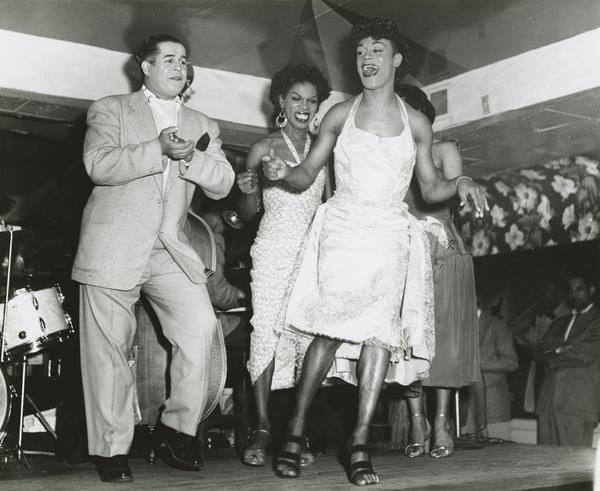
Figure 4. Dew Drop Inn entertainment featuring Patsy Vidalia in 1954 (Box 6 #109, Ralston Crawford Jazz Photography).
Was there a common denominator to these performances? Not necessarily. They offered Black performers a wider range of cultural characters and archetypes than had been the case on the nineteenth-century stage (probably wider than today, in fact). According to drummer Earl Palmer (1924—2008), “I don’t ever remember being on a show where there wasn’t some gays, you know on Vaudeville shows. Because entertainment was much more broader than it is now” (quoted in Spitzer 2016). While parodic performances of the mammy or Southern belle kind amounted to “playing for laughs,” performances in which Irving Hale, Richard Penniman, or Oscar Gibson “passed” as women were more subtle.
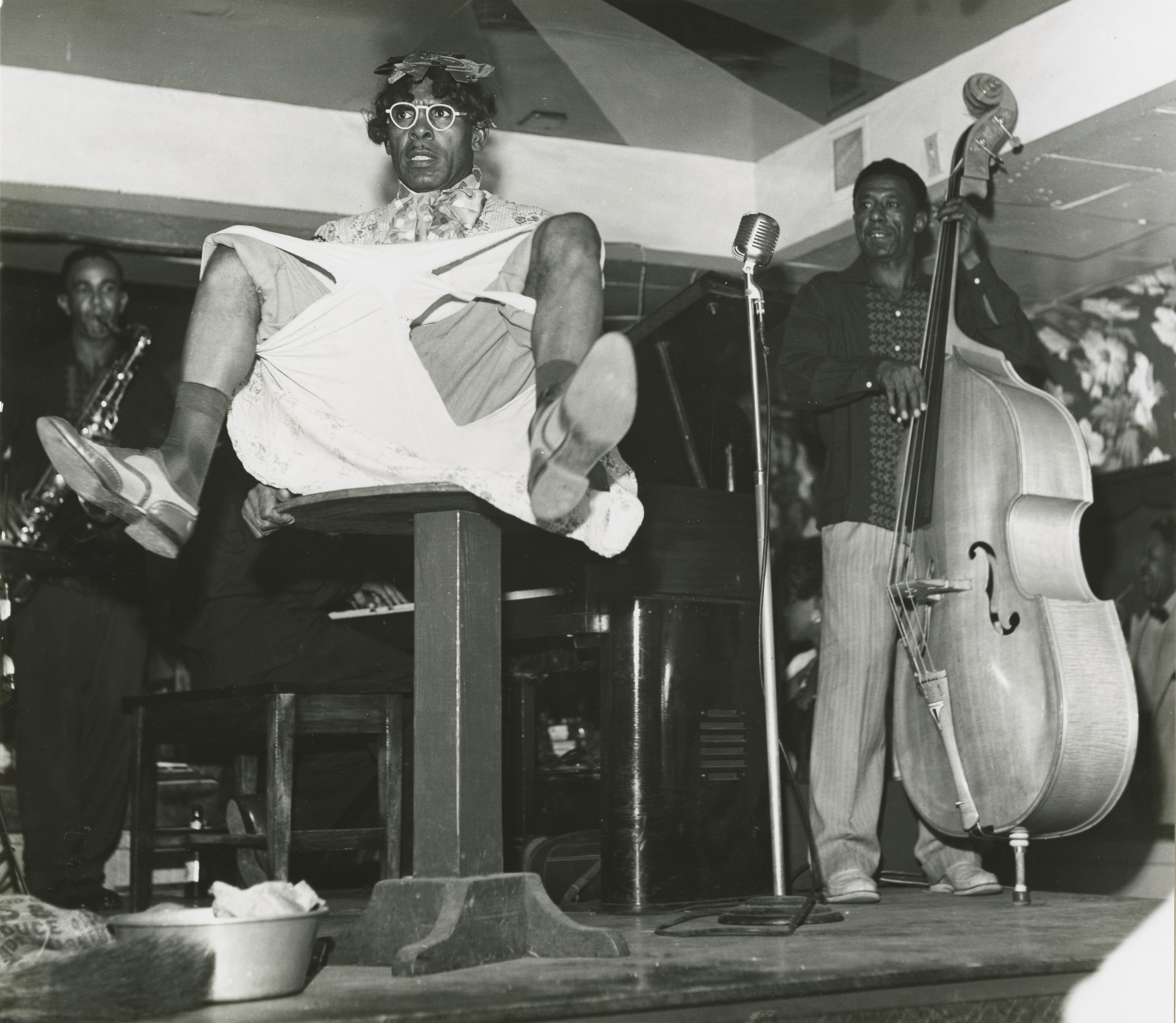
Figure 5. Comedian Lollypop Jones performing at the Dew Drop Inn in 1952 (Box 7 #118, Ralston Crawford Jazz Photography).
In a recent article, music scholar Tom Attah has argued that Little Richard consciously adopted the trappings of the “sissy” as a deliberate ploy to defuse and deflect accusations of sexual interest in the young white women attending his shows after 1955 (Attah 2023, 14). Speaking in 1997, Little Richard indeed confirmed that
it wasn’t just a gay thing. To be black and work for white girls, I had to look that way. If I didn’t wear make-up and look feminine, I couldn’t work the white clubs, they wouldn’t let me be with the white girls. The more effeminate I looked, they didn’t mind me being with the white women. They’d say, “Oh Richard, there ain’t nothin’ to him” (quoted in ibid.).
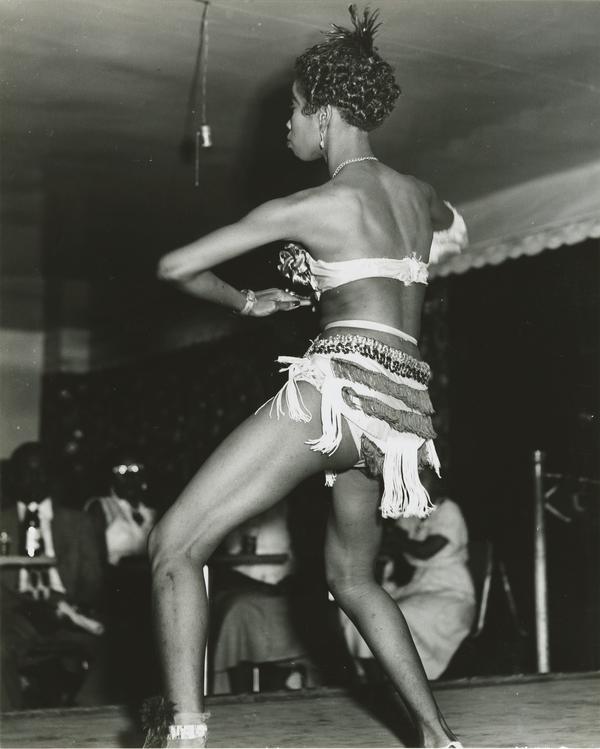
Figure 6. Shake dancer on the stage of Club Tiajuana in 1951 (Box 8 #141, Ralston Crawford Jazz Photography).
In the context of a Black club and a predominantly Black audience (Fig. 7), the choice of a female persona probably had a different meaning and must have elicited a different response.
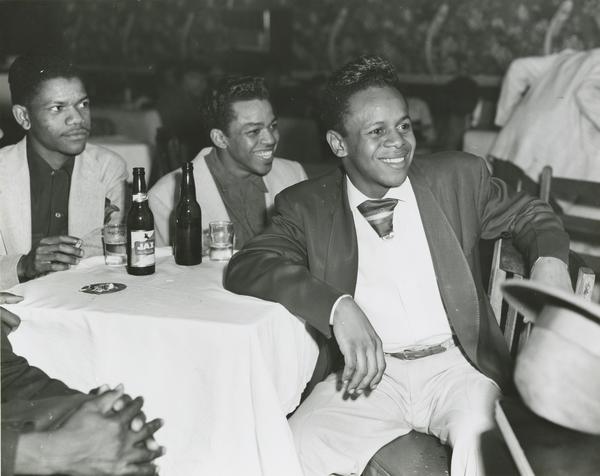
Figure 7. Patrons at Tiajuana Club, including James “Sugar Boy” Crawford (well-known author of “Jock-A-Mo”) on the right, 1953 (Box 8 #139, Ralston Crawford Jazz Photography).
To cisgender, straight Black men in the audience, watching a female impersonator on stage may have been a way to toy with heteronormativity without endangering it. In the performance of their own femininity, Patsy, Princess Lavonne, and Roberta embodied bawdy, up-front, actively flirtatious women, but Hale, Penniman, and Gibson deactivated the act’s threatening potential by claiming “mere” performance. Looked at in this light, the female impersonators were not threatening to hegemonic masculinity, and a man could respond to the “girl” on his lap without being assigned to the effeminacy or homosexuality that such behavior would have suggested if indulged in a different venue.
For all that they threatened traditional sexual patterns, “pansy acts” paradoxically “confirmed the masculinity of non-freakish black men” by casting queer men as curiosities (Hamilton 1998, 171). At the same time, if femininity could be performed, and was acknowledged as performance, it was logical to infer that masculinity was also performed. This logic inverted the insider joke, creating an uneasy insecurity about the foundations of assertive masculinity, while also establishing a “secret” alliance between the female impersonator and the Black heterosexual male audience. Both knew that unassailable masculinity was a cultural fiction.
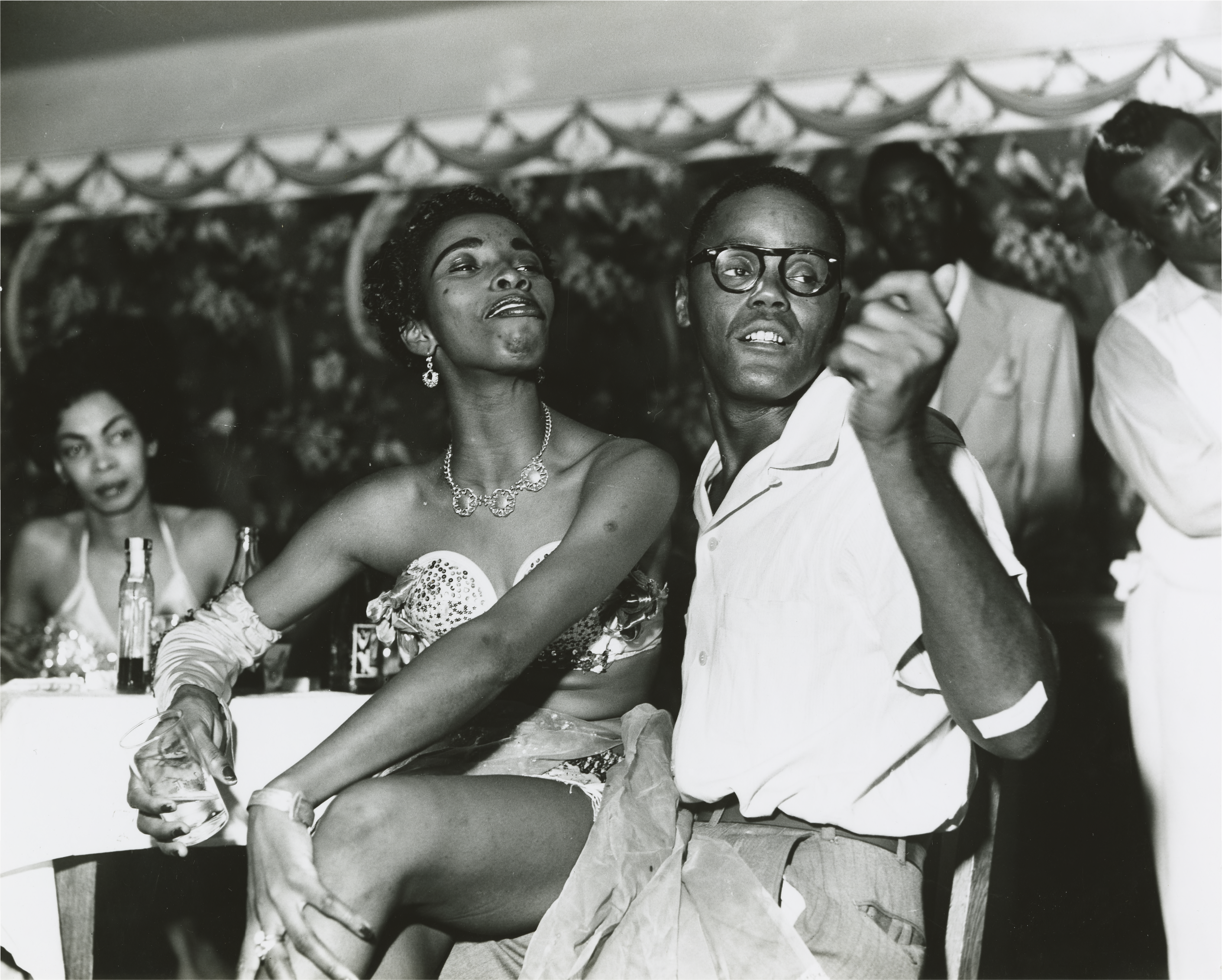
Figure 8. A dancer on the lap of a friend at Tiajuana Club, 1951 (Box 8 #144, Ralston Crawford Jazz Photography).
To Black female spectators (the least empowered in the masculinist, segregationist system of the “New South”), the female impersonators’ flamboyant performance of femininity may have had great appeal too. Their active sexuality and personal agency challenged the notion of women as passive and dependent. Patsy Vidalia was the voice of authority at the Dew Drop Inn—the enforcer of owner Frank Pania’s policies. She always used her masculine body in her act to remind audience members of her power. Musician Harold Battiste (1931—2015) recalled that she would “tease and flirt with the audience before reminding them ‘not to mess with her’ because of her actual manhood” (quoted in Bartlett 2004, 11). At the Caledonia Inn, Caledonia, the female impersonator was the owner. Although Caledonia lived as a woman, her bodily use of masculinity gave them the active credentials to engage in business and successfully run a bar. As models for a potentially different way of performing femininity, while remaining attractive to men, the freedom from gender restraints enacted by the female impersonators offered an alternative to traditional, respectable but dependent, femininity.
Gay men in the audience must have been moved by the sexual freedom of Patsy Vidalia, Little Richard, and Roberta. Indeed, though there appears to have been a general agreement on their part to “suspend disbelief” and to accept the notion of the performance as a purely theatrical event, outside the domain of ordinary life, drag acts also created an expectation of coherence between the performer’s social/performance front and their “true” inner self (Goffman, 1990, 56). As such, the performance pointed not just to a utopia but to an achievable goal.
In other words, while the New Orleans female impersonators were never on a soapbox lobbying for political overthrow, their performance effectively challenged the gender, sexual, and indeed racial binary. Not only was their flamboyant perfectionism neither male nor female; it also did a lot to attract white spectators to Black New Orleans clubs. In fact, they performed the impossible: gender-bending Black men, staging themselves as the lowest segment of the social order (Black women), receiving applause from both racially mixed audiences and respect for a job well done, in “a dress-rehearsal for a new social order” (Bartlett 2004, 155).
Perception of Black Female Impersonators across the Color, Gender, and Sexual Lines
As successful as they were on stage, female impersonators lived in precarious conditions once they stepped outside of the clubs in which they performed. Indeed, because cross-dressing in the streets was illegal in New Orleans, artists who did not leave their persona at the door risked arrest.21 During the 1950s, local harassment ordinances to “drive out the deviates” expanded, mandating the firing of “immoral workers” and the eviction of queer tenants. Being arrested for any of these offenses often led to unwanted public attention, as names, addresses, and charges were frequently published in well-read crime sections of major newspapers such as the Advocate or The Times-Picayune. This kind of exposure typically resulted in job loss and social exclusion from community networks (Fieseler 2023).
If white queer men could experience harassment, exposure, and violence, despite their economic privilege or social status, queer Black men were in fact isolated threefold: by the straight white community, the queer white community,22 and the straight community. On this last point, however, there is a modicum of disagreement between scholars. Laura Grantmyre and Daneel Buring, in their study of Pittsburgh and Memphis Black female impersonators from the early to mid-twentieth century, have highlighted a live-and-let-live ethos that allowed female impersonators to “perform in nightclubs, participate in parades, socialize in beauty parlors, sing in church choirs, and gather in neighborhood bars” (Grantmyre 2011, 987; Buring 1997). Laurence Senelick has similarly argued that, while white American drag artists before the 1970s closeted their sexuality when off-stage, Black performers “lived as unabashed ‘sissies’ and ‘fags’ off-stage” (Selenick 2000, 338). But Brett Beemyn, writing about “drag queens who performed before an overwhelmingly heterosexual audience” in Washington, DC’s Black entertainment district, has noted that “while they may have received a certain level of acceptance … it was only as long as they remained a form of exotic entertainment” (Breemyn 1997, 194).
Where does New Orleans fit in the acceptance-to-hostility continuum? According to musician and poet Eluard Burt (1937—2007), “All the musicians really loved Patsy and they respected what he was” and queernessin New Orleans “was just automatically acceptable in the black community. … And there was never—what later we get a gay-bashing thing, that never happened in the black communities. Because in the entertainment world you never know who is who, or who is what” (quoted in Spitzer 2016). Outside of the musicians’ community, however, things were more complex, as Figure 9 attests. Even when “they lived their life and they didn’t bother anybody” (Grantmyre 2011), Black female impersonators elicited a variety of responses in the Crescent City, from hostility to tolerance to full acceptance.
Many Black New Orleanians remember being warned against the “unhealthy” environment of the Dew Drop Inn and South Rampart Street by their parents or other figures of authority. “[The Gilbert Academy school principal] warned us in a voice drenched in acid: ‘Stay away from South Rampart Street, or you’ll end up there. A hint to the wise is sufficient,’” writer Tom Dent reminisced in the late 1970s (quoted in Rogers 1995, 6). Millie McClellan Charles lived only a few blocks from the Dew Drop Inn, but she was forbidden to go to there, as well as to the Tick Tock Tavern on South Rampart Street (Simmons 2015, 75). Clearly, “respectable” working-class parents did not want Black girls mingling with cross-dressers or scantily clad shake dancers. They feared Black nightlife on Rampart and its overt manifestations of sexual and bodily freedom. Worshippers at the soon-to-be-politically influential New Zion Baptist Church, which was located around the corner of the Dew Drop Inn, were similarly hostile to “gender rebels.”
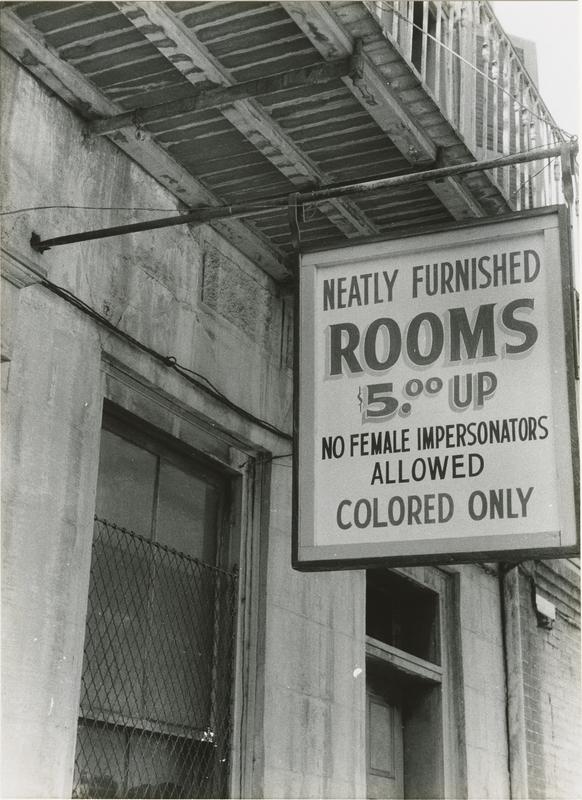
Figure 9. Sign on Burgundy Street advertising rooms for all “colored” people except female impersonators, 1950s (Box 9 #169, Ralston Crawford Jazz Photography).
On the other hand, the fact that Black female impersonators were often seen in the New Orleans cityscape on festive occasions—much like in Memphis, where Peaches, the city’s foremost African American female impersonator, marched through Black neighborhoods on Saturdays as a “majorette-in-drag” and participated in the Black community’s citywide Cotton Carnival Jubilee Parade (Buring 1997, 107—8)—points to a certain level of acceptance in New Orleans’s Black community.23
So do the many testimonies of straight women befriending female impersonators in the Crescent City. One of them, when interviewed by LaKisha Simmons in 2007, said that she “often went to clubs where she enjoyed music, danced, and delighted in the excitement of Black queer performers, whom she considered her friends” (quoted in Simmons 2015, 73).
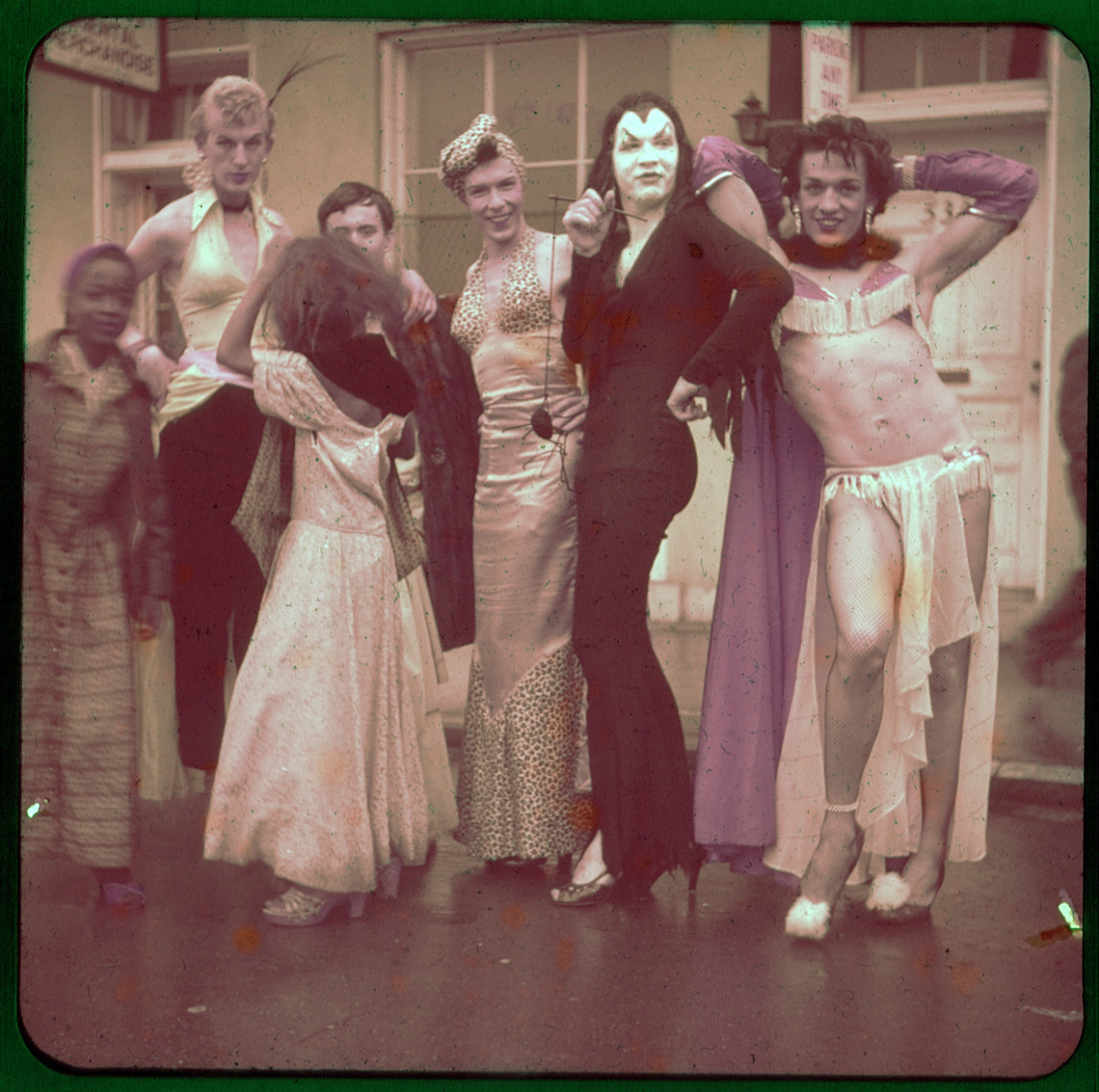
Figure 10. Four men in drag in the French Quarter, ca. 1951—1954 (Milton E. Melton, gift of Stephen Scalia, The Historic New Orleans Collection, 2012.0172.27).
Overall, therefore, it seems that New Orleans Black female impersonators of the 1940s to 1960s were what Patricia Hill Collins termed “outsiders within” (Collins 1986, S14—S32; see also Dunning 2009). By virtue of their racial identity, they occupied the same geospatial and social locations as other Black men, but they remained outside the full recognition accorded them in everyday life as a result of their challenge to gender and sexual norms. This is consistent with the findings of Kim Gallon, who in her study of the way Black queer performances in Washington, DC, were received by Black institutions such as Howard University, Black churches, and Prince Hall Masonic Temples, concluded that gender-nonconforming performances and homosexual expression were actually sustained by them, albeit with varying degrees of complexity and resistance (Gallon 2018). While queer individuals were not always embraced in Black families and communities, they were at least sufficiently protected to safely navigate the streets of their neighborhoods (hooks 1989).
Conclusion
Investigating the gender-bending practices of African American female impersonators in mid-twentieth-century New Orleans makes it possible to reflect on the long history of Black drag performance in the “Big Easy,” from Augustus Stevens to Patsy Vidalia to, I would add, contemporary bounce superstar Big Freedia.24 Long thought to be derivative of white carnival practices, or oppositional to it, Black gender bending had in fact been part of the city’s cultural landscape since at least the nineteenth century, and developed almost independently from white gender-nonconforming practices.
A second takeaway of this study is that, while George Lipsitz’s statement that “In New Orleans, [masquerade and imposture] are necessary tools for self-defense and survival in the one-sided war that white supremacy wages against African people in America” certainly rings true (Lipsitz 2011, 281), labeling cross-dressing as a “weapon of the weak” (Scott 1985) does not quite convey the complexity of the performance. For 1940s—1960s drag artists, the female persona was both an opportunity to challenge the expected racial, sexual, and gender norms of post-World War II America and a way to carve out a niche for the Southern (or national) blues circuit. Audience response was at least as equivocal: while spectators may have read the performance as a challenge to the heteronormative system, others may have seen it as “innocent fun” directed at “sissies” and women.
One more lesson from this historical analysis is that, outside of the music and night club environment, female impersonators did not meet an unqualified response either: embraced by the musical world, they were also treated as “freaks” by straight white fraternity members or as a threat to the Civil Rights movement’s ethics of racial, gender, and sexual respectability by local church members.25 As suggested by Laura Grantmyre in 2011, it seems that we cannot fully grasp the core of this history—with its ever-shifting yet consistently porous racial, sexual, and gender boundaries—if we rely solely on teleological or binary narratives of segregation versus integration, invisibility versus visibility, or margin versus mainstream. The reality, as I have hopefully shown, is more complicated.
One avenue for further research concerns the potential influence of Black female impersonators on local understandings of femininity. To what degree did local women borrow stylistically from female impersonators? And to what degree did female impersonators’ performances of femininity influence local heterosexual male desires? One story offers the beginnings of an answer here: the fact that soul singer Irma Thomas patterned her stage shows after Patsy Vidalia’s performances. “He gave me tips on how to wear make-up, what clothes to wear, how to move on stage and how to get off and on the bandstand,”she recalled in 1999 (quoted in Hannusch 2001, 136). Thomas learned the choreography and the song Hip Shakin’ Mama from Vidalia, sensuously provoking desire in her audiences with an act that was her impersonation of a female impersonator. There are probably other, similar instances of cross-fertilization in New Orleans history, and exploring them would help gauge the centrality of drag to the performance of gender in New Orleans over the longue durée.
Endnotes
- * Research for this article was completed in the fall of 2023 thanks to a Dianne Woest fellowship at the Historic New Orleans Collection. I am grateful to the director and to the reference associates of the Williams Research Center for their warm welcome and assistance.
- For criticism or supplementation of Butler’s and Garber’s ahistorical approach, see Ferris 1993; Stryker 2006; Sears 2015; Hartman 2019.↩︎
-
Similarly, George Chauncey described Harlem in the 1920s as a “homosexual mecca” (Chauncey 1994, 244).↩︎
-
In 1910s New Orleans, the term also referred to a popular Mardi Gras performance in which men masqueraded as women in the streets. See the captions to the John T. Mendes Photograph Collection (n. d.) at the Historic New Orleans Collection. Today, the term is no longer popular among drag performers. US television personality RuPaul, for instance, is known to have said, “I do not impersonate females! How many women do you know who wear seven-inch heels, four-foot wigs, and skintight dresses?” (quoted in Corso 2009)↩︎
-
Contemporary sociological studies have determined that most men who cross-dress are actually heterosexual (see Dynes 2016, 1312).↩︎
-
“Although drag is not an exclusively southern development, it does resonate within the region. It can be seen as a response to the excessively performative nature of southern femininity… . Drag modalities repurpose white southern femininity, modeling new ways of being southern that can sometimes break free from a tired old recycling of the myths of the lady and the belle” (McPherson 2003, 194).↩︎
-
Black female impersonators did occasionally model their skits on the “southern belle” trope, thus engaging in the sort of whiteface parodic performativity that “ethnic drag” has been shown to include (see Sieg 2002).↩︎
-
See especially Williams Wells Brown’s novel Clotel; or, the President’s Daughter (1853) and William Craft’s Running a Thousand Miles for Freedom (1860).↩︎
-
A later article about Augustus Stevens commented admiringly on his ability to counterfeit a woman’s appearance (see Fig. 3): “As a female impersonator in actions, talk, singing, dressing and performing, up the present date of them all, our dear friend, Augustus Stevens, is the leader. He is so perfect in his make-up that persons talk to him, men get stuck on him before they find out the real facts” (The Freeman 1903).↩︎
-
In Harlem, the Masquerade and Civic Ball—also known as “Faggots Ball” or “Fairies Ball”—was actually established as early as 1869 by the Hamilton Lodge of the Grand United Order of Odd Fellows, an African American association independent of other US fraternal orders that did not accept Black men. Musicians and literary figures like Langston Hughes and Bessie Smith were often in attendance in the 1920s to 1930s (see Garber 1989, 318—331; Wilson 2011, 33—34).↩︎
-
While some of them were essentially “pony ballet” numbers, in which groups of masculine-looking GIs dressed in tutus and performed ballet routines, and others were of the minstrel show kind, yet others featured skilled singers and dancers. The first all-Black soldier show, Jumping with Jodie, was produced by the soldiers of the 3966th Quartermaster Truck Company in Germany, and included a nightclub number set in Harlem featuring female impersonators (see Jura 2021).↩︎
-
In 1958 a Mexican tour guide named Fernando Rios was lured from a Bourbon Street gay bar and then ambushed and beaten to death. His three confessed attackers, undergraduates from nearby Tulane University, were found not guilty by a jury because Rios had allegedly made an “indecent advance” (see Delery-Edwards 2017).↩︎
-
Started as a barbershop run by entrepreneur Frank Pania at 2836 LaSalle Street, in Central City, a predominantly Black neighborhood, the Dew Drop Inn then blossomed into a restaurant and hotel featuring the “swankiest” night club in New Orleans from 1939 until 1972. After the club closed, it operated as an inn but then eventually stood empty after Hurricane Katrina. In 2010, it was designated a historic landmark, and the club reopened in March 2024 as a historic hotel and venue (see McNulty 2024; “Dew Drop Inn” n. d.). Located on St. Philip Street, just outside of the French Quarter in the Tremé area, the Caledonia Inn was owned and operated by the female impersonator from whom it took its name. According to New Orleans residents, this Caledonia was the inspiration for the all-Black musical comedy film short “Caledonia,” produced in 1945, which featured Louis Jordan. The lyrics to the blues classic “Caledonia” (“Caledonia, Caledonia, what makes your big head so hard?”) take on a whole new meaning when one realizes that the song was about a drag personality (see Bartlett 2004, 72; “Caldonia Inn” n. d.). The history of Club Desire, established at 2604 Desire Street, was recently told by historian Nick Weldon (2022; see also “Club Desire” n. d.). As for Club Tiajuana, it was a cheaper establishment located at 1209 Saratoga Street, near Earhart Boulevard (see “Club Tiajuana” n. d.).↩︎
-
Pania was one of these club owners who defied rigid Jim Crow racial boundaries by occasionally allowing white spectators into his club. A series of police raids pushed him to challenge the constitutionality of the segregation laws of the city in the mid-1960s, and he won, successfully securing an injunction against the police in 1967 (“Pania v. City of New Orleans” 1967).↩︎
-
The city’s first club featuring female impersonators, the Powder Puff, opened on Decatur Street in the French Quarter around the mid-1930s and closed in 1937 for ordinance violations. Opened by the same owners in 1938, the Wonder Club was situated in a lightly policed border-space in Jefferson Parish, just outside of New Orleans, and flourished until it was destroyed by a hurricane in 1947. The same year, Club My-O-My opened and competed with the Wonder Club for “the best impersonators.” After a fire destroyed its first location, it reopened in the space vacated by the now-defunct Wonder Club. It remained in operation on the lakeshore until it was destroyed by fire in 1972 (see Bartlett 2004, 63—72).↩︎
-
In 1954, the year the Supreme Court handed down its decision on school integration, Ebony (est. 1945) stopped publishing articles about homosexuality (replacing them with sections titled “Family,” “Marriage,” “Children,” “Military,” and “Work”) and the Black newspapers of Detroit, New York, and Chicago ended their coverage of drag shows. Martin Luther King was one of many civil rights figures who believed that attaining full citizenship for African Americans was dependent on the creation of a heteronormative Black culture (see Russell 2008, 114, 116, and 121). Jet (est. 1951), which was geared more toward a working-class readership and was less concerned with “respectability,” did continue to cover drag balls, however (see Conerly 2001, 386 and 389).↩︎
-
We know that queer Black men congregated in clandestine clubs such as Fourth World, which met in private homes. Sadly, no record of these festive events has survived (see Fieseler 2023). For an examination of the range of sexualities that existed behind closed doors in 1920s Harlem, see Robertson et al. 2012.↩︎
-
The reason why I settled on Patsy Vidalia, Little Richard, and Bobby Marchan as emblems of the Black female impersonator scene of the 1940s—1960s period had to do as much with source availability as with their significance to New Orleans performance culture. Other Black “female impersonators” such as Elton Paris (1922—2007) and Sir Lady Java (b. 1943) were ultimately left out because, though born in the city, they became famous elsewhere: in San Francisco for Elton Paris, in Los Angeles for Sir Lady Java. Another New Orleans native, Stormé DeLarverie (1920—2014), born from a wealthy white father and a Black mother, was omitted both because they were a male (not female) impersonator and because their career as a performer quickly took them to California (DeLarverie n. d.).↩︎
-
Note the emphasis on “dignity” (a remnant of the Civil Rights movement ethics of respectability) and on the absence of hierarchy among club workers.↩︎
-
Though most sources use the pronoun “he” when referring to Hale, according to musician Harold Battiste, who in 1995 was the director of jazz studies at the University of New Orleans, “She was always a woman—she lived as a woman. … She would make fun of herself and what she was” (quoted in Bartlett 2004, 68).↩︎
-
While used in a variety of publications, the quote has never been adequately referenced.↩︎
-
“It is unlawful to appear masked or disguised in the street or any public place” (Code of the City of New Orleans 1956, 580). This is the main ordinance that was used to persecute female impersonators, though queer individuals could also be arrested for “obstruction of free passage,” legalese for blocking a sidewalk. This ordinance is still on the books, but modified to allow for some exceptions such as “promiscuous masking” during the periods of Mardi Gras and Spring Fiesta and “participating in … exhibitions of minstrel troupes, circuses or other dramatic or amusement shows” (Code of the City of New Orleans 1995, Article VI, Division 1, Section 54—313 “Masks or disguises in public”). It is rarely enforced.↩︎
-
Until the 1970s, gay bars in and near the French Quarter sought to keep Black patrons out (or keep their numbers minimal). According to Howard Philips Smith, only three establishments—Gigi’s, the Safari House, and Café Lafitte in Exile—genuinely welcomed Black men (see Philips Smith 2017, 246).↩︎
-
Local lore has it that in 1948, the carnival parade organized by the Zulu Social Aid and Pleasure Club incorporated a Black female impersonator named “Corinne.” Details about “Corinne the Queen” can be found in Gumbo Ya-Ya, a collection of folk tales and gossip on Louisiana published in 1945 under the auspices of the Louisiana Writers’ Project (see Saxon 2008, 26).↩︎
-
On gender-bending practices in New Orleans bounce music, see Schoux Casey and Eberhardt 2018. On bounce as a queer “black safe space,” see Chastagner 2024.↩︎
-
“The politics of respectability offered no place for sissies,” as historian Jerry Watkins crudely puts it (Watkins 2017, 126).↩︎
References
Primary Sources
The Code of the City of New Orleans, Louisiana. 1956. New Orleans: Hauser Print Co.
Code of the City of New Orleans, Louisiana. 1995. https://library.municode.com/la/new_orleans/codes/.
DeLarverie, Stormé. N. d. “Stormé DeLarverie Papers.” Schomburg Center for Research in Black Culture, Manuscripts, Archives, and Rare Books Division, The New York Public Library.
The Freeman, An Illustrated Color Newspaper. 1901. “Augustus Stevens, Female Impersonator.” Digital Transgender Archive. www.digitaltransgenderarchive.net/files/kw52j838h. Accessed May 7, 2024.
The Freeman, An Illustrated Color Newspaper. 1903. “Stage.” Edited by “Woodbine.” Digital Transgender Archive. https://www.digitaltransgenderarchive.net/files/6682x430x. Accessed May 7, 2024.
“John T. Mendes Photograph Collection.” N. d. The Historic New Orleans Collection, Louisiana Digital Library. https://louisianadigitallibrary.org/islandora/object/hnoc-p15140coll1%3Acollection. Accessed May 7, 2024.
Letters from Female Impersonators. 1962. Volume Number Ten. Digital Transgender Archive. www.digitaltransgenderarchive.net/downloads/pn89d6592. Accessed May 7, 2024.
“Mr. Pat Waters Very Smart Club My-O-My Proudly Presents The World’s Most Beautiful Boys in Women’s Attire.” 1951. Flyer from April 12. Queer Music Heritage. www.queermusicheritage.com/fem-myomya.html. Accessed May 7, 2024.
“Pania v. City of New Orleans.” 1967. https://www.leagle.com/decision/1967913 262fsupp6511787. Accessed May 7, 2024.
Pittsburgh Courier. 1945a.“Louis Armstrong, Native New Orleans Boy, Gets Homecoming Welcome Sunday.” October 21.
Pittsburgh Courier. 1945b. “Display Ad 1—No Title.” October 21.
Pittsburgh Courier.1948. “Clicks in Mardi Gras Town: Armstrong Hot as Good Gumbo in N. O.” May 1.
Ralston Crawford Collection of Jazz Photography, William Ransom Hogan Jazz Archive, Howard-Tilton Memorial Library, Tulane University.
“Southern Decadence Party Invitations.” N. d. Flyers from several dates. LGBT+ Archives Project of Louisiana. https://lgbtarchiveslouisiana.org/southern-decadence-party-invitations/. Accessed May 7, 2024.
Secondary Sources
Attah, Tom. 2023. “The Boy Can’t Help It: Little Richard’s Disruption and Reconstruction of Black Male Screen Performativity.” In Pop Stars on Film: Popular Culture in a Global Market, edited by Kirsty Fairclough and Jason Wood, 11—29. New York: Bloomsbury.
Bartlett, Thomasine. 2004. “Vintage Drag: Female Impersonators Performing Resistance in Cold War New Orleans.” PhD dissertation, Tulane University.
Berry, Jason, Jonathan Foose, and Tad Jones. 1986. Up from the Cradle of Jazz: New Orleans Music since World War II. Athens: Georgia University Press.
Berubé, Allan. 2020. Coming Out Under Fire: The History of Queer Men and Women in World War II. Twentieth anniversary edition. Chapel Hill: University of North Carolina Press.
Bibler, Michael P. 2009. Cotton’s Queer Relations: Same-Sex Intimacy and the Literature of the Southern Plantation, 1936—1968. Charlottesville: University of Virginia Press.
Bibler, Michael P. 2013. “Queering the Region.” In The Cambridge Companion to the Literature of the American South, edited by Sharon Monteith, 188—203. Cambridge: Cambridge University Press.
Beemyn, Brett. 1997. “A Queer Capital: Race, Class, Gender, and the Changing Social Landscape of Washington’s Gay Communities, 1940—1955.” In Creating a Place for Ourselves: Lesbian, Queer, and Bisexual Community Histories, edited by Brett Beemyn, 183—210. New York: Routledge.
Bishop, Quinn. “My-O-My: The Forgotten History of How New Orleans’ Black Drag Queens Helped Shape Rock ‘N’ Roll.” Gambit 46, no. 25: 13—17.
Brewster, Lee G., Kay Gybbons, and Laura McAllister, eds. 1971. “Drag Queen vs. Transvestite.” Drag Queens: A Magazine About the Transvestite 1, no. 1: 11—12.
Buring, Daneel. 1997. Lesbian and Queer Memphis: Building Communities behind the Magnolia Curtain. New York: Garland Publishing.
Butler, Judith. 1990. Gender Trouble: Feminism and the Subversion of Identity. New York: Routledge.
“Caldonia Inn.” N. d. A Closer Walk NOLA. https://acloserwalknola.com/places/caldonia-inn/. Accessed September 7, 2024.
Carby, Hazel. 1994. “‘It Jus Be’s Dat Way Sometime’: The Sexual Politics of Women’s Blues.” In Unequal Sisters: A Multi-cultural Reader in American History, 2nd edition, edited by Vicki L. Ruiz and Ellen Carol DuBois, 238—249. New York: Routledge.
Chastagner, Claude. 2024. “The Queer Spaces of Black Dance Music.” Popular Culture Studies Journal 12, no. 1: 12—41.
Chauncey, George. 1994. Gay New York: Gender, Urban Culture, and the Making of the Gay Male World, 1890—1940. New York: Basic Books.
“Club Desire.” N. d. A Closer Walk NOLA. https://acloserwalknola.com/places/club-desire/. Accessed September 7, 2024.
“Club Tiajuana.” N. d. A Closer Walk NOLA. https://acloserwalknola.com/places/club-tiajuana/. Accessed September 7, 2024.
Conerly, Gregory. 2001. “Swishing and Swaggering: Homosexuality in Black Magazines during the 1950s.” In The Greatest Taboo: Homosexuality in Black Communities, edited by Delroy Constantine-Simms, 384—395. Los Angeles: Alyson Books.
Constantine-Simms, Delroy, ed. 2001. The Greatest Taboo: Homosexuality in Black Communities. Los Angeles: Alyson Books.
Corso, Susan. 2009. “Drag Queen Theology.” Huffington Post. April 15, 2009. https://www.huffpost.com/entry/drag-queen-theology_b_175120. Accessed September 7, 2024.
Cortés, Lisa, director. 2023. Little Richard: I Am Everything. New York: Magnolia Pictures.
Coyle, Kate and Nadiene Van Dyke. 1997. “Sex, Smashing, and Storyville in Turn-of-the-Century New Orleans. Reexamining the Continuum of Lesbian Sexuality.” In Carryin’ on in the Lesbian and Queer South, edited by John Howard, 54—72. New York: New York University Press.
“Cross-dressing.” N. d. Oxford English Dictionary. https://www.oed.com/dictionary/cross-dressing_n. Accessed September 7, 2024.
Delery-Edwards, Clayton. 2017. Out for Queer Blood: The Murder of Fernando Rios and the Failure of New Orleans Justice. Jefferson, NC: Exposit Books.
“Dew Drop Inn.” N. d. A Closer Walk NOLA. https://acloserwalknola.com/places/dew-drop-inn/. Accessed September 7, 2024.
Dunning, Stefanie. 2009. Queer in Black and White: Interraciality, Same Sex Desire, and Contemporary African American Culture. Bloomington: Indiana University Press.
Dynes, Wayne R. 2016 (originally published 1990). “Transvestism (Cross-dressing).” In Encyclopedia of Homosexuality, vol. 2, edited by Wayne R. Dynes, 1312—1313. New York: Routledge.
Ferris, Lesley, ed. 1993. Crossing the Stage: Controversies on Cross-Dressing. London: Routledge.
Fieseler, Robert W. 2021. “LGBTQ+ Rights Movement in Louisiana.” 64 Parishes. April 9, 2021, last updated March 24, 2023. https://64parishes.org/entry/lgbtq-rights-movement-in-louisiana. Accessed September 7, 2024.
Gallon, Kim. 2018. “‘No Tears for Alden’: Black Female Impersonators as ‘Outsiders Within’ in the ‘Baltimore Afro-American.’” Journal of the History of Sexuality 27, no. 3, 367—394.
Garber, Eric. 1989. “A Spectacle in Color: The Lesbian and Queer Subculture of Jazz Age Harlem.” In Hidden from History: Reclaiming the Gay and Lesbian Past, edited by Martin Duberman, Martha Vicinus, and George Chauncey, 318—331. New York: Meridian Books.
Garber, Marjorie. 1993. Vested Interests: Cross-Dressing and Cultural Anxiety. New York: Routledge.
Gebhard, Caroline. 1997. “Reconstructing Southern Manhood: Race, Sentimentality, and Camp in the Plantation Myth.” In Haunted Bodies: Gender and Southern Texts, edited by Anne Goodwyn Jones and Susan V. Donaldson, 132—156. Charlottesville: University Press of Virginia.
Godet, Aurélie. 2025. “Betwixt Fear and Despair: Joy in French Colonial Louisiana, 1682—1769.” Unpublished manuscript.
Godet, Aurélie. 2021. “Racial Passing at New Orleans Mardi Gras from Reconstruction to World War II: Flight of Fancy or Masked Resistance?” In Erasure and Recollection: The Memory of Racial Passing Within and Beyond the United States, edited by Aurélie Guillain and Hélène Charlery, 57—104. Brussels: Peter Lang.
Goffman, Erving. 1990 (originally published 1956). The Presentation of Self in Everyday Life. London: Penguin.
Grantmyre, Laura. 2011. “‘They Lived Their Life and They Didn’t Bother Anybody’: African American Female Impersonators and Pittsburgh’s Hill District, 1920—1960.” American Quarterly 63, no. 4: 983—1011.
Hamilton, Marybeth. 1998. “Sexual Politics and African-American Music; or, Placing Little Richard in History.” History Workshop Journal 46, no. 1: 161—176.
Hannusch, Jeff. 2001. The Soul of New Orleans: A Legacy of Rhythm and Blues. Ville Platte: Swallow.
Hartman, Saidiya. 2019. Wayward Lives, Beautiful Experiments: Intimate Histories of Social Upheaval. New York: W. W. Norton.
Hill Collins, Patricia. 1986. “Learning from the Outsider Within: The Sociological Significance of Black Feminist Thought.” Social Problems 33, no. 6: 14—32.
hooks, bell. 1989. “Homophobia in Black Communities.” In Talking Back: Thinking Feminist, Thinking Black, 120—126. Boston: South End Press.
Johnson, E. Patrick. 2008. Sweet Tea: Black Queer Men of the South. Chapel Hill: University of North Carolina Press.
Jura, Aaron. 2021. “GI as Dolls: Uncovering the Hidden Histories of Drag Entertainment During Wartime.” The National WWII Museum New Orleans. June 15, 2021. https://www.nationalww2museum.org/war/articles/drag-entertainment-world-war-ii. Accessed September 7, 2024.
Lhamon, Jr., W. T. 2002. Deliberate Speed: The Origins of a Cultural Style in the American 1950s. Cambridge: Harvard University Press.
Lipsitz, George. 2011. “New Orleans in the World and the World in New Orleans.” Black Music Research Journal 31, no. 2: 261—290.
Long, Alecia. 2005. The Great Southern Babylon: Sex, Race, and Respectability in New Orleans, 1865—1920. Baton Rouge: Louisiana State University Press.
Lott, Eric. 2013 (originally published 1993). Love and Theft: Blackface Minstrelsy and the American Working Class. New York: Oxford University Press.
McNulty, Ian. 2024. “Dew Drop Inn, a Nearly-Lost New Orleans Treasure, Is Back.” Nola.com.March 1, 2024. https://www.nola.com/entertainment_life/eat-drink/dew-drop-inn-reopens-as-historic-hotel-venue-in-new-orleans/article_2a08cec8-d732-11ee-b06d-0f58fb23cdseehtml. Accessed September 7, 2024.
McPherson, Tara. 2003. Reconstructing Dixie: Race, Gender and Nostalgia in the Imagined South. Durham, NC: Duke University Press.
Mitchell, Reid. 1995. All on a Mardi Gras Day: Episodes in the History of New Orleans Carnival. Cambridge, MA: Harvard University Press.
Mumford, Kevin. 1997. Interzones: Black/White Sex Districts in Chicago and New York in the Early Twentieth Century. New York: Columbia University Press.
Newton, Esther. 1972. Mother Camp: Female Impersonators in America.Chicago: Chicago University Press.
Philips Smith, Howard. 2017. Unveiling the Muse: The Lost History of Gay Carnival in New Orleans. Jackson, MS: University of Mississippi Press.
Robertson, Stephen, Shane White, Stephen Garton, and Graham White. 2012. “Disorderly Houses: Residences, Privacy, and the Surveillance of Sexuality in 1920s Harlem.” Journal of the History of Sexuality 21, no. 3: 443—466.
Rogers, Kim Lacy. 1995. Righteous Lives: Narratives of the New Orleans Civil Rights Movement. New York: New York University Press.
Rose, Al. 1974. Storyville, New Orleans: Being an Authentic, Illustrated Account of the Notorious Red-Light District. Tuscaloosa: University of Alabama Press.
Russell, Thaddeus. 2008. “The Color of Discipline: Civil Rights and Black Sexuality.” American Quarterly 60, no. 1: 101—128.
Saxon, Lyle. 2008 (originally published 1945). Gumbo Ya-Ya. Boston: Houghton Mifflin.
Schoux Casey, Christina and Maeve Eberhardt. 2018. “‘She Don’t Need No Help’: Deconsolidating Gender, Sex and Sexuality in New Orleans Bounce Music.” Gender and Language 12, no. 3: 318—345.
Scott, James C. 1985. Weapons of the Weak: Everyday Forms of Peasant Resistance. New Haven: Yale University Press.
Sears, Clare. 2015. Arresting Dress: Cross-Dressing, Law, and Fascination in Nineteenth-Century San Francisco. Durham, NC: Duke University Press.
Senelick, Laurence. 2000. The Changing Room: Sex, Drag and Theatre. London: Routledge.
Sieg, Katrin. 2002. Ethnic Drag: Performing Race, Nation, Sexuality in West Germany. Ann Arbor: University of Michigan Press.
Simmons, LaKisha. 2015. Crescent City Girls: The Lives of Young Black Women in Segregated New Orleans. Chapel Hill: University of North Carolina Press.
Spitzer, Nick. 2016. “The Dew Drop Inn.” American Routes Shortcuts, podcast. December 2, 2016.
Stryker, Susan. 2006. “(De)Subjugated Knowledges: An Introduction to Transgender Studies.” In The Transgender Studies Reader, edited by Susan Stryker and Stephen Whittle, 1—17. New York: Routledge.
Walker, Dave. 2020. “Take a Tour of Bourbon Street’s Music Scene of the 1950s.” The Historic New Orleans Collection.June 5, 2020. https://hnoc.org/publishing/first-draft/take-tour-bourbon-streets-music-scene-1950s. Accessed September 7, 2024.
Watkins, Jerry. 2017. “Keep on Carryin’ On: Recent Research on the LGBTQ History of the American South.” History Compass 15, no. 11: 124—128.
Weldon, Nick. 2022. “The Downtown Club with Uptown Ideas.” The Historic New Orleans Collection. September 2, 2022. https://hnoc.org/publishing/first-draft/the-downtown-club-with-uptown-ideas. Accessed May 7, 2024.
Wilson, James F. 2011. Bulldaggers, Pansies, and Chocolate Babies: Performance, Race, and Sexuality in the Harlem Renaissance. Ann Arbor: University of Michigan Press.
Wirt, John. 2023. “The Irrepressible Bobby Marchan.” 64 Parishes. February 28, 2023, last updated June 1, 2023. https://64parishes.org/the-irrepressible-bobby-marchan. Accessed September 7, 2024.