
How to cite
How to cite
Outline
Outline

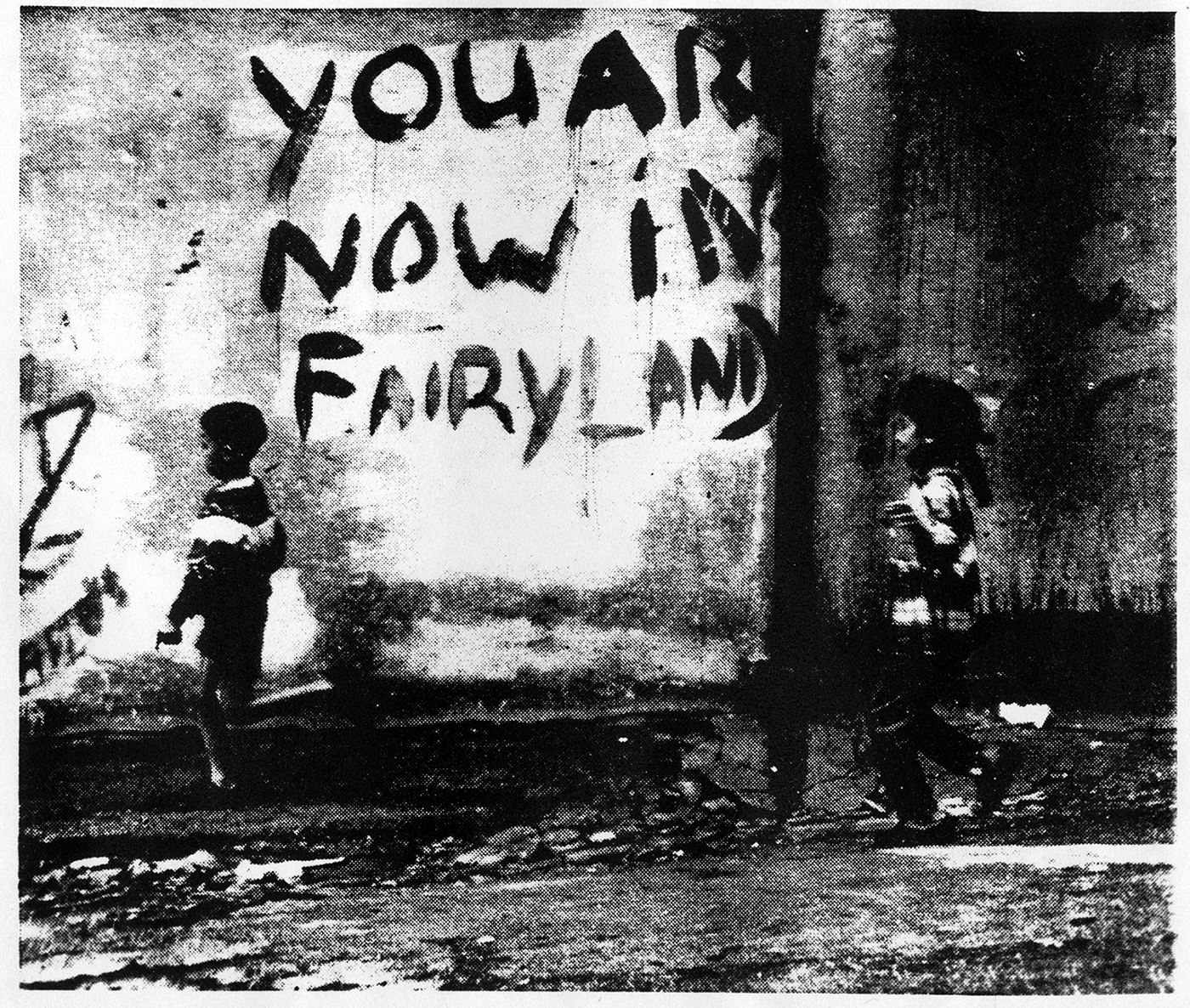
Figure 5: District Six before the forced removals, undated paper clip. National Library of South Africa, Cape Town (PHA 3709 Coons).
“YOU ARE NOW IN FAIRY LAND” was a famous piece of graffiti on one of the houses in District Six, later demolished, whose remains are made visible in Kewpie’s dragging rubble series—as if a kind of queer crossing had taken place. Today, many view the area as a memorial site for an almost fairytale-like neighborhood, where fairies—queers—once found refuge. Others, however, warn against the depoliticizing pitfalls of romanticized nostalgia for District Six, arguing that commemorating the displaced community can obscure a history of relative privilege and potential complicity within apartheid’s divide-and-rule policies.98
The majority of District Six’s population was classified as “without a tribe,” or “Coloured,”99 during the enforcement of the Group Areas Act between the 1960s and 1980s, as the apartheid regime occupied the inner city and “cleansed” it of traces of creolized life. Authorities arbitrarily sorted people across families and neighborhoods according to skin color and hair texture,100 often struggling to classify those living near the former port. Unlike the fixed categories of “Asian,” “Bantu,” and “White,” “Coloured”became an intermediate designation, marking ambiguous origins. Visible signs of creolization thus became the basis for imposed racial identities.101 This classification was also entangled with racist sexualization, as “Coloured” was linked to the effects of illegalized relationships and supposed miscegenation.102
Kewpie’s drag photos emerged in this political context, bearing witness to the potentially nonidentitarian, creolized cultural techniques of “indigenizing” that developed in District Six.103 Scholars such as Zimitri Erasmus and Mohamed Adhikari advocate for rehistoricizing “Coloured” to focus on social processes rather than rigid categories.104 Erasmus, in particular, emphasizes that creolization is shaped by transcultural practices produced through colonial disruption.105 This perspective highlights the transformation of social asymmetries, complex relations of inequality, and the political possibilities of mimesis. Transposing Glissant’s Antilles-based approach to the South African context, Erasmus points to forms of exclusion and resistance that are both flexible and heterogeneous. From the Cape, she foregrounds the “dirtiness” of historical and social connections and performative practices.
In Iberian colonialism, creole—“thick with interrelated and traveling meanings”106—was originally a paraphrase of mestizaje. Historically, it described those of European descent born in the colonies, but as colonial elites pursued “self-indigenization” and postcolonial independence, the term became associated with the subalterns deemed “racially impure” and lacking a culture of their own. Under the apartheid regime, the Population Registration Act No. 30 of 1950 defined Coloured as “not a white person or a native.”107 As a result, the inner-city population, including Kewpie, was forcibly relocated to townships, where they were further stratified by pigmentation and subjected to varying degrees of precarization.
The urban contact zones of the Cape expose the violent arbitrariness of racial classification with particular clarity.108 The Cape, at the tip of the African continent, is where the Indian and Atlantic Oceans meet. In the port area of that time, the contradictory and competing histories of European colonial expansion into Asia intertwined with the transatlantic slave trade and the mass production of “bare labor”—a prerequisite for the increasingly industrialized capitalist Vergesellschaftung within a new world system.109 These histories are marked by fundamental traumas shaped by overexploitation, forced migrations, corresponding forms of life, and necessarily arbitrary connections between all kinds of people subjected to the prevailing conditions. They inevitably gave rise to local performative cultural techniques, which—as seen in Kewpie’s photographs—can be read as forms of nongenealogical, globalized ways of relating.
As Katja Diefenbach discusses with regard to “the so-called triangular trade initiated by Portugal and Spain between Europe, West Africa, and the Americas,” the Dutch trading companies constructed “an enormous ensemble of unequal trade relations, capital ties and power differentials spanning the seas, bringing heterogeneous hemispheres, places and times into violent contact with each other through the slave trade, the plantation economy, mining and seafaring, triggering a process of creolization without precedent in history.”110 As she continues: this “immanent transformation of the powers to act from below is eminently political … : it transcends the ideational nexus of origin, culture and religion. From a Spinozist perspective, the conversion of the socio-military capabilities of regional slave dealers into forces of opposition to slavery manifests a universal power shared by all humans to break with their own traditions, origins, cultures and religions and build a more rational and freer society from below. It demonstrates humans’ capacity to attain an immanent transformation of their powers without transcendental mediation.”111
At the South African Cape, creolization processes emerged beyond what Paul Gilroy calls the Black Atlantic,112 extending particularly into the South Atlantic and Pacific regions. In the mid-seventeenth century, the Western Cape became a stopover for commercial ships of the Dutch East India Company (Vereenigde Oostindische Compagnie, VOC) on their way from Europe to Batavia (present-day Jakarta). As this outpost expanded into a colony, many people at the Cape—including political prisoners from Southeast Asia—were systematically enslaved or subjected to indenture.113 The Cape thus became a site where different performative practices intertwined, recalling the “dirtiness” of early globalization.
Initially, Cape Town served as a refreshment station for European trading ships traveling to and from Southeast Asia.114 Straddling the trade routes of the two oceans, it occupied a strategically contested position between East and West, fought over by competing European colonial powers. As Nadia Davids notes, this struggle resulted in “one of the most culturally heterogeneous regions on earth between the early 1700s and late 1800s.”115 The harbor area thus became a contact zone where people from vastly different backgrounds converged: the local Khoikhoi population, abductees and enslaved people, colonial officials and settlers, travelers, sailors, and refugees. Gilroy conceptualizes the Black Atlantic as a transcultural, international formation with a “rhizomorphic, fractal structure.”116 However, the Cape’s history is also deeply intertwined with both Europe’s prior colonial expansion into Asia and precolonial trade networks between Asia and Africa. Ultimately, the Cape is a reminder that the reach of the revolting “many-headed hydra,” which Peter Linebaugh and Marcus Rediker describe as the flipside of colonial expansion, extends beyond the Atlantic—resisting emerging racial classifications while roaming the world’s harbor taverns.117
By 1808, approximately 63,000 people had been forcibly deported to the Cape Colony. They left lasting traces through their languages and cultural practices, which were reshaped as they were forced to form new relationships under conditions of displacement. The majority came from Indonesia, Ceylon, and India, as well as from the southern Philippines, Persia, Macao, Madagascar, East Africa, and Mozambique. The VOC relied on preexisting forms of enslavement in its Southeast Asian colonies and adapted them at the Cape to suit its economic interests. To develop Cape Town as a port city and ensure local supplies, specific modes of exploitation were transferred and modernized—techniques that had long benefited the VOC in the Indian Ocean and helped drive the capitalization of the world.118 At the same time, colonial business enterprises recruited labor primarily in Holland and Germany. Alongside sailors and adventurers came people fleeing religious persecution or famine in Europe.119 Over time, diverse precarious groups formed a new class society shaped by European expansionist policies, often with fluid biographies revealing overlapping histories of colonial exploitation, complicity, and resistance.
The history of the Cape is of exemplary relevance to contemporary debates on critical race theory, as it lays bare the messiness of colonial conditions. By 1800, when the British Empire replaced the VOC’s rule and made Cape Town the capital of the Cape Colony, European settlerism had become increasingly differentiated. Southern Africa was drawn deeper into the immanently contradictory global capitalist economy of the nineteenth century.120 In this messy context, a new biologistic form of racism emerged, reinforced by segregation laws. Class differences became increasingly racialized, with skin color turned into a central marker of distinction.121
However, the British colonial division of the population into black and white proved inadequate in accounting for the afterlife of enslavement, which had linked the Indies and the Atlantic.122 By 1904, the category “Coloured” was introduced as a supplement to this arbitrary binary. In any case, many in Cape Town defied classification—they shared a commonality in their nonconformity to rigid racial attributions:
They are neither English, nor French, nor Dutch. Nor do they form an original class as Africans, but a singular mix of all together which has not yet acquired a conscience, and is therefore almost impossible to be exactly represented.123
This is how Robert Semple, a Boston-born traveler raised in England, described the population of Cape Town in his 1803 travelogue. What he perceived as a form of backwardness can, in turn, be understood as a specific prefiguration of today’s globalized modes of subjectivation—an effect of heterogeneous creolization processes that contradict prevailing governmental policies of segregation.
Overlapping colonization and migration movements brought about social and cultural encounters that had the potential to subvert existing power structures and concomitant categorizations. Like a transoceanic tavern, District Six (located near the harbor)—and later, the railroads, fish factories, and other industries—gathered a motley crew.124 Denis-Constant Martin describes its population before the forced removals as “extremely mixed including poor European migrants and African workers, American sailors and Asian shopkeepers, and of course a large number of colored workers, traders and artisans. The population of District Six was divided according to descent, religion and social status, but there were no racial antagonisms. On the contrary, beyond the divisions, most inhabitants shared the same pleasures and entertainments.”125 In this “fairy land,” a space characterized by an assemblage of languages, religious affiliations, and cultural practices—and by poverty and violence—people lived jumbled together, defying governmental distinctions based on skin color, faith, and descent. They exposed the hypercomplexities of colonial history that apartheid sought to dominate.126
“Apartheid,” Zimitri Erasmus concludes in Race Otherwise, “flattened South Africa’s complex entanglement with Indian and South Atlantic Ocean histories into a racial category—Coloured.”127 Erasmus emphasizes how a more nuanced perspective on South Africa’s colonial histories can challenge pigmentocratic interpretations of “coloniality”128 and racism:
The Indian Ocean can be thought of as an emergent epistemic space—a domain of lived experience that is configured by interconnected histories; by the exchange and movement of people, things and ideas; and by the circulation of technologies, communities and institutions; it is a space that enables critical inquiry into the normative ways of knowing.129
Performative practices, in particular, reveal the heterogeneous centrifugal forces of global-historical lines of flight legible in her description. Inextricable amalgamations of cultural repertoires conflicted with arbitrary binaries130—as exemplified in the local creolized carnival. While the focus thus far has been on Kewpie’s existential dragging, I will now discuss a temporary state of exception—a laboratory of an imagined elsewhere—that continues to mobilize queer performance.
Carnivalizing (Guys, Klopse, Atjas)
Every year around January 2, during Tweede Nuwe Jaar, an inner-city carnival parade takes place between District Six and the predominantly Muslim Bo-Kaap, formerly known as the Malay Quarter, which was also classified as Colouredunder apartheid.131 The parade stops in front of both Christian churches and mosques, reflecting how religious affiliations are interwoven through the families of its participants. It marks the beginning of a two-month season of weekly stadium competitions, followed by street parties in the townships. Unlike the official carnival in March, this event is rarely mentioned online or in tourist advertisements. Today, it serves as a symbolic reclaiming of the streets by descendants of former inhabitants, who now live in the townships and are bussed into the city center by their clubs for this one day. Their act of return and reclaiming resonates with Kewpie’s rubble series.
The carnival is believed to have originated in New Year’s parades as early as the 1820s. By the 1830s, in the wake of abolition, the transition from slavery to indenture and the emergence of new forms of exploitation, carnival became linked to a new, postcolonial calendar—one in which the memory of emancipation and the scarcely documented revolts of the enslaved took on an afterlife. Traces of these revolts remain embedded in a carnival repertoire that resists genealogical notions, instead emphasizing referential slipperiness. It testifies to a creolized knowledge of the entangled temporality and the political dimension of citation, also closely related to Kewpie’s dirty dragging.
“Street Scene—Emancipation Day” is the caption of a drawing by Heinrich Egersdörfer, published in the South African Illustrated News in 1885. Amid the proliferation of newspapers in the urban centers of the colonies, illustrated magazines became harbingers of a new image-based mass culture—one that, from the 1880s onward, increasingly shaped representations of carnival. Egersdörfer, who grew up in Germany, can be read as depicting Cape Town as a creolized contact zone. His street scene features two life-size, white-masked dolls—one male, one female. The grotesquely disfigured mask on the left resembles a skull, while the one on the right evokes a clown, together forming a kind of Janus head. The puppeteers and their accompanying band are dressed as firemen. Egersdörfer contrasts their faces, as well as those of the surrounding children, with the stark white puppet masks. In the background, a laughing family, dressed in Muslim garb, appears in a range of differing shades. The image thus presents a kind of diverse acting in concert on the street—an assembly shaped by people coming together through the dragging of artificial faces and complementary figures.
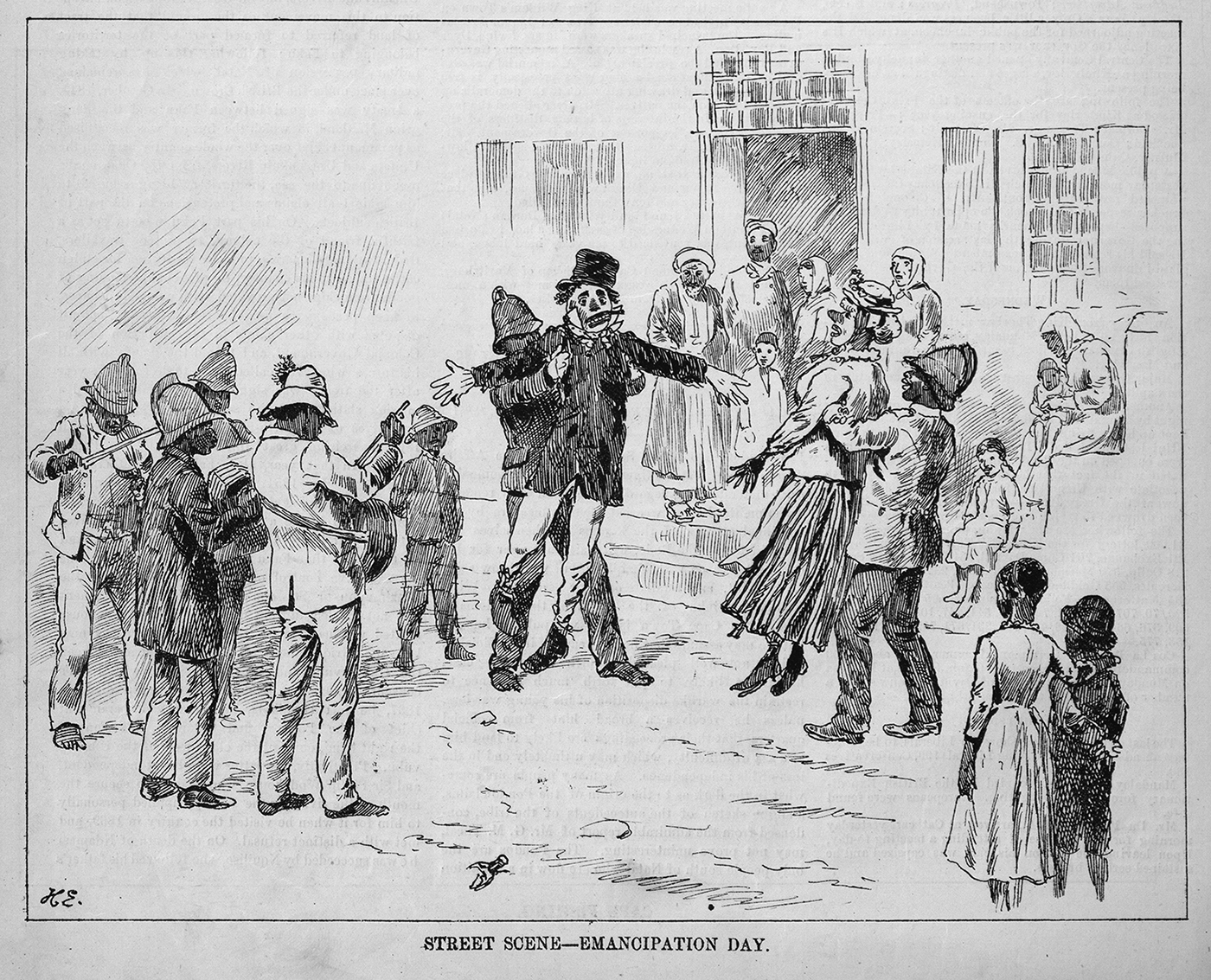
Figure 6: Heinrich Egersdörfer: Street Scene—Emancipation Day. South African Illustrated News 1885: 580. National Library of South Africa, Cape Town.
Martin interprets the caption provided by the South African Illustrated News as signaling a connection between the carnival season and political revolts.132 He argues that the procession-like celebrations for Emancipation Day on December 1, 1834—which themselves drew on military and Salvation Army parades—gained a creolized afterlife in carnival. And yet, even though these cultural performances of a globalized crowd amalgamated puppetry, Muslim dance performances, the Kalifa, and masked house visits (similar to European rural winter customs), they did not simply imitate recurring rituals.133 Instead, locally indigenized, their specific entanglements respond to the political dynamics of their time and place.
Martin associates Egersdörfer’s street scene with the traditional start of Cape Town’s carnival season on November 5—Guy Fawkes Day. In England and its colonies, the day is marked by doll burnings to commemorate the suppression of an assassination attempt against the crown at the onset of British expansion.134 However, in Egersdörfer’s scene, the Guys—as the dolls are called in Cape Town—are transformed into an attraction for all kinds of people. Their historical reference appears secondary; rather than directly invoking Fawkes as a historical figure, the Guys become an allegory of revolt within a playful performance that disregards the dolls’ original, local significance. They can be interpreted as both colonial and underdog figures—ambiguous personae through which social conditions are negotiated. The depicted assembly thus appears to engage in a local context with unfulfilled political promises, reworking a prior revolt through an emptied or resignified performative citation.
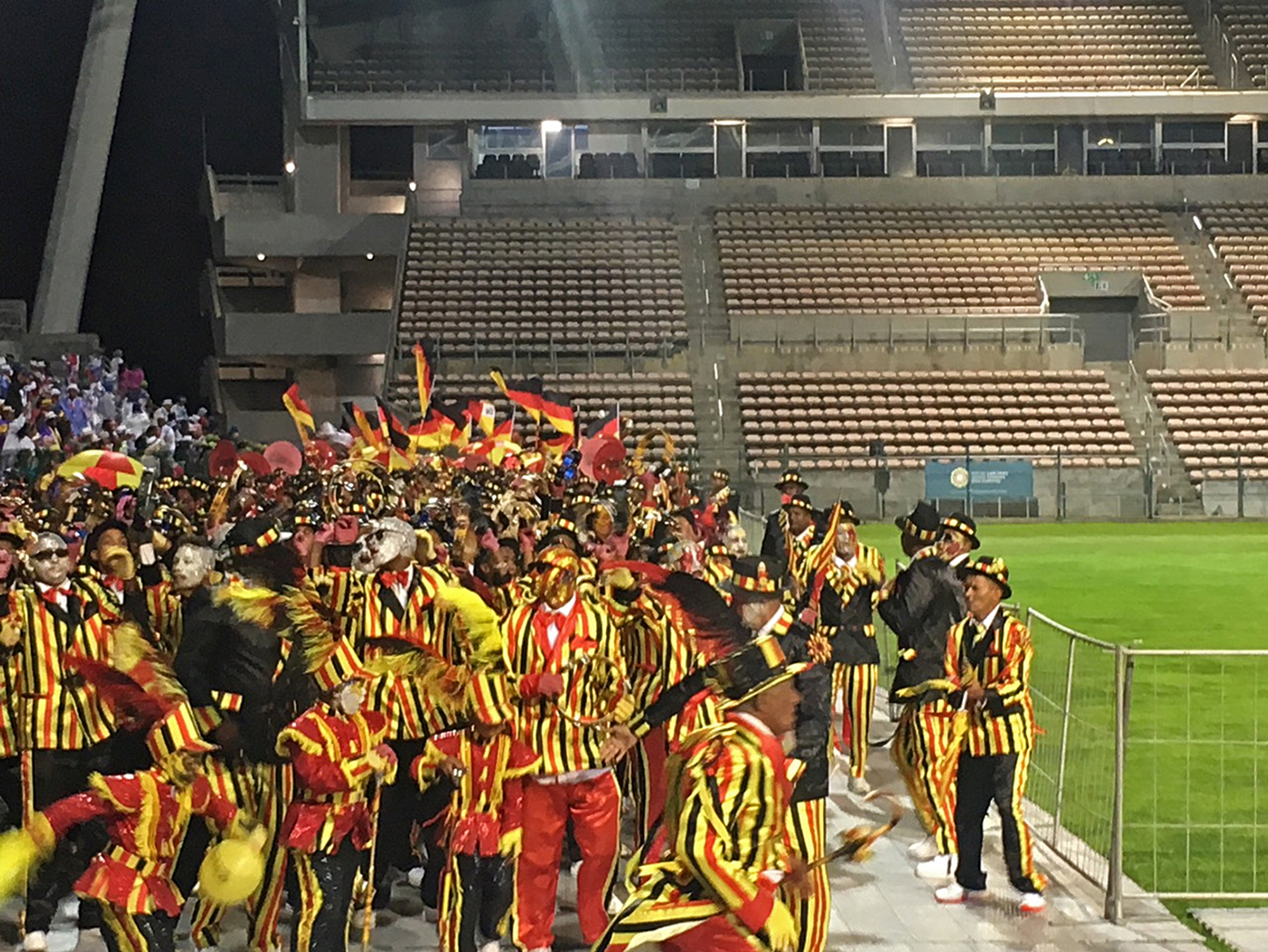
Figure 7: Carnival, Athlone Stadium, Cape Flats, 2019. Photo: Evelyn Annuß.
Riots and police measures against the street carnival were recorded in 1886, the year after Egersdörfer’s drawing was published.135 In the twentieth century, the carnival became increasingly organized. Compared to older carnival photos featuring matadors, gorillas, devils, and other figures, capturing a chaotic swarm of masks,136 the appearance of revelers grew more and more standardized. From 1977 to 1989, as public demonstrations faced tighter regulation, the apartheid regime banned this carnival in the inner city under the Riotous Assembly Act. Today, it is subject to crowd control, with barriers preventing physical interaction between maskers and bystanders. The Kaapse Klopse, as the expanding Cape Carnival clubs are called, now appear in coordinated costumes and carry flags that often hijack national colors—subverting nationalist symbolism by emptying it out.
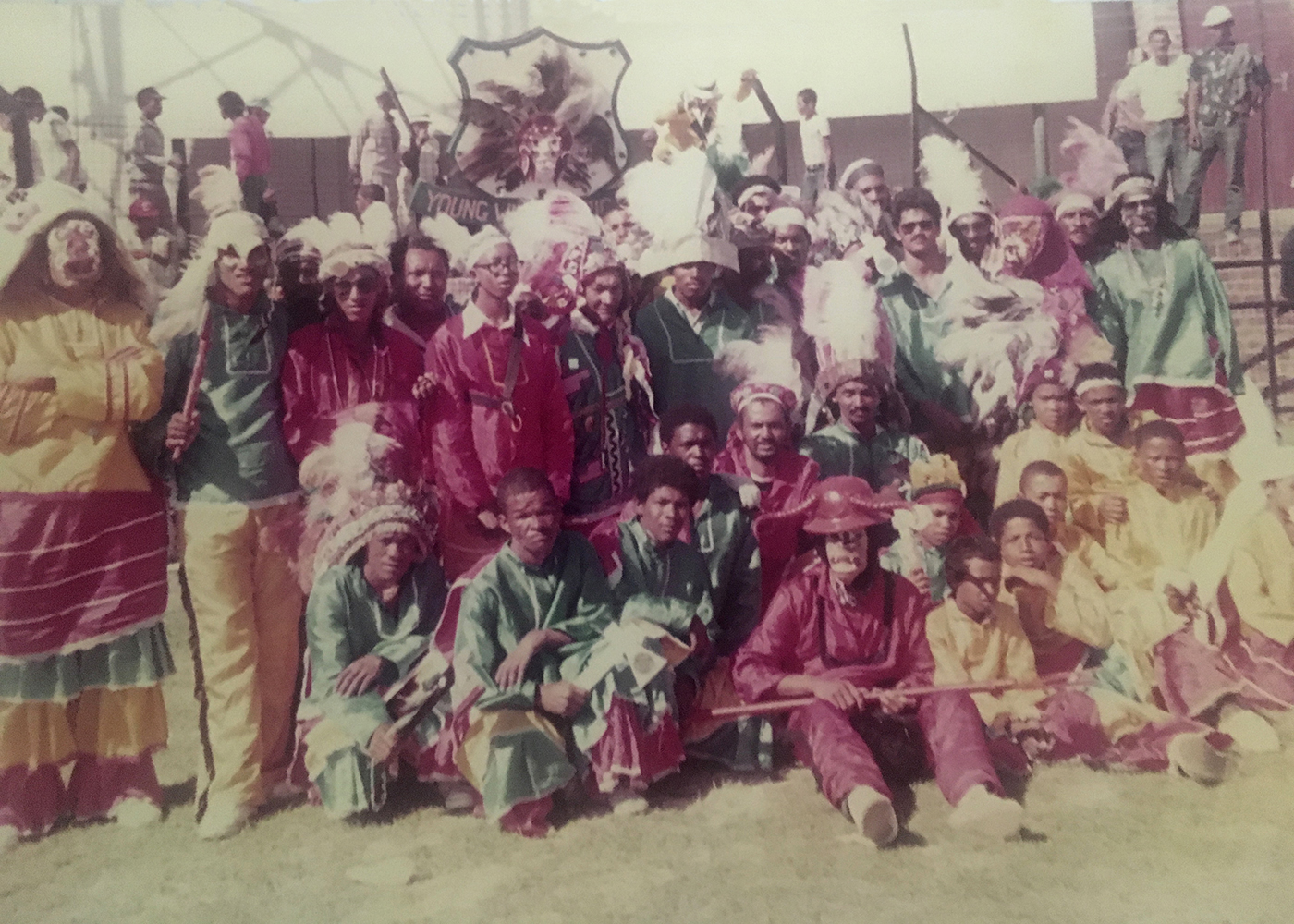
Figure 8: Atjas, Carnival, Hartleyvale Stadium, Observatory, Cape Town, undated. Kenny Misroll Private Collection (Cape Town).
While the singing, performing, and marching competitions in township stadiums remain a local affair, the inner-city parade has increasingly become a tool of city marketing.137 However, the memory of loosely organized groups of costumed people roaming the streets persists in the appearances of drag queens and other secondary figures who accompany the Klopse—smaller, peripheral groups adorned with feathered headdresses that evoke stereotypical images of “Amerindians,” alongside red devil and white fur figures.138 Like the Guys, the Atjas139—possibly a creolized abbreviation of “Apaches”—recall the potential these parades hold to erupt into revolt, citing figures of indigenous resistance from elsewhere. This act of “playing Indian”140 appears to be drawn from globalized modern mass culture and, like the colonial reference embedded in the Guys, seems to have little connection to the local context. Yet that displacement is precisely what makes the Atjas a countermodel to colonial settlerism and racist notions of lineage or indigeneity. By invoking fictionalized images of uprisings from elsewhere, the Atjas are akin to the glamorous drag queens like Kewpie, who—through their namesakes drawn from Hollywood actresses—overaffirm and liquefy standardized beauty ideals of white femininity. Their complementary modes of “making a scene” are connected in their use of overtly reinvented elsewheres as a means of resisting local governmental power. As performative transpositions, these practices are also akin to the visual and musical signature of the formerly so-called Coon Carnival—a local form of “dirty-facing” that carnivalesquely creolizes dominant stagings of racialized drag.
Dirty Facing (Jim Crow, Zip Coons)
In Cape Town, T. D. Rice’s song “Jump Jim Crow,” associated with blackface, was reportedly heard in the streets and bars as early as the mid-1840s.141 As an entr’acte of Americanized yet already creolized European folk theater, Rice’s folkloristic song-and-dance solo—featuring the blackened comic figure that he had popularized in the 1830s—preceded the later grotesquely standardized minstrel show genre. It reached Cape Town in the second half of the nineteenth century through transcontinental theatrical trade routes, carried by the expanding globalization of entertainment culture.142 From the early 1860s, visiting minstrel troupes, including a group of Christy’s Minstrels, staged musical-theatrical performances of grotesque blackface.143 By the end of the nineteenth century, performances by Black American artists, such as the Virginia Jubilee Singers led by Orpheus M. McAdoo, followed.144
In the context of the United States, blackface first emerged as a rowdy, (lumpen-)proletarian theater form in the industrialized North. Often drawing on plantation nostalgia, it conjured an imagined elsewhere that obscured the brutal hyperexploitation of the enslaved. It was a genuinely urban affair, particularly among the white, male industrial proletariat, though it later became a performance outlet for Black entertainers under segregation. Gradually, blackface spread across the Atlantic. The shrewd, unruly Jim Crow—a creolized comic figuration of a fugitive slave—was celebrated in London as early as the 1830s before gaining popularity at the Cape. Rice’s tramp, alongside his urban counterpart Zip Coon—the minstrel stock figure of the Black dandy—was cast as a trickster personifying ungovernability.145 At the Cape, however, blackface from the United States was not only performed for white audiences but also resignified by segments of the population who resisted classification within the racial hierarchy. In this context, blackface also became a mask of revolt.
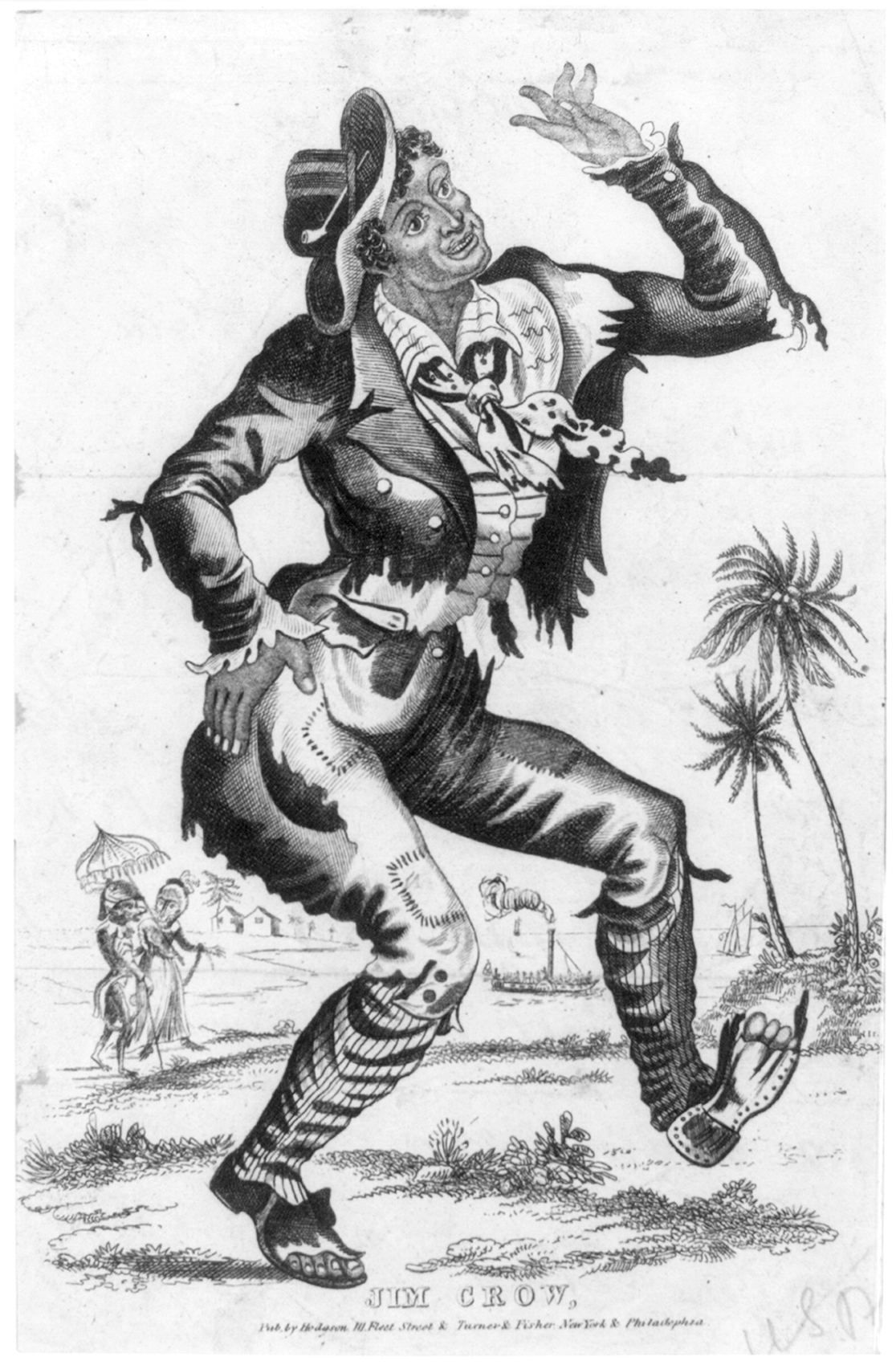
Abbildung 9: T. D. Rice as Jim Crow, 1830er-Jahre. Library of Congress, Washington, D.C. (2004669584).
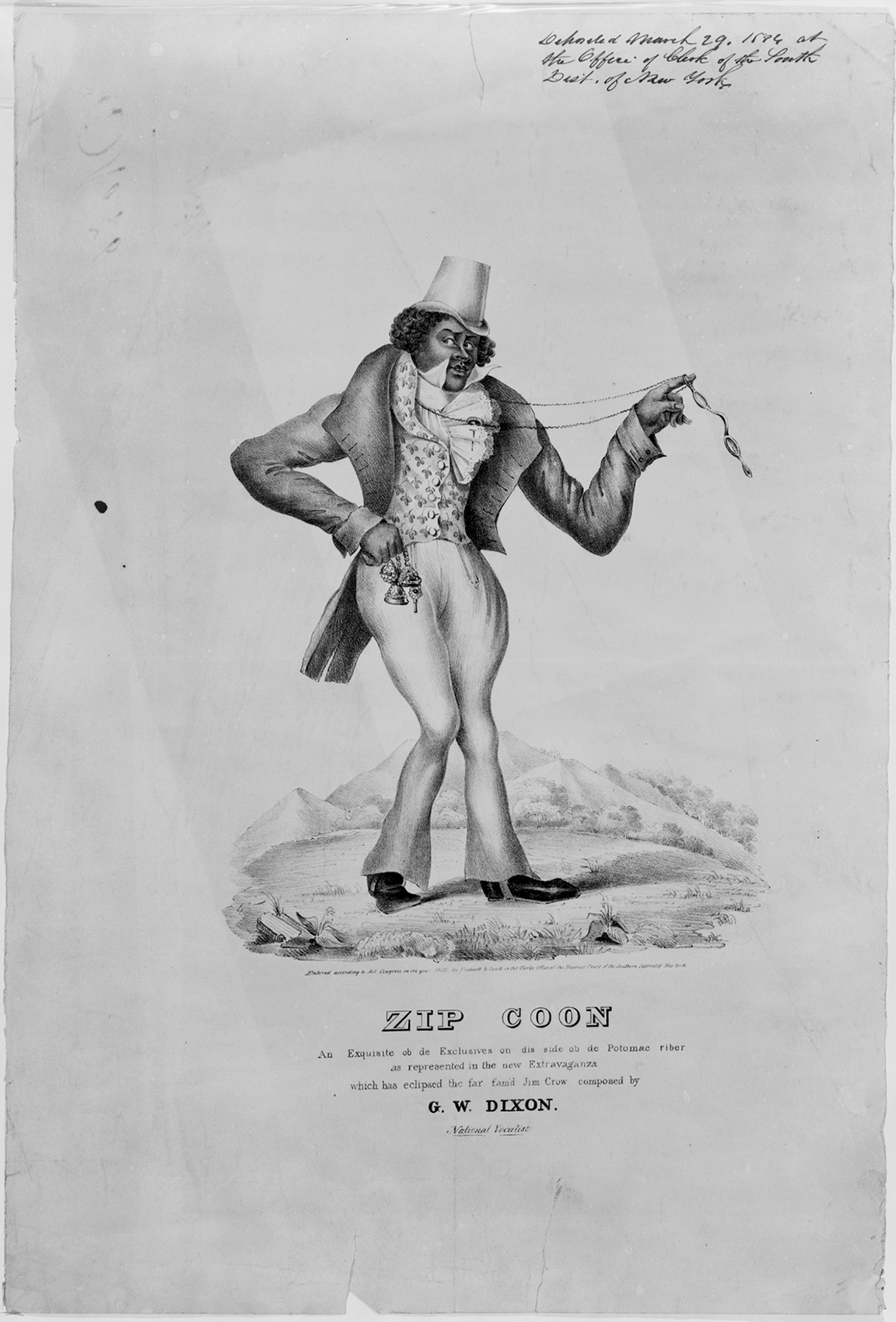
Abbildung 10: Zip Coon, sheet music, 1830s. Library of Congress, Washington, DC (00650780).
Presumably carried to the Cape through sheet music with illustrated covers or by singing sailors, the popular hit “Jump Jim Crow” had already reached the harbor area before increasingly racist minstrel shows began appearing on established stages. While already creolized, Jim Crow and Zip Coon—figures that blend the darkly masked Arlecchino of European folk theater and its descendants with transatlantic mimicry—became popular in District Six just a decade after emancipation.146 By this time, the transition to postslavery was already marked by regulations comparable to the later so-called Jim Crow conditions in the United States—a form of segregation that prefigured apartheid. In the 1840s, when “Jump Jim Crow” arrived at the Cape, Emancipation Day gatherings were reportedly intertwined with the carnival of the subalterns. Blackface became its visual signature, accompanying the transatlantic urban music of the New World. “Jump Jim Crow” was thus received as a marker of globalized mass cultural mobility. Under local colonial conditions, this music resonated as the sound of revolt:
The frivolous coloured inhabitants of Cape Town, who take a holiday on the slightest pretext, indulged their peculiar notions in regard thereto by going about in large bodies dressed most fantastically, carrying “guys,” and headed by blowers of wind and players of stringed instruments, who evoked from their horrible monsters the most discordant and blatant noises that ever deafened human ears.147
In 1886, the year of the carnival riots, the Cape Times reported on roving bands in various disguises, carrying dolls and noisily terrorizing their surroundings. In this context, minstrel quotations and carnivalesque appearances began to resonate. And creolized repertoire from elsewhere—as references to Jim Crow and Zip Coon—became indigenized. The heterogeneous, medley-like music, whose rhythmic changes structure the choral and dance interludes of the local carnival, make the interweaving of different sounds and movements associated with the carnival all the more apparent.148 Marching, accelerated polyrhythmic steps, bent knees, hips shifted backward, and isolated hand positions combine movement styles that simultaneously conjure cultural performances from different parts of the world. Rather than evoking the plantation nostalgia of minstrel shows, it was the danceable, creolized sound that may have been one of the primary attractions of this musical import to Cape Town’s harbor area.
This new music, which could already be heard there in the mid-nineteenth century—even before the start of the US Civil War and the increasingly overt racism shaping the form and function of minstrel shows—was also incorporated into local performances. These acts, featuring burnt cork makeup and grotesque costumes, adapted popular US hits for entertainment venues near the harbor.149 The first carnival clubs are documented as appearing in the late 1880s, linked to the local music scene. The so-called Coon Carnival, which referenced mass culture from the United States by parading through the streets in corresponding masks, transformed the racist-zoomorphic term for Black comic figures into a mode of assembly in which its original meaning was lost.150 Instead, its associations with dirty work and soot-stained faces were involuntarily reactivated.151
In this sense, Cape blackface can also be read as a form of dragging—of pulling back unforeseeable historical references. In his study of the local carnival and its clubs, the Klopse, Martin traces the term’s history in relation to these performances. He highlights the creolized afterlife of European folk theater, the carnivalesque street performances of the subaltern, and their class-specific references:
Klopse refers to the origins of the troupes, when they were emanations of social and sports clubs; it therefore seems perfectly legitimate to recycle this word in the 21st century. Most of the revellers, however, when speaking in English about themselves and the troupes they affiliate with, will still use the word “Coons” and some will talk about “Minstrels.” … While it is true that “Coon,” an abbreviation of racoon, became, in the first half of the 19th Century [sic], associated with blackface minstrelsy and was given a racist meaning, one should not forget that words may have a life of their own and that, when they travel, their meanings change. The signification a word has in the United States cannot and should not be considered as the only signification a word can have in English. In South Africa, the understanding of “Coon” was totally transformed and came to signify the main character and the main mask in the New Year festivals … As for “Minstrels,” those who object even to this word should be reminded that there were minstrels in Europe long before Europeans set foot in North America, and that they were jesters, jugglers, story tellers, singers and dancers whose “acts” were tightly intertwined with carnivalesque traditions … 152
From Martin’s perspective, blackface in the Cape was not a caricature of the Black Cape population but rather a testament to the possibility of recasting the obviously artificial, grotesque mask, which does not fit within the genre of anthropocentric imitatio.
Blackface, like the image of the Indians, gained even greater popularity through cinema. When Alan Crosland’s early sound film The Jazz Singer—featuring Al Jolson in blackface—was first shown in Cape Town in 1929, the creolized-diasporic carnivalesque mask became a defining feature of the carnival.153 It seemed to gesture toward an imaginary, globalized elsewhere. “Through the mask of the Coon, they have located themselves within the Black Atlantic,” Martin writes.154 He thus highlights that blackface at the Cape was linked to trickster figurations considered to be part of a nonwhite modernity emerging from the United States, aligning with Gilroy’s argument that “blackness can sometimes connote prestige rather than the unadorned inferiority of ‘bare life.’”155 Transposed to the Cape, blackface also mirrored the whiteface of the Guys, the carnival dolls that were already a part of the celebration. It then became an ambivalent sign of potential resistance among an urban population that could not be easily categorized by skin color.
Yet blackface in the Cape can also be read differently. Drawing from his research on English-language stage productions for British Cape audiences in the late nineteenth century, Chinua Thelwell argues in Exporting Jim Crow: “Any intellectually responsible explanation for the popularity of blackface minstrelsy must acknowledge the highly racialized worldview of the Cape and Natal colonists.”156 However, historical circumstances may be more complex than the rigid color line cemented during the Jim Crow era in the United States. The Dutch prehistory of colonial expansion from the Cape into Asia, too, disrupted the black-and-white grid of the British Empire. The popularity of minstrel shows, which Thelwell sees as an indicator of anti-Blackness, is further complicated by colonial competition and the cultural interdependencies of various subalterns. Transoceanic perspectives are therefore indispensable.
“Minstrelsy was globalized because of the increasing influence of American culture on nations such as imperial Britain …. It was also globalized by the appropriation of the form by colonized Black nations and communities eager to engage in and construct a transatlantic conversation among different Black populations,” as Louis Chude-Sokei underscores in The Last “Darky.”157 Dillon likewise calls for deeper reflection on transatlantic entanglements:
I would posit the temporal priority of an Atlantic performance tradition and argue that American minstrelsy overwrites a history of colonialism and anti-colonial revolt as well, replacing and erasing this broader geopolitical frame with one of nationalism and racism in which a white/black binary secures the force of white creole nationalism. Ironically, both nineteenth-century blackface minstrel performers and twentieth- and twenty-first century scholars of blackface minstrelsy have emphasized minstrelsy’s status as one of the earliest indigenous American musical and theatrical forms.158
The Cape carnivalesque “Coons” were not part of the bourgeois-colonial theater context that Thelwell examines. Instead, their blackface operated as a sign of an urban, creolized imagined elsewhere, underscoring the environmental dimension of referentiality rather than the racist representational function of the mask Thelwell describes. The Cape Townian use of carnival blackface therefore transposes the figurative into the ornamental.159
After the collapse of apartheid, blackface was replaced by glitter makeup, which typically covered the entire head. In a photograph taken during a carnival competition at Athlone Stadium, two D6 Raw supporters display their club affiliation in a way that faintly echoes Kewpie’s glamorous drag. The metamorphosis of blackface into glittering ornamentation does not simply decolonize a racist tradition; rather, it underlines the specific aesthetic quality of a mode of appearing that had already shaped the use of blackface in preapartheid Cape Town. The ornamental glitter makeup, covering the entire head, accentuates the Klopse’s outfit colors instead of the face, effectively making individual features disappear within the collective assemblage. It is therefore about referencing the social environment rather than serving as a representational or disfiguring mask.160 As a second skin, the makeup does not represent a person but instead signifies connections to fellow dancers, transforming the carnival into a form of performative commoning—a collective assertion of the right to appear together.161 In this sense, the carnivalesque street scenes strongly resonate with the way Kewpie’s posse dragged through the rubble of District Six.
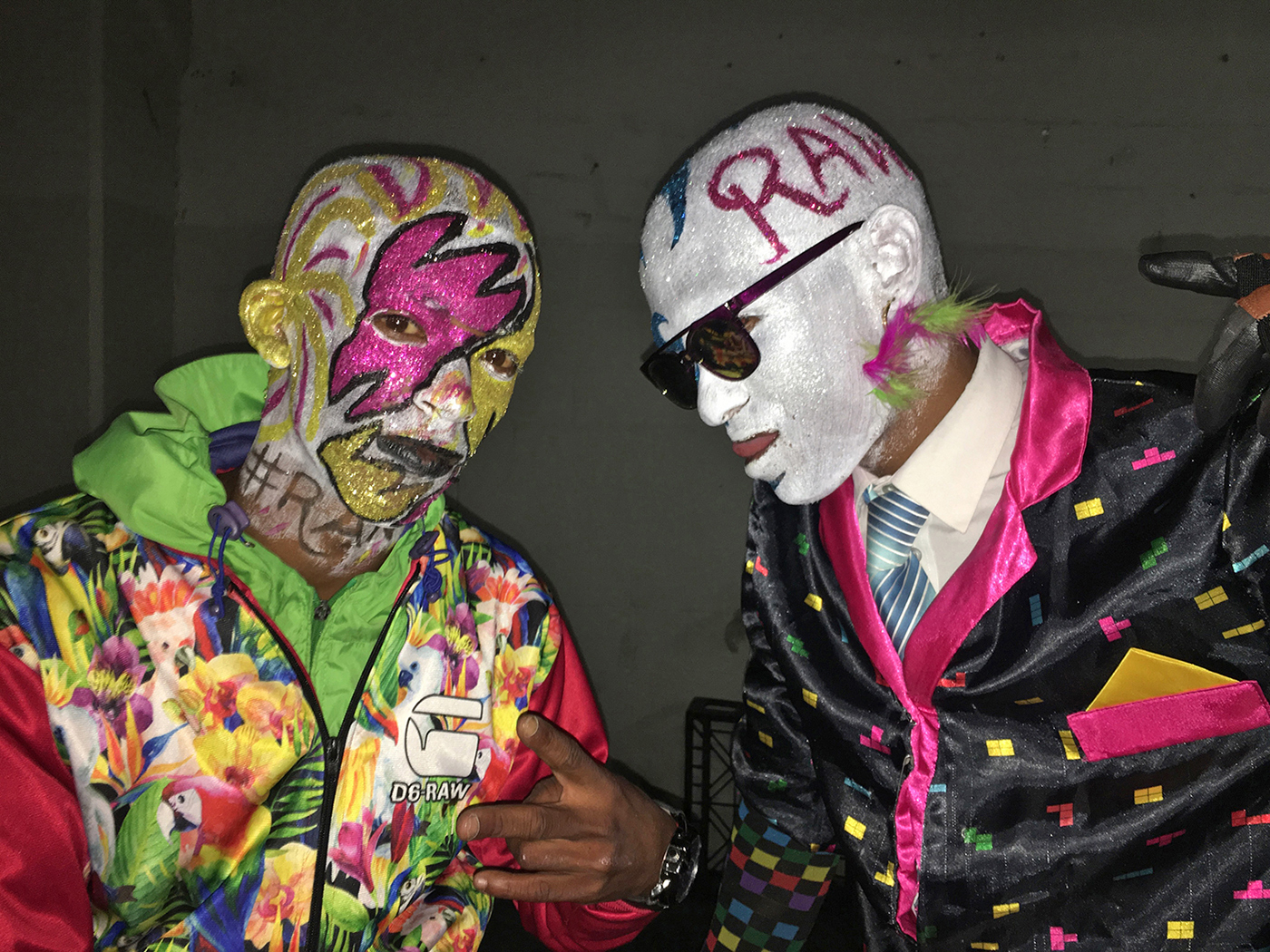
Figure 11: Mr. Raw & Mr. Raw, Carnival, Athlone Stadium, Cape Flats, 2019. Photo: Evelyn Annuß.
Challenging conventional interpretations of the face, the defacement produced by carnivalesque glitter aligns with another theater of minor, that is, nonrepresentational mimesis162—one that had long resisted hegemonic performance regimes in Old Europe and continued to shadow the history of “respectable” stage performances, despite the supposed expulsion of the harlequin. Perhaps within this folk-theatrical, genealogically interrupted undercurrent of carnival, new alliances emerged across time and space, notwithstanding the comic mask’s appropriation for racist entertainment. In this sense, Cape blackface and its afterlife lend a kind of glamorous, creolized survie to the class-specific connotations of the dark mask of the comici in precolonial European commedia.163
These ornamental masks that accompany dance and musical performances evoke an “excessive mimesis” that tends to disrupt order.164 Balke reads mimesis as performative, generative, and somatic—and thus precisely not as anthropomorphic representation, as petrified imitation. By emphasizing the constitutive dirtiness, that is, the messiness of the mimetic, to use his terminology, Balke highlights a specific potentiality of performing: the potentiality for referential and affective multidirectionality, of “queering” bourgeois-anthropocentric notions of representation.165 Implicitly drawing on Gilles Deleuze’s and Félix Guattari’s notion of becoming-minoritarian—that is, of becoming nomadic,166 he foregrounds a potential to reject control.
What is described here as constitutive of mimetic practices is reflected in the Cape Town Carnival as a creolized cultural technique of making oneself similar.167 The carnivalesque transposition of blackface onto the streets of a colonial port city such as Cape Town—and its rebellious afterlife—offers insight into people’s capacity to relate to elsewhere, beyond their immediate surroundings. In this respect, Atjas and Coons in Cape Town have always already been reflexively indigenized. However, this insight, inherent to the local carnival, remains obscured if one readily assumes a general representational function of the mask and projects its racialized charge in the US context onto differently situated forms of use.
The dirty facing of this carnival, which locally purloins and resignifies a quotation from globalized mass culture, thus reveals a specific disposition of reception. The creolized blackface resists the “faceism”168 that anthropomorphizes the mask and interprets the grotesque as suprahistorical—detached from its surroundings and its use—seeing it instead as the same racist distortion of an “actual” face across time and place. The Cape Town blackface quotation therefore challenges interpretations that attribute an almost absolute power to hegemonic control over references. It underscores the possibility for collective “reappropriation” and, in doing so, highlights its relationship to other modes of potentially conflicting drag.
Blackface, Moffies
In 1940, a year before Kewpie’s birth, an anonymous letter to the editor in the Cape Standard complained about drag queens and the carnival. “Moffies,” it claimed, “should be in a hospital or some similar place, away from the public.”169 The policing plea for their internment was justified as follows: “They are sexually abnormal—hermaphroditic in a pitiable condition, physically and mentally; the very thought of them should be repulsive to all but the scientists.” Drag queens, the letter continued, viewed with “almost sick … disgust,” were linked to the inner-city street carnival, where they played a special role as lead dancers, exposing the intersection of a temporary state of exception with queer everyday practices. The letter also referred to blackface as racial drag—and connected it to gender bending: Moffie Konserts (drag shows) and Coon Carnivals, it argued, confirmed the supposed primitiveness of the Coloureds and would reinforce claims of European superiority.
Written under the name “Coloured Student” and positioned as the voice of the educated classes, the letter follows bourgeois interpellations of “respectability” under colonial rule. By demarcating queer, deviant modes of appearance that blurred existing classifications, the letter also affirmed the hegemonic dispositif of representation. More than a mere rejection of supposedly inferior depictions, it exposes a deeper fear of performances “too slippery … to police.”170 In this sense, the letter illustrates how colonial strategies of divide and rule seeped into understandings of respectable representation, transforming them into a call for policing.
The demand to lock up drag queens, however, did not go unchallenged: “The information that Coloured Student gives about their sex is indeed enlightening … and it is apparent that he must have taken a lot of trouble to obtain information.”171 Read against the grain, the sarcastically phrased letter highlights the entanglement of gender bending and blackface—linking the public visibility of supposedly dirty bodies and dirty faces to a broader connection between queering and creolization. What is often treated as oppositional—drag as a queer counterhegemonic practice and blackface as hegemonic-racist defacement—appears deeply intertwined in the context of the Cape. This connection is already evident in one of the earliest newspaper references to a drag queen performance during carnival. Coloured Coons’ Gay Carnival, published in the Cape Times on January 3, 1930, describes the fusion of gender bending and blackface through minor, carnivalesque mimesis: “He is dressed in burlesque female attire, and carries a tiny parasol. His voice is carried away by the wind but his antics draw periodical bursts of delight from the spectators as he rolls his white eyeballs or prances up and down.”172 In this regard, the link drawn by Coloured Student is not plucked out of thin air.
Later sources make the local relationship between drag and blackface even more explicit. “PHA 3155 CT Coons 005” is the archival signature of a photograph housed in the National Library of South Africa in Cape Town. Its call number refers to the carnival’s former name, as it was known from the nineteenth century onward, while the image itself suggests a queer citation of blackface—“reminiscent,” as it were, of Kewpie’s drag scene. Shot by an unnamed photographer on January 4, 1961—before the forced removals—the photograph captures Wale Street, which connects District Six and the Bo-Kaap. Intended as a press image for the Cape Times (southern Africa’s first daily newspaper, established in 1876), it was probably never published and ultimately ended up in the archives as trash, so to speak. Unlike Kewpie’s personal photographs, its collection history is fragmented, and there is no known biographical information about the people depicted. Yet this very absence allows for a reading that prioritizes the analysis of modes of appearance over retrospective projections of identity by its viewers onto its subjects.
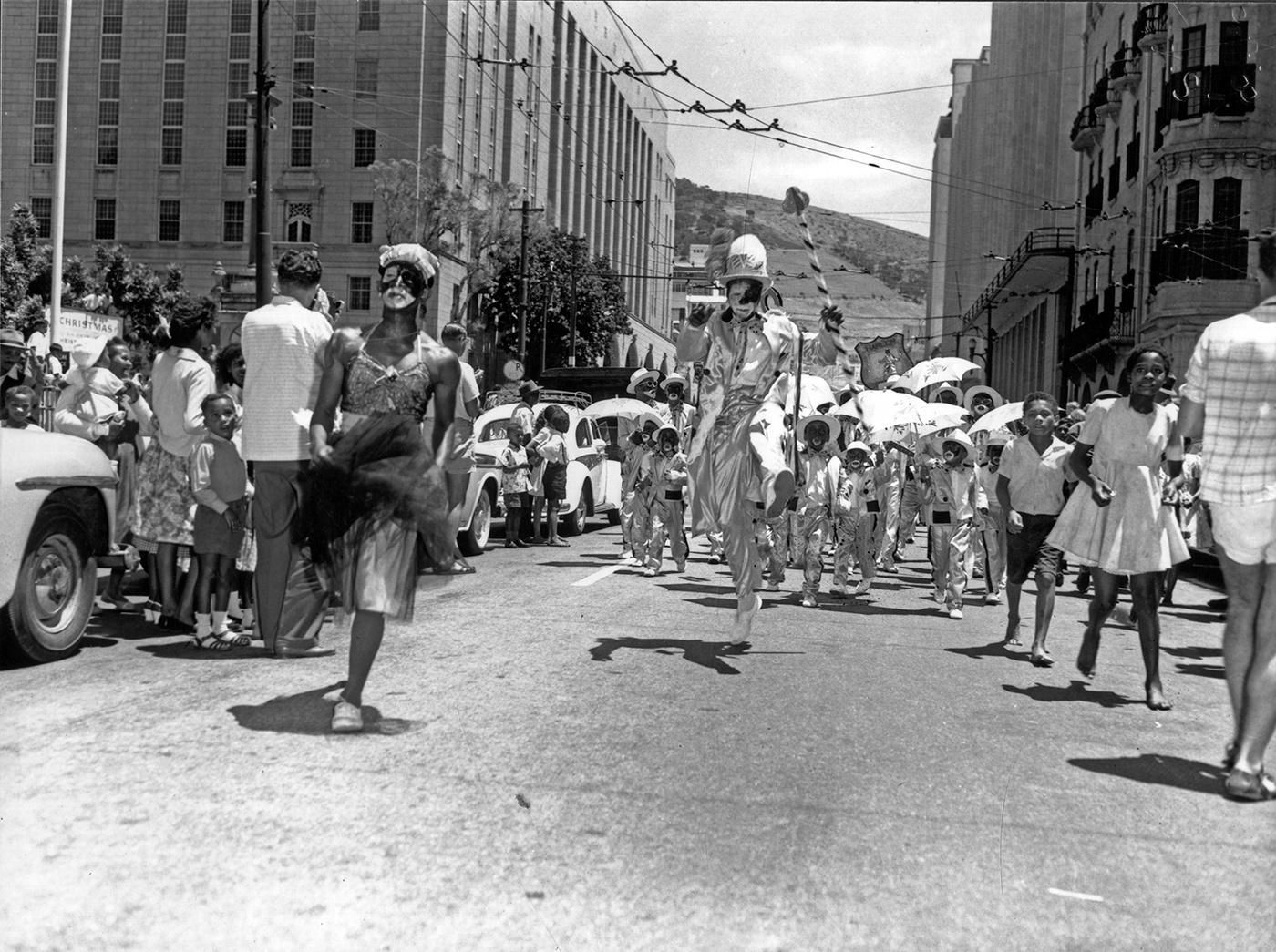
Figure 12: Carnival, Cape Town, Wale Street at the corner of St. George, early 1960s, probably the Honolulu Dainty Darkies. National Library of South Africa, Cape Town (PHA 3155 CT Coons 005).
The carnival image foregrounds an unknown drag queen. It is impossible to determine whether their engagement with gender bending extended beyond carnival—like Kewpie’s—or remained solely a festive performance. This “trouble to obtain information” underscores how the boundaries between carnival and queer everyday life in the Cape are not so clear-cut.173 Taken a few years before Kewpie’s well-documented images, this photograph already bears witness to a form of mimetic dragging—a transgressive form of embodied, danced performance that exceeds fixed notions of gender and identity. The drag queen depicted leads a train of dancers in minstrel costumes. In this sense, the image presents dragging not only as a performative act but also as a dynamic of being dragged along—perhaps less in the sense of gravitational pull and more in the joyous momentum of collectively making an appearance. Visually, what connects the drag queen to the dancers in tow is the mask they share: a specific form of blackface that anticipates the function of later glamour makeup. The image intertwines dragging and blackfacing against the backdrop of Cape Town’s fraught (post)colonial history—marked by exploitative labor, segregationist policies, and the racialized aesthetics of divide and rule that continue to shape its creolized carnival.
Their body is clearly in motion at the moment the picture is taken. Only their left leg is visible. The dress accentuates their broad shoulders and muscular arms. They appear to be waving a dark tulle skirt in front of their stomach, raised at an angle as they shift their weight onto their supporting leg. Their head is covered with a kind of cap. Their outfit contrasts with the carnival-like male costumes of those dancing diagonally and at a slight distance behind them—a voor-loper seemingly in mid-jump, throwing one leg forward; an advance dancer ahead of the group in a top hat with a conducting baton; children with parasols; and a few adults. At the same time, their made-up face corresponds with the masks of the other dancers: their right eye and overemphasized mouth are painted white, while their left eye and nose area are blackened. However, unlike the grotesque masks of US minstrel shows, where racialized distortion serves as a pejorative defacement, this makeup follows a different logic. Here, the reference to skin color is replaced by lines of flight that touch or cross each other—both within the photograph and beyond its edges. These lines of flight potentially decenter the viewer’s gaze, connecting the drag queen—despite their physical distance—to the masked figures behind them. Drag and carnival are linked here in a particular way: through ornamentalized face masks that do not merely grotesquely exaggerate the eyes and mouth in an interplay of black and white makeup but instead translate these features into a new constellation—one that diffracts stereotypical representations and highlights the fluid connections between bodies. The relationships among the performers are shaped by visual contrasts and correspondences that suggest rhythmic resonances. The drag queen’s mirror-inverted, ornamental face paint visually connects them to the voorloper dancing behind; their complementary makeup suggests that the two appear to be dragging along the rest of the dancers, with whom they share the overemphasized mouth, forming a loose chorus. It is as though the music animating the dancers has found a visual echo in their makeup.
Together, the people stage a play of possible, asignifying modes of relating.174 Their mode of appearing in the picture deterritorializes the individual body, exempting it from its representational function. Instead, it exposes the relational, tactile moment of this carnival, radiating outward into its surroundings and potentially resisting apartheid through blackface. In the photo, these living ornaments function not as instruments of derogatory, distorting imitation but as catalysts for mass assembly.175 And it is precisely this function that the drag queen allegorizes, interweaving queer and creolized mimesis.176
In terms of gender history, Cape Coloured carnival is largely a homosocial affair; traditionally, men have taken on most of the stereotyped roles, while women have been primarily responsible for its infrastructure.177 Moreover, carnival historiography often either ignores drag queens entirely or treats them merely as marginalized gay figures; conversely, within gay historiography, carnivalesque gender bending is often too readily subsumed into a broader gay community history.178 As a result, either the figure itself or its context tends to be overlooked. Despite critiques of the carnival—its complicities, its homosociality, and so on—it is precisely this so-called moffie figure that reveals the queer potential of creolized modes of cultural performance. This becomes all the more evident when juxtaposed with colonial-apologetic forms of essentialized self-representation and their genealogical claims.
Reenacting
The history of propaganda mass stagings legitimizing settler colonialism in South Africa began in 1910, at a time when the street carnival was already visually dominated by blackface. That year saw the performance of the South African Pageant of Union, a spectacle featuring over 5,000 participants, marking South Africa’s entry into the age of political mass stagings.179 Nostalgic depictions of colonial history dominated, with Jan van Riebeeck’s landing in Table Bay in 1652 serving as the Urszene. Some audience members may have recognized a model for this Dutch-flagged scene: Charles Davidson Bell’s 1851 historicist painting, in which van Riebeeck, surrounded by his soldiers, addresses a group of “natives” positioned lower in the composition. In any case, the scenic authentication of a Herrenvolk and its territorial claim asserted by the painting relied on the theatricalization of van Riebeeck’s arrival, drawing from colonial visual arts. What appeared as a reenactment was, in fact, a performative imitation of a painted colonial imaginary.
The contrast between these colonial stagings and the aesthetic register of carnival becomes even more apparent when considering how each engages with performativity. While propaganda spectacles relied on a colonial visual culture that kept performativity latent, mimetic dancing contradicted hegemonic representational politics and always held the potential to erupt into revolt. Other key historical reenactments and tableaux vivants in South Africa’s political history illustrate this dynamic. In 1938, the Boer migration into the continent’s interior was staged as the folkloristic Great Trekprocession. In 1952, under apartheid rule, the Van Riebeeck Festival celebrated 300 years of colonial history, serving as a platform for negotiating and communicating competing historical narratives. This was particularly evident in the representation of the so-called Cape Malay Community, as I. D. du Plessis, Commissioner of Coloured Affairs in the Ministry of Home Affairs, termed the Muslim-creole population. Classified as a subcategory of Coloured, this group was retroactively assigned a shared origin story, beginning with the arrival of Sheikh Joseph at the Cape in 1694. The pageant thus functioned as part of a broader, strategically invented tradition that essentialized and categorized cultural identities to legitimize apartheid policies.
Moreover, the “Malays” were intended to serve as a surrogate for Afrikaans customs. “Together with their language, the Cape Malays have lost any songs which their forefathers may have brought from the East,” du Plessis wrote in his 1972 study The Cape Malays, justifying his mission to claim them for governmental purposes.180 At the height of apartheid, du Plessis also intervened in the local carnival, attempting to co-opt it as a state-controlled cultural instrument. His goal was to replace the “cooning” of the streets, to use the term current at the time, with an apartheid-sanctioned performance of Nederlandse liedjes and “traditional” Afrikaans culture. As the carnival became increasingly regimented, it also became a contested form of collective performance. It was precisely the creolized, carnivalesque blackface associated with dragging—a form that defied genealogical classification and resisted attempts to control its signification—that clashed with apartheid ideology. Rather than being affirmed by the regime, blackface was rejected—perhaps precisely because of the uncanny parallels between South African Coloureds and Black performers from the United States. Creolized people, positioned with relative privileges within the Cape’s racial hierarchy and in a broader global context, disrupted the rigid racial binaries that apartheid sought to enforce.
Later, blackface did indeed subvert the reception of official propaganda. In 1988, just a few years before its collapse, the apartheid regime attempted to restage South Africa’s colonial history. Instead of commemorating the arrival of van Riebeeck, it marked the five-hundredth anniversary of Bartolomeu Dias’s landing—the Portuguese colonial power that had reached the Cape before the VOC. This event was staged as a tableau vivant on the Mossel Bay beach, which was still reserved for Blankes. Conceived by Marie Hamman, the spectacle once again dramatized and contained intracolonial tensions in the final years of apartheid. Leslie Witz describes “what made spectators gasp in astonishment”181: amid widespread boycotts by the marginalized population and political friction leading up to the event, the role of the Khoikhoi was reportedly played by white performers—allegedly wearing Afro wigs and dark makeup.182 Thus, upon his arrival on the coast, the Dias figure encountered Khoikhoi impersonators who evoked carnivalesque blackface. At a historical moment when the “others”refused to participate in apartheid’s representational spectacle, the blackened face became a site of disruption. The established dispositif of colonial reenactments—which had affirmed white supremacy through mass spectacles since the 1910s—was suddenly thrown into question. The obviously arbitrary mask, reminiscent of the so-called Coon Carnival of “the Coloureds,” undermined the founding narrative of apartheid, challenging the gestus of “this has been.”
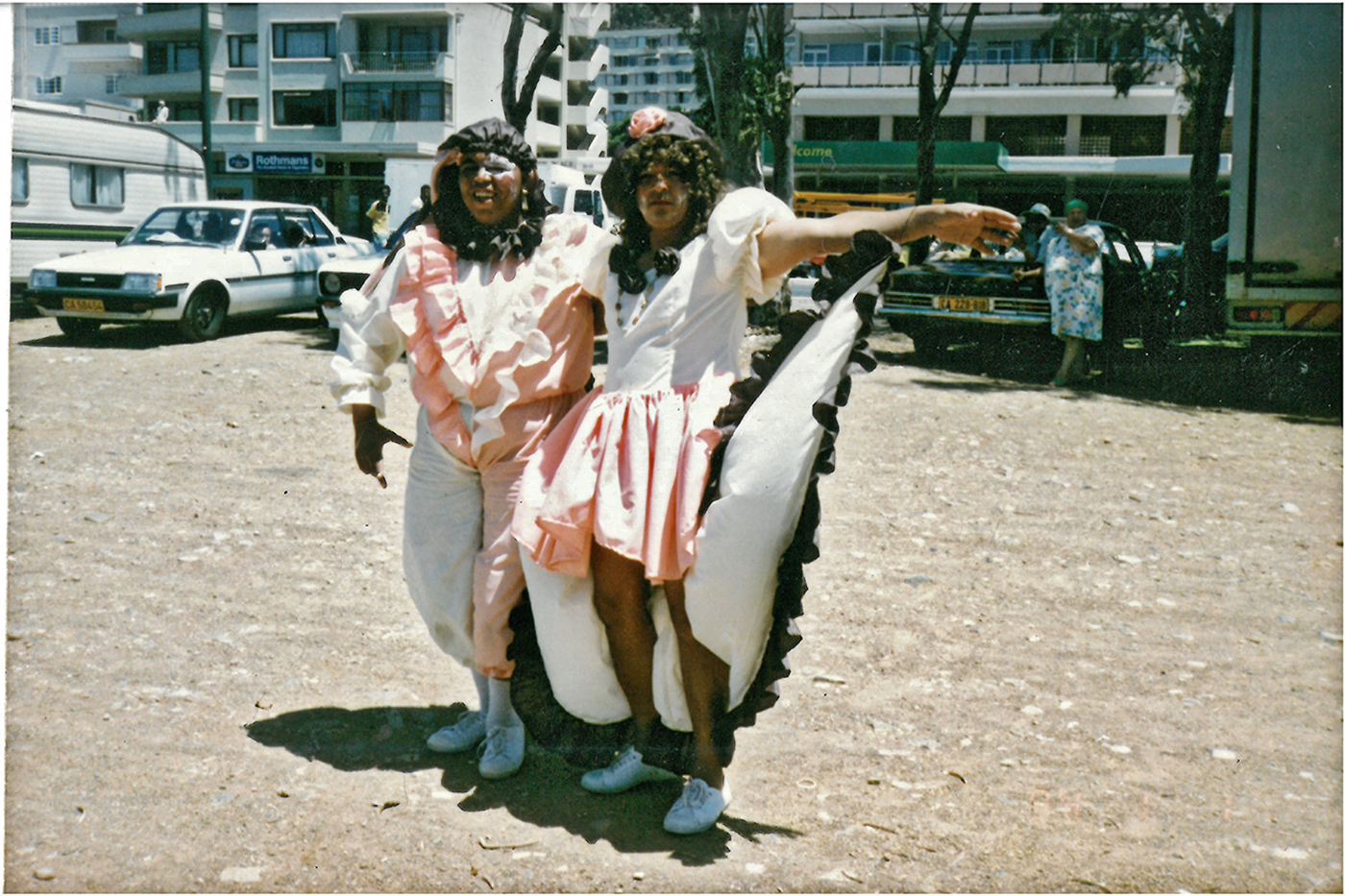
Figure 13: Mogamat Kafunta Benjamin and unknown friend, Carnival, nearby Green Point Track, Cape Town, undated, around 1990. Melvyn Matthews Private Collection (Cape Town).
Involuntarily, this living image exposed its kinship with the grotesque-ornamental masks of an obviously artificial imagined elsewhere—masks that acknowledge their own fictitious nature. At the same time, this revealed a fundamental distinction between minor carnivalesque mimesis and the rigid demands of propaganda representation: queer, creolized performance practices remain acutely aware of the fabrication of representation and the potential for referential slippage—precisely what propaganda reenactments must suppress. By 1988, this complicit mode of representation was no longer capable of essentializing “natives” or reaffirming the colonial narrative. Shortly before the long-overdue collapse of apartheid, attempts to stage reenactments that framed history—from the colonial landing to the victory of the National Party—as a linear success story had lost their efficacy. Representation could no longer fulfill its political function, as street carnival, with its ornamentalized blackface, had evolved beyond a temporary state of exception. By 1988, Blankes with their black-painted faces and their wigs inadvertently revealed that apartheid folklore was ultimately creolized dragging itself—while carnival coons, like carnival moffies, performatively exposed the arbitrariness of racialized and gendered classifications, as a photo of Mogamat Kafunta Benjamin from around that time shows.183
*
Neither the carnival nor Kewpie’s drag scenes offer a prospect of political—or even revolutionary—organization. But these queer, creolized modes of making a collective, loose appearance in public do bear witness to the possibility of encountering one another in a way other than identitarian. The world is creolizing itself, “le monde se créolise,” Glissant wrote in the 1990s in response to the longue durée of colonial contexts of violence.184 At the time when apartheid collapsed after the end of the Cold War, he added an urgent warning to what he conceived of as the creolization of the world: a warning against a “return of the identitarian.”185 Today, amid ongoing violent injustice and majoritarian identity-based interest politics-exacerbated by the global neoliberalization that followed the Cold War—Glissant’s warning seems painfully urgent—which is also to say: it is proving useful elsewhere. Were the ANC to fail in ensuring that Zulus, Blacks, Coloureds, Indians, and Whites could live together peacefully in South Africa, Glissant claimed, something would be threatened or even lost for humanity and our future in the twenty-first century—“notre avenir.”186
Amid the current authoritarian drift, dominant politics seem not only to foster global decreolization, but also fascization.187 The right-wing backlash in many places and the ways in which illiberal-libertarian politics are transforming societies of control allow new nationalisms, racisms, and “antigenderist” resentments to proliferate.188 And those politics, too, make use of the carnivalesque. Hence, to better understand the terror wrought by identitarian politics, I will now turn to a different historical setting, examining Nazi propaganda as a precursor to modern policies of exclusion, self-indigenization, and authoritarian fantasies of purity—formations that can themselves be seen as reactions to what Glissant would later call the creolization of the world. I will begin with another drag scene, shot in a Munich propaganda photo studio—one that appears to invert Kewpie’s D6 performance and the carnival images it drags in tow.
Endnotes
-
For a critique of District Six nostalgia, its identity-related pitfalls, and the conservative culturalist mobilization of hybridity in the context of relative privilege, see Adhikari, Burdened by Race, 2013, especially Trotter, Trauma, 2013; Adhikari, Predicaments, 2013; Erasmus, Coloured by History, 2001; Wicomb, Shame, 1998, You Can’t Get Lost, 2000. On the connection between moffie and gang culture, see Luyt, Gay Language in Cape Town, 2014: 23.↩︎
-
On the distinction between the South African term “Coloured” and the US term “of color,” see Erasmus, Race Otherwise, 2017: 20—21.↩︎
-
On pencil tests and hair politics, see Erasmus, “Hair Politics,” 2000.↩︎
-
In the Population Registration Act No. 30 of 1950, “Coloured” is negatively defined as “not a white person or a native”; see Erasmus’s introduction to Coloured by History, 2001: 13—28, here: 18; Race Otherwise, 2017: 35. See also Davids’s introduction to the Safundi specialissue, Sequins, Self & Struggle, 2017: 113—114.↩︎
-
For a critique of “miscegenation,” see Nyong’o, Amalgamation Waltz, 2009: 74; for a critique of corresponding sexualizations of “colouredness” with regard to District Six, see Ramsden-Karelse, “Moving,” 2020: 421.↩︎
-
See Erasmus, “Caribbean Critical Thought,” 2025; Stuart Hall reads “creolization as the process of ‘indigenization,’ which prevents any of the constitutive elements—either colonizing or colonized—from preserving their purity or authenticity,” 2015: 18. Gordon calls this “newly indigenous” (Creolizing Political Theory, 2014: 170). In contrast to this praxeological perspective, see today’s supposedly decolonial projections on indigeneity as cosmic environmental knowledge, such as in Weber, Indigenialität, 2018.↩︎
-
See Adhikari, Burdened by Race, 2013; Erasmus, Coloured by History, 2001; “Creolization,” 2011.↩︎
-
See Erasmus, “Creolization,” 2011: 640. On the historical sustainability of racializing attributions, preceded by processes of creolization, see Martin, “Jazz,” 2008: 11—116; on creolized modes of performing, with reference to Glissant, see Martin, “Imaginary Ocean,” 2008; Sounding, 2013. ↩︎
-
Erasmus, “Creolization,” 2011: 645; see also Coloured by History, 2001: 16; Race Otherwise, 2017: 84—87. Biologistic colonial racism was prefigured in the anti-Judaic and anti-Muslim politics of limpieza de sangre directed against converts, i. e., the propaganda of blood purity from the fifteenth century onwards—that is, during the Reconquista. This prefiguration is indicated via the Spanish etymology, creollo. On Portuguese Iberian colonialism and the introduction of a new mode of production based on enslavement, see Gorender, Colonial Slavery, 2022.↩︎
-
Cited in Erasmus, Coloured by History, 2001: 18; see Erasmus, Race Otherwise, 2017: 87—92; Reddy, “The Politics of Naming,” 2001: 74.↩︎
-
On the reciprocal conditionality of contact zones, which calls binaries into question, see Pratt, Imperial Eyes, 2008.↩︎
-
On bare labor, which reformulates Benjamin’s notion of “bare life” (“Critique of Violence,”2002: 236—252; “bloßes Leben,” “Zur Kritik der Gewalt,” II.1., 1991, 179—203) in the context of colonial hyperexploitation, see Dillon, New World Drama, 2014: 133; “the distance between capitalist production and primitive accumulation should be viewed as spatial rather than temporal” (35). From a global historical perspective on bare capital, see Zeuske, Handbuch Geschichte der Sklaverei, 2013: 613; Torabully and Carter, “Coolitude,” 2002. On the plantation system, see Wolford, “The Plantationocene,” 2021; Beckert, Empire of Cotton, 2014. ↩︎
-
Diefenbach, Speculative Materialism, 2025: 188, Chapter 2, “History and Ontology: Holland’s Historical Untimeliness,” on the historical nonsimultaneity and specificity of the Dutch accumulation regime—with reference to Wallerstein’s The Modern World-System II (2011: 36—73). On European expansion into the Asian region, see Osterhammel, Die Entzauberung, 1998.↩︎
-
Diefenbach, Speculative Materialism, 2025, Chapter 2, “History and Ontology: Holland’s Historical Untimeliness.”↩︎
-
Gilroy, Black Atlantic, 1993: Gilroy’s concept has since been criticized in several respects—with regard to its Atlantic focus, the lack of reflection on gender, more fluid forms of Othering and hyperexploitation, and indenture. On the necessary systematic reformulation of this concept with regard to the Indian Ocean and the transcontinental network of ports, see Hofmeyr: “the Indian Ocean makes a difference to the question of ‘who is a slave’ … the Atlantic model has become invisibly normative”; “The Black Atlantic,” 2007, on 14; see also Tinsley, “Queer Atlantic,” 2008, as well as Avery and Richards, Black Atlantic, 2023; Erasmus, Race Otherwise, 2017: 2—6; Hawley, India in Africa, 2008; Ledent et al., New Perspectives, 2012. ↩︎
-
On the gendering of indentured labor, see Hofmeyr, “The Black Atlantic,” 2007; on the gender history of colonial violence and so-called primitive accumulation, see Federici, Caliban, 2018; Re-enchanting the World, 2019. ↩︎
-
See van de Geijn-Verhoeven et al., Domestic Interiors, 2002: 131—134 (“From Asia to the Cape”).↩︎
-
Davids, “It Is Us,” 2013: 90n6. ↩︎
-
Gilroy, Black Atlantic, 1993: 4. ↩︎
-
On the political potentiality of cooperative port work and governmental difficulties to control port areas in particular, see Linebaugh and Rediker, Hydra,2000: 181, 206.↩︎
-
See Dooling and Worden, “Slavery in South Africa,” 2017: 121.↩︎
-
On the corresponding migration flows, their causes, and joint revolts by enslaved and ship people, see Bickford-Smith et al., Cape Town, 1999.↩︎
-
See Adhikari, “Predicaments,”2013: x. ↩︎
-
See Bickford-Smith et al., Cape Town, 1999: 112; Haron, “Early Cape Muslims,” 2017: 138; on the visual technology of racialized differentiation, see also Erasmus’s chapter “The Look,” Race Otherwise, 2017: 49—75.↩︎
-
See Adhikari, “Predicaments,” 2013.↩︎
-
Robert Semple, Walks, 1805: 26; cited in Bickford-Smith et al., Cape Town, 1999: 89.↩︎
-
On the tavern of the seas, see Martin, Coon Carnival, 1999: 53; see also Bickford-Smith, “The Origins,” 1990: 35—38; Corrigall and Marsden, “District Six,” 2020: 13. On the fluid topographies of places of passage such as seaports and pleasure venues see Meynen, Inseln und Meere, 2020: 365—366; on transatlantic “motley crews” Linebaugh and Rediker, Hydra, 2000. On the “motley crew,” einen “buntscheckigen Haufen,” see Marx, Das Kapital I, MEW 23, 1968: 268; on wandering fools in the European early modern period, their relatives, see also Amslinger et al., Lose Leute, 2019.↩︎
-
Martin, Coon Carnival, 1999: 92.↩︎
-
On the gang history of Cape Town, see Pinnock, Gang Town, 2016.↩︎
-
Erasmus, Race Otherwise, 2017: 6.↩︎
-
See Quijano, “Coloniality,” 2007.↩︎
-
Erasmus, Race Otherwise, 2017: 4; with reference to Pearson, Indian Ocean, 2003.↩︎
-
On nonbinary forms of gendering in Southeast Asia, see Davies, Gender Diversity, 2011; “Gender and Sexual Plurality,” 2018, “Islamic Identity,” 2019; see also Ismoyo, “Decolonizing Gender,” 2020, with regard to the issue of the Sulawesi Bugis as “transgender spiritual advisors.” On the Bugis slaves abducted from Batavia and brought to the Cape of Good Hope, see Zeuske, Handbuch Geschichte der Sklaverei, 2013: 626. On the diverse criticism of the binarization of “the Other,” see Lugones, “Coloniality of Gender,” 2023; “Decolonial Feminism,” 2010; Manchanda, “Queering the Pashtun,” 2014: 5.↩︎
-
On the history of carnival in the Cape, see Martin, Coon Carnival, 1999; “The Famous,” 2010; Oliphant, Changing Faces, 2013; on music, see Gaulier and Martin, Cape Town Harmonies, 2017. ↩︎
-
See Martin, Coon Carnival, 1999: 33.↩︎
-
See Martin, Coon Carnival, 1999: 31—34, 61—63, 89. ↩︎
-
On Guy Fawkes Day, the commemoration of the Gunpowder Plot (1605) against the Protestant King James I of England and Ireland and the suppression of this revolt, as well as the specific transposition of the puppets into the so-called Cape Coloured carnival of Cape Town, see Martin, Coon Carnival, 1999: 31—35. ↩︎
-
See Bickford-Smith, Ethnic Pride, 1995: 112—113.↩︎
-
Thanks to Kenny Misroll and Angel Mustafa McCooper for sharing their private collection of photographs of gorillas, Indians, devils and matadors, i. e., of other depictions than that collected in the archives. On the corresponding Bits and Pieces or Odds and Ends, whose names refer to the dragging along of heterogeneity, see Davids, “It Is Us,” 2013; Martin, Coon Carnival, 1999: 112.↩︎
-
See Davids, “It Is Us,” 2013.↩︎
-
The term Amerindian is obviously colonially charged, evoking Columbus’s projections onto the population he encountered at first contact on the American continent, and seems to claim a homogeneous ensemble of different people. However, I have decided to use it to mark this colonial legacy instead of erasing it from terminology by substituting it with another term that is still subject to colonial epistemology—be it First Nation or Native American. These terms refer to genealogical figures of thought, established by European colonialism, and the essentialization of rootedness. This obscures the possibility of thinking in terms of political violence connected to extractivism and hyperexploitation, i. e., modes of production, without substantializing the relation between people, blood relations, and land. For a critique of a respective genealogical thinking and the ideologization of indigeneity, see, e. g., Erasmus, “Who Was Here First?,” 2020.↩︎
-
On the Atjas, which began to appear at the end of the nineteenth century, see Martin, Coon Carnival, 1999: 93—94; “Imaginary Ocean,” 2008: 68—69.↩︎
-
With a view to Indianism in the United States, see Deloria, Playing Indian, 2022. ↩︎
-
On Jim Crow, see Lhamon, Raising Cain, 1998; Jump Jim Crow, 2003; on its European folk-theatrical prehistory, see Rehin, “Harlequin Jim Crow,” 1975. Nyong’o calls Jim Crow “darkened but clearly not African featured”; see Amalgamation Waltz, 2009: 110. On minstrel shows and blackface, see Bean et al., Inside the Minstrel Mask, 1996; Chude-Sokei, The Last “Darky,” 2006; Cockrell, Demons, 1997; Lott, Love and Theft, 1993; Meer, Uncle Tom Mania, 2005; Pickering, “The Blackface Clown,” 2003; Roediger, Wages of Whiteness, 1991; Taylor and Austen, Darkest America, 2012. On the connection between female impersonationand blackface in the minstrel context, see Garber, Vested Interests, 1992: 267—303; Mahar, Burnt Cork Mask, 1999: 343; Lott, Love and Theft, 1993; Strausbaugh, Black Like You, 2006. On the development of aesthetic forms, also Annuß, “Blackface,” 2014; “Racisms,” 2024. The multisignificant mask (Cockrell, 82; Roediger, 116) stands in contrast to the “other” of bourgeois theater, i. e., popular theater; see Belting, Faces, 2013: 63—83. On the critique of the “genre of the human” from the perspective of Black studies focused on the United States, see Jackson, Becoming Human, 2020: 23.↩︎
-
See Balme and Leonhardt, “Introduction” and the special issue, “Theatrical Trade Routes”in the Journal of Global Theater History 1, no. 1, 2016; see also the special issue “Routes of Blackface”edited by Cole and Davis, The Drama Review 57, no. 2, and Cole, Ghana’s Concert Party Theatre, 2001.↩︎
-
See Davis, “Christy’s Minstrels,” 2013.↩︎
-
Their repertoire also drew on minstrel genres, but they seem not to have performed in blackface; see Erlmann, “A Feeling of Prejudice,” 1988.↩︎
-
On Zip Coon and Black dandyism, see Miller, Slaves to Fashion, 2009. Gibbs reads Jim Crow as a “surrogate underdog” (211) prefigured in the mask of the harlequin (198) and “minstrelsy as a transatlantic genre,” as well as “part of the performance of revolutionary utopianism” (179, 180); see Temple of Liberty, 2014 (esp. “Spartacus, Jim Crow and the Black Jokes of Revolt”: 181—212). On the early connection between blackface and abolitionistmusicand the later bourgeoisification of the genre, see Meer, Uncle Tom Mania, 2005, esp. 25.↩︎
-
On the correspondence between Jim Crow and the Caribbean Jonkonnu, see Dillon, New World Drama, 2014: 218; Wynter, Sambos, 1979: 155); with a view to European folk theater and the arlecchino of the commedia, also Rehin, “Harlequin Jim Crow,” 1975: 685. Emphasizing the “flexibility of the form,” he criticizes the lack of comparative perspectives in research fixated on a US perspective: “The blackface make-up … was also part of a folk tradition in which it had no racial connotation, a factor which may also help to account for widespread acceptance of minstrelsy” (689). On the metatheatrical use of early forms of blackface, see Reed, Rogue Performances, 2009: 21. ↩︎
-
The Cape Times, Monday, January 4, 1886.↩︎
-
On the specifics of creolized (carnival) music in the Cape, see Gaulier and Martin, Cape Town Harmonies, 2017; Martin, Sounding, 2013, esp.: 53—100. For the street parade in the city center, see, among others, the video at https://www.youtube.com/watch?v=o1ItBWALzYc, accessed September 24, 2024; for the competition at Athlone Stadium: https://www.youtube.com/watch?v=ovjGp7nTFCc, accessed September 24, 2024. ↩︎
-
See Martin, Coon Carnival, 1999: 82.↩︎
-
On the South African transposition of the “‘coon,’ the fashion-conscious, urban, emancipated black male,” in the context not only of carnival but also of the urbanization of Zulu-speaking migrant workers, see Erlmann, “Spectatorial Lust,” 1999: 143. ↩︎
-
On the connection between the dark harlequin mask and dirty work, see Riha, Commedia dell’arte, 1980: 29.↩︎
-
Martin, Chronicle, 2007: 2—3; see Oliphant, Changing Faces, 2013: 68; Thelwell, Exporting Jim Crow, 2020: x.↩︎
-
On the reception of The Jazz Singer in Cape Town, see Martin, “Imaginary Ocean,” 2008: 69. On the diasporic use of blackface as a sign of a different, “non-white modernity,” Brühwiler, “Blackface in America and Africa,” 2012, 141; Martin, “Invincible Darkies,” 2010, 439.↩︎
-
Martin, “Imaginary Ocean,” 2008: 72.↩︎
-
Gilroy, Postcolonial Melancholia, 2005: 37.↩︎
-
Thelwell, Exporting Jim Crow, 2020: 35. Dillon, on the other hand, emphasizes the heterogeneity of the transatlantic audience in the colonial context: “ordinances notwithstanding, blacks were admitted to the theatre on a regular basis and made up an active part of the audience.” See New World Drama, 2014: 141. Blackface in the Cape Town carnival, according to Martin’s reading, was rather “an incarnation of modernity in the world of entertainment during the second half of the nineteenth century, as well as the personification of a form of cultural miscegenation shaped by relations of domination.” See Coon Carnival, 1999: 174. ↩︎
-
Chude-Sokei, The Last “Darky,” 2006: 141.↩︎
-
Dillon, New World Drama, 2014: 248.↩︎
-
On local, creolized forms of ornamentalization, see van de Geijn-Verhoeven et al., Domestic Interiors, 2002: 134, with regard to Asian designs in Cape Town.↩︎
-
“The head is included in the body, but the face is not. The face is a surface,” write Deleuze and Guattari; A Thousand Plateaus, 1987: 170.↩︎
-
On Josephine Baker’s staging of skin as a modern surface phenomenon that decouples the “key signifier of cultural and racial difference” from the flesh, see Cheng, Second Skin, 2011, 7. ↩︎
-
For the European context, see Münz, Das “andere” Theater, 1979.↩︎
-
On the performative transposition of the rural comic figure, the Bergamo dialect-speaking, sooty, filthy Arlecchino, see Rehin, “Harlequin Jim Crow,” 1975. It is possible, however, that the name of the comic figure in the European commedia, zanni (denoting figures who come in mobs, with an unclear gender), also evokes the name of Black slaves in medieval Islam (zanj).↩︎
-
Balke, Mimesis zur Einführung, 2018: 18; with regard to the reflection on dance and music (“tänzerisch-musikalische Darstellung”) in Koller, Die Mimesis der Antike, 1954, esp. 120. See also Benjamin’s reading of the mimetic in recourse to dance (Benjamin, “Doctrine of the Similar” (1933), 1979: 65—69/”Lehre vom Ähnlichen,” II.1, 1991: 204—210). For a critique of ethnographic productions of alterity in the discourse on mimetic excess, marking the Collège de Sociologie as one of Balke’s references (Balke, “Ähnlichkeit und Entstellung,” 2015), see Eidelpes, Entgrenzung der Mimesis, 2018, esp. 125. On the potential of excessive mimesis to wrest the tools of mimetic capacity from colonialism, in contrast Taussig, Mimesis and Alterity, 2018: 249.↩︎
-
On the essential messiness of references to the respective other of “a culture” and their function of undermining authority, see Balke, Mimesis zur Einführung, 2018: 16; on their power to produce dissimilarities in the similar, see Mimesis und Figura, 2016: 37—44; with regard to the prohibition of mimesis to subalterns in Greek antiquity: “Ähnlichkeit” 2015: 265; on the revolt dimension of mimesis, see Balke and Linseisen, Mimesis Expanded, “Introduction”: 2022: 12. This implies more than an understanding of the “messiness of identity” emphasized by Puar; see Terrorist Assemblages, 2007: 212. ↩︎
-
On becoming minoritarian, see Deleuze and Guattari, A Thousand Plateaus, 1987; Balke, “Ähnlichkeit und Entstellung,” 2015: 269.↩︎
-
See Kimmich, Ins Ungefähre, 2017: 141; Bhatti and Kimmich, Ähnlichkeit, 2015: 26—referring to Samir Amin’s call for a “right to be similar.” Amin, Spectres of Capitalism, 1998: 42.↩︎
-
Weigel, “Das Gesicht als Artefakt,” 2013: 11; Weigel, Grammatologie der Bilder, 2015, esp. 267; Macho, Vorbilder, 2011: 291—316.↩︎
-
Coloured Student: “Slashing Attack on Coloured Coons: I Don’t Like Them and Give My Reasons. ‘Disgusting and Degrading Festivals,’” Cape Standard, January 9, 1940: 3; quoted in Martin, Coon Carnival, 1999: 118.↩︎
-
Lhamon, Jump Jim Crow, 2003: 23.↩︎
-
F. Robertson, “Our Readers’ Views on Coons,” Cape Standard, January 16, 1940: 4. See Martin’s compilation of other sources in Chronicles, 2007.↩︎
-
“Coloured Coons’ Gay Carnival,” Cape Times, January 3, 1930.↩︎
-
For a reading of carnival as a temporal state of exception, by contrast, see Bakhtin, Rabelais, 1984; Rang, Historische Psychologie des Karnevals, 1983.↩︎
-
By way of contrast, see Nancy’s ontologization of being-with, Être singulier pluriel, 2013.↩︎
-
See Kracauer’s thesis of the rootlessness of living ornaments of the Weimar period, Das Ornament der Masse, 1977 (originally 1927): 59; The Mass Ornament, 1995. ↩︎
-
On the prominent role of drag queens in carnival, see Moffie van Hanover Park, a popular carnival song (Pacey 2014: 111) in creolized Afrikaans originating from Melahu, the transatlantic “lingua franca” of the colonial era (Willemse, “Afrikaans,” 2018), and initially written in Arabic in the Cape by deported Southeast Asian intellectuals (Worden et al., Cape Town, 1998: 127; on the Bugis script used: Groenewald, Slaves, 2010). On the queer Cape variant Gayle, see Olivier, “From Ada,” 1995; see also Luyt, Gay Language in Cape Town. In Cape Afrikaans, words from Malay, the local Khoikhoi, isiXhosa, isiZulu etc. resonate and intertwine with Dutch, Portuguese, and English chunks. ↩︎
-
On the role of women, see Baxter, “Continuity and Change,” 2001; Oliphant, Changing Faces, 2013: 86—92; on drag queens, see Pacey, “Emergence,” 2014: 118—122.↩︎
-
See Martin, Coon Carnival, 1999; Thelwell, Exporting Jim Crow, 2020. From the opposite perspective, they become an organic part of gay history; see Tucker, Queer Visibilities, 2009. See also Chetty, “A Drag,” 1995.↩︎
-
On the history of South African pageants, see Kruger, The Drama, 1999: 23—47, on 1988: Witz, “History,” 2009; with a view to the Van Riebeeck Festival of 1952 and the latent colonial rivalries: Witz, Apartheid’s Festival, 2003. ↩︎
-
Du Plessis, The Cape Malays, 1972: 40. Du Plessis was involved in the planning of the Group Areas, with which the population classified as nonwhite was expelled from District Six, while the Bo-Kaap remained Malays Quarter on his “folkloric” initiative; see Jeppie, Historical Process, 1986/87. On du Plessis’s role in the regulation of carnival during apartheid, see Gaulier and Martin, Cape Town Harmonies, 2017: 7—8; Coon Carnival, 1999: 120. On the “Malays” and Muslim history of the Cape, see Erasmus, Race Otherwise, 2017: 110—112; Haron, “Early Cape Muslims,” 2017; on the historicity and fluidity of classifications, see Jeppie, “Reclassifications,” 2001; Jephta, “On Familar Roads,” 2015.↩︎
-
Witz, “History,” 2009: 151.↩︎
-
See the photo series of the 1988 pageant, which has since surfaced at the Bartolomeu Dias Museum at Mossel Bay—a branch of the Western Cape Archives—and includes image captions. Listed as the Khoi Group are Debby and Penny Kruger, Emile Scheepers, Albert Brand, Niels Marx, and Corrie Coetzee.↩︎
-
On Mogamat Benjamin, see Smith, “Remebering Kafunta,” 2024; as a moffie voorloper, see Oliphant, Changing Faces, 2013: 36. See also the Mogamat Benjamin Collection (Ben.180), District Six Museum Archive.↩︎
-
Glissant, Introduction, 1996: 15. On retrospective criticism, see Erasmus: “I disagree that ‘the world is creolising’ … In my reading, Glissant suggests the world might be a better place were its inhabitants to consider themselves in relation.” See Creolization, 2011: 649. Mbembe takes up Glissant’s thesis with regard to the living conditions of those in precarious circumstances and reformulates it as the becoming-black of the world; see Critique of Black Reason, 2014.↩︎
-
See, however, today’s critique of unfulfilled promises of the Rainbow Nation by the Freeborn, such as Chikane, Breaking a Rainbow, 2018; Wa Azania, Rainbow Nation, 2014, New South Africa, 2018. On generational differences, also Newman and DeLannoy, After Freedom, 2014: 69—91. On the downfall of apartheid and the arrival of neoliberalism, see Godsell, “Colour of Capital,” 2018: 53; Houston et al., “Paradise Lost,” 2022.↩︎
-
Glissant, Introduction, 1996: 24; for the English translation: Glissant, Introduction to a Poetics of Diversity, 2020: 12.↩︎
-
See Toscano, Late Fascism, 2023.↩︎
-
For critique, see Butler, Who’s Afraid, 2024.↩︎