Contemporary Theatre Music in Relation to Gesture and Space
David Roesner 
How to cite
How to cite
Abstract
Abstract
In this chapter, a music-theatrical practice is put into focus: theatre music, and more specifically, live musicianship in theatrical productions. This practice at the intersection of composing, musicking1, improvising, performing, and even acting provides rich ground for an analysis of how music, space, gesture, and stillness are intertwined. Using four case studies as objects of enquiry, I argue that theatre music has come a long way from serving as a mere atmospheric or structuring accompaniment to theatrical performance. By demonstrating how formative the role of musicking often is for the style, meaning, and impact of contemporary theatre, and how inextricably music as a relational practice is enmeshed with space, motion, narrative, and performance on the theatre stage, I reiterate the need for analytical tools and more attention to theatre music—past and present.
Outline
Outline

Introduction
In the past couple of decades, theatre music in German-speaking theatre has seen major developments, rendering it a practice far from “incidental”2 and subservient. In particular, sounds and motions have been mobilised: moving out of the orchestra pit and onto the stage as well as from fixed mixes for stereo playback into flexible digital sound arrangements for surround sound setups. This has rendered the relational quality of theatre music much more dynamic: A practice continuously dialoguing at interfaces of speech and sound, noise and music, musical and scenic motion, sense and sensuality.3 In the following, I will explore one particular aspect in this wide range of performances: the relationship of stillness and motion—both in a musical and a physical sense—in the spatial and gestural interplay of musicians and actors onstage.
At the risk of stating the obvious, all four of these terms—stillness, motion, space, gesture—need some unpacking. Stillness and motion are relative terms and co-dependent. I will use “stillness” rather than “silence” to indicate a sense of a notable sonic and/or visual absence—recognised by an audience most often through contrast to its expectations, whether these have formed within the performance or been imported from other artistic or real-world contexts. Motion is a highly layered and complex term; on stage, it can grab our attention through moving gestures, bodies, lights, props, objects, etc. In music, it can refer to the trajectory of a melody, to motifs being passed around parts of an orchestra or band, to questions of rhythm, tempo, meter, to the acoustic behaviour of sounds in spaces, to the inner tensions expressed by expression marks (such as con moto), and of course to the micro- and macrostructures of a piece of music, such as the aptly named “movements” of a symphony.
Accordingly, space is both a condition and a result of music-theatrical actions: for a more detailed discussion of the many layers and meanings of space in theatre, I refer to Gay McAuley’s seminal study from 1999.4 For the purpose of this paper it is worth mentioning and distinguishing the theatre space, and within it, the performance space5, which creates the conditions for how sound and motions can unfold and can be perceived, as well as the presentational and fictional space, which guide us in how to “read” sound and motions, but are equally shaped by them.6
Gesture plays a privileged role in this context as a particular kind of motion. Jens Peters defines this in some detail with reference to Alexander Kuba, Vilém Flusser, and Walter Benjamin:7 he understands “gesture” as “the body’s movement” and its “static positions,”8 “for which there is no satisfactory causal explanation.”9 Gestures have, according to Walter Benjamin, “a definable beginning and a definable end. This strictly framed unity of every element of an attitude, which nonetheless as a whole is a living flow, is one of dialectical basic phenomena of the gesture.”10 In relation to gestures of making music, it is thus particularly those movements, gazes, stances, etc. that don’t seem directly related to the production of sound, that we thus notice as potentially theatrically significant.
The aim of this paper is then to develop and analyse some of the relationships of music and sound with stillness, motion, space, and gesture in the field of theatre productions which make noteworthy use of music—both live and pre-produced. They form part of a larger trend of innovative and advanced theatre music practices which I have described elsewhere11 and for which I have appropriated the term “relational music” (as opposed to incidental music, subservient music, or utilitarian music [= Gebrauchsmusik], all of which have contributed to sustaining the marginalised and maligned status of this musical practice for too long).12
In the first part of this article, I will look at three productions involving a live drummer on stage and seek to analyse how text, acting, and musicking (in Christopher Small’s coinage from 199813) are interwoven in each case. What rhythms are evoked here and how do they emerge, collide, or complement each other? How does the static placement of a drummer, his/her gestural repertoire, and the other actions on stage relate to each other? Case studies include: Thomas Ostermeier’s Richard III (Schaubühne Berlin 2015),14 Felix Rothenhäusler’s Nichts von euch auf Erden (Münchner Kammerspiele 2015),15 and Christopher Rüping’s Dionysos Stadt (Münchner Kammerspiele 2018).16
In the second part, I will look at a different relational configuration. In Thom Luz’s Olympiapark in the Dark (Residenztheater München, 2019), two general motions pervade the performance: arriving and shifting. The devised piece’s theme is reflective of the new artistic leadership of the Residenztheater arriving in Munich, including its resident director Thom Luz. In contrast to the case studies above, it is debatable whether we should call this a performance with theatre music, a piece of music-theatre, a staged concert, or whether we should simply accept that it is perhaps all and none of these things in a pure sense. The performance reflects processes of discovery, exploring, and getting to know an unfamiliar city through its musical history and its signature soundscapes. The aesthetic form, which Luz develops (inspired by Charles Ives’ composition Central Park in the Dark, 1906), is characterised by shifts on many levels: the performance itself shifts between being a theatrical performance, a sound installation, and a concert, its performers oscillate between acting and musicianship, speech becomes sounds, sounds become recordings, video recordings become musical scores, and so on. Luz offers an abundance of visual and auditory stimuli, which provide little focus and orientation for the audience, but instead an invitation to a flânerie of the senses.
Part 1: Drumming Theatre
The practice of using live musicians on stage is as old and common an idea as theatre itself. Using just a live drummer is significantly less common, as there are good reasons not to: the drum kit takes up space, is usually fixed to one spot, is often too loud in relation to an unamplified human voice, and can feel limited musically since melody and harmony are unavailable parameters to play with. It also carries pretty heavy iconographic and musically idiomatic baggage. Nonetheless, recent productions have made use of the drums, and seem to have seen their accompanying obstacles as adding to their appeal. The drum kit is, after all, quite a theatrical instrument and playing it quite a performative affair. The three productions I want to compare have a few things in common: in all three, the drum kit and the male drummer are visible, and the drums are amplified and played in combination with electronic sounds, ostensibly controlled also by the drummer. Also, the use of the drums is a core part of the performance’s overall aesthetic, co-defining the performance style rather than, for example, consisting of an isolated and diegetic event—such as the rock band sequence in Nicolas Stemann’s Die Räuber from 2008.
The drummer on the theatre stage is an interesting prism, I would argue, for a number of reasons. He/she is a particularly iconographic combination of musician and instrument, instantly recognizable and immediately evocative of certain musical styles such as rock and jazz as well as certain common clichés: a certain masculine primitivism,17 a mixture of being both the backbone of the band and its least creative part,18 and also generally the butt of many jokes.19
With regard to space and motion, drumming provides a paradox: there is, on the one hand, the relative fixity of “place” (in Michel de Certeau’s usage of the term “lieu”) and the relative gestural freedom in contrast to more intricately played instruments—in other words a more expansive sense of “place” or “espace” at the drum set.20
Drummers and their kit are inevitably something that draws attention on stage—both visually and aurally.21 They are rhythmical, spatial, sonic, and performative reference points for the performance and the performers around them.
Richard III
Ostermeier’s Richard III plays on a kind of thrust stage with a rough-walled backdrop including metal ladders and landings. A central feature is a vintage-style microphone hanging from the ceiling, which to me is strongly evocative of the kind of amplification a boxing ring announcer would use. The position of the drummer (Thomas Witte) at downstage left, situated below the stage, is therefore partly an orchestra pit position, partly a kind of ringside coach (see figure 1). His physical position, his clothes, and his demeanour, however, suggest in contrast to the other two productions, that Witte is really more of an offstage musical accompaniment—visible and in a few instances addressed by Lars Eidinger’s Richard, but otherwise clearly separated from the fictional world. This echoes the more conventional directorial style of the production, which has even been described by some as bland and conventional recitation theatre (“blass konventionelles Aufsagetheater”),22 calling the “thundering drum-set”23 its most dramatic aspect. For the most part, the music also functions almost like traditional entr’acte music, separating scenes or acts.24 Rather than echoing or anticipating the mood of the scenes, its funk-rock plus electronics sensibility asserts its own mood, evokes its own world, which is not directly paralleled in the production design or performance style. Moreover, the drums set the tone of the performance here rather than truly interact with Shakespeare’s text. Eidinger actually speaks to the drumming (rather than over it) only in a few instances, and he then often falls back to Shakespeare’s original lines rather than using the more prosaic German adaptation by Marius von Mayenburg. In these moments, there is an interesting tension between Elizabethan poetry and a kind of indie rap or poetry slam sound, as we may have seen from artists like Kae Tempest (e.g., Brand New Ancients, 2012/2014).
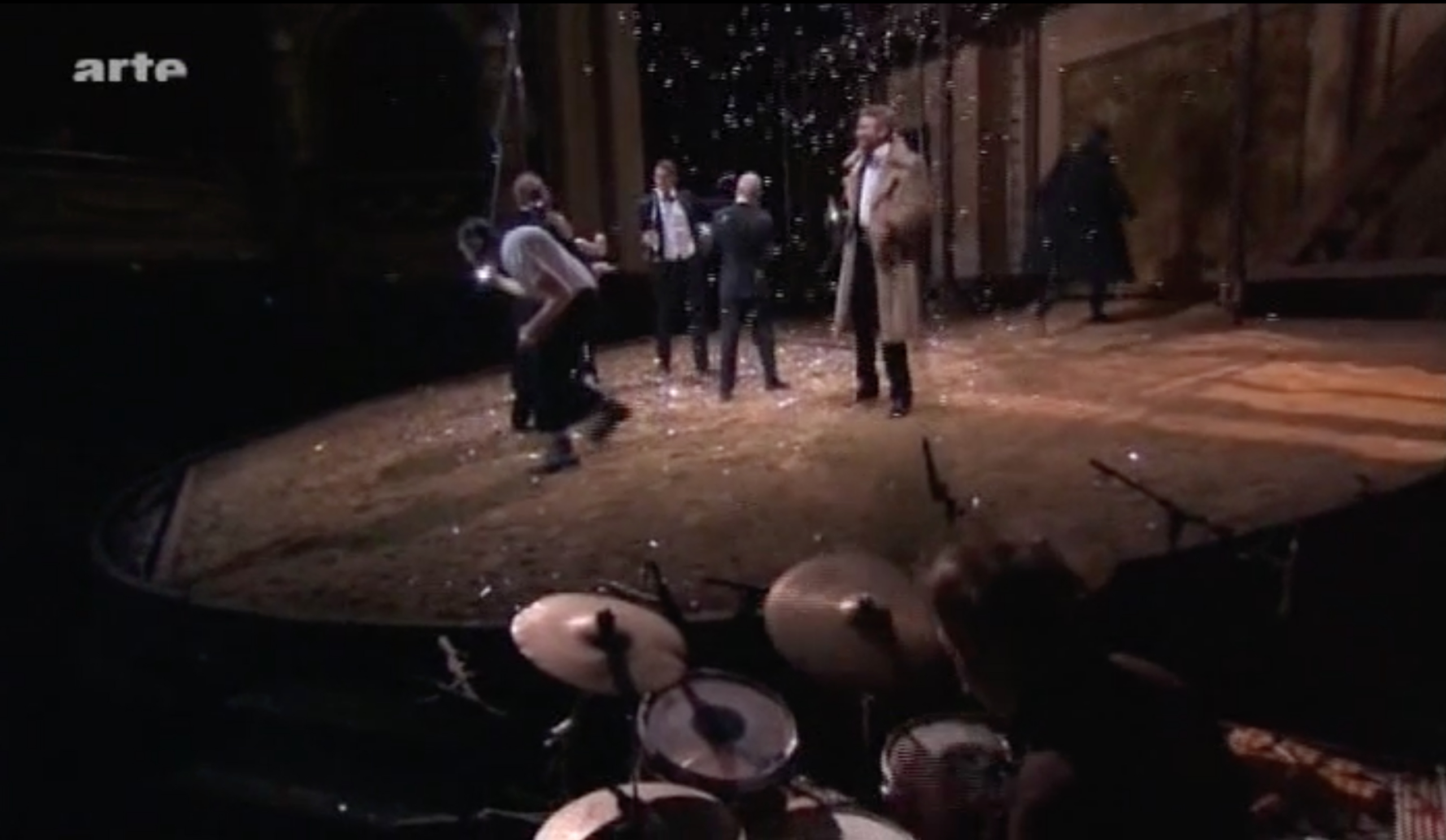
Figure 1: Thomas Witte drums from downstage left in Richard III; video still. © Arte25
Only Eidinger uses the drum-beats and the hanging microphone, particularly to deliver his soliloquies, both instilling and absorbing a Mick-Jaggeresque “bad boy of rock” attitude, which also turns his physical contortions into more than an expression of Richard’s disabilities. They are at least partly an expression of his non-conformity with societal rules of posture and behaviour. Gesturally, this seems almost like a transference: while the drummer plays in a very restrained and economical way, Eidinger paces, twists and contorts. The music itself by Nils Ostendorf also symbolises his physicality: frequently the drum patterns defy an easily detectable time signature and are cross-rhythmically juxtaposed to the synth bass pattern. His body is out of joint, as are the beats.
Nichts von euch auf Erden
Nichts von euch auf Erden is an adaptation of the dystopian novel by Reinhard Jirgl from 2014, in which mankind has depleted the Earth and emigration to the Moon and to Mars have started. Here, the role of the drummer is quite different. At the beginning, Matthias Krieg (who also composed the music) is situated right at the back of the smaller stage of the Kammerspiele and the visible drum set remains untouched for some time: initially, Krieg mainly plays a continuous layered texture of synth sounds from his laptop, which interweaves sonically with the sounds created by the performers who are standing in the few inches of water that cover the entire stage (figure 2). At this point the music helps to establish a floating quality of the production’s beginning: flowing movements by the actors, wave ripples and the light reflections they cause, softly undulating voices which are amplified and unstrained, and a continuous soundscape which is harmonically ambiguous and spatially unstable, as the individual tracks of the soundscape meander through space aided by the surround speaker setup.
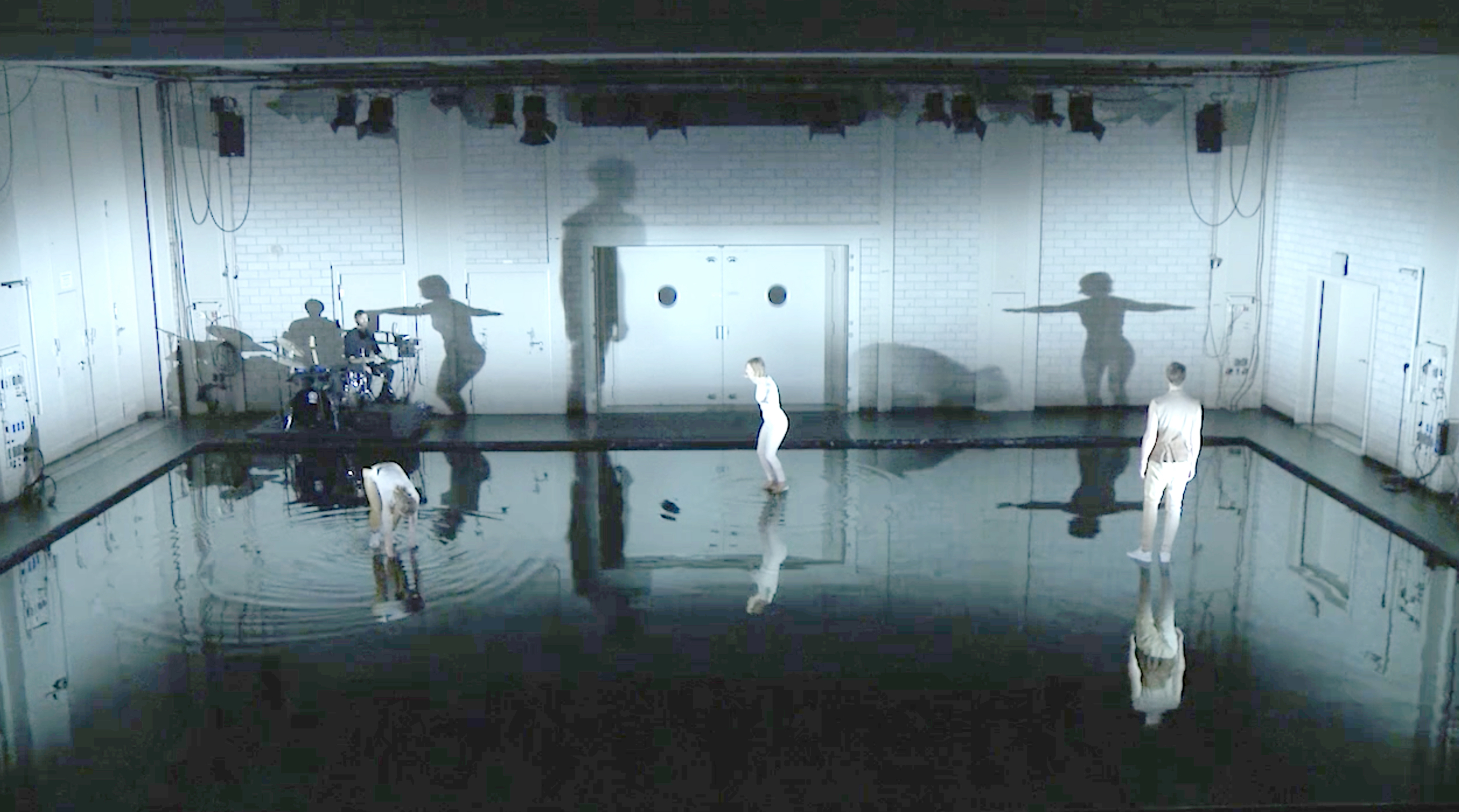
Figure 2: Stage for Nichts von euch auf Erden; video still. © Münchner Kammerspiele26
In later passages this interplay between music, text, and motion is transformed a number of times. One could even say that it is the central directorial approach to create ever-changing arrangements and relationships between the spoken text (its rhythm and melody), the abstract movements of the actors (often accentuated by costumes that transform their physical range of motion), and the space (as determined by scenography and music).
A few more examples stand out: Firstly, there is an almost jam-session-like dialogue between the drums (now more centre stage) and actor Christian Löber, who moves and gestures in fluid motions interspersed with punctuated utterances. His voice runs the gamut of rhythmic, dynamic, and timbral variations in the text, at times responding to, at others being led by Krieg’s improvised drumming. Secondly, and in addition to text, the music and the physical movement are densely interwoven; the stage lighting is also rigged to respond to the music, culminating in a scene towards the end of the show when we only hear the now acousmatic voice of Wiebke Puls, while a hanging rack of about one hundred lights “embody” that voice by modelling its rhythm and timbre like a spectrum analyser. The effect—on me, at least—was that of the lights becoming a speaking collective.
In contrast to the more identifiable idiom in Richard III, the music here is harder to pin down. It defies a clear genre and is also tonally ambiguous and rhythmically very rubato. While there are echoes of jazz and avantgarde styles, Krieg’s drumming consciously avoids recognizable patterns or grooves; it explores the kit as a source of sounds and accents, moves between sparse and dense accompaniments, and adopts a more speech-like quality. In his own words, he describes this movement from a more conventional background position of an on-stage accompanist to an active performance partner as follows: “When it works, I make music together with the speaking and performing actor on stage and we develop a textual-musical maelstrom.”27
Dionysos Stadt
This last statement is actually also quite a fitting description of how Christopher Rüping and his musician and on-stage drummer Matze Pröllochs approach The Ilias, and later Trojan Women, in the second part of his ten-hour production Dionysos Stadt. The “textual-musical maelstrom,” however, is quite different: here the drums—extended by trigger pads and samples and also supported by electronics from a tablet—transform the Trojan War into a relentless rave. The principles and dramaturgies of electronic dance music are applied to text and stage; Pröllochs develops steady, repetitive beats to looped samples, and the music tends to follow a pattern of extended crescendos with its texture getting both louder but also more layered (music by Pröllochs and Jonas Holle). On top of that, we have relentless28 descriptions of battleships, war heroes, fights, triumphs, and downfalls. Critic Maximilian Sippenauer writes: “The protagonist is the drum set, at which Matze Pröllochs is seated in midst of the illuminated white wall of Troy transposing the greatest battle in literary history into senseless noise.”29 Musically, it is far from noise, I would argue; it is instead an insistent pulse, which in its ebbing and flowing captures the increasing horror, the waves of ships, the duration of the war, and the contrast between an outer stillness as the siege plays out and inner growing tension of male frustration.
In the performance, the drums are indeed placed centre stage, built into a scaffolding which may well represent the city walls of Troy, but which also resembles a billboard or a wall of screens at a rock concert (stage design: Jonathan Mertz). And while both Pröllochs and Brombacher remain almost completely static over the course of this long opening, the audience is far from unchallenged, given the wall-to-wall projections by video artist Susanne Steinmassl, which seem to choreograph images and their movements on screen. Principally, there are busts by the actors often arranged in a triptych, sometimes as photos, sometimes transformed into slowly rotating marble busts, and finally morphing between the two. There are also moments of an onslaught of images in a music video style, colourful and in quick succession. And there is an extended section of small projected icons, such as Trojan horses or battle shields, falling like snow with a black backdrop. Through all this, one should add, the actors either wear make-up, face masks, or have words written on their faces and bodies—even the drum head of the bass drum has writing on it, saying “Shine Bright’—Lakedaimon.”30 It is not unusual for drum heads to be adorned with a band’s name, for example, but here—as with the faces and most other surfaces on stage—the writing is visibly added retrospectively with red sticky tape, a quick and dirty layering.
The central motion in this whole first section, then, is one of palimpsest overwriting, overlaying, superimposing. This echoes the musical idiom of electronic dance music, which pervades whole sections (and is, as you will have guessed, anything but “senseless noise”), but which in its use of loops, samples, beats, and the dialectic of repetition and variation becomes an expression of this palimpsest approach.
Out of the three productions, Pröllochs is also the most theatrical drummer—not, however, by what he does, but by how he is staged: To begin with, he actually makes an entrance (after a few minutes of visibly lingering behind the wall), already operating sounds through a tablet, later also makes an exit. At the set he plays, concentrated and with no unnecessary gestures or posing, and there is a certain tension between his slight frame and gently bopping shoulders and the amplified and at times quite powerful beats and solo passages he plays. He also wears a costume and make-up (see figure 7), again creating a tension between, on the one hand, the more masculine and tribal-looking face tattoo writings, and on the other hand, the more feminine cropped t-shirt and the dangling in-ear headphones resembling nipples. In this narrative context of hyper-beautiful women (Helena) and hypermasculine heroes (Hector, Achilles etc.), it is quite an androgynous look.
Most importantly, however, there is a drastic shift in status for the drummer. Having been the roaring engine of the show for about eighty minutes, everything changes after the fall of the walls of Troy (see figure 3). The white porcelain tiles are shattered noisily, the light changes into a warmer wash, and the Trojan women become the centre—but not as despondent servants lamenting their fate, but as self-assertive representatives of the #me-too movement. Pröllochs is dragged from his now quiet drum set and, while being referred to as a military leader, becomes the receiving end of abuse and ridicule from the “loot.”
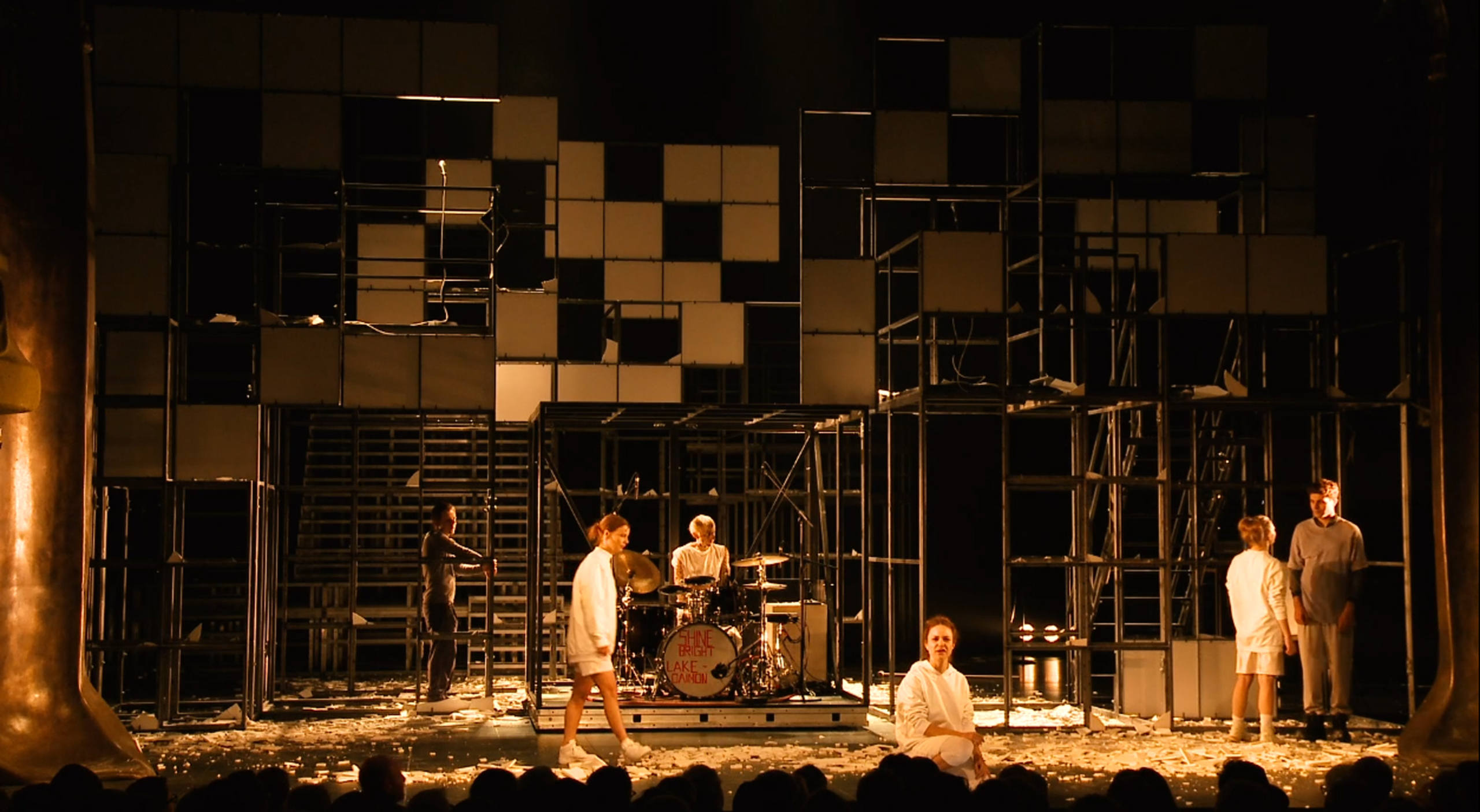
Figure 3: Women of Troy centre stage; video still. © Münchner Kammerspiele
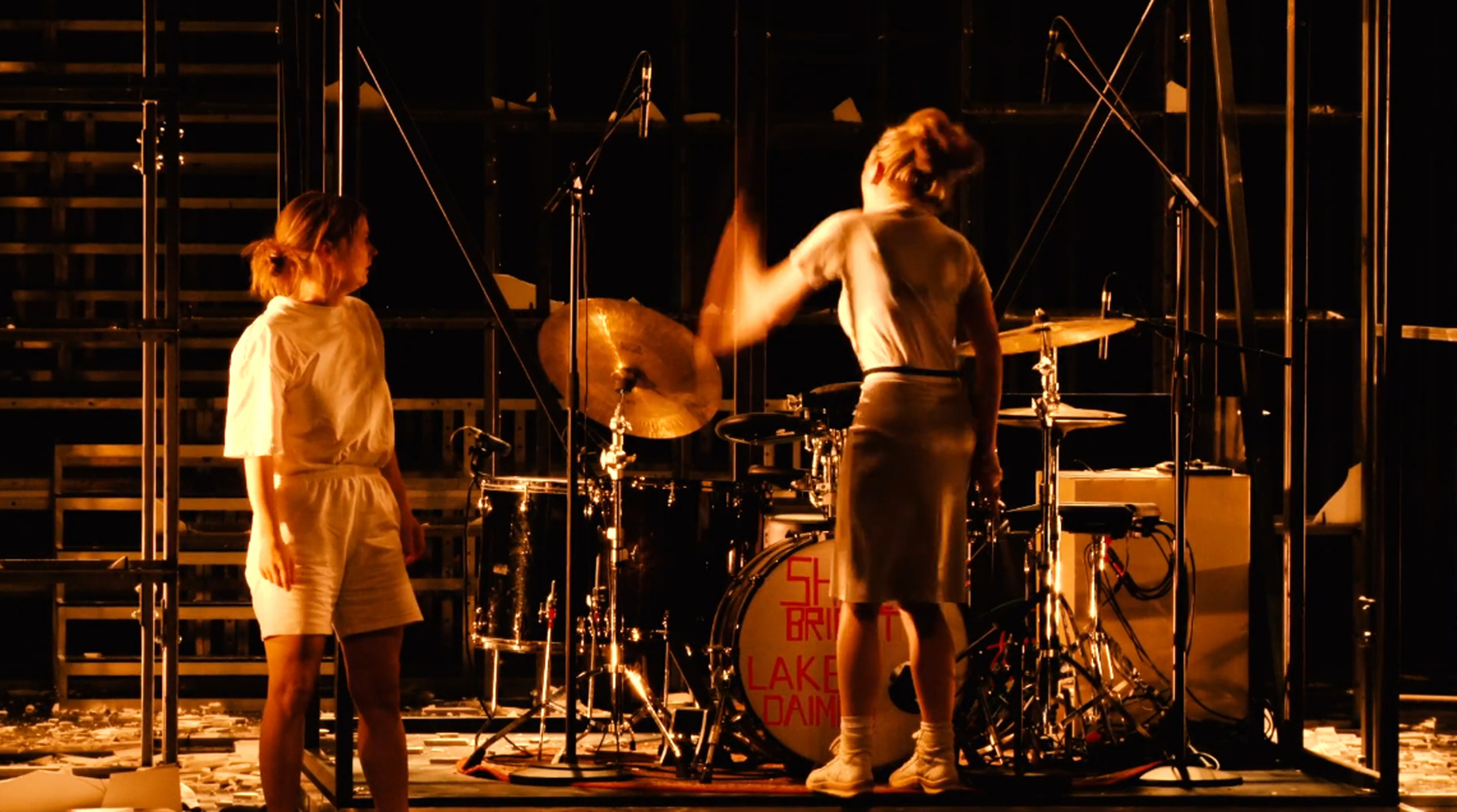
Figure 4: Banging their own drum: Maja Beckmann (left) and Gro Swantje Kohlhof; video still. © Münchner Kammerspiele
This reversal of status culminates in two gestures: at one point, the women begin to operate the men like puppets, raising their inanimate arms and voicing them as shallow and thoroughly primitive male specimens (“I can only drink and fight and fuck”) who compare the relative breast sizes of their female slaves. The second “gestic” moment (also in a Brechtian sense of the word31) happens, when Gro Swantje Kohlhof as Cassandra bemoans being traded off to Agamemnon to her mother Hecuba, and in an act of outrage picks up the sticks from the drum set. Standing in front of it, she hits its cymbals violently while sarcastically bellowing the bridal march “Treulich geführt” from Wagner’s Lohengrin. It is a poignant and telling contrast to Pröllochs’ physically restrained drumming—a moment in sharp acoustic relief also to the relative silence before and after it. It also highlights the gender reversal in musical and physical movement that is the undercurrent of the Troia part; the men are mostly still, their motions internalised, needing visible and audible amplification as they are caught up in loops and loops of sound and war, whereas the women play with some expansive swagger, projecting their lines, using the stiff immobile men as toys and banging their own drum (see figure 4).
Part 2: Arriving and Shifting: Motions in Thom Luz’s Olympiapark in the Dark
I have chosen the case study for the second part for two reasons: it widens the scope with regard to what role stillness, motion, space, and gesture might play for music on stage, and its genesis also suggests a different kind of relationship between music and scene. While all three theatre projects above were based on text (two canonical dramas and one novel adaptation) and have found ways to respond to these texts by choosing a performance style that made integral use of music and musicianship, most of Thom Luz’s projects and Olympiapark in particular are devised theatre32 (and often also composed theatre33). This means they are based on a variety of materials, ideas, and starting points, such as—in the case of Olympiapark—Charles Ives’ short composition Central Park in the Dark (1906). It is not, in his view, “theatre with music.” Instead, the production of sound and its ensuing theatricality are at the heart of the performance.34
As director-in-residence under the new artistic leadership of Andreas Beck at the renowned Residenztheater München, Luz sought to thematically explore the city of Munich from the perspective of a new arrival and through a lens (or should one say: an ear trumpet?) of its musical and sonic history. He wanted the performance to be understood as an invitation to perceive the world as musical. Again, the palimpsest became an important trope and technique in the devising process. The Olympiapark in Munich is itself an artificial mound, erected on tons of rubble from World War II, and Charles Ives’ composition is a compositional rendering of what men would have been hearing “some thirty or so years ago (before the combustion engine and radio monopolised the earth and air), when sitting on a bench in Central Park on a hot summer night.”35 The idea of historic layers and subsequent superimpositions is also present in the performance itself; pieces of music from Munich’s cultural past are continuously being cited, at times performed, but often played over each other, or combined with more contemporary materials and sources.
But let us go back to the beginning of the piece and look at how Luz and his creative team36 relate motion, gesture, and music together as a process of arriving, becoming, framing, and shifting.
Daniele Pintaudi opens the performance by a gesture of drawing a frame around most of the black box stage, which the audience looks down on from their raked seating. The frame is intangible, though, conjured up through a laser beam hitting a series of small mirrors and reflected in ninety-degree angles around the front of the stage (see figure 5). As if Ives drew a compositional frame around the sounds of nature in the park, we are now encouraged visually to look at the ensuing performance as a music-theatrical event—even though for most of it we are allegedly just witnessing the preparations for a concert to be held at the end of the performance.
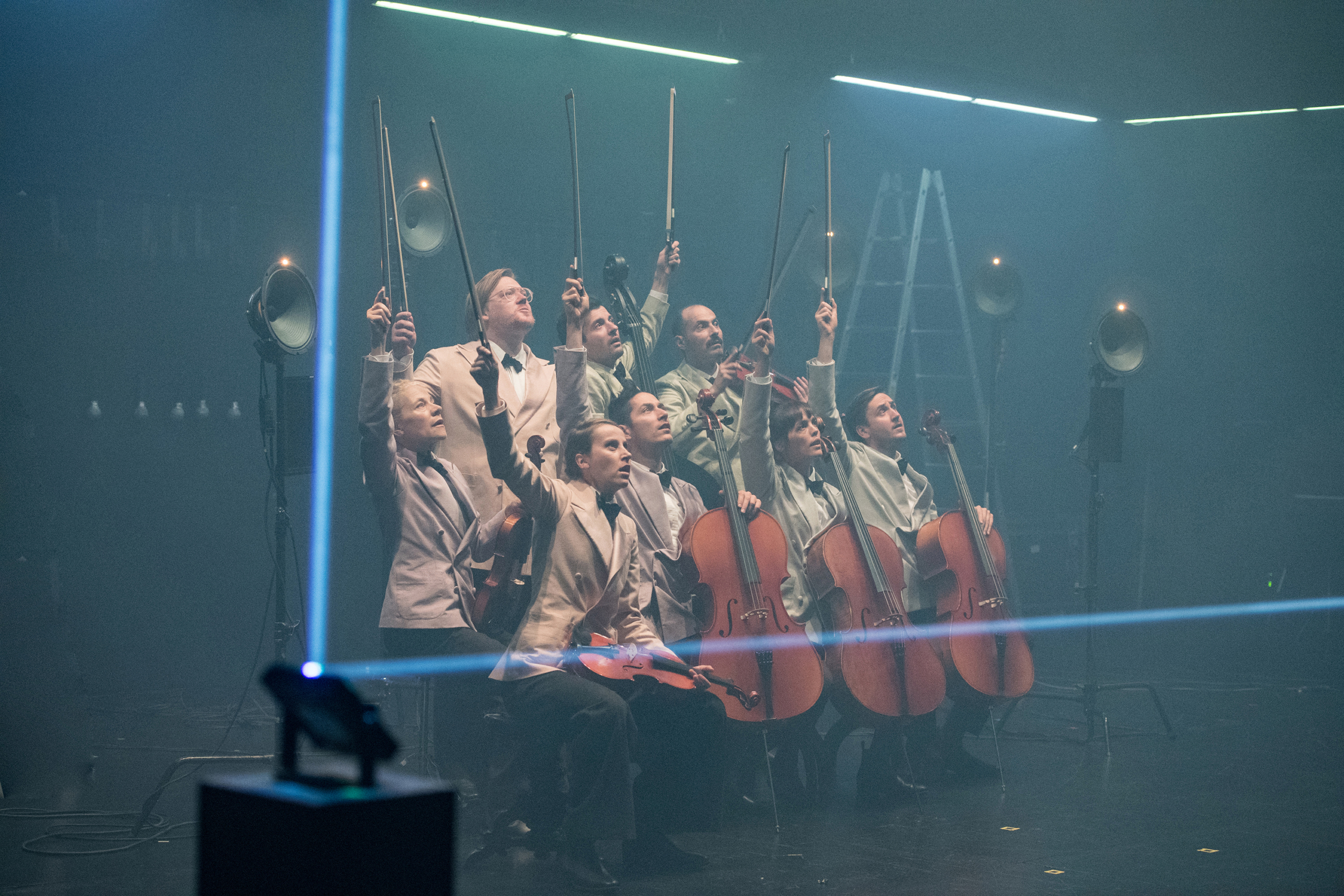
Figure 5: Ensemble and speakers in Olympiapark in the Dark. © Sandra Then
The attention then shifts from the presentational space to the performance space, since the actor-musicians become audible first from outside before entering the space via the landing usually reserved for light technicians near the back of the audience. They are seemingly introduced to the new space by a guide, but since they all talk in a cluster of voices, little detail can be made out. Already we are invited to concentrate on the sound rather than the semantics of this vocal cloud which passes through the entire space, down a spiral staircase out into the lobby again and back with equipment and musical instruments.
The act of arriving is then composed as a continuous music-theatrical process and is staged in multiple forms. We see the actor-musicians getting to know the new place and beginning to populate it and make it into a space (see de Certeau’s distinction above). We encounter Munich through the eclectic research presented by the performers, the bits of information about musical pieces, about measurable loudness of certain events (such as the audience’s cheer for a goal in the Allianz arena), but also through documents such as an old promotional Super8 film, which seems to have been made by the Tourism Board and highlights all the main attractions commonly associated with the city. Arriving also involves unpacking instruments and equipment, testing and rehearsing as forms of accommodation and acculturation to new surroundings. These are acts of settling in and filling the place not just physically, but also sonically, checking how it resonates with the new arrivals.
All of this may seem mundane and potentially quite boring—and some of the spectators seem to find that to be the case. But Luz has a fascination for the quotidian, the non-dramatic, the aesthetics of everyday non-events. He cites the Swiss-German author Robert Walser as an inspiration for his idea of theatre, claiming that Walser once said: “Theatre should make an effort to calm down those who are too confused, and to confuse those who are too calm.”37
The meditative, aimless pace—often associated with a notion of flânerie—certainly contributes to this kind of theatrical phenomenology, but there is also the appeal (or the confusion) of the many shifts and defamiliarizations that characterise Luz’s style. Here are a few examples: Firstly, the projector, which plays the promotional Super8 film, projects the film bottom up and backwards so that we struggle to see and hear the familiar sights of the beer garden at the Chinesischer Turm in the Englischer Garten (complete with a Bavarian brass band), or the soccer stadium with its resident FC Bayern as filmic representations. The familiar is estranged or recontextualised and turned into objects of colour, motion, and abstract sound.
Secondly, many props on stage are transformed into instruments; bubble wrap and a tray of pebbles become percussive sound sources, and a step ladder is turned into a mallet instrument, first by hitting its steps (which sound higher as they get smaller), but also by accompanying the act of climbing it in mickey-mousing fashion with the solfege of the actor-musicians.
The performers themselves, thirdly, oscillate between being actors, performers, and musicians—not quite private, not quite in their usual professional habitus, and not quite fictional characters either. Is the viola player (Mareike Beykirch) a trained musician stepping out of her comfort zone to deliver a short monologue or a professional actor and amateur musician?
Forthly, many of the sounds produced on stage—steps, breaths, singing, speaking—are recorded and played back, sometimes layered or looped, through individual moveable active speakers (see figure 10). This renders them “objets sonores” or sound objects in two ways: They become short musical units in Pierre Schaeffer’s sense,38 and “a coming together of an acoustic action and a listening intention.”39 In addition, they are objects that sound, but the speakers are deliberately not staged as “transparent” media, not mere “neutral” amplifiers of sound, but moveable objects, the acoustic properties and sonic behaviour of which are brought well into focus. We are thus “ceasing to listen to an event through the intermediary of sound, we will still be listening to sound as a sound event.”40 That sound event is inextricably linked to its arrangement and motion in space and to the gestures which produced it and which are remembered as the sound is removed from one object and placed into another, making it both acousmatic and non-acousmatic at the same time.
Finally, there is quite a playful and ironic shift from video to notation, rendering moving images into a graphic score. Video artist Jonas Alsleben filmed the performers on a day out in Olympiapark, small black dots in a wide landscape, following trails or walking up and down the hilly terrain. In the performance, this is projected silently on a canvas, upon which two lines of staves have been drawn. The filmed individuals are thus transformed into moving note-heads and ephemeral instructions for the actor-musicians, who improvise a live rendition of this animated score. Other than being a rather funny scene, which gets a chuckle out of the audience, it is also a whimsical stab at normative ideas of notation and “the work” in music theatre, suggesting the composability of all materials in the tradition of John Cage or Mauricio Kagel. It calls the mediality and modality of music-theatrical performance into question: a film becomes a score, a score becomes impermanent, images become musical, sounds become objects, playing music becomes theatre, speaking becomes a composition, and so on.
This also renders our ideas of genre (is this music-theatre?) obsolete. Luz’s piece is not “music-theatre” in a traditional sense with its originally close links to (and rejections of) opera, certainly.41 But in a wider sense, there are connections to Christoph Marthaler, Mauricio Kagel, or Alvin Lucier, all of whom have worked at the boundaries of this term, widening the frame in different directions. Looking at the performance in the context of “theatre music” as outlined above, however, is also not an attempt to categorise it, but to follow the trails of sound, music, and motion relationships in theatre, and to extrapolate some of the common questions across different but related phenomena. In the end, it remains a performance that defies categorization and in doing so and in making us investigate the aesthetic conditions and processes of listening to and encountering our surroundings, it is quite meta-theatrical. If we wanted to put a label on it, Heiner Goebbels’ idea of a “polyphony of the elements”42 of theatre comes to mind. This, he argues, “allows us to see a performance from different perspectives. A polyphony which opens up many access points and enables audiences to individually synthesise their impressions from all the single impressions.”43 This kind of polyphony is then both the result of an undirected, contemplative, strolling process of discovery and creation by the artistic team, and the condition for a similarly aimless, flâneur-like mode of attending44 and experiencing Luz’s performances.
Conclusion
Using a range of recent productions in German theatres, which are quite different at first glance and cover very diverse thematic ground, I have sought to highlight the experimental nature in which they all redefine the relationship of music and scene, or sound, motion, and gesture—both in support of their narratives, and, just as importantly, in order to facilitate an aesthetic experience for their audiences.
In part one, all three productions I discussed use the drum set and the drummer as theatrical partners, helping to frame the characters and the text in different ways, inviting us to look and listen with fresh eyes and ears. They involve the musician as a persona45 to very different extents, though: Richard III barely highlights the performative aspects of musicking on the theatre stage, Nichts makes the drummer an equal performative partner, while Troja even (quite literally) overwrites the musician’s persona with a fictional character and uses his physical presence to redraw the gender hierarchies in an ancient play. In different ways, all productions also make use of the various kinds of iconographies and musical idiomaticness of drumming, sometimes citing, but often underplaying the rock/jazz/dance baggage and the clichés of a drummer’s habitus.
In part two, the production in question (Olympiapark in the Dark) further dissolves the separation between actor and musician, between acting and musicking, presenting and representing sounds, gestures, personae, and worlds. It seeks to transform processes of arriving and of acquainting oneself with a new surrounding and its eclectic histories in a non-linear process of perception and absorption, leading to a performance structure which affords an experience and may even trigger a contemplation on the nature of music-theatrical relations themselves.
All performances have in common, I should add, that they display a certain playfulness, an ironic quality and a sense of humour—despite all of them touching on very serious themes: from the abuse of power by a narcissistic leader, to the end of the world as we know it, the atrocities of ancient warfare, or the complex histories of Munich as a gravitational centre for the highest achievements of the arts and the lowest moments of humanity. An experimental approach to music and theatre seems to offer ways in which to deal with the paradoxes and entropies of human life on stage.
With respect to the music in question, I hope to have demonstrated that rather than merely amplifying a current mood or semantic on stage, theatre music—in the many forms we encounter it today—often proves to be a much more complex expressive partner in contemporary theatre, hardly a separate function but an integral part of it, particularly when it physically and spatially asserts itself in such varied ways as I have outlined here.
In a time of renewed interest for the performance of music—as expressed, for example, by new musicology and some of its protagonists like Nicholas Cook, Georgina Born, Carolyn Abbate, or Christopher Small46—the kind of enquiry proposed here adds another layer, I would argue, since it looks at live performance outside of a generic dispositive such as the concert, the opera, or the musical, all of which come with more established rules and expectations for the role of music and indeed for musicians within them. Tamara Quick summarises this aptly by stating: “In the context of theatre music in particular, one can no longer speak of music as an object or a work that is comprehensible in written form, but exclusively of an artistic practice full of performative processes. Theatre music is an integral part […] of a theatre production that is constituted by manifold artistic, personal, and institutional relations.”47 It thus demonstrates the layers of connections and meanings between music, gesture, and motion in contexts, which are not guided by generic rules and expectations.
I could only hint at the implications this has for analysing phenomena such as those used as case studies here,48 but I hope it has become evident that theatre music requires a multilateral approach (quite distinct also from how we analyse film music), which takes musical, sonic, theatrical, performative, cultural, technological, as well as further aspects into account.
Acknowledgements
Many thanks to all colleagues who offered constructive comments to an early version of this paper presented at the conference “Music as an Experimental Field for Movement” (Strobl, Austria, Sept. 2020), to Stephanie Schroedter and Lisa Konnerth for organizing the conference brilliantly and inviting my contribution, and to Tamara Quick for her feedback on the written draft of this chapter.
***
Funding by the Deutsche Forschungsgemeinschaft (DFG, German Research Foundation)—Project number 390568112 was also very gratefully received.
-
Christopher Small, Musicking: The Meanings of Performing and Listening (Hanover: University Press of New England, 1998).↩︎
-
Roger Savage, “Incidental Music,” in New Grove Dictionary of Music and Musicians, 2nd edition, vol. 12, ed. Stanley Sadie (London: Macmillan, 2001), 138-45.↩︎
-
Theatre artist and scholar Bagryana Popov asserts: “Music is essentially relational: meaning and affect are created between people within the performance space. It is part of the atmosphere in theatre. It is a corporeal, sensory presence, and affects the space and shapes the moment, with all its inherent dramaturgy and nuance.” “Music, Silence and the Single Note in the Creation of Meaning in Theatre,” in Australasian Drama Studies 67 (Oct. 2015): 28-48, 48.↩︎
-
Gay McAuley, Space in Performance. Making Meaning in the Theatre (Ann Arbor: University of Michigan Press, 1999).↩︎
-
Ibid., 25.↩︎
-
Ibid., 30.↩︎
-
Jens Peters, Narration and Dialogue in Contemporary British and German-Language Drama (Texts—Translations—Mise-En-Scène) (PhD dissertation, University of Exeter, 2013), accessed 21 June 2021, https://ore.exeter.ac.uk/repository/bitstream/handle/10871/14393/PetersJ.pdf;sequence=3;Narration.↩︎
-
“Bewegungen des Körpers” und “statische Haltungen”. Alexander Kuba, “Geste/Gestus,” in Metzler Lexikon Theatertheorie, ed. Erika Fischer-Lichte, Doris Kolesch, and Matthias Warstat (Stuttgart: Metzler, 2005), 129-36, 129 (trans. Jens Peters).↩︎
-
“Für die es keine zufriedenstellende kausale Erklärung gibt.” Vilém Flusser, Gesten (Bensheim and Düsseldorf: Bollmann, 1991), 8 (trans. Jens Peters).↩︎
-
“Einen fixierbaren Anfang und ein fixierbares Ende. Diese streng rahmenhafte Geschlossenheit jedes Elements einer Handlung, die doch als ganze in lebendigem Fluß sich befindet, ist sogar eines der dialektischen Grundphänomene der Geste.” Walter Benjamin, “Was ist das epische Theater?,” in Gesammelte Schriften II.2, ed. Rolf Tiedemann and Hermann Schweppenhäuser (Frankfurt am Main: Suhrkamp, 1977), 519-39, 521 (trans. Jens Peters).↩︎
-
David Roesner, “‘Gequietsche, Gewaber oder Gewummer.’ Methodische Herausforderungen bei der Analyse von Theatermusik,” in Methoden der Theaterwissenschaft, ed. Christopher Balme and Berenika Szymanski-Düll (Tübingen: Narr, 2020), 169-86.↩︎
-
See also: David Roesner, Theatermusik. Analysen und Gespräche (Berlin: Theater der Zeit, 2019).↩︎
-
Christopher Small, Musicking: The Meanings of Performing and Listening (Hanover: University Press of New England, 1998).↩︎
-
William Shakespeare, Richard III, trans. Marius von Mayenburg. Director: Thomas Ostermeier, stage design: Jan Pappelbaum, costumes: Florence von Gerkan, music: Nils Ostendorf, video: Sébastien Dupouey, dramaturgy: Florian Borchmeyer. Schaubühne Berlin, 7.2.2015.↩︎
-
Reinhard Jirgl, Nichts von euch auf Erden. Director: Felix Rothenhäusler, stage design: Matthias Singer, costumes: Elke von Sivers, music: Matthias Krieg, dramaturgy: Tarun Kade. Münchner Kammerspiele, 16.12.2015.↩︎
-
Dionysos Stadt based on varied ancient Greek texts. Director: Christopher Rüping, live-musician: Matze Pröllochs, stage design: Jonathan Metz, costumes: Lene Schwind, dramaturgy: Valerie Göhring, Matthias Pees, Music: Jonas Holle, Matze Pröllochs. Münchner Kammerspiele, 6.10.2018.↩︎
-
Dillon speaks of “performing masculinity through drumming.” Gregory M. Dillon, Masculinity in Carioca Carnaval Drumming (Master thesis, University of Massachusetts Dartmouth, 2013), iii, accessed 13 July 2022, https://www.umassd.edu/media/umassdartmouth/portgrad/Dillon.MasculinityCarnaval.MAthesis.pdf.↩︎
-
Bill Bruford, Uncharted. Creativity and the Expert Drummer (Ann Arbor: University of Michigan Press, 2018).↩︎
-
For a particularly in-depth and authoritative analysis see Matt Brennan, Kick It. A Social History of the Drum Kit (Oxford: Oxford University Press, 2020).↩︎
-
Michel Certeau, The Practice of Everyday Life (Berkeley, CA: University of California Press, 1984).↩︎
-
Brennan, Kick It, 156-65.↩︎
-
Peter von Becker, “Alles gegeben, bürgerlich geblieben. Lars Eidinger als Richard III. an der Schaubühne,” in Der Tagesspiegel, 9.2.2015, accessed 4 January 2021, https://www.tagesspiegel.de/kultur/lars-eidinger-als-richard-iii-an-der-schaubuehne-alles-gegeben-buergerlich-geblieben/11344546.html.↩︎
-
“Das donnernde Schlagzeug.” Ibid. (my translation).↩︎
-
It is noteworthy that in Peter Boenisch and Thomas Ostermeier’s account of the genesis of the production, music is mentioned only occasionally and in passing (Peter M. Boenisch and Thomas Ostermeier, The Theatre of Thomas Ostermeier [London: Routledge, 2016], 187-227).↩︎
-
The still (figure 1) stems from a TV broadcast of the production by arte, with kind permission. The programme was called: Richard III, broadcast on 18 July 2020, archived at: https://programm.ard.de/TV/arte/richard-iii-/eid_287243198817257.↩︎
-
The stills (figures 3-9) stem from unpublished video recordings by the Münchner Kammerspiele for their archive used here with kind permission by the theatre. The details of both productions are detailed in footnotes in the introduction.↩︎
-
“Wenn es funktioniert, mache ich mit den sprechenden und performenden Schauspieler*innen zusammen Musik auf der Bühne, entwickeln wir einen inhaltlich musikalischen Sog.” Roesner, Theatermusik, 187 (my translation).↩︎
-
The first section, which features Peter Brombacher as the main narrator and is mainly a list of the ships and their crew, lasts well over twenty-five minutes.↩︎
-
Maximilian Sippenauer, “Mehr als nur Theater. Dionysos Stadt—Christopher Rüpings zehnstündiger Ritt durch die Topoi der Antike bereitet den Münchner Kammerspielen ein großes Theatererlebnis,” in Nachtkritik.de, 7.10.2018, accessed 4 January 2021, https://nachtkritik.de/index.php?option=com_content&view=article&id=15919:dionysos-stadt-christopher-ruepings-zehnstuendiger-ritt-durch-die-topoi-der-antike-bereitet-den-muenchner-kammerspielen-ein-grosses-theatererlebnis&catid=99&Itemid=100190 (my translation): “Protagonist ist das Schlagzeug, an dem Matze Pröllochs inmitten der weißleuchtenden Mauer Trojas sitzt und die größte Schlacht der Literaturgeschichte in sinnloses Lärmen transponiert.”↩︎
-
Lakedaimon (engl.: Lacedaemon) was a Son of Zeus and King of Sparta. It is possible that the logo is also a reference to the Rihanna Song from 2012 “Shine bright like a diamond”.↩︎
-
See Kenneth Fowler, Received Truths: Bertolt Brecht and the Problem of Gestus and Musical Meaning (New York: AMS, 1991).↩︎
-
See Tina Bicât and Chris Baldwin, Devised and Collaborative Theatre: A Practical Guide (Ramsbury, Marlborough: Crowood Press, 2002); Deirdre Heddon and Jane Milling, Devising Performance. A Critical History (Basingstoke: Palgrave Macmillan, 2006); Alison Oddey, Devising Theatre: A Practical and Theoretical Handbook (London: Routledge, 1994); Jacqueline Smart and Alex Mermikides, eds., Devising in Process (London: Palgrave Macmillan, 2009).↩︎
-
See Matthias Rebstock and David Roesner, eds., Composed Theatre. Aesthetics, Practices, Processes (Bristol: Intellect, 2012).↩︎
-
In the following I refer to two unpublished sources: A live interview I conducted with Thom Luz on 16 December 2016 as part of the symposium “Singing the Document. Exploring the Relationship of Documentary Material and Its Music-Theatrical Treatment,” hochX Munich (see http://www.theaterwissenschaft.uni-muenchen.de/aktuelles/archiv/archiv_2016/termine/symp_sing_act_doc/index.html, accessed 13 July 2022) and a guest appearance he made to talk about Olympiapark in the Dark on 28 November 2019 in Tamara Quick’s seminar “Von der Banda zur Band: Musizieren auf der Theaterbühne” (Theatre studies, LMU Munich).↩︎
-
Charles Ives, Central Park in the Dark [Musical Score], ed. John Kirkpatrick (Hillsdale, NY: Mobart Music Publications, 1978).↩︎
-
Director, stage design, and lighting: Thom Luz, musical direction: Mathias Weibel, costumes and lighting: Tina Bleuler, video: Jonas Alsleben, dramaturgy: Katrin Michaels. With actors/musicians Mareike Beykirch, Elias Eilinghoff, Christoph Franken, Camill Jammal, Barbara Melzl, Mara Miribung, Daniele Pintaudi, Noah Saavedra.↩︎
-
Walser is quoted with this line elsewhere (“Die Theaterkunst sollte sich Mühe geben, die allzu Verwirrten zu beruhigen und die allzu Beruhigten zu verwirren.”), at Deutsches Theater, accessed 14 August 2020, https://www.deutschestheater.de/mediathek/hoer-stuecke/podcast-304/. I could, however, not find an original source for the quotation.↩︎
-
See Pierre Schaeffer, Treatise on Musical Objects: An Essay Across Disciplines, trans. Christine North and John Dack (Oakland: University of California Press, 2017). Also: Jean-François Augoyard, Sonic Experience: A Guide to Everyday Sounds, trans. Andra McCartney and David Paquette, ed. Henry Torgue (Montreal: McGill Queens University Press, 2005), 6.↩︎
-
Schaeffer, Treatise on Musical Objects, 213, original emphasis.↩︎
-
Ibid., original emphasis.↩︎
-
See Andrew Clements, “Music Theatre,” in New Grove Dictionary of Music and Musicians, 2nd edition, vol. 17, ed. Stanley Sadie (London: Macmillan, 2001), 534-5.↩︎
-
Heiner Goebbels, Aesthetics of Absence (London and New York: Routledge, 2015), 104.↩︎
-
Ibid. See also: David Roesner, “The Politics of the Polyphony of Performance: Musicalization in Contemporary German Theatre,” in Contemporary Theatre Review 18/1 (2008): 45-55.↩︎
-
I am using this word advisedly with reference to George Home-Cook’s study of aural attention in theatre. George Home-Cook, Theatre and Aural Attention (Houndmills, Basingstoke: Palgrave, 2015).↩︎
-
Philip Auslander, “Musical Persona: The Physical Performance of Popular Music,” in The Ashgate Research Companion to Popular Musicology, ed. Derek B. Scott (Farnham, Surrey and Burlington, VT: Ashgate, 2009), 303-15.↩︎
-
Carolyn Abbate, “Music—Drastic or Gnostic,” in Critical Inquiry 30 (spring 2004): 505-36; Georgina Born, “For a Relational Musicology: Music and Interdisciplinarity, Beyond the Practice Turn. The 2007 Dent Medal Address,” in Journal of the Royal Musical Association 135, no. 2 (2010): 205-43; Nicholas Cook, Beyond the Score: Music as Performance (New York: Oxford University Press, 2013); Small, Musicking.↩︎
-
“Insbesondere im Kontext heutiger Theatermusik kann nicht mehr von Musik als Objekt oder schriftlich begreifbarem Werk gesprochen werden, sondern ausschließlich von einer künstlerischen Praxis voller performativer Prozesse. Theatermusik ist ein integraler Bestandteil […] einer sich aus vielfältigen künstlerischen, personellen und institutionellen Relationen konstituierenden Theaterproduktion”. Tamara Yasmin Quick, “Die Qualität im Relationalen. Herausforderungen in der Analyse theatermusikalischer Interpretationen,” in Analyse & Interpretation, ed. B. Asmus (Mainz: Schott, 2024, 160-80, here: 165)) (my translation).↩︎
-
For more detailed methodological discussions see: Quick, “Die Qualität im Relationalen” and Roesner, “‘Gequietsche, Gewaber oder Gewummer.’”↩︎