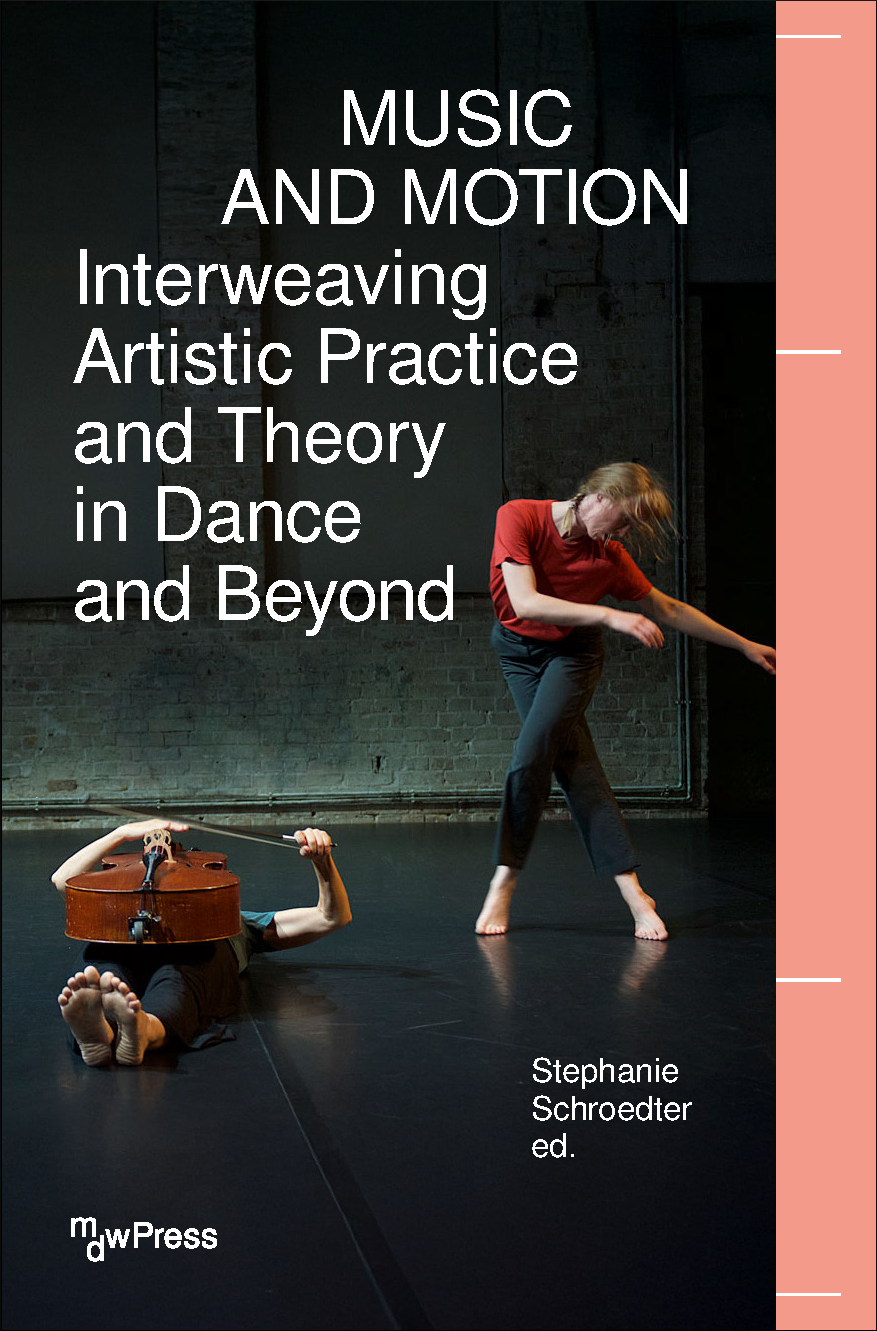
Adriana Hölszky’s Roses of Shadow and Deep Field in Martin Schläpfer’s Choreography
Barbara Dobretsberger 
How to cite
How to cite
Abstract
Abstract
On the basis of an in-depth study of the score and the video material provided by the Düsseldorf Opera, the interplay of music and movement is explored. The independence of the creative processes always emphasized in statements by Adriana Hölszky and Martin Schläpfer—the putting down on paper of the sounds and the dance staging took place practically without prior consultation between composer and choreographer—could lead one to expect a looseness, perhaps even non-commitment between music and ballet. However, the analytical findings of both the music and the choreography point to a number of associative interconnections. Understanding Hölszky’s music as moving sounds and Schläpfer’s choreography as musicalized movement is favored by related procedures such as repetition, variation, motif development or mirroring. Despite this structural proximity and despite a certain affinity of Hölszky and Schläpfer to a “cosmic world view,” music and choreography drift apart repeatedly and cause irritations in the perception of Roses of Shadow and Deep Field.

With Roses of Shadow, Adriana Hölszky has presented what she describes in the subtitle of the work as a sound choreography for soprano and eight instrumentalists. Although the work was commissioned in 2016/17 for a Düsseldorf choreography by Martin Schläpfer, the composer refrains from designating it as a ballet genre—unlike Deep Field, a ballet also choreographed by Schläpfer in 2013. This may be sufficient for an analysis that initially focuses on the functionality and meaningfulness of the composition as a “work as such.” “There [will be] no mutual visualization […]; it is more like Martin Schläpfer and I encircle each other—and we sometimes lose sight and sound of each other in the process,”1 the composer says about the process of creation, thus emphasizing the autonomy of the musical work. Adriana Hölszky is still not entirely satisfied with the subtitle “sound choreography”; with “sound space transformation, spatial sound transformation, sound image, complimentary transformation, sonnets of no return, like a sonnet of no return”2 she circles around the most diverse terms that were considered and discarded again in the search for a subtitle.
The subtitle acts as a program, so to speak—Roses of Shadow is a choreography of sounds, a spatial composition or staging of spatial sound. This reads more freely, more independently, perhaps also more reflectively than the simply functional reference to “ballet music” in the subtitle of Deep Field.3 Nevertheless, the same principle applies to both works in the creative process, namely a focus on the musical composition per se, which Adriana Hölszky calls “absolute music.”4 The choreographic design, the pictorial, dance, and rhythmic realization was as little “prepared” by her in Deep Field as in Roses of Shadow, and in this aspect was consciously left entirely to her colleague.
This radical compositional attitude—an analogy would be the composition of an opera without a rudimentary idea about the visualization of the scenes—is based on the one hand on the composer’s own working method of doing her creative work in voluntary self-isolation. On the other hand, it is based on the new territory that the composer entered when she started writing ballets. On the genesis of Deep Field, the ballet written three years before Roses of Shadow, she notes: “I’ve never had the desire to work with or rather for dance before.”5 Her novitiate as a ballet composer may have triggered an impulse in 2013 to compose something “useful” for ballet. This would explain the somewhat stronger orientation towards the “balletic” (more on this in the second part of this essay dedicated to Deep Field). Indeed, no other work for dance was composed in the creative period between the two ballets discussed here. But even before and after that, one searches in vain for a ballet composition in Hölszky’s œuvre. It is a genre that probably fundamentally has a rather limited appeal for her, apart from Stravinsky’s ballets, in which “the music actually has an independent rank, is independent of a choreography.”6

Figure 1: Scene from Roses of Shadow. © Gert Weigelt
One could interpret this as a sign of mature sovereignty, but also of the composer’s confidence that the choreography would not merely be adequate (in the true sense of the word, an “egalitarianism” on Martin Schläpfer’s part would have been neither desirable nor appropriate). Rather, the fact that there was the chance of an artistically independent, fascinating dance composition coming to light,7 which the choreographer had shied away from, may have contributed to the conception of Roses of Shadow as a “sound choreography” and to the rejection of an intentional, “ballet-suitable” composition.
The basis of this approach to Roses of Shadow is a video production made available by the Düsseldorf Opera. Leaving aside the admission that “with Roses of Shadow a score [emerged] on whose basic coordinates the composer and choreographer intensively agreed, but with whose elaboration Adriana Hölszky then withdrew in order to finally hand over a finished work to Martin Schläpfer and more: to leave the score to him full of trust and freedom,”8 the analytical approach to the work (in the sense of the “complete” choreographed work) followed the chronology of the ballet’s genesis. When asked about the “basic coordinates” that were set out in advance, the composer explains that it was Schläpfer’s wish to use only a few musicians live, a maximum of nine, in order to facilitate the financing of tours. Due to the planned use of a voice, or rather a text, there was some skepticism on the part of the choreographer at first, but this was able to be resolved. Apart from these two agreements, there were no discussions beforehand.9
Following this genesis, the approach to Roses of Shadow presented here began with the study of the score and the analysis of the music; this was followed by an examination of the choreography based on the available video material.10 Similarly to the musical investigation, where special attention was paid to aspects of form, structure, motifs, density, and color of soundscapes, the examination of the choreography focused on the recognition of connections (e.g. through repetition, mirroring, variation, or motif development), on associative interweavings with the music (especially in the text-bound parts) and finally on the question of a dramaturgy. It should be added that neither a comprehensive systematic choreographic analysis nor a complete musical analysis is presented here, but rather individual aspects of music and choreography are singled out in order to contribute to an interdisciplinary exchange.
Nine centers of sound—from voice to wind instruments, strings, koto, accordion and piano to percussion—form the starting point of Roses of Shadow. The palette of timbres is expanded by additional instruments such as alphorn, euphonium, and harmonica (in a wide variety of tunings) as well as by the use of lip sounds, mutes, mallets, plastic cards, oil barrels, and iron ball marbles. Thus, Hölszky overturns Martin Schläpfer’s stipulation of limiting the number of musicians to nine. With regard to the text on which the sound choreography is based, it is relevant that the speaking, creaking, and whispering voices performed by the instrumentalists, which complement the soprano—despite all kinds of sound alienations quite plainly referred to as “voice” —are described by the composer as a “‘shadow’ ensemble or as ‘ghost voices.’”11
Käthe Recheis and Georg Bydlinski translated texts and poems by North American Indians into German12 which acted as an “‘ignition’, [as] the starting point for intensive compositional work.”13 A second inspiration, though more due to the “aura”14 than to a direct setting of text excerpts, comes from Shakespeare’s Sonnet 67. A look at this poem may be permitted with due brevity; after all, the title of the work originates from this poem, and the composer quotes the central line on the back cover of the score: “Why should poor beauty indirectly seek Roses of shadow, since his rose is true?” Without even being able to comment here on the numerous subtleties and thus possibilities of interpretation inherent in Shakespeare’s text, it is at any rate permissible to describe this sonnet, however much abbreviated, as a lament about the abuse and exploitation of natural beauty. Why should a second-rate beauty invent shadow roses by dubious means, when nature holds the true rose in her possession? In terms of content, this consideration closes a circle to the fragments that Hölszky extracts from the texts of the Native Americans.
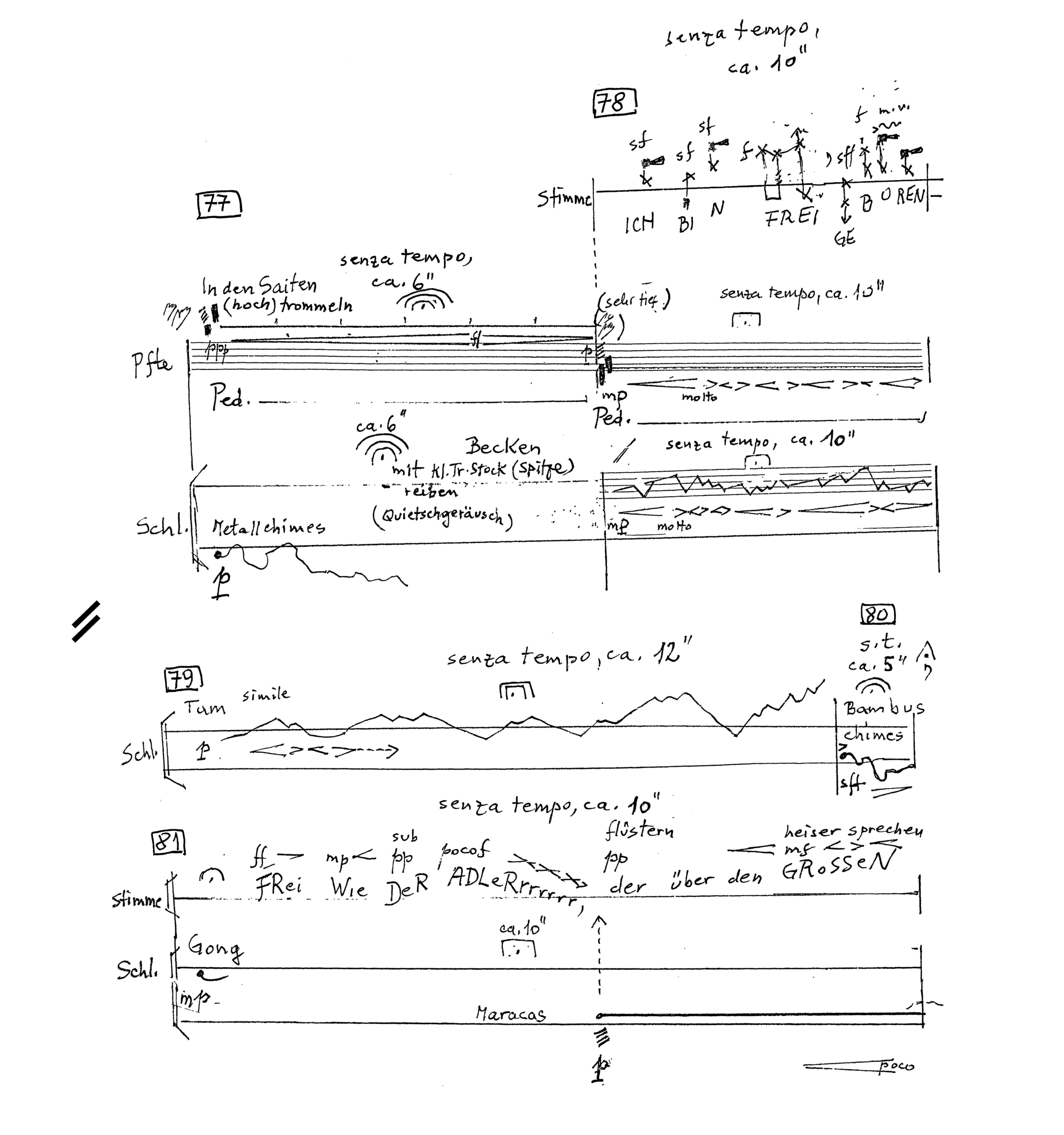
Music example 1: Roses of Shadow, p. 33, mm. 77-81. © 2017 by Breitkopf & Härtel, Wiesbaden
The inclusion of text and voice, since it is not customary in the context of “ballet music,” is certainly remarkable and has an impact on the choreography. A dramatic ballet with a concrete narrative style could not be created on the basis of the text fragments; this would require a plot to be forcibly superimposed. Martin Schläpfer chooses a path that does justice to the composition’s looseness—especially on the text level—and its tendency towards the merely suggestive and associative, and yet does not lose itself in arbitrariness. The renunciation of a concrete story, already manifest in the composition, means a special challenge for the choreographer in creating a dramaturgy, which he cannot do without in the forty-minute Roses of Shadow any more than in the full-length Deep Field. Specific examples from the choreography of Roses of Shadow will be given to illustrate Schläpfer’s associative approach to translating sounds into movement:
Phase I, mm. 52ff. (“I cry with thirst.”15; minute 5:18): Three dancers remain frozen, listening to the words, four female dancers fall to the floor, as if exhausted.
Phase I, mm. 78ff. (“I am born free, free like the eagle soaring over the great blue sky.”16; minute 7:09-9:24): The lying dancers rise collectively; from m. 79 the limbs begin to loosen, the vertical, upright position stabilizes, the wings and the eagle’s eye are symbolized by illustrative gestures. At the same time, however, part of the ensemble performs “hopping” movements that are bizarrely reminiscent of eaglets still unable to fly, hopping around in their eyrie waiting for food. Whether these figures, or rather their gestures, are to be guilelessly acknowledged with a smirk, or are instead meant to represent an ironic, subtle commentary—a counter-position to the powerful, seemingly invincible eagle that has matured into an adult bird—remains open. In any case, this interpretation as a metamorphosis motif would correspond with Hölszky’s subtle irony. The latter is already revealed in the preparatory, detailed study of the score: the soprano voice begins with the clearly articulated text (“I am born free, free like the eagle soaring over the great blue sky.”17), moves into a “trumpet” articulation (m. 87), to phonemes in chains of trills (mm. 89-90) and finally to bright, accentuated, bird-like but miserably choppy R sounds (m. 94).
Phase III, m. 10 (“the trees”18; minute 20:03): The abruptly assumed posture with asymmetrically “gnarled,” tree-top-shaped, branch-shaped, or root-stick-like arranged limbs seems like a sculpture of the text fragment placed in space. The second compositional parallel passage which immediately follows in m. 15 (“the stones”19; minute 20:30) releases part of the ensemble from its stiffness and prompts more sweeping, round movements illustrating “rolling” pebbles with some imagination. The choreography in the third parallel passage in m. 20 (“the earth”20; minute 20:42) with the dancers’ bodies sinking to the ground is semantically easy to interpret.
Phase VII, mm. 1ff. (“You spread death, you buy and sell death, but you deny it, you do not want to look it in the face. Poor white man, in your rage, in your glamour, in all your prosperity, you have lost your heritage […].”21; minute 38:30-40:20): Here the narrative proximity between music, or rather text, and choreography is equally clear and, because it is maintained over a longer period of time, most detailed. A female soloist, the only one dancing on pointe, performs a kind of dance of death that torments the other members of the ensemble and ultimately drives them to their knees. This archaic image is heightened by the rhythm of the music, which is for once, at least in parts, accentuated in the prima ballerina’s dance. This is a striking procedure because there is little congruence between dance and compositional rhythm in Martin Schläpfer’s choreography. This performance is also noticeable because normally the tutti, also split into smaller groups, is given preference over solos.
Despite this “parallelism” between music, or rather word/voice, and dance shown here in the examples, Hölszky’s statement quoted at the beginning—“there will be no mutual imaging”22—is valid. Apart from those few passages where, in intensive and synchronous study with one eye on the score and the other eye following the choreography, a conspicuous interweaving can be discovered on a rhythmic and gestural level; music and dance move in their own spheres that cannot be semantically pinpointed, but nevertheless appear coherent in their independence.
For the composition itself, Hölszky notes “wave-like discharges of powerful sound energies”23 and a “compactness and menace of sound”24 that increase until the end of the work. Both are also visible in Schläpfer’s choreography, on the one hand through the dancers, who often perform in tutti rather than as soloists, and who as a collective seem to overrun the stage at times with a massive energy of movement. On the other hand, gestures associated with the search for protection increase towards the end of the ballet, which correlate with the increasing “menace of sound”25 described by Hölszky.
Schläpfer composes his choreography from a series of associatively arranged, but often semantically ambiguous images. All the more weight is given to those sections—one could also say “scenes” of the choreography—which leave little or no room for interpretation, that is, which are relatively unambiguous. As an example of the development of a dramaturgy detached from Hölszky’s composition by means of pictorial associations, the mm. 64ff. (“where there is danger or pain”26; minute 30:10) from phase IV may be cited here. The tunnel created by the men’s legs closes above the female dancers crawling on the floor in the manner of soldiers; the women are virtually suffocated in the tunnel, which could offer protection, on their “mission.” Towards the end of phase VII (m. 37; minute 42:03), the female soloist’s point work gradually dies away, and in a striking contrast to the score, which introduces a homorhythmic fortissimo stretta starting in m. 43 (minute 42:40), the ensemble tips over into strangely lethargic, powerless movements. The fact that the soloist finally withdraws from the ensemble into the background of the stage is reminiscent of an archaic ritual in which death departs silently after the harvest has been completed.
The astronomical analogue of “‘sound paths’”27 underlying the creative process is poetic and detached from any earthly heaviness. If one continues Hölszky’s metaphor, one sees a double star (voice—percussion) orbited by seven planets (or instruments). Just as the gravitational forces in our cosmos create cohesion and coherence, the timbres in Roses of Shadow are linked to each other by contrasts or similarities—giving each other impulses, cancelling each other out, entering into a dialogue, or merging into a collective event. Thus, after an in-depth analysis of the work (to be understood here in the sense of the combination of composition and choreography), the following question arises: Are Adriana Hölszky and Martin Schläpfer simultaneously conveying a vision and a longing for a redemptive cosmos to the audience? What is the message of the text, which is sometimes semantically unambiguous and “earth-heavy,” sometimes merely reduced to phonemes, and of the sound of the final measures sucked into the abyss? And what is the message conveyed by Schläpfer with the apocalyptic, many-limbed, tangled beings that the dance stage gives birth to at the end of his choreography?
The composition is divided into seven sections, which the composer calls phases, ranging from about three to about eleven minutes. As the composer informs us, the number seven has no symbolic meaning; the final number of phases resulted from shifts in the underlying texts and the associated reduction from thirteen to ten and ultimately seven phases at the beginning of the compositional process.28 The following indications, which are more exemplary than complete, may serve in future refined analyses as a starting point for recognizing connections within the composition. The focus here is on the material, structural and textual levels, as well as on overarching “shaping principles” and references between the individual phases. In places, reference is made to Martin Schläpfer’s choreography.
Phase I: “Heaven. A white mountain”29 are the first words that could evoke a creation myth. But the already ambiguous mood (“white mountain”—idyll or hostile place?) does not last long, for “the sky begins to shed its tears”30 (mm. 37-41). “I cry with thirst”31 (mm. 52-53) and another “the sky begins to shed its tears” (mm. 54-55) confirm that the “voice,” the carrier of the text, the lyric persona, is not granted a stay in paradise. Hölszky’s statement that “from the beginning to the end of the work […] the compactness and menace of the sound increases like a maelstrom”32 is already fulfilled at the beginning of the work.
The text “I walk through the high grass”33 (from m. 103) “far out in the desert mountains”34 (mm. 107-108) is a foretelling of freedom, but even more of threat, and ultimately sinks into the “niente” (m. 110). Schläpfer’s interpretation starting in m. 78, which has already been mentioned in more detail above, fits into the dark, questioning atmosphere created by the composer or, even more, complements it with its own images. In addition to the metamorphosed figures that seem like helplessly hopping eaglets, these images include, for example, the ensemble looking expectantly in one direction, with facial expressions and pantomimic gestures that are understandable but not narratively assignable (from minute 10:35).
Phase II: Desemanticized phonemes in the voice and soundscapes characterize mm. 1-52, until in mm. 53-54 the voice continues as if it had never been interrupted—“and heard the ants talk, the ants talk.”35 This passage is not without an ironic twist that is characteristic of Hölszky’s composing: the percussion produces a maximum volume (quadruple forte) with the antique cymbal in m. 55, falling back into a subito pianississimo with the tam-tam in m. 55, only to fade away into a “niente” after a brief attempt at a crescendo. The question therefore arises as to whether the talking of the ants could actually be perceived. “I am akin to the stars”36 in m. 57 has the instruction “speak hoarsely” and is the first passage in the forty-minute composition to be an absolute voice solo (i.e., without percussion). The assumption that this text passage, together with its continuation, could be a key passage in Hölszky’s composition as well as in the choreography is confirmed in the analytical findings: “free like the eagle soaring over the great blue sky; a light breeze touches its face. A white mountain rises …”37 is performed in a normal speaking voice and is again accompanied by percussion (mm. 58-61). The text of this scene is clearly acted out in the choreography: arm movements imitating eagle wings, arms stretched up to the “great blue sky” (m. 59), which, however, unmistakably formulate a counterposition with their thumbs pointing to the ground, and a “light breeze” (m. 60), which throws the ensemble to the ground in a disorderly fall (minute 16:30). “Brightly white arcs of light tilt from its top …”38 (mm. 62-63) as well as the following chant performed with phonemes are again “accompanied” by the ensemble. After the tutti sound of mm. 69-70, repeated three times, the voice, supported only by a soft and quiet percussion sound (again: “hoarse”), has a soloistic effect in mm. 71-72 and m. 74: “akin to the stars.”39 The tutti tremolo in m. 73 seemingly has no other function than to accentuate the revelation of this kinship with the stars. The pronounced execution of this core statement, “akin to the stars,”40 that is, as the legend indicates, a “speaking with emphasis on the consonants and persistence on ‘T’,”41 lends particular weight to the end of this phase II section. However, no one should be misled by this analytical finding—which only takes into account a partial aspect of the score—into assuming a poetic underpinning of the text. Exactly the opposite is to be heard: like rifle shots, the instruments hammer their forte strokes (mm. 68-70) into a soundscape of glissandi, tremolo, and accentuated repetitions. Thus, the confession of a starry affinity falls into an environment with a threatening effect. The reverberation, an eight-part whisper (voice and seven instruments) in desemanticized consonants (m. 75) appears in its four repetitions like a commentary on the confession of the lyric persona. The fact that Martin Schläpfer was by no means merely skimming the surface of the text, but was subtly plumbing the depths and shallows of Adriana Hölszky’s music, can be seen in the introduction of a prop in this phase II: a ball. The expectation from the audience’s perspective, however, amounts to nothing, because there is no ball game to be seen. Instead, the ball is used as a threatening, injurious weapon, which is sometimes held aloft triumphantly. As good as this scene is to decipher in itself, the function of the solo that follows the fight with or around the ball (minute 19:00) remains cryptic.
Phase III is characterized by a tutti tonality, predominantly on a piano level. The voice becomes part of the instrumentation—its phonemes are unable to lend any clarity to the dramaturgical events, but it nevertheless creates connotations. A fortissimo measure repeated three times (m. 6) sets an impulse, after which the voice, dynamically placed above the instruments, unmistakably produces a precisely intoned sighing glissando (from b’ to a-sharp’, from m. 9 from e-flat’’ to d’’). M. 10, the first measure of this section to feature a spoken text (“the trees,”42 spoken by the entire ensemble), is followed by nine-part harmonica sounds, and is replaced four measures later by the next tutti text (m. 15 “the stones”43). In mm. 16-19 the harmonica tutti sound is repeated and leads into a speaking voice tutti again in m. 20 (“the earth”44), and to the end of this phrase after four more harmonica measures. These mm. 10-24 are loud in both the spoken text and the harmonica parts, but the short text phrases are by no means clear. The composer subtly increases the tempo of these three speaking-voice measures from quarter = 46 bpm to quarter = 56 bpm, granting the text—“the trees,” “the stones,” “the earth”—only the equivalent of thirty-second-note values. Nothing in this score is left to chance or approximate execution. Schläpfer’s interpretation of this passage has already been referred to above.
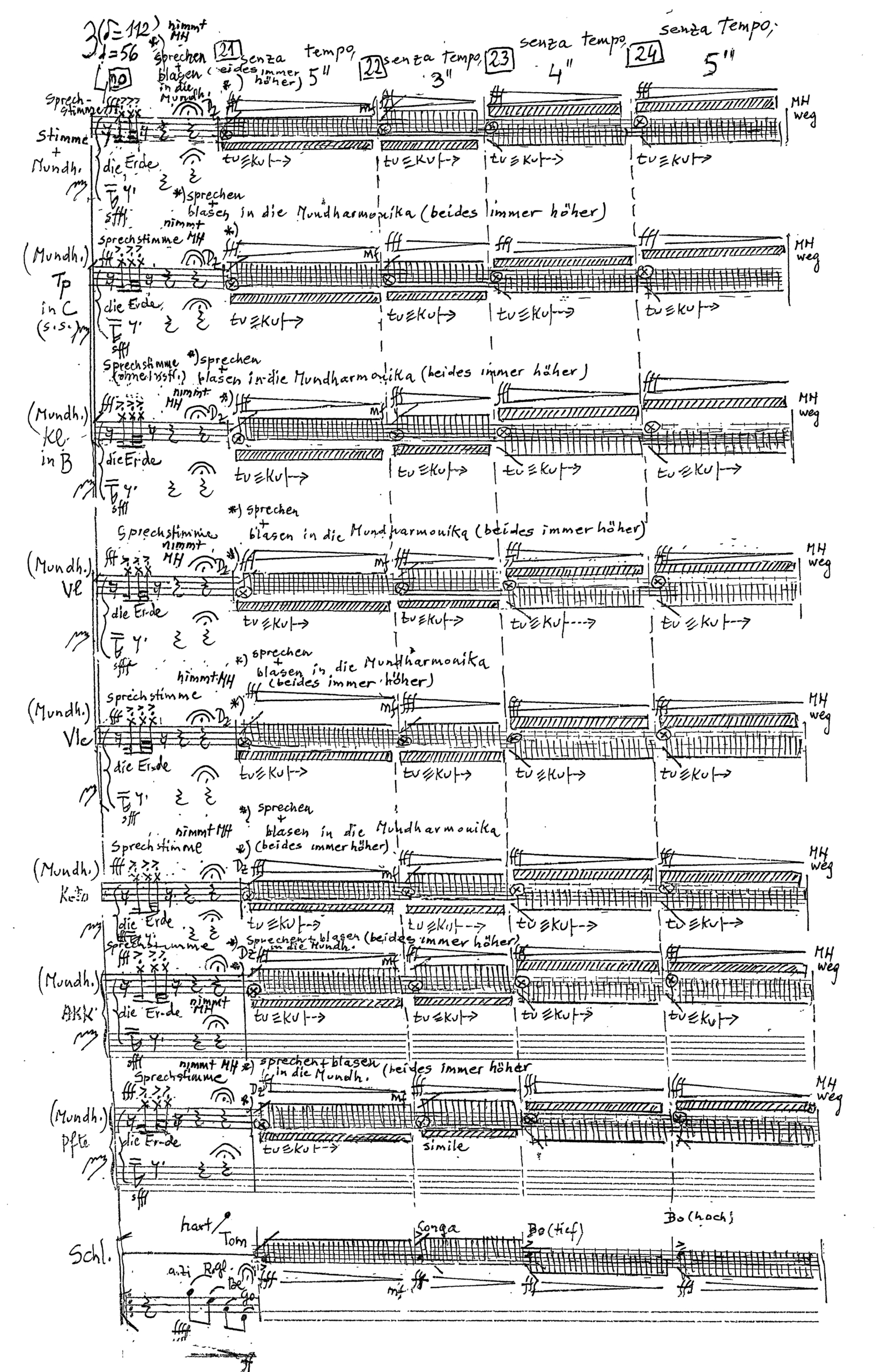
Music example 2: Roses of Shadow, p. 73, mm. 20-24. © 2017 by Breitkopf & Härtel, Wiesbaden
The following section reveals another phenomenon of Hölszky’s style, namely a pronounced will to shape the composition, despite all the allowing and losing oneself in sound textures. From m. 25 onwards, a chamber-music-like instrumentation of percussion, accordion (from m. 29) and piano (from m. 31) continues, whereby the latter two instruments are brought close together not only tonally but also in terms of compositional technique. Mm. 37ff. seem like a reprise of mm. 1ff. (“staccatissimo sempre”), or, if one encounters this old-fashioned term in the context of Hölszky’s composition, a déjà vu. Mm. 48ff. show, similar to mm. 10ff., the increase to a fortississimo sound, which is interrupted in mm. 50-51 with a threefold repetition of a motivic interlocking of percussion, koto, and piano. The motif of three falling semitones (m. 51) as well as the rising and falling broken chords (m. 50; in terms of timbre, entrusted to a wide variety of percussion instruments) form a tonal caesura, after which the return to the harmonica sound takes place in m. 52. Here, too, the thesis of the “recapitulation characteristic” is confirmed (see mm. 11ff.). In the continuation (mm. 56ff.), the accordion and piano enter into a dialogue again (see mm. 31ff.). As in phases I and II, phase III ends in a quiet finale (“niente”).
Similar to phase I (piano and percussion), phase IV begins with a percussion sound, which is joined by the alphorn from m. 11. It is, however, quite obviously not the striking timbre of the alphorn that is intended to have a new effect here. Rather, the composer exploits the tonal range of arpeggiated and repeated motifs (“snapping,” “sucking in,” “creaking voice”) and in m. 14 allows the voice to join in with the same “motifs” (“snapping”) in quasi-polyphonic two-part harmony. From m. 29 onwards, contrary to what one might expect from a mere reading of the score with its differentiated motifs, a flat sound gradually builds up. The use of the speaking voice (“as a recitative” for the first time in this phase IV in m. 41) does not mark a new internal section because of the mixture with the instrumental timbres (e.g., the instruction “sing into the instrument” in the euphonium; e.g., the flutter-tongue glissando in the bass clarinet in m. 42). There is a caesura only in m. 50, but it is very clear with a general pause of twelve seconds, into which only the rainmaker enters with a pianissimo sound. The appeal of the text—“Walk around the mountain”45—is spoken hoarsely by the voice. The text continuation “walk softly”46 is presented a total of six times, whereby mm. 55-57 show small, almost inconspicuous variations and therefore dispense with the repetition signs otherwise familiar from the score. Counteracting the text, Hölszky creates a march character through accents in strict 4/4 time, creating a stiff and military counter-world to the appeal in the Native American texts, namely to walk quietly, softly. Schläpfer has the male dancers slide on their knees at this point, burdened with the weight of the female dancers on their shoulders. These body sculptures underline the oppressive, hopeless moment of the voice’s hoarse appeal. The technique of repetition with small variations also defines mm. 58ff. up to the text “where there is danger or pain”47 (played three times). The transition to include the solo voice in m. 70 is striking, first beginning with phonemes performed bocca chiusa, and from m. 73 ends phase IV speaking hoarsely, whispering hoarsely, astonished, very intensely and whispering: “Draw a circle of thoughts around the gentle silent mountain, and the mountain becomes crystal, and you see the open valley through the crystal mountain, and all the truth of the valley is yours.”48 Analogous to the solo voice, Martin Schläpfer places a male solo dancer at the center of the stage, who—in a counterpoint to the text that can be interpreted as a promise—sinks to the ground at the end of his scene.
Phase V follows attacca. The sound of the trumpet in C is striking; despite the mute used, it has a bright and other-worldly quality. However, mm. 1-5 with their fanfare-like motif in m. 4 are not without a certain ironic, perhaps even threatening note, for the trumpet is both the instrument of the white man and the instrument of war. As abruptly as this tonal digression appeared, it departs. Apart from the change of meter, mm. 7-14 take up the staccatissimo soundscape of the beginning of phase III almost precisely; the trumpet is completely absorbed into the collective sound. In m. 15, underpinned by the bass drum with a pianissimo swirl, it emerges in a senza tempo measure. The connotation of a cadenza is obvious, even if the virtuosity here is distorted into a creaking and whispering into-instrument speech. In phase V, this is the last solo appearance of the trumpet, for the sound of the accordion (from m. 16) and the harmonica (from m. 19), played in glissandi by the soprano, take center stage, while the piano plays in unison with the accordion (mm. 19 and 21). The structure, divided by the alternation of rhythmically dense action and pauses, changes starting in m. 24 to a flat sound, which thins out from mm. 28-29 to a dialogue between waterphone and iron ball marble. In conception, these measures would be comparable to the end of phase III; here, however, the sound events are once again gathered into a restless tutti. Phase IV is the first section of the composition so far that remains without spoken or sung text. Collective lip sounds, the creaking voice as well as phonemes groaned or “creaked” into the alphorn and the contrabass clarinet merge into a collective “murmuring voice” (m. 36). That the collective has lost all grounding, with the exception of the two wind instruments (which sing as low as possible into the instrument), may well be asserted: In aperiodic, very short bursts, “as high as possible” is murmured here. With the exception of the piano and the alphorn (singing into the instrument in head voice), phase V ends in a collective exhalation into the harmonica. The snare drum has the final word with a repeated motif that “sweeps” wildly in the forte which already played a central role in phase IV (mm. 49-60; “Walk around the mountain, walk softly, walk softly …”49). The fact that the choreography works with motifs on an equal footing can be seen in the gestural motifs (“throw-away gesture,”50 shaking, defiant and defensive gesture), which accumulate especially in this phase, possibly stimulated by the “illusions of movement” created by the music (the fanfare exhorting to departure, periodic or aperiodic creaking, sweeping). In this, Schläpfer refers, whether consciously or unconsciously, to the gestural character of Hölszky’s music; for example, even the soprano voice, “deconstructed” into phonemes and desemanticized, is reduced to a gestural moment, an extremely abbreviated moment of movement of a sound event.
Phase VI is also a wordless phase. The interactions of the instruments and the voice become increasingly chaotic; blocks of sound with ordered, homorhythmic structures become noticeably rare. The end of the phase is most compact with the presto possibile (from m. 30), in which the violin and violoncello enter into a partly hocket-like dialogue, while the bass drum forms the foundation with a tremolo. This final drum tremolo is familiar from the final measures of phases I and III (both times extremely restrained dynamically). In phase VI, it rises to a quadruple forte in the final measure. There is an obvious element of symmetry here which seems legitimate in view of the image of the planetary orbits. If, as the composer suggestively conveys, the nine sound centers move like celestial bodies, there are always planetary passages that create a similar, but never an identical constellation in the “sound cosmos.” Or, to use another of Hölszky’s images, through the “chemical bonds […] [of the] ‘sound molecules’”51 of the bass drum to the two string instruments, a new chemical element is formed—“new substances”52 are formed.
Phase VII builds on the small-scale sound connections of the preceding phase. The percussion, particularly colorful here with various instruments, creates a “thunder sound” (m. 2), after the piano has reinforced the percussion rhythm with clusters (played in the strings) in the opening measure. After the textless phases V and VI, the voice is present in this last phase of the work: “You spread death, you spread death, you buy and sell death, you buy and sell death, but you deny it, you don’t want, you don’t want, you don’t want to face it. You buy and sell death.”53 The textual repetitions are also emphasized musically with slightly varied or even identical motifs (mm. 1-11), a technique that can also be found in the other phases (e.g., in phase IV, in which mm. 52-67 also feature motif repetitions, but applied to both the voice and the instrumental tutti). The staccatissimo soundscape (from m. 10 and in the varied resumption from m. 14) can be understood as a derivative of similar soundscapes in phases III and V. The chemical reaction, so to speak, of all tonal elements leads to an increase in dynamics and to an intensified structuring of the temporal progression in blocks. Examples of this are: Block of mm. 10-11; block of mm. 12-13 (quasi as an echo with tremolo sounds to the phonemes of the voice); block of mm. 14-15 (with the staccatissimo as in the block of mm. 10-11); block of mm. 16-17 (again with phonemes in the voice in addition to an ostinato, but subtly varied percussion part); block of mm. 18-23. This block features tremolos, repeated notes and a motif in trumpet and clarinet that can be derived from m. 4 of phase V. Already there, it has a strangely dark, ironic sound. The integration of the voice into the instrumental tutti is hocket-like, so that the voice remains audible as the carrier of the central textual message: “Poor white man, in your rage, in your splendor, in all your prosperity, you have lost your heritage.”54 In multiple forte and as high as possible, the voice rings out at this point. Ten seconds of general pause, into which only a sound from inside the piano reverberates, end this sequence. The following block of mm. 24-34 seems short of breath and as if thinned out, interspersed with fermatas and pauses: “Now you want mine … there … take it … I have more.”55 Respectfully following the score, Martin Schläpfer brings the ensemble to a standstill (albeit incomplete) here (minute 40:20). The continuation of this conflict-laden “scene” takes place with slowed movement impulses, whereby the most striking aspect of the stage performance is probably the slowly fading dance on pointe—the soloist gradually relinquishes her position of prominence among the ensemble (minute 42:03), thus introducing the final sequence of Roses of Shadow. The block of mm. 35-36 is a derivative of the staccatissimo blocks (m. 10, m. 14). However, its density is increased and it ends with a glissando in the voice (crescendoing, decrescendoing), which acts as a counterpoint to the polyphonic texture of the instruments. The block of mm. 37-46 is fluctuating in tempo and in this, too, a contrast to what precedes. “You who live where the sun sets—HEY—you thunder beings.”56 Rhythmically divided into clear quarter note beats, the block of mm. 47-49 follows. The fact that Martin Schläpfer lets the music rage here, while the ensemble, in its calm and almost lethargic movements, remains untouched by the rhythmic impulse, shows the independence, if not originality, of his staging of Adriana Hölszky’s sound choreography. This block with the oft-repeated “Hey” circles within itself. The composer arranges for m. 49 to be presented seven times. This interjection, whose semantics are ambiguous, is heard no less than forty times. Is it the call of the white man who, in his own downfall, still triumphantly snatches the inheritance from the Native American? Or a vital commitment to a universal, mystical energy that embraces and, in a sense, protects man as part of the cosmos? In any case, the last “niente” of the composition fades out between single and quadruple forte—a “downfall” in a creaking and aperiodic roar (mm. 50-52). “Morse-like” is the instruction for the last three extremely quiet measures. Is this a magical redemption, allowing oneself to fall in a quasi Big Bang-like chaos that slides into a Morse-like pulsating gentle pianissimo state? The choreography could also suggest this interpretation.
If, after this study of the score, one returns once again to a consideration of the total work of art, which is composed of music, dance and—admittedly not given due consideration in the context of this contribution—the strikingly dark stage design (Markus Spyros Bertermann) dominated by a monolith, then some questions remain unanswered. A plot line cannot be discovered in Martin Schläpfer’s choreography. However, his associative use of the stage space (collective vs. grouping vs. solo performance; vertical vs. horizontal; close to the floor vs. upright posture; furthermore, small, expressive gestures such as hand movements, head posture, etc.) suggests, on a large as well as small scale, the narration of individual phases of a drama. The fact that the range of interpretation is wide and remains wide even on closer examination places the choreography on an equal footing with Adriana Hölszky’s composition, whose ambiguity is likewise not resolved by this analysis. Of course, this conclusion does not refer to a deficiency in the artistic production—be it composition or choreography—but is rooted in Hölszky’s and Schläpfer’s artistic process and intention.
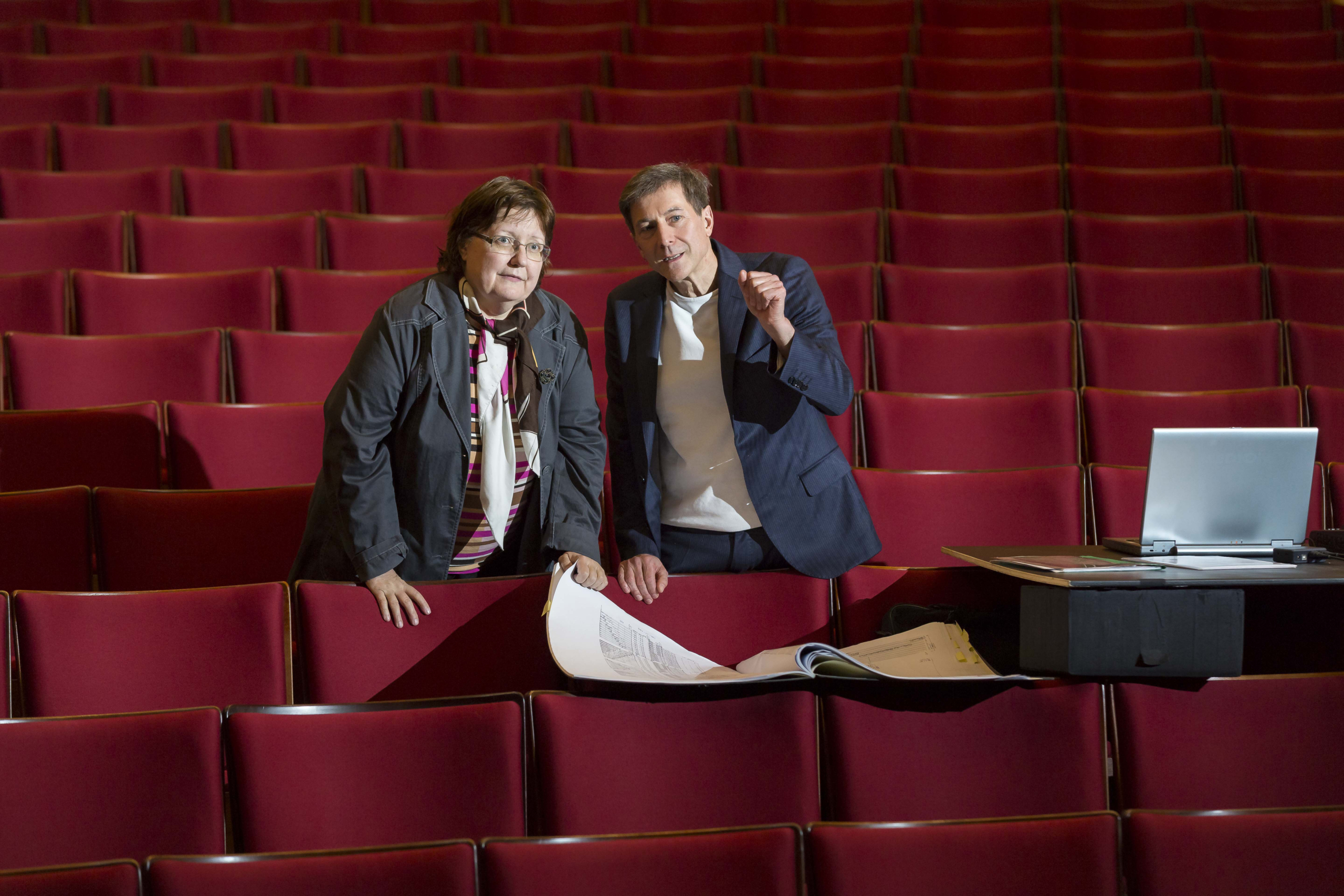
Figure 2: Adriana Hölszky and Martin Schläpfer during the rehearsal for Deep Field. © Sascha Kreklau
Deep Field, unlike Roses of Shadow, which was composed three years later, is explicitly identified as a ballet. However, here, too, something seems to resist the classification as ballet music. The term seems too harmless, too banal, does not seem to do justice to this superlative text-based work. “This is not a ballet evening!” says Adriana Hölszky about Deep Field.57
The subjects of Roses of Shadow and Deep Field are deeply related. Both are about man’s relationship to nature, to his fellow world, but also about his own responsibility, which he is hardly empowered to perceive. However, let us start with the title Hölszky chooses for her 2013 commission for the Düsseldorf Opera initiated by Martin Schläpfer: Deep Field. A title rich in associations, almost poetic, which the composer borrowed from the name of one of the Hubble space telescopes. This “giant eye”58 enables us humans to look at populations of distant galaxies—a fascination of a special kind that obviously inspires not only further astronomical research but also a composer like Adriana Hölszky. Far from it, however, would be the assumption that Hölszky is only concerned with the greatest possible range in her outward gaze. Those familiar with her work know of her affinity for introspection: “First you see nothing, then more and more stars, and finally everything pulverizes, the whole drama of humanity, the stories of living and dying, language, everything becomes universe, mystery …”59 However, before man’s self-suffering is entrusted to the universe and allowed to sink into the “deep field” and dissolve, before man attains “that divine substance”60 which Hölderlin’s Empedocles longs for, the dramas must be acted out and lived through. For this—and this may at least strike some as unusual in the composition of ballet music—texts are needed, and Hölszky chooses these carefully. In order to illuminate the interplay of the composition and the choreography, at least pars pro toto, an analysis of the video production (provided by the Düsseldorf Opera) will be preceded by a study of the score.
Like Roses of Shadow, Deep Field is divided into what the composer calls phases and epilogues. Only phase X does without an epilogue, resulting in a division into ten phases and nine epilogues.
Hölszky opens the work with a quotation from the first scene of Hölderlin’s fragmentary tragedy The Death of Empedocles. Respect, but also fear, for the divine being of Empedocles (“all-transforming”61 and “sadly searching”62) and the awareness that even this “beautiful star” must set, resonate in Panthea’s words. The end of the text (and thus also of phase I)—“Already the clear day dawned before me and around the sun wavered, like a soulless shadow, the world.”63—seamlessly joins, quasi in an enjambment, the title of phase II: “Earth.” However, let us first trace the return of the Hölderlin text in the final phase (phase X). The second block of Hölderlin quotations is attached to the end of the work like a frame, or rather like an inexorable parenthesis: only fragments of text from Panthea’s appearance remain, scraps of words transformed from the originally longing to the threatening, torn from their context of meaning. Phase I as well as phase X bear the title “Delirium,” and yet it is not a return, but a metamorphosis of delirium.
The texts of Nietzsche, this word-metamorphosis artist par excellence, fit seamlessly into Hölszky’s “Sound exposures of a Metamorphosis”64 (the subtitle of the work). “Birds of Prey,”65 the title of phase VI, refers to the element of air (see phase II “Earth,” phase IV “Water,” phase VIII “Fire”); the text modules from the Dionysus dithyrambs are heightened in their mysteriousness by being heard simultaneously. That the quotation of “I am your labyrinth”66 (from the “Lamentation of Ariadne”), partly written in universals, stands out graphically like a motto from the score is one thing; that it is also audibly exposed in the polyphony of sounds is another and stands pars pro toto for the coherence of the subtitle. Nevertheless, the considerations can be spun even further: the view through Deep Field, the space telescope that allows our eyes to access distant galaxies, is a glimpse into a labyrinth of stars and galaxies. Thus, the labyrinthine is also found in the title so carefully chosen by Hölszky. Her reference—“You have only reached the inside when you have passed through these illuminations”67—can be understood as an appeal, namely not only to look through Deep Field, the telescope, but to go into Deep Field. What the composer calls illuminations are the labyrinths and metamorphoses of our life on earth. The third layer of texts included in the composition are fragments from Hanns Johst’s Die Stunde der Sterbenden (Hour of the Dying). The expressionist drama from the beginning of World War I depicts the drastic suffering of war and served as inspiration for the composer. Johst, however, changed from a pacifist to a right-wing nationalist only a short time later and, as a friend of Himmler’s and honored by Hitler, made a career as a poet. “As president of both the Reichsschrifttumskammer’ (Reich Chamber of Culture) and the ‘Deutsche Akademie der Dichtung’ (German Academy for Poetry) 1935-1945, he was one of the leading literary figures of the Nazi regime.”68 The omission of this fact in the program notes for the premiere led to criticism. The literary scholar Karl Carino says, “historical decency demands that the author’s National Socialist turn after his early Expressionist phase be mentioned and reflected in the program.”69 However, he describes Hölszky’s inspiration by a youthful work by Johst as “not reprehensible.”70 This is where we will connect: Phase VIII “Fire” opens with the words “He died. He is rigid and cold.”71 This, as well as most of the following text fragments, get lost in the noisy polyphony. Individual key words stand out visually from the score’s graphics and are also perceptible acoustically: “Forward”72 (m. 4), “Forward. Through the rain. Through the fire.”73 (mm. 39-43), “Earth”74 (m. 120), “Thrown down”75 (m. 129), “The dying”76 (mm. 136/138), and “Bleeding darkness”77 (m. 146).
These words, like those of Hölderlin and Nietzsche, are by no means isolated in space. If one follows the textual levels of the individual phases closely, a network of either identical words or words of the three poems connected by associative fields becomes apparent. Even if the text seems to play a marginal role in the vastness and complexity of the musical realization of the score, it is likely to have been a decisive parameter in the compositional process itself. This is also and especially true of the text mentioned in the title of phases III, V, VII, and IX—Hesse’s love fairy tale “Piktor’s Metamorphoses.” “For me, Hesse’s fairy tale is the inexpressible, the utopian space,”78 says Hölszky, and indeed the longings formulated in “Piktor’s Metamorphoses” stretch out their arms like tentacles to the texts of Hölderlin and Nietzsche. Just a few examples: the garden as a symbol of paradise; the spring as a symbol of the origin of life and spiritual inspiration; the thirst-quenching waters of the earth rising up to Empedocles as well as to Piktor; the stooped, troubled posture of the tree Piktor and of Empedocles, which can also be found in Nietzsche’s text fragments; thirst as a metaphor and also as a real threat in all texts up to Johst’s Hour of the Dying; the loneliness of the individual, which connects all four texts.
On the compositional level, if one searches for similar networks of relationships, one also makes a find. Due to the limited scope of the publication and the “density” of the score, references follow only pars pro toto. The “framework” of phase I and X (“Delirium” 1 and 2) as the opening and closing sections has already been mentioned. Phase II “Earth” and phase VIII “Fire” are characterized by a block-like structure. Phases III, V, and VII (“Piktor’s Metamorphoses” 1, 2, and 3) characterize the changing nature, the metamorphosis of Piktor on several levels. While in “Piktor’s Metamorphosis 1” he initially appears as a soloist, symbolized by the sound of the trumpet (the connotation of a Wagnerian leitmotif may arise spontaneously when listening and reading the score), the shades of sound and structures change increasingly. “Metamorphosis 2” shows the dominance of an elaborated micropolyphony, while “Metamorphosis 3” is determined by looseness and colorfulness. The last metamorphosis in phase IX (“Piktor’s Metamorphosis 4”) takes on the character of a synthesis through the integration of the Nietzsche text (from m. 25). To recognize a moment of intensification here, a kind of final effect, will not be mistaken. The following “Delirium 2” functions more or less as a swan song.
Both in phase IV “Water” and in phase VI “Birds of Prey,” the composer explicitly uses illustrative structures and associative motifs. In order to help with understanding the compositional process as well as for orientation during listening, it can be helpful in phase IV to interpret a rippled water surface (mm. 7ff.), wave forms (mm. 24ff.), a surge of water (mm. 45ff.), crystalline frozen water (mm. 49ff.), a drop shape (mm. 76ff.), and water collected in a basin (from mm. 82ff.). The same applies to phase VI “Birds of Prey” with its dominance of repeated motives, groups of notes to be played as quickly as possible, and chains of trills. As monumental as the oversized score and its calligraphic notation may be, the attention to detail must not be neglected. This will hopefully provide stimuli for further research.
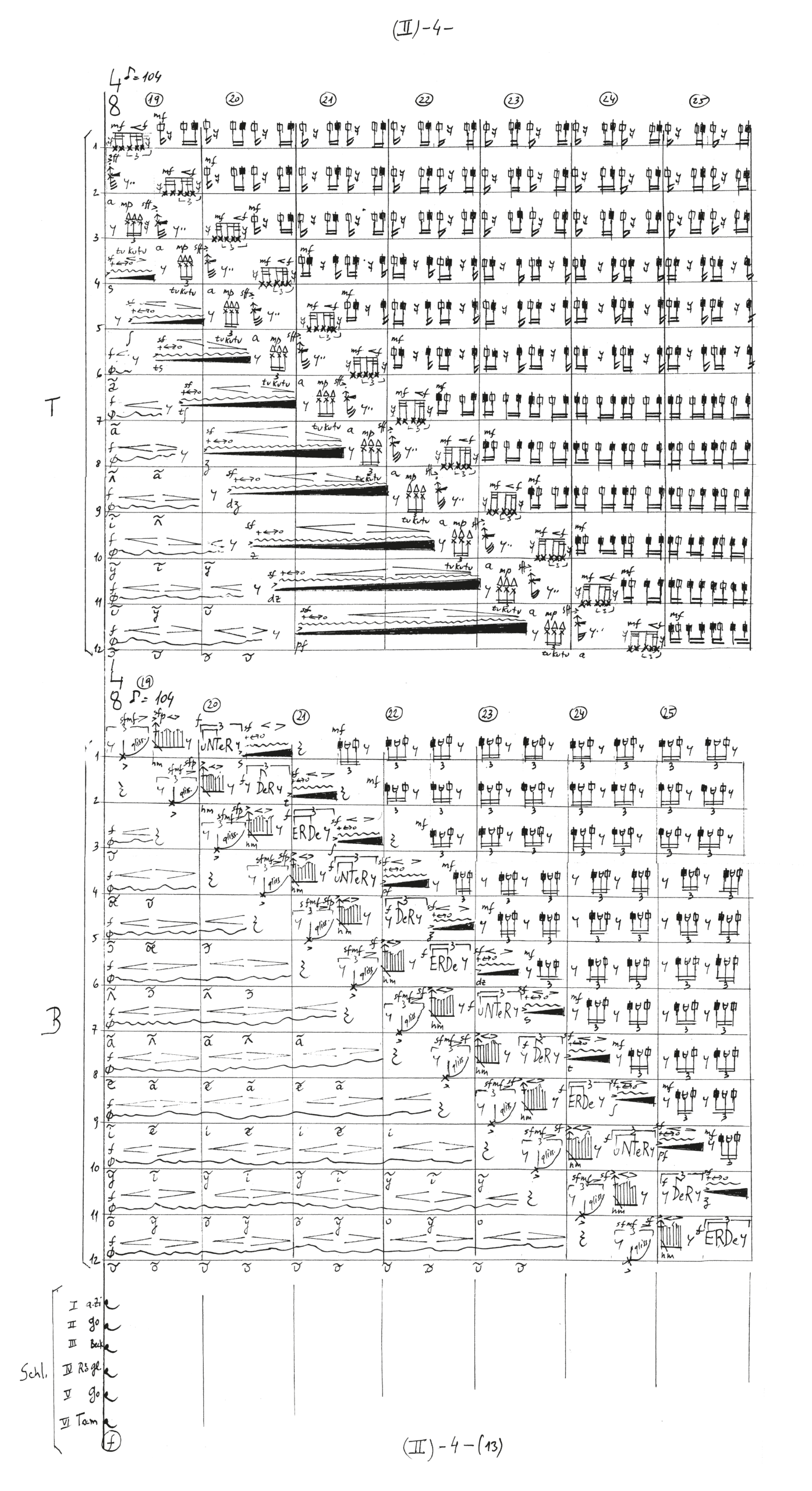
Music example 3: Deep Field, (II) – 4 – (13), mm. 19-25. © 2014 by Breitkopf & Härtel, Wiesbaden
Several challenges arose for Martin Schläpfer in the choreographic design. On the one hand, Adriana Hölszky’s musical calligraphy is in many areas closer to a metamorphosing texture than to a closed form. On the other hand, it is (as in the work Roses of Shadow, created in 2016) the textual level that not only guides the choreographer, but can also restrict him like an unwelcome shackle. “For me, this was a great challenge, as I am hardly used to choreographing to language—even if it is pounded. Of course, I can’t just escape words, but I don’t want to give them power over my work either.”79 In the soloistic beginning of the ballet, Martin Schläpfer stages the dancer’s performance almost redundantly to the spoken voice played from the tape. The rhythmic congruence between voice (music) and dance as well as the striking doubling of words through movement and gesture seems almost naïve. Examples include the sideways hopping at the words “where the spring rises”80 (mm. 12-13; minute 1:35) or the covering of the eyes with the feet at the words “you have never seen him?”81 (mm. 26-27; minute 1:58). Props—namely the posts projecting into the stage like a garden fence or like oversized flower stalks, which disappear again as quickly as they appeared—underline the fairy-tale-like narrative impression of this first scene. However, this entry into Deep Field, which is oriented towards a concretization of the music, or rather of the text, is lost in the subsequent phases. Only the handling of rhythm remains to a certain extent a programmatic parameter until the final part of the work (Panthea, Delirium 2). Where Hölszky utilizes clear rhythms in the music, these are reproduced in the dance movement. And where Hölszky’s music proves rhythmically elusive through soundscapes, tremoli, glissandi, and an almost impulse-free flow and transformation, Martin Schläpfer resorts to choreographing motivically deployed, shimmering or tremulous movements (cited as an example: phase II “Earth”; minute 11:20), which establish a connection to the timbre of the instruments or voices on a micro-level. This (along with the preference for dancing on pointe in Deep Field and the preference for dancing on flat soles in Roses of Shadow) is probably the clearest contrast to the choreography for Roses of Shadow, created three years later, which is (even) more independent and free of associations in the dance “visualization” of the musical events.
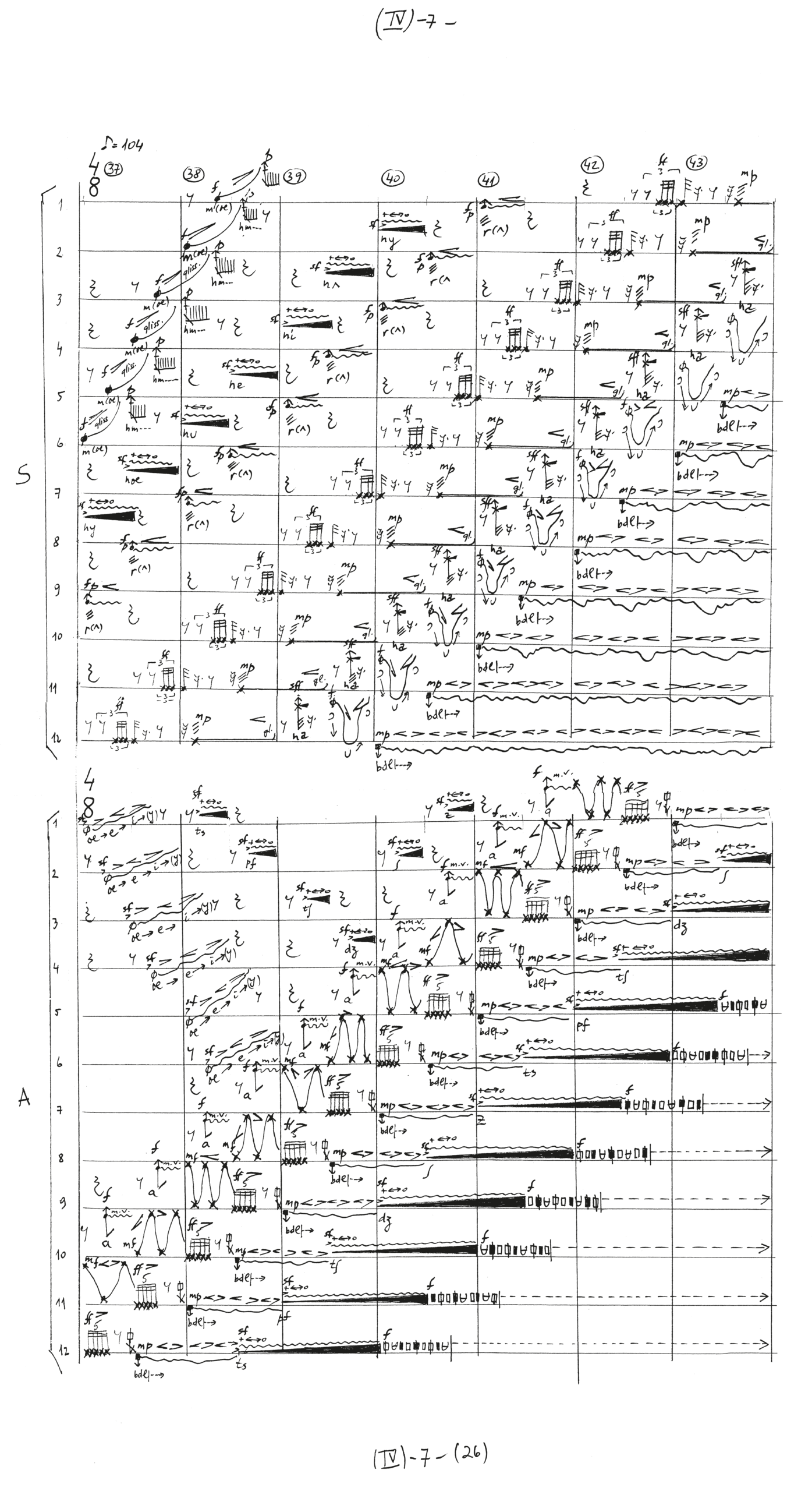
Music example 4: Deep Field, (IV) – 7 – (26), mm. 37-43. © 2014 by Breitkopf & Härtel, Wiesbaden
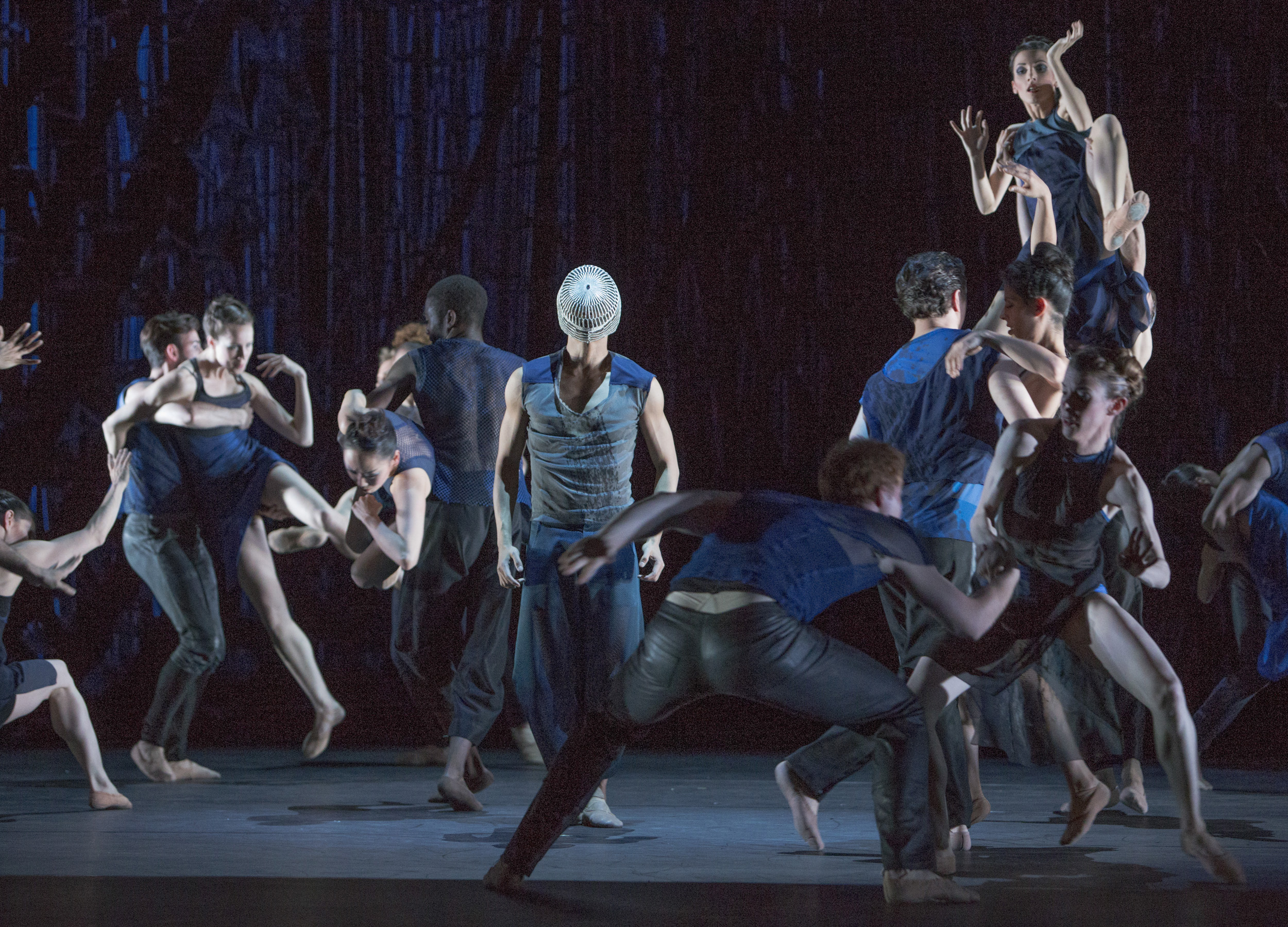
Figure 3: Scene from Deep Field. © Gert Weigelt
Not a quotation from Hölszky’s Deep Field, but from Hölderlin’s The Death of Empedocles shall be placed at the end of this essay: “Then dare! What you have inherited, what you have earned, / What your fathers’ mouths have told you, taught you, / Law and custom, the old gods’ names, / Forget it boldly, and, like newborns, / Raise your eyes to the divine nature […].”82 In Roses of Shadow and Deep Field, Adriana Hölszky and Martin Schläpfer address how little man has succeeded in this enlightened view of nature and the cosmos; each has their own artistic means, which complement each other, but also collide with each other (“counteract and also oppose,”83 as described by the choreographer) or at times seem to run incoherently alongside each other. However, in the view of both artists, everything that exists—on earth as well as in the inner and outer cosmos—is interconnected. This is without a doubt the core message in Roses of Shadow as well as in Deep Field, and just as doubtlessly, the failure of man in his approach to the “God question”84 is brought to our attention and made audible to us in sounds and movements that are not afraid to slide into the bizarre. The “passing by” of sound and movement, the missed synthesis between music and movement, the (occasional) drifting into seemingly incoherent parallel worlds, which particularly in Roses of Shadow is partly irritating (and probably deliberately intended to irritate), is both an artistic program and a philosophical statement—both Adriana Hölszky’s music and Martin Schläpfer’s dance are “existential.”85
-
Anne do Paço, “Eine Hymne auf die Schönheit dieser Erde. Roses of Shadow,” in Programmheft Ballett am Rhein, vol. 33, ed. Deutsche Oper am Rhein Düsseldorf Duisburg (Düsseldorf, 2017): 12-6, 13 (trans. Stephanie Schöberl): “Es [wird] kein gegenseitiges Bebildern geben […]; es ist vielmehr so, dass Martin Schläpfer und ich uns umzingeln—und wir uns dabei auch mal aus den Augen und Ohren verlieren.”↩︎
-
Adriana Hölszky, phone conversation between Adriana Hölszky and Barbara Dobretsberger, Stuttgart / Salzburg on December 14th, 2021 (trans. Stephanie Schöberl): “Klangraumverwandlung, Raumklangverwandlung, Klangbild, komplimentäre Verwandlung, sonnets of no return, like a sonnet of no return.”↩︎
-
Adriana Hölszky, Deep Field (Wiesbaden: Breitkopf & Härtel, 2014).↩︎
-
Adriana Hölszky, phone conversation between Adriana Hölszky and Barbara Dobretsberger, Stuttgart / Salzburg on December 20th, 2021 (trans. Stephanie Schöberl): “absolute Musik.”↩︎
-
Anne do Paço, “Zirkulationen des Lebendigen. Adriana Hölszky, Rosalie und Martin Schläpfer im Gespräch mit Anne do Paço über ihre Uraufführung Deep Field,” in Programmheft Ballett am Rhein, vol. 20, ed. Deutsche Oper am Rhein Düsseldorf Duisburg (Düsseldorf, 2014): 8-20, 9 (trans. Stephanie Schöberl): “Ich hatte bisher noch nie den Wunsch, mit bzw. für den Tanz zu arbeiten.”↩︎
-
Hölszky, phone conversation between Adriana Hölszky and Barbara Dobretsberger, December 14th, 2021 (trans. Stephanie Schöberl): “die Musik tatsächlich einen eigenständigen Rang hat, unabhängig von einer Choreographie ist.”↩︎
-
Do Paço, “Eine Hymne auf die Schönheit dieser Erde. Roses of Shadow,” 13.↩︎
-
Ibid. (trans. Stephanie Schöberl): “Und so entstand mit Roses of Shadow eine Partitur, über deren Grundkoordinaten sich Komponistin und Choreograph intensiv verständigten, mit deren Ausarbeitung sich Adriana Hölszky dann jedoch zurückzog, um Martin Schläpfer schließlich ein fertiges Werk zu übergeben und mehr: ihm die Partitur voller Vertrauen und Freiheit zu überlassen […].”↩︎
-
Cf. Adriana Hölszky, phone conversation between Adriana Hölszky and Barbara Dobretsberger, Stuttgart / Salzburg on December 7th, 2021.↩︎
-
I have to admit that, regrettably, when watching the video, my point of view was limited to the perspective taken by the videographer; the whole stage is not always visible, so that actions which might have been useful for an interpretation had to be disregarded.↩︎
-
Adriana Hölszky, Roses of Shadow (Wiesbaden: Breitkopf & Härtel, 2017), back cover of the book [n.p.] (trans. Stephanie Schöberl): “ein ‘Schatten’-Ensemble oder als ‘Geisterstimmen.’”↩︎
-
Cf. Käthe Recheis and Georg Bydlinski, Weißt du, dass die Bäume reden. Weisheiten der Indianer (Freiburg: Herder, 1983).↩︎
-
Hölszky, Roses of Shadow, back cover of the book [n.p.] (trans. Stephanie Schöberl): “die ‘Zündung,’ der Ausgangspunkt einer intensiven kompositorischen Arbeit.”↩︎
-
Adriana Hölszky, “Es sollte nicht nach Kammermusik riechen,” conversation between Adriana Hölszky and Dorothee Krings (December 2017), accessed 7 December 2021, https://rp-online.de/nrw/staedte/duesseldorf/kultur/es-sollte-nicht-nach-kammermusik-riechen_aid-17639615.↩︎
-
Trans. Barbara Dobretsberger: “Ich weine vor Durst.”↩︎
-
Trans. Barbara Dobretsberger: “Ich bin frei geboren, frei wie der Adler, der über den großen blauen Himmel schwebt.”↩︎
-
Trans. Barbara Dobretsberger: “Ich bin frei geboren, frei wie der Adler, der über den großen blauen Himmel schwebt.”↩︎
-
Trans. Barbara Dobretsberger: “die Bäume.”↩︎
-
Trans. Barbara Dobretsberger: “die Steine.”↩︎
-
Trans. Barbara Dobretsberger: “die Erde.”↩︎
-
Trans. Barbara Dobretsberger: “Ihr verbreitet Tod, ihr kauft und verkauft Tod, aber ihr verleugnet ihn, ihr wollt ihm nicht ins Gesicht sehen. Armer weißer Mann, in deiner Wut, in deinem Glanz, in all deinem Wohlstand hast du dein Erbe verloren […].”↩︎
-
Do Paço, “Eine Hymne auf die Schönheit dieser Erde. Roses of Shadow,” 13 (trans. Stephanie Schöberl): “dass es kein gegenseitiges Bebildern geben wird.”↩︎
-
Hölszky, Roses of Shadow, back cover of the book [n.p.] (trans. Stephanie Schöberl): “wellenartige Entladungen von gewaltigen Klangenergien.”↩︎
-
Ibid. (trans. Stephanie Schöberl): “Kompaktheit und Bedrohlichkeit des Klanges.”↩︎
-
Ibid. (trans. Stephanie Schöberl): “Bedrohlichkeit des Klanges.”↩︎
-
Trans. Barbara Dobretsberger: “wo Gefahr ist oder Schmerz.”↩︎
-
Hölszky, Roses of Shadow, back cover of the book [n.p.] (trans. Stephanie Schöberl): “‘Klangbahnen.’”↩︎
-
Cf. Hölszky, phone conversation between Adriana Hölszky and Barbara Dobretsberger, December 14th, 2021.↩︎
-
Trans. Barbara Dobretsberger: “Himmel. Ein weißer Berg.”↩︎
-
Trans. Barbara Dobretsberger: “der Himmel beginnt seine Tränen zu vergießen.”↩︎
-
Trans. Barbara Dobretsberger: “Ich weine vor Durst.”↩︎
-
Hölszky, Roses of Shadow, back cover of the book [n.p.] (trans. Stephanie Schöberl): “Von Anfang bis Ende des Werks nimmt die Kompaktheit und Bedrohlichkeit des Klanges wie ein Sog zu.”↩︎
-
Trans. Barbara Dobretsberger: “Ich laufe durch das hohe Gras.”↩︎
-
Trans. Barbara Dobretsberger: “weit draußen im Wüstengebirge.”↩︎
-
Trans. Barbara Dobretsberger: “und hörte die Ameisen reden, die Ameisen reden.”↩︎
-
Trans. Barbara Dobretsberger: “Ich bin mit den Sternen verwandt.”↩︎
-
Trans. Barbara Dobretsberger: “frei wie der Adler, der über den großen blauen Himmel schwebt; ein leichter Wind streift sein Gesicht. Ein weißer Berg erhebt sich …”↩︎
-
Trans. Barbara Dobretsberger: “Leuchtend weiße Bögen aus Licht neigen sich von seiner Spitze …”↩︎
-
Trans. Barbara Dobretsberger: “mit den Sternen verwandt.”↩︎
-
Trans. Barbara Dobretsberger: “MiT DeN STeRNeN VeRWaNDT.”↩︎
-
Hölszky, Roses of Shadow, V (trans. Stephanie Schöberl): “Sprechen mit Hervorhebung der Konsonanten und Verharren auf ‘T.’”↩︎
-
Trans. Barbara Dobretsberger: “die Bäume.”↩︎
-
Trans. Barbara Dobretsberger: “die Steine.”↩︎
-
Trans. Barbara Dobretsberger: “die Erde.”↩︎
-
Trans. Barbara Dobretsberger: “Geh uM DeN BeRG.”↩︎
-
Trans. Barbara Dobretsberger: “geh leise.”↩︎
-
Trans. Barbara Dobretsberger: “wo Gefahr ist oder Schmerz.”↩︎
-
Trans. Barbara Dobretsberger: “Zieh einen Kreis aus GeDaNKeN um den sanften stillen BeRG, und der Berg wird zu KRiSTaLL, und du siehst das offene Tal durch den kristallenen BeRG, und die ganze WaHRHeiT des Tales ist dein.”↩︎
-
Trans. Barbara Dobretsberger: “Geh um den Berg, geh leise, geh leise …”↩︎
-
Term chosen by Stephanie Schroedter. E-Mail to Barbara Dobretsberger from August 23th, 2020.↩︎
-
Hölszky, Roses of Shadow, back cover of the book [n.p.] (trans. Stephanie Schöberl): die “chemischen Bindungen [der] ‘Klangmoleküle.’”↩︎
-
Ibid. (trans. Stephanie Schöberl): “neue Substanzen.”↩︎
-
Trans. Barbara Dobretsberger: “Ihr verbreitet Tod, ihr verbreitet Tod, ihr kauft und verkauft Tod, ihr kauft und verkauft Tod, aber ihr verleugnet ihn, ihr wollt ihm nicht, ihr wollt ihm nicht, ihr wollt ihm nicht ins Gesicht sehen. Ihr kauft und verkauft Tod.”↩︎
-
Trans. Barbara Dobretsberger: “Armer weißer Mann, in deiner Wut, in deinem Glanz, in all deinem Wohlstand hast du dein Erbe verloren.”↩︎
-
Trans. Barbara Dobretsberger: “Jetzt willst du meines … da …nimm es … ich habe noch mehr.”↩︎
-
Trans. Barbara Dobretsberger: “Du, der dort wohnt wo die Sonne untergeht—HEY—ihr Donnerwesen.”↩︎
-
Anne do Paço, “Zirkulationen des Lebendigen. Adriana Hölszky, Rosalie und Martin Schläpfer im Gespräch mit Anne do Paço über ihre Uraufführung Deep Field,” in Programmheft Ballett am Rhein, vol. 20, ed. Deutsche Oper am Rhein Düsseldorf Duisburg (Düsseldorf, 2014): 8-20, 20 (trans. Stephanie Schöberl): “Ein Ballettabend ist dies nicht!”↩︎
-
Adriana Hölszky, in Programmheft Ballett am Rhein, vol. 20, ed. Deutsche Oper am Rhein Düsseldorf Duisburg (Düsseldorf, 2014), 5 (trans. Stephanie Schöberl): “Riesenauge.”↩︎
-
Ibid. (trans. Stephanie Schöberl): “Erst sieht man nichts, dann immer mehr Sterne, und schließlich pulverisiert sich alles, das ganze Drama der Menschheit, die Geschichten vom Leben und Sterben, die Sprache, alles wird Universum, Geheimnis …”↩︎
-
Meinhard Prill, “Friedrich Hölderlin,” in Kindlers Neues Literatur-Lexikon, ed. Walter Jens, vol. 7 (Munich: Kindler-Verlag, 1990), 923-34, 933 (trans. Stephanie Schöberl): “jene göttliche Substanz.”↩︎
-
Trans. Stephanie Schöberl: “allverwandelnd.”↩︎
-
Trans. Stephanie Schöberl: “traurigforschend.”↩︎
-
Trans. Barbara Dobretsberger: “Schon dämmerte der klare Tag vor mir und um die Sonne wankte, wie ein seellos Schattenbild, die Welt.”↩︎
-
Trans. Barbara Dobretsberger: “KLANGbelichtungen einer METAmorphose.”↩︎
-
Trans. Stephanie Schöberl: “Raubvögel.”↩︎
-
Trans. Barbara Dobretsberger: “Ich bin dein Labyrinth.”↩︎
-
Do Paço,“Zirkulationen des Lebendigen,” 12 (trans. Stephanie Schöberl): “Das Innere hat man erst erreicht, wenn man durch diese Belichtungen hindurchgegangen ist.”↩︎
-
Wulf Piper and editorial department of Kindlers Literatur-Lexikon, “Hanns Johst,” in Kindlers Neues Literatur-Lexikon, ed. Walter Jens, vol. 8 (Munich: Kindler-Verlag, 1990), 832 (trans. Stephanie Schöberl): “Als Präsident der Reichsschrifttumskammer wie der Deutschen Akademie der Dichtung 1935-1945 gehörte er zu den führenden Literaten des NS-Regimes.”↩︎
-
Karl Carino, in csi, “Kritik am Umgang der Rheinoper mit Nazi-Dichter,” in RP Online, 26 May 2014, accessed 7 December 2021, https://rp-online.de/kultur/kritik-am-umgang-der-rheinoper-mit-nazi-dichter_aid-20385655 (trans. Stephanie Schöberl): “Allerdings gebiete es der historische Anstand, die nationalsozialistische Wende, die der Autor nach seiner expressionistischen Frühphase genommen hat, im Programmheft zu erwähnen und kritisch zu reflektieren.”↩︎
-
Ibid. (trans. Stephanie Schöberl): “nicht verwerflich.”↩︎
-
Trans. Barbara Dobretsberger: “Er starb. Er ist starr und kalt.”↩︎
-
Trans. Barbara Dobretsberger: “Vorwärts.”↩︎
-
Trans. Barbara Dobretsberger: “Vorwärts. Durch den Regen. Durch das Feuer.”↩︎
-
Trans. Barbara Dobretsberger: “Erde.”↩︎
-
Trans. Barbara Dobretsberger: “Hingeworfen.”↩︎
-
Trans. Barbara Dobretsberger: “Das Sterben.”↩︎
-
Trans. Barbara Dobretsberger: “Blutende Finsternis.”↩︎
-
Do Paço, “Zirkulationen des Lebendigen,” 13 (trans. Stephanie Schöberl): “Hesses Märchen ist für mich das Unaussprechbare, der utopische Raum.”↩︎
-
Ibid., 8 (trans. Stephanie Schöberl): “Für mich war dies eine große Herausforderung, bin ich es doch kaum gewohnt, zu Sprache—auch wenn sie zerstampft ist—zu choreographieren. Natürlich kann ich mich den Worten nicht einfach entziehen, möchte ihnen aber auch nicht die Macht über meine Arbeit geben.”↩︎
-
Trans. Barbara Dobretsberger: “wo die Quelle springt.”↩︎
-
Trans. Barbara Dobretsberger: “Du hast ihn nie gesehen?”↩︎
-
Friedrich Hölderlin, Sämtliche Werke. Kleine Stuttgarter Ausgabe, vol. 4, ed. Friedrich Beissner (Stuttgart: Cotta, 1962), 68f., accessed 7 December 2021, http://www.zeno.org/Literatur/M/H%C3%B6lderlin,+Friedrich/Drama/Der+Tod+des+Empedokles/%5BErste+Fassung%5D/2.+Akt/4.+Auftritt. “So wagt’s! was ihr geerbt, was ihr erworben, / Was euch der Väter Mund erzählt, gelehrt, / Gesetz und Brauch, der alten Götter Nahmen, / Vergeßt es kühn, und hebt, wie Neugeborene, /die Augen auf zur göttlichen Natur […].”↩︎
-
Do Paço, “Zirkulationen des Lebendigen,” 10 (trans. Stephanie Schöberl): “entgegnen und auch entgegen setzen.”↩︎
-
Ibid., 20 (trans. Stephanie Schöberl): “Gottfrage.”↩︎
-
Ibid. (trans. Stephanie Schöberl): “existentiell.”↩︎