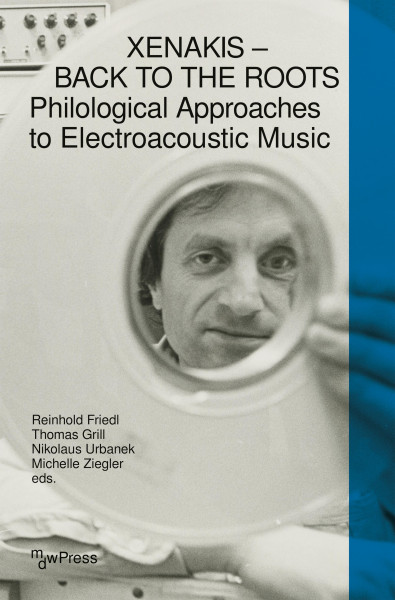
Reinhold Friedl, Thomas Grill, Nikolaus Urbanek, Michelle Ziegler
How to cite
How to cite

This volume is the result of a symposium at the University of Music and Performing Arts Vienna (mdw) in May 2022 on the occasion of the 100th anniversary of the birth of Iannis Xenakis. It focuses on the electroacoustic work of the Greek-French composer. Taking advantage of the possibilities at mdw, the symposium approached Xenakis’s electroacoustic works from two perspectives – through theoretical reflection on the one hand and through the performance of all of Xenakis’s electroacoustic works on the other. The performances at mdw’s Klangtheater offered a unique opportunity to directly perceive continuities and discontinuities in his electroacoustic œuvre, giving audiences the chance to expand their experience by listening to both the composer’s aesthetic development and the technological changes taking place from the mid-1950s to the mid-1990s.
The electroacoustic work of Iannis Xenakis can be differentiated into individual phases, each of which is related to different aesthetic, technical and historical contexts.1 An early first phase in the late 1950s and early 1960s is marked by his experiences in Le Corbusier’s architectural studio, his contact with Pierre Schaeffer and his work at GRMC (Groupe de recherches de musique concrète). Inspired by musique concrète, Xenakis used pre-recorded acoustic material in his electroacoustic works, which could range from crackling and hissing like burning charcoal to noises sounding like jet engines or the processed recordings of bells. This phase comprises the following tape works: Diamorphoses (1957), Concret PH (1958) for the Philips Pavilion of the Brussels World’s Fair, Analogique B (1959), Orient-Occident (1960) and finally the scandalous Bohor (1962) – the two withdrawn film soundtracks Vasarely (1960) and Formes rouges (1961) should also be mentioned in this context. The second phase is marked by the composition of the first ‘polytope’, Polytope de Montréal (1967) for the French Pavilion at the World’s Fair in Montréal, the ballet Kraanerg (1969) combining instrumental and tape music and the 12-channel work Hibiki Hana Ma (1970) for the World’s Fair in Osaka. The transition to what James Harley calls the third phase of large multimedia spectacles is rather smooth: Persepolis (1971), Polytope de Cluny (1972), La Légende d’Eer (1978) – the latter for the inauguration of the Centre Pompidou in Paris. Central to this phase of his electroacoustic composing is the inclusion of space against the background of the specific local and architectural conditions as well as the coordination of the specific multimediality of light, movement and music – which required not least the technically demanding synchronisation of sound spatialisation, lights, lasers and music. The fourth phase is marked by the development of the computer-based sound synthesis system UPIC (Unité Polyagogique Informatique de Centre d’Études de Mathématique et Automatique Musicales/CEMAMu), which allows the user to directly transform graphic structures – realised with the help of an electromagnetic pen on a large electromagnetic drawing board – into musical ones. The sonic results of this phase are Mycènes alpha (1978), the radiophonic work with texts by Françoise Xenakis Pour la paix (1981), Taurhiphanie (1987), Voyage absolu des Unari vers Andromède (1989) and the withdrawn work Erod (1997). The fifth and final phase in the early 1990s comprises only two computer-generated works: GENDY 301/GENDY 3 (1991) and S.709 (1994). Harley calls it the ‘phase of stochastic synthesis’.
This richness of different approaches as well as Xenakis’s ambition to configure his electroacoustic material on his own using sophisticated processes (multiplicative tape techniques, stochastic synthesis, granulation, to name just a few) gave rise to an extensive body of sources. This allows glimpses into his compositional process but also vividly demonstrates the experimental and at times almost contradictory ways in which he proceeded. Against this backdrop, a philological study of this heterogenous material is not only essential but also promises to be fruitful for future research of other electroacoustic musical works and source studies. The questions to be addressed are quite fundamental and include the following: In what sense can electroacoustic recordings be regarded as text? What do words like “original” and “authenticity” mean, and what are the consequences for electroacoustic music’s performance and interpretation? Furthermore, due to the specific material situation of the sources of electroacoustic music, basic philological research is urgently needed: tapes are increasingly falling victim to physical decay, unsystematic digitisation is obscuring musical evidence, and some machines used for the reproduction of electroacoustic music have long since been discarded and disappeared. What’s more, and not insignificantly, there exists an urgent need to preserve knowledge of how to use these machines and read the various carrying media. Against this background, a philological approach that interprets historical documents not only as textual sources but also as cultural sources could provide valuable insights.
That is why the contributions in this volume are particularly dedicated to a philological approach under the title ‘Back to the Roots’. The perspective taken by the collected contributions is twofold: On the one hand, the volume is primarily dedicated to specific philological case studies of Xenakis’s electroacoustic work and thereby contributes to Xenakis research, which has received rather little attention to date (section “Philological Practice”). On the other hand, the special characteristics of Xenakis’s compositions allow essential insights into basic philological research in the field of electroacoustic music (section “Philological Context”).
Philological Context: Based on musical-philological considerations, Nikolaus Urbanek discusses the question of how Xenakis’s electroacoustic œuvre represents a particular challenge for the development of a theory of musical writing, with a view to current approaches in transdisciplinary writing research. Laura Zattra reflects on the personal archives of different composers of electroacoustic music as a whole body of sources and a mirror of the collector’s personality, incorporating mixed methods of philology, archaeology, oral history and ethnography. In the case of early tape music, Michelle Ziegler argues that a comprehensive evaluation of compositional practices needs to consider sketches on paper in connection with sketches on tape, as they both reveal integral parts of the creative process. Elena Minetti explores the writing strategies of different composers to achieve a specific function in musique mixte: the synchronisation of musical events between recorded sounds and live instruments or voices.
Philological Practice – Xenakis’s Challenge: As a vantage point for the subsequent philological studies of Iannis Xenakis’s works, James Harley anchors the electroacoustic music of the composer in his orchestral œuvre by demonstrating common sonic entities in both. Two case studies then evaluate expansive archival sources: Pierre Carré/François Delécluse demonstrate that the recent discovery of a digital command tape for the Polytope de Cluny not only allowed different re-enactments of the multimedia show in 2022, but in combination with an examination of other archival documentation gives an insight into Xenakis’s thinking on sound and space. Based on a close study of the sources for the electronic piece Mycènes alpha and the instrumental piece Anémoessa (1979) for choir and orchestra, Marko Slavíček argues that for Xenakis self-borrowing was a means of exploring instances of sonic material in diverse contexts, relying on drawing as a compositional tool. Reinhold Friedl digs for hidden sources and shows that Xenakis was not only inspired by traditional musics but also borrowed their sounds extensively in his electroacoustic work. Peter Nelson breaks with the notion of the legendary intransigence of Xenakis’s computer instrument UPIC by reimagining it as the re-intonation of ancient voices, thereby envisioning “technology as utterance”.
Back to the Roots: The third and final section of the book reveals the liveliness of an encounter with Xenakis’s person and music with the accounts of two of Xenakis’s companions and with a round table on the performance practice of his electroacoustic works. Curtis Roads describes how his encounters with Xenakis provided a clear direction for starting his own composition algorithms and in general fostered an understanding of composing as a contribution to humanity. Michel Chion explains the decision to dispose of the production tapes for his musique concrète from a composer’s perspective in order to avoid the undocumented publication of single elements and to prevent the work from being misunderstood as a “succession of pretty sounds” that might be abused as such in other music. In the concluding roundtable, Jan Brozca, Reinhold Friedl, Thomas Grill, Katharina Klement, Christian Tschinkel and Anatol Wetzer give insight into their decisions in the preparation of the performances in 2022 and thereby reveal the variety and vitality of approaches that consider the roots of the past and result in a lively actualisation of Xenakis’s electroacoustic work.
The editors are deeply indebted to Max Bergmann and the mdwPress Board of Trustees for including this volume in the mdwPress publishing programme. We would also like to thank the anonymous reviewers whose peer reviews provided important information. Many thanks also go to Kimi Lum for her fantastic foreign language editing and to Johannes Fiebich for his help in finalising the manuscript. Last but not least, many thanks to the authors for their wonderful co-operation.
Basel – Berlin – Vienna, summer 2024
Reinhold Friedl, Thomas Grill, Nikolaus Urbanek and Michelle Ziegler
Endnoten
- The years of composition given in this book are based on the Xenakis catalog of works by Durand-Salabert-Eschig (https://www.durand-salabert-eschig.com/en-GB/Composers/X/Xenakis-Iannis.aspx) and the website of „Les amies de Xenakis“ (https://www.iannis-xenakis.org/en/category/works/). In cases of doubt, the information follows the premiere dates and not the composition dates, as in the case of La Légende d’Eer, for example.↩︎