The Social-Transformative Potential of Music Mediation
Axel Petri-Preis  , Sarah Chaker , Annette Ziegenmeyer
How to cite
How to cite
Outline
Outline

How can diverse musical interactions be productively used to promote inter- and transcultural communication, support human thriving and flourishing, empower marginalised social groups, or make society as a whole more sustainable, just and inclusive? This question has gained significant relevance in recent years (Baker 2024b; Hesser and Bartleet 2021; Westvall and Akuno 2024). François Matarasso even speaks of a “normalisation of participatory art” (Matarasso 2019, 25) and emphasises that it “has spread from the marginal urban and rural spaces it occupied in the 1970s to the centres of cultural power. It can be found in arts and cultural institutions; social, urban and economic policy; health and education services; criminal justice; housing; the voluntary sector; the media; across the Internet, and in communities everywhere” (ibid., 21). Some background to this development might be provided by the finding that humanity is currently in a “multi-crisis”, as the philosopher Byung-Chul Han calls it in his latest book The Spirit of Hope (Han 2024). We are faced with global challenges of a magnitude that has led the Bulletin of the Atomic Scientists to set their Doomsday Clock1 to just 90 seconds to midnight, warning of an impending global catastrophe. The arms race of the major military powers has reached a new peak in light of new geopolitical instabilities, man-made climate change and the exploitation of nature are progressing inexorably despite better knowledge, the rise of right-wing, nationalist and anti-democratic movements is eroding democracies, societies are becoming increasingly polarised, and social inequality is higher worldwide than ever before.
“Music-makers” – by this we mean, in the sense of Christopher Small (1998), all people who are involved in musical interactions in any way, thereby questioning and overcoming the established binary division into professional and non-professional musicians (Elliott, Silverman, and Bowman 2016; Matarasso 2019) – employ the cohesive power and the great importance that music has for most people (DeNora 2000; Rüdiger 2023) “as a catalyst for positive social change” (Hesser and Bartleet 2021, 8). In other words, the social-transformative potential of music is deliberately explored to constructively shape democratic society collectively and to enable as many people as possible to participate in and contribute to it through artistic-educational practices. Music and music mediation practices will not be able to solve global crises and problems (see also Lapidaki 2020, 270), despite what affirmative slogans such as “solutions for cultural, social, health, educational, environmental, and economic Issues” (Hesser and Bartleet 2021) might suggest. We do believe, however, that music-makers can trigger positive changes in their immediate environment, in the “world within [their] reach” (Erelli in Camlin 2023, 14), by deliberately initiating communal encounters and interactions in social spaces through music. “Democracy must be renewed every day”, was written last year on the construction site covering designed by David Leitner during the renovation of the Presidential Office at the request of the Austrian Federal President Alexander van der Bellen.2 In the daily struggle for respectful, solidarity-based coexistence in times of multiple crises, we see music mediation as an effective means of initiating negotiation processes and developing patience and routine in this regard, to accept and share the knowledge of others, to get to know the biographies, experiences and perspectives of fellow human beings, to discuss values, to experience solidarity and develop joint actions, to access one’s own creative potential, to develop creative power in a team and to transfer it to other contexts – all these are exercises that we consider helpful, if not indispensable, for living together in democratic societies.
Music as Social Practice
When this book refers to “music”, it does not denote a thing or artefact that exerts a particular societal effect (although music can certainly be objectified). Instead, music is conceived as a human activity, inherently social and signifying practice – something that people do, develop and practise together (Blaukopf 1982; Elliott and Silverman 2015; Shepherd 1992; Small 1998). The purposes of music can range “from emotional expression or enjoyment, to communication or representation, to the reinforcing and transmission of social norms and/or rituals” (Westvall and Akuno 2024, 16). People actively incorporate music into their daily lives for various functions and purposes, such as entertainment, mourning, prayer, healing, or relaxation, to name but a few (Schramm and Kopiez 2008, 253-263) – all activities that exceed the purely aesthetic quality or autonomous value of music. Tia DeNora and Gary Ansdell also emphasise that what matters is “what is done with, done to, and done alongside musical engagement” (2014, 9). Thus, it is always practitioners embedded in practices, with their respective resources, who can achieve a specific – within the context of this volume, socially transformative – effect through and with music. It is also important to consider that music, as a Janus-faced phenomenon, can be used not only for positive, inclusive purposes but also for social distinction (Bourdieu 1987), manipulation (Brown and Volgsten 2005), or even as a tool of torture (Cuzick 2016). How an individual or group experiences and interprets a particular music is subject to individual differences and depends on their life experiences, as well as the specific context in which the music occurs. Music is far from being a universally understandable “world language” (Kopiez 2004), as numerous ethnomusicological studies and research into sub- and pop-cultural music practices repeatedly demonstrate. For musicians and music mediators, especially those socialised in classical music, who plan, initiate and conduct socially oriented musical interactions and mediation offers, it is of great importance to develop a critically reflective attitude towards their own social background and the privileges that may be associated with it, towards their own artistic practice and the often associated implications and traditional assumptions.
Music Mediation as a Distinct Cultural Practice
In this volume, we focus on a distinct artistic-educational practice and approach to music: music mediation. Since understanding what this entails can be challenging, especially on an international level, we aim to clarify this concept here. By “mediation”, we do not refer to a one-way transfer of knowledge or skills in the sense of direct impartation or transmission, nor to the resolution of disputes between two or more parties. Rather, our understanding of music mediation is a broad artistic-educational practice implemented by individuals with diverse biographical, educational and professional backgrounds. It deliberately seeks to establish various relationships between people and musics (Duchesneau and Kirchberg 2020; Petri-Preis, Kirchberg and Müller-Brozović 2025; Müller-Brozović 2017; Petri-Preis and Voit 2025).
From a structural point of view, music mediation is embedded in a network of guidelines and demands relating to cultural institutions, as well as to cultural policy and socio-political considerations, whereby – depending on the perspective – different innovative potentials are attributed to it. According to the logic of cultural institutions, it is associated with audience development, the hope of acquiring new audiences. From the perspective of cultural education, music mediation is capable of enabling intensive aesthetic experiences that stimulate musical learning processes. In terms of cultural policy, it is believed to enable access to the cultural heritage. Finally, from a socio-political perspective, music mediation is seen as having the potential to exert a socially transformative effect on concert life, (higher) music education and society as a whole.
This is realised through a wide range of presentational and participatory formats that can be considered characteristic of music mediation: concert formats for and with various dialogue groups3 (which may be moderated, staged, or immersive), participatory workshops and long-term project collaborations (for example, between cultural institutions and educational or social institutions), community projects (often conducted with marginalised social groups) and media-based mediation forms (e.g. programme booklets, radio features, apps). Music mediation formats currently take place in classical concert halls as well as alternative venues (e.g. socio-cultural centres or clubs), public institutions (e.g. schools, hospitals, or prisons), public spaces and virtual spaces.
In different national contexts across Europe and North America, this practice is referred to as “médiation de la musique” / “médiation musicale” (France, Québec/Canada), “musikformidling” (Denmark), “divulgazione musicale” / “comunicazione musicale” (Italy) and “mediación musical” (Spain), to name just a few. Since the discourse on music mediation has so far been conducted largely within national contexts and the boundaries of language groups, this volume sets the ambitious goal of elevating it to an international level. To this end, the literal English translation ‘music mediation’ is used. The aim, however, is not to rename existing practices, all of which have their own lines of development and histories, or to establish music mediation as a kind of umbrella term. The decision to introduce music mediation as a new term on a global level is based on our conviction that it is a distinct, comparatively new professional artistic-educational practice, albeit one that overlaps with related fields of practice.
Overlaps with Related Fields
In the English-speaking world, community music, in particular, exhibits significant overlap with music mediation. Originating as part of the British community arts movement of the 1960s and 1970s, community music draws on a rich history of socially engaged music practice. In its narrower sense, it is an “interventionist practice” (Higgins 2012) pursuing activist goals, “challenging repressive and hierarchical social norms, and [committing] to personal growth and empowerment” (Bartleet and Higgins 2018, 3). As a counter-cultural phenomenon, it long defined itself through its explicit distancing from established cultural institutions and a “high-brow” culture perceived as elitist and exclusionary (Bartleet and Higgins 2018). Historically, community music and music mediation emerged from different contexts and directions (Hill 2020). Their development is strongly influenced by the specific cultural policy agendas and funding structures in the respective countries. Thus, civil society activities tend to be enabled within the liberal state model in Anglo-Saxon countries rather than within the welfare state orientation typical of continental Europe. This might explain why Community Music projects developed much later in Germany than in the UK, as they are at odds with the welfare state principle of provision (Hill 2020, 48). While community music functioned as a grassroots movement working from the bottom up, the first initiatives in music mediation arose in bourgeois centres of cultural production such as concert halls and orchestras, and thus in powerful and hegemonic spaces. Over time, however, the boundaries between these two fields of practice have become increasingly blurred. From the 1990s onward, community music began to connect with cultural institutions. In the field of music mediation, community-oriented projects with explicitly sociopolitical goals have been developed, particularly in light of global crises in the early 2000s, an increasingly diverse population, and a growing awareness of the social responsibility of artists and cultural institutions. Consequently, the clear attribution of the idea of cultural democratisation to music mediation and cultural democracy to community music, as described by Constanze Wimmer and Alicia de Bánffy-Hall at the conference Rethinking Classical Music Practice: Audience and Community Engagement in Classical Concert Life, must be regarded as overly simplistic, since reality is far more complex. Regarding their formats, however, a distinction between the two fields of practice can, drawing on Thomas Turino (2016), most readily be described as follows: community music tends towards participatory performances, while music mediation focuses on presentational performances. Yet even here, the boundaries are increasingly dissolving. For example, the community projects of the Elbphilharmonie Hamburg or the Traction project (see François Matarasso’s contribution in this volume) address both the processual dimension and the product in the form of a presentation. Not least in light of shared core values such as inclusion and participation, Axel Petri-Preis (2022a) advocates increased collaboration between actors in the two fields. In the Handbuch Musikvermittlung [Handbook of Music Mediation] (Petri-Preis and Voit 2023), he argues that music mediation and related fields such as community music share a family resemblance in the sense of Ludwig Wittgenstein (Petri-Preis 2023). According to Wittgenstein, such a family resemblance exists when there is not merely one essential common characteristic among two or more entities, but rather a series of overlapping similarities (Weiberg 2022, 235-242). Therefore, music mediation and community music might best be described as siblings. As such, they pursue very similar goals from different points within the social sphere.
Two additional fields of practice should also be mentioned here, as they exhibit overlaps with music mediation in an international context. Social Action Through Music (SATM) describes projects in Latin America initiated since the founding of El Sistema in Venezuela, aimed at achieving social change through playing in an orchestra, which is often idealistically referred to as a “model for an ideal global society” (Gustavo Dudamel as cited in Lee 2012). The Venezuelan model, founded in 1979 by José Antonio Abreu (Baker 2016), quickly gained international attention, which led to the creation of worldwide affiliates and programmes inspired by El Sistema: the Sistema Global website lists, for instance, 257 affiliated programmes4. Under the International Society for Music Education (ISME), an El Sistema Special Interest Group was established in 2012, although it was renamed Critical Debates on Music Education and Social Change5 in 2019 following critical research by Geoffrey Baker (2014). Socially Impactful Music-Making (SIMM)6 refers to musical activities that have intrinsic musical value while also aiming to effect social change on individuals and groups (Sloboda et al. 2020). According to the authors, who also founded the SIMM research platform, SIMM as a field of practice has no “rigidly-defined boundaries” and “its manifestations in different parts of the world are tempered by local conditions” (ibid., 116). This practice includes a wide range of activities, from local grassroots initiatives to publicly funded classical cultural institutions such as orchestras or concert halls.
Social Transformation through Music Mediation
Music mediation has its origins in so-called classical music and classical concerts, and it is still strongly rooted in this field. At first glance, it may seem paradoxical then to dedicate this volume to the social-transformative potential of music mediation. For it is precisely the practice of classical music that was and is closely linked symbolically to the white bourgeoisie’s claims to power and domination. As Kristina Kolbe states: “Not only has the institutionalization of classical music been characterized by discourses of European elitism, institutional whiteness and imperialist expansion, but its aesthetic history has equally been shaped by a profoundly troubled relationship with non-eurological7 music.” (Kolbe 2023) The exclusive nature of classical art music, which historically excluded and demarcated socially ‘downward’ – benefiting a small social stratum and ruling class – now faces disadvantages under rapidly changing social conditions. With concert halls increasingly empty, its proponents are under growing pressure to justify their cultural politics.
However, music mediation has significantly disrupted the so-called classical bourgeois concert system since its emergence a few decades ago (Petri-Preis 2022b) and continues to transform it sustainably. Initially, this was under the guise of cultural democratisation, concerned with how to give the general population access to classical music – essentially, the dominant social group was prepared to allow broader sections of society to partake in ‘their’ culture, known as ‘high culture’. Remnants of this notion persist in the cultural policy strategy of audience development. Having moved beyond its initial phase, music mediation is now following a different path, influenced by decolonial (Gaupp 2023), power-critical (Chaker 2023; Stoffers 2023) and discrimination-critical perspectives (Mecheril 2023), within the broader context of a social turn in the arts (Bishop 2006). Instead of merely aiming for cultural democratisation, music mediation now acknowledges the fundamental plurality of culture in the sense of cultural democracy. It is increasingly distancing itself from the normative specifications and concepts of its bourgeois origins. Consequently, music mediation today focuses on using music and specific music formats to foster encounters between people from different biographical, social and cultural backgrounds who might otherwise not meet, thereby enabling cultural participation and exchange, and contributing to human flourishing. This, we believe, is where the social-transformative potential of music mediation, which we address in this volume, lies.
We recognise that aiming for social transformation through music may be justifiably criticised (see e.g. Kertz-Welzel 2025) if not pursued in a mutually respectful, thoughtful and sustainable manner. Geoffrey Baker, for example, argues in his text Is it time to stop talking about music and social transformation? that many socially-oriented music projects focus on changing individuals rather than structures and employ deficit-oriented attributions (Baker 2024a, 9; see also Wimmer 2012). He shows that this approach reveals colonial and paternalistic logics, making it ethically questionable and problematic. Mina Young further argues that socially oriented music projects in the US often employ a “white savior” discourse, thereby “perpetuating the status quo power structure rather than changing a meaningful number of lives for the better” (Yang 2023, 89). Echoing this sentiment, Baker polemically states: “‘Music for social control’ would often be more appropriate. Or ‘music for social reproduction’, because in many cases the underlying ideology seems to be normalisation” (Baker 2024a, 5).
Such criticism is valid and should be taken seriously, although it does not necessarily apply to all music mediation or community-oriented projects. Nevertheless, we are aware that within the field of music mediation, some projects may still adhere to paternalistic and sometimes even culturally imperialistic or neo-colonial logics, thereby contributing to the perpetuation of social inequality rather than challenging it.8 With this volume, we have deliberately set out to conceptualise music mediation as a hegemony-critical practice. Identifying and clearly naming existing privileges and hierarchies, power relations, perceived interpretative authorities, and internalised mechanisms of exclusion is an essential prerequisite for establishing relationships between people and musics and co-creative work on an equal footing. This is crucial for developing the socially transformative potential that includes all participants and recognises and critically addresses existing structures of inequality and disadvantage.
Research on Socially Transformative Music Activities
The increasing number of musical projects with socially transformative aims and socio-political goals over recent decades has made a notable impact and contributed to a gradual change in concert and music life (e.g. improved accessibility, visibility, diversification of programmes, and shifts in power structures within institutions). Correspondingly, there has been a growing interest in research: networks and platforms such as Étude Partenariale sur la Médiation de la Musique [Music Mediation Partnership Study] (EPMM, 2014)9, Social Impact of Making Music (SIMM, 2017)10, Forum Musikvermittlung an Hochschulen und Universitäten [Forum Music Mediation in Higher Music Education] (2017) and the ISME Special Interest Group Critical Debates in Music Education for Social Change (2019)11 have emerged. Special journal issues (e.g. Bartleet and Pairon 2021) have focused on the topic, handbooks on social justice in music education (Benedict et al. 2015), community music (Bartleet and Higgins 2018) and music mediation (Petri-Preis and Voit 2023) have been published, and relevant international journals have been established (IJCM 200812, IJMM 202413). Furthermore, publications addressing specific aspects such as artistic citizenship (Schmidt Campbell and Martin 2006; Elliott, Silverman, and Bowman 2016; Westvall and Akuno 2024), music in prisons (e.g. Bánffy-Hall, Eberhard, and Ziegenmeyer 2021; Cohen and Henley 2018; Doxat-Pratt 2021; Kallio and Gorton 2022), community opera (e.g. Fabris and Cauzillo 2024; Matarasso et al. 2023), music and climate (e.g. König 2024; Eusterbrock 2022; Dixon et al. 2024), social action through music programmes in South America (Baker 2014, 2021; Rodríguez-Sánchez 2013; Rincón Prat 2015; Puche Perneth 2023; see also Baker 2024a), and the attitudes and working conditions of music mediators and socially engaged musicians (Bisschop and Van Zijl 2023; Chaker 2025; Sloboda et al. 2020; Petri-Preis 2025 forthcoming; Westerlund and Karttunen 2024) have appeared.
This volume thus joins a growing body of research and publications on socially-oriented musical practices. What sets it apart is its specific focus on relating the concept of socially transformative potential to the practice of music mediation for the first time, addressing it on an international level, and integrating diverse perspectives from both research and practice.
Structure and Contents of the Book
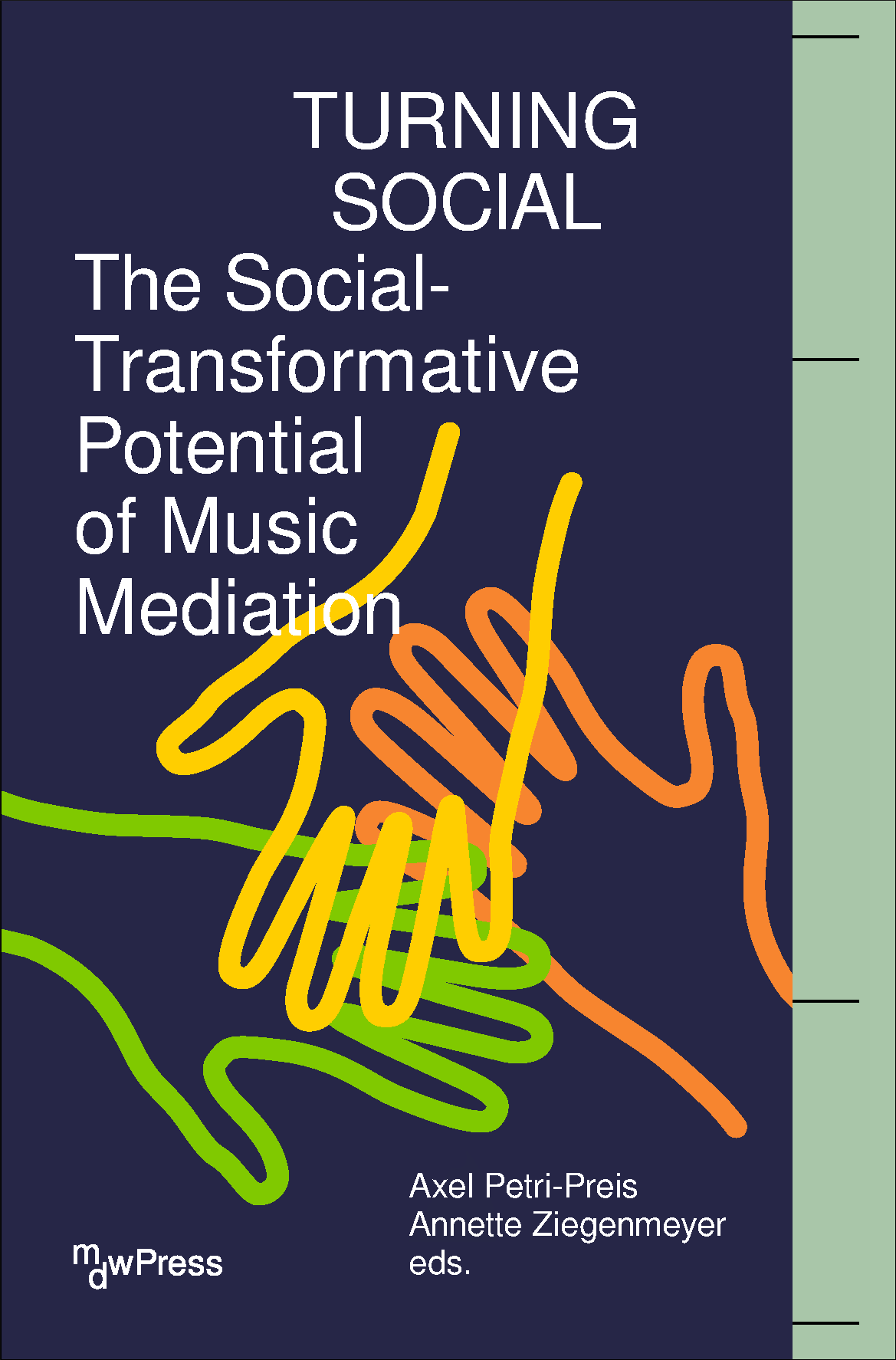
This edited volume is based on an international conference organised by Sarah Chaker and Axel Petri-Preis, titled Turning Social: On the Social-Transformative Potential of Music Mediation, which took place on 15th and 16th June 2023 in the Joseph Haydn Hall at the mdw – University of Music and Performing Arts Vienna. It represents, in many ways, a continuation and deepening of a series of events held by the two organisers during the winter semester of 2019/20 – just before the outbreak of the COVID-19 pandemic – which explored the innovative potential of music mediation with respect to classical concert life, higher music education, and society as a whole. The contributors to the lecture series focused on practices, concepts and formats which have been attributed with transformative power regarding how music is produced, performed, and received. This lecture series led to the publication Tuning up! The Innovative Potential of Music Mediation, the first peer-reviewed English-language publication on music mediation (Chaker and Petri-Preis 2022).
The University of Music and Performing Arts, where Sarah Chaker works as a music sociologist and Axel Petri-Preis as a music mediator, provided a particularly interesting context for an international conference specifically on the social-transformative potential of music mediation. Established in 1817, it is one of the oldest and most prestigious higher music education institutions (HMEIs) worldwide, with a central focus on achieving the highest artistic excellence and expertise in classical music (education). At the same time, the current administration emphasises the social and societal responsibilities of the university and is committed to active socio-political engagement, which is reflected in various ways. For instance, the university hosted the international conference Rethinking Classical Music Practice: Audience and Community Engagement in Classical Concert Life in 2021 – still affected by the COVID-19 pandemic – organised by Axel Petri-Preis and Constanze Wimmer. The university also offers Master’s programmes in Contemporary Arts Practice and Music in Society, which critically examine the relationship between music and society on both artistic and academic levels. The university’s own press, mdwpress, publishes the International Journal of Music Mediation (IJMM), the first scholarly journal on music mediation, edited by Axel Petri-Preis together with Irina Kirchberg (Université de Montréal) and Irena Müller-Brozović (Anton Bruckner Private University). There are also close collaborations with Music is a Great Investment (MIAGI) and Musethika, and in 2024, the festival KlangBildKlang took place, focusing specifically on community-oriented musical activities. Although the ideas of “international top-level” excellence through supreme artistic mastery, on the one hand, and “culture with a stance” that advocates diversity, equality, and democratic values, on the other, often seem like separate worlds with little apparent connection, there is a fundamental tendency to understand social engagement and musical virtuosity (MacDonald and Saarikallio 2024) not as “competing concepts” (Gaunt et al. 2021, 4), but rather as “partnering values” (ibid.) that can, ideally, enrich and enhance each other.
The conference was held in a hybrid format, allowing participation both physically and digitally. Keynotes, lectures, practice reflections, discussions, and artistic contributions approached the topic from diverse perspectives and were provided by renowned researchers, practitioners, musicians, and university leaders, initiating lively and stimulating discussions among the participants. This variety of formats is reflected in the volume, which includes not only scholarly articles, but also transcriptions of discussions and practice reflections. For the latter, we as editors emphasised that these should not be polished best-practice examples, of which there are already more than enough. Instead of promoting their projects, we asked contributors, in accordance with the ideas of Donald Schön (1987), to engage as reflective practitioners in reflection-on-action – that is, in critical reflection on their own practice from a temporal distance. We believe that, in the spirit of a positive failure culture, valuable insights for future work can be gained from mishaps and problems. As Bernhard König, music mediator and advocate for a resonance-aesthetic in community-oriented projects states: “Where everything always succeeds, transformative effects seldom occur.” (König 2024) In addition to the conference speakers, we invited other esteemed authors to contribute to this volume, aiming to expand and deepen the initiated discourse.
Our book is divided into five major thematic sections that address essential aspects of the topic. These include the concept of “cultural democracy”, approaches to decolonising music mediation practice, the attitude of artistic citizenship, and the implications of embracing a socially transformative potential of music mediation for higher music education. Since we do not want to remain static in the present with this publication, our final section looks ahead and constructs possible futures for the field of music mediation, and for music and societal life as a whole.
To present the thread that runs throughout the book, we will next delve into the theoretical foundations and individual sections and their interconnections, providing a brief overview of the contributions.
Cultural Democracy
In the 1990s and 2000s, the practice of music mediation was largely characterised by a cultural-political approach known as cultural democratisation (Matarasso 2019; Petri-Preis 2025 forthcoming). This approach emerged from the increasing awareness that publicly funded cultural institutions produce numerous exclusions and generally target a wealthy, formally educated, white bourgeois audience. Its goal was to reach new audiences and diversify the public. The idea was to provide a broader population with access to existing ‘high culture’ offerings. While this aim is commendable, as fundamentally everything should be done to overcome and eliminate undemocratic structures, this approach also reveals problems. To put it bluntly, access is granted to a curated cultural offer based on the cultural tastes of the ruling class. This approach is underpinned by a normative understanding of culture that attributes more value to a “legitimate culture” (Bourdieu 1987) – in this case, classical music – than to other forms, such as popular or orally transmitted musical forms of expression. François Matarasso expresses his scepticism towards the cultural democratisation approach, due to its risk of perpetuating social inequality, in his book A Restless Art: “It risks implying that people lack knowledge, skill, confidence, awareness or even taste. It defines one person as proficient and the other as deficient.” (Matarasso 2019, 66)
Increasingly, however, there is a growing awareness in music mediation of the at times paternalistic nature of opening up culture to the masses and the need for a broad concept of art and culture that includes all artistic expressions and considers them fundamentally equal. This is quite likely related to the increasing academisation of music mediation, i.e. the education of music mediators at universities, and the subsequent critical engagement with issues such as cultural participation and the societal responsibility of artists and power structures in the cultural sector. With the rise in socially oriented projects, there is a noticeable renaissance of the counter-concept to cultural democratisation – that of cultural democracy (Petri-Preis 2025 forthcoming). This concept was developed and promoted by the British community arts movement in the 1960s and 1970s. In 1984, a group of community artists succinctly expressed it as follows:
Let us tell the story… We believe that people have the right to create their own culture. This means taking part in the telling of the story, not having a story told to them. This story of ours… We believe that people have the right to put across their own point of view in their own particular way. This means not being told how to do this by people who don’t understand it. Now listen to our story… We believe that people should have the right to reply. This means that people should have equal access to resources to give them an equal voice. (Quoted in Matarasso 2019, 73)
In his contribution From Us & Them to We. Some Thoughts on Co-Creation, Cultural Democracy and a Human Rights Approach to Music Inclusion, François Matarasso first discusses the invention of the ‘fine arts’ in the 19th century as the origin of a dichotomy of us and them in culture. He then describes cultural democratisation and cultural democracy as the two central cultural-political approaches of the post-war era. To the latter, he attributes the potential to overcome the dichotomy of artists and non-artists – us & them – in favour of a co-creative we of professional and non-professional artists on an equal footing. As an example of a co-creative approach in the field of opera, Matarasso discusses the project Traction – Opera Co-Creation for Social Transformation and draws on Amartya Sen’s and Martha Nussbaum’s capability approach to argue that co-creation has the potential to enlarge people’s capabilities to do and be what they want.
Annette Ziegenmeyer, in her contribution Change of Perspective as a Starting Point for Social Transformation? Relevance and Design of Musical Meetings with Delinquent Youth, explores whether the work of music students with delinquent youth can trigger transformative learning processes. Based on observations and informal conversations with students from her course at Luebeck University of Music, the author uses Jack Mezirow’s transformative learning theory to reconstruct how confrontation with the realities of the young people leads to reflections on the students’ own privileged situations, how they reflect on issues of interpretative authority and artistic control, and how they develop a strength-based approach to teaching from their experiences.
Ana Čorić’s article From the Bottom-Up: On the Potential of a Festival’s Music Mediation Program in Innovating the Music Education Ecosystem in Croatia focuses on the music mediation programme of the Music Biennale Zagreb, questioning its specific characteristics and, above all, whether the programme is capable of critically addressing existing hierarchies and power structures, as well as inclusions and exclusions in the Croatian education system.
Decolonising Music Mediation
The idea of “cultural democracy” as an anti-hegemonic concept is closely related to post- and decolonial thinking. Matarasso, for instance, notes that many community artists of the 1960s and 70s were inspired and significantly influenced by Paolo Freire’s postcolonial thinking in his book Pedagogy of the Oppressed from 1968 (Matarasso 2019, 69). For this volume, the section on decolonisation holds particular significance both in the context of music mediation’s historical development and in light of some current projects. As mentioned earlier, music mediation is deeply rooted in classical music, which holds a hegemonic position primarily in Western Europe and North America. Therefore, music mediation must face the critical question of whether it “is also an attempt by those in power in the artistic field to define the artistic practices of other groups as deficient, deny their value and legitimacy, and thus maintain their own power, e.g. their cultural subsidies” (Ardila-Mantilla, Busch, and Göllner 2018, 200). The discourse on enabling cultural participation could, from a critical perspective, also be analysed as a moment of oppression by construing members of “certain social groups as (still) unmusical and (still) not culturally engaged” (ibid., 200). Due to its close ties with classical concert life and the frequently imposed requirement of audience development, music mediation always risks participating in the perpetuation of the canon of male, white composers, existing exclusions and discriminations, and the maintenance of (patriarchal) power structures. The project of decolonisation involves, in a broad sense, recognising and working towards overcoming the diverse impacts of colonialism across different societal spheres (Castro Varela and Dhawan 2020).
In her article Othering Mechanisms vs. Empowerment. Toward a Decolonial Agency in Music Mediation?, Lisa Gaupp describes the socio-cultural foundations of various group concepts, discusses their potential connection to social inequalities, and examines current societal developments and efforts towards empowerment in the cultural field. She concludes by calling for power to be transferred to plural networks, where collective agency with a diversity of perspectives continuously redefines and negotiates music mediation while unlearning established positions and hegemony in institutions.
Barbara Balba Weber, in her text The Project Villagio Culturale. Intercultural Co-Creation in Times of Uncertainty, reflects on how decolonial approaches can be applied in a concrete music mediation project. Her project, Villagio Culturale, brings together people of different backgrounds – refugees, locals, and students – in a remote Swiss mountain village to develop songs, dances, or scenes through artistic interactions, which are then presented in various social contexts. She highlights the importance of continuous learning, reflection on discrimination and exclusion mechanisms, and the unlearning of established hegemonies and power structures.
Artistic Citizenship
While previous discussions have focused on the cultural-political programme of cultural democracy and the importance of critically examining classical concert life for colonial structures in order to overcome them, this section attempts to shed light on the underlying attitude of music-makers. The concept of “artistic citizenship” has gained significant attention in the academic field over the past decade, particularly due to the publication of the highly regarded anthology Artistic Citizenship: Artistry, Social Responsibility, and Ethical Practice by David Elliott, Marissa Silverman, and Wayne D. Bowman in 2016. Elliott and his colleagues define artistic citizens as individuals who “are committed to engaging in artistic actions in ways that can bring people together, enhance communal well-being, and contribute substantially to human thriving” (Elliott, Silverman, and Bowman 2016, 7). Their theoretical foundation is primarily based on Aristotle’s ethics of virtue and understanding of praxis, which connect artistic action with ethical responsibility for a good life, as well as on American pragmatism, as shaped by John Dewey. Dewey argues in his seminal work Art as Experience (1934) that artistic action should be integrated into personal and communal life. Since then, the concept has been extensively adopted and critically expanded. Helena Gaunt et al. (2021) note that Elliott, Silverman, and Bowman construct a dichotomy between artistic citizens and “mere artists”. They counter this by arguing that social orientation and artistic excellence are not “competing concepts” but “partnering values” (ibid., 4). One does not exclude the other; rather, they can ideally enhance each other. Wolfgang Lessing (2023) extends the theoretical foundation of the concept from an instrumental pedagogical perspective by incorporating ideas from the spatial sociology of Martina Löw (2001). He observes that a key characteristic of artistic citizenship might be the disrupting of spatial institutionalisation (Lessing 2023, 40). He understands musical action as a space-constituting element “capable of altering existing spatial configurations” (ibid.), while spatial-structural changes can also enable different kinds of musical practices (ibid., 44). While Lessing illustrates his theses with an example from instrumental pedagogy, we will use an example from music mediation to illustrate this point: Rineke Smilde et al. describe in their book If Music Be the Food of Love, Play On: Meaningful Music in Healthcare (2019) how musicians, through their person-centred approach, transform the spatial configurations of a hospital. Patient rooms, corridors, and staff break rooms become sites of musical interaction and attentive listening. “Artistic Citizens never operate solely within the boundaries assigned to them but change spaces through their artistic or artistic-pedagogical work” (Lessing 2023, 46). At the same time, as “relational (dis)orders of social goods and people (living beings) at locations” (Löw 2001, 271), these spaces also influence the musical practice of musicians, who react situatively to the conditions and needs in this intimate and vulnerable setting. The most recent discussion of the concept comes from Maria Westvall and Emily Achieng’ Akuno (2024). In their anthology Music as Agency: Diversities of Perspectives on Artistic Citizenship, Charles Carson and Maria Westvall coin the term “artizenship” for a negotiated and co-creative practice: “The concept of ‘artistic citizenship’, as we see it, is less about ‘helping others’ in a traditional, top-down way and more about facilitating the kinds of engagement and empowering interactions that are perhaps best understood as a form of co-creation” (Carson and Westvall 2024, 11).
In their contribution Accessibility and Sustainability in Higher Music Education through Artistic Citizenship, Maria Westvall and Charles Carson advocate a “diversified norm” in higher music education institutions, including a variety of musical genres, styles, and expressions. This, they argue, can critically question and overcome hegemonic and exclusionary structures in music education and artistic practices. Against this backdrop, they see their concept of “artizenship” as “a position, a process, and a lens that can mirror civic responsibility and empathy in inclusive ways” (Westvall and Carson in this volume). According to them, in the context of higher music education, this expanded notion of artistic citizenship could improve accessibility and sustainability, while also enhancing the relational and co-creative potential of critical democratic practices.
In their practice reflection New Concert Formats and Music Mediation at Stegreif – The Improvising Symphony Orchestra, Immanuel de Gilde and Lorenz Blaumer describe music mediation not as an add-on but as an integral part of their artistic practice. In particular, they discuss their #bechange project, which musically engages with the UN Sustainable Development Goals. In this context, the concept of “artistic citizenship” has a role for the orchestra to play, in that each musician sees themselves as having a responsibility to contribute to society and become artistically active in collective and co-creative processes with different communities.
In The Gum Goddess in the Opera Lab: On Participatory Devising Processes and the Courage to Fill Gaps, Krysztina Winkel reflects on her work with the Opera Lab of the Vienna State Opera. In collaboration with Superar, an NGO offering free music education for children and young people, artists work with adolescents to develop pieces based on reference works from the current repertoire of the Vienna State Opera. In particular, she focuses on the transformative potential of her work for a publicly subsidised, state cultural institution and how new artistic energies can emerge from the tension between ‘high culture’ and a diverse urban society.
In conversation with Axel Petri-Preis, Djanay Tulenova, Avri Levitan, and Johannes Meissl present the Musethica programme and reflect on its significance for students and faculty, as well as for HMEIs as a whole. While the programme remains rooted in the logic of cultural democratisation, it offers music students an initial opportunity to expand their focus on artistic action for art’s sake towards a societal perspective. The programme aims to provide music students with diverse performance opportunities, while also offering people with limited access to live cultural events the chance to experience classical concerts in a relaxed setting. Djanay Tulenova, a former student at mdw and participant in the programme, describes how her experiences fostered an attitude as an artistic citizen, aligning high artistic standards with a sense of social responsibility.
Music Mediation in Higher Music Education
Sloboda et al. (2020, 1) note that, over the past few decades, socially oriented music projects have increasingly moved from the margins of the global music industry to the centre (see also Matarasso 2019, 19-21). This development naturally has implications for the university education of young musicians, which has traditionally prepared them mainly for solo careers or orchestral positions. Therefore, it is not surprising that graduates of HMEIs often do not feel adequately equipped for their later careers (Bork 2010; López-Íñiguez and Bennett 2020; Petri-Preis 2023; Smilde 2009) and have to acquire the necessary knowledge and skills either on the job or through further qualification measures (Baker 2024b, 6-8; Petri-Preis 2023). David Elliott, Marissa Silverman, and Wayne Bowman criticise: “From a broadly human perspective, the agendas and objectives of many arts educators are narrow, insular, remote, and disconnected from the affairs that matter most in people’s everyday lives” (Elliott, Silverman, and Bowman 2016, 11). They argue that technical proficiency on the instrument, the primary focus of artistic one-to-one tuition, is important but not sufficient. This does not mean that the much-vaunted artistic excellence in higher music education is unimportant in socially oriented music projects. On the contrary, it is crucial! However, it alone is not enough to effectively engage with different societal contexts beyond an understanding of l’art pour l’art. Musicians in the 21st century, who increasingly work in portfolio careers, need a form of “expanded professionalism” (Westerlund and Gaunt 2021) to establish themselves in a music labour market that is undergoing comprehensive change (Petri-Preis 2024). Consequently, remarkable transformation processes are now taking place at some higher music education institutions: new study programmes are being established, existing curricula are being adapted, and both traditional and popular musics that were not previously part of university research and teaching are being included.
Heidi Westerlund and Sari Karttunen, in their text Transforming Higher Music Education: Systems Learning through Counter-Stories of Finnish Socially Engaged Musicians, provide insights into the reflections of socially engaged musicians in Finland and discuss how these might impact the training of professional musicians. They argue that higher music education institutions should provide their students with spaces for “systems reflexivity […], the capacity to identify, critically challenge, and reimagine the structures of current systems” (Westerlund and Karttunen in this volume), and “triple-loop learning”, which shifts the focus from the knowing subject to the social conditions of knowledge construction and the potential for institutional transformations. They advocate the incorporation of the knowledge and expertise of socially engaged musicians into the training of professional musicians, in order to further develop and transform it.
In their conversation with Sarah Chaker and Axel Petri-Preis, Lydia Grün, Ulrike Sych, and Sean Gregory – three individuals in influential positions at renowned higher music education institutions – discuss the societal responsibility of tertiary music education, the limits of social engagement for musicians, the redefinition or realignment of the concept of ‘artistic excellence’, and the role of artificial intelligence in higher music education. The conversation concludes with a reflection on exclusion mechanisms in tertiary music education and appropriate strategies to overcome them. In addition to the three conversation partners, students also voice their perspectives on the current state of higher music education through transcribed video messages.
In his chapter Towards Community Engagement in Music Curricula: Students’ Perspectives on the Master’s Programme Contemporary Arts Practice (CAP), Axel Petri-Preis offers insights into a new artistic-academic master’s programme from the students’ viewpoint. By allowing students to specialise in study profiles (elemental music-making, music mediation/community music, improviser*composer-performer, and transmedial performance) and providing connections between them, the MA innovatively responds to societal and musical challenges and changes. Through semi-structured interviews with students, Petri-Preis paints a nuanced picture of their expectations and experiences in this programme and their definition of community engagement as musicians. The many valuable findings show that programmes like the MA CAP are a crucial contribution towards a stronger focus on community engagement and societal responsibility in music curricula.
In her article Doing Music Difference, or: What Do We Do with Other Musics?, Shanti Suki Osman provides a theoretically grounded insight into an anti-discrimination workshop she conducted at the symposium Diskriminierungskritische Perspektiven in die Curricula an der Schnittstelle von Bildung und Kunst! [Discrimination Critical Perspectives on the Curricula at the Interface of Education and Art!] which was hosted and initiated by Carmen Mörsch at the Schauspielhaus Dortmund in June 2023. She argues that discrimination-critical music mediation, which centres on listening as a means of critically questioning power relations and power imbalances, can contribute to the development of diversity-sensitive approaches in transcultural projects and society in general.
Towards Possible Futures
At the end of our volume, we venture a look into the future. Based on the findings and premises of the preceding sections, the contributions in this section are intended as impulses that can and should be taken up to actively work towards constructing desirable futures in concert life, higher music education, music mediation, or society at large. The articles may offer perspectives on actively shaping possible futures in the sense of doing future or “futuring”, which Oomen, Hoffman, and Hajer define as “the identification, creation, and dissemination of images of the future, shaping the possibility for action, thus enacting relationships between past, present, and future.” (Oomen, Hoffman, and Hajer 2021; specifically for the future of classical music, see also Smith, Peters, and Molina 2024).
In her contribution We urgently Need a Social Turn, Sabine Reiter reviews the development of music mediation in Austria over the past quarter-century. She places particular focus on the networks that have formed in the field of music mediation and the needs of practitioners in this area. She concludes by advocating for the consistent continuation of the social turn in music mediation and calls on established cultural institutions to reflect on their self‑understanding and initiate substantial transformation processes.
In her article Why Don’t We Discuss it? How to Get the Evaluation of Music Mediation Activities out of its Procrustean Bed?, Irina Kirchberg addresses the topic of evaluating music mediation activities. Based on group discussions with musicians, cultural managers, and representatives of musicians’ professional associations, she identifies three central problem areas and presents suggestions on how evaluations can transform from an unloved and restrictive practice into a tool for the critical and reflective further development of music mediation activities.
Daniela Bartels, in her text Music Mediators as Builders of a Public Culture Based upon Love? Philosophical Concepts of Love as a Compass for Music Mediation Practice, delves into philosophical concepts of love and examines their significance for socially oriented music mediation activities. Reflecting on a project she conducted with students and a shanty choir in Luebeck (Germany), she argues that local initiatives like these can establish an ethic of love, with potentially transformative effects on society as a whole. Concerning the university education of music mediators, she advocates supporting and strengthening students in developing their emotional and social capacities.
In her text Music Mediation and Potential for Change. An Approach via Convention Theory, Anke Schad-Spindler takes a convention-theoretical perspective and illuminates the potentials, conflicts, and resistances in collaborative music mediation projects through a fictional case study. Drawing on Pierre Bourdieu’s thinking, she focuses in particular on the role of music mediators as intermediaries who often bring organisations with divergent orientations and goals into dialogue and are expected to know the respective logics and conventions and to communicate with different stakeholders. She concludes that critical-analytical thinking, negotiation, and mediation skills are central for music mediators and should therefore be given greater consideration in their training.
We wish you, dear readers, an inspiring read.
Endnotes
-
The Doomsday Clock, created in 1947, is a symbolic representation designed to warn society about the imminent threats posed by human-made technologies that could potentially destroy the earth. For more information see https://thebulletin.org/doomsday-clock/
(accessed April 14, 2025).↩︎ -
See https://www.bundespraesident.at/aktuelles/detail/baustelle-mit-botschaft
(accessed April 14, 2025).↩︎ -
We prefer the term “dialogue group” over “target group” as it denotes a reciprocal rather than a monodirectional relationship. See also Petri-Preis and Voit (2023).↩︎
-
See https://sistemaglobal.org/programme-directory/(accessed April 14, 2025).↩︎
-
See https://www.isme.org/our-work/special-interest-groups-and-forum/critical-debates-music-education-social-change(accessed April 14, 2025).↩︎
-
This is the full name that is used in Sloboda et al.
(2020). On their website the network uses “Social Impact of Making
Music”, see https://www.simm-platform.eu/ (accessed April 14, 2025).↩︎ -
George Lewis introduces the terms “afrological” and “eurological” in his essay Improvised Music After 1950: Afrological and Eurological Perspectives (1996) in order to describe distinct but overlapping approaches to music-making and improvisation. These terms do not denote biological or geographical determinism, but rather represent cultural and aesthetic orientations rooted in different historical, social, and ideological contexts.↩︎
-
This is often related to neoliberal funding logics and the structural conditions at large cultural institutions; see, for example, the contributions by Matarasso and Winkel in this volume.↩︎
-
See https://epmm.p2m.oicrm.org/
(accessed April 14, 2025).↩︎ -
See http://www.simm-platform.eu/
(accessed April 14, 2025).↩︎ -
See http://www.isme.org/our-work/special-interest-groups-and-forum/critical-debates-music-education-social-change(accessed April 14, 2025).↩︎
-
See https://intellectdiscover.com/content/journals/ijcm(accessed April 14, 2025).↩︎
-
See https://ijmm.world/ijmm (accessed
April 14, 2025).↩︎
Bibliography
Ardila-Mantilla, Natalia, Thomas Busch, and Michael Göllner. 2018. “Musiklernen als sozialer Prozess. Drei theoretische Perspektiven.” In Musiklernen, edited by Wilfried Gruhn and Peter Röbke, 178-203. Innsbruck, Esslingen, Bern-Belp: Helbling.
Baker, Geoffrey. 2014. El Sistema: Orchestrating Venezuela’s Youth. New York: Oxford University Press.
Baker, Geoffrey. 2016. “Citizens or Subjects? El Sistema in Critical Perspective.” In Artistic Citizenship. Artistry, Social Responsibility, and Ethical Praxis, edited by David J. Elliott, Marissa Silverman, and Wayne D. Bowman, 313-338. New York: Oxford University Press.
Baker, Geoffrey. 2021. Rethinking Social Action through Music. The Search for Coexistence and Citizenship in Medellín’s Music Schools. Cambridge: Open Book Publishers.
Baker, Geoffrey. 2024a. Is it time to stop talking about music and social transformation? Accessed April 14, 2025. https://www.researchgate.net/publication/380760374_Is_it_time_to_stop_talking_about_music_and_social_transformation.
Baker, Geoffrey. 2024b. The social impact of making music in Colombia: reflections and proposals. Accessed April 14, 2025. https://www.researchgate.net/publication/380546181_The_social_impact_of_making_music_in_Colombia_reflections_and_proposals.
Bánffy-Hall, Alicia de, Daniel Mark Eberhard, and Annette Ziegenmeyer, eds. 2021. Musik im Strafvollzug. Perspektiven aus Forschung und Praxis. Münster: Waxmann.
Bartleet, Brydie-Leigh, and Lee Higgins, eds. 2018. The Oxford Handbook of Community Music. New York: Oxford University Press.
Bartleet, Brydie-Leigh, and Lee Higgins. 2018. “Introduction: An Overview of Community Music in the Twenty-First Century.” In The Oxford Handbook of Community Music, edited by Brydie-Leigh Bartleet and Lee Higgins, 1-22. New York: Oxford University Press.
Bartleet, Brydie-Leigh, and Lukas Pairon, eds. 2021. “Special issue: The social impact of music making.” Musicae Scientiae 25, no. 3. Accessed April 14, 2025. https://journals.sagepub.com/toc/msxa/25/3.
Benedict, Cathy, Patrick Schmidt, Gary Spruce, and Paul Woodford, eds. 2015. The Oxford Handbook of Social Justice in Music Education. New York: Oxford University Press.
Bishop, Claire. 2006. “The Social Turn: Collaboration and Its Discontents.” Artforum International 44, no. 6: 178-183.
Bisschop, An D., and Anemone Van Zijl. 2023. “Layers and dynamics of social impact: Musicians’ perspectives on participatory music activities.” Musicae Scientiae. DOI: https://doi.org/10.1177/10298649231205553.
Blaukopf, Kurt. 1982. Musik im Wandel der Gesellschaft. Grundzüge der Musiksoziologie. München, Zürich: R. Piper & Co.
Bork, Magdalena. 2010. Traumberuf Musiker? Herausforderungen an ein Leben für die Kunst. Mainz: Schott.
Bourdieu, Pierre. 1987. Distinction. A Social Critique of the Judgement of Taste. Cambridge: Harvard University Press.
Brown, Steven, and Ulrik Volgsten. 2005. Music and Manipulation. On the Social Uses and Social Control of Music. Oxford, New York: Berghahn.
Camlin, David A. 2023. “Community Music and the Civic Imagination.” In Listen to your Neighbourhood. Musik als Medium kultureller und Sozialer Arbeit, edited by Hubert Minkenberg, 10-21. Weinheim, Basel: Beltz.
Carson, Charles D., and Maria Westvall. 2024. “Art for All’s Sake: Co-Creation, ‘Artizenship’ and Negotiated Practices.” In Music as Agency: Diversities of Perspectives on Artistic citizenship, edited by Maria Westvall and Emily Achieng’ Akuno, 8-18. London: Routledge.
Castro Varela, María do Mar, and Nikita Dhawan. 2020. Postkoloniale Theorie. Eine kritische Einführung. 3rd edition. Bielefeld: transcript.
Chaker, Sarah. 2025. “More Than Just Another Piece of the Puzzle: Cultural and Art Mediation as Part of Musicians’ Portfolio Careers and How It Affects Their Social Situation: Quantitative-Empirical Findings from Austria.” International Journal of Music Mediation 1, no. 1. DOI: https://doi.org/10.71228/ijmm.2024.12.
Chaker, Sarah, and Axel Petri-Preis, eds. 2022. Tuning up! The Innovative Potential of Musikvermittlung. Bielefeld: transcript.
Chaker, Sarah, and Axel Petri-Preis, eds. 2022. “Musikvermittlung and Its Innovative Potential. Terminological, Historical and Sociological Remarks.” In Tuning up! The Innovative Potential of Musikvermittlung, edited by Sarah Chaker and Axel Petri-Preis, 11-38. Bielefeld: transcript.
Chaker, Sarah. 2023. “Wie Musikvermittlung spielend das Konzertwesen transformiert – eine praxistheoretisch informierte Bestandsaufnahme.” In Handbuch Musikvermittlung – Studium, Lehre, Berufspraxis, edited by Axel Petri-Preis and Johannes Voit, 45-53. Bielefeld: transcript.
Cohen, Mary L., and Jennie Henley. 2018. “Music-Making Behind Bars: The Many Dimensions of Community Music in Prisons.” In The Oxford Handbook of Community Music, edited by Brydie-Leigh Bartleet and Lee Higgins, 153-172. New York: Oxford University Press.
Cuzick, Suzanne. 2016. “Music as Torture / Music as Weapon.” In The Auditory Culture Reader, edited by Michael Bull and Les Back, 379-392. London: Routledge.
DeNora, Tia, and Gary Ansdell. 2014. “What can’t music do?” Psychology of Well-Being 4, no. 23. DOI: https://www.doi.org/10.1186/s13612-014-0023-6.
DeNora, Tia. 2000. Music in everyday life. Camebridge: University Press.
Dewey, John. 1934. Art as Experience. New York: Minton, Balch.
Dixon, Catherine Emma, Laurie S. Goldman, Stephan Crawford, and Phoebe Camille Lease. 2024. “Music as a vehicle for climate change communication: The ClimateMusic Project.” In Storytelling to accelerate climate solutions, edited by Emily Coren and Hua Wang, 265-293. Cham: Springer Nature.
Doxat-Pratt, Sarah. 2021. “Musical communities in the society of captives: Exploring the impact of music making on the social world of prison.” Musicae Scientiae 25, no. 3. DOI: https://doi.org/10.1177/10298649211017616.
Duchesneau, Michel, and Irina Kirchberg. 2020. “Le parti pris disciplinaire de la médiation de la musique. Orientations politiques, pratique, recherche et enseignement au Québec.” Revue musicale OICRM 7, no. 2: 53-77. DOI: https://doi.org/10.7202/1072415ar.
Elliott, David J., and Marissa Silverman. 2015. Music Matters: A Philosophy of Music Education. 2nd edition. New York: Oxford University Press.
Elliott, David J., Marissa Silverman, and Wayne D. Bowman, eds. 2016. Artistic Citizenship. Artistry, Social Responsibility, and Ethical Praxis. New York: Oxford University Press.
Elliott, David J., Marissa Silverman, and Wayne D. Bowman, eds. 2016. “Artistic Citizenship: Introduction, Aims, and Overview.” In Artistic Citizenship. Artistry, Social Responsibility, and Ethical Praxis, edited by David J. Elliott, Marissa Silverman, and Wayne D. Bowman, 3-21. New York: Oxford University Press.
Eusterbrock, Linus. 2022. “Climate-conscious popular music education. Theory and practice.” Journal of Popular Music Education 6, Special Section: Popular Music and the Environment, 385-401. DOI: https://doi.org/10.1386/jpme_00098_1.
Fabris, Dinko, and Vania Cauzillo. 2024. “Community opera: A short introduction and a case study in Italy.” International Journal of Community Music 17, 19-36. DOI: https://doi.org/10.1386/ijcm_00095_1.
Gaunt, Helena, Celia Duffy, Ana Coric, Isabel R. González Delgado, Linda Messas, Oleksandr Pryimenko, and Henrik Sveidahl. 2021. “Musicians as ‘Makers in Society’: A Conceptual Foundation for Contemporary Professional Higher Music Education.” Frontiers in Psychology 12. DOI: https://doi.org/10.3389/fpsyg.2021.713648.
Gaupp, Lisa. 2023. “Othering versus Handlungsmacht?” In Handbuch Musikvermittlung – Studium, Lehre, Berufspraxis, edited by Axel Petri-Preis and Johannes Voit, 187-191. Bielefeld: transcript.
Han, Byung-Chul. 2024. The Spirit of Hope. Oxford: Polity Press.
Hesser, Barbara, and Brydie-Leigh Bartleet. 2021. Music as a Global Resource: Solutions for Cultural, Social, Health, Educational, Environmental, and Economic Issues Compendium. 5th edition. New York: Music as a Global Resource.
Higgins, Lee. 2012. Community Music. In Theory and in Practice. New York: Oxford University Press.
Hill, Burkhard. 2020. “Community Music als musikalisches und soziales ‘Projekt’.” Diskussion Musikpädagogik 87, 45-50.
Kallio, Alexis, and Alexandra Gorton. 2022. Music in prisons: A preliminary report. Accessed April 14, 2025. https://research-repository.griffith.edu.au/server/api/core/bitstreams/2618e13a-e439-4498-adcb-933964b8b5b1/content.
Kirchberg, Irina, Irena Müller-Brozović, and Axel Petri-Preis. 2025. “Launching the First International Journal of Music Mediation.” International Journal of Music Mediation 1, no. 1. DOI: https://doi.org/10.71228/ijmm.2024.22.
Kolbe, Kristina. 2023. “(Un)settling Institutional Hegemony: Challenges of Diversity Strategies in the ‘Western’ Classical Music Sector.” In Voices for Change in the Classical Music Profession: New Ideas for Tackling Inequalities and Exclusions, edited by Anna Bull, Christina Scharff, and Laudan Nooshin, 69-80. New York: Oxford Academic. DOI: https://doi.org/10.1093/oso/9780197601211.003.0006.
Kertz-Welzel, Alexandra. 2025. “What we should consider before proposing music education for social change.” In Zukunft. Musikpädagogische Perspektiven auf soziale und kulturelle Transformationsprozesse, edited by Kai Martin, 36-43. Weimar: Hochschule für Musik FRANZ LISZT Weimar.
König, Bernhard. 2024. Musik und Klima. Munich: Oekom Verlag.
Kopiez, Reinhard. 2004. “Der Mythos von Musik als universell verständliche Sprache.” In Musikermythen. Alltagstheorien. Legenden und Medieninszenierungen, edited by Claudia Bullerjahn and Wolfgang Löfer, 49-89. Olms, Hildesheim et al.: Georg Olms Verlag.
Lapidaki, Eleni. 2020. “Toward the Discovery of Contemporary Trust and Intimacy in Higher Music Ecucation.” In Humane Music Education for the Common Good, edited by Iris M. Yob and Estelle R. Jorgensen, 261-273. Bloomington: Indiana University Press.
Lee, Chris. 2012. “Bravo, Gustavo! How Maestro Dudamel Is Saving Classical Music.” Newsweek, February 6, 2012. Accessed April 14, 2025. https://www.newsweek.com/bravo-gustavo-how-maestro-dudamel-saving-classical-music-65809.
Lessing, Wolfgang. 2023. “Artistic Citizenship – Reflections on a Concept of Orientation in Music Education.” üben & musizieren.research, special edition 2023: 16-53.
Lewis, George E. 1996. “Improvised Music after 1950: Afrological and Eurological Perspectives.” Black Music Research Journal 16, no. 1: 91-122.
López-Íñiguez, Guadalupe und Dawn Bennett. 2020. “A lifespan perspective on multi-professional musicians: does music education prepare classical musicians for their careers?” Music Education Research 22, no. 1: 1-14. DOI: https://doi.org/10.1080/14613808.2019.1703925.
Löw, Martina. 2001. Raumsoziologie. Frankfurt am Main: Suhrkamp.
MacDonald, Raymond, and Suvi Saarikallio. 2024. “Healthy musical identities and new virtuosities: a humble manifesto for music education research.” Nordic Research in Music Education 5, 43-66. DOI: https://doi.org/10.23865/nrme.v5.5565.
Matarasso, François. 2019. A restless Art. How participation won, and why it matters. London: Calouste Gulbenkian Foundation.
Matarasso, François, James Bingham, Irene Calvis, Paulo Lameiro, and Mikel Zorrilla. 2023. Co-Creating Opera, Guidance from the Traction Project. Accessed April 14, 2025. https://co-art.eu/content/files/co-creating_opera_guidence_from_the_traction_project.pdf.
Mecheril, Paul. 2023. “Migrationspädagogische Perspektive auf Musikvermittlung.” In Handbuch Musikvermittlung – Studium, Lehre, Berufspraxis, edited by Axel Petri-Preis and Johannes Voit, 205-208. Bielefeld: transcript.
Müller-Brozovic, Irena. 2017. Musikvermittlung. Kulturelle Bildung Online. Accessed April 14, 2025. https://www.kubi-online.de/artikel/musikvermittlung.
Oomen, Jeroen, Jesse Hoffman, and Maarten A. Hajer. 2021. “Techniques of futuring: On how imagined futures become socially performative.” European Journal of Social Theory 25, no. 2. DOI: https://doi.org/10.1177/1368431020988826.
Petri-Preis, Axel. 2022a. “Im fruchtbaren Zwischen. Zum Gemeinsamen von Musikvermittlung und Community Music.” üben & musizieren, no. 5.
Petri-Preis, Axel. 2022b. “The Big Bang of Musikvermittlung. On the Emergence of a New Social World and Its Future Innovative Potential.” In Tuning up! Innovative Potentials of Musikvermittlung, edited by Sarah Chaker and Axel Petri-Preis, 47-70. Bielefeld: transcript.
Petri-Preis, Axel. 2023. “Learning trajectories of classical musicians engaging in Musikvermittlung.” Music Education Research 25, no. 1: 13-23. DOI: https://doi.org/10.1080/14613808.2022.2109609.
Petri-Preis, Axel. 2023. “Musikvermittlung und ihre Überschneidungen mit verwandten Praxisfeldern.” In Handbuch Musikvermittlung – Studium, Lehre, Berufspraxis, edited by Axel Petri-Preis and Johannes Voit, 311-314. Bielefeld, transcript. DOI: https://doi.org/10.1515/9783839462614-049.
Petri-Preis, Axel. 2024. “Neue Wege in der künstlerischen Hochschullehre. Der Master Contemporary Arts Practice.” In Disruptionen in der Hochschulbildung. Co-Kreatives Lernen und Lehren, edited by Stefanie Gandt, Tobias Schmohl, Benjamin Zinger, and Christina Zitzmann, 17-28. Bielefeld: wbv.
Petri-Preis, Axel. 2025 Forthcoming. “‘That’s what we actually should be doing.’ Learning and Participation Managers in Orchestras – Beliefs, Obstacles, Strategies.” Music Education Research.
Petri-Preis, Axel, and Johannes Voit. 2023. Handbuch Musikvermittlung – Studium, Lehre, Berufspraxis. Bielefeld: transcript.
Petri-Preis, Axel, and Johannes Voit. 2025. “What is Music Mediation?” International Journal of Music Mediation 1, no. 1. DOI: https://doi.org/10.71228/ijmm.2024.14.
Petri-Preis, Axel, Irina Kirchberg, and Irena Müller-Brozović. 2025. “Launching the First International Journal on Music Mediation.” International Journal of Music Mediation 1, no. 1. DOI: https://doi.org/10.71228/ijmm.2024.22.
Puche Perneth, Camilo. 2023. Stories from the frontline of music and social transformation: A study of teachers working for Batuta in the Caribbean Coast of Colombia. DMA thesis, Boston University.
Rincón Prat, Gloria Constanza. 2015. El impacto social y educativo del programa musical ‘Batut’a el sistema nacional de orquestas sinfónicas juveniles e infantiles en Colombia. PhD thesis, Universidad Complutense de Madrid.
Rodríguez-Sánchez, Andrea del Pilar. 2013. “Los programas musicales colectivos como espacios de construcción de paz. Caso Programa Música para la Reconciliación de la Fundación Nacional Batuta en Colombia.” Fòrum de recerca 5, no. 18, 81-96. DOI: http://dx.doi.org/10.6035/ForumRecerca.2013.5.
Rüdiger, Wolfgang. 2023. “Jeder Klang sagt Wir – und jede:r trägt Klänge in sich – Von der Kommunikativen Musikalität zur Community Music als Artistic Citizenship.” üben & musizieren.research, special edition 2023: 54-63.
Schmidt Campbell, Mary, and Randy Martin, eds. 2006. Artistic Citizenship. A Public Voice for the Arts. New York: Routledge. DOI: https://doi.org/10.4324/9780203960448.
Schön, Donald A. 1987. Educating the reflective practitioner: Toward a new design for teaching and learning in the professions. San Francisco: Jossey-Bass.
Schramm, Holger, and Reinhard Kopiez. 2008. “Die alltägliche Nutzung von Musik.” In Musikpsychologie. Das neue Handbuch, edited by Herbert Bruhn, Reinhard Kopiez, and Andreas C. Lehmann, 253-265. Reinbek bei Hamburg: Rowohlt.
Shepherd, John. 1992. “Warum Popmusikforschung?” PopScriptum (Schriftenreihe des Forschungszentrum Populäre Musik der Humboldt-Universität zu Berlin) – Begriffe und Konzepte, no. 1/92: 43-67. Accessed April 14, 2025. https://edoc.hu-berlin.de/bitstream/handle/18452/20903/pst01_shepherd.pdf.
Sloboda, John, Heidi Westerlund, Geoffrey Baker, An De Bisschop, Gloria Zapata Restrepo, Joanne Gibson, Sari Karttunen, Anemone Van Zijl, Julian Castro, Juan S. Rojas, and Alessandro Mazzola. 2020. “Music for Social Impact: an overview of context, policy and activity in four countries, Belgium, Colombia, Finland, and the UK.” Finnish Journal of Music Education 23, no. 1-2: 116-143.
Small, Christopher. 1998. Musicking. The Meanings of Performing and Listening. Middletown, CT: Wesleyan University Press.
Smilde, Rineke. 2009. Musicians as lifelong learners. Discovery through biography. Delft: Eburon.
Smilde, Rineke, Erik Heineman, Krista DeWit, Karolien Dons, and Peter Alheit. 2019. If Music be the Food of Love, Play On. Meaningful Music in Health Care. Utrecht: Eburon.
Smith, Neil Thomas, Peter Peters and Karoly Molina, eds. 2024. Classical Music Futues: Practices of Innovation. Cambridge: Open Book Publishers. DOI: https://doi.org/10.11647/OBP.0353.
Stoffers, Nina. 2023. “Machtkritische Perspektiven auf Musikvermittlung.” In Handbuch Musikvermittlung – Studium, Lehre, Berufspraxis, edited by Axel Petri-Preis and Johannes Voit, 107-111. Bielefeld: transcript.
Weiberg, Anja. 2022. “Familienähnlichkeit.” In Wittgenstein-Handbuch, edited by Anja Weiberg and Stefan Majetschak, 235-242. Stuttgart: J.B.Metzler.
Westerlund, Heidi, and Helena Gaunt, eds. 2021. Expanding Professionalism in Music and Higher Music Education. A Changing Game. London: Routledge.
Westerlund, Heidi, and Sari Karttunen. 2024. “The protean music career as a sociopolitical orientation: The mutually integrated, non-hierarchical work values of socially engaged musicians.” Musicae Scientiae 28, no. 3: 502-519. DOI: https://doi.org/10.1177/10298649231222548.
Westvall, Maria, and Emily Achieng’ Akuno, eds. 2024. Music as Agency. Diversities of Perspectives on Artistic Citizenship. London: Routledge.
Westvall, Maria, and Emily Achieng’ Akuno, eds. 2024. Introduction: Artistic Citizenship in a Global Perspective. In Music as Agency: Diversities of Perspectives on Artistic citizenship, edited by Maria Westvall and Emily Achieng’ Akuno, 1-7. London: Routledge.
Wimmer, Michael. 2012. Kulturelle Bildung und Ungleichheit. Accessed April 14, 2025. https://educult.at/wimmers-weekly/kulturelle-bildung-und-ungleichheit/.
Yang, Mina. 2023. “‘To Share Music With Children’: The LA Phil and Neoliberal Philanthropy in Inglewood.” In Voices for Change in the Classical Music Profession: New Ideas for Tackling Inequalities and Exclusions, edited by Anna Bull, Laudan Nooshin, and Christina Scharff, 81-90. Oxford: Oxford University Press.